

What do you think?
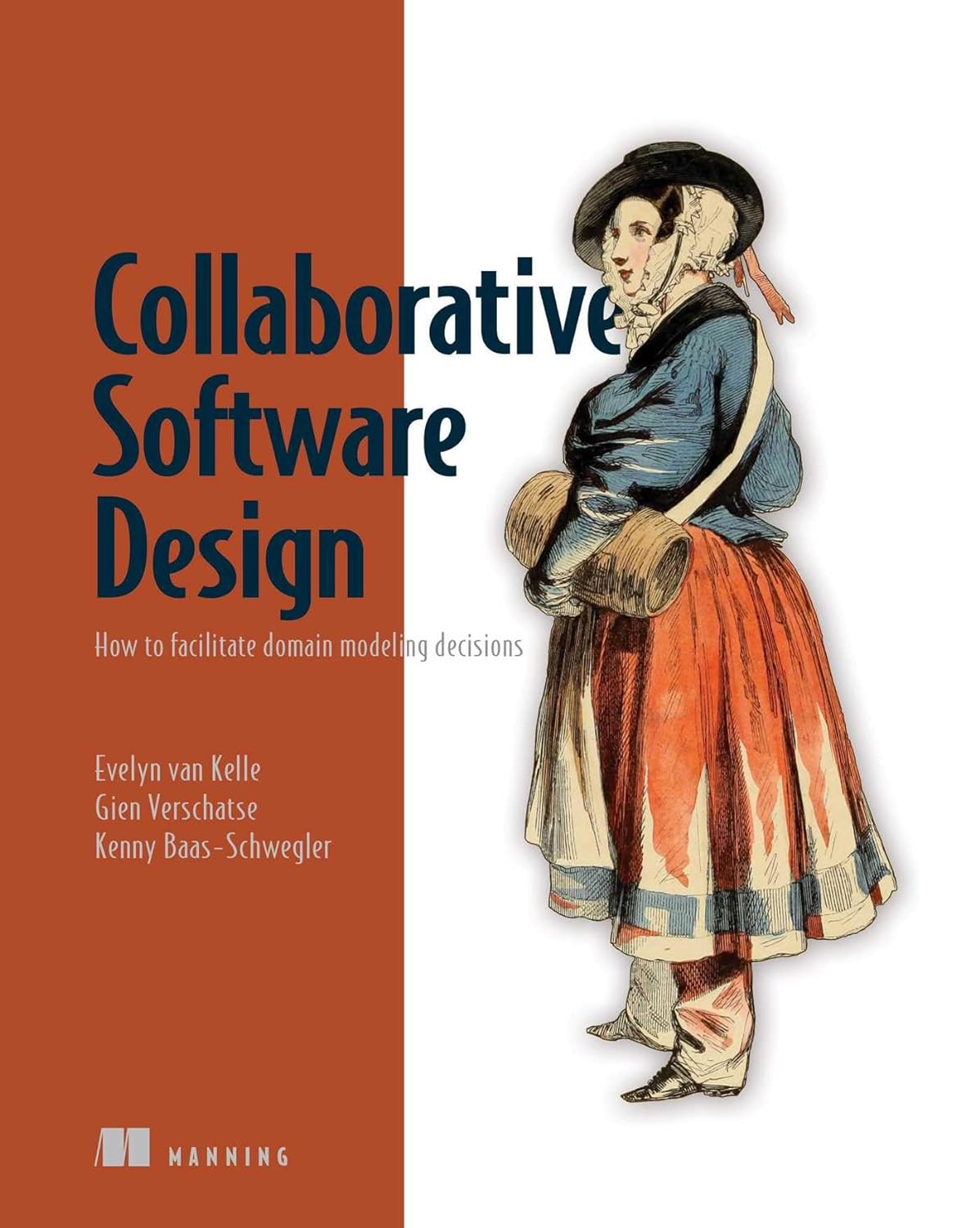
Collaborative Software Design: How to Facilitate Domain Modeling Decisions
Good practices, collaboration tools, and effective techniques for incorporating your key stakeholders into the software design process.
In Collaborative Software How to facilitate domain modeling decisions you’ll learn how
Don’t spend months building the wrong software! Collaborative Software How to facilitate domain modeling decisions is a unique and practical guide for effectively involving all stakeholders in the design of software. It combines tried-and-tested collaborative modeling tools such as Event Storming and domain storytelling with vital skills to overcome rank, mitigate cognitive bias, and resolve conflicts. Best of all, collaborative modeling makes it easy for software teams to design software directly with their stakeholders—no need to rely on a centralized or top-down design.
Purchase of the print book includes a free eBook in PDF, Kindle, and ePub formats from Manning Publications.
About the technology
It’s a challenge to arrive at achievable, sustainable software design decisions. Fortunately, there’s a collection of tools and techniques you can use to facilitate productive decision-making sessions, even when you involve a diverse group of business and technical stakeholders.
Collaborative modeling is a highly effective approach to software design that incorporates stakeholders directly in the decision-making process. It uses process visualizations, engaging sessions, and social dynamic management to ensure everyone is contributing to a shared goal.
About the book
Collaborative Software How to facilitate domain modeling decisions is a practical guide to conducting effective software design sessions that involve all business and technical stakeholders. It lays out pragmatic techniques for making collaborative design decisions, ensuring you’re getting a group’s full participation and input to solve real business problems. You’ll deliver results by combining collaborative modeling tools, and learn how to manage conflicts, handle resistance, and keep everyone involved even when a session has ended. Put these techniques into practice, and you’ll be able to facilitate incredibly effective design sessions in which everyone’s voices are heard.
About the reader
For any tech leader who wants to make better architectural decisions.
About the author
Evelyn van Kelle is a strategic software delivery consultant, with experience in coaching, advising, facilitating, and guiding organizations and teams in designing and maintaining socio-technical systems. Gien Verschatse is an experienced consultant and software engineer that specializes in domain modeling and software architecture. Kenny Baas-Schwegler is a strategic software delivery consultant and agile software architect focusing on socio-technical systems thinking.
In Collaborative Software How to facilitate domain modeling decisions you’ll learn how
Don’t spend months building the wrong software! Collaborative Software How to facilitate domain modeling decisions is a unique and practical guide for effectively involving all stakeholders in the design of software. It combines tried-and-tested collaborative modeling tools such as Event Storming and domain storytelling with vital skills to overcome rank, mitigate cognitive bias, and resolve conflicts. Best of all, collaborative modeling makes it easy for software teams to design software directly with their stakeholders—no need to rely on a centralized or top-down design.
Purchase of the print book includes a free eBook in PDF, Kindle, and ePub formats from Manning Publications.
About the technology
It’s a challenge to arrive at achievable, sustainable software design decisions. Fortunately, there’s a collection of tools and techniques you can use to facilitate productive decision-making sessions, even when you involve a diverse group of business and technical stakeholders.
Collaborative modeling is a highly effective approach to software design that incorporates stakeholders directly in the decision-making process. It uses process visualizations, engaging sessions, and social dynamic management to ensure everyone is contributing to a shared goal.
About the book
Collaborative Software How to facilitate domain modeling decisions is a practical guide to conducting effective software design sessions that involve all business and technical stakeholders. It lays out pragmatic techniques for making collaborative design decisions, ensuring you’re getting a group’s full participation and input to solve real business problems. You’ll deliver results by combining collaborative modeling tools, and learn how to manage conflicts, handle resistance, and keep everyone involved even when a session has ended. Put these techniques into practice, and you’ll be able to facilitate incredibly effective design sessions in which everyone’s voices are heard.
About the reader
For any tech leader who wants to make better architectural decisions.
About the author
Evelyn van Kelle is a strategic software delivery consultant, with experience in coaching, advising, facilitating, and guiding organizations and teams in designing and maintaining socio-technical systems. Gien Verschatse is an experienced consultant and software engineer that specializes in domain modeling and software architecture. Kenny Baas-Schwegler is a strategic software delivery consultant and agile software architect focusing on socio-technical systems thinking.
300 pages, Paperback
Published April 30, 2024
Ratings & Reviews
Friends & Following
Create a free account to discover what your friends think of this book!
Community Reviews
Displaying 1 - 3 of 3 reviews

December 23, 2025
I approached Collaborative Software Design: How to Facilitate Domain Modeling Decisions with solid expectations, and overall it is a competent and thoughtful book. The authors clearly have deep experience in running collaborative design sessions, and the book offers many practical insights into how to structure workshops, guide discussions, and involve diverse stakeholders in domain modeling decisions. The examples and techniques are well explained and grounded in real-world practice.
However, while the content is solid, the book sometimes feels overly verbose and slow-paced. Many ideas are revisited multiple times from slightly different angles, which can make sections feel longer than necessary. I occasionally found myself skimming, especially when concepts had already been clearly explained earlier in the book.
Another limitation is that the book tends to stay at a fairly high level of abstraction. While it provides good guidance on how to facilitate conversations, it offers fewer concrete, end-to-end examples showing how the outcomes of these sessions directly influence downstream design decisions over time. More detailed, continuous case studies would have helped connect facilitation techniques more tightly to long-term software design impact.
Overall, this is a valuable book for architects, team leads, and facilitators who regularly run domain modeling workshops. It’s a good reference and confidence booster rather than a page-turner, and for experienced practitioners it may feel more like reinforcement than revelation.
However, while the content is solid, the book sometimes feels overly verbose and slow-paced. Many ideas are revisited multiple times from slightly different angles, which can make sections feel longer than necessary. I occasionally found myself skimming, especially when concepts had already been clearly explained earlier in the book.
Another limitation is that the book tends to stay at a fairly high level of abstraction. While it provides good guidance on how to facilitate conversations, it offers fewer concrete, end-to-end examples showing how the outcomes of these sessions directly influence downstream design decisions over time. More detailed, continuous case studies would have helped connect facilitation techniques more tightly to long-term software design impact.
Overall, this is a valuable book for architects, team leads, and facilitators who regularly run domain modeling workshops. It’s a good reference and confidence booster rather than a page-turner, and for experienced practitioners it may feel more like reinforcement than revelation.

August 24, 2025
What a gem!
Before picking up this book, I expected a practical guide to tools (like Event Storming and Business Model Canvas) and session rules (such as check-in and check-out). And yes, those are covered very clearly. But the real surprise is how much broader the book goes - it's ultimately about group dynamics.
The authors manage to put words and structure around things I had always thought of as intangible:
* The roots of resistance and how to address them.
* The importance of ranking and how facilitators should play it.
* Common cognitive biases in software engineering,
* And even the elegant concept of polarities (a true “eye-opening” for me).
What I especially like is how the book doesn’t just describe situations through case studies - it gives them memorable, metaphorical names. Expressions like "when words and music don’t go together", "turn on the light on shadows before they turn into demons", "climate report", or "ethnographic field notes" stick with you long after reading.
This isn’t just a manual for running better workshops - it’s a book that changes how you see collaboration itself.
Before picking up this book, I expected a practical guide to tools (like Event Storming and Business Model Canvas) and session rules (such as check-in and check-out). And yes, those are covered very clearly. But the real surprise is how much broader the book goes - it's ultimately about group dynamics.
The authors manage to put words and structure around things I had always thought of as intangible:
* The roots of resistance and how to address them.
* The importance of ranking and how facilitators should play it.
* Common cognitive biases in software engineering,
* And even the elegant concept of polarities (a true “eye-opening” for me).
What I especially like is how the book doesn’t just describe situations through case studies - it gives them memorable, metaphorical names. Expressions like "when words and music don’t go together", "turn on the light on shadows before they turn into demons", "climate report", or "ethnographic field notes" stick with you long after reading.
This isn’t just a manual for running better workshops - it’s a book that changes how you see collaboration itself.

Read
August 10, 2024Read through this on vacation. Also in parallel working through the book in a book club. It‘s very theory heavy and I‘m still digesting. Also this book is way more facilitator oriented than I thought, when I picked it up and suggested it to my colleagues. But it definitely contains a lot of interesting insights and knowledge gold nuggets. It‘s just a lot. Will come back to reading this one, once I’ve also finished this with the book club.
Displaying 1 - 3 of 3 reviews