Jump to ratings and reviews
Rate this book

L'Arte e la Morte

Rate this book
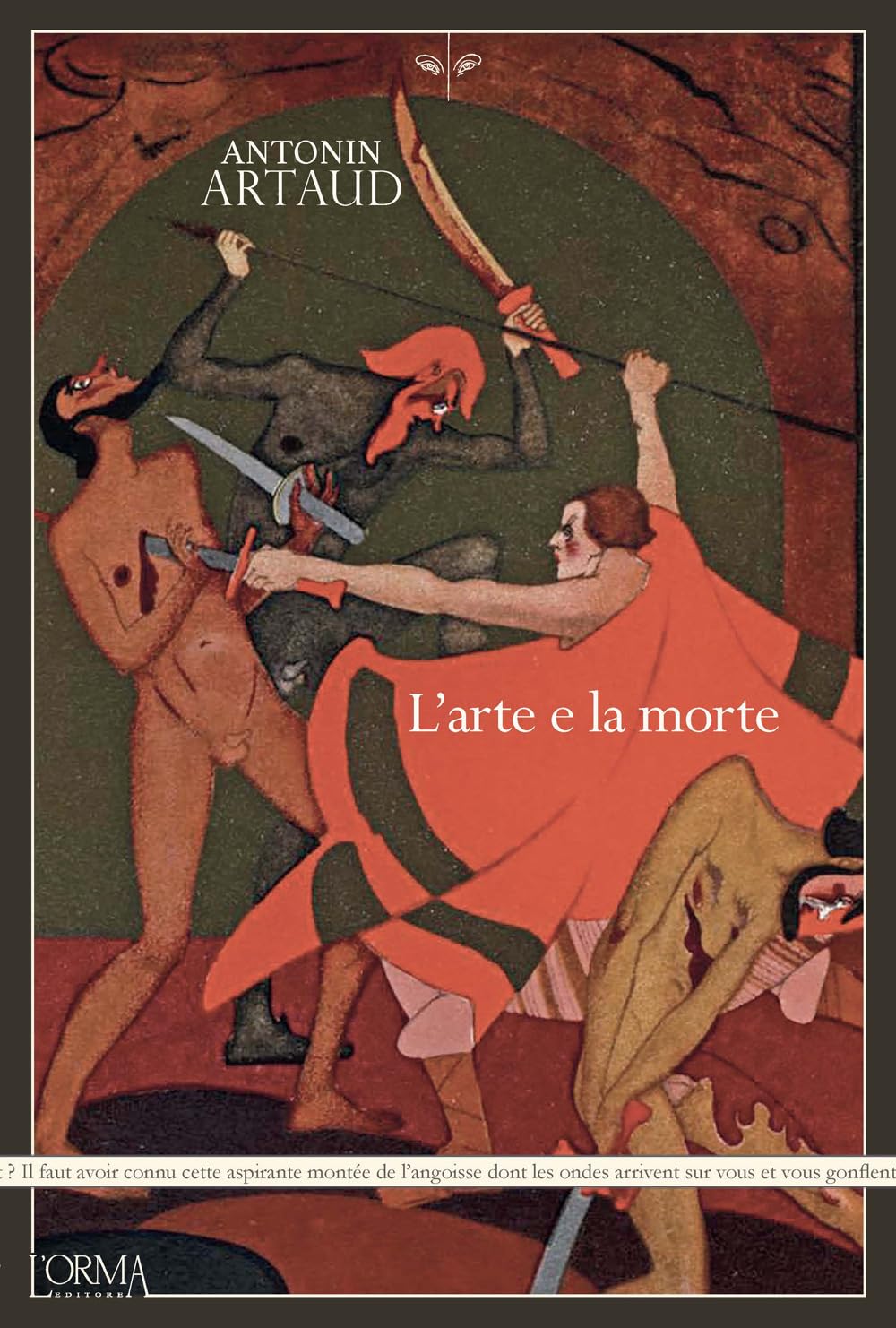
Vertiginosa raccolta di scritti surrealisti del 1929, «L’arte e la morte» è un fuoco d’artificio nella scrittura di quell’inquieto poeta in prosa che è stato Antonin Artaud. Otto testi per stravolgere ogni logica. Con una lingua lirica e allucinata, Artaud scrive una lettera d’amore a una veggente, narra il tormento erotico di Eloisa e Abelardo, si abbandona a visioni bibliche, trasfigura il suo corpo in immagine e ne esplora i confini sensoriali. Frutto della giovanile adesione di Artaud al movimento surrealista, «L’arte e la morte» è un piccolo gioiello di scrittura visionaria, un’avventura folle nella mente di una delle personalità più eclettiche e irrequiete del Novecento.

88 pages, Paperback

First published January 1, 1929

7 people are currently reading
153 people want to read

About the author

Antonin Artaud

282 books798 followers
French surrealist poet and playwright Antonin Artaud advocated a deliberately shocking and confrontational style of drama that he called "theater of cruelty."

People better knew Antoine Marie Joseph Artaud, an essayist, actor, and director.

Considered among the most influential figures in the evolution of modern theory, Antonin Artaud associated with artists and experimental groups in Paris during the 1920s.

Political differences then resulted in him breaking and founding the theatre Alfred Jarry with Roger Vitrac and Robert Aron. Together, they expected to create a forum for works to change radically. Artaud especially expressed disdain for west of the day, panned the ordered plot and scripted language that his contemporaries typically employed to convey ideas, and recorded his ideas in such works as Le Theatre de la cruaute and The Theatre and Its Double .

Artaud thought to represent reality and to affect the much possible audience and therefore used a mixture of strange and disturbing forms of lighting, sound, and other performance elements.

Artaud wanted that the "spectacle" that "engulfed and physically affected" this audience, put in the middle. He referred to this layout like a "vortex," a "trapped and powerless" constantly shifting shape.

Ratings & Reviews

What do you think?
Rate this book
Friends & Following

Create a free account to discover what your friends think of this book!

Community Reviews

5 stars
31 (26%)
4 stars
47 (39%)
3 stars
37 (31%)
2 stars
2 (1%)
1 star
1 (<1%)
Displaying 1 - 11 of 11 reviews
Profile Image for Regina Beaz.
8 reviews
April 10, 2025
Una breve pero interesante compilación de automatismos surrealistas alrededor de la muerte, el deseo, la carne y el arte.

Nunca dejará de sorprenderme la cantidad de imágenes que Artaud generaba, las palabras que escoge y sus figuras retóricas son arrolladoras.
Profile Image for Andrés Eichmann.
66 reviews3 followers
February 2, 2021
Artaud My love, corazoncito. El lenguaje me enseñas a usar de otras maneras. Surrealistas de mierda que no se dan cuenta del genio que tienen enfrente. Es mejor para Artaud así. Suicidio, el fondo del alma y la muerte de la intelectualidad. El bien y el mal ¿siquiera existen? ¿Donde quedaron tus cojones Breton? Frente a este hombre loco e irreverente.
Vete por unas kawas, que frente a él no eres más que un mensajero de mierda.
Gran texto después de leer “Los Tarahumara”
Profile Image for Edwing Marroquin.
82 reviews
April 24, 2025
"No siento el apetito de la muerte, siento el apetito del no ser, de no haber caído jamas en ese divertimento de imbecilidades, abdicaciones, renunciamientos y obtusos encuentros que es el yo de Antonin Artaud"
Profile Image for Jack Rousseau.
199 reviews4 followers
January 23, 2022
Art and Death is a collection of short prose, loosely connected, all of which are written in stream of consciousness style, with surrealist overtones, and preoccupied with art, sex, and death...

Who, in the heart of some anxiety at the bottom of certain dreams, has not know death as a marvelous, disruptive feeling which could never be confused with anything else of a mental order? One must have experienced with this exhausting crescendo of anguish which comes over one in waves and then swells one up as if forced by some unbearable bellows. Anguish which draws near then withdraws, each time stronger, more ponderous and replete. This is the body itself, having reached the limit of its strength and distension, and yet must go on. It is a sort of suction cup on the soul, whose acridity spread like acid into the furthermost bounds of the senses. And the soul cannot even fall back on a breakdown. For this distension itself is false. Death is not so easily satisfied. In the order of physical experience, this distension is like an inverted image of the contraction which takes possession of the mind over the whole extend of the living body.
[...]
- Who, in their heart...

* * *

Madam,
You live in a poor room in the midst of life. We would like to hear the sky murmur at your windows, but in vain. Nothing, neither your appearance, nor an air distinguishes you from us, but some foolishness or other more deeply-rooted than experience leads us to endlessly slash and banish your face, right down to the jointures of your life.
[...]
- Letter to the Clairvoyante, for André Breton

* * *

Life shrinks before his eyes. Whole areas of his brain rotted. This is a known phenomenon, yet it is not simple. Abelard did not put his condition forward as a discovery but, anyway, he wrote:
My Dear Friend,
I am huge. I cannot help it, I am a summit where the highest masts assume breasts in the shape of sails, while women feel their sexual organs turn as hard as pebbles. For my part, I cannot help feeling all these eggs haphazardly pitch and toss under their dresses according to the time and the mind. Life comes and goes, grows small through their breast-pavement. The world's aspect changes from one minute to the next. Souls with their celluloid cracks wrapped themselves around fingers and Abelard passed between the films, for the mind's erosion hung over everything.
[...]
- Heloise and Abelard

* * *

The sky's murmuring frame continued to trace the same amorous signs on the window pane of his soul, the same friendly messages which might perhaps save him from being a man if he consented to save himself from love.
He must give in. He cannot contain himself any longer. He gives in. This harmonious seething presses in on him. His genitals throb: a tormenting wind murmurs, making a sound higher than the heavens. The river flows with female corpses. Are they Ophelia, Beatrice, or Laura? No, ink, no, wind, no, reeds, banks, shores, foam, flakes. The floodgates are down. Abelard has made floodgates out of his desire. At the juncture of the atrocious, harmonious upsurge. It is Heloise, rolling over, borne towards him - AND SHE IS VERY WILLING.
[...]
- Transparent Abelard

* * *

Ucello, my friend, my fantasy, you lived with this myth about hair. The shadow of that great lunar hand whereby you imprint the fantasies of your brain will never reach your ear's vegetation, which turns and teems leftward with all the drifts of your heart. The hairs are left, Uccello, dreams are sinister, as are nails and the heart. The shades all open sinister as human orifices, naves. With your head resting on that table where the whole of humanity capsizes, how could you see anything else but the huge shadow of a hair. A hair like two forests, like three finger-nails, a meadow of eyelashes, like a rake in the sky's grasses. Choked and hanged people, eternally staggering about on the plains of that flat table-top on which your heavy head is bowed. And near you, when you examine facets, what do you see but the branching circulation, a latticework of veins, the tiniest trace of a wrinkle, the floral tracework of a sea of hair.[...]
- Uccello the Hair, for Génica

* * *

These discharged, nausea, lashes. These are the things where Fire starts. Tongues and their fire. Fire woven into coiled tongues in the shimmering of the earth, opening up like a belly in labour, with its honey and sugar bowels. All this soft belly's obscene wound yawns open, but the fire gapes above it with burning, tortuous tongues, with vents as if thirsting at the tips. This fire entwined like clouds in limpid water and beside it the light delineates a rule and filaments. And the earth half open, everywhere, revealing arid secrets. Secrets like surfaces. The earth and its guts and its prehistoric solitude, the earth's primitive formations where the world's strata are uncovered in coal-black shadows.[...]
[...]
- The Anvil of Strength

* * *

He said he saw a great preoccupation with sex in me. But taut sexual organs, swollen like an object. An object made of metal and boiling lava, filled with rootlets, with boughs caught by the air.
The astounding genital calmness filled with so much scrap iron. Air gathers around the iron from every direction.
And above them a fiery growth, a meagre, tangled pasture which takes root in this bitter mould. And it grows with ant-like gravity, an ant-hill foliage forever digging deeper into the earth. This heinously black foliage grows and digs down, and as it delves, it seems as if the earth grows distant, that the ideal centre of everything gathers about a progressively more slender point.
[...]
- The Personal Automaton, to Jean de Bosschére

* * *

I wanted her shimmering with flowers, with flowers, with little volcanoes attached to her armpits and especially that bitter cystic lava at the core of her body, standing erect.
There was also an eyebrow arch and the entire sky passed under it. A sky truly full of rape, kidnapping, lava; a storm and fury sky, in short, an utterly theological sky. A sky like a standing arch, like the trumpet of doom, like hemlock drunk in dreams, a sky contained in all the phials of death, a Heloise above Abelard sky, a loving suicide sky, a sky possessing all the furies of love.
The sky was a protestor's sin, sin held back at confession, those ins which burden the conscience of priests, a truly theological sin.
And I loved her.
[...]
- The Window of Love
Profile Image for Valentina Messina.
26 reviews1 follower
April 20, 2024
"Questo flusso, questa nausea, queste strisce, è da questo che comincia il Fuoco. Il fuoco di lingue. Il fuoco intessuto in trecce di lingue, nel luccichio della terra che si apre come un ventre che partorisce, dal grembo di miele e zucchero. Da tutta la sua oscena ferita si socchiude questo ventre molle, ma il fuoco si socchiude al di sopra in lingue torte e ardenti che portano sulla punta spiragli di sete. Questo fuoco contorto come nuvole nell'acqua limpida, con accanto la luce che traccia un rigo e delle ciglia. E la terra spalancata da ogni parte che mostra aridi segreti. Segreti come superfici. La terra ei suoi nervi, le sue solitudini preistoriche, la terra dalle geologie primitive, in cui si scoprono pezzi di mondo in un'ombra nera come il carbone. La terra è madre sotto il ghiaccio del fuoco. Guardate il fuoco nei Tre Raggi, con l'incoronazione della sua criniera brulicante di oc- chi. Miriadi di miriapodi di occhi. Il centro ardente e convulso del fuoco è come la punta dilaniata del tuono in cima al firmamento. Il centro bianco delle convulsioni. Un assoluto di splendore nel contrasto della forza. La spaventosa punta della forza che si spezza in un fracasso completamente blu."
Profile Image for Ziortza Pereira.
Author 1 book24 followers
October 18, 2018
La magia de Artaud es que cada uno entiende lo que quiere. Ahí van mis pensamientos :
La primera parte del libro la he sentido como una elegía a la misma muerte y a la propia vida al mismo tiempo. Una enaltación de las almas perdidas. Una muestra de amor a lo perdido sin intención de busqueda.
Lo entiendo también como una nota de suicidio dirigida a las musas, como una abstracción surrealista que habla de la desesperacion y la perdida de la conciencia de la vida.
En cuanto a la segunda parte, es pintura pura. Pintura en palabras pero pintura al fin y al cabo.
El texto "Sobre el suicidio" es probablemente una de los mejores escritos que voy a leer en mi vida. Si sólo vas a leer unas pocas páginas de Artaud que sean las de ese texto.
Este libro me ha invitado a escribir y a desligarme del significado de las palabras.
Lo voy a releer sin duda.
Profile Image for Maty Vazquez.
4 reviews
September 23, 2020
mi primer lectura de este autor que me intriga mucho. personaje oscuro e interesante, el arte y la muerte es una maravilla, el resto de escritos también tienen su valor (resaltaría los que hablan del opio y del suicidio ya que son los que dejan un mensaje más claro)
recomendando para cualquier adolorido
Profile Image for simbolismx ~ pedro andré.
26 reviews1 follower
November 9, 2025
[…] cuerpo que ha llegado al límite de su distención y de sus fuerzas, y que sin embargo debe seguir avanzando.
Una suerte de ventosa pegada al alma, cuya aspereza, como si de vitrolo se tratara, corre hasta los últimos límites de lo sensible. Y el alma ni siquiera posee el recurso de quebrarse.

Este hombre sabía cosas que yo no
Profile Image for Maurizio Manco.
Author 7 books132 followers
October 3, 2017
"La vita spalanca davanti a noi il baratro di tutte le carezze che ci sono mancate. Che ce ne facciamo di questo angelo accanto a noi che non ha saputo rivelarsi?" (p. 13)
Profile Image for vini.
4 reviews
August 25, 2023
El prológo de Lerardo es hermoso y la traducción de Goldstein es pulcra.
Profile Image for bel.
21 reviews
September 9, 2025
ayy Artaud Artaud, que loquillo lindo, conecto con el, lo entiendo, hermosa su existencia, otro incomprendido más
Displaying 1 - 11 of 11 reviews

Can't find what you're looking for?

Get help and learn more about the design.