What do you think?
Rate this book


160 pages, Hardcover
First published April 5, 2005
Subarus are to Vermont what bicycles were once to Beijing, so nearly ubiquitous that it's impossible to recognize your neighbor by his vehicle. The supermarket parking lot might as well be a Subaru dealership. (p20)But while wandering through, McKibben visits and introduces us to farmers, professors, students, birders, other environmentalists - a whole host of characters who have found their homes throughout the region and are working on ways to make it better. Sometimes he talks about the huge and long-term effort it takes to turn an environmental issues into something positive:
It takes longer to be responsible, in logging as in every other thing on the Earth. (p26)Overall, McKibben comes off as somewhat curmudgeonly but I usually found it hard to disagree with most of what he says. There are moments of optimism:
To be around young people, who haven't yet made all the compromises and concessions that life will urge them to make, and to see them finding older people who can help them go a different way, is to be reminded that the world really is constantly fresh, and that therefore despair for its prospects is not required. (p51)Of course, considering my interests, my favorite sections were when he discusses wildlife conservation. For example, there is a lot of worry around the world about invasive species - animals that make a place within an environment to which they are not native and end up wreaking havoc (see: lionfish in Florida). McKibben explores some of that while hanging out with Warren King, conservation biologist and birder:
If we're going to talk about wildness, and believe me we are, we have to face the truth that it's a little hard to separate out the natural and the artificial, a little hard to figure out exactly where we're planting our feet. For instance: this afternoon Warren and I are standing on a little bridge above Dead Creek a few miles south of the waterfowl refuge. "You notice how the water is kind of mocha here?" he asks. "One reason is the clay soils - the particles get stirred up all the way along the creek by carp fanning their tails." But carp are an exotic species, introduced from afar. So is the mocha color "right"? (p66)He goes on to talk about more at-one-time-invasive species, that have made a home in the area, and how some of them are wiping out native species, while at the same time, creating their own niche and becoming helpful to other species in the area. McKibben continues,
So do you wring your hands over this, rooting for the dogwood and the prickly ash, rooting up the buckthorn? Or do you just decide that nature is whatever it is - that since the world is in constant flux, there's no real damage that can be done to it? (p67)I found the discussion of what "wild" really means anymore fascinating. This was somewhat touched upon in Craig Child's The Animal Dialogues, though I think he still distinguishes between "scenic wilderness" that you may find in a park versus true, wild wilderness. McKibben, however, wonders if this "wild" really exists anymore.
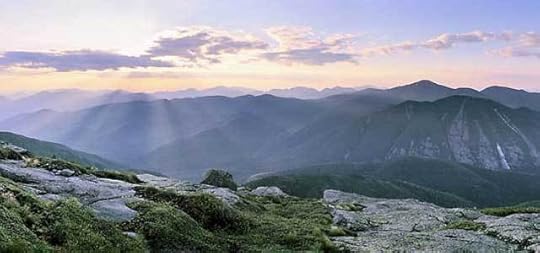
These questions of what constitutes the natural, what composes the real, when you draw the baseline, how much change a place can stand before it loses it essence - they are the questions that will grow stronger and louder the farther west we go, into the Adirondack wild (whatever "wild" means). (p69)
Was our place wild, or natural, anymore? For that matter, was any place? The peculiar physics of global warming mean, in fact, that the North and South Poles will be hardest hit - that is, the places that really are free of any other human history, really are wild if any place is wild, might just as well be in the middle of the eastern megalopolis or the SoCal suburbs. (p99).However, he goes on to add that "the idea that there is no such thing as pure wilderness has made the relative wild all the more precious." (p100)
For me, then, one of the reasons for wild places is so other people can fall in love with them — because surely there are others wired like me, for whom this landscape w ill be enough. Enough to reorient their compass in a new direction, too. Most of the time now we live under a kind of spell, a lulling enchantment sung by the sirens of our consumer society, telling us what will make us happy. That enchantment is a half-truth at best — you don't need to look very hard at our culture to see that deep happiness is not its hallmark. But breaking that spell requires something striking. For some, it requires seeing how poor people really live, or understanding the depth of our ecological trouble. Or, maybe better, it requires seeing other possibilities, the kind of possibilities I've been describing on this trip. A world where neighbors provide more for each other, growing food and bottling wine and making music, a world where we could take our pleasure more in the woods than in the mall. A world where hyperindividualism begins to fade in the face of working human and natural communities. (p134)I'm not sure how wide the appeal for this book might be, but I'd definitely recommend it for environmentalists, conservationists, and others, like me, interested in these kinds of issues. It will certainly give you a lot to think about and absorb. This was not what I expected out of this short book about wandering through Vermont but it was more than worth it!