

What do you think?

Coming of Age: How Adolescence Shapes Us
Adolescence is the most dramatic and formative period of our both thrilling and traumatic, it is when we become who we are, when the smallest things can have life-long effects. But it is also full of contradictions, making it bewildering to live through and usually misunderstood in retrospect. We often struggle to connect with the adolescents in our lives, but most of us have yet to come to terms with our own adolescence and how it has shaped who we are.In this moving, empowering book, which is full of counter-intuitive insights, Lucy Foulkes, an expert in adolescent psychology, draws on the latest studies and in-depth interviews to demystify adolescent behaviours - friendship, bullying, risk-taking, sex, mental illness, love and much more. She unpicks the social hierarchies that colour all of adolescent life and reveals some surprising underlying that as adolescents we are deeply conservative more than we are rebellious; that what seems like recklessness is often calculated and risk-averse; that the same peer influence that can lead to bullying can also be used to prevent it; that popularity is a mixed blessing even while friendship at this time can be a life-changing good. She explains why appearance counts for everything at this age and why we can be so fickle and cruel, but also how adolescents can astound the adults in their lives with their empathy and capacity to support and nurture one another.If our identities are a story, then the first crucial draft is written in adolescence. This book helps us to read that story - in ourselves and as it is being written in others - helping us to appreciate and accept it and where there is pain to begin to rewrite it.
227 pages, Kindle Edition
Published July 4, 2024
About the author
Lucy Foulkes
4 books49 followersDr Lucy Foulkes is an academic psychologist, specialising in mental health and social development in the adolescent years. She is a senior research fellow at the Anna Freud National Centre for Children and Families in London, and an honorary lecturer at University College London (UCL).
Losing Our Minds: The Challenge of Defining Mental Illness – which examines how to think and talk about mental illness in a more helpful way – is her first book.
Lucy can be found on Twitter (@lfoulkesy) and Instagram (@drlucyfoulkes).
Losing Our Minds: The Challenge of Defining Mental Illness – which examines how to think and talk about mental illness in a more helpful way – is her first book.
Lucy can be found on Twitter (@lfoulkesy) and Instagram (@drlucyfoulkes).
Ratings & Reviews
Friends & Following
Create a free account to discover what your friends think of this book!
Community Reviews
Displaying 1 - 16 of 16 reviews

Read
July 18, 2026Source of book: Bought for myself
Relevant disclaimers: None
Please note: This review may not be reproduced or quoted, in whole or in part, without explicit consent from the author.
And remember: I am not here to judge your drag, I mean your book. Books are art and art is subjective. These are just my personal thoughts. They are not meant to be taken as broader commentary on the general quality of the work. Believe me, I have not enjoyed many an excellent book, and my individual lack of enjoyment has not made any of those books less excellent or (more relevantly) less successful.
***
This another one of my volunteer-work related reads. It was actually recommended to me by a friend as we talking about the mental adjustment it can take, shifting abruptly from dealing with adults to dealing with younger people, since it’s important not to let yourself fall into the trap of believing the problems of the latter are trivial or fleeting or carry less significance than those of adults.
I’m honestly not sure if this book helped with that directly, but I think it did indirectly and, honestly, quite significantly. I wasn’t quite prepared to find an academic (if accessibly written) study of adolescence to be so … well. So fucking moving? Drawing on an impressive range of studies, alongside personal testimony provided for the book, Foulkes explores a broad spectrum of adolescent concerns, from popularity and friendship, to grief and bullying, love and sex, and, of course, the ways identity (be it issues of gender, race, class, sexuality, disability, mental health etc.) intersect with those. All with the aim--essentially--of “explaining” adolescence, why it’s so intense for the people going through it and why it has such a disproportionate impact on us across our whole lives.
There’s a lot that’s fascinating here (I was especially struck by ideas of ‘perceived’ popularity versus ‘sociometric’ popularity) and it’s clearly well-researched and well-grounded but, mostly, I just found it kind of very … lovely? There’s a warmth here and a non-judgemental approach throughout, especially when it comes to the things we usually judge teenagers for (sexual curiosity, risk taking behaviour, the seemingly obsessive need to conform, etc.), as well a consistent challenge to our culturally-shaped tendency to devalue and dismiss teenage experience.
For me, the book genuinely helped me think about my own adolescence in ways that are gentler and, perhaps, more useful than I have in years. It was, to say, the least a complicated time, for all sorts of reasons. As Foulkes says:
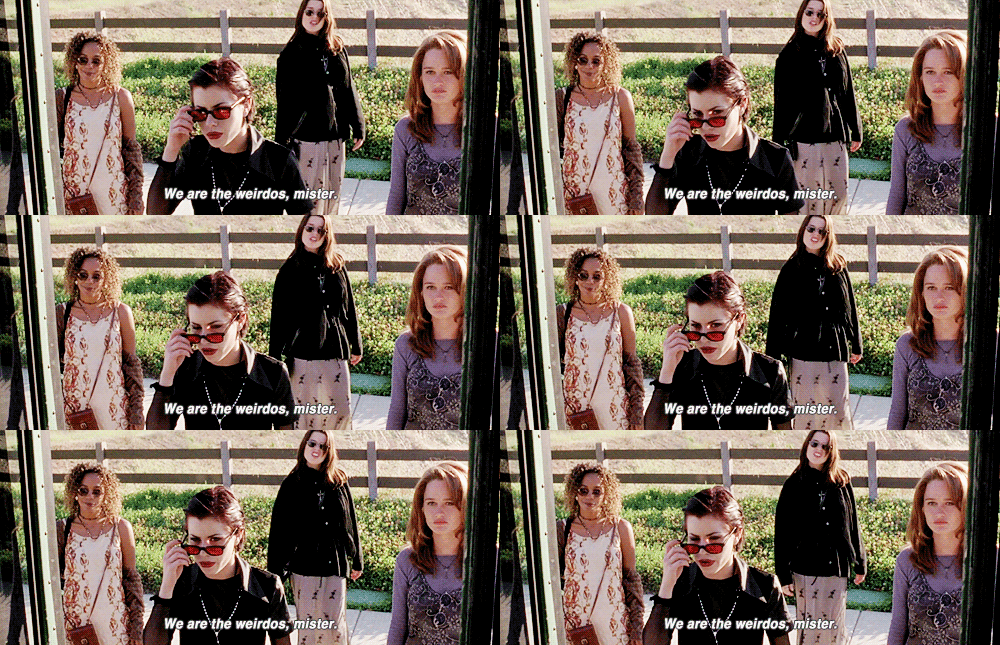
I don’t think I’ve quite reached the ‘celebrating’ stage yet. But I have been trying to give some space to a part of me that never really got to live or be seen. So far it’s involved re-watching The Craft and planning some nonsense teen witchcraft hijinks on the full moon. But you know, what? It’s a start. And I don’t think I’d have even got to that point without this book.
Relevant disclaimers: None
Please note: This review may not be reproduced or quoted, in whole or in part, without explicit consent from the author.
And remember: I am not here to judge your drag, I mean your book. Books are art and art is subjective. These are just my personal thoughts. They are not meant to be taken as broader commentary on the general quality of the work. Believe me, I have not enjoyed many an excellent book, and my individual lack of enjoyment has not made any of those books less excellent or (more relevantly) less successful.
***
This another one of my volunteer-work related reads. It was actually recommended to me by a friend as we talking about the mental adjustment it can take, shifting abruptly from dealing with adults to dealing with younger people, since it’s important not to let yourself fall into the trap of believing the problems of the latter are trivial or fleeting or carry less significance than those of adults.
I’m honestly not sure if this book helped with that directly, but I think it did indirectly and, honestly, quite significantly. I wasn’t quite prepared to find an academic (if accessibly written) study of adolescence to be so … well. So fucking moving? Drawing on an impressive range of studies, alongside personal testimony provided for the book, Foulkes explores a broad spectrum of adolescent concerns, from popularity and friendship, to grief and bullying, love and sex, and, of course, the ways identity (be it issues of gender, race, class, sexuality, disability, mental health etc.) intersect with those. All with the aim--essentially--of “explaining” adolescence, why it’s so intense for the people going through it and why it has such a disproportionate impact on us across our whole lives.
There’s a lot that’s fascinating here (I was especially struck by ideas of ‘perceived’ popularity versus ‘sociometric’ popularity) and it’s clearly well-researched and well-grounded but, mostly, I just found it kind of very … lovely? There’s a warmth here and a non-judgemental approach throughout, especially when it comes to the things we usually judge teenagers for (sexual curiosity, risk taking behaviour, the seemingly obsessive need to conform, etc.), as well a consistent challenge to our culturally-shaped tendency to devalue and dismiss teenage experience.
For me, the book genuinely helped me think about my own adolescence in ways that are gentler and, perhaps, more useful than I have in years. It was, to say, the least a complicated time, for all sorts of reasons. As Foulkes says:
Appreciating why teenagers do the things they do can help people understand the young people in their lives today – but, perhaps most importantly, it can also help people understand themselves. Through this understanding comes compassion, for others and for ourselves, and indeed forgiveness. This matters because teenagers are often derided and stereotyped. The common narrative about teenagers is that they consistently behave in all sorts of stupid, selfish, short-sighted ways. Ultimately, reflecting on our adolescence and how it affects our adult life also means celebrating our former selves: the wild and fragile person that helped us become who we are today.
I don’t think I’ve quite reached the ‘celebrating’ stage yet. But I have been trying to give some space to a part of me that never really got to live or be seen. So far it’s involved re-watching The Craft and planning some nonsense teen witchcraft hijinks on the full moon. But you know, what? It’s a start. And I don’t think I’d have even got to that point without this book.

September 2, 2024
Foulkes is a academic psychologist, and this is a reflection, based largely on studies into Western teenagers, on how adolescence in WEIRD countries works. Coming in, I was hoping for something more focused on how adolescence has evolved, which would have required a different approach. Instead, this is an in-depth look at how teens navigate risk taking, first loves, sex, and other common new experiences. Foulkes mostly concludes that teenagers take physical risks to avoid taking too many social risks, and that much of teenage behaviour is driven by a strong desire to fit in. She also notes how powerful social, including romantic, bonds are during this period, and looks briefly at impulse control. The most interesting research was into the social network functions of high school, including the researchers' dilemma of how to describe the "popular" kids when it turns out, consistent across studies, nobody actually likes them (as opposed to actual popular kids, who tend to have social capital but not the high status of 'popular' kids).
It was readable, and surprisingly emotional - Foulkes notes how much we all have still unpacked from our own adolescence, which tends to continue to evoke shame, embarrassment and sadness - as well as joy - in adults throughout their lives.
For action, she advocates against an approach which tries too hard to de-risk adolescence through surveillance, noting that an important developmental stage involves learning to survive challenges, trust in your own resilience and endure bad choices, as well as learning to make better ones. I just wish that had been based on a broader range of evidence.
It was readable, and surprisingly emotional - Foulkes notes how much we all have still unpacked from our own adolescence, which tends to continue to evoke shame, embarrassment and sadness - as well as joy - in adults throughout their lives.
For action, she advocates against an approach which tries too hard to de-risk adolescence through surveillance, noting that an important developmental stage involves learning to survive challenges, trust in your own resilience and endure bad choices, as well as learning to make better ones. I just wish that had been based on a broader range of evidence.

April 8, 2025
Interessant, maar vooral heel mooi en empathisch geschreven

July 18, 2025
Adolescence was a big time for me - my dad died, I started going out with the guy who I am now married and have two children with - so lots of this hit home for me.
June 6, 2025
"Coming of Age" by Lucie Foulkes is both an informative and emotionally resonant read. Drawing on a wealth of research, Foulkes explores major themes of adolescence such as sex, bullying, friendships, and risk-taking with clarity and sensitivity. While the book is rich in academic sources, it remains highly accessible, making it suitable for both scholars and general readers with an interest in adolescent development.
Yet, the value of Coming of Age goes beyond academic insight or personal curiosity. Foulkes offers readers a space for reflection, encouraging them to revisit and make sense of their own adolescent experiences. In doing so, the book provides not just understanding, but also a sense of healing, offering thoughtful answers to why things may have happened the way they did, and how we might begin to let go of lingering teenage pain.
Yet, the value of Coming of Age goes beyond academic insight or personal curiosity. Foulkes offers readers a space for reflection, encouraging them to revisit and make sense of their own adolescent experiences. In doing so, the book provides not just understanding, but also a sense of healing, offering thoughtful answers to why things may have happened the way they did, and how we might begin to let go of lingering teenage pain.

August 3, 2025
A very readable, insightful account of the identities we form in adolescence, and how they affect the rest of our lives. I especially liked Foulkes’ emphasis on storytelling and narrative, and how important it is for us to be able to look back and form a narrative of our own about our teenage years. Foulkes makes interesting observations about popularity, for example (‘perceived’ popularity versus ‘sociometric’ popularity); about why teenagers are risk-takers in some ways, conservative in others; and about sensible parental attitudes towards teenage sex. There might have been more discussion of social media and the way that screen use has transformed life for this generation of teens, but I found this book illuminating regardless, both in terms of thinking about my own teenagers and in terms of better understanding my own messy adolescence.

July 18, 2024
Fascinating psychological description of adolescence. The early chapters on popularity, image and risk-taking are excellent. Foulkes writes at a popular level but with an academic rigour reviewing key psychological findings. The sense of development of self and the difficulties that brings is striking and rings true of my experience and research. The final chapter around reflection of teenage memories has some really intriguing ideas as well.

April 5, 2026
I work with teenagers, and this has hit home about all the barriers, learning curves and experiences they face in such formative years.
I love how the book gives some advice in ways of how to manage behaviours (such as making sure they are given space to get their own experiences instead of controlling their lives) and using the personal stories as evidence gave it a magic touch.
Adolescence is never easy, I hope I can utilise what I have learnt from the book to support them better.
I love how the book gives some advice in ways of how to manage behaviours (such as making sure they are given space to get their own experiences instead of controlling their lives) and using the personal stories as evidence gave it a magic touch.
Adolescence is never easy, I hope I can utilise what I have learnt from the book to support them better.

September 28, 2025
Illuminating read about what it feels like to be teenager
The book reminds how adolescence is a crucial time for the formation personality and the social element in this process being a key one. Interesting thoughts on teenage love as well as insights in what causes bullying and what it takes to tackle it effectively
The book reminds how adolescence is a crucial time for the formation personality and the social element in this process being a key one. Interesting thoughts on teenage love as well as insights in what causes bullying and what it takes to tackle it effectively

January 18, 2026
I use the things I learned about in this book in practice as a suicide prevention professional, would recommend to all mental health professionals especially those working with CYP and people who have experienced trauma within adolescence (for further context about adolescence as a developmental period)
December 22, 2024
A very moving understanding of adolescence.
There's definitely things I'd like to know in more depth and that looks across cultures. However, I love the aim of de-stigmatising that stage of life, which the author did very successfully and in an accessible way!
There's definitely things I'd like to know in more depth and that looks across cultures. However, I love the aim of de-stigmatising that stage of life, which the author did very successfully and in an accessible way!

September 28, 2025
Read this in two days -- super informative, readable, hopeful. I absolutely loved the way Dr. Foulkes weaved true adolescent stories in with psychological research. So many lightbulb moments and highlights
November 24, 2024
As a parent of adolescents I found this book enlightening and fascinating. Really sensitively written with an engaging style.

April 30, 2025
4.5* rounded down ⭐️⭐️⭐️⭐️
Somehow both packed with research and yet condense?
I really bloody enjoyed this.
Somehow both packed with research and yet condense?
I really bloody enjoyed this.

June 2, 2026
An accessible read about the psychology of adolescence. Very interesting and makes you reflect on your own experiences in a new context.

Want to Read
July 19, 2026Reviewed by Alexis Hall.
Displaying 1 - 16 of 16 reviews