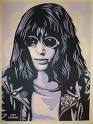
The authorized story of an American band who shaped the history of music for generations. Today's new music-makers are looking back at the bands that broke the ground, and the Ramones are the original high priests of punk, the stars of rock 'n roll high school, the royal avatars of rock, raunch, and rebellion. 60 photographs and illustrations.
In 1995 Ben Weasel wrote a Maximum Rocknroll column about what was appropriate to wear as a punk, be it to a show or just to head out on errands. I won't give all of his rules, of which there are many, but the gist of them are that the only acceptable way to dress, if one must dress as a punk, is to dress like the Ramones. T-shirt, black leather jacket with no spikes and if pins must be attached then they have to be US pins on the collar, jeans, a sneakers, preferably Converse (this is before Nike owned Converse). Ramones t-shirts were I'm sure fine for Mr. Weasel, because in 1995 no one really wore Ramones shirts that didn't actually like the Ramones. Actually in 1995 the Ramones didn't really have that many US fans outside of the punk world, case in point I saw them that year in a shitty club in Massachutes that I also saw The Queers at. They both sold the place out, but seriously the Queers were never bigtime. People respected the Ramones, but they weren't big time. It would take the band finally calling it quits, and three of the original four members dropping dead before you couldn't spit on an East Village Street without hitting some hipster looking fuck in a Ramones Shirt. And those shirts come in all kinds of colors, purple and pink and red and blue, colored Ramones shirts to match whatever outfit one chooses to wear. You'd think that the Ramones had been as big as the Rolling Stones or something, but no.
Where is this going? As an amendment to Ben Weasel's rules, I propose that no Ramones shirts shall ever be worn that come in any color besides black or white. If you wear any other color Ramones shirt you are a tool, an idiot, a douchebag, some kind of fashionista or some other kind of sub-human slime that deserves to be mocked, ridiculed and rejected from all civilized society. It's that fucking serious. Wearing any other color Ramones shirt is like covering a Ramones song but picking UP and DOWN as opposed to only DOWN. You say it doesn't make a difference, and it sounds the same, but really it's just how it's done. No arguments, you are making a mockery of a great band by wearing these shirts and looking like a hipster douchebag.
Now what about the book? It's not very good. It's written in a breezy, very fanboy like manner that reads like something that should be in a magazine like Bop, or in one of those corporate 'fanzines' that were produced in the 90's to try to give credibility to sleazy money grubbing record labels trying to make a quick buck. Not to say this isn't sincere, I believe that the author loves the band, but he's just not a very good writer, and while I know he is old enough to know better, he comes across like a gushing teenage girl.
There is also no critical awareness to this book. If you never listened to the Ramones and read this book you would believe that they got better with every record, so that as a result Mondo Bizzaro is there best record ever, and that even records like Brain Drain and Subterranean Jungle were better than their first record and Rocket to Russia (the book was written in 1993, so the author knows nothing of Acid Eaters or Adios Amigos). This just isn't true, I've yet to meet a single person who admits to liking more than a few songs off of any of their post-End of the Century albums (EOTC being a questionable record also, feelings generally being mixed about it's inclusion into the pantheon of great Ramones albums, some people including only the first four and call EOTC crap that Phil Spector ruined. Myself I believe that the Ramones only really made two great albums, their self-titled debut and Rocket to Russia (album number 3) with Leave Home and Road to Ruin as good albums, End of the Century as ok and everything else as forgettable, with a good song here and there), and it seems strange reading a book where the author keeps talking about how they got better and better over time. They don't though, the Ramones are great when they do what they do best and that is play short fast songs, once they get too thinky about the songs they go bad. To display the authors total lack of critical awareness though one only has to look at the praise he throws towards Dee Dee Ramone's solo rap project under the name Dee Dee King. You'd think that Dee Dee had made It Takes a Nation of Millions or Straight Outta Compton, a seminal hip-hop record, instead of what the album actually was (it's terrible, funny but terrible).
The third to last chapter also was edited worse than my review, but that's not meant to be nit picky, it just looked like the copy editor decided to not bother with that one. All and all the book was kind of breezy and fun, but filled with too many exclamation points and fanboy gushings that made me wince every time they popped up (which was about once a page at least). I would love to read a real biography on the Ramones and not a sugar coated authorized biography that this is.
Mica tanto miei cari "fratellini". I 4 della formazione originaria son tutti morti, prematuramente, ma le canzoni che ci avete lasciato stanno sempre più prendendo piede, soprattutto dopo la Vostra dipartita, chissà perchè poi? Forse eravate troppo avanti, seppur nella vostra semplicità, o era proprio questa semplicità, genuina a rendervi così autentici e poco digeribili dai palati delle masse? Non lo so, quello che so di certo è che quando, nel 2003 o giù di lì, un mio carissimo amico mi disse: "Li conosci i Ramones?" ed io risposi di no, che non li avevo nemmeno mai sentiti in vita mia, lui ribattè dicendo: "Dovresti provare ad ascoltarli, per me fanno proprio al tuo caso". Ed io appena sentii i primi secondi di Blitzkrieg Bop, capii che sarebbero stati il mio gruppo preferito di sempre!
3.5 Stars. A solid read with a good overview of the history of The Ramones. Personally I would have liked it to be more in depth - this is fairly surface level. But it’s well worth the read especially if you, like me, love The Ramones.
I really enjoyed this book: it's a very well-written account of The Ramones' career, with tons of exclusive anecdotes and interviews with the band, their friends, family, and crew (the author knew the band and was able to get access to a lot of their inner circle). It's full of humor and it pulls no punches - it's not afraid to attribute to the Ramones the historical significance that is rightfully theirs, but at the same time it paints their personal flaws and professional and artistic missteps unflinchingly. The book is by turns funny, frustrating, inspiring, and heartbreaking, much like the band itself.
What dropped the book from 4 stars to 3, for me, is the author's constant interjections of his own biases; he never misses a chance to take potshots at bands he dislikes, from the Sex Pistols to Smashing Pumpkins, Pearl Jam and Live. And he's certainly free to do that, seeing how it's his book and all, but I found it distracting and offputting.
After my delicate neuronal structure had been completely altered after hearing the first Ramones album, I quickly grabbed this book at the library, the Edgewater branch, ahhhh, home, memories, reading this book in about 3 days, The life of a 13 year old boy
I LOVE the Ramones: let me start there. But this book is written like a passed note to your junior high crush. Exclamation marks ABOUND. Not your best, Jim Bessman.
Somehow, we all know the beat to “Twenty, twenty, twenty-four hours to go.” We all know the chorus to Blitzkrieg Bop. We all know the now-famous look that defined a punk generation: ripped jeans, black leather jackets, and converse sneakers. The Ramones, today, are not only well-known, but counted among Rolling Stone’s Top 100 rock bands of all time. But it wasn’t always like that - once upon a time, the Ramones were nobodies from Queens, talented but uncelebrated, and they would remain that way for much of their careers. Formed from adolescent angst and the earliest stirrings of the punk movement, the Ramones began playing local venues, including the now-famous CBGB in lower Manhattan, in the early 1970s. Capitalizing on their unconventional approach to musicianship (play as hard and fast as you can) The Ramones quickly secured a record deal and garnered a small but loyal following. Music journalist Jim Bessman does a phenomenal job describing the storied career of the band - the revolving door of drummers, the mental and emotional strife plaguing their still-developing minds, and the dozens of recording room nightmares and on-stage antics that seemingly come complete with every successful band. And speaking of success, one of the cornerstones of this book actually explains how, even though they are a household name today, the New York band only saw a menial amount of financial and critical success during their most active years. Because even though they played CBGB regularly, toured often, and even starred in their own movie directed by then up-and-coming director Joe Dante, the Ramones lacked one thing: radio play. In true punk fashion, most Ramones songs, as loved as they are today, were simply too unpalatable for the airwaves. Where the Beatles crooned and smiled for the cameras, the Ramones screamed and sulked. Where the Talking Heads swayed and sang of romance and charm, the Ramones head-banged to songs about sniffing glue. So while their contributions to the punk movement are undeniable, they were never as played, or even listened to, as much as they are today. Jim Bessman asserts that the Ramones were not only the frontrunners of the underground punk scene, but musically ahead of their time all together. The Ramones were the quintessential American band: crashing into the scene with bravado, machine-gunning lyrics that were simultaneously harsh and flirtatious, playing their guitars fast enough to snap the strings, and injecting so much good old-fashioned rock n’ roll energy in the room that you can’t help sing along, bouncing and screaming, to punk’s eternal call-to-arms: “Hey ho, let’s go.”
Only a corporately produced "official" biography could deliver such a breathless and banal image of any band. Here are The Ramones scrubbed clean for, let's say, thirteen year olds in 1995, if the dated design is an indication. It may admit their "dope habits", but the consequences of such are completely glossed over, as are the highs and lows of the actual scenes represented in each of the cities it passingly mentions in its Wikipedia-basic summa of their career. Most photos are among the easiest to find of The Ramones, and are often give. Ridiculous captions that suggest thoughts and intentions of the subjects that no one could possibly know decades removed from the moments captured. The Ramones are regarded as basically a harmless pop band (which, compared to those who followed them, is almost true, but still a gross misrepresentation of their impact), who have a steady rise in relevance and impact over their career (simply untrue). Their first show in England is described as changing the country forever.
I considered keeping this book for my children to read when they are nine or ten. But, even then, I'd rather they be confronted with the tension of the good and bad from any artist or scene, and be presented with an account closer to the whole truth about any band, even one on the cutting edge of a beloved new art and culture.
The thing is, the Ramones had this tough guy reputation but as this book documents they whinged about mixer taps, warm beer, driving n the wrong side of the road and spitting punks. They were ionised all over the world, especially and ironically South America. And yet, you can't walk down the road anywhere for long without seeing a Ramones t-shirt. And even my special needs class last year sang AO Let's Go with ever greater gusto. A bit like Tony Blair apogising to the Irish, is it not time Smokin' Joe Biden issued an apology, on behalf of the USA, to Johnny, Joey, Tommy and Dee Dee, even more than Martin Peters, they were a generation ahead of their time....
It’s interesting to read a history of the Ramones that was written while the Ramones were all still alive and an active band. Probably their biggest impact on the culture was the influence they had on Green Day which brought punk to the mainstream in a more lasting way, but that wouldn’t come until a year after this book was published. And all the stuff about how Dede is cleaning up his act and things are looking up for him is pretty sad to read now.
As with the Ramones and their music, this book doesn’t seek perfection. For example, the author and editor missed this passage “Ace Frehley of Danger Danger”?!? Maybe it was an intentional dig at Kiss, who knows. Overall a decent tribute to a massively influential band.
This book was half-ass. Doesn't do anything for the Ramones mythology. Take it or leave it. Two-stars but I gave it three for the effort... and for the dearly departed Ramones.
Let me begin by saying I've liked the Ramones for a very long time. Since roughly 1980. And while I've enjoyed their music, I never thought they were musical geniuses or lyrical geniuses the way Lennon and McCartney were or even Trent Reznor. It was just fun, fast music. This book is about the music, but I'm downgrading it a couple of stars because the author thinks the Ramones are the world's greatest band, for all intents and purposes. He's a real fan boy. But since this is an authorized biography, I guess you would expect that.
The band started out in New York in 1974. Four disaffected young people who couldn't play a musical instrument to save their lives. They couldn't even imitate their musical heroes, the way Bowie or McCartney did. But they did get instruments and learn a chord. Their first show was a disaster, but soon the new club, CBGB's, found them and nothing was ever the same again. They'd come on stage and rip through 17 songs in 15 minutes or 23 or 24 songs in 20 minutes. The object seemed to be to get through the songs as quickly as possible, with as much loudness as possible. The chiefs at Sire, a new outfit, heard their demo and signed them, and all of a sudden they had a record. And it got great reviews! All of a sudden, they were the founders and leaders of a new punk movement, and they influenced the Sex Pistols, The Clash, The Damned, and many, many other bands. They toured a lot and continued putting out records. That's pretty much the book. A couple of lineup changes, the only one of which -- when bassist and song writer Dee Dee quit -- was big. There's mention of drugs and alcohol, but just barely. This is a PG rated book, unlike other rock biographies I've read. A lot of the songs are quoted in the text, or snippets of songs, but it serves, in my opinion, to show just how insipid their lyrics were -- not how great they were like the author asserts! While the Ramones never sold many records, they did tour a lot, and I guess that's what prompted the author to write, "Everyone in the known universe loves the Ramones today." Huh? They made $400 for their shows. Their albums sold in the 25,000 to 40,000 range. Obviously NOT everyone in the known universe loves the Ramones.... One weakness of the book is that it was written in 1993, before three of the four members had died. I'd love an updated version, just to see what the author would say about what happened to them. It was a decent rock bio, but I've read many better. One nice thing about the book, though, was all of the photos of the band and various fliers that would be put up in various places. Nice touch. Recommended for punk rock fans and fans of the Ramones, but probably no one else....
Dettagliatissima ricostruzione che ripercorre la carriera della band attraverso i giudizi dei critici musicali dell'epoca e le testimonianze dei collaboratori. Il lavoro è nel complesso molto accurato e restituisce efficacemente l'idea "progettuale" che ha decretato l'influenza (perchè parlare di "successo" in termini commerciali non sarebbe appropriato) del suono dei Ramones e le motivazioni dietro ad ogni scelta artistica. Un percorso segnato in ogni sua tappa dalla tensione fra revival bubblegum e rumore dissacratorio, sintetizzati in un'irriproducibile estetica minimal e naif; il paradosso di una band che ha fatto della rapidità una cifra poetica, riuscendo al tempo stesso a durare più di quanto gli addetti al settore si aspettassero, ma i cui componenti alla fine altrettanto rapidamente ci hanno lasciato. Il tutto è talmente rigoroso ed accurato da risultare un po' algido: non ci si sofferma davvero sul background di vita dei componenti (come invece aveva fatto il commoventissimo documentario "End of the Century") e in molti casi si assiste quasi ad un elenco telefonico di nomi e citazioni. Per i fan del quartetto americano si tratta comunque di un volume imprescindibile.
I didn't actually finish this book. It was put together so horribly. It seemed as if the writer was so excited to write a book about The Ramones and getting to meet them that he put aside any education he had on writing and released this. The whole setup of the book was annoying; random pictures in the middle of pages, exclamation points at the end of every quoted Ramone sentence, run on sentences, changing subjects in the middle of sentences. This book was so promising, seeing as it was written as The Ramones were still together. Skip this book and find another biography to read. I bought this book based on the ratings on this website. I won't make that mistake again.
Killer book on the Ramones. Whilst going through my punk rock purist phase, I read this book cover to cover in a matter of days. The only reason I didn't read it in one sitting, is because of my desire to relish every word on every page. Music historians must own this, or at least read it. Actually... Read it or die.
A nice piece of work, generally, that falls short solely because it just misses the band's break-up, seemingly never-ending farewell tour, and the deaths of Joey, Dee Dee and Johnny which followed all too soon. An updated version of this is probably in the pipeline and would be welcome.
If you are a fan of the Ramones, or just 1970's punk rock in general, this is the definite biography of Joey, Johnny, Dee Dee, and Marky. From their early days playing at CBGB's, to the so-called end of their career, this book covers it all.
I liked the content a lot. The author did his research, was knowledgeable, and told some interesting stories. But it read like a really long newspaper article, had too many exclamation marks, and could have used an editor.
Hey ho lets go! A punk bio of the greatest punk band ever to bleed on its guitar strings. Nice treatment of the Dee Dee issues. Could have been better only if it had been written later.