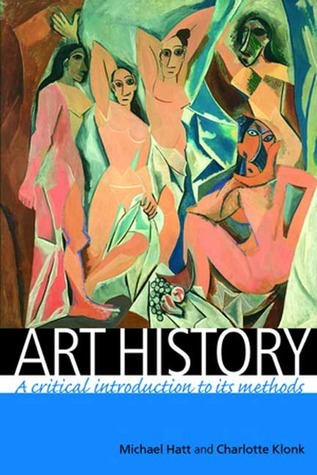
Art A critical introduction to its methods provides a lively and stimulating introduction to methodological debates within art history. Offering a lucid account of approaches from Hegel to post-colonialism, the book provides a sense of art history’s own history as a discipline from its emergence in the late-eighteenth century to contemporary debates. By explaining the underlying philosophical and political assumptions behind each method, along with clear examples of how these are brought to bear on visual and historical analysis, the authors show that an adherence to a certain method is, in effect, a commitment to a set of beliefs and values. The book makes a strong case for the vitality of the discipline and its methodological centrality to new fields such as visual culture.
This book will be of enormous value to undergraduate and graduate students, and also makes its own contributions to ongoing scholarly debates about theory and method.
This book is getting a 5 star rating not for critical theory itself (which I pretty much loathe in the the abstract!), but because it is a really clear introduction to a lot of different theory. I've just done a (compulsory) course in art theory as part of my degree, and honestly I feel like this book is more useful than the lecture series was! It really helps explain how theories which weren't originally related to art, e.g. Marxism or psychotherapy, can be related to art, as well as outlining the general theories and explaining all the main figures for each theory. I honestly don't know how I'd have got through the course without this book, highly recommended!
Very useful book to help with different approaches to art history and historiography; well researched, with helpful bibliography and logical sectioning of the chapters. I am glad to have bought this one.
Read for art historiography. Good foundation of the theories surrounding the history of art history. Definitely for those with some art history background however.
After a plunge into a single painting, Picasso’s Les Demoiselles d’Avignon, to illustrate the many modes of interpretation, the book scans “the most important methods that have been used in art history since the early nineteenth century”. As an introductory text, its scope is limited, perhaps necessarily. ‘Art’ in its title sounds big, but examples are drawn from only one category, namely painting in Western Europe. That means that plenty of things -- sculpture, photography, architecture, conceptual art and installations, along with non-Western art -- are scarcely mentioned, and a discussion of the art market and patronage is nowhere to be found.
Part one consists of five solid chapters on major theories and methods. Arranged roughly in chronological order, these pivot on changing ways and means of interpretation. Hegelian philosophy is first up, followed by a chapter on connoisseurship with its focus on stylistic hallmarks. The chapter on iconographical methods was especially illuminating for me, and the following one on methods drawn from social history was a good tour of those horizons.
But then comes part two. Here the book veers off into wholly different domains – feminism, psychoanalysis, semiotics, and postcolonialism. These chapters offer discussion rather than interpretive frameworks like those of the book's first part. Because they touch on art only tangentially, the chapters seem bolted on. Hot topics added perhaps to lure a wider range of readers? Hard to say. In any case the authors' critical appraisals of these domains are insightful, but the chapters themselves provide only rickety bridges to the mainland of art history and its methodologies. In critical commentary on psychoanalysis, the authors observe that Freud and Lacan disliked visual evidence, and didn't look for it; therefore psychoanalysis really has little to tell us about art. Similarly, about semiotics, the authors conclude that for most art historians, that once fashionable field is pretty much a dead end. Such conclusions left me puzzled; if these intellectual fashions are so irrelevant in art history, why include them?
But never mind, these bolted-on bits can be skipped; the book is worthwhile for its first part alone.
Clear and very well structured. Even as a short introduction it gives a very good overview of the main art theory issues. Easy to understand and from there read more thoroughly on a particular subject from original works to which Hatt and Klonk address. Also good book to use against those who claim that art history is easy, you just 'blah' about pictures ;)
Preferred other art history methods surveys such as Preziosi which include excerpts of key figures. This one seems written more for art history professionals with a specific interest in intellectual historiography —the discussion of Panofsky for instance dithers forever about Hegel and P’s Perspective book before discussing iconology.
Art History: A Critical Introduction to Its Methods by Michael Hatt and Charlotte Klonk
‘There is no art history without theory or methode’
What makes one interpretation of a work of art better than another? Some ways of interpreting are more comprehensive than others. They have fewer contradictions and account for more detailed observations. If you have a framework within which to view an artwork your interpretation will be more plausible and more persuasive. This book is concerned with these frameworks or methods and offers an account of the most important methods since early nineteenth century.
This book makes a distinction between theoretical questions in art history and the philosophical discipline of aesthetics. While aesthetics is interested in the universal characteristics involved in the perception of beauty, art historians require theories that negotiate the relationship between the specific and the general. While aesthetics looks at the universal features of the perception of art, theoretical art history focuses on historically and culturally specific ways of seeing.
The aim of this book is quite straight forward, to provide an introduction to the key approaches in art history and set them in context. The book is organised chronologically, from the German philosopher Hegel (Georg Wilhelm Friedrich Hegel 1770 – 1831) to postcolonialism. The different methods can be, and are, combined by scholars, but there are limits to how this van be done.
Part One of the book is concerned with; Hegel’s postulation of an ‘Absolute Spirit’ which makes it possible to see a work of art as a product of different societies while at the same time being able to see the ‘logic’ between the different works of art. Connoisseurship (Berenson) as a reaction on Hegel’s approach to art and focusses on individual creativity. Formalism (Riegl and Wölfflin) that raises the question of the historicity of vision. Iconography – iconology (Panofsky) how under different historical circumstances particular themes or ideas are articulated. Marxism and the social history of art marks the shift from the search for a single causal explanation for historical change to the more multi-factorial recent approaches.
Part Two of the book examines these more recent approaches such as; Feminism, has not only another subject of study, for instance the work of woman artists or images of masculinity. Feminism is also methodologically diverse since feminist art history often draws from Marxism and psychoanalysis, as well as other theoretical traditions. Psychoanalysis on the difference between Freud and the way unconscious desires are expressed in works of art and Lacan who shows how such desires are culturally determined. Semiotics, in art history is has been used to try to grasp more clearly the different functions of pictorial elements and forms of representation. Postcolonialism, focuses on two positions, one following Edward Said, which polarises Western and non-Western culture. The other arguing that all cultures are created by cross-cultural exchange.
Conclusions Art history has always been informed by intellectual debates elsewhere and art-history has always been an interdisciplinary enterprise. Many scholars use insights and principles from different art historical methods. Are all these different methods compatible? To some extent it is possible To combine different methods, but it is often necessary to make choices and give a solid motivation.
The ‘hermeneutic problem’ is how is it that a contemporary observer from one historical and cultural position can claim and understand works from a different context. From Hegel’s ‘Absolute idea’ to Marxism offers a mechanism that gives art its place in history yet allows us to understand it from where we are now.
If we give up the idea of a connecting principle common to different cultures, then how do we know that we are giving a valid interpretation? All we can hope to do than is to construct and tell a compelling story. Are (Art) historians more like novelists than like scientists? This book provides a very interesting read, but please take it chapter by chapter, because the writers are for sure hardcore scientists and not yet novelists.
Dr. Klonk was one of my docents for a semester, and she gave a lecture on this same topic. I had to miss the lecture sometimes, and was afraid that I wouldn't be able to catch up, but this book made it so that I could read one or two chapters on certain art historical methods whenever I wasn't able to attend and still be up to speed with everyone else. No extensive background knowledge is required to grasp the contents of this book, which are quite valuable to students of art history. I haven't come across any other book that breaks down the most important analytical methods in so few pages.
I read this book for class and thought I'd add it to my Goodreads bc I actually read pretty much all of it! This is a gem for art history beginners like myself. It breaks down the most common and useful methodologies in art history in a digestible way, and I have already been using it often as a reference. I don't know if anyone that follows me on Goodreads will ever need this book, but I'm so happy I own it, and it really opened my eyes to the history of art history! Slay Hatt and Klonk!
Helpful book! With an overwhelming amount of reading to do for my Art History Methods class, this was the only book I fully got through. I chose this one to help me through my overview course of all the complicated concepts and methodologies, and it really helped clear things up and was pretty interesting and enjoyable. A valuable resource for me!
Dit boek heeft een maand in beslag genomen om uit te krijgen. Ik geef toe dat ik twee weken/20 dagen een pauze ervan heb genomen omdat er zoveel informatie op nog maar 256 pagina's geschreven staat. Het las desalniettemin redelijk vlot en het is op een boeiende manier geschreven. Interessante samenvatting van de westerse historiografie zoals we die kennen.
Uuh wetenschapsfilosofie 2.0: even onduidelijk en langdradig, hoewel Hatt & Klonk veel specifieker zijn in onderwerp. Ook inmiddels aardig verouderd qua laatste twee hoofdstukken. Thanks voor het overzicht van kunsthistorische benaderingen, tho! Het is niet makkelijk om daar een behapbaar boek van te maken. De schrijfstijl kom helaas echt wel wat meer to the point, iets minder afdwalen.
No harm in adding my uni textbooks, right? Good book for sure, though I haven’t passed the class yet. Lets hope the paper I turn in next Friday will be a passing grade 🤞
This is a good introduction to art historiography, although you do need to have some knowledge about art history/know the canon of artists to understand this book. Some chapters were clear and understandable, but others (especially the one about semiotics) were awful. What I appreciated was the critical appraisal at the end of each chapter, it made the content that you just read much more understandable.
i think that hatt and klonk are good and laying out the methods of looking at art very well. helping me, and co-learners, understand the articles we read in class by the actual art historians who use the methods. thanks h&k!
Oh, I crammed for an exam with this little gem. Covers the major occurances in the development of Art History as a discipline, and its surprisingly an easy read. Well, I think so anyway.
I'll say I'm finished with this, since it's really a reference book for school, anyway. Very useful and succinct, which is a rare quality in art historical theory.