Jump to ratings and reviews
Rate this book

Beowulf

Rate this book
Santiago García y David Rubín han unido sus talentos para poner al día el mito de 'Beowulf', que durante más de mil años ha inspirado a partir del poema heroico del mismo título, obra fundacional de la literatura inglesa, a generaciones de autores, desde J. R. R. Tolkien hasta un buen número de guionistas de Hollywood. Aunque el texto se redactó en lo que hoy es el Reino Unido, trata de las aventuras de un héroe escandinavo en tierras que en la actualidad pertenecen a Dinamarca y un monstruo, Grendel, ha llegado al reino de los daneses. Durante doce años, devora a sus mujeres y hombres, hasta que desde la otra orilla del mar llega Beowulf para intentar salvarlos. Pero es que además de la versión completa que proponen García y Rubín, que sigue fielmente el argumento y la estructura en tres actos del texto original, Esta edición limitada especial 10.º aniversario de 'Beowulf' incluye un importante material adicional como son los bocetos, lápices, tintas, estudios de personajes del propio Rubín, las 22 planchas nunca antes publicadas del 'Beowulf' inconcluso dibujadas por Javier Olivares, origen del proyecto, junto con una profusión de apuntes gráficos de ese trabajo, y el texto “Mitos y leyendas. Diez años después de Beowulf” escrito por Santiago García.

296 pages, Hardcover

First published November 20, 2013

8 people are currently reading
1270 people want to read

About the author

Santiago García

295 books51 followers
Santiago García Fernández es un traductor, teórico e historietista español licenciado en Periodismo en la Universidad Complutense de Madrid.
Antiguamente, firmaba a veces como Trajano Bermúdez.

Ratings & Reviews

What do you think?
Rate this book

Friends & Following

Create a free account to discover what your friends think of this book!

Community Reviews

5 stars
333 (19%)
4 stars
689 (39%)
3 stars
526 (30%)
2 stars
144 (8%)
1 star
32 (1%)
Displaying 1 - 30 of 272 reviews
Profile Image for Jon Nakapalau.
6,488 reviews1,022 followers
November 7, 2025
Beautiful and moving - a fine example of how the classics can be introduced to a new generation - hope to see more from this creative team. I would give this book to someone who has to read Beowulf for school; the illustrations and faithful adherence to the text will help them to visualize several scenes that may be hard to conceptualize.
Profile Image for Dave Schaafsma.
Author 6 books32.1k followers
April 17, 2017
An oversized hardcover comics version of this epic tale. The language from the Lehmann and Heaney versions are missing, but there are words to help us with the story, though the tale is told primarily through dramatic and darkly colorful images. What we may recall from high school and college English course versions (and maybe a relatively recent movie adaptation) is Beowulf and Grendel (and John Gardner's Grendel is a great text to use in studying various versions of this story, of course). But in this version we get a longer tale, with multiple monsters, and a better idea of his character.

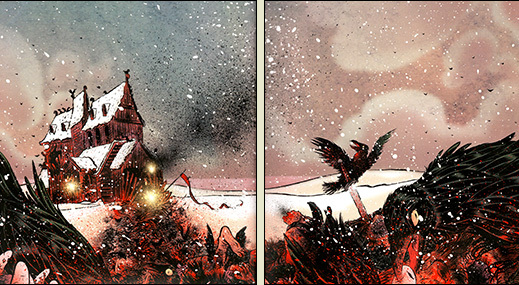
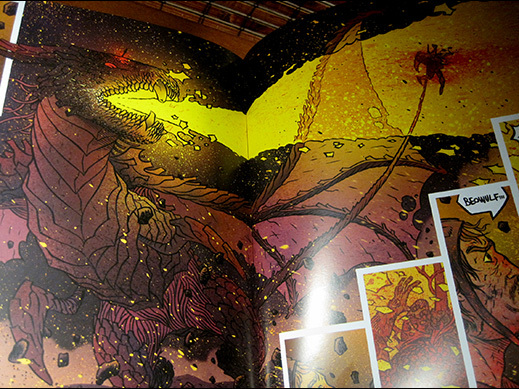
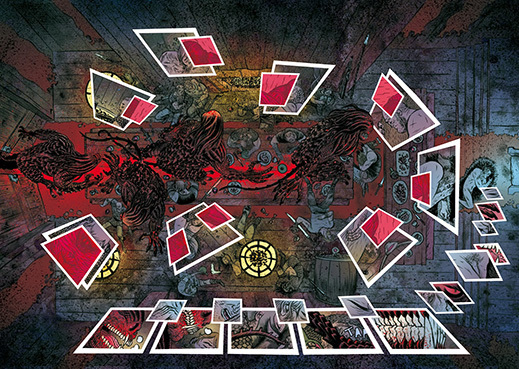
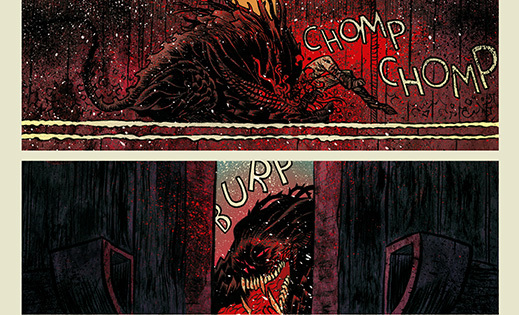
The art is great from Rubin, dramatic and colorful and horrific and powerful. Grendel is larger than life, truly monstrous (especially in and through these oversized pages!), but Beowulf is also larger than life and heroic-seeming. It's got an epic feel, appropriate to the genre.

I love the metafictional ending, too. Surprising. Overall pretty great, something to use in teaching Beowulf for sure.

Here's some images of Rubin's artwork from the book:

https://www.google.com/search?q=david...
Profile Image for Chad.
10.3k reviews1,060 followers
July 25, 2018
Garcia and Rubin concentrate on the battles in this gorgeous over-sized hardcover. They still maintain the classic 3 act structure with Beowulf fighting Grendel, his mother, and then fifty years later a dragon. They keep the story simple often going wordless for long stretches letting Rubin's art tell the story. Rubin's art is highly detailed, reminiscent of Jeff Smith and Paul Pope with some psychedelic 40's cartoons thrown in for good measure. It's a shame we didn't get to read this version of the story in high school. I would have stayed awake.
Profile Image for Urbon Adamsson.
1,935 reviews99 followers
February 12, 2025
PT Em termos de narrativa, acho que está muito bem executada. Não sou especialista na história original, mas parece-me uma adaptação bastante sólida. A sequência visual dos eventos está bem conseguida.

Enquanto adaptação, faz justiça ao material de origem. O meu principal problema é com a arte em si. Gosto dela e reconheço a sua qualidade, mas acredito que poderia ser melhor. Por vezes, os painéis parecem demasiado desorganizados, o que dificulta a compreensão da ação.

Uma história como esta beneficiaria de ilustrações mais limpas, com menos ruído visual.

Dito isto, continua a ser um trabalho sólido e bem conseguido.

--

EN In terms of narrative, I think it’s very well executed. I'm not an expert on the original story, but it feels like a strong adaptation. The visual sequencing of events is spot on.

As an adaptation, it does justice to the source material. My main issue is with the artwork itself. While I like it and recognize its quality, I believe it could be improved. At times, the panels feel too cluttered, making it difficult to follow the action.

A story like this would benefit from cleaner illustrations with less visual noise.

That said, it remains a solid and well-crafted work.
Profile Image for Sud666.
2,330 reviews198 followers
April 27, 2017
Beowulf is a classic Scandinavian tale that likely made it's way to Anglo-Saxon lands during the Viking invasions of England during the late 700's and into the 800's C.E. The original manuscript, a single medieval document, is housed in the British Library in London.

This version is a beautiful hardcover graphic novel retelling of the famous saga of Beowulf and his Geats. On an interesting historical note, the Geats of Beowulf's tribe were likely to have lived in the south of Sweden. At the time when Geats considered themselves apart from the other Swedes, and was later subsumed and subjugated by the Swedes. The reason this is important is because those events are from the 500 CE era. In fact, Gregory of Tours (a French monk) speaks of invading "Danes" in the year 520 who followed a King named Chlochilaicus (Hygelac in the tongue of the Geats) was likely speaking of Geats, since Beowulf's liege is a King Hygelac. Thus this story has some very old roots that pre-date the likely more common Anglo-Saxon version. The inclusion of certain Christian imagery would be hard to explain otherwise. But, let us put history aside and just look at this wonderful tale for what it is.

The Danes under the guidance of King Hrothgar have prospered. To take celebrate the Danes have built a fine mead hall named Heorot. But suddenly, after the feast, a unknown being invades and kills the sleeping Danish Warriors. The next day more Spear Danes head out to avenge their kin. It is not to be and the monster which kills them has a name-Grendel.

A dozen years later a band of Geats, led by their warchief Beowulf, land on the shores of Heorot and claim to have come to defeat the monster. The rest of the story is known by most people and I shall not replay it. If you are one of those few rare individuals who is not familiar with this take, then do yourself a favor and grab this GN.

Santiago Garcia and David Rubin bring this old Norse saga to life in this beautiful GN. Even though the prose can be a little sparse, due to the nature of the graphic novel as a medium, this tale captures the essence of this tale- a story of honor and bravery in order to secure everlasting fame.
Their Beowulf is strong and fierce, but also a man who is so heroic that he can rise above the insults from a young brash Dane and even agrees to fight the monster unarmed. What is interesting in this version of the story is the inclusion of the final part of the Beowulf saga. Most people tend to think Beowulf's tale over with the slaying of Grendel and his mother. But, keeping with the original work, Beowulf returns to his homeland to eventually become King of the Geats.

After nearly fifty years of peace it seems another monster has returned. In a closing of the circle, King Beowulf sets forth to slay a dragon, the last monster of his lands, and to join enteranl heroes such as Siegfried. The way in which his death is achieved and the lessons it imparts to Wigalf, who succeeds him to the Crown, are priceless and the stuff of Norse honor.

All in all, a beautiful retelling of a famous saga. The entire edition is well produced and you can tell the authors wanted to do justice to the original source material. I was unsure as to how I felt about the art. For the most part it works, though it has a strange cartoonish feel to it. It took me awhile to get used to this grim, bloody, typically Norse tale of valor, death, honor and battle illustrated by what looks like someone who drew inspiration from the Samurai Jack Cartoons. But, as the story progressed I found the art to be quite acceptable, though sadly it never rises to the epic nature of the tale. That is a shame, because if the art had been of a higher quality I think this version of Beowulf would have gotten a 5 star review. It is the rather cartoon-like quality of the art that inadvertently injects some childish feel to this tale that seem totally out of place. But, that is not meant to imply that this art is bad. It most certainly is not. In a strange way, you will get used to it. Perhaps it is the monsters that suffer most from the art. Grendel and Mommy looks like an Alien Queen mated with Doomsday and Grendel was the miscegenated offspring. The Dragon at the end? It also suffers. That is why the art didn't deserve a 5 star rating, it seems to add an element of childishness that is out of place.

Still this is a well done, well written and well illustrated book, small complaints aside. A worthy Graphic Novel version of a classic old saga. If you consider yourself a fan of Norse mythology or just fancy a good blood and guts hero-meets-monster tale-then I highly recommend Beowulf.
Profile Image for Mangrii.
1,138 reviews480 followers
September 29, 2021
Beowulf, uno de los poemas épicos en prosa más influyentes que existen y cuyo manuscrito original aún se conserva en la Biblioteca Británica de Londres, es quizá también una de las mayores fuentes de inspiración para viajes del héroe y una plétora de películas y novelas. Por tanto, enfrentarse una vez más a la historia del bravo héroe escandinavo, puede no suponer un gran escenario. Sin embargo, lo que hacen Santiago García y David Rubín, más allá de darle una vuelta a la historia, es ser fidedignos a la misma, pero reforzando la epicidad del mismo.

Con el dibujo de David Rubín, la sangre y la suciedad parecen emanar de la pagina a un ritmo vertiginoso. Con una narrativa solidad, que a veces consolida dos líneas de lectura, Beowulf se presenta como un acercamiento a cualquier lector hacia la mítica figura, tocando el do mayor hasta el fin de la saga (no siempre contada). Aunque a veces las elecciones visuales de Rubín no me terminen de convencer, siendo confuso con pequeñas viñetas detalle que entorpecen, admito ver mis ojos brillas en algunas magistrales escenas capaces de transmitir el mayor de los horrores en la batalla. Delicatesen.
Profile Image for Seth T..
Author 2 books959 followers
April 24, 2017
Beowulf by Santiago García and David Rubín

Every society, every culture, every niche of the human experiment has its monsters. You just have to know where to look. Whether the Jewish Lilith, broxa, or Rahab. Whether the Greek cyclops, Minotaur, or Gorgon. Whether the sailors’ Kraken, the mermaid, or sirens. Whether the Japanese yokai, Chinese qilin, Australian bunyip, or Islam’s Dead Sea apes. Monsters abound, each fulfilling their own role in the structure of the societies they haunt.

The Christian mythos, long dominant in the West, has its fill as well—many proliferating in the medieval era. Dragons are tied to the Serpent that tempted humanity in the Earthly Paradise, and were often only defeated by those in tune with the sacred call of the Divine (e.g. St George). Ghosts linger as remnant scatterments of the damned, exacting often arbitrary retributions as mindless graspings for revenge. Demons make their homes in the hearts of men, women, and children, causing mayhem and disaster, and are former angels, twisted from their original state of noble beauty for (or from) their violent rebellion against God. Even vampires, whose Western tradition arrived rather late, are in the West intimately tied the trappings of Christian faith, being subject to Holy Water, holy ground, crosses, sunlight, and faith. But among the more well-renowned monsters of the Christian folklore is Grendel (even more so than his mother, who is really only known as “Grendel’s Mother”).

Whether “God-cursed Grendel came greedily loping” (Heaney, 711) or “Grendel gliding, God’s wrath on him” (Rebsmen, 711), reference to the Christian foundation to the myth is essential in understanding the role of the creature. Beowulf, though obviously apocryphal to the religion (it’s unlikely that you’ll ever wander into a church preaching through the saga), is founded in Christianity and traffics deeply in the the religion’s vernacular as coin of its realm. Grendel and his kind are the offspring of the first murderer, Cain the killer of his kin-blood who, being ever cursed by the Shaper and Measurer of our world, sired evil and cunning man-killers, banished from heartlove and born in hatred (Rebsamen, 106–112).

From Cain came ogres and trolls and elves, but more—from Cain came Grendel. Monster of monsters. Beowulf begins with a hearty description of the Spear-Danes, whose heroic campaigns raised from a wasteland walls of glory. And yet these mighty men fall fully under the power of Grendel, a creature none can thwart. Has God’s light left his people (for yes, Christianity had infiltrated Northern Europe by this time and the great Danish Christian viking king Canute began his reign in AD 1017)? Beowulf‘s temporary answer at least is Of course not because, “Oh hey look who it is: Beowulf!” And indeed, reference to Almighty God and his graciouness pepper the narrative so that we remember that there by the grace of God goes our hero.

Beowulf by Santiago García and David Rubín

So yes, the Christian foundation to the story is entirely essential. Although, maybe not, since García and Rubín sever any reference to the mythos in their vibrant retelling of the fable.
_______

Now let’s interject here with a short discussion of comparison of interpretations. Because there’s nothing so interesting as comparison. Beowulf, depending on whom you ask, opens as such:

In Hall:
“Lo! the Spear-Danes’ glory through splendid achievements. The folk-kings’ former fame we have heard of, how princes displayed then their prowess-in-battle.”

In Heaney:
“So. The Spear-Danes in days gone by and the kings who ruled them had courage and greatness. We have heard of these princes’ heroic campaigns.”

In Rebsamen:
“Yes! We have heard of years long vanished, how Spear-danes struck, sang victory songs, raised from a wasteland walls of glory!”

In Gummere:
“Lo, praise of the prowess of people-kings, of spear-armed Danes, in days long sped, we have heard, and what honor the athelings won!”

In Raffel:
“Hear me! We’ve heard of Danish heroes, Ancient kings and the glory they cut for themselves, swinging mighty swords!”

In Liuzza:
“Listen! We have heard of the glory in bygone days of the folk-kings of the spear-Danes, how those noble lords did lofty deeds.”

In Alexander:
“Attend! We have heard of the thriving of the throne of Denmark, how the folk-kings flourished in former days, how those royal athelings earned that glory.”
_______

Beowulf by Santiago García and David Rubín

Translation, the adaptation of a text for an audience for whom that text was not originally intended, is a tricky business. There’s never really going to be a right answer. Plenty of wrong answers, but no right answers.

The above is a comparison of several translations of the opening to Beowulf. What it shows more than just which authors are more talented is that there are always going to be a variety of ways to approach a text. And they can each be valid. That doesn’t stop us from having preferences—it just means that we prefer one vision or way of revealing a text to another.

Like with the above, I definitely prefer Rebsamen. Compare with Heaney here:

“Spear-danes struck, sang victory songs, raised from a wasteland walls of glory!”

vs.

“The Spear-Danes in days gone by had courage and greatness. We have heard of these princes’ heroic campaigns.”

Beowulf by Santiago García and David Rubín

The one is showy, the other is telly. In Rebsamen, the Spear-Danes are doing things; in Heaney, we hear rumour that the Spear-Danes once did things. Are both legitimate adaptations of the original text? Almost certainly. But they underscore, I think rather distinctly, how the purpose revealed in an adaptation is going to depend unavoidably on the goals of the translator.
_______

There are (now) two major comics adaptations of Beowulf1 In 1999, Gareth Hinds released in three issues an adaptation that makes heavy use of the actual text of Beowulf.2 Nearly 20 years later, we get a new adaptation—this one from Spain and adapted by Santiago García and David Rubín. And they are substantially different from each other.

Beowulf by Santiago García and David RubínGareth Hinds does a good job showing Beowulf old and broken at the end of things.
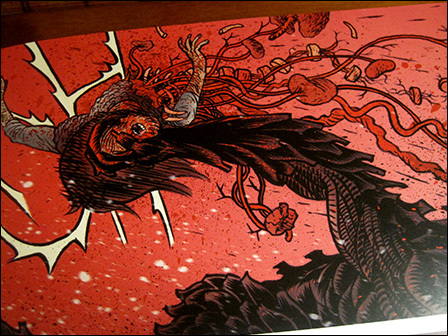
Where Hinds’ illustrations are relatively static and artfully posed, Rubín’s are wildly dramatic and bursting with life. Hinds feels noble and distant and Rubín feels visceral and present. Hinds’ palette is subdued and by the final third nearly entirely desaturated (which does go a long way toward drawing the reader into the stiffness and age-pain in Beowulf’s limbs). Rubín’s pages burst with colour, especially heavy, groteque reds, emphasizing more trenchantly the violence of the time, of the events. In Hinds, bodies are strewn with thick black splatter connoting the gush of lifesblood; in Rubín, viscera is spilt in vibrant crimson and the organs fly in a tangle of stretching innards that would compare well with Michael Avon Oeming’s gratuitously explosive work in Powers.

Beowulf by Santiago García and David RubínPray to St Oeming, that your organs might find their way to heaven.
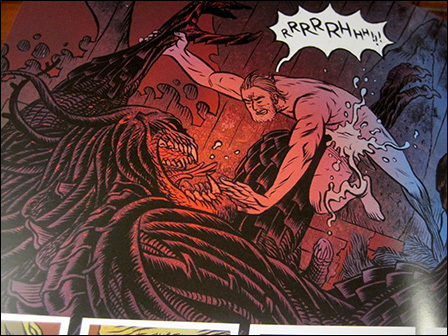
Curiously though, as far as creature-design goes, neither Hinds’ nor Runbin’s Grendel is much removed from the other. Both are dark, hulking abstractions from the human frame, built of seemingly exposed sinews. Each has their sex emphasized: Rubín’s by overtly showing Grendel’s penis as he ejaculates onto Beowulf and initiates the fateful battle, and Hinds’ by hiding Grendel’s member in a mane of snaking thick pubic tendrils. These monsters are each clearly perversions of the masculine male, a twisting corruption of what could have been.

Rubín’s Grendel:
Beowulf by Santiago García and David RubínPremature, Grendel. But don’t be mad. No shame in it, Buddy.
vs Hinds’ Grendel:
Beowulf by Santiago García and David Rubín

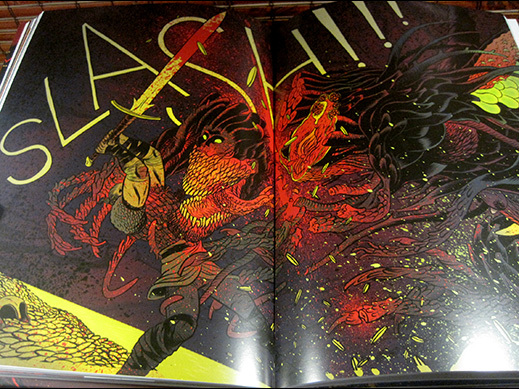
One final note on Rubín’s art: it’s just fantastic. While thoroughly in the realm of what I’ve seen from him before in the Aurora West books and the more recent Heracles revamp (The Hero), Rubín’s laid out a more grounded (mostly) style than what we saw in The Hero (which is simultaneously more fantastic with its sci-fi/fantasy blend and its more cartoonish vision). Beowulf in his hands is still distant and distinct from realism, but it at least puts us in mind that this story is meant to have happened in our world. The size of these pages is great as well, really giving Rubín’s layouts the opportunity to breathe. Even if you don’t care for the story of this particular hero and the three monsters (plus Swedes) he faces, Rubín’s art may be enough to draw your interest.

Beowulf by Santiago García and David Rubín

But the differences are more than just in the art. Hinds pulls directly from the text, using only narrative boxes and eschewing dialogue balloons. These text blocks are heavy and depending on what you’re reading for may either be a joy or a chore. For me personally, they sit at odds with and distract from the story being told in the art. I felt this in 1999 and I feel it today (usually now when reading Hinds’ adaptation, I’ll skip entirely reading any of the text and focus wholly on the images—thankfully I’m familiar enough with the Beowulf text that this is plausible for me). For this new work, however, writer Santiago García (whose dream this edition realizes) uses no direct quotation save for in its curious postlogue. Apart from a single “12 years later”, I don’t believe I remember any other use of narrative balloons. Everything is revealed through direct dialogue. In this sense, Hinds is more similar to the telly Heaney and García to the showy Rebsamen. García’s adaptation mirrors Rubín’s (they make a good team!) in that both work to promote the action of the story at the expense of (or perhaps to counteract) the distance of one thousand years. In Hinds, the reader feels the ancient quality of the story, that we are privy to something old and foreign. In García and Rubín, there is immediacy. This is no longer something distant nor something foreign.

Beowulf by Santiago García and David RubínGareth Hinds and his narrative blocks

And then again, the difference is in more than just the art and the writing style. Just as the variety of prose translators choose to emphasize each in their own manner and direction, García and Rubín create a very different kind of Beowulf story by entirely revoking the Christian mythos as the story’s foundation. While every prose translation underscores both the hand of God as well as Grendel’s biblical origin, and Hinds retains the presence of the Almighty lurking behind the scenes (though only remarking that Grendel derives of a cursed race), García and Rubín have none of it. Their monster is without origin and their story is entirely secularized. It’s probably a good question: are monsters better when they merely are or when there is a reason for their existence? Godzilla exists because of the hubris of humanity, but Kong exists simply because he does. Dracula exists because of manifest perversions. Krueger exists because of manifest perversions. Frankenstein’s monster exists because of humanity’s hubris. The evil dead come to be from humanity’s hubris. Jaws exists simply because it does, maybe as an allegorical nudge for humanity to remember their domain and not infringe on the domain of others. Are the monsters that are monsters for a reason better monsters? I don’t know, but in this case, I think Grendel is more interesting if he has some tie to the origin of the human species than if he is merely some wandering brute. This is, from my view, the only one of two missteps in this new adaptation. (The other is probably Grendel ejaculating on Beowulf. I still can’t decide whether it was spontaneous or if the creature was caught in the midst of masturbating onto the hero. Either way, it probably doesn’t matter, but the moment is so strange and unheralded a departure from the source that it sticks out perhaps overmuch as a distraction—in fact, I’m still trying to figure out its purpose and value to the book… maybe it is enough that it simultaneously underscores Grendel as a part of nature while also highlighting how apart he is from civilized interaction.)

Beowulf by Santiago García and David Rubín

One of the most interesting aspects of García and Rubín’s Beowulf is that in its conclusion, the creators transition the reader from myth to fact, from reading the adventure of this monster slayer to being pulled exteriorily into experience a kind of tl;dr rendition of the book’s production. We move from seeing that famous Hwæt wê Gâr-dena to a panel of the saga’s opening lines (strangely using the Lesslie Hall translation rather than the Heaney one that García references in the aftermatter as the book’s source), then to a script description of the eight panels on this book’s first page, then to page 1 pencils, then to inks and colours, then to layout of the cover, then to Rubín’s email to García that the book is complete, then to it’s print and publication and sale and acquirement by a reader and opening by that reader, and then finally, with the book having been opened (within itself!), the book finally ends with FIN. As if Beowulf’s life and death, his whole adventure, can only truly conclude with the consumption of his life and death by the reader. Beowulf’s goal here is eternal glory and he finally achieves that with each new reader—ironic that in a book that steadfastly elides the hero’s religious origins that he must be consumed body and blood by the reader to achieve his final, lasting victory.
_____

[Review courtesy of Good Ok Bad.]
_____

NOTES:
1) This discounts the more fanciful and less faithful adaptations of the story, like Kid Beowulf, in favour of what we may consider largely “straight” adaptations.

2) Originally using text from Gummere’s translation, but switching to Church’s for trade paperback collection.
Profile Image for Rory Wilding.
800 reviews29 followers
December 1, 2017
Considered as being the oldest surviving long poem in Old English, Beowulf – authored by an anonymous Anglo-Saxon poet – can be seen as the prototype for the hero’s journey as not only has it inspired the likes of Star Wars and The Lord of the Rings, but it is a story that has been through many artistic interpretations over the centuries and given its unspecified origins, there is no definitive take on the epic poem, whether it is Robert Zemeckis’s 2007 3D motion capture film adaptation or this Spanish graphic novel by Santiago García and David Rubín.

For twelve years, the monster Grendel has devoured the men and women of Denmark, but when the legendary Geatish warrior Beowulf travels to the Kingdom with his band of soldiers and offers his assistance to King Hrothgar, thus begins a battle for the warrior that will define his life as a story that will be told through the ages.

As much as we love reading and telling stories about heroes (especially in this day and age where superheroes are very prominent in various media), sometimes heroes can’t fight forever and come out of every battle unscathed as in the case of Beowulf, he is a character that has both physical and emotional scars despite the people around him that worship him as a leader.

What is primarily a visual read, both García and Rubín gives this simple story of a man versus monsters extra layers, in terms of their adaptation being a brutal examination of how a man can be as monstrous as the supernatural forces they are facing. As for the eponymous hero, his initial motivations aren’t ideal as he fights for treasure from a king, who is an old man that is broken by the horror that is terrorising his kingdom, something which will echo Beowulf later as an old man.

Given the many interpretations there have been of Beowulf, every one ought to know the broad strokes of the story, which itself often suffers from its loose three-act structure, from the hero versus Grendel to then his mother to finally a fifty-year jump when he sacrifices himself against a dragon. Even in this book features the story’s silliest sequence featuring Beowulf goes full Austin Powers to fight the gargantuan Grendel without the need for weapons or indeed clothes.

If there was ever a single reason to read this version of Beowulf even for those who are overly familiar with it, it is the work of David Rubín. Published as an oversized hardcover volume, Rubín’s art – using a dark red colour palette – is expressively big with wide panels showing the dominant figures, whether it is man or monster. Speaking of monsters, they are demonic with Grendel and his mother brutally massacring in the grimy surroundings of Denmark.

Concluding with a meta epilogue that plays into how the poem can be transferred into other media over the centuries, Santiago García and David Rubín delivers a brutal and epic visualisation of a hero’s journey that is steeped into the inner monstrous feelings of humanity.
Profile Image for Erica.
1,472 reviews498 followers
November 21, 2017
I first and last read Beowulf in college and while I was both confused and impressed with it at the time, I can't say I remember it well at all. Mostly, I remember Grendl and his lair. I think that's the only part I really enjoyed of the epic poemstory.

This is a graphic novel adaptation of ye Olde English poem and it's a lot easier to read and understand, especially with the pictures for context. It doesn't seem as foreign in narrative structure as it did when I read the textbook version. However, the sense of otherworldliness also did not manifest but maybe you can only get that on a first reading when you know nothing about the story.

The art.
I am of two minds.
Mind one: it deftly conveys the sense of blood and battle and heroic deeds.
Mind two: it does not have a Nordic flavor; these dudes could be Vikings, Celts, any violent, white tribe of people on the European side of the Atlantic ocean. Because, you know, all barbaric tribes from back then look the same.

I felt this adaptation was strongly male-centric. And you're thinking, "Um...it wasn't Olde English chick lit, Erica. It's a manly MAN tale about men and manliness and monsters and all the dudebro things you could ever want" and yes, I know, that's true, mostly. Buuut...I thought I remembered Grendl's mom having a speaking part. I thought I remembered finding out more about her monster son through her, I thought she added a twist to the tale in telling her child's story. And maybe I made that all up; again, I haven't read Beowulf for about 25 years and I was not accustomed to understanding that type of storyline at the time so the whole thing was a bit overwhelming to me and there's a good chance my imagination was fired up and supplied Grendl's backstory as well as his mother's shame in having a horrible kid but also her protectiveness over said brat.
Whatever the case, that didn't show up here. Maybe it's never existed outside my mind but if it is in the original telling, it's not in this one.

I enjoyed reading this but I think I need to revisit the source material because I feel like the depth and the weirdness I'd encountered before weren't here.
Profile Image for Roman Zarichnyi.
682 reviews44 followers
July 28, 2022
Героїчний епос «Беовульф», написаний анонімним англосаксонським поетом, вважається найстарішою й найдовшою поемою з усіх національних епічних поем середньовічної Європи, яка збереглася до наших днів. Пам’ятка дійшла до нас у рукописі давньоанглійською мовою початку X століття, що ледь не згорів під час пожежі у XVIII столітті. Сьогодні цей примірник зберігається у Британському музеї в Лондоні. У VIII столітті, автор розповів версію подій, що могли би відбутися у VI столітті, а його послідовники продовжували переповідати її доти, доки хтось у X столітті це записав усе на папері. Твір «Беовульф» можна розглядати, як прототип подорожі героя, який став найціннішим джерелом для письменника Джон Р. Р. Толкіна під час написання казки «Гобіт, або Туди і звідти» та трилогії «Володар перснів» чи навіть натхненням для Джороджа Лукаса в створенні «Зоряних воєн».

Але ця історія також зазнала багатьох художніх інтерпретацій упродовж століть, і, з огляду на її невизначене походження, немає остаточного погляду на неї, незалежно від того, чи це фантастична драма «Беовульф» (2007) Роберта Земекіса, чи роман «Ґрендель» (1971) Джона Ґарднера, де події епосу переповідаються від імені потвори Ґренделя, чи іспанський графічний роман Сантьяґо Ґарсіа й Девіда Рубіна. Сьогодні піде мова саме про мальовану історію, яку я придбав виключно через художника Девіда Рубіна, стиль малюнку якого вельми подобається.

Християнські міфи, які протягом тривалого часу домінували на Заході мають своє цікаве наповнення, враховуючи те, що багато з них поширилися в епоху середньовіччя. Дракони пов’язані зі Змієм, який спокушав людство в земному раю, і часто були переможені лише тими, хто був у гармонії зі священним покликом Бога. Привиди затримуються, як залишки проклятих, вимагаючи часто свавільної відплати, як бездумне прагнення помститися живим. Демони, що оселяються в серцях чоловіків, жінок і дітей, спричиняючи хаос і катастрофи, які є колишніми ангелами, що втратили свій первісний стан благородної чистоти через їхній бунт проти Бога. Навіть вампіри, чия західна традиція прийшла досить пізно, але тісно пов’язані з атрибутами християнської віри, підпорядковуючись святій воді, святій землі, хрестам, сонячному світлу та вірі. Але серед найбільш відомих монстрів християнського фольклору є Ґрендель. Від Каїна пішли огри, тролі та ельфи, але також від Каїна народився Ґрендель, монстр усіх монстрів, який описується як «створіння темряви, позбавлене щастя і прокляте Богом, руйнівник і пожирач нашого людського роду». Це, звісно, не єдина згадка Біблії в оригінальній поемі, але зв’язок Ґренделя й Каїна, та використання цього монстра у поемі та коміксі є найбільш явним.

Оригінально «Беовульф» починається з опису датчан-списоносців, чиї героїчні походи підняли їхню славу до небес. І все ж ці могутні люди потрапляють під владу Ґренделя, створіння, якому ніхто не має змоги протидіяти в його злодіяннях. Сантьяґо Ґарсія та Девід Рубін враховують цей аспект першоджерела й в першій частині «Монстр» ми бачимо, як тодішній король виголошує величну й мотивуючу промову, яка розтягнулася на кілька сторінок і привертає найбільше уваги під час читання. «Фортуна прихильна до данців! Я, Гротґар, син Галфдана, син Беова, син Скілда, прибув на ці береги в скромному дрейфуючому човні, який тепер очолює найславетнішу еру датчан! Наші перемоги славляться! Наші легенди ширяться! Але немає більшої слави, ніж зал, збудований нашими руками! Історії заспівані в Геороті лунатимуть у всьому світі протягом століть! Тож святкуймо, сини мої — за нашу спільну, за вічну славу! Слава списоносцям-датчанам!» — виголошує тост величний Гротґар, поки на задньому плані ми спостерігаємо жахливі й жорстокі діяння монстра. Король каже, що це був лише демон, якого сколихнули пісні Георота. І наказав синам своїм іти у світ, щоби гнів датчан вилився на землю кров’ю цього монстра, сина Каїна. Далі автори переносять нас за дванадцять років після цих подій, де ми знайомимося із Беовульфом, який прибув до земель, проклятих гнівом Ґренделя, щоби знайти зло та стерти його з лиця Землі.

І Ґарсіа, і Рубін, які є передусім художниками, надають цій простій історії про людину проти монстрів додаткові шари, як із візуальної, так із сюжетної сторін. Їхня адаптація є жорстоким дослідженням того, як людина може бути такою ж жахливою, як надприродні сили, з якими вона стикається. Що стосується однойменного героя, його початкові мотиви не ідеальні, оскільки він бореться за скарби від короля, який є старим чоловіком, розбитим жахом, що тероризує його королівство. А далі вже йде історія честі та хоробрості, щоби забезпечити собі вічну славу. У підсумку, їхній Беовульф сильний і жорстокий, але водночас і людина настільки героїчна, що може піднятися над образами молодого нахабного датчанина й навіть погоджується битися з монстром без зброї. Цікавим у цій версії історії є включення заключної частини саги про Беовульфа. Більшість людей схильні вважати історію Беовульфа закінченою вбивством Ґренделя та його матері, які є епогеєм частин «Монстр» та «Матір» відповіно у цій мальованій історії. Але, дотримуючись оригінального твору, Беовульф повертається на батьківщину, щоби згодом стати королем ґеатів, давньогерманського племені мореплавців, що проживало на півдні Швеції. І тут автори зробили долю старого короля, якому допоміг молодий вбивця монстрів, долею самого Беофульфа. Ми це бачимо в завершальній частині «Інший монстр», де головний герой постарів, а його королівське життя перетворилося на буденні справи, без звитяги та слави. Але знову у світі з’явився монстр, який терорезує простий народ. І забутий король розуміє, що це його доля, момент повернутися в ті славні часи. А вбивство монстра назавжди буде оспіване піснями та розказане в легендах, бо він не побоявся знову стати лицем до лиця до найбільшого земного зла.

Навіть для тих, хто узагалі не знайомий з оригінальним твором, є одна причина прочитати цю адаптацію «Беовульфа» — це робота Девіда Рубіна. Це якраз те, чому я купив цю мальовану історію, хоча також був знайомий з українським перекладом Олени О’Лір, який вийшов у видавництві «Астролябії». І це мало спонукати придбати цей комікс. Але все ж художня складова. Малюнок митця — з використанням темно-червоної кольорової палітри — виразно стелиться великими й широкими панелями, що показують домінуючі фігури, будь то людина чи монстр. Статичні й динамічні малюнки Рубіна є надзвичайно драматичними та постійно вирують життям. Добре, що він також займався й розфарбуванням історії, адже відчув її дуже добре. Як результат, сторінки рясніють кольорами, особливо важкими, ґротескними відтінками червоного, ще різкіше підкреслюючи насильство того часу й подій. Монстри, особливо на розворотах, виглядають епічними та ефектними. Але навіть їм не зрівнятися до сцен із нутрощами жертв, які розлиті яскравим багряним кольором і вражають своєю гидотою й жорстокістю. А збільшений формат видання тільки посилює ефект сприйняття від малюнку Девіда Рубіна. Це було потужно!

Завершуючи отой весь текст нагорі, можу сказати, що Сантьяґо Ґарсія та Девід Рубін створюють ефектну, жорстоку та епічну подорож героя використовуючи силу дев’ятого мистецтва, яка заглиблена у внутрішні жахливі почуття людства. Що ж, цей графічний роман однозначно вартує вашої уваги.
Profile Image for mackenzie.
84 reviews48 followers
May 18, 2024
“To idly live is to wait for death. You must grasp for glory when it comes.”

Saw this at the library and knew I had to get it. The artwork is beautiful and the retelling of the story is amazing. I loved every page 🫶🏻
Profile Image for L. McCoy.
742 reviews8 followers
February 26, 2018
Okay, I’m just gonna warn, in order to express my thoughts, even though there’s no nudity, bloody imagery or uncensored language in this review because of Goodreads rules (I do wish I could show you guys some of the awesome but bloody panels from this book) I have to talk about something kinda unexpected and gross briefly. If you’re particularly sensitive to gross things I suggest you don’t read this book or the cons section of this review.

What’s it about?
This is a comic adaptation of Beowulf, a classic story about a guy who ends up joining a team of people and they start hunting a monster down!

Pros:
The story is pretty interesting, of course I’m a bit of a sucker for bad-a** fantasy stories!
The art is just awesome! Seriously, the artist and colorist did an amazing job!
There’s some sweet action throughout! Lots of bloody fights with the monster.
The horror is so well done! Fantastic illustrations of monsters and gore (though I should warn if you mind gore, stay away for sure, this is like, Crossed levels of gore)!

Cons:
The characters aren’t that interesting. They’re all very bland and generic fantasy characters.
Ready? Here’s the gross part of the review. So, in one scene something bothered me. For the most part it was a good action scene but for some reason Beowulf sleeps naked in this book and he came. I get that fighting a monster would be exciting but nobody needed to see that! I’m anti-censorship and if they want to put that in there, fine but… eww…
I read a version of this story years ago and don’t remember much about it yet this story was still predictable to me as it most likely will be to the majority of fans of dark fantasy.
I don’t entirely get or like the ending.

Overall:
It’s not bad but I probably wouldn’t recommend it. I could definitely see this being good for a high school discussion on Beowulf or something (yeah, I know, there’s a lot of gore and that other gross thing but really, what teen ain’t familiar with gory horror or how certain bodily functions work). I will also say that the art is freaking amazing so if it’s at your library it might be worth checking out just for the art! It’s also a short read, I probably would have finished it in an hour if I wasn’t watching important videos.
description
(Above: I was recently eating Apple Jacks and was trying to remember the commercials. Here I come I am cinnamon!)

3/5
Profile Image for Phoebe Jeziel.
769 reviews37 followers
June 30, 2019
Rating:🌟🌟

The art was well done, but I don’t think it does justice to Beowulf’s epic story. It’s graphic and very cartoonish, and in a way I feel it sort of cheapens the tale.

Also they added an explicit scene that I found extremely unnecessary and distasteful. Also like... why was Beowulf naked half the time??

Look, I recently read Beowulf and enjoyed it. This is not up to par to the original by any means necessary, but I wasn’t expecting it to be. Yet I still came out disappointed. 🤷🏽‍♀️
Profile Image for Cori.
964 reviews184 followers
September 17, 2023
This may be for you if you're looking for:
Gore. A modern feel to an old classic. Gore. An Epic. An easy bridge to old world mythology. Gore.

What is this, exactly? A graphic novel version of Beowulf, exactly. I read Tolkien's translation of this a couple years back and enjoyed it immensely. After reading someone else's rave for this version, I decided to give it a try.

Phenomenal. The artwork is bold. Be prepared for a lot of red. And dead. Some redemption. And a smidge of nudity, as old world myths are apt to do...but it's Beowulf. So anyone familiar with the subject material would likely go in expecting all of that. For anyone NOT familiar with the subject material, and wanting to read the story, but intimidated by the old world English, this may be the perfect first step for you.

I'd rate this an R for gore, violence, adult themes, gore, mild cursing, nudity, and gore.

Original review published 9/16/23.
Profile Image for Dave.
81 reviews29 followers
February 11, 2020
Art work is beautiful.

Unfortunately for this version (fortunately for me), I was also gifted the most gorgeous hardcover of Beowulf one has ever seen. The 32nd of a limited edition of 1200 copies from Easton Press. Signed by the artist, Yoann Lossel, who provided striking illustrations to accompany the most poetic translation (Frederick Rebsamen) I have ever experienced of Beowulf.

A leatherbound hardcover with translucent overlays to protect the amazing art. The book works both from an aesthetic and academic approach.

Books were once solely the possessions of kings. And this is the most kingly gift I have ever received. This along with six volumes of Vincent van Gogh - The Letters (a gift from the same person) are the most prized books I own.

I understand very well the difference between a graphic novel and its source presented in the format of an epic poem. I can appreciate both. Once one has read the Rebsamen translation, recommending any other version becomes difficult.

A tale worth reading (a foundation of modern high fantasy and significant historical value on its own not to mention a great story) and if epic poetry close to its original English fails to interest, then I can not recommend the graphic novel from Image enough.
Profile Image for Molly.
1,202 reviews53 followers
June 9, 2017
Another one I will have to eventually buy, if only for the absolutely phenomenal artwork. It's been some years since I read Beowulf, but this illustrated version made me desperately want to revisit the text. I've said it before, but if more middle-ages literature was initially presented to me in graphic novel format, my interest in it wouldn't have taken nearly so long to develop. Oh, and college would have been SO. MUCH. EASIER.
Profile Image for Kim.
1,124 reviews100 followers
January 3, 2019
Well, this really is an adult Graphic novel! Extremely adult graphics! Quite graphic raping and pillaging! European GN authors certainly don't completely hold back, but they don't over do it either. A bit here and there is great for shock value and no doubt some wide eyed adolescent giggling is to be enjoyed here. For an epic Scandinavian saga there are very few words but much thought and skill has gone into the images. Quite brilliant, I'll be looking out for more of the authors work.
Profile Image for Marc Pastor.
Author 18 books455 followers
June 13, 2015
Per narrativa, per dibuix, per color, per épica. Una salvatjada magistral.
Profile Image for Cindy Alanis.
316 reviews37 followers
May 31, 2024
Essa é uma adaptação belíssima do clássico poema épico que fundou a literatura inglesa. Gostei bastante, mas queria mais.
Profile Image for Roman Stadtler.
109 reviews25 followers
May 24, 2017
Wow. This is now my second favorite Beowulf adaptation, right after Ruth Lehmann's translation (the best, in my opinion, beating Heaney's because it keeps the particular end of line alliterative metre/sound of how we think the story was told)! This truly feels like a heroic epic, full of action, horror, sadness, victory, and some glory. *SPOILER, kinda* Grendel is truly scary and horrible looking (and visibly aroused during the first battle with Beowulf. That sounds silly, I know, but it's disturbing, adds to the monstrousness of his presence, as you wonder "Is it going to . . . ?" It's a interesting new wrinkle to the character and situation), all teeth, corded muscle and scaly armored buggy hide.

The art is wonderful, with little inset boxes that draw the eye to details within the overall picture, or sometimes tell a concurrent flow of movement within the overall scene, such as showing the dragon's devastation in the larger frames while Beowulf walks through that devastation in the smaller frames, but both small and large images are linked, visually, the small frames not breaking the art. It's all so well done! My only complaint was there's sometimes beautiful two-page spreads with a person obscured in the center because they disappear in the spine of the book. I don't know how this could've been avoided without the art suffering, but it's too bad. One woman's head is unseen, for instance, as people run from the dragon's fire, she's been run through, dropped her baby, it's intense and awful, but her death is in front of us, centered, but we can't see her face. It has a distancing effect, especially since we see everyone's else's reactions to both her and the general chaos around them.

The final few pages, as they revealed themselves, got me to do an immediate reread (of those pages), as they're perfect, speaking to the timelessness of the story. Thrilling and brilliant.
Profile Image for Relstuart.
1,247 reviews112 followers
February 6, 2017
The version of this published by Image is huge. The art is well represented. IT is a bit stylized. I liked the color palette with it's dark colors with glowering crimson ad the layouts were pretty well done. It is essentially the classic story. I enjoyed it and it was certainly worth the $16.

Profile Image for Petergiaquinta.
661 reviews128 followers
July 24, 2018
The last hundred years have seen Beowulf retold, retranslated, re-imagined, and re-illustrated over and over and over again. The thousand years before that? Not so much, once it was given a thorough going over by those monks and scribes who thought the best way to teach the Gospel to the pagan Anglo-Saxons would be to reinterpret their stories through a Christian lens.

But before that occurred, Beowulf had been premium entertainment for centuries before the monks arrived and wrote it all down, stripping the heroic tale of much of its pagan content and adding a bunch of big "G" Godstuff to help spread the good news. They were the first to re-imagine the story, and what it was like before they overlaid their Christian veneer to the original, we can only guess. For several centuries the Beowulf manuscript was owned by a series of rich douchebags, one of whom wrote his name at the top of the manuscript and another who let his mansion burn down destroying a number of priceless texts and damaging the only extant copy of Beowulf. "Ashburnham," he called his house in the countryside, and wasn't he right about that? Today the singed manuscript, called the Nowell Codex, can be found in the British Library where hopefully it is safe from most stupid rich people.

Here, just in case you want to view the original manuscripts:
http://www.bl.uk/manuscripts/FullDisp...

When I was a lowly English undergrad, my first professor in the six-part survey of the canon of English literature skipped right over Beowulf and everything else by those anonymous Anglo-Saxons. He told us he wasn't interested in that German stuff, and so he went straight to the Middle Ages and started with the Middle English of Chaucer. Thus, everything I've picked up about Beowulf I've learned pretty much on my own, with a lot of help from JRR Tolkien among others (his 1936 essay "Beowulf: The Monsters and the Critics" is brilliant), which included writing in response to a comps question comparing Beowulf and John Webster's White Devil, which you have to admit is a rather odd pairing.

Despite my prof's reluctance to teach us the Anglo-Saxons, I'm rather fond of these early maniacs who loved language as much or more than they enjoyed crushing their enemies, looting, pillaging, and driving their women before them. (Or was that Conan the Barbarian?) The Anglo-Saxon creative mind is ruminative and reflective, and there's a beauty to those sparse lyrics the equal of any other period. Plus, those Anglo-Saxons could be wicked funny when they wanted.

It's just too bad the priests monkeyed so much with the original literature, but that early Christian interloping was just child's play compared to how the story would get twisted and turned over time, and that brings us to Santiago Garcia's recent graphic novel rendition of Beowulf, which you shouldn't waste your time on, unless you're just a glutton for punishment or you don't know any better. From the cover itself through the final panel, Garcia takes far too many liberties with the text and the art, and none of it is any good. There's a clue there on the cover about Garcia's intentions. See the way Beowulf's head is superimposed over Grendel's? Clever, eh? Let's conflate the hero with the monster and get all postmoderny and all. Sure, Batman is the Dark Knight; the hero is the villain these days, and Beowulf is the same damn thing as Grendel, right Santiago? Yawn.

And yet it might have been a stroke of postmodern genius, had John Gardner not written Grendel over 40 years ago with its sympathetic Grendel narrator and its obtuse Beowulf. And it could have been considered clever had not over a thousand years ago the original author of the manuscript itself hadn't already conceived of the true monsters of the story as those humans inside the mead hall, not the creatures lurking about in the foul marshes or guarding an ancient treasure in their lairs. But that's where Garcia gets it wrong here...Beowulf himself is in stark contrast to these human monsters, and to lump him among them is not only to misrepresent the text but to misunderstand the creative genius of the original story tellers, as well as the values of their society. Here in Garcia's reimagining of the text, Unferth is a boy and Hrothulf is absent altogether. In their place, Beowulf himself represents the violence and ignorance of this brutal culture based on vengeance and blood money. And this is a mistake, as is the accompanying art which also fails at its attempt to blend genres combining early Japanese block print aesthetics with contemporary comic book chaos.

Garcia is hardly the first to make a mess of Beowulf. Christopher Lambert as a very blonde Beowulf in outer space in the absolutely idiotic 1999 sci-fi movie might be the worst version of Beowulf I've come across, but this awful movie has plenty of competition for the very bottom of the barrel. Even Neil Gaiman (of whom I'm usually a big fan) wrote a ridiculous joke of a script for the nearly unwatchable Robert Zemeckis motion capture movie version in 2007. (Grendel as Hrothgar's son is stoopid enough, but Gaiman makes Grendel's mother the sexy Angelina Jolie, and then goes even one further in the stoopid department by making the dragon Beowulf's son...sigh.)

And just in case you think me some stick in the mud Beowulf purist, I'm a great fan of Gardner's Grendel, as well as Richard Wilbur's 1950 poem "Beowulf." And I even enjoy Michael Crichton's 1976 novel Eaters of the Dead, as well as the goofy-ass movie it spawned in 1999, Thirteenth Warrior, where the traveling Arab scholar Ahmad Ibn Fadlan (played by Antonio Banderas) joins up with a boatload of Vikings to protect Hrothgar and Heorot from the onslaught of a pack of marauding Neanderthal Grendels. And as silly as that sounds, it all works out rather nicely, as far as I'm concerned. Not so much with Garcia's recent reimagining of Beowulf.


Here are a few more of my favorite things Beowulf:

*The 1939 Heritage Press edition of Beowulf with its beautiful artwork by Lynd Ward
http://50watts.com/Lynd-Ward-illustra...
*Burton Raffel's 1963 translation of Beowulf
*Seamus Heaney's 2001 translation of Beowulf
*Benjamin Bagby's public performances of the text in its original Old English
https://www.youtube.com/watch?v=np1Mr...
http://www.bagbybeowulf.com
Profile Image for Truebluedah ♪.
163 reviews21 followers
September 18, 2019
This book was super helpful.
For those who are hating reading Beowulf (for school, I assume..) this will help. I’d still suggest reading the actual poem but this will help make things make more sense!

The art is very good and detailed, but that can backfire at times. (There is lots of violence and some nudity 🤭🙈)

Otherwise, this book is great and definite worth purchasing!
🥑🥑🥑🥑🥑

Emojis to describe this book:
🙈😳🤭🗡‼️🐲🐉🙅🏻‍♂️🤦🏻‍♂️
Profile Image for Destiny Pitters.
17 reviews1 follower
October 27, 2023
As someone who didn’t care for it in grade school, I’m shockingly moved by the work García and Rubín did on this gorgeously illustrated adaption of the full Beowulf story. The atmosphere! The colour contrast! The not-so-subtle juxtaposition of violence in humans and monsters! And those final pages? I knew how it would end, and yet I was still sad LOL. This should be a must-have companion to the poem for any high school/university class.
Profile Image for Berna Labourdette.
Author 18 books585 followers
August 2, 2019
Hay muchas adaptaciones al cómic de esta saga, pero ésta es mi favorita. No sólo por los maravillosos diseños de Rubín (dinámicos y con espectaculares splash page) si no también por cómo arma la historia García, una historia ya conocida, pero que se enfoca en esta oportunidad en la visión de reyes y padres (cómo gobernar, cuál es el legado que dejas, quienes son los padres de los monstruos). Muy buena.  
Profile Image for Sarah.
348 reviews57 followers
May 8, 2019
Beautiful graphic novel. Bloody and violent just like the original tale.
Profile Image for Rod Brown.
7,347 reviews281 followers
August 20, 2017
When Grendel's penis started getting close-ups and ejaculated on Beowulf's stomach, I was ready for a dramatically different reinterpretation of this age-old classic. But then I realized the artist was just going for shock and awe to offset the rather pedestrian script. There's action and gore aplenty for fans of Conan-style sword and sorcery epics, but little else worth mentioning.
Profile Image for Lynn.
202 reviews29 followers
November 27, 2016
I wasn't the biggest fan of the drawing style and the stories were a bit short and only with few dialogues, but this was surely a entertaining graphic novel to read.
Profile Image for Derek Royal.
Author 16 books74 followers
February 12, 2017
An intriguing and intelligent comics adaptation of the Old English classic. I particularly enjoy Rubin's art and the metafictional turn at the very end.
Displaying 1 - 30 of 272 reviews

Can't find what you're looking for?

Get help and learn more about the design.