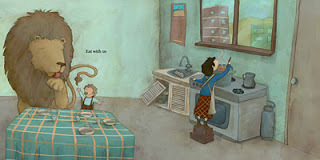
A simple, imaginative story depicting the complex emotional reality of a girl whose father no longer lives at home. The girl conjures up an imaginary companion ― a lion ― who will join her on the long walk home from school. He will help her to pick up her baby brother from daycare and shop at the store (which has cut off the family’s credit), and he’ll keep her company all along the way until she is safely home. He will always come back when she needs him, unlike her father whom she sees only in a photograph ― a photograph in which he clearly resembles a lion. Correlates to the Common Core State Standards in English Language CCSS.ELA-LITERACY.RL.1.7 Use illustrations and details in a story to describe its characters, setting, or events.
Jairo Buitrago lives in Mexico City and is the author of Jimmy the Greatest, Two White Rabbits, Walk with Me, Cave Paintings, among others—all of which have earned many starred reviews. His most recent books are Wounded Falcons and Drawing Outdoors.
That was deeper than I was expecting. I didn't read the synopsis, which pretty much gives everything away. I'm glad I went into it without knowing too much; the emotional impact was greater.
The pictures depicting the results of the girl's imagination, are quite sweet. They also convey a sense of place (the story looks like it takes place somewhere in South America; I doubt you'd see a small child picking up her baby brother from daycare in most parts of North America). It's a nice little peek into the lives of other people, lives that might be very different from our own. But the emotions conveyed--especially in the last part of the book--are universal. Though it's not explicitly explained, we can draw our own conclusions, any of which are fairly emotional.
The depth of this little picture book surprised me. In a good way!
No le coloco 5 estrella sólo porque te deja un poco con el corazón apretado. Un libro álbum cargado del simbolismo de la imaginación de una niña que regresa a casa del colegio a casa acompañada de un león maravilloso... Pero ese león esconde una triste verdad ... Entre la nostalgia de quiénes ya no están y el recuerdo indeleble que dejan en nosotros y nosotras, todo desde la mirada casi inocente de una niña que extraña en demasía. Hermoso también, de principio a fin.
I love the subtle, unforced approach these two talented artists imbue their stories with. Superbly sensitive and simple. A young girl bolsters her spirit with an imaginary companion in order to cope with the many daily challenges and expectations of her that make up her daily life: long walks to school by herself, collecting her baby brother whilst her mother works, navigating the wilds and dangers of a large unpredictable city, negotiating for food when the credit is all gone and then preparing the daily meals and all without the guidance or security of having two parents about. Buitrago and Yockteng have taken a massive slice of life and condensed it into a story of profound meaning that even the youngest of readers will connect with. Superb.
I audibly gasped at the end of this book. I might let out a little laugh or a little 'aw' at some picture books, but I'm rarely caught so off guard by where we're heading that I actually gasp. This is so well done. It's a bit heart-breakingly beautiful, but amazing. Buitrago's work is always good and honest and deals with topics that I wish more children's books would try to tackle. Love. Love. Love. Recommended!
Walk with Me is one of those unique picture books that can evoke different responses from the various people who read it. Younger kids will be struck by its themes of imagination and courage, which were super sweet and beautifully done. As you spend the afternoon with the heroine of the story, you'll be swept up into her story, so don't be surprised if you cry a little tear at the end. We did.
Camino a casa es un álbum ilustrado que a través de sus dibujos y la imaginación de una niña, nos muestra con especial sutileza un problema que es muy recurrente actualmente: la ausencia de una figura paterna. Una de las cosas que más me ha gustado de este libro, son la relevancia que toman las imágenes en la narración de toda la historia. Si ponen atención a todos los detalles de las ilustraciones podrán descubrir muchas cosas interesantes y que revelarán el transfondo de la historia.
Me ha parecido nostálgico y enternecedor. Créanme cuando les digo que les llegará al corazón.
A simple, emotionally resonant story about a young girl who invents a lion as a an imaginary friend who will fill the roles of her father who no longer lives at home. Translated from Spanish, originally published in Mexico.
Sweet and touching story of a girl living in poverty, keeping her father in her heart. Leaving the city, a little girl asks a lion to walk her home from school (escuela). The lion keeps her company while scaring everyone else. He protects her on the city streets, waits while she picks up her baby brother from daycare, and roars when the storekeeper won't give the girl credit anymore. He sits at the table entertaining her brother while she cooks dinner and waits at the curb while her mother comes home from the factory. The girl releases him from his duties as long as he comes back when she calls, then she goes to bed with her mother and brother in a room with cracked walls and only one mattress on the floor. But before she goes to sleep she reaches out and touches a framed photo of her family, one with her mother, baby brother, herself, and her father (whose hair looks a lot like a lion's mane).
A beautiful translated picture book about a young girl giving herself a source of confidence as she takes on the role of an adult too early. I'm not sure which part made me sniffle more, when the store wouldn't give them credit or when she had to pick up her baby brother from daycare. Best for one-on-one sharing.
Se me aguó el ojo hojeándolo. Mi papá era el deseo en cada estrella fugaz, el protagonista de ghost, el papá que reencarnaba en perro en Fluke... esa mamá era mi mamá, ese hermano era el mio, esa escena de los tres en la misma cama la viví...too close to home
A veces sólo faltan imágenes y una pequeña prosa para despertar la propia narrativa interior. Un nuevo favorito!
This story of a little girl and her strong imaginary friend appear to be just that on the surface. Diving deeper, this translated story reveals how the little girl conjures an imaginary friend, a lion, to cope with the absence of her father. It was both a touching and heart-breaking read to see her struggle and courageously walk with her lion.
Aww! What a beautiful book about courage! This is one of those great books where the illustrations and text mesh together seamlessly in one glorious picture book experience.
A solid 4.5 for me - because I thought this was about an imaginary friend lion and then those last few pages made me suddenly gasp and burst into tears.
After school, a girl asks a lion to walk home with her; if she has company, she won't fall asleep on her way. We see her walk further and further from school, pick up her baby brother at the babysitter's, buy groceries, and cook dinner.
OK, this one took me a while to understand. After she mentions falling asleep, I thought that this was some kind of world where people mysteriously fall asleep in the afternoons, and that all the people in the pictures were yawning. But, this is a lovely story about the harsh reality that many children live in, where they're forced to grow up quickly because their family would fall apart if they didn't.
Wow. I can't rate, because I cannot imagine what young me would have thought of this, nor can I imagine how to share it with children. But I hope it does get shared, for both mirrors and windows.
This book is a story that a girl goes home and spends her daily life with a huge lion. It symbolizes a lion as her father and illustrates her desires to spend time with her father. It is awarded by the American Library Association. I highly recommend this book for students and a teacher in the early childhood program because it can be used when teaching family values to children, especially for days associated with family or parents.
The girl asks a lion to accompany her when she goes to school, picks up her brother in the nursery, and waits for her mom to come back home from the work. The imaginary friend, the lion, keeps walking next to her. The lion would return to the hill which is the girl and the lion's meeting place, but the lion would be there for the girl when she needs him. This picture book communicates with readers through few and simple texts with rich illustrations. First of all, the lion is portrayed as a huge animal than a normal and real-life sized one. Other people at a school and on the streets are afraid of the animal, but the lion is kind to the girl who asks the lion to accompany with her. For instance, the lion lets her ride on his back and plays with her brother while she's making food. The lion represents a friend she could rely on because the last page of the illustrations show a picture of her family with a father who is not at home anymore. Next to the picture frame, the Spanish word, desaparecido, of the article on the newspaper alludes the disappearance of her father. Another clue of the girls’ longing for her father as well as representing a symbol of the lion is the yellow flower. When the girl asks the lion to walk with her on the first page of the book, she hands over a yellow flower to the lion. The same flower is placed on the table next to the family picture. Illustrations of this picture book also convey the environments of her family. Even though the text clearly indicates that her mother “gets home from the factory”, the overall illustrations implicate her neighborhood by illustrating a cracked school and nursery building, wires on the utility poles, and patched blankets. The timing of the father’s disappearance also coincides with the season the story is told. Several images of calendars show that the season is summer, and the picture frame also addresses the family picture was taken during the summer. Like this, illustrations in this book imply a lot of backgrounds to readers to guess and imagine untold stories. Authors might not put some hints and metaphors in their books because readers’ responses must be diverse. However, it is interesting to think about authors’ intentions in texts and illustrations by using cues.
A beautiful little book that's perfect for story time or one-on-one reading time. It's one of many lovely books that's socially conscious and offers a tale of a difficult childhood full of too many responsibilities.
I didn't find it as poetic poetic and moving as other books in this genre but I loved its simplicity. It can be difficult to find books with such a generous picture to words ratio. It's typically about one sentence per page which is great for groups or younger children (and older children can follow the images for a more detailed story).
My only qualm is that something about the layout fell a bit flat for me. With so little text I'd like to see it interact more with the images. The overall placement of the text moves and it's sometimes black and sometimes white against darker images but I wanted more from the images and layout. Some pages, particularly those at the beginning and end of the book, felt a bit boring and dated with just a line of text and a simple image on glossy paper. Overall, quite a lovely book.