

What do you think?
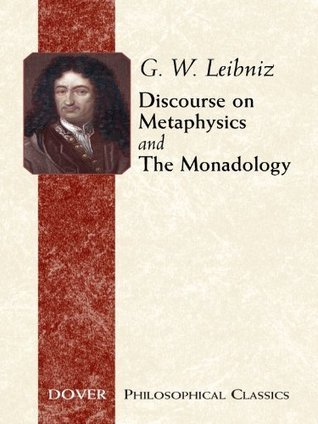
Discourse on Metaphysics and The Monadology
Two of Leibniz's most studied works. Published in 1686, the Discourse on Metaphysics consists of the philosopher's explanation of individual perception as an expression of the rest of the universe from a unique perspective. The Monadology, written in 1714, offers a concise synopsis of Leibniz's philosophy, establishing the laws of final causes.
102 pages, Kindle Edition
First published October 31, 1992
About the author
Gottfried Wilhelm Leibniz
1,391 books590 followersGerman philosopher and mathematician Baron Gottfried Wilhelm von Leibniz or Leibnitz invented differential and integral calculus independently of Isaac Newton and proposed an optimist metaphysical theory that included the notion that we live in "the best of all possible worlds."
Gottfried Wilhelm von Leibniz, a polymath, occupies a prominent place in the history. Most scholars think that Leibniz developed and published ever widely used notation. Only in the 20th century, his law of continuity and transcendental homogeneity found implementation in means of nonstandard analysis. He of the most prolific in the field of mechanical calculators. He worked on adding automatic multiplication and division to calculator of Blaise Pascal, meanwhile first described a pinwheel in 1685, and used it in the first mass-produced mechanical arithmometer. He also refined the binary number system, the foundation of virtually all digital computers.
Leibniz most concluded that God ably created our universe in a restricted sense, Voltaire often lampooned the idea. Leibniz alongside the great René Descartes and Baruch Spinoza advocated 17th-century rationalism. Applying reason of first principles or prior definitions, rather than empirical evidence, produced conclusions in the scholastic tradition, and the work of Leibniz anticipated modern analytic logic.
Leibniz made major contributions to technology, and anticipated that which surfaced much later in probability, biology, medicine, geology, psychology, linguistics, and computer science. He wrote works on politics, law, ethics, theology, history, and philology. Various learned journals, tens of thousands of letters, and unpublished manuscripts scattered contributions of Leibniz to this vast array of subjects. He wrote in several languages but primarily Latin and French. No one completely gathered the writings of Leibniz.
Gottfried Wilhelm von Leibniz, a polymath, occupies a prominent place in the history. Most scholars think that Leibniz developed and published ever widely used notation. Only in the 20th century, his law of continuity and transcendental homogeneity found implementation in means of nonstandard analysis. He of the most prolific in the field of mechanical calculators. He worked on adding automatic multiplication and division to calculator of Blaise Pascal, meanwhile first described a pinwheel in 1685, and used it in the first mass-produced mechanical arithmometer. He also refined the binary number system, the foundation of virtually all digital computers.
Leibniz most concluded that God ably created our universe in a restricted sense, Voltaire often lampooned the idea. Leibniz alongside the great René Descartes and Baruch Spinoza advocated 17th-century rationalism. Applying reason of first principles or prior definitions, rather than empirical evidence, produced conclusions in the scholastic tradition, and the work of Leibniz anticipated modern analytic logic.
Leibniz made major contributions to technology, and anticipated that which surfaced much later in probability, biology, medicine, geology, psychology, linguistics, and computer science. He wrote works on politics, law, ethics, theology, history, and philology. Various learned journals, tens of thousands of letters, and unpublished manuscripts scattered contributions of Leibniz to this vast array of subjects. He wrote in several languages but primarily Latin and French. No one completely gathered the writings of Leibniz.
Ratings & Reviews
Friends & Following
Create a free account to discover what your friends think of this book!
Community Reviews
Displaying 1 - 30 of 33 reviews

August 28, 2020
Until recently whenever I thought of Leibniz, I thought of him as "that guy who Voltaire demolished in Candide," or "that guy who was embroiled in a priority dispute with Isaac Newton over the invention of calculus." In other words, I wasn't giving this genius his due. He was one of the most brilliant men of his era, or any era, and he had a mind that ranged far and wide. So what if his "best of all possible worlds" philosophy looks silly nowadays (and even thenadays), and who cares if Newton beat him to calculus by a few years (we actually use the notation system created by Leibniz)? This is a man who deserves respect.
This volume covers some of Leibniz's metaphysical ideas including, man's nature and place in the universe, the characteristics of god, the mystery of consciousness and much more. It may not all be believable, but I found much of it interesting and thought provoking. If you're new to Leibniz I wouldn't jump right into this kind of source material though. I recommend starting by reading The Courtier and the Heretic or The Dream of Enlightenment first. Neither one of these books focuses solely on Leibniz, but their explanations of his ideas were clear and easy to read.
This volume covers some of Leibniz's metaphysical ideas including, man's nature and place in the universe, the characteristics of god, the mystery of consciousness and much more. It may not all be believable, but I found much of it interesting and thought provoking. If you're new to Leibniz I wouldn't jump right into this kind of source material though. I recommend starting by reading The Courtier and the Heretic or The Dream of Enlightenment first. Neither one of these books focuses solely on Leibniz, but their explanations of his ideas were clear and easy to read.

August 22, 2020
Collection of two of Leibniz' most important writings. That is, with hindsight, since both texts weren't published during his lifetime. In these works he lays out his metaphysical system as opposed to Descartes' mechanistic philosophy and Spinoza's monism. In offering an alternative metaphysics Leibniz draws heavily upon Scholastic philosophy, especially the notion of substantial form.
His project is basically to preserve the mechanistic philosophy of nature (as formulated by Descartes and Galileo, and developed further by Newton and Leibniz himself) but in such a way that Christian theology would serve as the foundation of this world. In short: Leibniz wouldn't adopt Newton's God as a master watchmaker, creating the device and once in a while readjusting some spring. In taking this step, he adheres to the famous dictum 'hypothesi non fingo'.
It would be too tedious to set out all his arguments and concepts, but in summary Leibniz offers us this. There is only one substance - God - and the universe consists of an infinity of entities that are manifestations of this substance. These entities are immaterial and contain all other entities as well as the entire system of relations between all entities within them. It is this metaphysical system out of which the material world emerges, so to speak. Scientists study this material world through the mechanistic lens, philosophers should study the underlying immaterial world. Supposedly this way of conceiving of the world solves the body-mind problem that emerged out of Descartes' dualism.
The metaphysical system of Leibniz is entirely conceived of in logical terms. That is, he analyzes this world through the use of logical principles, axioms, definitions, and deductions. Through this rationalistic enterprise (here we see the influence of Scholasticism) Leibniz is able to discover God both as Creator and the foundation of the world. This dualistic conception is important, since it circumvents all sorts of problems, like the problem of the existence of the world - a problem which Descartes never solved (according to Him God's goodness is our guarantee).
It is unclear to me in what way Leibniz differs from Spinoza, since both assume God to be the sole substance (and to be, in this sense, the universe). According to Spinoza this substance manifests itself as an infinity of modes (of which mind and are matter are the ones we are familiar with), while Leibniz claims this substance manifests itself as an infinity of immaterial entities (souls in the Aristotelean sense - that is, the essence which makes a thing that thing) out of which the material world emerges somehow. Both are heavily deterministic, but whereas Spinoza adopts a Stoic ethic as a result of this, Leibniz draws a line between necessary facts and contingent facts - allowing him to adapt a rather fuzzy theory about human freedom. We are fully determined by God through his laws (and thus, ultimately, through His will) yet our essence is contingency, letting us freely act in the way we want - thus allowing for personal responsibility.
I am neither a professional philosopher nor a logician, but it really seems to be a fishy move. Especially the way Leibniz 'solves' the mind-body problem. Also, his Neo-Platonic outlook on all the beings in the universe - i.e. everything resembles God's perfection in a particular degree, the highest beings (human beings) resemble God's perfection to the highest degrees - seems rather convenient to neatly fit the Christian ethics into his metaphysical system. To me it seems as if Leibniz wanted to prove his theological convictions to be right and in order to succeed in this he had to bend the existing systems, with the help of logic, in such a way that all fits perfectly. Wishful thinking of course, which is proved by later centuries, when his technical inventions were adopted and his metaphysical and ethical theories were largely forgotten.
I will re-read this work in the future, when I have some more insights into this type of philosophy, possibly learning some new things.
His project is basically to preserve the mechanistic philosophy of nature (as formulated by Descartes and Galileo, and developed further by Newton and Leibniz himself) but in such a way that Christian theology would serve as the foundation of this world. In short: Leibniz wouldn't adopt Newton's God as a master watchmaker, creating the device and once in a while readjusting some spring. In taking this step, he adheres to the famous dictum 'hypothesi non fingo'.
It would be too tedious to set out all his arguments and concepts, but in summary Leibniz offers us this. There is only one substance - God - and the universe consists of an infinity of entities that are manifestations of this substance. These entities are immaterial and contain all other entities as well as the entire system of relations between all entities within them. It is this metaphysical system out of which the material world emerges, so to speak. Scientists study this material world through the mechanistic lens, philosophers should study the underlying immaterial world. Supposedly this way of conceiving of the world solves the body-mind problem that emerged out of Descartes' dualism.
The metaphysical system of Leibniz is entirely conceived of in logical terms. That is, he analyzes this world through the use of logical principles, axioms, definitions, and deductions. Through this rationalistic enterprise (here we see the influence of Scholasticism) Leibniz is able to discover God both as Creator and the foundation of the world. This dualistic conception is important, since it circumvents all sorts of problems, like the problem of the existence of the world - a problem which Descartes never solved (according to Him God's goodness is our guarantee).
It is unclear to me in what way Leibniz differs from Spinoza, since both assume God to be the sole substance (and to be, in this sense, the universe). According to Spinoza this substance manifests itself as an infinity of modes (of which mind and are matter are the ones we are familiar with), while Leibniz claims this substance manifests itself as an infinity of immaterial entities (souls in the Aristotelean sense - that is, the essence which makes a thing that thing) out of which the material world emerges somehow. Both are heavily deterministic, but whereas Spinoza adopts a Stoic ethic as a result of this, Leibniz draws a line between necessary facts and contingent facts - allowing him to adapt a rather fuzzy theory about human freedom. We are fully determined by God through his laws (and thus, ultimately, through His will) yet our essence is contingency, letting us freely act in the way we want - thus allowing for personal responsibility.
I am neither a professional philosopher nor a logician, but it really seems to be a fishy move. Especially the way Leibniz 'solves' the mind-body problem. Also, his Neo-Platonic outlook on all the beings in the universe - i.e. everything resembles God's perfection in a particular degree, the highest beings (human beings) resemble God's perfection to the highest degrees - seems rather convenient to neatly fit the Christian ethics into his metaphysical system. To me it seems as if Leibniz wanted to prove his theological convictions to be right and in order to succeed in this he had to bend the existing systems, with the help of logic, in such a way that all fits perfectly. Wishful thinking of course, which is proved by later centuries, when his technical inventions were adopted and his metaphysical and ethical theories were largely forgotten.
I will re-read this work in the future, when I have some more insights into this type of philosophy, possibly learning some new things.

January 28, 2024
"Cuando puedo reconocer una cosa entre otras, sin poder decir en que consisten sus diferencias o propiedades, el conocimiento es confuso" (p. 113).
"Monadología y Discurso de metafísica" de Leibniz es una obra magistral que cautiva desde el principio hasta el final. La profundidad de los conceptos y la claridad en la exposición del pensamiento leibniziano hacen de este libro una joya indispensable para cualquier amante de la filosofía.
La "Monadología" nos sumerge en el fascinante mundo de las mónadas, las unidades fundamentales de la realidad según Leibniz. A través de una prosa elegante y rigurosa, el autor explora la naturaleza indivisible y activa de estas entidades, ofreciendo una visión única de la realidad que desafía las concepciones tradicionales, combinando las perspectivas del materialismo y el racionalismo.
"Las almas actuan segun las leyes de las causas finales, por apeticiones, fines, y medios. Los cuerpos actuan segun las leyes de las causas eficientes o de los movimientos" (p. 55).
Ademas, el "Discurso de metafísica" complementa de manera brillante la Monadología, expandiendo y contextualizando las ideas filosóficas de Leibniz. La coherencia entre ambos textos revela la maestría del autor al construir un sistema filosófico integral y fascinante.
Debo decir que la estructura lógica de los argumentos, combinada con la originalidad de las ideas presentadas, demuestra la genialidad de Leibniz como pensador. Su capacidad para unir la metafísica con la lógica y la teología en un todo coherente es admirable y deja una impresión duradera en el lector.
Por ultimo, la influencia del libro en la ciencia computacional posterior es innegable, y su relevancia perdura hasta nuestros días. Leibniz nos invita a reflexionar sobre la naturaleza última de la realidad de una manera que despierta la mente. Hay que dar gracias a Lebniz por perfeccionar la máquina de Pascal (una calculadora mecánica que utilizaba engranajes) y por la creacion del calculo, entre otros aportes.
En definitiva, este libro es una obra maestra que merece no solo cinco estrellas, sino una admiración constante. La profundidad intelectual, la elegancia literaria y la originalidad de las ideas hacen del libro una lectura esencial para aquellos que buscan explorar las fronteras del pensamiento filosófico.
"Monadología y Discurso de metafísica" de Leibniz es una obra magistral que cautiva desde el principio hasta el final. La profundidad de los conceptos y la claridad en la exposición del pensamiento leibniziano hacen de este libro una joya indispensable para cualquier amante de la filosofía.
La "Monadología" nos sumerge en el fascinante mundo de las mónadas, las unidades fundamentales de la realidad según Leibniz. A través de una prosa elegante y rigurosa, el autor explora la naturaleza indivisible y activa de estas entidades, ofreciendo una visión única de la realidad que desafía las concepciones tradicionales, combinando las perspectivas del materialismo y el racionalismo.
"Las almas actuan segun las leyes de las causas finales, por apeticiones, fines, y medios. Los cuerpos actuan segun las leyes de las causas eficientes o de los movimientos" (p. 55).
Ademas, el "Discurso de metafísica" complementa de manera brillante la Monadología, expandiendo y contextualizando las ideas filosóficas de Leibniz. La coherencia entre ambos textos revela la maestría del autor al construir un sistema filosófico integral y fascinante.
Debo decir que la estructura lógica de los argumentos, combinada con la originalidad de las ideas presentadas, demuestra la genialidad de Leibniz como pensador. Su capacidad para unir la metafísica con la lógica y la teología en un todo coherente es admirable y deja una impresión duradera en el lector.
Por ultimo, la influencia del libro en la ciencia computacional posterior es innegable, y su relevancia perdura hasta nuestros días. Leibniz nos invita a reflexionar sobre la naturaleza última de la realidad de una manera que despierta la mente. Hay que dar gracias a Lebniz por perfeccionar la máquina de Pascal (una calculadora mecánica que utilizaba engranajes) y por la creacion del calculo, entre otros aportes.
En definitiva, este libro es una obra maestra que merece no solo cinco estrellas, sino una admiración constante. La profundidad intelectual, la elegancia literaria y la originalidad de las ideas hacen del libro una lectura esencial para aquellos que buscan explorar las fronteras del pensamiento filosófico.

May 13, 2025
i make a lot of leibniz jokes so i decided i should at least read beyond the leibniz-clarke debates. this was challenging, but adopts a very helpful cartesian-esque model of organizing ideas geometrically. monadology is cool. it presents haecceity as aggregates of monads such that a total "unit" of matter can be divided infinitesimally which can be extended e.g. body organs cells compounds atoms. so within machines there are so-called aggregates of substances, a mechanical unity or a efficient to final causality (entelechy), a mode of atomism which does not acknowledge an objective physical space ergo. a maximum number of distinct possible beings exist in parallelism, or simple substances (the simplest being the actual, or the necessary Being which produces actuality, that being which is God, that if He is possible he must exist, according to leibniz) which perceives other simple substances, logically formal relationships where the function of space can be extended. harmony, and by extension nature, mind, and morality are therefore are possible and so are pre-established by God.
while omitted from this page i also hope to go over his correspondence with arnauld, which is included in my edition, but this was nonetheless a pleasant read in regards to determinism and free will presuming a very christian lens, of course, my own convictions notwithstanding
while omitted from this page i also hope to go over his correspondence with arnauld, which is included in my edition, but this was nonetheless a pleasant read in regards to determinism and free will presuming a very christian lens, of course, my own convictions notwithstanding

July 5, 2020
Pre monadic bliss.

March 1, 2025
C’était une dinguerie, mais je ne l’aurais sans doute pas autant aimé si je n’avais pas eu toute une année de cours dessus

November 14, 2023
The most interesting part was discovering that Leibniz didn’t really bother arguing for his positions in the way Spinoza, Hume, Peirce, or many other philosophers do. His expository method seems confined to presenting (genuine, interesting) problems and then explaining his solution. He didn’t spend much time justifying these solutions though, or comparing them to other possible answers. The result is that his system seems self-consistent, but far-fetched and unmotivated.
He also talks a surprising amount about scripture in his Discours de Métaphysique, and I can’t tell how much of it is him brown-nosing (as he is known to do) and how much is him being overly dogmatic. Neither option is good.
He also talks a surprising amount about scripture in his Discours de Métaphysique, and I can’t tell how much of it is him brown-nosing (as he is known to do) and how much is him being overly dogmatic. Neither option is good.

December 12, 2018
We are in 1686, Leibniz is talking about some properties/qualities of reality and its “god”. Well, he assumes that there is such an impossible “god” doing everything perfect for its own glory. Boring. I almost threw this book at /dev/null (a sort of hellish digital black hole; but Leibniz would claim that his “god” can read stuff there). But, hey, that is exactly the point of reading philosophy! To bring DISCOMFORT (Thanks, B. Russell). So I replaced “god” by “nature” and kept reading the damn thing. You may have some extra motivation because the text is short and Voltaire wrote Candide as satire of this nonsense. By the way, Voltaire’s book is delicious and gets even better after reading this one. Take away: Leibniz was writing to be understood, no fancy language and ingenious analogies with mathematical concepts. And some of the 90 monads, at the end of the book, are sober reasoning over nature (the ones not stating that “god perfection is absolutely infinite” and so on).

May 14, 2020
He figures out a more primary knowledge then "i think therefore i am" mainly the law of noncontridiction. I also learned that the conservation of energy or the 3rd law of thermodynamics was known to ancient philosophers long before Boltzman.
May 27, 2020
Beautifully written. Not very difficult to understand. Monads is better than his Metaphysics. Obviously Gravity can replace God in this work. He was very close to the Newtonian realty. Alas he was Christian. He was human.
May 7, 2025
Ultra cohérent et giga convaincant mais belek y a Dieu (et vzy les preuves de Dieu dans la monadologie 🥱🥱😴)
March 31, 2025
Short but relatively uninteresting. The main takeaway themes for me were control i.e. free will, and perfection (and by association, purpose). Some highlight snippets:
“a being is active in proportion as it is in existence”
perfection requires purpose in order to make judgement about perfection
submission = acceptance + purpose
“the immortality which men desire includes memory”
infinity is really just the struggle to understand ultimate beginnings and ultimate ends
“what is active in certain respects is passive from another point of view”
====
Notes from book:
EDITOR’S INTRO:
“Descartes said that [...] in bodies, everything is reducible to extension with its modifications of form, divisibility, rest and motion, while in the soul everything is reducible to thinking with its various modes of pleasure, pain, affirmation, reasoning, will, etc”
“[Leibniz argues] Is it not evident that a being really exists only in so far as it acts? A being absolutely passive would be a pure nothing, and would involve a contradiction”
“In restoring to created substances the activity which the Cartesian school had too much sacrificed, Leibniz thought to contribute to the clearer distinction between the created and the Creator. He justly remarked that the more the activity of the created things is diminished, the more necessary becomes the intervention of God, in such a way that if all activity in created things is suppressed, then we must say that it is God who brings everything in them to pass and who is at the same time their being and their action (operari et esse). What difference, however, is there between this point of view and that of Spinoza? Would we not thus make nature the life and the development of the divine nature? In fact, by this hypothesis, nature is reduced to a mass of modes of which God is the substance. He, therefore, is all that there is of reality in bodies as well as in spirits”
“May we say that it is the motion which distinguishes the full atom from the empty atom?”
“Leibniz showed admirably that an absolutely passive substance would be a pure nothing, that a being is active in proportion as it is in existence; in a word, that to be and to act are one and the same thing.” (my note: control = active; otherwise = passive; to have control is to exist)
“That which does not act does not exist [...] whatever acts is force.” (my note: energy is life; control is existence)
Sugrue video notes: per Descartes, mind = thought, body = extension, God = perfection - my note: perfection requires purpose in order to make judgement about perfection - Perfection = something that completely fulfills its purpose without possibility of improvement.)
DISCOURSE ON METAPHYSICS:
“one acts imperfectly if he acts with less perfection than he is capable of.” (my note: capable relates to free will, control)
“modern thinkers imagine that nothing is so perfect that there might not have been something more perfect. They think that they are thus safeguarding the liberty of God. As if it were not the highest liberty to act in perfection according to the sovereign reason.”
“My opinion is that God does nothing for which he does not deserve to be glorified” (my note: I completely disagree)
“to act conformably to the love of God it is not sufficient to force oneself to be patient, we must be really satisfied with all that comes to us according to his will.” (my note: submission = acceptance + purpose)
“it is for him to know the hour and the proper place to let good designs succeed.”
“One is able to say, therefore, that he who acts perfectly is like an excellent Geometer who knows how to find the best construction for a problem; like a good architect who utilizes his location and the funds destined for the building in the most advantageous manner, leaving nothing which shocks or which does not display that beauty of which it is capable; like a good householder who employs his property in such a way that there shall be nothing uncultivated or sterile, like a clever machinist who makes his production in the least difficult way possible; and like an intelligent author who encloses the most of reality in the least possible compass.” (my note: Is beauty purpose? Or maybe feelings in general?; purpose is the prerequisite for assessing perfection AND identity)
My note: God = infinite creation, purpose, judgement
My note: the problem with God is we assume purpose applies to everything instead of nothing
“It is quite difficult to distinguish God's actions from those of his creatures.”
“That which happens is assured [...] but not necessary.” (my note: seems like a loophole to avoid fatalism)
My note: asking why indefinitely = final cause
“The only immediate object of our perceptions which exists outside of us is God, and in him alone is our light.”
“It has not always, however, sufficient power to overcome the inclination, for, if it did, it would no longer be limited in any way, and this superiority to limitations is reserved to that unique grace which is absolutely efficacious.”
“God alone constitutes communication between substances.”
My note: God is infinite creation but infinite creation is only experienced through the senses, and the senses are part of infinite creation? Created by God? - follow up note: IC includes the mind, not just the physical senses, although the mind would also be part of IC)
“the immortality which men desire includes memory.”
“Suppose that some individual could suddenly become King of China on condition, however, of forgetting what he had been, as though being born again, would it not amount to the same practically, or as far as the effects could be perceived, as if the individual were annihilated, and a king of China were the same instant created in his place? The individual would have no reason to desire this.” (my note: Mind > Body)
“it seems that the greatest satisfaction which a soul, satisfied in other respects, can have is to see itself loved by others. However, with respect to God there is this difference that his glory and our worship can add nothing to his satisfaction” (my note: be your own judge)
“A single spirit is worth a whole world, because it not only expresses the whole world, but it also knows it and governs itself as does God”
“If the dominant principle in the existence of the physical world is the decree to give it the greatest possible perfection, the primary purpose in the moral world or in the city of God which constitutes the noblest part of the universe ought to be to extend the greatest happiness possible.”
MONADOLOGY:
“since feeling is something more than a mere perception I think that the general name of monad or entelechy should suffice for simple substances which have only perception, while we may reserve the term Soul for those whose perception is more distinct and is accompanied by memory.”
My note: infinity is underlying alot of his themes: continuity of perception, indivisibility of monads; infinity is really just the struggle to understand ultimate beginnings and ultimate ends
“Our reasoning is based upon two great principles: first, that of Contradiction, by means of which we decide that to be false which involves contradiction and that to be true which contradicts or is opposed to the false.” (my note: relative truth)
“what is active in certain respects is passive from another point of view.”
“And as the same city regarded from different sides appears entirely different, and is, as it were multiplied respectively, so, because of the infinite number of simple substances, there are a similar infinite number of universes which are, nevertheless, only the aspects of a single one as seen from the special point of view of each monad.”
“it will be in place here to point out another harmony which appears between the physical realm of nature and the moral realm of grace, that is to say, between God considered as the architect of the mechanism of the world and God considered as the monarch of the divine city of spirits.” (my note: IC, IJudge/IPurpose)
“a being is active in proportion as it is in existence”
perfection requires purpose in order to make judgement about perfection
submission = acceptance + purpose
“the immortality which men desire includes memory”
infinity is really just the struggle to understand ultimate beginnings and ultimate ends
“what is active in certain respects is passive from another point of view”
====
Notes from book:
EDITOR’S INTRO:
“Descartes said that [...] in bodies, everything is reducible to extension with its modifications of form, divisibility, rest and motion, while in the soul everything is reducible to thinking with its various modes of pleasure, pain, affirmation, reasoning, will, etc”
“[Leibniz argues] Is it not evident that a being really exists only in so far as it acts? A being absolutely passive would be a pure nothing, and would involve a contradiction”
“In restoring to created substances the activity which the Cartesian school had too much sacrificed, Leibniz thought to contribute to the clearer distinction between the created and the Creator. He justly remarked that the more the activity of the created things is diminished, the more necessary becomes the intervention of God, in such a way that if all activity in created things is suppressed, then we must say that it is God who brings everything in them to pass and who is at the same time their being and their action (operari et esse). What difference, however, is there between this point of view and that of Spinoza? Would we not thus make nature the life and the development of the divine nature? In fact, by this hypothesis, nature is reduced to a mass of modes of which God is the substance. He, therefore, is all that there is of reality in bodies as well as in spirits”
“May we say that it is the motion which distinguishes the full atom from the empty atom?”
“Leibniz showed admirably that an absolutely passive substance would be a pure nothing, that a being is active in proportion as it is in existence; in a word, that to be and to act are one and the same thing.” (my note: control = active; otherwise = passive; to have control is to exist)
“That which does not act does not exist [...] whatever acts is force.” (my note: energy is life; control is existence)
Sugrue video notes: per Descartes, mind = thought, body = extension, God = perfection - my note: perfection requires purpose in order to make judgement about perfection - Perfection = something that completely fulfills its purpose without possibility of improvement.)
DISCOURSE ON METAPHYSICS:
“one acts imperfectly if he acts with less perfection than he is capable of.” (my note: capable relates to free will, control)
“modern thinkers imagine that nothing is so perfect that there might not have been something more perfect. They think that they are thus safeguarding the liberty of God. As if it were not the highest liberty to act in perfection according to the sovereign reason.”
“My opinion is that God does nothing for which he does not deserve to be glorified” (my note: I completely disagree)
“to act conformably to the love of God it is not sufficient to force oneself to be patient, we must be really satisfied with all that comes to us according to his will.” (my note: submission = acceptance + purpose)
“it is for him to know the hour and the proper place to let good designs succeed.”
“One is able to say, therefore, that he who acts perfectly is like an excellent Geometer who knows how to find the best construction for a problem; like a good architect who utilizes his location and the funds destined for the building in the most advantageous manner, leaving nothing which shocks or which does not display that beauty of which it is capable; like a good householder who employs his property in such a way that there shall be nothing uncultivated or sterile, like a clever machinist who makes his production in the least difficult way possible; and like an intelligent author who encloses the most of reality in the least possible compass.” (my note: Is beauty purpose? Or maybe feelings in general?; purpose is the prerequisite for assessing perfection AND identity)
My note: God = infinite creation, purpose, judgement
My note: the problem with God is we assume purpose applies to everything instead of nothing
“It is quite difficult to distinguish God's actions from those of his creatures.”
“That which happens is assured [...] but not necessary.” (my note: seems like a loophole to avoid fatalism)
My note: asking why indefinitely = final cause
“The only immediate object of our perceptions which exists outside of us is God, and in him alone is our light.”
“It has not always, however, sufficient power to overcome the inclination, for, if it did, it would no longer be limited in any way, and this superiority to limitations is reserved to that unique grace which is absolutely efficacious.”
“God alone constitutes communication between substances.”
My note: God is infinite creation but infinite creation is only experienced through the senses, and the senses are part of infinite creation? Created by God? - follow up note: IC includes the mind, not just the physical senses, although the mind would also be part of IC)
“the immortality which men desire includes memory.”
“Suppose that some individual could suddenly become King of China on condition, however, of forgetting what he had been, as though being born again, would it not amount to the same practically, or as far as the effects could be perceived, as if the individual were annihilated, and a king of China were the same instant created in his place? The individual would have no reason to desire this.” (my note: Mind > Body)
“it seems that the greatest satisfaction which a soul, satisfied in other respects, can have is to see itself loved by others. However, with respect to God there is this difference that his glory and our worship can add nothing to his satisfaction” (my note: be your own judge)
“A single spirit is worth a whole world, because it not only expresses the whole world, but it also knows it and governs itself as does God”
“If the dominant principle in the existence of the physical world is the decree to give it the greatest possible perfection, the primary purpose in the moral world or in the city of God which constitutes the noblest part of the universe ought to be to extend the greatest happiness possible.”
MONADOLOGY:
“since feeling is something more than a mere perception I think that the general name of monad or entelechy should suffice for simple substances which have only perception, while we may reserve the term Soul for those whose perception is more distinct and is accompanied by memory.”
My note: infinity is underlying alot of his themes: continuity of perception, indivisibility of monads; infinity is really just the struggle to understand ultimate beginnings and ultimate ends
“Our reasoning is based upon two great principles: first, that of Contradiction, by means of which we decide that to be false which involves contradiction and that to be true which contradicts or is opposed to the false.” (my note: relative truth)
“what is active in certain respects is passive from another point of view.”
“And as the same city regarded from different sides appears entirely different, and is, as it were multiplied respectively, so, because of the infinite number of simple substances, there are a similar infinite number of universes which are, nevertheless, only the aspects of a single one as seen from the special point of view of each monad.”
“it will be in place here to point out another harmony which appears between the physical realm of nature and the moral realm of grace, that is to say, between God considered as the architect of the mechanism of the world and God considered as the monarch of the divine city of spirits.” (my note: IC, IJudge/IPurpose)

August 22, 2023
Reading the existing Goodreads reviews on this book is an absolute trip. I have NO idea what book y'all are reading, but it certainly isn't the same book I just read. A third of the reviews seem to have misunderstood the books, a third of the reviews resent Leibniz for being a theist, and a third are just way out there on their own. (For all I know, I am about to enter the first or third category myself.)
But I get it -- Leibniz is a fascinating figure, and his metaphysical system is an exceptional study. I have not found anything else lately that so thoroughly quickens and emboldens the philosophical imagination, for better or for worse. G.W. Leibniz seems to stand apart on account of his breadth and originality, and despite the fact that you don't find too many contemporary metaphysical Leibnizians nowadays, there has been a strong increase in appreciation for his thought since the days of Voltaire, and this is not without justification.
Leibniz's treatment of monads is attractive for a couple of reasons. One of them is his interest in maintaining a robust view of substances, over against the Cartesian reduction to position and extension. In this way he seeks to preserve the value of the Scholastic tradition without repeating its mistakes, and while this gratifies the casual Aristotle fan in me, it also represents a thoughtful eye to the past, in a man who is otherwise quite unafraid to fly off on his own and build a whole new system.
Another reason I enjoy reflecting on his metaphysics is because of the strong role of the divine at its core. God is foundational to Leibniz's picture of the universe, and not simply as creator, but as designer, harmonizer, sustainer, and basis for the perceptions, appetites, and perfections of every substance. He nonetheless seems to avoid problems like occasionalism, and, me being a compatibilist vis-a-vis free will, I personally have no issues with the divine determinism built in. I'm not saying that he gives sufficient justification to accept what is generally understood to be quite a radical metaphysic -- merely that it is enriching to reflect upon it.
Both works together are a fairly short read, and I will probably reread sometime in the near future. The ROI for these works was pretty high, and it makes me want to read more of his work.
But I get it -- Leibniz is a fascinating figure, and his metaphysical system is an exceptional study. I have not found anything else lately that so thoroughly quickens and emboldens the philosophical imagination, for better or for worse. G.W. Leibniz seems to stand apart on account of his breadth and originality, and despite the fact that you don't find too many contemporary metaphysical Leibnizians nowadays, there has been a strong increase in appreciation for his thought since the days of Voltaire, and this is not without justification.
Leibniz's treatment of monads is attractive for a couple of reasons. One of them is his interest in maintaining a robust view of substances, over against the Cartesian reduction to position and extension. In this way he seeks to preserve the value of the Scholastic tradition without repeating its mistakes, and while this gratifies the casual Aristotle fan in me, it also represents a thoughtful eye to the past, in a man who is otherwise quite unafraid to fly off on his own and build a whole new system.
Another reason I enjoy reflecting on his metaphysics is because of the strong role of the divine at its core. God is foundational to Leibniz's picture of the universe, and not simply as creator, but as designer, harmonizer, sustainer, and basis for the perceptions, appetites, and perfections of every substance. He nonetheless seems to avoid problems like occasionalism, and, me being a compatibilist vis-a-vis free will, I personally have no issues with the divine determinism built in. I'm not saying that he gives sufficient justification to accept what is generally understood to be quite a radical metaphysic -- merely that it is enriching to reflect upon it.
Both works together are a fairly short read, and I will probably reread sometime in the near future. The ROI for these works was pretty high, and it makes me want to read more of his work.

April 27, 2019
I read this book for Liebniz’s argument from contingency to a necessary being. I also enjoyed his thoughts related to PSR, necessity, contingency, and how infinity factors in the discussion. This part alone is worth five stars (although it only covers a small portion of this book). Although I think Leibniz’s argument doesn’t quite succeed (due to the BCCF/MCCF objection), his ideas are great and since have been further developed into successful arguments for a necessary being (see the writings of Joshua Rasmussen, Alexander Pruss and William Lane Craig). The rest of the book I’d give a three.

August 20, 2018
Useful as a prereq to various texts.

May 3, 2021
"It can indeed be said that every substance bears in some sort the character of God's infinite wisdom and omnipotence, and imitates him as much as it is able to; for it expresses though confusedly, all that happens in the universe, past, present, and future, deriving thus certain resemblance to an infinite perception or power of knowing."
This book is remarkable. It is undoubtedly a complicated book, both in its prose and in the idea that it tries to convey but having given the time to it intently, the reader would be enthralled by the marvel that is wrapped in the words therein. The book is very comprehensive and encompasses a multitude of ideas and religious thoughts (perspectives), which might not be discernible to the readers generally. I read this book conjointly with Emile Durkheim's - The Elementary Forms of Religious Life and that helped me in better appreciating the two books. I could find correlations in the fundamental perceptions about religious life and how the two reverberate the fact that there are (can be) as many religions as there are humans. This is further echoed in the ideas of Swami Vivekananda in his writings and especially in the book - Premyoga. Moreover, the precept of the Vedanta philosophy as understood and propagated by Swami Vivekananda finds encapsulation in this book.
The idea in the discourse seems one to reconcile, what various religions have meant to convey but in a more logical, coherent, and reasonable manner. This book, as mentioned in its introduction, bridges a gap and tries to reconcile the facets of science intricately with philosophy, religion, and God. It's been written in an erudite manner which may overburden the mental faculties. But it makes absolute sense if one reads it in light of Hindu philosophical traditions. A conjoint reading of Durkheim's & Swami Vivekananda's work mentioned above alongside A Source Book in Indian Philosophy by Dr. S. Radhakrishnan may help the reader make an absolute sense of the metaphysical phenomenology.
This book is remarkable. It is undoubtedly a complicated book, both in its prose and in the idea that it tries to convey but having given the time to it intently, the reader would be enthralled by the marvel that is wrapped in the words therein. The book is very comprehensive and encompasses a multitude of ideas and religious thoughts (perspectives), which might not be discernible to the readers generally. I read this book conjointly with Emile Durkheim's - The Elementary Forms of Religious Life and that helped me in better appreciating the two books. I could find correlations in the fundamental perceptions about religious life and how the two reverberate the fact that there are (can be) as many religions as there are humans. This is further echoed in the ideas of Swami Vivekananda in his writings and especially in the book - Premyoga. Moreover, the precept of the Vedanta philosophy as understood and propagated by Swami Vivekananda finds encapsulation in this book.
The idea in the discourse seems one to reconcile, what various religions have meant to convey but in a more logical, coherent, and reasonable manner. This book, as mentioned in its introduction, bridges a gap and tries to reconcile the facets of science intricately with philosophy, religion, and God. It's been written in an erudite manner which may overburden the mental faculties. But it makes absolute sense if one reads it in light of Hindu philosophical traditions. A conjoint reading of Durkheim's & Swami Vivekananda's work mentioned above alongside A Source Book in Indian Philosophy by Dr. S. Radhakrishnan may help the reader make an absolute sense of the metaphysical phenomenology.
April 22, 2025
Discourse on Metaphysics (3.5 stars)
Has good points on what makes a substance individual, how truths are known in different ways, how there are also different types of truth, different causes such as final and intelligent causes. Has bad points on Free will and substances being mirrors of the universe. The whole of the Discourse is built upon the presupposition that God exists and Leibniz never tries to prove the existence of God (in this book, he does in the Monadology).
The Monadology (5 stars)
Gives an amazing proof of Gods existence (Contingency argument) that has made me believe in God. Though it should be noted this argument was made 600-700 years before Leibniz by the Islamic philosopher Ibn Sina.
Has good points on what makes a substance individual, how truths are known in different ways, how there are also different types of truth, different causes such as final and intelligent causes. Has bad points on Free will and substances being mirrors of the universe. The whole of the Discourse is built upon the presupposition that God exists and Leibniz never tries to prove the existence of God (in this book, he does in the Monadology).
The Monadology (5 stars)
Gives an amazing proof of Gods existence (Contingency argument) that has made me believe in God. Though it should be noted this argument was made 600-700 years before Leibniz by the Islamic philosopher Ibn Sina.

Read
September 4, 2021There's a near-30-year gap between the first essay in this and the last, and it really shows! While Leibniz's "this is the best of all possible worlds" argument was fully deserving of the mockery it received from Voltaire, his development of his theory of monads is really fleshed-out by the end and I was surprised to find myself almost accepting it as legitimate. So he might not have been correct, strictly speaking, but he sure got a whole lot better at arguing for his (there's no getting around this) incredibly bizarre metaphysical theories!
August 30, 2024
J’ai trop aimé parce que c’était vraiment un condensé du coup de khâgne, mais j’enlève une étoile pour certains passages bien trop spécifiques et compliqués sur genre de la géométrie ??? Mais c’était cool quand même, c’était juste long à lire !!
PS : J’ai envie de développer une théorie sur la romance Descartes - Leibniz, trop de lettres échangées… Bref…
PS : J’ai envie de développer une théorie sur la romance Descartes - Leibniz, trop de lettres échangées… Bref…

May 22, 2025
Le discours de métaphysique et la Monadologie sont des textes courts qui à eux deux occupent les pages 149 à 247 du volume. Le reste est composé d'une longue introduction (7-147), d'un recueil de textes périphériques pertinents aux deux essais centraux (lettres et courts essais, 249-380) et de copieuses et précieuses notes (396-550.)
Une édition fortement recommandée.
Une édition fortement recommandée.
Read
August 13, 2024J’AI ENFIN FINIS

Read
September 29, 2025nota: no he llegit tot el gruix de les meditacions, però si la Monadologia al complet i les meditacions amb més calat
October 28, 2025
POURQUOI ILS ONT LAISSÉ LE TEXTE EN VIEUX FRANÇOIS C’EST ILLISIBLE mais la monade grand concept philosophique quand même + il a posé toutes les bases pour Spinoza.

February 20, 2026
franchement pas mal bb, t’écris bien

May 1, 2021
Discourse on Metaphysics - 3.5 stars
The Monadology - 5 stars
The Monadology - 5 stars

June 12, 2025
I read this on the recommendation of one of my Deleuze reading group buddies. Obviously I am not an expert on early modern philosophy, but Leibniz's style is very straightforward and easy to understand, which is refreshing after breaking my head over Deleuze for months. The concept of monads are really interesting, espeically in the abstract as it relates to souls. Obviously on the physical plane, they seem odd, but in the abstract his reasoning is very clear. I think there is an interesting relationship with God and how he makes things all fit together and "see" each other. This usage of God to fill in some of the gaps can be frustrating, but it does seem fitting of his epoch. Otherwise, I know he influenced a lot of people down the line, hopefully I will be able to follow that genealogy a bit better having read this little volume

January 29, 2017
Where I think Leibniz is too quick to use "the mysteries of God" as an answer to serious questions, the sheer accessibility of this text is actually really nice. Both works are short enough to be read quickly, and written in a way that is easily understood. Leibniz is placed within an area where one can find themes from Descartes and Spinoza. To simply state, he distances himself from Cartesian subjectivity and Spinoza's monism in order to produce a philosophical system that carries a lot of similarities with the atomists (e.g. Lucretius).
August 13, 2010
Leibniz (1646-1716) was a true polymath and has been called the most comprehensive thinker since Aristotle. In these two great works by the founder of modern German speculative philosophy, the reader is introduced to Leibniz's matephysics, including his conception of physical substance, the motion and resistance of bodies, and the role of the divine within the dynamic universe.

December 14, 2015
I enjoyed the Discourse on Metaphysics a lot more than the Monadology. Certain parts in the former book were excellent but the latter seemed repetitive, opaque, and contradictory in some ways. I believe Descartes is more insightful
Displaying 1 - 30 of 33 reviews