Readers of O’Leary know this. They know that her writing is not about flawlessly phrased lines, neatly-packed and ready for liberal quoting. No. What it is about – where it almost impossibly hits the mark – is through its simple, what?!-provoking STORYTELLING. Of course, it is not that her storytelling is actually simple or smooth-sailing: the layered, cleverly constructed structure of The No-Show – as all of O’Leary’s other books – suggest otherwise. But it is, rather, that it comes across, time and time again, as simple and effortless, just the way it should be – in the hands of a brilliant writer, as O’Leary undeniably is. Indeed, were there such a thing as ‘literary romance’ – and this is a solid endorsement if there ever was one – O’Leary would, hands down, make the list. (And, if you ask me, only few other writers would be keeping her company, on that list.) Astonishingly, I also find that she is doing even more – in The No-Show – than she did in all her previous books. And it is astonishing because it was that sense of persistent hesitance in this regard which kept me from reading this sooner. I kept asking myself, What could O’Leary possibly do that is more, after The Road Trip? Imagine then, the happiness! A happiness only readers can imagine. To find that she has.YES.done.more. Once more.
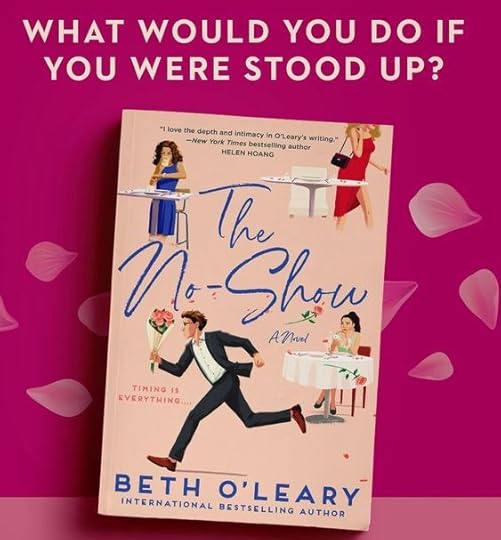
Don’t get me wrong. The general storyline of The No-Show is very unassuming: there is this key idea – the unhappy tangibility of a variously recurring Valentine’s day – around which the entire narrative revolves. (Valentine’s days tending to go wrong, naturally. But not for the reasons you will suspect, at first. PATIENCE.) Also not uncharacteristically, there are a fair few characters to be keeping up with. Broken characters, obviously, who know not how to contain the world’s shakenness. (Make sure to take mental notes: it is ALL very important.) Somewhat like in The Road Trip, the more psychologically problematic character – who also ties together all the separate storylines of The No-Show – is not directly known to the reader. Seemingly notorious for his unmistakable and questionable messiness, Joseph Carter finds his way in the narrative of all three female protagonists, having stood up all three on a Valentine’s day: Siobhan the life coach slash the vulnerable-kind-of-tough woman, Miranda the tree-climber and the all-time doer, and simple, sensible, subdued Jane, who carries around – much like Joseph and Siobhan, though in different ways – the weight of a traumatic past that will not be silenced.
The narrative and its unfolding alternates between the stories of these three unrelated women, jaw-droppingly converging only in its latter part. The ending is one of acquired contentedness. Sombrely so, though all the more striking for it. There is the sense that all characters embark on an ‘it’s been a long time coming’ trajectory, and we are there, all the way, assisting to their innumerable missteps. It gets dark – as it must, with O’Leary. One particularly detestable, narcissistic, domineering women-seducer – Richard Wilson – is about to/destroy(s) the life of more than one of these protagonists. One of them flees, for a while. But what will happen to the other one, whose flight turns even more perilous, or perhaps...fatal?
O’Leary does it right. She does not downplay manipulation, abuse, or violence, but is still intent on capturing the complex (un)predictability of human slips and inescapable tragedy of life. She also takes care of her characters as much as allowing them to find their own way. There is this highly characteristic sense of domesticity and tender friendship in O’Leary’s writing. Where indeed would Siobhan be without her housemate Fiona and her Marlena? Or Miranda without her feisty sisters Frannie and Adele – who are staying over at her place for a while – as well as the tough guys at work? Or Jane without her newfound, kind friend, Aggie? The spaces for authenticity, opened up by unconditional, loving friendship, are a fundamental feature in all the central protagonists’ individual journeying. This, as it seems to me, is O’Leary’s suggestion. Her choice, in turn, not to infiltrate Joseph’s psyche directly was absolutely phenomenal: it is through this wilful withholding that the horror of certain truths and many other upended assumptions strike to the core of the reader’s own humanness…And you will not know what hit you. That is, until much later…Time; time in this book plays an essential role…Clever, O’Leary…
What can I say, in fact? Other than that she definitely ‘fooled’ me (no doubt about that)…I was also wistfully reminded of some storyline developments in Lessons in Chemistry (those who have read both books might know what I am referring to) and this added to my burgeoning affection for this book. And for the writer. Because she knows what romance needs to be engaging. Because she takes small but solid risks, wanting to pursue a writing path that is her own...Simply because she is an exceptionally talented storyteller.
4.75 stars. Unbeatable, in the genre...And unerringly exciting!
Wonderful kick-off to the summer reading! 👌