

What do you think?

A Brutal Design
“There were moments in Solomon’s novel that truly frightened me, and yet, like its narrator, Samuel Zelnik, I found myself obsessively compelled to uncover its mysteries. This is a haunting, thought-provoking novel that shows a place where the senseless meets reality.” — Gabe Habash, author of Stephen Florida
“Keenly political, rich with implications for both the past and the future. This is an exhilarating and boldly original debut.” — Helen Phillips, author of The Need
"A BRUTAL DESIGN is a deft blend of sci-fi, noir, and a dash of Sebald that examines our yearning for utopia. It is propelled by unease, yet funny and beautiful, too. Once I started reading it, I could not stop." — Erin Somers, author of Stay Up With Hugo Best
“An uncompromising portrait of the human psyche.” — Soon Wiley, author of When We Fell Apart
After the fascist takeover of his homeland and the murder of his parents, Jewish architecture student Samuel Zelnik thinks that he and his friends are bound for the gulag—or worse. Instead, he receives an unexpected offer of freedom working in the experimental utopian city of Duma. Awed by the city’s dramatic architecture but confused by the other residents’ strange behavior, Zelnik searches for his long-lost uncle who emigrated to Duma before him. His wanderings reunite him with Miriana Grannoff, an exiled avant-garde artist who was once his teacher. Her memorial installations hidden around the city equally enchant and repel him. And gradually, they begin to reveal a Duma is not the workers’ paradise it pretends to be.
“Keenly political, rich with implications for both the past and the future. This is an exhilarating and boldly original debut.” — Helen Phillips, author of The Need
"A BRUTAL DESIGN is a deft blend of sci-fi, noir, and a dash of Sebald that examines our yearning for utopia. It is propelled by unease, yet funny and beautiful, too. Once I started reading it, I could not stop." — Erin Somers, author of Stay Up With Hugo Best
“An uncompromising portrait of the human psyche.” — Soon Wiley, author of When We Fell Apart
After the fascist takeover of his homeland and the murder of his parents, Jewish architecture student Samuel Zelnik thinks that he and his friends are bound for the gulag—or worse. Instead, he receives an unexpected offer of freedom working in the experimental utopian city of Duma. Awed by the city’s dramatic architecture but confused by the other residents’ strange behavior, Zelnik searches for his long-lost uncle who emigrated to Duma before him. His wanderings reunite him with Miriana Grannoff, an exiled avant-garde artist who was once his teacher. Her memorial installations hidden around the city equally enchant and repel him. And gradually, they begin to reveal a Duma is not the workers’ paradise it pretends to be.
264 pages, Kindle Edition
Published January 30, 2024
About the author
Zachary C. Solomon
1 book14 followersZachary C. Solomon is from Miami, Florida. He received an MFA from Brooklyn College, where he was a Truman Capote fellow. He lives with his wife, the novelist Mandy Berman, and their two children in New York’s Hudson Valley. A BRUTAL DESIGN is his first novel.
Ratings & Reviews
Friends & Following
Create a free account to discover what your friends think of this book!
Community Reviews
Displaying 1 - 24 of 24 reviews

February 15, 2025
I liked to think in terms of metaphor. I was studying to be an architect. I believed first and foremost in representation. I believed that every built thing casts a shadow; that the shadows say as much if not more than the structure; that structure both is defined by and defines builder and dweller; that all homes are also the signs of homes; that all buildings are symbolic of buildings; and that all constructs of whatever kind are signs and symbols.
A Brutal Design by Zachary C. Solomon is published by Lanternfish Press and was entered for the 2024 Republic of Consciousness Prize, US & Canada. Judge Rebekah Rine said of the novel:
Every building is a philosophy. Every building is an argument about the way architects think the world should be. And sometimes it seems like the architect wasn’t thinking about me at all.
quote from the author, Zachary C. Solomon
A Brutal Design is a fascinating novel, applying architectural and art-history ideas to the history of anti-semitism and fascism.
It is set in a world similar to our own, but in an unspecified time and place. It opens with our first person narrator, Samuel Zelnik, a Jewish architectural student, completing the long journey (so long he's rather lost track of where, geographically, he is) to the community of Duma, an idealistic community city established in the desert.
He believes he is going there to work on the community's architecture, and initially his observations of what he sees are based on the buildings, most of which use brutalist techniques to convey a sense of egalitarian, including the Crescent where he lives and the Fulcrum which seems to be the administrative centre:
The Fulcrum building appeared: a thundering concrete shed that rose five stories above a bustling courtyard filled with bench-like concrete slabs and concrete planters filled with spiky desert plants. People milled about with their briefcases and backpacks, wearing more work uniforms-overalls and hardhats; suits and assorted office attire. Some sat on the concrete slabs, eating apples and reading newspapers. The Fulcrum building loomed over them, blotting out the sun and blanketing the courtyard in shade. It lacked any real architectural detail: just a malformed block of material with thin, vertical glass windows stenciled into the concrete, and only one larger concentration of glass: a meeting space that cantilevered over the courtyard in the shape of the letter T.
…
Imposing, anonymous architecture, vast windowless interiors, echoing hallways. This was egalitarianism in building form, yet I did not feel reassured. Back home, a building meant for the processing of people into classes of varying importance would reveal its purpose through pompous Neoclassical flourishes and stately columns. Architecture that did everything it could to tell you that you were not worthy. This was the oppo-site, yet deep within me the worry wouldn't settle. Where I came from, you did not transition from a waiting room into greener pastures.
Although he also notes that some residents live in more individualised accommodation.
The houses behind the walls were beautiful too, with front rooms shaped like shipping containers jutting out over small, grassy yards. They had flat roofs and smooth concrete walls with wide rectangular windows or thin vertical slits. Some of the houses lacked traditional corners where the concrete walls met, they met at glass. Vertical glass panes set into the concrete in place of corners, so that the walls never touched. The houses seemed impressionable, mutable, while being utterly permanent. The glass made me think that if I lived in one of these houses, I could enter or leave through any wall-that nothing was bound, that there were infinite paths through the space.
I realized that I was looking at the first evidence I'd seen of Duma's progressive architectural bona fides. These were malleable, changeable constructions. Built for additions and annexes, for easy and affordable expansions and contractions. They were utilitarian but had personalized flair. I admired them and was hungry to work on something similar.
Solomon has said, in an interview in Jewish Telegraphic Agency that he was inspired by planned communities, and in particular a NY Times article on Olivetti's Ivrea in Italy, as well as buildings such as Le Corbusier's Unite d' Habitation
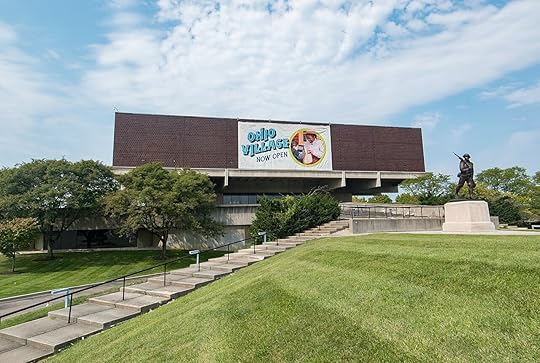
The Ohio History Centre, where Solomon wrote most of the novel and of which he has described as "an absolutely hideous, massive, monumental, Brutalist building.
Those are all good things to me. Sitting in their archive and writing in this cold, echoey, inhospitable, deeply uncomfortable space, with the archivists and librarians giving me dirty looks for no reason — everything about it was so perfect. I was able to write my book in a space that was exactly like the world I was trying to create. "
Zelnik is also looking for his Uncle who had previously journey to Duma, and had written to him, telling him to join him. However, Zelnik is unable to find him, and also discovers that far from being employed as an architect, he is assigned to manual labour in a factory, assembling objects whose purpose is unclear.
As the novel progresses, his back story becomes a little clearer, although one the reader has to piece together. His father and mother were murdered with many others when members of the Jewish community was herded into a synagogue, which was then set on fire. He was taken in by his uncle, although the uncle was imprisoned for some years as part of the authorities anti-semetic crackdown. Zelnik himself attended an academic instituion, Barnova, which was originally a home of free thought and liberalism, but increasingly became under the control of the authorities - so that, for example, a lecture course that debated fascist ideas from a critical viewpoint seemed to shift to one that promoted them. Zelnik was part of a group who resisted this shift, and it was when arrested after a demonstration was broken up, it was the authorities who encouraged him to join his uncle in Duma: Duma was an "experiment in the desert", he said, where alternate ideologies could be put to test without threat ... we think it could be perfect for a free-thinker, he said. This place isn't well suited for people like you.
One of those living in the nicer housing in Duma, and who seems to be exempt from the more physical work, was Erich, one of Zelnik's fellow students, and one who seemed more comfortable with the new direction, having previously been ostracised by the more liberal classmates. And Erich re-introduces the initially delighted Zelnik to Miriana Granoff, an avant-garde artist and professor from Barnova who had initially led the student resistance movement before being exiled.
She was famously a leftist artist, known for uncanny, lifelike fabrications that she often employed in activist contexts as statements against war, famine, disease, corruption. Like some of my favorite professors, Grannoff had been a casualty of the purge of Barnova's left-leaning faculty members and had, we'd thought, emigrated to South America. Thinking about Grannoff being here made me relax a bit, but then I remembered who I was talking to.
And increasingly, the world around him becomes somewhat surreal - he suffers blackouts and times where he's unclear if a conversation happened or was dreamed; the other inhabitants of Duma are evasive; a supervisor at the factory who he then meets elsewhere both claims to not be who Zelnik says he is, but also accuses Zelnik of actually being someone else; and his neighbour turns out to be responsible for clandenstine art which Granoff wants, rather contrary to the Granoff he knew from Barnova, to suppress.
And he discovers various large-scale installations, which prove to be Grannoff's artworks, ones that speak to fascism, and even the holocaust (such as a life-scale recreation of a Commandant's house) but which, Zelnik realises, may not be memorials but something more sinister:
I wondered what process rendered a work of art a memorial, as distinct from an homage. Was it where you stood? Was it context alone?
…
How weak the threshold between memorial and her Marge. Why couldn’t a person – not me, but another – visit the site of tragedy and feel inspired by it? Enlightened? Think to himself: this was the site of a success. This was the site of an accomplishment.
And as the novel comes to an end, Duma comes under military attack, and Zelnik discovers more of the secrets of the community and the sinister reality of the experiment that is underway. As he looks around the ruins, he imagines how we might rebuild Duma, but then catches himself in his own arrogance:
I realized what I was doing.
I was creating a mode of existence that was inflexible in its idealized flexibility, just like Dumanian architecture, only fit to the specifications of what I believed was true equality.
Suddenly, I didn't want to design buildings anymore.
Nobody should have such power.
Very impressive and a novel that is even more timely in 2025 than when published in early 2024, as America shifts rapidly to an authorarian state. 4.5 stars.
Other reviews
World Architects
Jewish Book Council
Forward
Tupelo Quarterly
The publisher
Lanternfish Press, founded in Philadelphia in 2014, publishes literature of the rare and strange: fiction that crosses the boundary between literary and speculative; real or imagined tales of characters at the margins of history; essays rooted in a strong sense of place; a cabinet of curious Victorian reprints. We seek the grotesque, the alien made familiar, the “I don’t know what this is—but I love it.”
Lanternfish aims to make books and publication accessible to readers and writers who fall outside the literary mainstream, whether in race, sexuality, gender, situation, or pure individual oddity. We're a home for books that defy pigeonholes—and for the readers who love them.
A Brutal Design by Zachary C. Solomon is published by Lanternfish Press and was entered for the 2024 Republic of Consciousness Prize, US & Canada. Judge Rebekah Rine said of the novel:
Is Utopia possible, or will humanity’s trend toward brutalization always reveal itself? Zachary Solomon paints a picture of a utopian city designed as a refuge from the fascism taking over much of the world. A young architect enters this city full of optimism, then becomes increasingly disturbed by the secrets within. Filled with mystery, labyrinths, and alarming imagery, A Brutal Design is at once a warning, and an absurdly visceral novel.
Every building is a philosophy. Every building is an argument about the way architects think the world should be. And sometimes it seems like the architect wasn’t thinking about me at all.
quote from the author, Zachary C. Solomon
A Brutal Design is a fascinating novel, applying architectural and art-history ideas to the history of anti-semitism and fascism.
It is set in a world similar to our own, but in an unspecified time and place. It opens with our first person narrator, Samuel Zelnik, a Jewish architectural student, completing the long journey (so long he's rather lost track of where, geographically, he is) to the community of Duma, an idealistic community city established in the desert.
He believes he is going there to work on the community's architecture, and initially his observations of what he sees are based on the buildings, most of which use brutalist techniques to convey a sense of egalitarian, including the Crescent where he lives and the Fulcrum which seems to be the administrative centre:
The Fulcrum building appeared: a thundering concrete shed that rose five stories above a bustling courtyard filled with bench-like concrete slabs and concrete planters filled with spiky desert plants. People milled about with their briefcases and backpacks, wearing more work uniforms-overalls and hardhats; suits and assorted office attire. Some sat on the concrete slabs, eating apples and reading newspapers. The Fulcrum building loomed over them, blotting out the sun and blanketing the courtyard in shade. It lacked any real architectural detail: just a malformed block of material with thin, vertical glass windows stenciled into the concrete, and only one larger concentration of glass: a meeting space that cantilevered over the courtyard in the shape of the letter T.
…
Imposing, anonymous architecture, vast windowless interiors, echoing hallways. This was egalitarianism in building form, yet I did not feel reassured. Back home, a building meant for the processing of people into classes of varying importance would reveal its purpose through pompous Neoclassical flourishes and stately columns. Architecture that did everything it could to tell you that you were not worthy. This was the oppo-site, yet deep within me the worry wouldn't settle. Where I came from, you did not transition from a waiting room into greener pastures.
Although he also notes that some residents live in more individualised accommodation.
The houses behind the walls were beautiful too, with front rooms shaped like shipping containers jutting out over small, grassy yards. They had flat roofs and smooth concrete walls with wide rectangular windows or thin vertical slits. Some of the houses lacked traditional corners where the concrete walls met, they met at glass. Vertical glass panes set into the concrete in place of corners, so that the walls never touched. The houses seemed impressionable, mutable, while being utterly permanent. The glass made me think that if I lived in one of these houses, I could enter or leave through any wall-that nothing was bound, that there were infinite paths through the space.
I realized that I was looking at the first evidence I'd seen of Duma's progressive architectural bona fides. These were malleable, changeable constructions. Built for additions and annexes, for easy and affordable expansions and contractions. They were utilitarian but had personalized flair. I admired them and was hungry to work on something similar.
Solomon has said, in an interview in Jewish Telegraphic Agency that he was inspired by planned communities, and in particular a NY Times article on Olivetti's Ivrea in Italy, as well as buildings such as Le Corbusier's Unite d' Habitation
The Ohio History Centre, where Solomon wrote most of the novel and of which he has described as "an absolutely hideous, massive, monumental, Brutalist building.
Those are all good things to me. Sitting in their archive and writing in this cold, echoey, inhospitable, deeply uncomfortable space, with the archivists and librarians giving me dirty looks for no reason — everything about it was so perfect. I was able to write my book in a space that was exactly like the world I was trying to create. "
Zelnik is also looking for his Uncle who had previously journey to Duma, and had written to him, telling him to join him. However, Zelnik is unable to find him, and also discovers that far from being employed as an architect, he is assigned to manual labour in a factory, assembling objects whose purpose is unclear.
As the novel progresses, his back story becomes a little clearer, although one the reader has to piece together. His father and mother were murdered with many others when members of the Jewish community was herded into a synagogue, which was then set on fire. He was taken in by his uncle, although the uncle was imprisoned for some years as part of the authorities anti-semetic crackdown. Zelnik himself attended an academic instituion, Barnova, which was originally a home of free thought and liberalism, but increasingly became under the control of the authorities - so that, for example, a lecture course that debated fascist ideas from a critical viewpoint seemed to shift to one that promoted them. Zelnik was part of a group who resisted this shift, and it was when arrested after a demonstration was broken up, it was the authorities who encouraged him to join his uncle in Duma: Duma was an "experiment in the desert", he said, where alternate ideologies could be put to test without threat ... we think it could be perfect for a free-thinker, he said. This place isn't well suited for people like you.
One of those living in the nicer housing in Duma, and who seems to be exempt from the more physical work, was Erich, one of Zelnik's fellow students, and one who seemed more comfortable with the new direction, having previously been ostracised by the more liberal classmates. And Erich re-introduces the initially delighted Zelnik to Miriana Granoff, an avant-garde artist and professor from Barnova who had initially led the student resistance movement before being exiled.
She was famously a leftist artist, known for uncanny, lifelike fabrications that she often employed in activist contexts as statements against war, famine, disease, corruption. Like some of my favorite professors, Grannoff had been a casualty of the purge of Barnova's left-leaning faculty members and had, we'd thought, emigrated to South America. Thinking about Grannoff being here made me relax a bit, but then I remembered who I was talking to.
And increasingly, the world around him becomes somewhat surreal - he suffers blackouts and times where he's unclear if a conversation happened or was dreamed; the other inhabitants of Duma are evasive; a supervisor at the factory who he then meets elsewhere both claims to not be who Zelnik says he is, but also accuses Zelnik of actually being someone else; and his neighbour turns out to be responsible for clandenstine art which Granoff wants, rather contrary to the Granoff he knew from Barnova, to suppress.
And he discovers various large-scale installations, which prove to be Grannoff's artworks, ones that speak to fascism, and even the holocaust (such as a life-scale recreation of a Commandant's house) but which, Zelnik realises, may not be memorials but something more sinister:
I wondered what process rendered a work of art a memorial, as distinct from an homage. Was it where you stood? Was it context alone?
…
How weak the threshold between memorial and her Marge. Why couldn’t a person – not me, but another – visit the site of tragedy and feel inspired by it? Enlightened? Think to himself: this was the site of a success. This was the site of an accomplishment.
And as the novel comes to an end, Duma comes under military attack, and Zelnik discovers more of the secrets of the community and the sinister reality of the experiment that is underway. As he looks around the ruins, he imagines how we might rebuild Duma, but then catches himself in his own arrogance:
I realized what I was doing.
I was creating a mode of existence that was inflexible in its idealized flexibility, just like Dumanian architecture, only fit to the specifications of what I believed was true equality.
Suddenly, I didn't want to design buildings anymore.
Nobody should have such power.
Very impressive and a novel that is even more timely in 2025 than when published in early 2024, as America shifts rapidly to an authorarian state. 4.5 stars.
Other reviews
World Architects
Jewish Book Council
Forward
Tupelo Quarterly
The publisher
Lanternfish Press, founded in Philadelphia in 2014, publishes literature of the rare and strange: fiction that crosses the boundary between literary and speculative; real or imagined tales of characters at the margins of history; essays rooted in a strong sense of place; a cabinet of curious Victorian reprints. We seek the grotesque, the alien made familiar, the “I don’t know what this is—but I love it.”
Lanternfish aims to make books and publication accessible to readers and writers who fall outside the literary mainstream, whether in race, sexuality, gender, situation, or pure individual oddity. We're a home for books that defy pigeonholes—and for the readers who love them.

Did Not Finish
March 21, 2024On page 65 I stopped. [I have always insisted that any decent novel is bound to trigger someone. This one triggered me. I may return and see if I can get past my issues. Then again, I reread my own review and think: why?]
I should have known better because these dystopian stories all feature a male POV character and women who are mere sketches. The tie to architecture tempted me both as literal landscape and as metaphor for what we make of our society. Most of the so-called classic dystopias offer brutality with little nuance. Perhaps male readers fail to notice? Perhaps I'm unfair to men? Perhaps the autocratic notion feels inevitable to some people? Perhaps it is a relief to find a worst-case scenario in fiction?
Two women with a speaking rolls so far. One is villainous and the second is from his past. The latter exists in order to be humiliated by an apologist for what is clearly a dystopia. Many people admire this novel. As a horror story, it starts off well. If that is what you're looking for, this will fit the brief. Certainly creepier than novels such as 1984 which are designed to show how society can go wrong.
It is easy to write dystopian stories about manipulation and devastation in the world. Too easy. What I yearn for is solutions. Hope. I want a way through, not doors slammed shut.
I "did not like it" because it offered me nothing useful. Instead of brutalizing myself with this novel, I have begun Isabel Wilkerson's Caste. I don't need to read a fantasy version of the reality when the reality is already beastly enough to be frightening.
nitpicking: "The concierge gestured to the hallway behind her and entered through..." (32).
There is an "I" missing ["and I entered through"]; it is the POV character, not the concierge who enters. A great deal of "reinforced concrete" but how does he know it's reinforced concrete? The synthetic meals—so much like what he might look for in a meal out here and now—why that nasty "meat" there and then? And how can it be "greasy"? Fats are hard to come by in a vegan world.
And the POV character seems so astonishingly dull. Why go, what is the point? To find the uncle he thought dead? to eat? to escape completing his dissertation? Why not notice the danger that readers recognize immediately. The back cover makes some details clear that are not in the text: "he thinks that he and his friends are bound for the gulag—or worse." Yes, well...
I should have known better because these dystopian stories all feature a male POV character and women who are mere sketches. The tie to architecture tempted me both as literal landscape and as metaphor for what we make of our society. Most of the so-called classic dystopias offer brutality with little nuance. Perhaps male readers fail to notice? Perhaps I'm unfair to men? Perhaps the autocratic notion feels inevitable to some people? Perhaps it is a relief to find a worst-case scenario in fiction?
Two women with a speaking rolls so far. One is villainous and the second is from his past. The latter exists in order to be humiliated by an apologist for what is clearly a dystopia. Many people admire this novel. As a horror story, it starts off well. If that is what you're looking for, this will fit the brief. Certainly creepier than novels such as 1984 which are designed to show how society can go wrong.
It is easy to write dystopian stories about manipulation and devastation in the world. Too easy. What I yearn for is solutions. Hope. I want a way through, not doors slammed shut.
I "did not like it" because it offered me nothing useful. Instead of brutalizing myself with this novel, I have begun Isabel Wilkerson's Caste. I don't need to read a fantasy version of the reality when the reality is already beastly enough to be frightening.
nitpicking: "The concierge gestured to the hallway behind her and entered through..." (32).
There is an "I" missing ["and I entered through"]; it is the POV character, not the concierge who enters. A great deal of "reinforced concrete" but how does he know it's reinforced concrete? The synthetic meals—so much like what he might look for in a meal out here and now—why that nasty "meat" there and then? And how can it be "greasy"? Fats are hard to come by in a vegan world.
And the POV character seems so astonishingly dull. Why go, what is the point? To find the uncle he thought dead? to eat? to escape completing his dissertation? Why not notice the danger that readers recognize immediately. The back cover makes some details clear that are not in the text: "he thinks that he and his friends are bound for the gulag—or worse." Yes, well...

February 25, 2024
Beautiful prose, thought provoking themes, and an inventive scenario.

February 7, 2024
Va čia yra Literatūra. Also, mind blowing buvo pamatyti kai ką labai artimo (palieku intrigą)

September 23, 2025
Picked this out randomly at the library and holy shit. This book was GOOd. First book in a day for me (I think).
Read this book if: you like Severance or World War II history or the Truman Show or anything else remotely interesting.
Someone call Jordan Peele or A24 and get them on this stat!
Read this book if: you like Severance or World War II history or the Truman Show or anything else remotely interesting.
Someone call Jordan Peele or A24 and get them on this stat!
January 25, 2025
Interesting, pretty fresh, fun to read

Read
January 30, 2025Yay Zachary!!

Read
February 8, 2025Shout out to Jason for letting me borrow his copy!
November 22, 2023
Occasionally, a book finds the world at exactly the right time. Considering violence in the Middle East, hate crimes against Jews and Muslims in the US, and fascists on the march, A Brutal Design is that rare book that hits the mark and hits the market at the right time.
Writing a review of this dystopian novel without any spoilers is little like making an omelet without breaking any eggs. I was given access to this book as part of an early reader program so I feel especially compelled to gloss over most of the plot points.
In search of his uncle, Zelnik arrives at the “worker’s paradise” of Duma in an unnamed European country. As an architecture student, Zelnik is awed by the city and amazed to find Holocaust memorials built by his old professor, who was herself exiled. These memorials, as the best ones do, both appall and appeal. It slowly dawns on Zelnik that the line between life and art is crumbling in Duma.
Mr. Solomon’s language and style is both direct and liquid. Like the memorials in the book, his words are gorgeous in their construction and contain actions or thoughts that are dark and disturbing.
The best books on difficult topics (racism, human trafficking, the Holocaust and so on), leave you thoughtful, disquieted, and a little amazed. That’s A Brutal Design.
Writing a review of this dystopian novel without any spoilers is little like making an omelet without breaking any eggs. I was given access to this book as part of an early reader program so I feel especially compelled to gloss over most of the plot points.
In search of his uncle, Zelnik arrives at the “worker’s paradise” of Duma in an unnamed European country. As an architecture student, Zelnik is awed by the city and amazed to find Holocaust memorials built by his old professor, who was herself exiled. These memorials, as the best ones do, both appall and appeal. It slowly dawns on Zelnik that the line between life and art is crumbling in Duma.
Mr. Solomon’s language and style is both direct and liquid. Like the memorials in the book, his words are gorgeous in their construction and contain actions or thoughts that are dark and disturbing.
The best books on difficult topics (racism, human trafficking, the Holocaust and so on), leave you thoughtful, disquieted, and a little amazed. That’s A Brutal Design.
January 26, 2024
A provocative and necessary read, A Brutal Design immerses the reader in an absurdist universe that feels presciently possible in light of today's global events.
Zachary C. Solomon, the first-time author of this tightly written novel, brings us to Duma, an ostensibly utopian city where nothing is as it seems and everything is frightening. Underneath the thinnest veneer of sanity, Duma reveals itself - through the book’s hapless protagonist, Samuel Zelnik - to be a place of abject hopelessness, where art and architecture exist in service to a perverted reality that celebrates fascism and the horrors of the Holocaust.
Solomon is a master storyteller and crafter of soaring prose. A Brutal Design defies genre categorization, simultaneously existing as a work of horror, mystery and dystopian fiction. Its pace is whip-saw fast, and days after finishing the final page I find myself still unwinding its implications, unable to stop thinking about Samuel Zelnik and the dangers of Duma.
Zachary C. Solomon, the first-time author of this tightly written novel, brings us to Duma, an ostensibly utopian city where nothing is as it seems and everything is frightening. Underneath the thinnest veneer of sanity, Duma reveals itself - through the book’s hapless protagonist, Samuel Zelnik - to be a place of abject hopelessness, where art and architecture exist in service to a perverted reality that celebrates fascism and the horrors of the Holocaust.
Solomon is a master storyteller and crafter of soaring prose. A Brutal Design defies genre categorization, simultaneously existing as a work of horror, mystery and dystopian fiction. Its pace is whip-saw fast, and days after finishing the final page I find myself still unwinding its implications, unable to stop thinking about Samuel Zelnik and the dangers of Duma.

May 29, 2024
This book left me feeling with a relative feeling of dislike while at the same time leaving me with realizations of horror after reading the book and reflecting on the events I remembered from beginning to end. So I would say it succeeded as a dystopian story. It is not for the faint of heart and probably hits a little close to home for many as it is most definitely offering commentary on 20th century totalitarianism, our present day, and when we as individuals fail. One of the more different books I have read in some time. The integration of art and architecture in the story was thought provoking as well. All in all this was actually a well composed story. Just don’t expect much in the way of heroism as I wouldn’t say it’s about that at all.

August 23, 2025
This is a very odd dystopian tale blending Jewish history, architectural allegory, and a chilling social experiment. The Times of Israel called it “a richly imagined” desert utopia and praised how it grapples with antisemitism and the Holocaust in speculative fiction...
Unfortunately I just didn't get it. The longer I read, the weirder and more surreal things got—not in an alluring, Kafka-esque way, but in an erratic, disorienting way that made me question what I was even following. Jewish speculative fiction? The Holocaust?
Unfortunately I just didn't get it. The longer I read, the weirder and more surreal things got—not in an alluring, Kafka-esque way, but in an erratic, disorienting way that made me question what I was even following. Jewish speculative fiction? The Holocaust?
Read
November 22, 2025More fantastical and surreal than I expected. A Brutal Design doesn’t offer a traditional plot or conventional character development; instead, it unfolds as a surreal, Alice-in-Wonderland-style exploration of philosophical ideas. Solomon examines the relationship between aesthetic ideals and fascist ideology, showing how the pursuit of an egalitarian utopia (like the Soviet Union) can degenerate into a nightmare of enforced uniformity and submission, where the machinery of bureaucracy descends into violence.

March 21, 2024
My blurb:
With commanding intelligence and dystopian foresight, A BRUTAL DESIGN secures Zachary C. Solomon's place in the world of letters with a voice steeped in history, literature, art, and philosophy and maturity beyond its years. His taut, elegantly written, and exquisitely bleak novel presciently pits fascism against dwindling humanity, asking, "Do we value life little enough that we’d exchange it for advancement and comfort?" This is a haunting, sinister, and brilliant debut.
With commanding intelligence and dystopian foresight, A BRUTAL DESIGN secures Zachary C. Solomon's place in the world of letters with a voice steeped in history, literature, art, and philosophy and maturity beyond its years. His taut, elegantly written, and exquisitely bleak novel presciently pits fascism against dwindling humanity, asking, "Do we value life little enough that we’d exchange it for advancement and comfort?" This is a haunting, sinister, and brilliant debut.
March 18, 2025
I really wanted to like this more than I did, it’s got a fantastic setting and some really gripping imagery, not to mention (sadly) timely thoughts on fascism. But the parts where I felt pulled into the surreal setting the most flew by too quickly and I was pulled back out too often. The disorientation was intentional, sure, but this is a rare book that I felt could have used a couple hundred more pages to luxuriate in the unsettling spaces being described.

April 14, 2026
Something like 1984 but more odd this book is written in an intriguing way even though it kept barreling through like a nightmarish dream. I am still not sure what I just read but I finished it. This would make a decent movie (The Brutalist is not based on this book though the main character is substantially similar)
Read
November 22, 2025More fantastic and surreal than I expected. Solomon explores the relationship between aesthetic ideals and fascist ideology, illustrating how a vision of egalitarian utopia can devolve into a regime sustained by conformity and submission.

March 2, 2024
An harrowing heartbreaking read - tragically timeless and continually relevant.
March 14, 2024
This was a brilliant story! A delightfully odd exploration of art, perception, hope, and darkness.
September 13, 2024
Distopian Utopia, or is it?
December 1, 2024
Much more fantastical than I expected
January 25, 2026
At times I could not be compelled to get into the story. However, the metaphors and symbolism are the highlights of the book and keep things interesting.
January 30, 2026
Trying to be an antifascist Catch-22, and the character development doesn't quite get there. Enjoyed the prose though.

decided-not-to-read
February 9, 2024Recommended by Andrew Silow-Carroll.
I found this boring, wandering, not particularly well-written. Halfway through the book we were still in "Act I," in that it was still the set-up.
I found this boring, wandering, not particularly well-written. Halfway through the book we were still in "Act I," in that it was still the set-up.
Displaying 1 - 24 of 24 reviews