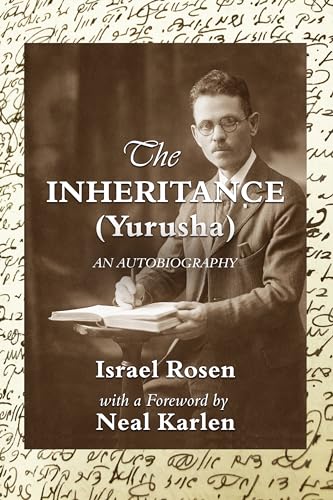
A young boy, Elliot Rosen, watched his Zayda (grandfather) writing in Yiddish and drawing pictures with his fountain pen in a book that was kept hidden and secret. After his Zayda’s death in 1948 the book was kept from the young boy’s eyes. In 1960, when the boy’s Bubba (grandmother) died, the book was taken by the boy’s oldest uncle Max, and no one wanted to talk about it. In 1979, Uncle Max gave the book to his youngest brother, Dave (the boy’s father), and the next day, Max died. The young boy, now a married man, took the book and made it his responsibility to get it translated. Now, after many decades, Elliot Rosen has been able to bring the amazing story of survival and life’s journey of Yisroel Ayzik Rosen (Israel Rosen) to the public. This extraordinary work about a man whom Neal Karlen describes as a mensch in the book’s brilliant foreword, might only be one man’s story, but it is also every immigrant’s story in one way or another. It is tearful, painful, and sometimes depressing, yet funny, uplifting and ultimately spiritual.
This was a very hard read for me yet very a fascinating one!
This is a story of a proud jew who worked hard his whole life and in the early 1900's migrated to America to realize the American dream, yet it wasn't smooth sailing to say the least.
He loved God and he very much loved America!
Since this was transliterated from the original Yiddish, the writing feels very choppy and incohesive at times but the raw emotions of the author is preserved and you feel like you're living through these episodes with him.
I would recommend this to someone interested in what early Jewish immigrants went through coming to America.
Many of the best “Jewish stories” are tales of Exodus, as is this – a story of challenging choices in the face of plagues, deprivation and hardship, strange encounters in strange lands, the power of family near and far, and a persistent and abiding love of truth and justice informed by faith in an all–mighty and fearsome God. What makes this story exceptional is its telling in a kind of transliterated American Yiddish seemingly stitched from rags collected by the narrator’s grandson – his inheritance. Reads like sorrowful but uplifting music. Beautiful.
Mr. Rosen kept his faith in God and maintained a moral steadfastness during his mostly difficult life. He lived from 1870 to 1948, and this autobiography of his life in Eastern Europe and America, originally written in Yiddish for his family, is an uplifting window into those times.