Everything you've seen or read till now took you only to the brink . . .
The universe called.She answered..Witch-girl from a backwater Earth. Unwilling heir to the star-flung Kerrion Empire. Rebel at the deep end of the Five Eternities . . . Shebat Kerrion had dreamed a dozen lifetimes and now she meant to change the future of the cosmos.,"Combining the rational wonder of SF with the extravagance of the best fantasy!" -- Isaac Asimov's Science Fiction Magazine.".Neither pure fantasy, nor straight science fiction, nor earthbound dynastic saga, Dream Dancer is a prophetic and stunning amalgam of all three. It is a family saga with the epic appeal of Dune and the action and excitement of Star Wars. It is a saga of love, power and treachery that will appeal to men and women equally; full of action, compulsively readable and quite unlike anything being published in the realms of fantasy today..
Janet Ellen Morris (born May 25, 1946) is a United States author. She began writing in 1976 and has since published more than 20 novels, many co-authored with David Drake or her husband Chris Morris. She has contributed short fiction to the shared universe fantasy series Thieves World, and edited the Bangsian fantasy series Heroes in Hell. Most of her work has been in the fantasy and science fiction genres, although she has also written several works of non-fiction.
Morris was elected to the New York Academy of Sciences in 1980.
In 1995, Morris and her husband and frequent co-writer Christopher Morris founded M2 Tech. Since that time, their writing output has decreased in proportion to the success of the company, which works with U.S. federal and military agencies on non-lethal weapon systems and software.
As a 1960’s child, I grew up reading the classics. Quirkily enough, I was also an avid science fiction fan from an early age, devouring what the library had to offer from the likes of Asimov, H.G. Wells, Jules Verne, Clarke, Heinlein . . . to name just a few. That love of all things profound continued as sci-fi broached the boundaries of the various TV series on offer, and later, the many cinematic delights that stretched the imagination. So, when I come across an ‘Author’s Cut” version of a story originally published in 1980, combining a masterly blend of some of the best loved tropes employed by those legends mentioned above, I was obviously intrigued: Think of the epic scope of Homer’s Odyssey; the allegory of Frank Herbert’s Dune; the intimate bond experienced between Pilot and his sentient ship, ‘Moya’ in Farscape, and the ‘plucked from obscurity/thrown into the beyond-world cosmic destiny’ of Jupiter Ascending, and you’ll start to appreciate what I mean, for those elements are masterfully combined and beautifully portrayed in Janet Morris’ operatic rendering: Dream Dancer. A young girl – Shebat – is eking out a meager living in a hick town near a futuristic New York. But this isn’t like any place you’d know, for things have regressed and future Earth’s civilization is a backward, ill-educated shadow of what it once was. Anyone who is anyone moved away, a long, long time ago, leaving the dregs of society to fend for themselves. However, a combination of superstition, blinkered prejudice and sheer chance sees Shebat uprooted from all she knows and planted into a new environment beyond the stars where people live in huge, world sized cities made of metal and glass and traverse the cosmos in semi-conscious ships through a medium capable of reducing the vast distances involved. This is a thoroughly engaging saga. The concepts involved are innovative. The pace, animated – as is the prose. The modus of space travel used is superb, and the empire that lurks beyond the stars, chilling. (Think Dune/Babylon 5/Jupiter ascending) for whole planets now belong to a ruling elite, and the families making up that elite are never content with what they have. Not surprising, seeing as the major houses are as much a political entity as they are a commercial corporation. Plucked from poverty and anonymity, Shebat is thrust into the limelight on a stage galactic in scope. A stage where political backbiting, murder and betrayal are an everyday way of life. Against all the odds . . . she shines. But what price to pay for burning too brightly when all are out to eclipse your flame? Dream Dancer – a definite ‘must-read’ for any true sci-fi aficionado.
The entire Kerrion Empire trilogy is great space opera.
Notes added after a reread I first read Dream Dancer some thirty years ago. Based on my very positive memory of the book, I gave it five stars when I started entering my reads (those I could remember) in my GoodReads DB. I am happy to say that Dream Dancer has held up very well and is still a damn good read. Were I reading it for the first time, I would probably give it four stars; however, I will respect the opinion of my earlier self and leave my rating at five stars. (I have become more critical I suppose.) Dream Dancer mixes SF/F genres somewhat. It is mainly space opera but has some fantasy elements . One thing I noticed this time is that one of the main characters seems to have what we would call "net addiction", and suffers when cut off. (Much like some present day compulsive smart-phone users.) This was written before there was an Internet (TCP/IP had only just been standardized) -- very prescient of Janet Morris. Good book if you can find a copy.
Note added after another reread a decade later: The entire The entire Kerrion Empire trilogy is now available in ebook format. (DRM free apparently.)
Quite an impressive story, much more than I was expecting from an impulse buy that has been collecting dust on my bookshelf for about 5 years. I'm glad I finally read it. For a 1980 publication date, there are some sophisticated technological ideas, as well as quite a few rather inventive ideas besides. The language is rich and lyrical, though for some reason I never felt fully immersed in the story. Since I bought the whole trilogy, I expect I'll continue with it at some point, though I don't feel a driving need to continue it immediately.
When this series was brand new, I cherished and read these books twice; and encouraged all of my friends to read them... I really loved the sentient ships, I think, and they're what I remember most, many years later; aside from the fact that Morris's writing is really good. This set of 3 is one that I have kept with me for many years, through all the moves and sell-off purges to winnow my collection.
This is book one of the Kerrion Empire trilogy, all of which came out in the 80's and all of which are great reads. Morris is one of the few Sci Fi writers who can successfully mix space politics, cultural wars and soap opera ingrigue. C.J. Cherryh is another. The heroine of this series is a resident of the now down and out planet earth which has fallen into a dark age and sees all science as magic and enchantments. By accident Shebat is rescued from her endentured service on earth and thrust into the stars with the enchanters and all their advantages. At first taken to be a simple girl, it soon becomes clear that Shebat is not quite what she seems and not everything can be explained by science and technology, even in the star capitals of the far away future. In real life, Morris is a defense analyst for the U.S. military, specialing in non lethal weaponry.
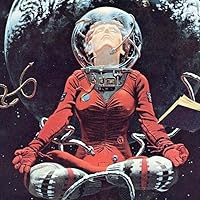
I must have tried to read this when I was a kid. The cover is very familiar -- and eyecatching to teenage boys. It's a woman floating in space, wearing a dress that seems to be made of a length of gauze, a piece of string, and a pigeon. There are also some more-phallic-than-usual starships.
...I wonder if the cover was painted as a nude in space (a scene from the book!) and then covered over with the dress (also from the book! but a different scene) for publication. Hm. No, the coronet doesn't fit that scenario. Oh well.
No, the cover isn't as interesting as I'm making it sound.
A trio of Galactic aristocrats land on backwater, impoverished Earth. Two are immediately beaten to death by irate locals. Marada Kerrion escapes in the company of Shebat, a starving waif with a bit of magical talent.
This has potential. The book doesn't come through for it, at least not for me. After the opening, the narrative splinters into a Great Family political drama, with Shebat bouncing around between the glowering Kerrion patriarch, his Hera-esque wife, various of his wastrel children, and others. Marada -- the Kerrion heir and presumed male protagonist -- disappears offstage for most of the book, leaving Shebat moping around with an adolescent crush and nothing to do but become the galaxy's greatest dream-dancer and also starpilot. People plot, scheme, betray each other, have not-very-consensual sex, commit assassinations and suicides and marriages. A lot of *that* happens offstage too. There's about three times as much plot as there is book, and this is just the first of a trilogy.
Also, the language is absurdly florid. If you're going to distract me with your rhetorical flourishes, they'd better be luminously lovely (or else funny as hell). These are just distracting.
The feeling of reading every third chapter from somebody's _Dune_ pastiche rapidly wore me out, and I wound up skimming out of sheer stubbornness. I was unable to follow most of the pieces around the board; whether this was lack of exposition or lack of attention is not really my problem.
I am glad to have finally probed the mystery of the girl wearing a pigeon, but I don't need to read the sequels.
Dream Dancer is a wonderful mix of fantasy, science fiction, and most epic of sagas with a strong feel of historical fiction thrown in. I couldn't get enough of this series! Strong character of both sexes, action non-stop, twists and turns on the background of most authentically recreated or newly created world that was a pleasure to get acquitted with, this story won't leave the reader indifferent. Prepare to read deep into the nights, if not to finish each book of the series in one sitting!
A complex and engrossing tale in the best "space-opera" traditions of Asimov, Norton, and Cherryh. Set against the Byzantine political backdrop of an interstellar trade consortium, the story explores metaphysical and quantum-physical themes of identity, interpersonal relations, and cultural assimilation through a well-woven third-person multi-threaded close-viewpoint approach.
The readers' minds'-eye alternately zooms in on the thoughts of individuals, pans out to capture multiple characters in tableau, and offers panoramic glimpses of the richly-detailed future world that Ms. Morris has so lovingly crafted for the reader. These shifts in perspective are generally handled with the adroit clarity and precision of an author at the height of her mastery. The prose is lyrical, moving, and attentive. The fictional milieu is well-realized, with a minimalist approach to exposition: there is no explanation for how the Earth became a primitive backwater of humanity; no history of mankind's colonization of the stars. Ms. Morris' solution to FTL interstellar travel is well-grounded in currently-accepted theories about astrophysics and quantum mechanics, while taking just enough believable leeway to get around time-dilation and all the narrative messiness that comes with it.
While firmly set within a traditional futuristic science-fiction milieu, Dream Dancer also comes with its own share of fantastical elements; whether this "magic" is truly supernatural and efficacious, scientifically possible, or merely superstitious remains a point of uncertainty throughout the work, depending on the viewpoint character in any given moment. The eponymous "dream dancing" and ship-pilot interface might be paranormal, pseudo-scientific telepathy, cybernetic enhancement, supernatural magic, superstitious hokum, or all of the above. The naive narrator/protagonist's quaint homespun protection charms might do nothing, but they agitate the environment to produce a visible effect. The uncertainty about these fantastical elements is reminiscent of Herbert's Dune (the Bene Gesserit sisterhood in particular), and the third of Arthur C. Clarke's famous three laws: "Any sufficiently advanced technology is indistinguishable from magic."
The characters are distinct and deeply imagined for the readers' benefit. The number of major characters is substantial and somewhat daunting in the first third, but thereafter stabilizes. Ms. Morris carefully controls our experience of each character, presenting even the most despicably corrupt as greater-than-the-sum-of-parts: sympathetic and fully-realized characters with motivations and obligations familiar to any reader.
As I would expect from Ms. Morris, the plot and subplots are tightly-woven, with no loose ends left dangling. The pacing starts off slowly, but soon accelerates to light-speed, carrying the reader through to the end on a wave of "sponge-space" to arrive breathless and blinking at the end.
The ebook edition does suffer from an unfortunate number of typos, a few of which (a handful of missing words scattered here and there) are particularly jarring to the reader; however, this is not out of keeping with similar quality-control issues faced by most major publishers in the present day and age. Although unfortunate, these errors didn't prevent me from thoroughly enjoying this work (-0.5 stars).
There were moments in the pacing where I had the distinct impression that something had been left out in the editing. But by the end of the story, I couldn't have told you what they might have been. The various threads as presented came together into a satisfying whole, with no notion that anything was missing, or any stone had been left unturned, so -0.5 stars for one or two points of uneven editing.
Otherwise, this was a delightful and fulfilling read, highly recommended to any fan of classic Science-Fiction. I'm looking forward to the next book in the Kerrion Empire series.
This book has been on my shelf for years. I finally decided to try it, and I am so glad I did. I am not a big science fiction fan, but I loved this book. The plot was exciting, but it was the characters that I so enjoyed. They were wonderful & horrible!
Was absolutely wowed by this book. For me it contained elements of Star Trek, The Hunger Games and many more books that I love. I really related to Shebat, the earth witch, and understood what she was going through. I was disappointed at the end because I wanted to know more, but hey, this will make me buy the next book. Well done to Janet - a fabulous author!
Janet Morris has created a complex, vast and politically chaotic universe in this 3 book series, along with unique and complex characters whose misguided loyalties, ambitions and beliefs make them believable, intriguing protagonists whose actions drive political drama and personal conflict. The heir to the Kerrion governorship, Marada Kerrion, lands on Earth (slumming with his fiance and a friend) and leaves with Shebat, a superstitious, uneducated orphan of 15, leaving his other companions dead on the planet and thus bringing his family into possible war with his fiance's family. Shebat is adopted into the Kerrion family and immediately thrust into political intrigue and danger from Marada, his half-brothers, Chaeron and Julian, their mother, Ashera, and the plots and machinations of the pilots guild and the down-trodden poor. Shebat is intelligent, rebellious and escaping her adopted family, goes underground and learns to be a "dream dancer," a person who can telepathically enter a client's dreaming mind and spin dreams--a profession that is akin to prostitution and is illegal, as it can be used to influence revolt against the ruling class. Shebat also obtains her pilot's license and the gift of a sentient ship that forms an almost symbiotic union with its pilot. The unknowing pawn of rebellious forces, Shebat does not know who to trust and is therefore manipulated into treasonous acts, escaping a deadly fate by being returned to Earth and then rescued by her sentient ship, which she has named "Marada,' along with another companion and enemy; her husband. The series is well-written, fast-paced with a robust world of technology and magic, political intrigue and personal conflict.
It's a long, long time since I last read this! I'm now old enough to realise that many of the characters I thought were acting as.mature adults were little more than lads themselves. Shebat, the main female character, is almost a child, young enough to make me feel a little shocked by the implied sexual activity. She's forced to grow up very quickly, a destitute orphan snatched from a life of slavery on impoverished earth, to be adopted by a wealthy, powerful family in a future where all the wealth is now concentrated in space, in artificial habitats. Is she just a pawn in a complicated political game, or is her new family genuinely fond of her? The question is never fully answered as adapts to her new life and learns how to be a space cruiser pilot.
My initial fascination with this book when I read it all those years ago was that it was my first encounter with the idea that the AIs controlling space ships could be sentient, possessed of self awareness and emotions. It's an idea other authors have explored since, but that doesn't in any way weaken this particular story. There's a second book fortunately because this one only feels like a short introduction to cruiser consciousness. One feels they could become major players.
I’m a little conflicted. It was a good book and interesting story, but the part that bothered me was how it took me a lot of effort to understand the surroundings, the locations. To be honest I still don’t have a complete image of what exactly happened where. The spaceships, the location where the dream dancers live, the Kerrion head quarters, the sponge space? It could be because of the storytelling language. Because I’m not unfamiar with sci fi and space travelling. Although I’m talking about series/movies and informative books. Not sci fi books. This might be my very first one, to be honest. Which could explain it. Anyhow. It was definately not a bad story, I just stuggle to visualize everything. And I couldn’t find anything online, like a book evaluation or something that could have helped me more... pity!
This entire review has been hidden because of spoilers.
My first step into a scifi novel by Janet Morris, and it's another example of why I love her storytelling. Rich writing and imaginative concepts, compelling characters. Not to leave spoilers, but the concept of faster-than-light travel is intriguing. The adaption of a girl from a primitive world to a technological culture is fascinating. The court politics and intrigue is engrossing. "...interrogation disguised as pleasantry, of manipulation masquerading as advice." Loved that line! I've jumped right into book 2!
I'm finding the writing style to be compelling and also a barrier to understanding. It's refreshing when so much that I read these days is written in much simpler prose and verbiage. Long winding sentences and unfamiliar word choices make me stop to think and reread.
The story so far is interesting, although the inciting incident where the main characters meet seems unrealistic; I'm not really buying into the two deaths, it seems they could have been so easily avoided that it doesn't make sense. Regardless, enjoying the read!
This book is a tad like being on acid but for some reason it hooked me. I started reading at my mom's house because I had forgotten my own book. I like the setting--meaning the actual setting and the the what makes it scifi/fantasy (i.e., the magic used, etc). It would not get more than 3 stars from me however because it has very little character development. Things kind of jump around haphazardly with not enough explanation of why the characters are doing what. But it has intrigued me enough that I have moved on to the second book...
Entertaining start to this series that is set in a well detailed, expansive universe. I particularly liked the pilot/AI ship dynamic and concept of "sponge space" to achieve FTL. As for the lead character Shebat, so far mixed feelings, as she seems too emotional and impotent, as she lets others constantly drag her into events/situations. Hopefully, she will evolve more admirable traits in the next entry.