Technical writer and volunteer fireman Charles Forrester died at age 37. But his insurance covered freezing in liquid nitrogen against the possibility of someday being thawed, repaired, and returned to life. Which is how he woke up in 2527, with a quarter of a million dollars coming to him from the same insurance policy. Not that he was rich—he was quickly informed that two million was a bare subsistence income. He needed a job, and quick. While looking, he somehow unintentionally insulted a man who took out a license to injure or kill him, attracted the attention of a woman who wanted to begin a relationship, said relationship being very unlike anything Forrester had heard of in his time—and he found a job. However, his employer was an alien, one of a group being held captive on Earth to keep them from getting home and giving the location of Earth to a civilization which might be hostile. And that was when things really became interesting.
Frederik George Pohl, Jr. was an American science fiction writer, editor and fan, with a career spanning over seventy years. From about 1959 until 1969, Pohl edited Galaxy magazine and its sister magazine IF winning the Hugo for IF three years in a row. His writing also won him three Hugos and multiple Nebula Awards. He became a Nebula Grand Master in 1993.
Where would Science Fiction be without cryogenics, hypersleep and sundry other technological ways of re-imagining the Rip Van Winkle story? The useful trope that is Freezing (and reviving) people allows for authors to transplant characters forward in time into unfamiliar environments without having to negotiate the tricky, paradox-minefield of time travel, and this is exactly the underpinning of Frederick Pohl's The Age of the Pussyfoot.
Frederick Pohl is deservedly well-regarded in Science Fiction. Gateway is genuine SF classic up there with Niven's Ringworld in its combination of solid story and great ideas. Unfortunately Pussyfoot isn't in this league, and to my jaundiced eye, isn't a particularly strong book, but it's still an entertaining and occasionally amusing read.
Pohl's central character -Charles Forrester, a former volunteer fireman - awakens from cryogenic sleep in the 26th century. Frozen after being horribly injured on the job he has been brought back to life in an era where technology has finally reached a level high enough to rejuvenate his broken body.
So far, so standard cryogenics story, but more interestingly, in the ultra capitalist future people like Forrester aren't revived unless their assets have appreciated to the point that they can pay for their own revival. Forrester has accumulated vast riches in his half-millennium in the freezer and is left with 250,000 dollars after his revival, an amount he believes will set him up for life (this is one of the amusing 1970s tells in Pussyfoot - If I woke up in five hundred years time with nothing but 250k I wouldn't be ecstatic - a quarter of a mill won't even pay for an apartment in 2017 Melbourne, let alone make you rich).
Of course Forrester's windfall turns out to be a few weeks spending money and what follows is a sometimes amusing fish-out-of-water tale as Forrester tries to reconcile his conservative 1970's mindset and technologically stone-age skills with the 26th Century world. Using a 'joymaker' a combined smart-phone/drug-dispenser he learns about the strange, liberated world he lives in and eventually about an interstellar conflict between humanity and the Sirians- a race that humans have attacked without provocation and eight of whose members they keep prisoner on Earth. Naturally, Forrester becomes entangled with this conflict, with consequences for both himself and humanity as a whole.
Pussyfoot is a quick read, and it's quite entertaining.
Forrester's archaic 20th century manners give rise to a number of social faux-pas, one of which sees him being hunted down and killed for fun by a group of Martians (Being killed isn't such a big deal when you can be revived the same day), and he is constantly offending people by accident and getting himself into tricky situations.
There are some nicely prescient elements to this story - for example, Forrester is constantly besieged by messages on his joymaker that he either can't or won't find time to read, much like the plague of pointless emails that we all deal with in 2017. However, he often feels deliberately obtuse in the manner of his being unable to fit in. He constantly ignores advice, even when his track record of doing so has gotten him kicked to death, and his bloody-minded ignorance grated on me.
There is satire here- the world of the future seems as stratified as our own world, and the homeless/poor are occasionally hunted for sport by the richer elements of their society. The people of the future call men from Forrester's era 'kamikazes' due to their rapid and sometimes destructive impulsiveness and decision making, contrasting them with 26th century folk who are eventually shown to be weak, indecisive and soft, lacking the spine of a 1970s guy like Forrester (I imagined him as a seventies cop type, with a big black moustache).
Despite these positives, Pussyfoot felt unfinished to me. The ending rushes up and feels tacked on, as though Pohl just wanted to end the story and move on to something else. Furthermore, the conflict with the Silarians is unsatisfying, and to be honest the book had me cheering for them to get revenge on humanity.
In my opinion, The Unincorporated man is a much better cryogenic fish-out-of-water story, and a richer satire of an ultra capitalist future. Pohl's Pussyfoot is an entertaining and easy read, but it left me feeling unsatisfied.
Frederik Phol’s “The Age of the Pussyfoot, (1969 and shorter Magazine version 1965)” is not regarded, or referred to, as are his collaborations with Cyril Kornbluth, such as “The Space Merchants,” and his excellent Gateway series, though, perhaps it ought to be as it is also an excellent example of the subtle cynical satire he and Kornbluth are known for.
Often, the genesis of a sf novel comes from an inspiration set off by a new scientific discovery or the development of a new technology. The author might speculate as to how this new item might develop over time; how it will affect society, its customs and culture. Pussyfoot, according to Pohl’s biography, the inspiration came from a non-fiction article written by Robert C. W. Ettinger, that came across his desk while he was editing IF magazine in 1964. The article was about an actual proposition of a system of freezing human beings by way of Cryonics so that they might be thawed out at a future date and so on, thus you have this novel.
The most interesting aspect in this case is that forty-five years later, it isn’t the idea of Cryonics that stands out, but rather it is another element that was referred to throughout the entire story which he called a “joymaker.” This was based on an M.I.T. Project MAC which consisted of “two big IBM 7094’s, plus half a dozen or so servant computers, that are available to anyone with a remote-access console in his home or office...” He goes on to explain that it is hooked up through the telephone lines (or perhaps at a future date via radio). He assumed that this bit of technology would eventually be minimized and become portable... Hey, Fred! This is a smart phone!
His characters are entirely dependent on these things and he even shows the unique kind of anxiety and helplessness one would have if his or hers happens to breakdown or get lost.
There are many other interesting social elements to this tightly written novel. A book that perhaps fits better with current time rather than when it was originally written.
He wakes up after having been frozen for two hundred years, and has to get used to 23rd century society. The acclimatization isn't all straightforward. They fix him up with a job, and he asks what his salary is going to be.
"A bit over two million dollars a week," they tell him. He's pleased! "Oh no," they say, concerned, "that's rock-bottom minimum. You simply can't get by on less than two million."
As you can see, a logical projection of current trends in Western society...
Fred Pohl ( 1919- 2013) was a long-time science fiction writer who created a massive body of work. This one by Pohl is not one of his better ones, but it works as a sometimes amusing satire. It's the story of a man who dies in 1969 and wakes up 500 years in the future. How can he ever fit into such an alien society?
I've never been much of a sci-fi reader. My loss. I wonder what I would have thought of this book in 8th grade, when it was new. I'm sure I would have found it engaging and fun...it's certainly that. But how much of the details would I have dismissed as pure fantasy?
Pohl writes of devices, pharmaceuticals, policies and morality so clearly not of the time he wrote this (1968) that he pushed the setting of his story 500 years into the future...yet a mere 43 years later, a lot of it is already here. Pohl predicts the Internet, the iPhone and more.
It's a short book, an easy afternoon's read...if you can find a copy. Long out of print, this one deserves fresh attention and exposure to a new generation of readers.
I love Frederik Pohl. His insights amaze me. I didn't love this as much as Gateway and his entire Heechee Saga series of books, but I liked it a lot. This is a quick read and an interesting point of view of what he thought 2008 would look like, from a 1968 perspective. While he set the book in the year 2527, in the afterward he said he actually thought we were about 50 years away from this "future." He wrote the book in 1968, and he got a great deal right about where are we today. Impressive!
Fred Pohl was more an editor than an author in his own right around the time The Age of the Pussyfoot was published, but this book shows just what a crackerjack writer he was (and remains!).*
Sticking to a satirical vein he explored with frequent collaborator C.M. Kornbluth in the '50s, Pohl uses the ever convenient plot device of suspended animation to plop a mid-20th century American fire-fighter in the world of the 26th century. What follows is a deftly and breezily (though never vapidly) written picaresque as our man Forrester navigates the treacherous new social and technological landscape.
This ends up becoming a delightful inversion of the pervasive "Mighty Whitey" Good-Ol'-American-Gumption-Saves-The-Day style of adventure and science fiction writing, as Forrester continually shows himself to be not only not up the task of simply living day-to-day, but also so blinded by presumption and arrogance that he takes far too long to consider that he might need to listen to other people to learn how to adjust. Through his befuddled misadventures, we get a kind of tour of a society almost entirely redrawn by technology, most obviously by the technologies of Death Reversal (rendering murder and fights to the death A-OK as long as the murdering party has his insurance and bonds in order) and the ubiquitous networked communicator and pharmacological fabricator, the Joymaker.
The Joymaker is the most famous and striking element of The Age of the Pussyfoot, for in it Pohl very much foresaw in the late 1960s a device much like the smartphones of our early 21st century (give it a couple of decades for the on board feel-good-drugs dispenser). Every citizen of the city of Shoggo (our Chicago) and presumably across the country possesses this device, which serves as a personal communicator, calendar and organizer, medical and mood-altering drug dispensor, and networked access point to centralized computational resources (apps on the cloud, essentially!).
As a daily user of an iJoymaker, Forrester's constant dismissal of his Joymaker's attempts to deliver urgent messages (much to his chagrin and detriment) generated a profound anxiety for me! Pohl of course intends his readers to realize just how unwise Forrester is being for ignoring his messages and communications, even while this would have been an entirely understandable approach for a mid 20th century individual unused to being perpetually "reachable". Forrester's dunderheadedness in this regard is even more striking to the early 21st century individual adapted to the world of constant contact than it was for the works contemporary readership.
The Age of the Pussyfoot's plots hums along at a healthy clip, and never slows down for long, but plot is not as important to the work's success as Pohl's phenomenal and well thought-out world-building and his feel for how technology shapes human actions and perceptions. As such a sense (and its capable expression) is one of the essences of successful science fiction, The Age of the Pussyfoot earns a place as a fascinating (if not really profound) gem of satirical SF.
*This review was written about a year before Mr. Pohl passed away in September 2013. The "and remains" refers to his blog "The Way the Future Blogs", which is being carried on by his wife Elizabeth Anne Hull with some material he had written that hadn't yet been published.
I enjoyed this pulp sci-fi so much more than I thought I would! Forrester dies in 1969 and wakes up almost 600 years in the future, and most of the book is him wilfully refusing to learn what’s up with the future, getting into trouble, and then being like well how was I supposed to know?? Which makes for a fun ride and a character that’s compelling, if not a little humorously frustrating at times.
There were so many profound and thought-provoking aspects to this future world that are still as relevant today (if not more) as they were in the 1960s when this book was written. Also super cool to see what a writer in the 1960s thought the future might look like!
In my opinion Pohl was the weakest link of the well-known collaboration with C. M. Kornbluth, but still I think that this book is quite solid to deserve a read. It has some few psychedelic elements here and there, although sometimes plot develops too quickly with no time for the reader to wander in this chaotic future world.
We kennen Frederik Pohl van het heerlijk verrassende en meeslepende Gateway en lazen ook Beyond the Blue Event Horizon met plezier.
De onsterfelijke diepvriesmens is alvast een knullige vertaling van 'The Age of the Pussyfoot' en knullig, zo vonden we het boek ook op gang komen. Ligt het aan de vertaling uit 1971? Wie weet.
Charles Forrester ontwaakt na 6 eeuwen diepvriesslaap in een totaal nieuwe maatschappij. Frederik Pohl probeert aan de hand van Forrester's ervaringen enkele visies en punten duidelijk te maken, maar verliest daarmee zijn karaktervorming wat uit het oog. We vonden Forrester astrant, dom en irritant. Het is moeilijk mee te groeien met zo'n hoofdpersonage. De plot was alsnog een beetje verrassend, maar eigenlijk maalden we daar al niet meer om.
Want me to define disjointedness with an example? Look at the cover of the Del Rey edition of this novel... And now flip open to the introduction where Pohl writes how he is hopeful that this novel might be read by the general public at large (not just SF fans). And back to the cover again which features a many-tentacled alien in a spaceship.
But despite the fact that publishers didn't expect this book to appeal to the mainstream, Pohl certainly hoped it might.
The book scores early when the protagonist wakes up in the far future after having been frozen for centuries to find out that his investments are now worth millions. After a bit of partying he learns that weekly subsistence wages are measured in millions...
The reader has to remember that Pohl was writing this more than 40 years ago, and he gets a lot of it right. As a satire, it's not cutting-edge anymore. But it's a nice reminder of where we've come from in the recent past, and just how much society and technology have changed in a few decades.
4 stars - a fun read, written by a consummately capable author.
A technical writer and volunteer fireman dies in 1969, is frozen, and is revived in 2512. He has various adventures, and gets involved with the Sirians (sic - not Syrians!) who are at war with Earthlings. In 2512 there is a device called the joymaker, which is an AI-equipped cell phone that can stimulate its owner's nervous system directly; it does not appear as fantastic in the age of USB-powered vibrators and electric shock-giving Xbox mods, as it did in 1969.
I read this when it was originally published as a three part series in Galaxy SciFi magazine in 1966. I was impressed then and have watched as our world has developed in ways scarily like those predicted!
How would a commoner of the 1500s fare if transported to the modern world? Terribly. The language, customs, laws, economy and more would be almost incomprehensible. Even if they could muddle their way through life, they'd never truly "fit in". So goes The Age of the Pussyfoot, where a man from the 20th century is unfrozen in the 26th century after being cured of deadly injuries. Everything is strange, he constantly commits faux pas he doesn't notice, can hardly understand how anything works or what's going on, and bumbles from trouble to trouble.
One aspect is weirdly prescient. The joymaker, a handheld device carried by everyone in the far future, functions as a combined personal assistant, telephone, information lookup, means of ordering everything from food to transportation, and can administer aerosolized psychoactive drugs. Aside from the drugs it does everything a modern smartphone does. It even bombards you with constant distracting message notifications. Also on point are "post-industrial" bullshit jobs and Silicon Valley polycules (though these aspects are barely touched on). I was about to scoff when Pohl in his afterword wrote "I don't think it will be that long. Not five centuries. Perhaps not even five decades." But honestly, he was exactly right. Gives me the heebie jeebies thinking about what the 26th century might actually be like (if we make it so far).
As a story, it's disappointing. Specifically, the ending is a deus ex machina nothing that doesn't even resolve the main relationship between our 20th century primitive and a 26th century woman. Will he ever adapt to this brave new world? Will she ever respect him? Oh, but Pohl was so kind as to literally tell us, in the exact words, that he lives happily ever after. hahaha
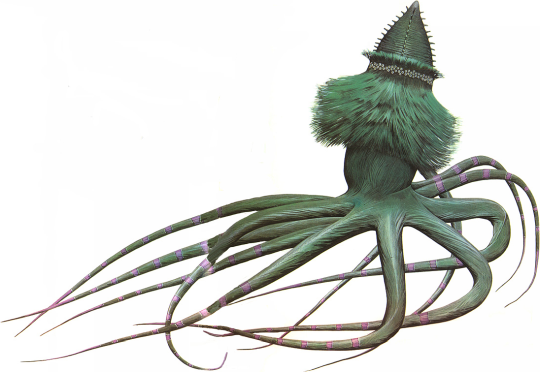
Oh yeah, there were some aliens. The Sirians are such a tiny and underdeveloped element of the plot I almost forgot I read this as part of my Barlowe's Guide pledge. Which is insane, I mean, look at that drawing. This image defined the concept of aliens to me as a kid. The tentacles, the dozens of eyes, the thousands of hairs in that collar, immaculate. I was hoping there might be some fish out of water coming to understand each other element to the story (several Sirians live in "house arrest" on Earth while their race is at war with humanity), but alas.
I bought and read “The Age of the Pussyfoot” in 2001, shortly after moving into my first apartment. I heard that it was part of the inspiration for a video game I was a big fan of, “System Shock”. I remember thinking the book was strange, and some disappointment in that it is nothing like “System Shock”, but it’s also interesting. I recently decided to pick it up again.
SUMMARY Charles Forrester was a volunteer fire fighter who was killed in the year 1969. By the year 2527 the damage by the fire can be repaired, he is revived, and inherits a small fortune in insurance. He tries to adapt to a world that is nothing like what he remembers and “modern” society is alien to him.
Forrester soon learns that everything in this world has a price though, and just subsisting from week to week requires a fortune. Fortunately, people tend to earn that much money even with fairly menial jobs. Forrester takes a job as an assistant to an alien, a Sirian, who is currently living on Earth after being taken as a prisoner-of-war in a recent conflict. Forrester soon becomes a focal point of important, world-changing events, and must decide whether to integrate with this strange new future, or change it forever.
OVERALL: 3.4 out of 5 “The Age of the Pussyfoot” is an amazing book based on the future that Pohl describes. The “Joymaker” is not far off from the mobile smart phones that people carry around today (in fact, smart phones can do a lot of things that a Joymaker can’t).
In the author’s notes in the back, Pohl wonders if the future he has described may occur in 2018 rather than 2527, and he isn’t too far off the mark in some respects. Sadly, rejuvenation technology to bring people back from unfortunate death does not exist yet. We also haven’t make contact with any aliens, as far as I know.
Besides the compelling and very original look at the future of humanity, Pohl does a good job asking questions about human behavior, and at what point certain taboos and social boundaries are torn down or replaced.
RATINGS BY CATEGORY CHARACTERS: 3 out of 5 The writer is dealing with a cast that are so far removed from modern humanity (and rightly so), that it’s difficult to say if they’re well written or not. They are generally entertaining, though confusing, and they are only presented within the lens of Forrester’s eye (without him, these people would seem completely alien).
Forrester is well written, and generally feels like an everyday sort of guy, but I don’t like him. He tends to be rash and impulsive, and makes a lot of choices that I think are stupid. He becomes more likable halfway through the book. He becomes less impulsive, and begins to make decisions about what he wants for himself in this future society.
PACE: 4 out of 5 It’s not a long book, and not many moments are wasted. It flows quickly and enjoyably.
STORY: 4 out of 5 I think it is easy to present “fish out of water” stories that eventually become boring drags filled with stale jokes and predictable moments of “Oh, I didn’t understand that.” This book is better than that. Though Forrester is aggravatingly naïve and impulsive at different times, stubbornly refusing to accept that some things have changed from what he is familiar with, there is enough going on here to keep a reader interested to the very end. He tries to adapt, he makes friends, he makes enemies, and the same situations aren’t repeated over and over again (with the exception of a pair of children who constantly tease him over his unfamiliarity with things they consider basic).
There is a lot of “psychology of humanity” in this book, rather than psychology of individuals. Pohl looks at how we behave, how we react to crises, and asks the reader what the best way of handling things is.
DIALOGUE: 3 out of 5 Dialogue is well-written, though I don’t like most of the terms invented by the author. “Sweat” seems to be the general exclamation and interjection used by adults and children alike, while “Kamikaze” is generally the noun and adjective used by 26th century people to describe people from the 20th century.
STYLE/TECHNICAL: 3 out of 5 There are some parts of the story where Pohl really expects the reader’s imagination to do the heavy lifting, but he describes people and places in an easy-to-understand way, and most of the events aren’t too confusing. In the places where the reader may get lost, I think the idea is that Forrester is lost well- trying to understand concepts, places, and behaviors in this strange future.
Ausgeliehen damals aus der Stadtbibliothek in der Hardcover-Ausgabe des Marion von Schröder Verlags. Ich war noch ein Teenager, doch es hat mir so gut gefallen, dass ich mehr vom Autor lesen wollte und es dann auch tat, allerdings meist Kurzgeschichten. Es ist eine Art Utopia, in der Nachfolge von "Der Schläfer erwacht" von H.G. Wells, denn die Hauptfigur erwacht 200 Jahre in der Zukunft, nachdem sie eingefroren wurde. Eine bessere Welt, aber mit Fehlern. Und da gibt es noch die Sirianer: Eine Invasion droht. Ich fand die Zukunftswelt interessant, die sozialen Aspekte davon. Und das Buch war spannend.
If you imagine the most colorful stereotype you can of retro science fiction (minus space battles) you would get pretty close to what this book is. People are frozen to wait for a time when science (and their bank accounts) has improved enough to allow their resurrection. Flying cars whiz between shining buildings where people partake in cafes and malls as beautiful as the Garden of Eden. Food and drink are synthesized for us. There are aspects of the story that seem a bit outdated to the 21st Century reader, such as the air-headed nature of the female lead, but other aspects that send ideas shooting into the future, such as that same woman being identified as a living, breathing individual who cannot be owned by a man, who has sexual autonomy, who can have children with as many different men as she pleases, and who has control of her own income through whatever means she has talent for. Pohl really saw far ahead in the creation of the joymakers, little wands that act as communicators, remote controls, drug dispensers, and internet hookups. (I couldn't help but imagine that they look like the microphones from Mermaid Melody Pichi Pichi Pitch throughout the book!)
The main character is fascinating in that he keeps the reader in the dark for most of the story by purposefully allowing himself to stay in the dark. He does not embrace this new world, ignoring messages and books and other useful information, more curious about the history leading up to his current reality than in the world around him 600 after his birth. The book chronicles his first couple months as a sort of time traveler permanently stuck in the future trying to navigate the bizarre nature of human life when everything has been built to serve them and maintenance is the name of the game.
*SPOILERS* Charles Forrester wakes up nearly 600 years in the future after becoming one of the first people frozen right before death, revived when technology advanced enough to restore him to health and youth. He finds himself in the vast city of Shoggo among smooth, colorful buildings with flying cars zipping around, giant TV screens, police bots, and handheld devices called joymakers that act as communicators, remote controls, drug dispensers, and more. At first Forrester believes he is rich; his savings from the 1970s have increased in value so that he has a quarter a million dollars. However, after some gratuitous spending, he finds out that the reality is that most of his money was used to bring him back to life (the other half of waiting as an ice cube is waiting for your money to be sufficient to pay for the science) and there are many, many more things to pay for these days: rare foods, joymaker fees, comfortable living, etc. Forrest struggles to shake his 20th Century hangups in order to survive in this new world. He resents the fact that people don't really perform real work anymore, mostly being paid for clubs and hobbies. He also finds interpersonal relationships very confusing, especially as he falls in love with a woman named Adne who he eventually learns has two children by different fathers, neither of whom she was ever married to, and who freely takes birth control and shares her body. He is also confused by everyone's casual treatment of death now that permanent devise is mostly avoidable; people are allowed to fill out paperwork and kill another person legally and he is beaten up due to one such filed license. (There is some suggestion later that permanently dead bodies are cleaned up and added to the Sea of Soup that produces much of the synthetic meat and other foods we have seen Forrester eat throughout the story.) When he realizes that medical and joymaker expenses will soon bankrupt him, Forrester takes the highest paying job readily available and spends his time informing an alien about the history of humanity. The few alien Sirians on the planet are part of a warlike race humanity watches from afar, the ones on Earth kept comfortably captive to prevent them from escaping and bringing the weight of their space fleet upon us. Failing to properly follow instruction, Forrest is fired from that job and starts a tedious job as a system monitor, spending about three hours per day under a dangerously radioactive lake. When he learns of the eventual harm this will do to his body, thus the high pay, he promptly quits, resulting in a surrendered salary and utter bankruptcy. He goes to Adne's children when he joymaker stops working to learn this and they take him to where the Forgotten Men live near the highway. Those who somewhat by choice do not work to maintain a joymaker or other societal comforts spend their time asking for money, drinking much of it away, and reminiscing about the past they left behind when they were frozen. Things change when Forrester witnesses the darker side of humanity as rich people occasionally descend upon the Forgotten Men to kill them for the thrill of ending someone's life permanently. Running as his closest friend is murdered, Forrester is caught by the Sirian he once worked for and hypnotized into helping the alien get back to its ship and take off, leaving him behind. Dazed and confused, he goes to see Adne and her friend Hironubi, who are watching the news. It becomes apparent that the escaped Sirian is on its way home and the imminent destruction of Earth is expected. That being said, the Sirian left most of its substantial Earth wealth to Forrester, making him truly wealthy. No one finds this odd, since the Sirians were always odd. Still, Forrester is overcome with guilt, retreating to his restored apartment for most of a month before emerging to discover that most of the Earth's population has opted to die and be frozen until a future after Sirian destruction arrives. Looking for anyone to talk to, he goes to see Hironubi, who once offered him a job as part of a society that aims to cut technology out of human life. He sees this as a huge opportunity and is working with the remaining Sirians to bring down the system that allows people to live frivolously while machines take care of them. Though Forrester agrees with Hironubi in part, he decides he cannot abide by this potential genocide of the frozen humans. Though the police bots have all been taken over, he has the idea to slice his throat, thus forcing the medical robots to take him to the freezing place to be seen by a human doctor. This works and his throat rapidly heals while the Sirians and Hironubi are taken care of. His part in the Sirian escape is revealed, but outweighed by his saving the human race. Slowly humanity is unfrozen and it is presumed that Forrester continues his journey through future society for many hundreds of years.
This is actually the only Pohl book I have ever liked except for some written with Kornbluth. The story is a vehicle for exploring a potential society of the 26th century. It is told from the POV of a man frozen in the 20th century and revived 6 centuries later, with a lot of money, or so he thinks. The character of the protagonist is actually very well chosen. He is intelligent but very egotistical and never listens. Thus he gets in a lot of trouble allowing the author to describe many aspects of the culture from the highs to the lows. Never the less it is a fast reading (5 hrs) and fun story. Recommended.
Loved it, mind spinning ideas. Only book that I read that predicted how crazy people of the future will be about their cell phones. He called them "Joymakers" and people could not live without them. All other Science Fiction books were talking about moon bases and holidays on Mars. Frederik Pohl actually scored a hole in one with this prediction. I read his other books, whenever I can find them, with great interest because of this story.
An interesting forward look at what future gadgets and mores could do, based on extrapolations from the 60s. The understandable but constant confusion of the lead character reduce the drama, as he is always trying to understand what's going on now, and reacting often blindly. A fast read and an okay pulp sci-fi.
Dağınık ve anafikirsiz bir roman bence. Neye odaklanacağını şaşırmış. Uzunca bir süre 600 sene sonrasının dünyasını ve onun farklarını anlatmaya çalışırken sonunda alakasız bir yere kaymaya çabalamış. Pek sevmedim.
This was a fun book, though very short - I mostly read it all in one sitting (OK, a very long bus ride). I didn't know what to expect from this book, but the cover is no indication, that's for sure. This book had a pretty unique setting and plot - being a man transported 500 years to the future into a society that doesn't really fear death (because they can be easily resurrected), and they're consumed with luxuries but can still have a hard time affording them, and there's a backdrop of the potentially imminent invasion of an alien species. I'm sure that each of these elements have appeared in books I've read before, but lumping them all together and with their particular nuances - well, it really created an impressive and believable setting that was unlike any one thing I've read before. The characters were a bit caricatured, but not overdone like Heinlein, rather just the right amount to make them fun and relatable but still mostly believable. The plot had several different main threads (just like the setting has several different pivot points), some appearing very weighty and some less weighty, and that kept it interesting and entertaining the whole time without ever really being sure what was going to happen, or without even really knowing which plot thread was the most significant. Honestly, with all the different aspects of the book, I felt like it could've easily been much longer and dived more into this unique and fascinating world that he'd created. Nonetheless, it did end satisfactorily and tie up pretty much all the loose ends.
I came into this book not knowing what to expect, but knowing that Pohl is a great author because of his Gateway series. However, this was somehow still not exactly what I expected. The tone was significantly lighter than "Gateway", but different aspects of the book also echoed many other books I've read. The time skip and radical social change often made me think of "The Forever War" by Haldeman. There was a significant section towards the end that really made me think of "Crime and Punishment"-lite. But then he also had his own thing, such as the "joymaker". Excluding its pharmaceutical abilities, it's incredible how well Pohl predicted networked computing with individual miniaturized devices (i.e. smartphones) - and this some 50 years ago when computing itself was still in its infancy. As a whole it was a very enjoyable book with many different positive influences and a fairly unique setting and plot. I definitely recommend it to most sci-fi fans.
I debated a lot about how many stars this book would get – at one point it was in the running for 1 (which would mean I didn’t finish it), but it pulled itself up before sinking back down again. The author’s note clarified for me that Pohl didn’t himself “invent” the one piece of tech-prediction that impressed me. His hand-held, pocket-sized computers were derived from MAC labs at MIT, and he even admits (rightly) that they might exist in “perhaps five decades,” although the main difference between smartphones and “joymakers” is that Pohl’s creations, being products of the drug-addled sixties, will spray you with tranquilizers whenever your heart rate is up.
The plot centers around that far more ridiculous technology, cryogenics, which has allowed his main character, a schnook from the mid-twentieth century, to find himself “un-frozen” five hundred years later with a whole stack of money from the interest on his life insurance policy (he finds out about inflation soon enough). In his note, Pohl is naively optimistic about cryogenics, ignoring the cost to the living of maintaining frozen bodies for centuries, as well as the lack of economic or other motivations for un-freezing useless people who lack basic survival skills in a future time. That problem however, is central to the plot of our “schnook,” called “Man Forrester” by his joymaker, and something else by the occasional human he deigns to talk to. I disliked him almost immediately, and was constantly infuriated by his unwillingness to respond to (or even read) his text messages, to ask for information when he needed it, or even to make the faintest effort to figure out what was going on before catastrophe struck, time and again, due to his willful ignorance.
Inadvertently, I think Pohl may have written the character of the ultimate “MAGA Republican” – a white man who reached adulthood in the late 1960s and refuses to accept that anything has changed since and responds with anger and dismay whenever he is not placed at the center of importance, responding instead by betraying everyone and wrecking everything and then blaming others for it. I doubt that’s what he intended, however.
سال ۲۵۲۷ میلادی است و چارلز دالگلیش فورستر، پس از ۵۹۶ سال از انجماد درآمده و دوباره زنده شدهاست. او یک آتشنشان بوده که در سال ۱۹۶۹ میلادی هنگام نجات جان عدهای در آتش گرفتار شده و جان باخته ولی بدنش را فریز کرده نگه داشتهاند و حال که زندهاش کردهاند میبیند در دنیایی تازه و در شهری به نام شوگو قدم گذاشته و پول اندکی که بیمهاش در بانک برایش گذاشته به یکچهارم میلیون دلار رسیده. انسانها همگی وسیلهای به نام جویمیکر دارند که پیامهای شخصی، داروهای مختلف، جستجویشغل یا و غذا و کلا همه کار را میشود با آن انجام داد. فورستر در روزهای ابتدایی زندهشدنش زیاد به اخطارات و درخودستهای جویمیکرش گوش نمیدهد و به همین دلیل گرفتاریهای زیادی برایش پیش میآید: زنی که به او علاقهمند شده را از دست م��دهد (ادنه بنسن)، پیشنهاد شغل را رد میکند، دچار یک دوئل احمقانه بر سر زندگیاش میشود، ورشکست شده و بیخانمان میشود (دوست بیخانمانش جان ویتلوی پیر را از دست میدهد)، کارمند بیگانگان (سیریانها، موجوداتی که انسانها در یکی از سفرهای اکتشافی خود، سفینه آنها را نابود کردهاند و حال به خاطر ترس از رو شدن مسئله آنها را در زمین محبوس کردهاند) میشود و در حالت هیپنوتیزم، یکی از آنها را که در زمین محبوساند فراری میدهد که باعث میشود ترس از حمله سیریانها جامعه را فرا بگیرد و ۹۸.۱ درصد انسانها خودکشی کنند و فریز شوند. البته از توطئه تایکو هیرونیبی که با سیریانها متحد شده هم جلوگیری میکند و زمین را موقتا نجات میدهد.
Charles Dalgleish Forrester Shoggo Joymaker Adne Bensen Sirians Taiko
This is like the idiot's version of "Hitchhiker's Guide to the Galaxy", although in a temporal sense. The protagonist, Forrester, was killed while on duty as a volunteer fireman in 1969. For some bizarre reason the fire company agrees to pay to put him in liquid helium and attach some money to his name. After 600 years the money grows to the point where it pays for his revival and healing. He thinks he's rich because he has $250K, and he makes the mistake of stepping on the foot of a Martian, who grew up in only 1/3 Earth's gravity and thus doesn't have strong bones. The Martian files for a license to hunt him, and goes chasing him around. He gets a girlfriend who thinks he's an idiot, and all of these "wacky" things happen. I mean, hey man, it's the future!
I got to page 75 and I abruptly realized that I couldn't read another stupid page, I couldn't stand another dumba$$ "shenanigan", and that I hated this book. It's supposed to be a satire on late 1960's culture, I believe (I conferred with my Baby Boomer mother at length about this and the value of money in that time during which it was written and published). If it didn't belong to the library I'd throw it out the window. Don't bother, really. Read a better book.
Pohl, Frederik. The Age of the Pussyfoot. Ballantine, 1969. When he was preparing his 1966 magazine serial, The Age of the Pussyfoot, for book publication, Frederik Pohl wrote an afterword that said he probably set the story too far in the future, that 50 rather than 500 years, might have been more reasonable for some of his prognostications. He had seen some emergency medical resuscitations and had been shown one of the early time-sharing computers. He was also aware of the sexual revolution of the 1960s and the growing drug culture. From these few real-world elements, he constructed a future with easy cryogenic storage and unlimited medical life extension, an online culture that has portable devices that resemble web-connected cell phones that also deliver mood-altering drugs. Charles Forrester, a twentieth-century guy who died in a fire, has insurance that puts him in the freezer for 500 years until he can be resurrected. Because death is not considered permanent, dueling and contract murder have been legalized. Charles discovers that stepping on a Martian’s fragile foot can get you back in the freezer if you are not careful, or even start an interplanetary war. Still fun after all these years. 4 stars.
When Charles Forrester burns to death in 1969 he does not expect to be awakened from cryogenic sleep in 2527. Once awakened however, he must come to terms with a bewildering array of new norms and mores, including that a license has been taken out by somebody to kill him. This is considered no big deal as he would normally just go back to the freezers and be regenerated - if he had money - but Forrester quickly finds that he has very little and must find a paying job. He also finds that Earth is sort of at war with the Sirians, after a human ship killed or captured the occupants of a Sirian ship and it is only that the Sirians don’t know it was Earth that has prevented full-scale war. Forrester unexpectedly gets a lucrative work offer just to sit around and talk about humanity but his suspicions are aroused when he finds that his employer is one of the captured Sirians. The Sirian hypnotizes Forrester into helping him escape and Earth goes into a panic with nearly all humans rushing to sit the war out in freezers, while a fifth column known as the Ned Lud Society assists in planning an invasion. Stirring stuff from Frederik Pohl with a dash of satire thrown in.
I first read this in Galaxy Science Fiction in 1965. My stand-alone novel was 1969 and Pohl has an afterword where he mentions the time scale is way too big, things will happen much faster.
A firefighter dies in a fire and is frozen (some rich guy set it up mainly for himself, but offered to firefighters). After he was there long enough to have his money expand into millions, he had enough to pay for the medical staff to revive him.
He's kind of dumb and stubborn in adapting to this world.
The main thing I love about this book is illustrated by the title "The Age of the Pussyfoot" is an easy future without all the conflict that makes "interesting" times. And I believe if we survive, that description will describe the world then.
A pretty good romp into a future world dominated by fear of alien attack and dependence on small machines. I would probably give this 3.5 stars if it allowed. Charles Forrester died in the 1960's but was revived in the 26th century when technology allowed it. He has to navigate his new world that seems bent on killing him again and again, as well as find work in order to pay for his personal machine that tells him everything. It's a pretty fun Sci-Fi, though I w0uldn't call it essential reading. Worth checking out though..
Picked it up in Oxfam as the cover and title looked good, then discovered the character’s name is “Charles” (great name).
A witty utopian sci-fi. In the story everyone has a ‘joymaker’ which is like their AI butler, in the authors note at the back he said it was inspired by M.I.T.’s project MAC, these days it’s more akin to an advanced version of chatgpt (pretty good prediction for a book written in 1968, even if he thought it’d be connected by radio waves).
Likeable characters, interesting situations and I also predict festivals having a ‘crawl’ section in the near future.