What do you think?
Rate this book

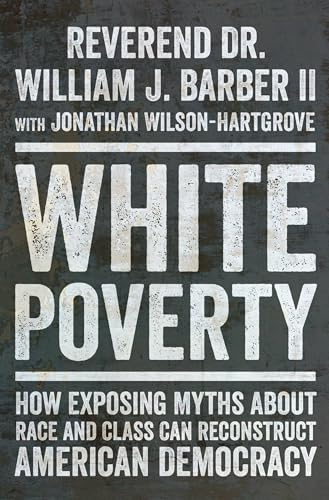
278 pages, Kindle Edition
Published June 11, 2024
That encounter awakened me to the need to spread the message expressed so clearly in Barber’s recent book, White Poverty. My household and my extended family have been familiar with William Barber for many years. For one thing, he’s an ordained minister in my denomination, the Christian Church (Disciples of Christ). For another, until recently, he was the pastor of a church within the region where I live, North Carolina. He now teaches at Yale Divinity School, where my oldest brother studied. We've attended a few of his rallies and seen him on the news.
The dust cover says his book tells “how exposing myths about race and class can reconstruct American democracy.” That description seems accurate though abstract. A broad summary statement can’t substitute for the interplay of statistics and stories White Poverty includes.
The starting point of the discussion is the need for us to take off our blinders; that is, to see poverty, to see the poor. Misleading statistics understate how widespread the crisis of poverty is. Speaking of it merely as an abstract phenomenon fails to see it as violence, as Coretta Scott King told her audience during the summer after the assassination of her husband, who started the first Poor People’s Campaign:
“I must remind you that starving a child is violence…Neglecting school children is violence. Punishing a mother and her family is violence. Discrimination against a working man is violence. Ignoring medical need is violence. Ghetto housing is violence. Contempt for poverty is violence." (p. 14f.)The next step in the discussion is recognition that more poor people are white than are Black (or from any other minority group). Barber emphasizes this point with an abundance of statistics and stories. Then he proceeds to refute four long-term lies that have blinded people to white poverty. (1) The lie of racism, which over time was invented to justify the economic domination and enslavement of Black people, and which has been used to make white and Black people afraid of each other. (2) The lie that only Black people need, want, or care about economic change to end poverty, a lie stemming from the “divide and conquer” strategy of segregationists. (3) The lie that poverty is only a Black issue, which “obscures the fact that white folks are potentially the largest single base for a movement of poor people that could demand our government address the crisis of poverty in America.” (p. 95) And (4) the lie that we cannot overcome division in our country. While it’s true that actions lead to reactions, just as Reconstruction was followed by Jim Crow, and the “Second Reconstruction” of the civil rights movement and War on Poverty was followed by the backlash of the religious right and culture wars, this lie merely seeks to persuade the poor that their plight is hopeless, whereas specific experiences have shown that it’s not.
Barber argues that those who resist changes that would help the poor are only hurting themselves. An economy that puts profits over people and normalizes greed will kill democracy. Two key issues in this argument are accessible voting rights and sustainable wages. There has been plenty of tire spinning and not much traction in advancing these causes at a federal level. These two factors, however, will build the economy from the bottom up to the benefit of everyone. The Biden administration made some economic progress using this philosophy despite meeting resistance. Yet, as Pete Buttigieg confessed to William Barber in 2019, even within the Democratic Party consultants advise politicians against talking about poverty or talking directly with poor people. Nevertheless, Barber’s campaigns have pulled together poor people and their advocates, Black, white, and brown, into huge rallies from coast to coast, from Texas to Wisconsin. A rally to confront Senator Joe Manchin of West Virginia about his decision not to support the wages or voting access for poor people drew a gathering where 90 percent of the demonstrators were white.
White Poverty appeals to poor people and their advocates to become a “moral fusion,” a movement for change. As a fusion, such a movement would unite people of any and every skin tone, religious persuasion, and previous political point of view. Barber concludes with a water metaphor—streams flowing long distance from many places but coming together with great force, like the waters he witnessed at Niagara Falls.
Barber's inauguration sermon for President Biden is at the book's end, along with 20 pages of notes and an epilogue by Jonathan Wilson-Hartgrove, Barber's co-author and Yale colleague. The sermon lists the justice “stones” that need to be lifted from the bottom for everybody to rise (p. 237f.): racial, economic, healthcare, ecological, disability, housing, wages, and immigration. These are the causes that will flow together into a mighty river when peace and justice come.
Any American of any skin color and any economic or educational status will benefit from reading White Poverty. I pray that this message will reach and encourage poor white people to rise up and work with others for a democracy where there is justice for all.