

What do you think?

A Temple of Texts
Winner of the 2007 Truman Capote Award for Literary Criticism, "A Temple of Texts" is the latest critical collection from one of America's greatest essayists and novelists. Here, William H. Gass pays homage to the readerly side of the literary experience by turning his critical sensibility upon all the books that shaped his own development as a reader, writer, and human being. With essays on figures ranging from William Shakespeare and Gertrude Stein to Flann O'Brien and Robert Burton, Gass creates a "temple" of readerly devotion, a collection of critical explorations as brilliant and incisive as readers have come to expect from this literary master, but also a surprisingly personal window into the author's own literary development.
418 pages, Paperback
First published February 14, 2006
About the author
William H. Gass
71 books774 followersWilliam Howard Gass was an American novelist, short story writer, essayist, critic, and former philosophy professor.
Gass was born in Fargo, North Dakota. Soon after his birth, his family moved to Warren, Ohio, where he attended local schools. He has described his childhood as an unhappy one, with an abusive, racist father and a passive, alcoholic mother; critics would later cite his characters as having these same qualities.
He attended Wesleyan University, then served as an Ensign in the Navy during World War II, a period he describes as perhaps the worst of his life. He earned his A.B. in philosophy from Kenyon College in 1947, then his Ph.D. in philosophy from Cornell University in 1954, where he studied under Max Black. His dissertation, "A Philosophical Investigation of Metaphor", was based on his training as a philosopher of language. In graduate school Gass read the work of Gertrude Stein, who influenced his writing experiments.
Gass taught at The College of Wooster, Purdue University, and Washington University in St. Louis, where he was a professor of philosophy (1969 - 1978) and the David May Distinguished University Professor in the Humanities (1979 - 1999). His colleagues there have included the writers Stanley Elkin, Howard Nemerov (1988 Poet Laureate of the United States), and Mona Van Duyn (1992 Poet Laureate). Since 2000, Gass has been the David May Distinguished University Professor Emeritus in the Humanities.
Earning a living for himself and his family from university teaching, Gass began to publish stories that were selected for inclusion in The Best American Short Stories of 1959, 1961, 1962, 1968 and 1980, as well as Two Hundred Years of Great American Short Stories. His first novel, Omensetter's Luck, about life in a small town in Ohio in the 1890s, was published in 1966. Critics praised his linguistic virtuosity, establishing him as an important writer of fiction. In 1968 he published In the Heart of the Heart of the Country, five stories dramatizing the theme of human isolation and the difficulty of love. Three years later Gass wrote Willie Masters' Lonesome Wife, an experimental novella illustrated with photographs and typographical constructs intended to help readers free themselves from the linear conventions of narrative. He has also published several collections of essays, including On Being Blue (1976) and Finding a Form (1996). His latest work of fiction, Cartesian Sonata and Other Novellas, was published in 1998. His work has also appeared in The Best American Essays collections of 1986, 1992, and 2000.
Gass has cited the anger he felt during his childhood as a major influence on his work, even stating that he writes "to get even." Despite his prolific output, he has said that writing is difficult for him. In fact, his epic novel The Tunnel, published in 1995, took Gass 26 years to compose. An unabridged audio version of The Tunnel was released in 2006, with Gass reading the novel himself.
When writing, Gass typically devotes enormous attention to the construction of sentences, arguing their importance as the basis of his work. His prose has been described as flashy, difficult, edgy, masterful, inventive, and musical. Steven Moore, writing in The Washington Post has called Gass "the finest prose stylist in America." Much of Gass' work is metafictional.
Gass has received many awards and honors, including grants from the Rockefeller Foundation in 1965, the Solomon R. Guggenheim Foundation in 1970. He won the Pushcart Prize awards in 1976, 1983, 1987, and 1992, and in 1994 he received the Mark Twain Award for Distinguished Contribution to the Literature of the Midwest. He has teaching awards from Purdue University and Washington University; in 1968 the Chicago Tribune Award as One of the Ten Best Teachers in the Big Ten. He was a Getty Foundation Fellow in 1991-1992. He received the Lannan Lifetime Achievement Award in 1997; and the American Book Award for The
Gass was born in Fargo, North Dakota. Soon after his birth, his family moved to Warren, Ohio, where he attended local schools. He has described his childhood as an unhappy one, with an abusive, racist father and a passive, alcoholic mother; critics would later cite his characters as having these same qualities.
He attended Wesleyan University, then served as an Ensign in the Navy during World War II, a period he describes as perhaps the worst of his life. He earned his A.B. in philosophy from Kenyon College in 1947, then his Ph.D. in philosophy from Cornell University in 1954, where he studied under Max Black. His dissertation, "A Philosophical Investigation of Metaphor", was based on his training as a philosopher of language. In graduate school Gass read the work of Gertrude Stein, who influenced his writing experiments.
Gass taught at The College of Wooster, Purdue University, and Washington University in St. Louis, where he was a professor of philosophy (1969 - 1978) and the David May Distinguished University Professor in the Humanities (1979 - 1999). His colleagues there have included the writers Stanley Elkin, Howard Nemerov (1988 Poet Laureate of the United States), and Mona Van Duyn (1992 Poet Laureate). Since 2000, Gass has been the David May Distinguished University Professor Emeritus in the Humanities.
Earning a living for himself and his family from university teaching, Gass began to publish stories that were selected for inclusion in The Best American Short Stories of 1959, 1961, 1962, 1968 and 1980, as well as Two Hundred Years of Great American Short Stories. His first novel, Omensetter's Luck, about life in a small town in Ohio in the 1890s, was published in 1966. Critics praised his linguistic virtuosity, establishing him as an important writer of fiction. In 1968 he published In the Heart of the Heart of the Country, five stories dramatizing the theme of human isolation and the difficulty of love. Three years later Gass wrote Willie Masters' Lonesome Wife, an experimental novella illustrated with photographs and typographical constructs intended to help readers free themselves from the linear conventions of narrative. He has also published several collections of essays, including On Being Blue (1976) and Finding a Form (1996). His latest work of fiction, Cartesian Sonata and Other Novellas, was published in 1998. His work has also appeared in The Best American Essays collections of 1986, 1992, and 2000.
Gass has cited the anger he felt during his childhood as a major influence on his work, even stating that he writes "to get even." Despite his prolific output, he has said that writing is difficult for him. In fact, his epic novel The Tunnel, published in 1995, took Gass 26 years to compose. An unabridged audio version of The Tunnel was released in 2006, with Gass reading the novel himself.
When writing, Gass typically devotes enormous attention to the construction of sentences, arguing their importance as the basis of his work. His prose has been described as flashy, difficult, edgy, masterful, inventive, and musical. Steven Moore, writing in The Washington Post has called Gass "the finest prose stylist in America." Much of Gass' work is metafictional.
Gass has received many awards and honors, including grants from the Rockefeller Foundation in 1965, the Solomon R. Guggenheim Foundation in 1970. He won the Pushcart Prize awards in 1976, 1983, 1987, and 1992, and in 1994 he received the Mark Twain Award for Distinguished Contribution to the Literature of the Midwest. He has teaching awards from Purdue University and Washington University; in 1968 the Chicago Tribune Award as One of the Ten Best Teachers in the Big Ten. He was a Getty Foundation Fellow in 1991-1992. He received the Lannan Lifetime Achievement Award in 1997; and the American Book Award for The
Ratings & Reviews
Friends & Following
Create a free account to discover what your friends think of this book!
Community Reviews
Displaying 1 - 30 of 31 reviews

July 8, 2012
If you care passionately about literature, especially literature published by Dalkey Archive, these essays will yield Aeolian harps of amazement, banjos of bliss, castanets of cheeriness, didgeridoos of delight, euphoniums of ecstasy, fiddles of fortune, guzhengs of giddiness, harmonicas of happiness, igils of idolatry, jew’s harps of joyousness, kazoos of kittenishness, lyres of lovespurts, mandocellos of magnificence, nose flutes of niceness, oboes of oooohess, piccolos of pleasure, quinticlaves of quiddity, reed organs of rightness, sackbuts of sensuality, tubas of totalfuckingwowness, vuvuzelas of veryfuckingamazingness, wurlitzers of wowwowwilliamgassness, xiaos of x-marks-the-spot, yodellers of yespleasemoregassness and zugtrompettes of zilovewilliamgassnessosity. His essays in here range from superlative prefaces on Alasdair Gray, Rabelais, Erasmus, Stanley Elkin, Robert Coover and Flann O’Brien, as well as personal reminiscences of his time with William Gaddis, Elkin and John Hawkes. His piece ‘Fifty Literary Pillars’ is Gass’s personal canon of essentials (compiled here via Nathan) and ‘The Sentence Seeks Its Form’ and ‘In Defence of the Book’ are outstanding essays on the craft of the poetic, perfectly euphonious sentences Gass considers tantamount to fellatio from Audrey Tatu on a waterbed. Throw in some pieces on Rilke and one or two philosophical digressions and you have £10 well spent. Essential.

Read
February 9, 2021Video review: https://www.youtube.com/watch?v=R1CKH...

January 21, 2014
"...works of art are my objects of worship, and that some of these objects are idols at best—rich, wondrous, and made of gold—yet only idols; while others are secondary saints and demons, whose malicious intent is largely playful; while still others are rather sacred, like hunks of the true cross or biblical texts, and a few are dizzying revelations."
If there is love at first sight, then; this is love at first reading!
A temple of texts indeed! Here are thoughts so sublime, they become sacred. For Gass, reading is an act of piety & he is the high priest initiating us into the world of books & authors that he has admired over the years.
A Temple of Texts has a very logical thought / content progression ( no wonder that, Gass being a philosophy professor after all.) It begins with the beginning- with a call to arms to rescue & defend the Classics, it moves on to a general discussion on the nature of Influence & then focusses on the area of Literary Influence. Gass mentions his list of fifty works that have influenced him, but:
"To my dismay, this list was immediately taken to be a roll call of “best books,” an activity I have no sympathy for, and certainly did not apply in this case, because not all great achievements are influential, or at least not on everybody. So Proust was not there, or Dante or Goethe or Sophocles, either. Awe often effaces every other effect." How true!
This is immediately followed by the essay 'The Fifty Pillars'- but going by the above quoted passage; these are Not to be taken as the Best books of all times- mainly as influential texts for Gass.
Some nuggets:
On Thomas Hobbes’s Leviathan, or the Matter, Form, and Power of a Commonwealth:
"The book sets the biggest and best intellectual trap I know."
Gass calls Gaston Bachelard’s Poetics of Space:
"La favorita."
On Samuel Taylor Coleridge’s Biographia Literaria:
"I am not the only reader who considers the Biographia the greatest work of literary criticism ever—even if Coleridge plagiarizes from the German idealists."
The list is a balanced one, partly dominated by the philosophers Plato, Aristotle, Kant,Wittgenstein, etc, but mostly by Literature, across its various genres.
I feel that nonfiction like essays and diaries have an advantage over fiction in that they bring us closer to the writer's real / personal self- quite like the Inside the Actors' Studio series of interviews; they take us up close & personal to the writer's world so you get this delightful anecdote in In Defense of Books about how while looking for another book in the library, Gass came across The Sot-Weed Factor, or how he has read The Magic Mountain more number of times than any other of Mann's book & so on.
Readers swoon over Gass' intricate poetic style & the frequent sampling of his books has convinced me of that- essays like The Sentence Finds Its Form, Sacred Texts, etc, are particularly delightful on that point. Here's one example from A Defense of the Books:
“so, too, must the language keep its feet, and move with grace, disclosing one face first before allowing another, reserving certain signals until the end, when they will reverberate through the sentence like a shout down a street, and the vowels will open and close like held hands, and the consonants moan like maybe someone experiencing pleasure, and the reader will speed along a climbing clause, or sigh into a periodic stop, full of satisfaction at this ultimate release of meaning: a little winter love in a dark corner.” Indeed!
But here in the essays the style is more of informal, chatty sort- like how in a university lecture hall students will listen spellbound to a beloved professor as he would bring examples from all corners of the world to make his concepts crystal clear- in short, a very engaging style. I envy his students!
Gass is a writer's writer & these essays show how language ought to be used. His is a style that can't easily be aped because the form would require the content of his vast learning. There are about fourteen writers & their books being discussed here ( not counting several others that are discussed/referred to here & there.), & so deep is Gass' insight & unique presentation of each of them that even browsing at random, you wouldn't confuse one for the other!
Both newbies & the already initiated ones would gain from this collection as it introduces the former to new writers-books & further illuminates the texts for the latter. Almost all the essays are excellent gems in their own way but some score more on the Four Cs– my favs:
A Temple of Texts: The Fifty Pillars, priceless for Gass' personal introduction of sorts for each of the work selected.
[The Sentence Finds its Form
Sacred Texts
Evil]– together these three are the heart stealers!
Erasmus: The Praise of Folly
Robert Burton: The Anatomy of Melancholy– Gass makes my life difficult- reading his intro, I wanted to start reading it right away!
Anonymous: A Thousand and One Nights- magical, like the book itself!
William Gaddis: And His Goddamn Books– about time I paid attention to this other Gaddis!
Robert Coover: The Public Burning – the trials & tribulations of its publishing history would make an excellent arty movie!
The people who didn't make it to the list but nonetheless got vociferous support:
Malcolm Lowry
Freud : Gass adds in a postscript, "I realized that one book was missing which ought—absolutely—to have been present: Freud’s The Interpretation of Dreams, a work, among all of his others, that made a convert of me for more than twenty years. This masterpiece I just—well, I just forgot. Let it stand for the Nothing that is not here, and the Nothing that is." ( That last line, btw, is from Wallace Stevens' 'The Snow Man': "For the listener, who listens in the snow, And, nothing himself, beholds Nothing that is not there and the nothing that is." )
There were some surprises too, like the essay on Gertrude Stein's Three Lives as I've only heard negative things about the lady but Gass has this to say:
"Why hadn’t I known long before reading Stein—was I such a dunce?—that the art was in the music—it was Joyce’s music, it was James’s music, it was Faulkner’s music; without the music, words fell to earth in prosy pieces; without the music, there was only comprehension, and comprehension may have been analysis, may have been interpretation, may have been philosophy, but it wasn’t art; art was the mind carried to conclusions ahead of any understanding by the music—the order, release, and sounding of the meaning."
And I thought he had learnt his music only from Joyce & Proust! ( the "profoundest meditator") but that influence came later. Gass expertly demonstrates that we don't just read the text but more importantly, we hear it! Musicality of prose is paramount to him & he deftly analyses sample texts from Dickens, Faulkner, Djuna Barnes, Alexander Theroux, Henry James, & Melville to show why their prose is so powerful in that masterful essay The Sentence Seeks Its Form.
The essays collected here have appeared as individual pieces / reviews in various publications & as Introductions- Preface-Foreword-Afterword to many books so readers could easily sample them elsewhere but here they are nicely gathered in a beautiful bouquet so the variety in form & substance in content may be better appreciated. But don't just go by my words because as Gass rightly says:
"Accounts cannot intervene in aesthetic determinations; only the direct, informed, repeated experience of the work will serve, and therefore no one without that experience should be persuaded to admire a Mona Lisa or a pyramid, only to acknowledge its extensive and positive press.
What one can do, with description and analysis and expressions of enthusiasm, is entice, lure others to peek between the covers; to remove possible prejudices or expectations that might interfere with the experience; to provide suggestions of where best to start, what to expect, how to look or read or listen; and to give reasons why the work should be treated with seriousness and respect."
All in all, an essay collection that is packed with erudition & wit- truly a quoter's delight! It's invaluable as a reference book & I know I'll go back to seek its blessings again & again- a temple of texts indeed!
* * *
Gasspeak:
If there is love at first sight, then; this is love at first reading!
A temple of texts indeed! Here are thoughts so sublime, they become sacred. For Gass, reading is an act of piety & he is the high priest initiating us into the world of books & authors that he has admired over the years.
A Temple of Texts has a very logical thought / content progression ( no wonder that, Gass being a philosophy professor after all.) It begins with the beginning- with a call to arms to rescue & defend the Classics, it moves on to a general discussion on the nature of Influence & then focusses on the area of Literary Influence. Gass mentions his list of fifty works that have influenced him, but:
"To my dismay, this list was immediately taken to be a roll call of “best books,” an activity I have no sympathy for, and certainly did not apply in this case, because not all great achievements are influential, or at least not on everybody. So Proust was not there, or Dante or Goethe or Sophocles, either. Awe often effaces every other effect." How true!
This is immediately followed by the essay 'The Fifty Pillars'- but going by the above quoted passage; these are Not to be taken as the Best books of all times- mainly as influential texts for Gass.
Some nuggets:
On Thomas Hobbes’s Leviathan, or the Matter, Form, and Power of a Commonwealth:
"The book sets the biggest and best intellectual trap I know."
Gass calls Gaston Bachelard’s Poetics of Space:
"La favorita."
On Samuel Taylor Coleridge’s Biographia Literaria:
"I am not the only reader who considers the Biographia the greatest work of literary criticism ever—even if Coleridge plagiarizes from the German idealists."
The list is a balanced one, partly dominated by the philosophers Plato, Aristotle, Kant,Wittgenstein, etc, but mostly by Literature, across its various genres.
I feel that nonfiction like essays and diaries have an advantage over fiction in that they bring us closer to the writer's real / personal self- quite like the Inside the Actors' Studio series of interviews; they take us up close & personal to the writer's world so you get this delightful anecdote in In Defense of Books about how while looking for another book in the library, Gass came across The Sot-Weed Factor, or how he has read The Magic Mountain more number of times than any other of Mann's book & so on.
Readers swoon over Gass' intricate poetic style & the frequent sampling of his books has convinced me of that- essays like The Sentence Finds Its Form, Sacred Texts, etc, are particularly delightful on that point. Here's one example from A Defense of the Books:
“so, too, must the language keep its feet, and move with grace, disclosing one face first before allowing another, reserving certain signals until the end, when they will reverberate through the sentence like a shout down a street, and the vowels will open and close like held hands, and the consonants moan like maybe someone experiencing pleasure, and the reader will speed along a climbing clause, or sigh into a periodic stop, full of satisfaction at this ultimate release of meaning: a little winter love in a dark corner.” Indeed!
But here in the essays the style is more of informal, chatty sort- like how in a university lecture hall students will listen spellbound to a beloved professor as he would bring examples from all corners of the world to make his concepts crystal clear- in short, a very engaging style. I envy his students!
Gass is a writer's writer & these essays show how language ought to be used. His is a style that can't easily be aped because the form would require the content of his vast learning. There are about fourteen writers & their books being discussed here ( not counting several others that are discussed/referred to here & there.), & so deep is Gass' insight & unique presentation of each of them that even browsing at random, you wouldn't confuse one for the other!
Both newbies & the already initiated ones would gain from this collection as it introduces the former to new writers-books & further illuminates the texts for the latter. Almost all the essays are excellent gems in their own way but some score more on the Four Cs– my favs:
A Temple of Texts: The Fifty Pillars, priceless for Gass' personal introduction of sorts for each of the work selected.
[The Sentence Finds its Form
Sacred Texts
Evil]– together these three are the heart stealers!
Erasmus: The Praise of Folly
Robert Burton: The Anatomy of Melancholy– Gass makes my life difficult- reading his intro, I wanted to start reading it right away!
Anonymous: A Thousand and One Nights- magical, like the book itself!
William Gaddis: And His Goddamn Books– about time I paid attention to this other Gaddis!
Robert Coover: The Public Burning – the trials & tribulations of its publishing history would make an excellent arty movie!
The people who didn't make it to the list but nonetheless got vociferous support:
Malcolm Lowry
Freud : Gass adds in a postscript, "I realized that one book was missing which ought—absolutely—to have been present: Freud’s The Interpretation of Dreams, a work, among all of his others, that made a convert of me for more than twenty years. This masterpiece I just—well, I just forgot. Let it stand for the Nothing that is not here, and the Nothing that is." ( That last line, btw, is from Wallace Stevens' 'The Snow Man': "For the listener, who listens in the snow, And, nothing himself, beholds Nothing that is not there and the nothing that is." )
There were some surprises too, like the essay on Gertrude Stein's Three Lives as I've only heard negative things about the lady but Gass has this to say:
"Why hadn’t I known long before reading Stein—was I such a dunce?—that the art was in the music—it was Joyce’s music, it was James’s music, it was Faulkner’s music; without the music, words fell to earth in prosy pieces; without the music, there was only comprehension, and comprehension may have been analysis, may have been interpretation, may have been philosophy, but it wasn’t art; art was the mind carried to conclusions ahead of any understanding by the music—the order, release, and sounding of the meaning."
And I thought he had learnt his music only from Joyce & Proust! ( the "profoundest meditator") but that influence came later. Gass expertly demonstrates that we don't just read the text but more importantly, we hear it! Musicality of prose is paramount to him & he deftly analyses sample texts from Dickens, Faulkner, Djuna Barnes, Alexander Theroux, Henry James, & Melville to show why their prose is so powerful in that masterful essay The Sentence Seeks Its Form.
The essays collected here have appeared as individual pieces / reviews in various publications & as Introductions- Preface-Foreword-Afterword to many books so readers could easily sample them elsewhere but here they are nicely gathered in a beautiful bouquet so the variety in form & substance in content may be better appreciated. But don't just go by my words because as Gass rightly says:
"Accounts cannot intervene in aesthetic determinations; only the direct, informed, repeated experience of the work will serve, and therefore no one without that experience should be persuaded to admire a Mona Lisa or a pyramid, only to acknowledge its extensive and positive press.
What one can do, with description and analysis and expressions of enthusiasm, is entice, lure others to peek between the covers; to remove possible prejudices or expectations that might interfere with the experience; to provide suggestions of where best to start, what to expect, how to look or read or listen; and to give reasons why the work should be treated with seriousness and respect."
All in all, an essay collection that is packed with erudition & wit- truly a quoter's delight! It's invaluable as a reference book & I know I'll go back to seek its blessings again & again- a temple of texts indeed!
* * *
Gasspeak:

Read
May 23, 2017Is this Gass's masterpiece? Admittedly, I'm not in a position to judge, having only dipped lightly into his fiction and read one other prose piece. And, of course this is not a "piece," but a collection, though the elements do unite. In any case, Gass proves himself to be a brilliant, eloquent, and passionate advocate for an aesthetic and for the great writers and writing that have enriched his reading--and thinking--life.
I'll say again that, being the stingy bastard that I am, I will perhaps always have a quibble here and there with Gass, not because he's wrong in any sense, but because I doubt the completeness of his ideal, which may be perfect but somewhat narrow, and I am loathe to admit the supremacy of the word over the idea. But in this book Gass challenges me quite persuasively, and thus improves my own notion and appreciation of what literature is capable of. Most of all, he's a writer full of ideas who knows just how to dress them. Or, to put it another way, he he writes about writing like it's nobody's business.
I think it's fair to say, as a writer of essays, Gass is in a class with the classical. Welcome to the canon.
I'll say again that, being the stingy bastard that I am, I will perhaps always have a quibble here and there with Gass, not because he's wrong in any sense, but because I doubt the completeness of his ideal, which may be perfect but somewhat narrow, and I am loathe to admit the supremacy of the word over the idea. But in this book Gass challenges me quite persuasively, and thus improves my own notion and appreciation of what literature is capable of. Most of all, he's a writer full of ideas who knows just how to dress them. Or, to put it another way, he he writes about writing like it's nobody's business.
I think it's fair to say, as a writer of essays, Gass is in a class with the classical. Welcome to the canon.

Read
July 5, 2012Here links to images of the exhibition catalogue "A Temple of Texts: Fifty Literary Pillars" whence the origin of the title piece here ::
http://omeka.wustl.edu/omeka/items/sh...
___________
Gass' Fifty Literary Pillars. Thanks for compiling this, Jimmy.
http://omeka.wustl.edu/omeka/items/sh...
___________
Gass' Fifty Literary Pillars. Thanks for compiling this, Jimmy.
June 13, 2013
My first experience of Gass was his introduction to Gaddis' The Recognitions, back when I just liked buying and reading immensely long books which were proclaimed under-rated masterpieces or had been discussed in David Foster Wallace's essay on pomo fiction (I can't remember which camp Gaddis fell into). I was charmed, and found a copy of Omensetter's Luck. I can remember literally nothing about it. The Recognitions is my favorite novel. I decided to give Gass another chance.
And for the first quarter of this book I was not only charmed, but thrilled. Gass defends literature as more or less what makes life worth living, despite the fact that it's not necessarily morally edifying. "If you do not admire the writings of Thomas Hobbes," he argues, "it is not Hobbes whose ghost now has to feel uneasy." Excellent.
This leads into a group of essays in chronological order: a funny review of 'The Book of Prefaces' (early in the series, I guess, because it includes Chaucer), then praise of Erasmus, 1001 Nights, Rabelais and Burton. I approve of these authors, although not for the same reasons that Gass approves of them. At this point of my reading, I was very, very happy.
The next more or less chronologically ordered essay is on Gertrude Stein. Now Gass mentions 17th century authors often and with approbation, so it's not as if he doesn't read anything written before Rilke. But he certainly appears to have read nothing with any great seriousness written between Burton and Rilke, other than, perversely, Dickens (I'm overstating for effect; I know he's read a lot). This irritates me, because I love the 18th century, and think that people who really love literature should love the 18th century.
Then I noticed that Gass has very little to actually *say* about anyone. His essays on Gaddis are about how nobody likes him enough and how they once went to Russia together. When he really wants to praise someone, he'll quote a paragraph, then point out how many sounds the words in that paragraph have in common. You can do that with this paragraph. It is not enjoyable, nor enlightening, nor a good way to judge prose. Once he starts doing it with Dickens, you know you're in trouble.
Gass' formalism isn't something to be thrown away without thought. It's great that he pays attention to prose rather than, as with James Wood and his ilk, 'character' and vague liberal platitudes. But it's hard to see what, if any, criteria he has for his very strong formal judgements. If you ignore the formalism, though, the criteria become very clear. You're good if you're a friend of William Gass, and/or have excruciatingly dull anti-clerical sentiments, and/or were read by Gass when he was young (at least two authors receive the highest Gassian praise--he read them twice, back to back, even though the first time he didn't really get it, but the second time he read it straight through without stopping).
If you should believe in something, anything, other than James Wood's vague liberal platitudes, and are not a friend of William Gass, you're basically a nazi and should be denied access to any scrivening implements whatsoever; no computers, no pens, no chisels. That's because we're alone in the universe which is a cruel and dark place that doesn't matter anyway and fashionable nihilism fashionable nihilism fashionable nihilism.
How anyone who can write so well, has achieved such genuine (i.e., artistic) success, and has known people who have, I dare say, achieved even greater success, can really think what Gass seems to think is beyond me.
On the upside, he's convinced me to give Elkin and Coover a chance, so if they turn out to be good, I will have used my time reading this book very well.
And for the first quarter of this book I was not only charmed, but thrilled. Gass defends literature as more or less what makes life worth living, despite the fact that it's not necessarily morally edifying. "If you do not admire the writings of Thomas Hobbes," he argues, "it is not Hobbes whose ghost now has to feel uneasy." Excellent.
This leads into a group of essays in chronological order: a funny review of 'The Book of Prefaces' (early in the series, I guess, because it includes Chaucer), then praise of Erasmus, 1001 Nights, Rabelais and Burton. I approve of these authors, although not for the same reasons that Gass approves of them. At this point of my reading, I was very, very happy.
The next more or less chronologically ordered essay is on Gertrude Stein. Now Gass mentions 17th century authors often and with approbation, so it's not as if he doesn't read anything written before Rilke. But he certainly appears to have read nothing with any great seriousness written between Burton and Rilke, other than, perversely, Dickens (I'm overstating for effect; I know he's read a lot). This irritates me, because I love the 18th century, and think that people who really love literature should love the 18th century.
Then I noticed that Gass has very little to actually *say* about anyone. His essays on Gaddis are about how nobody likes him enough and how they once went to Russia together. When he really wants to praise someone, he'll quote a paragraph, then point out how many sounds the words in that paragraph have in common. You can do that with this paragraph. It is not enjoyable, nor enlightening, nor a good way to judge prose. Once he starts doing it with Dickens, you know you're in trouble.
Gass' formalism isn't something to be thrown away without thought. It's great that he pays attention to prose rather than, as with James Wood and his ilk, 'character' and vague liberal platitudes. But it's hard to see what, if any, criteria he has for his very strong formal judgements. If you ignore the formalism, though, the criteria become very clear. You're good if you're a friend of William Gass, and/or have excruciatingly dull anti-clerical sentiments, and/or were read by Gass when he was young (at least two authors receive the highest Gassian praise--he read them twice, back to back, even though the first time he didn't really get it, but the second time he read it straight through without stopping).
If you should believe in something, anything, other than James Wood's vague liberal platitudes, and are not a friend of William Gass, you're basically a nazi and should be denied access to any scrivening implements whatsoever; no computers, no pens, no chisels. That's because we're alone in the universe which is a cruel and dark place that doesn't matter anyway and fashionable nihilism fashionable nihilism fashionable nihilism.
How anyone who can write so well, has achieved such genuine (i.e., artistic) success, and has known people who have, I dare say, achieved even greater success, can really think what Gass seems to think is beyond me.
On the upside, he's convinced me to give Elkin and Coover a chance, so if they turn out to be good, I will have used my time reading this book very well.

February 12, 2015
Quite an interesting book about other books and various events and just thoughts really. Looks at Gass’s opinion on 1001 nights, his 50 favourite books, Robert burton, Irish authors (flann Obrien), Gertrude stein (yawn), elias canetti, GG marquez, the sentence rodin, sacred text and evil. Interesting read overall with some good random insights in places on random things.

Want to Read
April 14, 2019معبد متن ها
"کیمیاگران واقعی سرب را به طلا تبدیل نمی کنند بلکه جهان را به کلمات تبدیل می کنند "
ویلیام هوارد گاس داستان نویس، منتقد ادبی و استاد فلسفه اهل آمریکا است
كتاب" معبد متن ها "اثر وی، برنده جايزه نقد ادبي ترومن كاپوت می باشد. اين جايزه، سي هزار دلار ارزش دارد و از بزرگترين جوايز سالانه نقد ادبي است ". معبد متن ها " در سال 2006 چاپ شد و پيش از اين هم جايزه دانشگاه يووا را كسب كرده بود. اين منتقد و رمان نويس كه پيشتر جايزه بهترين كتاب سال را برده بود، جايزه نقد سال را براي كتاب و مقالات خود كسب كرده است. منتقدان ديگر بر اين باورند كه از ويژگي هاي بارز " ويليام گاس " اين است كه به خوبي مي تواند جايگاه يك اثر هنري را در ذهن ما روشن كند. او در اين كتاب توانسته است مسائل و نظريه هاي بسيار جديدي را ارائه كند كه براي هر نويسنده و منتقدي، مفيد واقع شود
جمله معروفی از این کتاب:
“The true alchemists do not change lead into gold; they change the world into words.”
"کیمیاگران واقعی سرب را به طلا تبدیل نمی کنند بلکه جهان را به کلمات تبدیل می کنند "
ویلیام هوارد گاس داستان نویس، منتقد ادبی و استاد فلسفه اهل آمریکا است
كتاب" معبد متن ها "اثر وی، برنده جايزه نقد ادبي ترومن كاپوت می باشد. اين جايزه، سي هزار دلار ارزش دارد و از بزرگترين جوايز سالانه نقد ادبي است ". معبد متن ها " در سال 2006 چاپ شد و پيش از اين هم جايزه دانشگاه يووا را كسب كرده بود. اين منتقد و رمان نويس كه پيشتر جايزه بهترين كتاب سال را برده بود، جايزه نقد سال را براي كتاب و مقالات خود كسب كرده است. منتقدان ديگر بر اين باورند كه از ويژگي هاي بارز " ويليام گاس " اين است كه به خوبي مي تواند جايگاه يك اثر هنري را در ذهن ما روشن كند. او در اين كتاب توانسته است مسائل و نظريه هاي بسيار جديدي را ارائه كند كه براي هر نويسنده و منتقدي، مفيد واقع شود
جمله معروفی از این کتاب:
“The true alchemists do not change lead into gold; they change the world into words.”

April 1, 2021
Over many years of reading I've claimed many authors as favorites. Inevitably some fell by the wayside as my personal interests changed and aesthetic sensibilities became, hopefully, more enlightened. "The old gods go/And the new gods come" as Carl Sandburg, one of those casualties along the wayside, put it. Two who've stayed the course and might today be considered the top of the heap are William Gaddis and William H. Gass. In this collection of essays one of the longest is an appreciation by Gass for the works of Gaddis. If those 27 pages of high regard for a personal favorite by a personal favorite are worth the expense and difficulties of acquiring the book (it was hard to get), they're not the only delights to be found in it. William H. Gass was one of the most perceptive and penetrating and intelligent critic/essayists of our time. Though he usually wrote on literary and philosophical subjects, he wasn't shy about dipping his toes in other pools of thought. Here in A Temple of Texts examples of literary subjects are Gertrude Stein, Robert Coover, Flann O'Brien, and Elias Canetti. The philosophic touch on modern ideas of evil and the nature of spectacle while other pools might be represented by an essay on the forms of the sentence the one on Auguste Rodin. Gass's discerning insight into subjects is only part of his strength. He writes a prose so delicious that it'll hook any reader into sitting up and taking notice. To read a Gass sentence is to be entertained as much as informed. Few writers can write as well as Gass could, or write with such higher-ordered appreciation of his topics.
I encourage you to read him, not just the essays but the towering fiction, too. He has few equals.
I encourage you to read him, not just the essays but the towering fiction, too. He has few equals.

February 21, 2019
have had a very pleasant past few days in the company of professor gass

August 18, 2011
wonderful book of essays about books and literature, but also touches on history, politics, theater, wars, love, hatred, death and more. my Favorite was about William Gaddis "And His Goddamn Books" and also about Robert Coover and also about Stanley Elkin, and Sevevo and Flann O'brien and two connected essays about Rilke. just wonderful, reading this is like taking a pill that makes you forget some of the irritations of recent times like the destruction of public libraries and CIA hit squads.

Want to Read
August 24, 2008This review was posted on Amazon...
No one is better than William H. Gass at communicating the sublime and rapturous excitement of reading. This essayist, novelist and teacher is now in his eighties, and yet he still approaches books as if he were a young man hurrying to a rendezvous with a gorgeous older woman. When Gass describes the diction of Robert Burton or Gertrude Stein, the sentences of John Hawkes or Robert Coover, he shifts constantly between reverent awe and visceral eagerness, between a hunger for more and a touching sense of gratitude. Yes, gratitude, for how else can an encounter with great beauty leave us but feeling riven, blessed and thankful? A Temple of Texts is Gass's sixth collection of essays; the first, Fiction and the Figures of Life, appeared in 1970 and proclaimed the arrival of a new master of the ornate style. While most writers make their sentences as plain and sturdy as Davy Crockett's buckskin, Gass prefers his to dazzle with sequined metaphors or clauses that spool out like silken scarves from a magician's top hat. And yet for all his linguistic virtuosity, he always manages to sound intimate, confessional, even vulnerable. I love her, he says of Gertrude Stein, defying those elders of the tribe who deem the writer's sentences impenetrable nonsense. Here Gass recalls his first evening with Stein's early classic, Three Lives. Listen: "I remember the room, the chair, the failing light in which I began the book, going straight through from Anna to Lena and then rereading 'Melanctha' immediately after; reading right on through the night, in an actual sweat of wonder and revelation I would experience with this work and no other. My stomach held the text in its coils as if I had swallowed the pages.... Why hadn't I known long before reading Stein -- was I such a dunce? -- that the art was in the music -- it was Joyce's music, it was James's music, it was Faulkner's music; without the music, words fell to earth in prosy pieces, without the music, there was only comprehension, and comprehension may have been analysis, may have been interpretation, may have been philosophy, but it wasn't art; art was the mind carried to conclusions ahead of any understanding by the music -- the order, release, and sounding of the meaning." In some of his essays -- several in his previous collections, Tests of Time and The Habitations of the Word -- Gass's more theoretical sallies can be dauntingly hard to follow just because of his verbal music, which spurns the carefully expository oom-pah-pah for a kind of freestyle jazz that seductively sashays around his theme. Gass just can't help it; he loves the sound and color of words, from the strutting verbs to the rutting copulatives. His visual metaphors, like compressed poems, effortlessly make us see the familiar with new eyes; his longer pieces sometimes -- like "The Stuttgart Seminar Lectures" (in Tests of Time) -- sometimes even come framed as experimental short stories. Occasionally, Gass's relentless Technicolor leaves his page somewhat blurry to the casual, hurried reader, so just slow down. His best work, and that means most of it, possesses a pointillist beauty, a warmth of human feeling and an urgency like that of no other essayist alive. You read Gass on writers that matter, and you immediately wonder how you've managed to live this long without Rilke, Robert Walser, Thomas Hobbes, Colette, Julio Cortazar, Malcolm Lowry, Sir Thomas Browne, Erasmus or Italo Calvino. A Temple of Texts provides the most seductive introduction to Gass's world of words, if only because it includes an annotated list of his favorite books. Originally published as a pamphlet (I am looking at my own copy now), "A Temple of Texts: Fifty Literary Pillars" reprinted the extended captions accompanying an exhibition at Washington University in St. Louis, where Gass taught philosophy for many years. He tells us that he dashed off these 100 to 200-word notes in just a few days, but they are marvelous miniatures nonetheless. Each is essentially a love letter, a Valentine. Plato's dialogues, Gass forthrightly claims, "are among the world's most magical texts." Paul Valéry's Eupalinos is "my favorite essay." "Of the books I have loved ... there has been none that I would have wished more fervently to have written" than Rilke's Notebooks of Malte Laurids Brigge. Ford Madox Ford's Parade's End stands as "the most beautiful love story in our language." Gaston Bachelard's Poetics of Space offers "writing which gives me a warm feeling, like sunny sand between the toes." See what I mean? You want to run to a bookstore already. Besides this desert-island library, A Temple of Texts offers full-length meditations on Rabelais, Flann O'Brien, and The Arabian Nights, on Rilke and Rodin, on evil and sacred writing, and on the learned humor of The Anatomy of Melancholy, the wisdom of The Praise of Folly, and the churchly music of Thomas Browne's somber, Latinate prose. Indeed, the collection as a whole is largely a defense of the classics, an honoring of high art and fine writing in an embattled time: "Classics are by popular accord quite old and therefore out of date; while by the resentful they are representative only of the errors of their age, their lines sewn always on the bias, their authors willing tools of power and unjust privilege. Odd, then, that the good books were usually poisons in their time, when those biased pages were burned, those compliant authors jailed, and their ideas deemed diseases of the worst kind -- corruptions of the spirit -- to be fought with propaganda first, followed by prison, fire and firing squad, the gallows and the stake, all at the behest of the powers in place -- majesties, Popes, czars, sultans, CEOs, and CIAs -- the writers' names made to stand for Machiavellian casts of character, Marxian acts of mischief, Humean disbelief, and not for the clear-eyed, hard-boiled arguments, exposures, revelations, condemnations, and realities their works contained." In some essays Gass can scarcely subdue his anger at the enemies of art and civilization. The cowboy jingoist and the fundamentally religious won't find his views to their taste, nor will those who worship at the altar of the Internet or sacrifice to the American idols of pop culture: "A book can be a significant event in the history of your reading, and your reading (provided you are significant) should be an essential segment of your character and your life.... In this country, we are losing, if we have not lost, any appreciation for what we might call 'an intellectual environment.' ... Libraries have succumbed to the same pressures that have overwhelmed the basic cultural functions of museums and universities ... so that now they devote far too much of their restricted space, and their limited budget, to public amusement, and to futile competition with the Internet. It is a fact of philistine life that amusement is where the money is.... Of course libraries contain books, and books contain information, but information has always been of minor importance, except to minor minds. The information highway has no destination, and the sense of travel it provides is pure illusion. What matters is how the information is arranged, how it is understood, and to what uses it is going to be put. In short, what matters is the book the data's in." Like the grizzled gunfighter who straps on his Colt yet one more time, Gass draws on a lifetime's skill, for invective, wit and persuasion, to defend what matters -- "the sustaining of standards, the preservation of quality, the conservation of literacy's history, the education of the heart, eye, and mind." Meanwhile, our world has come to worship crud, and Gass fearlessly, fiercely tells us so. For just this reason, many of the pieces on contemporary writers sound a valedictory note: William Gaddis, John Hawkes, Stanley Elkin -- all gone, leaving only their wonderful sentences and books behind. But who will read them? Will you? These were authors who were serious about writing. "How serious? Beckett serious." For instance, William Gaddis "never toured, read in circles, rode the circuit. He rarely gave interviews or published opinions. He didn't cultivate the cultivated, nose around the newsworthy, network or glad-hand, sign books or blurb. He didn't teach, prognosticate, distribute awards. He was suspicious of wannabes, wary of flatterers; he guarded his gates. He didn't write the way he did to prove how smart he was, to create a clique that would clack at his every move. Or to get reviewed. Or to receive the plaudits of some crowd. Or to be well paid and bathe in a tub of butter. Or to be feared or sneered at or put down by pip-squeaks. He wrote as well as he could and as he felt the art required, and he knew he would not be thanked for it." Well, I want to thank William H. Gass for writing as well as he has. All my adult life I've read his fiction and nonfiction, envied his learning, bowed my head before his dazzling prose. Sometimes I have even found in his sentences my own thoughts come back to me with what Emerson called a "certain alienated majesty." Has anyone more nobly stated the very principles of reviewing? "What one can do, with description and analysis and expressions of enthusiasm, is entice, lure others to peek between the covers; to remove possible prejudices or expectations that might interfere with the experience; to provide suggestions of where best to start, what to expect, how to look or read or listen; and to give reasons why the work should be treated with seriousness and respect." Here then, my friends, is a true Temple of Texts. Let us lift up our hearts with gladness before every page, and rejoice. Michael Dirda is a columnist for Book World, and his online discussion of books takes place each Wednesday at 2 p.m. on washingtonpost.com
No one is better than William H. Gass at communicating the sublime and rapturous excitement of reading. This essayist, novelist and teacher is now in his eighties, and yet he still approaches books as if he were a young man hurrying to a rendezvous with a gorgeous older woman. When Gass describes the diction of Robert Burton or Gertrude Stein, the sentences of John Hawkes or Robert Coover, he shifts constantly between reverent awe and visceral eagerness, between a hunger for more and a touching sense of gratitude. Yes, gratitude, for how else can an encounter with great beauty leave us but feeling riven, blessed and thankful? A Temple of Texts is Gass's sixth collection of essays; the first, Fiction and the Figures of Life, appeared in 1970 and proclaimed the arrival of a new master of the ornate style. While most writers make their sentences as plain and sturdy as Davy Crockett's buckskin, Gass prefers his to dazzle with sequined metaphors or clauses that spool out like silken scarves from a magician's top hat. And yet for all his linguistic virtuosity, he always manages to sound intimate, confessional, even vulnerable. I love her, he says of Gertrude Stein, defying those elders of the tribe who deem the writer's sentences impenetrable nonsense. Here Gass recalls his first evening with Stein's early classic, Three Lives. Listen: "I remember the room, the chair, the failing light in which I began the book, going straight through from Anna to Lena and then rereading 'Melanctha' immediately after; reading right on through the night, in an actual sweat of wonder and revelation I would experience with this work and no other. My stomach held the text in its coils as if I had swallowed the pages.... Why hadn't I known long before reading Stein -- was I such a dunce? -- that the art was in the music -- it was Joyce's music, it was James's music, it was Faulkner's music; without the music, words fell to earth in prosy pieces, without the music, there was only comprehension, and comprehension may have been analysis, may have been interpretation, may have been philosophy, but it wasn't art; art was the mind carried to conclusions ahead of any understanding by the music -- the order, release, and sounding of the meaning." In some of his essays -- several in his previous collections, Tests of Time and The Habitations of the Word -- Gass's more theoretical sallies can be dauntingly hard to follow just because of his verbal music, which spurns the carefully expository oom-pah-pah for a kind of freestyle jazz that seductively sashays around his theme. Gass just can't help it; he loves the sound and color of words, from the strutting verbs to the rutting copulatives. His visual metaphors, like compressed poems, effortlessly make us see the familiar with new eyes; his longer pieces sometimes -- like "The Stuttgart Seminar Lectures" (in Tests of Time) -- sometimes even come framed as experimental short stories. Occasionally, Gass's relentless Technicolor leaves his page somewhat blurry to the casual, hurried reader, so just slow down. His best work, and that means most of it, possesses a pointillist beauty, a warmth of human feeling and an urgency like that of no other essayist alive. You read Gass on writers that matter, and you immediately wonder how you've managed to live this long without Rilke, Robert Walser, Thomas Hobbes, Colette, Julio Cortazar, Malcolm Lowry, Sir Thomas Browne, Erasmus or Italo Calvino. A Temple of Texts provides the most seductive introduction to Gass's world of words, if only because it includes an annotated list of his favorite books. Originally published as a pamphlet (I am looking at my own copy now), "A Temple of Texts: Fifty Literary Pillars" reprinted the extended captions accompanying an exhibition at Washington University in St. Louis, where Gass taught philosophy for many years. He tells us that he dashed off these 100 to 200-word notes in just a few days, but they are marvelous miniatures nonetheless. Each is essentially a love letter, a Valentine. Plato's dialogues, Gass forthrightly claims, "are among the world's most magical texts." Paul Valéry's Eupalinos is "my favorite essay." "Of the books I have loved ... there has been none that I would have wished more fervently to have written" than Rilke's Notebooks of Malte Laurids Brigge. Ford Madox Ford's Parade's End stands as "the most beautiful love story in our language." Gaston Bachelard's Poetics of Space offers "writing which gives me a warm feeling, like sunny sand between the toes." See what I mean? You want to run to a bookstore already. Besides this desert-island library, A Temple of Texts offers full-length meditations on Rabelais, Flann O'Brien, and The Arabian Nights, on Rilke and Rodin, on evil and sacred writing, and on the learned humor of The Anatomy of Melancholy, the wisdom of The Praise of Folly, and the churchly music of Thomas Browne's somber, Latinate prose. Indeed, the collection as a whole is largely a defense of the classics, an honoring of high art and fine writing in an embattled time: "Classics are by popular accord quite old and therefore out of date; while by the resentful they are representative only of the errors of their age, their lines sewn always on the bias, their authors willing tools of power and unjust privilege. Odd, then, that the good books were usually poisons in their time, when those biased pages were burned, those compliant authors jailed, and their ideas deemed diseases of the worst kind -- corruptions of the spirit -- to be fought with propaganda first, followed by prison, fire and firing squad, the gallows and the stake, all at the behest of the powers in place -- majesties, Popes, czars, sultans, CEOs, and CIAs -- the writers' names made to stand for Machiavellian casts of character, Marxian acts of mischief, Humean disbelief, and not for the clear-eyed, hard-boiled arguments, exposures, revelations, condemnations, and realities their works contained." In some essays Gass can scarcely subdue his anger at the enemies of art and civilization. The cowboy jingoist and the fundamentally religious won't find his views to their taste, nor will those who worship at the altar of the Internet or sacrifice to the American idols of pop culture: "A book can be a significant event in the history of your reading, and your reading (provided you are significant) should be an essential segment of your character and your life.... In this country, we are losing, if we have not lost, any appreciation for what we might call 'an intellectual environment.' ... Libraries have succumbed to the same pressures that have overwhelmed the basic cultural functions of museums and universities ... so that now they devote far too much of their restricted space, and their limited budget, to public amusement, and to futile competition with the Internet. It is a fact of philistine life that amusement is where the money is.... Of course libraries contain books, and books contain information, but information has always been of minor importance, except to minor minds. The information highway has no destination, and the sense of travel it provides is pure illusion. What matters is how the information is arranged, how it is understood, and to what uses it is going to be put. In short, what matters is the book the data's in." Like the grizzled gunfighter who straps on his Colt yet one more time, Gass draws on a lifetime's skill, for invective, wit and persuasion, to defend what matters -- "the sustaining of standards, the preservation of quality, the conservation of literacy's history, the education of the heart, eye, and mind." Meanwhile, our world has come to worship crud, and Gass fearlessly, fiercely tells us so. For just this reason, many of the pieces on contemporary writers sound a valedictory note: William Gaddis, John Hawkes, Stanley Elkin -- all gone, leaving only their wonderful sentences and books behind. But who will read them? Will you? These were authors who were serious about writing. "How serious? Beckett serious." For instance, William Gaddis "never toured, read in circles, rode the circuit. He rarely gave interviews or published opinions. He didn't cultivate the cultivated, nose around the newsworthy, network or glad-hand, sign books or blurb. He didn't teach, prognosticate, distribute awards. He was suspicious of wannabes, wary of flatterers; he guarded his gates. He didn't write the way he did to prove how smart he was, to create a clique that would clack at his every move. Or to get reviewed. Or to receive the plaudits of some crowd. Or to be well paid and bathe in a tub of butter. Or to be feared or sneered at or put down by pip-squeaks. He wrote as well as he could and as he felt the art required, and he knew he would not be thanked for it." Well, I want to thank William H. Gass for writing as well as he has. All my adult life I've read his fiction and nonfiction, envied his learning, bowed my head before his dazzling prose. Sometimes I have even found in his sentences my own thoughts come back to me with what Emerson called a "certain alienated majesty." Has anyone more nobly stated the very principles of reviewing? "What one can do, with description and analysis and expressions of enthusiasm, is entice, lure others to peek between the covers; to remove possible prejudices or expectations that might interfere with the experience; to provide suggestions of where best to start, what to expect, how to look or read or listen; and to give reasons why the work should be treated with seriousness and respect." Here then, my friends, is a true Temple of Texts. Let us lift up our hearts with gladness before every page, and rejoice. Michael Dirda is a columnist for Book World, and his online discussion of books takes place each Wednesday at 2 p.m. on washingtonpost.com

June 8, 2012
This book, by the estimable critic and novelist William Gass, is a worthy companion to its author’s several prize-winning essay collections (such as The World Within the Word and Tests of Time). The introductory essay is almost perfect as Gass sings the praises of multiplicity, contradiction and polyphony in literature, urging readers to become, above all else, omnivorous (“The healthy mind goes everywhere”). “Influence” rambles engagingly about the title phenomenon’s central relationship to artistic creation, meanwhile tossing off witty aphorisms with imperturbable ease. “Fifty Literary Pillars” then offers concise tributes to literary and philosophical works that have influenced Gass, acknowledging consensus classics but also including more arcane selections. He celebrates some of my favorites, including Renaissance masters Erasmus and Rabelais, and unique antiquarian Robert Burton (whose Anatomy of Melancholy is a vast treasure-trove of beguiling eccentricities). There are also the Latin American magical realists, Gertrude Stein’s innovative prose experiments and Robert Coover’s abrasive political novel The Public Burning. Gass loves Dickens’s verbal energy, Henry James’s stentorian complexity, postmodernist intellectuals and philosophical clowns. Unfortunately, for this reader, he scorns hypertext (“The information highway has no destination, and the sense of travel it provides is pure illusion”). Three very different masters receive special attention: manic rhetorician Stanley Elkin, underrated satirist William Gaddis (Gass writes amusingly about being persistently mistaken for him) and the great German poet Rilke (evidently Gass’s favorite writer). Of the last three I revere only Rilke, but will try in the future to explore the prose of Elkin and Gaddis. This is a heavy tome with worthwhile inspiration for the dedicated and intrepid reader.

Read
February 5, 2009It's unfortunate that the term critic often connotes negativity and sniping. What novelist and professor of philosophy William Gass practices in his critical essays is more in the line of learned appreciation or ecstatic advocacy. Though many of these pieces first appeared in other books as forwards, afterwards, and introductions, reviewers feel that A Temple of Texts may be his most cohesive collection yet. Gass's allusions and elaborate metaphors don't make for skimming. But for these willing to dig in, the author fulfills his mission "to provide suggestions of where best to start, what to expect, how to look or read or listen; and to give reasons why the work should be treated with seriousness and respect."
This is an excerpt from a review published in Bookmarks magazine.

December 16, 2020
A motley crew of essays, which, if it had been conceived as a book, shoudn't have been.
A masturbatory self-congratulatory paean to literature whose explicit consciousness of it being so passes at best for a smile of an exhibitionist.
It does elicit some sympathy, our list of favourite books (the listing is the cornerstone concept of the collection) being rather similar, and biographic details are cute—one is always touched to encounter Bobs and Bills who are, in real life, murderously inaccessible writers—but above that, the ideas are solid and uninteresting, and the drooling over well-written pages of high literature one can do alone.
There is a lengthy (objectively; the rest is too boring to be assessed on any scale) biographical sketch or two of Rilke with a superficial analysis of flat translations, there is a quasi-review of a philosophical treatise of modern times in an LRB style, an obituary, uninhibited doting praise and more, the eclecticism hinting at excavation of a desk drawer, all in all torture for nothing.
Sum total: Gass is well read. God help us all.
Also, I feel like I was gangbanged by a throng of rhetoric devices. Can't stand even a faint odor of alliteration anymore. Anaphor? Zeugma? Word play? Fucking rhyme? I am hurt. Keep away.
A masturbatory self-congratulatory paean to literature whose explicit consciousness of it being so passes at best for a smile of an exhibitionist.
It does elicit some sympathy, our list of favourite books (the listing is the cornerstone concept of the collection) being rather similar, and biographic details are cute—one is always touched to encounter Bobs and Bills who are, in real life, murderously inaccessible writers—but above that, the ideas are solid and uninteresting, and the drooling over well-written pages of high literature one can do alone.
There is a lengthy (objectively; the rest is too boring to be assessed on any scale) biographical sketch or two of Rilke with a superficial analysis of flat translations, there is a quasi-review of a philosophical treatise of modern times in an LRB style, an obituary, uninhibited doting praise and more, the eclecticism hinting at excavation of a desk drawer, all in all torture for nothing.
Sum total: Gass is well read. God help us all.
Also, I feel like I was gangbanged by a throng of rhetoric devices. Can't stand even a faint odor of alliteration anymore. Anaphor? Zeugma? Word play? Fucking rhyme? I am hurt. Keep away.

Read
April 22, 2026A great series of philosophical and literary essays by one of America’s sharpest writers. I did not read all the essays (I’m not sufficiently educated on Erasmus, Sabato, or Rabelais to keep up) but the writing was of a consistent quality; serious and playful in equal measure. It was for the former quality I was brought to the text (nobody reads philosophy and lit crit for “fun”) but for the latter I stayed. Sentences such as, “For the o’s in the phrase “good books” are like owl eyes, watchful and piercing and wise,” show a wordplay professing a deeper (as he might say almost religious) love of writing itself. My only issue with Gass is his occasional snobbery. He looks down on film, most contemporary art, and all religion (the last point I’m more than okay with). The result is an occasional schoolmasterly tone that doesn’t rub right.

February 20, 2022
Intricate, artistic, and occasionally impenetrable essays by a master wordsmith. Gass writes essays with the same elan that he applies to his fiction. At his best, such as in the Auguste Rodin essay, Gass makes the reader sink into a vividly imagined landscape filled with gripping historical actors. At his worst, Gass comes off as tying language into needlessly complex knots for the selfish thrill of showing off his great learning. This happens most often in the essays about an abstract subject or theme, where the tight formula of the critical review is abandoned. Still, these essays are overall engaging, enlightening, and may even be necessary reading for young writers working to hone their craft.

August 7, 2024
I finally read this collection, specifically over July 30th, to celebrate the Gass centennial. What a mind! And what a generous guide! As always, Gass sends me back into the stacks to seek out other writers and books whose works and words he celebrates, having persuaded me they're worthy of my time.

Read
December 11, 2022William Gass’s spindle diagram of a Henry James passage. “One is to imagine a stake driven through the sentence at its core in order to show the spine upon which the sentence hangs.”
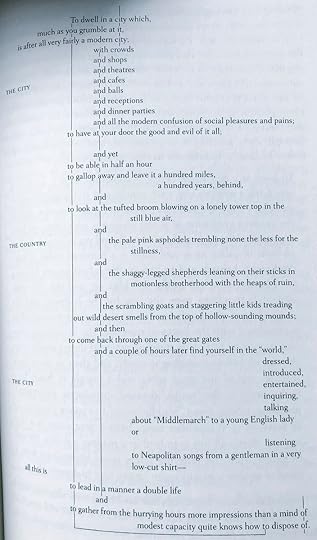
“The Sentence Seeks Its Form”
“The Sentence Seeks Its Form”
Read
May 24, 2017See review at my reader's page here: https://www.goodreads.com/review/show...
April 27, 2018
Read a few of the key essays and skipped around some. Gass is good here, but I prefer his fiction. His books on literature are all the same, basically.
September 17, 2021
Really enjoying essay collections and this one makes you feel better about the vastness of what you don't know, haven't experienced, otr may not care for in different classics.

Want to Read
June 22, 2024April 20, 2015
I did not read every one of these essays, but I loved the ones I did read. These were the essays on more general topics - on the young man reading the classics, on the nature of the sentence, on evil.
The marvel of good essay writing is their language and style, their meandering and diction, their side trips. They make me scratch my head and say I didn't understand a word and, yet, I loved the reading of them. They also have the marks of erudition and, often, erudition on display, but without any sense of self-love. Rather, they express joy and take the reader into that joy on a companionable, sometimes serious, ride into the country.
Mr. Gass' essays have all these qualities that I love.
The marvel of good essay writing is their language and style, their meandering and diction, their side trips. They make me scratch my head and say I didn't understand a word and, yet, I loved the reading of them. They also have the marks of erudition and, often, erudition on display, but without any sense of self-love. Rather, they express joy and take the reader into that joy on a companionable, sometimes serious, ride into the country.
Mr. Gass' essays have all these qualities that I love.

October 16, 2015
Gass has an unfortunate habit of assuming the reader's knowledge is equally expansive and eclectic as his own. This leads to a number of baffling essays, though his gift with language is so extraordinary that even these were a delight to read even as I failed to understood them. That being said, a few of these essays, particularly when he focuses on singing the praises of literature at large such as in Sacred Texts or the titular Temple of Texts, are so strong they easily make the whole book worth while.

March 5, 2012
Una colección de ensayos, que no sólo abarca libros y literatura, sino la sociedad, la cultura, la religión, incluso el mal.
Como es natural, cada uno tendrá sus favoritos y sus gustos, a mi especialmente me han gustado, los referentes a las Mil y una noches, Erasmo, Rabelais, O'Brien, Sabato, Caneti y García Márquez. También En defensa del Libro y Textos Sagrados.
Lo más importante es que te entran unas ganas irrefrenables de leer todos los libros que comenta.
Como es natural, cada uno tendrá sus favoritos y sus gustos, a mi especialmente me han gustado, los referentes a las Mil y una noches, Erasmo, Rabelais, O'Brien, Sabato, Caneti y García Márquez. También En defensa del Libro y Textos Sagrados.
Lo más importante es que te entran unas ganas irrefrenables de leer todos los libros que comenta.
September 7, 2019
I'm not sure what I was on 4 years ago when I first read this, but I did not give Gass his due that time around. I thought this collection of essays was great, if a bit stronger on the back-half. Not quite all of the essays had the intellectual heft I would expect from Gass, but it was nothing to get wound up about. Of particular pleasure were "The Sentence Seeks its Form", "In Defense of the Book", "Spectacles", and anything he wrote on Rilke.
March 19, 2008
I found it odd that I disliked whtat are perhaps Gass's most-straightforward writings. I've always admired his command of language but felt he fell short in terms of developing a narrative. In these essays, he does so for the most part and loses his svengali-like control of the English language.

Want to Read
June 22, 20101st edition, signed by author

June 5, 2007
especially an essay on The 1001 Nights
Displaying 1 - 30 of 31 reviews