

What do you think?
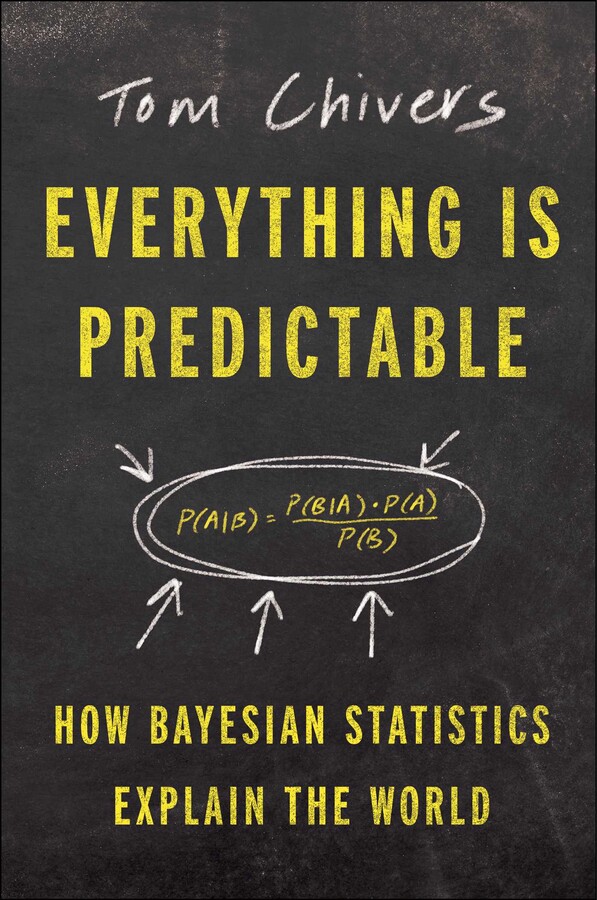
Everything Is Predictable: How Bayesian Statistics Explain Our World
A captivating and user-friendly tour of Bayes’s theorem and its global impact on modern life from the acclaimed science writer and author of The Rationalist’s Guide to the Galaxy .
At its simplest, Bayes’s theorem describes the probability of an event, based on prior knowledge of conditions that might be related to the event. But in Everything Is Predictable, Tom Chivers lays out how it affects every aspect of our lives. He explains why highly accurate screening tests can lead to false positives and how a failure to account for it in court has put innocent people in jail. A cornerstone of rational thought, many argue that Bayes’s theorem is a description of almost everything.
But who was the man who lent his name to this theorem? How did an 18th-century Presbyterian minister and amateur mathematician uncover a theorem that would affect fields as diverse as medicine, law, and artificial intelligence?
Fusing biography, razor-sharp science writing, and intellectual history, Everything Is Predictable is an entertaining tour of Bayes’s theorem and its impact on modern life, showing how a single compelling idea can have far reaching consequences.
At its simplest, Bayes’s theorem describes the probability of an event, based on prior knowledge of conditions that might be related to the event. But in Everything Is Predictable, Tom Chivers lays out how it affects every aspect of our lives. He explains why highly accurate screening tests can lead to false positives and how a failure to account for it in court has put innocent people in jail. A cornerstone of rational thought, many argue that Bayes’s theorem is a description of almost everything.
But who was the man who lent his name to this theorem? How did an 18th-century Presbyterian minister and amateur mathematician uncover a theorem that would affect fields as diverse as medicine, law, and artificial intelligence?
Fusing biography, razor-sharp science writing, and intellectual history, Everything Is Predictable is an entertaining tour of Bayes’s theorem and its impact on modern life, showing how a single compelling idea can have far reaching consequences.
384 pages, Hardcover
First published April 25, 2024
Ratings & Reviews
Friends & Following
Create a free account to discover what your friends think of this book!
Community Reviews
Displaying 1 - 30 of 217 reviews

May 1, 2024
There's a stereotype of computer users: Mac users are creative and cool, while PC users are businesslike and unimaginative. Less well-known is that the world of statistics has an equivalent division. Bayesians are the Mac users of the stats world, where frequentists are the PC people. This book sets out to show why Bayesians are not just cool, but also mostly right.
Tom Chivers does an excellent job of giving us some historical background, then dives into two key aspects of the use of statistics. These are in science, where the standard approach is frequentist and Bayes only creeps into a few specific applications, such as the accuracy of medical tests, and in decision theory where Bayes is dominant.
If this all sounds very dry and unexciting, it's quite the reverse. I admit, I love probability and statistics, and I am something of a closet Bayesian*), but Chivers' light and entertaining style means that what could have been the mathematical equivalent of debating angels on the heads of a pin becomes both enthralling and relatively easy to understand. You may have to re-read a few sentences, because there is a bit of a head-scrambling concept at the heart of the debate - but it's well worth it.
A trivial way of representing the difference between Bayesian and frequentist statistics is how you respond to the question 'What's the chance of the result being a head?' when looking at a coin that has already been tossed, but that you haven't seen. Bayesian statistics takes into account what you already know. As you don't know what the outcome is, you can only realistically say it's 50:50, or 0.5 in the usual mathematical representation. By contrast, frequentist statistics says that as the coin has been tossed, it is definitely heads or tails with probability 1... but we can't say which. This seems perhaps unimportant - but the distinction becomes crucial when considering the outcome of scientific studies.
Thankfully, Chivers goes into in significant detail the problem that arises because in most scientific use of (frequentist) probability, what the results show is not what we actually want to know. In the social sciences, a marker for a result being 'significant' is a p-value of less that 0.05. This means that if the null hypothesis is true (the effect you are considering doesn't exist), then you would only get this result 1 in 20 times or less. But what we really want to know is not the chance of this result if the hypothesis is true, but rather what's the chance that the hypothesis is true - and that's a totally different thing.
Chivers gives the example of 'it's the difference between "There's only a 1 in 8 billion chance that a given human is the Pope" and "There's only a 1 in 8 billion chance that the Pope is human"'. At risk of repetition because it's so important, frequentist statistics, as used by most scientists, tells us the chance of getting the result if the hypothesis is true; Bayesian statistics works out what the chance is of the hypothesis being true - which most would say is what we really want to know. In fact, as Chivers points out, most scientists don't even know that they aren't showing the chance of the hypothesis being true - and this even true of many textbooks for scientists on how to use statistics.
At this point, most normal humans would say 'Why don't those stupid scientists use Bayes?' But there is a catch. To be able to find how likely the hypothesis is, we need a 'prior probability' - a starting point which Bayes' theorem then modifies using the evidence we have. This feels subjective, and for the first attempt at a study it certainly can be. But, as Chivers points out, in many scientific studies there is existing evidence to provide that starting point - the frequentist approach throws away this useful knowledge.
Is the book perfect? Well, I suspect as a goodish Bayesian I can never say something is perfect. I found it hard to engage with an overlong chapter called 'the Bayesian brain' that is not about using Bayes, but rather trying to show that our brains take this approach, which all felt a bit too hypothetical for me. And Chivers repeats the oft-seen attack on poor old Fred Hoyle, taking his comment about evolution and 'a whirlwind passing through a junkyard creating a Boeing 747' in a way that oversimplifies Hoyle's original meaning. But these are trivial concerns.
I can't remember when I last enjoyed a popular maths book so much. It's a delight.
Tom Chivers does an excellent job of giving us some historical background, then dives into two key aspects of the use of statistics. These are in science, where the standard approach is frequentist and Bayes only creeps into a few specific applications, such as the accuracy of medical tests, and in decision theory where Bayes is dominant.
If this all sounds very dry and unexciting, it's quite the reverse. I admit, I love probability and statistics, and I am something of a closet Bayesian*), but Chivers' light and entertaining style means that what could have been the mathematical equivalent of debating angels on the heads of a pin becomes both enthralling and relatively easy to understand. You may have to re-read a few sentences, because there is a bit of a head-scrambling concept at the heart of the debate - but it's well worth it.
A trivial way of representing the difference between Bayesian and frequentist statistics is how you respond to the question 'What's the chance of the result being a head?' when looking at a coin that has already been tossed, but that you haven't seen. Bayesian statistics takes into account what you already know. As you don't know what the outcome is, you can only realistically say it's 50:50, or 0.5 in the usual mathematical representation. By contrast, frequentist statistics says that as the coin has been tossed, it is definitely heads or tails with probability 1... but we can't say which. This seems perhaps unimportant - but the distinction becomes crucial when considering the outcome of scientific studies.
Thankfully, Chivers goes into in significant detail the problem that arises because in most scientific use of (frequentist) probability, what the results show is not what we actually want to know. In the social sciences, a marker for a result being 'significant' is a p-value of less that 0.05. This means that if the null hypothesis is true (the effect you are considering doesn't exist), then you would only get this result 1 in 20 times or less. But what we really want to know is not the chance of this result if the hypothesis is true, but rather what's the chance that the hypothesis is true - and that's a totally different thing.
Chivers gives the example of 'it's the difference between "There's only a 1 in 8 billion chance that a given human is the Pope" and "There's only a 1 in 8 billion chance that the Pope is human"'. At risk of repetition because it's so important, frequentist statistics, as used by most scientists, tells us the chance of getting the result if the hypothesis is true; Bayesian statistics works out what the chance is of the hypothesis being true - which most would say is what we really want to know. In fact, as Chivers points out, most scientists don't even know that they aren't showing the chance of the hypothesis being true - and this even true of many textbooks for scientists on how to use statistics.
At this point, most normal humans would say 'Why don't those stupid scientists use Bayes?' But there is a catch. To be able to find how likely the hypothesis is, we need a 'prior probability' - a starting point which Bayes' theorem then modifies using the evidence we have. This feels subjective, and for the first attempt at a study it certainly can be. But, as Chivers points out, in many scientific studies there is existing evidence to provide that starting point - the frequentist approach throws away this useful knowledge.
Is the book perfect? Well, I suspect as a goodish Bayesian I can never say something is perfect. I found it hard to engage with an overlong chapter called 'the Bayesian brain' that is not about using Bayes, but rather trying to show that our brains take this approach, which all felt a bit too hypothetical for me. And Chivers repeats the oft-seen attack on poor old Fred Hoyle, taking his comment about evolution and 'a whirlwind passing through a junkyard creating a Boeing 747' in a way that oversimplifies Hoyle's original meaning. But these are trivial concerns.
I can't remember when I last enjoyed a popular maths book so much. It's a delight.

June 10, 2024
I strongly recommend this book. It is an accessible and engaging tour of Bayesian probability theory. The book balances conceptual exposition, breezy intellectual history, and practical applications. The meat of the work concerns two domains ripe for a Bayes' revolution: research science and real-world decision-making/discourse. There is also a special coda about how the brain itself may be a Bayesian agent.
My full review is at Substack:
https://open.substack.com/pub/stetson...

My full review is at Substack:
https://open.substack.com/pub/stetson...

Read
March 12, 2025Imagine you've thrown a coin, caught it but still have not had a chance to look at it. What are the chances it is a head? Think of it for a second before reading further. Here is a choice of the two possible answers: 1) 50:50; 2) 100% or 0 chance: the outcome is already certain; the result of it you do not know yet, but it is already out there. The answer to this question would define if you are inclined to be a Baeysian or not (this "not" is often called "frequentist"). It is not as simple as it sounds as the implications of this could be quite broad, almost on the level of the whole coherent world view. If your answer was 50:50, you are a Bayesian indeed believing that a probability is more subjective than objective (it can be only based upon someone's subjective priors to start with.) In the case of this coin experiment it is still uncertain for you, so it is 50% chance. Though for someone who has already taken a pick it is what it is.
Recently with Covid we dealt with the another example of a bayesian thinking or the lack of it. If you have a covid test with 95% accuracy, and it came back positive. Does it mean the chance you have a Covid is 95%? The correct answer is "no". It is much lower as it also depends on the rate of prevalence in the population at the moment you've tested. There were many arguments at that time related to the incorrect interpretation of statistics. Some of them were pretty grim. For better examples and more explanation how this works I would recommend to read this book. Chivers explains it with the great clarity. I think he is a journalist rather than a scientist or mathematician. So the book is a little sketchy. It covers a lot of ground from the examples like that to the biography of Reverend Bayes. Also he interviews neuroscientists, psychiatrists and psychologists for this book.
The debate between the frequentists and the bayesians is not an empty one. It has a got a pretty fundamental applications for many serious things such as scientific method for example. The statistical experiment of testing hypotheses for the purpose of science is based on frequentist logic. The debate is raging for more than a century already. So far the frequentists prevail but they are losing ground, especially with emergence of an AI and so called replication crisis in science. Many of the hypotheses accepted are not confirmed when an experiment is replicated. The were a few scandals recently, most prominently in social psychology propagating different 'nudge' theories.
The chapter I was personally mostly fascinated with is about a hypothesis of Bayesian brain It is gaining ground between the neuroscientists as far as I understand but its root is more remote in the 19th century":
And nowadays some scientists think it is much broader than just perception. It is all cognition and emotions as well. Around 200 million years ago the mammals have evolved neocortex. This is where it properly starts. But because it is so complicated to summarise i would be really brief: the mammals’s brain produces a full 3d model of the reality. Based upon this model it can simulate different scenarios just in its head and predict future: both its own actions and the possible changes in the environment. Also it identifies the gaps between the model and the sensory input and try to minimise them either by adjusting the model or taking actions to adjust the environment closer to the model. Your imagination is also basically your brain playing its model. Your shopping list is sort of the same: your prediction of your future shopping that would be later met with the reality in the shop.
But how does it relate to the Bayesian logic? Its main logical proposition is that to build up a hypothesis one needs to have some priors. One needs to start somewhere to build a model being a brain as well. So the idea is that the brain has got wired in an explicit and pretty narrow set of assumptions about the reality.
So the brain is not only Bayesian; it is inherently biased.
Chivers expands his story into examples from popular culture such as seeing a different colours of a dress, visual illusions etc. He also goes as far as to repeat after Chris Frith calling the reality is "a controlled hallucination". I think it is a step too far in terms of definition of a word "hallucination" in this context. But it is not essential. Here is how he explains this idea:
He does it on the example of him having a cup of coffee that is unexpectedly got cold. He also goes on explaining how the brain corrects the mismatch between the expectation (or model; or hallucination depends what you prefer to use) and the sensory input. Though he somewhat loses an explanatory power in the process.
He also incorporates the conversation with Karl Firston and his daring free energy priciple that some scientists call "a unified brain" theory.
I find all of this is a very fascinating stuff. The book is a bit too wide-ranging and "popular-sciencey" but easy to read. There are not that many popular books on bayesian theory. So this one is a good starting point.
------
(1) the quotes are from a different book Ive read recently A Brief History of Intelligence: Evolution, AI, and the Five Breakthroughs That Made Our Brains. The content of these two books overlaps ever so slightly but only in this particular idea of a brain as a generative model.
Recently with Covid we dealt with the another example of a bayesian thinking or the lack of it. If you have a covid test with 95% accuracy, and it came back positive. Does it mean the chance you have a Covid is 95%? The correct answer is "no". It is much lower as it also depends on the rate of prevalence in the population at the moment you've tested. There were many arguments at that time related to the incorrect interpretation of statistics. Some of them were pretty grim. For better examples and more explanation how this works I would recommend to read this book. Chivers explains it with the great clarity. I think he is a journalist rather than a scientist or mathematician. So the book is a little sketchy. It covers a lot of ground from the examples like that to the biography of Reverend Bayes. Also he interviews neuroscientists, psychiatrists and psychologists for this book.
The debate between the frequentists and the bayesians is not an empty one. It has a got a pretty fundamental applications for many serious things such as scientific method for example. The statistical experiment of testing hypotheses for the purpose of science is based on frequentist logic. The debate is raging for more than a century already. So far the frequentists prevail but they are losing ground, especially with emergence of an AI and so called replication crisis in science. Many of the hypotheses accepted are not confirmed when an experiment is replicated. The were a few scandals recently, most prominently in social psychology propagating different 'nudge' theories.
The chapter I was personally mostly fascinated with is about a hypothesis of Bayesian brain It is gaining ground between the neuroscientists as far as I understand but its root is more remote in the 19th century":
“In the nineteenth century, a German physicist and physician named Hermann von Helmholtz proposed a novel theory to explain the properties of perception. He suggested that a person doesn’t perceive what is experienced; instead, he or she perceives what the brain thinks is there—a process Helmholtz called inference. Put another way: you don’t perceive what you actually see, you perceive a simulated reality that you have inferred from what you see.” (1)
And nowadays some scientists think it is much broader than just perception. It is all cognition and emotions as well. Around 200 million years ago the mammals have evolved neocortex. This is where it properly starts. But because it is so complicated to summarise i would be really brief: the mammals’s brain produces a full 3d model of the reality. Based upon this model it can simulate different scenarios just in its head and predict future: both its own actions and the possible changes in the environment. Also it identifies the gaps between the model and the sensory input and try to minimise them either by adjusting the model or taking actions to adjust the environment closer to the model. Your imagination is also basically your brain playing its model. Your shopping list is sort of the same: your prediction of your future shopping that would be later met with the reality in the shop.
But how does it relate to the Bayesian logic? Its main logical proposition is that to build up a hypothesis one needs to have some priors. One needs to start somewhere to build a model being a brain as well. So the idea is that the brain has got wired in an explicit and pretty narrow set of assumptions about the reality.
"the neocortex may be prewired to assume that incoming sensor data, whether visual, auditory, or somatosensory, represent three-dimensional objects that exist separately from ourselves and can move on their own. Therefore, it does not have to learn about space, time, and the difference between the self and others. Instead, it tries to explain all incoming sensory information it receives by assuming it must have been derived from a 3D world that unfolds over time." (1)
So the brain is not only Bayesian; it is inherently biased.
Chivers expands his story into examples from popular culture such as seeing a different colours of a dress, visual illusions etc. He also goes as far as to repeat after Chris Frith calling the reality is "a controlled hallucination". I think it is a step too far in terms of definition of a word "hallucination" in this context. But it is not essential. Here is how he explains this idea:
"Instead of our image of the world coming in from our senses, our brains are making it up, constantly. We build a 3D model around ourselves. We’re predicting – hallucinating – the world. There’s not just a bottom-up stream of information – there is, vitally, a top-down one, as well. Higher-level processing in our brain sends a signal down, towards our nerve receptors, telling them what signals to expect."
He does it on the example of him having a cup of coffee that is unexpectedly got cold. He also goes on explaining how the brain corrects the mismatch between the expectation (or model; or hallucination depends what you prefer to use) and the sensory input. Though he somewhat loses an explanatory power in the process.
He also incorporates the conversation with Karl Firston and his daring free energy priciple that some scientists call "a unified brain" theory.
I find all of this is a very fascinating stuff. The book is a bit too wide-ranging and "popular-sciencey" but easy to read. There are not that many popular books on bayesian theory. So this one is a good starting point.
------
(1) the quotes are from a different book Ive read recently A Brief History of Intelligence: Evolution, AI, and the Five Breakthroughs That Made Our Brains. The content of these two books overlaps ever so slightly but only in this particular idea of a brain as a generative model.

November 28, 2024
Thoroughly enjoyed the audiobook, very informative and fascinating without being dull or 'too much'. After having 'listened' to it, I catch myself explaining about certain things to the people in my life - with borrowed lines from the book (or at least the 'ideas'/Bayesian approach), so more than just 'entertaining', it's also sort of 'helpful'.

October 12, 2024
WOW, This was as pleasant as a blanket on a rainy evening.
For people trying to get Bayesian statistics better, or even learn what that is - the book is amazing, with great examples and perfect structure.
At the same time, it was not technical, and the audiobook version was like sitting next to a buddy telling you about his job, or research, that he is passionate about too.
For people trying to get Bayesian statistics better, or even learn what that is - the book is amazing, with great examples and perfect structure.
At the same time, it was not technical, and the audiobook version was like sitting next to a buddy telling you about his job, or research, that he is passionate about too.

August 30, 2025
I've read a fair number of books like this and found this to be exceptional. Chivers will really spell out Bayesian stats versus the Frequentist (with a lot going over your head if you don't pay attention). He argues that everything is Bayesian. We all approximate predictions based on prior experiences and constantly going about auto correcting those predictions. The author has a real passion for the topic and presents it with gusto. Highly recommend.

July 16, 2025
“The Fox knows many things – the hedgehog one big one” -Archilochus. Tom Chivers has the big idea that Bayesian epistemology explains everything. Not just numerical decision theory, as in Thomas Bayes’ actual equation (See the book cover.), but many aspects of our lives from sociology down through homeostatic biological systems. And it’s true that if you boil Bayes down to the basic prior assumption/acquire data/posterior assumption cycle of a feedback loop, you can find it almost everywhere. I feel it would be better to think of Bayes Equation as a numerical tool describing predictive probabilities rather than a universal principle. The book is at its strength on Decision Theory (chapter 3) and its weakest on Brain Science (chapter 5).
I read this book to learn, and am not expert in the subject, and so would be interested in hearing the thoughts of other readers to the criticisms I’ve raised in each chapter. Finally, I’ve noted a few errata that I feel are due to bad editing, that really slowed down my understanding while I tried determine if it was him or me.
Introduction “A Theory of Not Quite Everything”. The gist of the title is that everything is predictable, so long as we understand that prediction is not predestination, but an evaluated probability. This introduction is a teaser, giving the equation and describing the many fields in which Bayesian statistics are relevant, but without really explaining it.
Chapter One “From The Book of Common Prayer to the Full Monte Carlo”. Thomas Bayes was a British 18th century Presbyterian minister and amateur mathematician, some of whose work was published posthumously. Chivers gives a biographical narrative that relates Bayes’ innovative statistical thinking to his Nonconformist theology. I needed to do a little outside reading and found that Non-Conformism was a catch-all for various schools of Christian Protestant thought, that were outside the Church of England orthodoxy. Chivers gives history of the subtle philosophical difference between Bayesian and “frequentist” statistics, and of the rivalry between proponents of each, with some explaining along the way. The author seems to be a Bayesian partisan himself, as the descriptions of “frequentist” formulation are less lucid. Perhaps he is assuming we are already well-schooled in that.
Chapter Two “Bayes in Science”. This chapter emphasizes the philosophical distinction in the meaning of p-value. It is not the likelihood of the truth of the hypothesis given the data, but likelihood of the data given the hypothesis. To me, this seems more important in the less deterministic sciences, where p-value thresholds might be .05 - such as sociology, psychology, medicine. Chivers’ writing takes on a pedantic tone. When the non-Bayesian Daniël Lakens describes the meaning and use of frequency statistics in the philosophy of science, Chivers thinks he is being “implicitly Bayesian.” I guess it is easier to argue against a position that YOU have restricted to a purer form that its owners do. Note correction on page 140. Misconception. The aerodynamic theory used in the example is solely applicable to gliders. Propelled air vehicles also have rocket-like dynamics. Note correction on page 153, line 1. Editing error. You multiply prior and likelihood together, not posterior and likelihood.
Chapter Three “Bayesian Decision Theory”. Most of the chapter consists of an explanation and examples of decision theory that anyone who has written software will readily understand. Near the end, he brings up the topic of AI, which he casts into a Bayes framework. It seems an attempt to bring a popular topic under his own umbrella. As he admits, “As you can imagine, you can model this is a Bayesian way even if the AI isn’t explicitly running Bayes under the hood.”
Chapter Four “Bayes in the World”. This chapter is about using a Bayesian orientation as a method of epistemology. Many people make inaccurate predictions. Chivers says this can be improved by assigning probabilities to priors, even in questions which appear not easily quantifiable, and then incorporating observed information. He opens with some examples of how humans sometimes misapply learned heuristics. Some of the examples, including the familiar Monty Hall three doors scenario, which I last saw in Mlodinow’s The Drunkard's Walk: How Randomness Rules Our Lives, seem to be cases of how to count the states of independent variables. By the end, his theme has generalized into how to think more systematically in a non-binary way about prediction. Note correction on page 232-3, example. Editing error. If each card has either a number or a letter on one side, and either a person or an animal of the other side, then no card should be having a star. Note correction on page 233, line 5. Editing error. The claim is about numbers and animals, not squares and animals.
Chapter Five “The Bayesian Brain”. I think he is attempting to explain human perception in Bayesian terms, and perhaps it is so in a conceptual way. But the explanations seem muddled. Is he talking about perception, or conscious decision making, or both at the same time? In defining a theory of a top-down stream of information, he writes about sending electrical signals down from brain to nerve receptors, breaking down of composite forms into more elementary forms, and “higher-level parts” of the brain to “lower-level parts”, all in the same description. It seems a model of human perception envisioned as a hierarchical network of computers. But is that the biology? By the end of the chapter, he cites a somewhat sketchy description of the brain’s more automatic functions to be corrections on bad prior assumptions of lack of function. Homeostasis would be better understood as a negative feedback cycle.
Conclusion “Bayesian Life”. Reiterate and wrap up.
I read this book to learn, and am not expert in the subject, and so would be interested in hearing the thoughts of other readers to the criticisms I’ve raised in each chapter. Finally, I’ve noted a few errata that I feel are due to bad editing, that really slowed down my understanding while I tried determine if it was him or me.
Introduction “A Theory of Not Quite Everything”. The gist of the title is that everything is predictable, so long as we understand that prediction is not predestination, but an evaluated probability. This introduction is a teaser, giving the equation and describing the many fields in which Bayesian statistics are relevant, but without really explaining it.
Chapter One “From The Book of Common Prayer to the Full Monte Carlo”. Thomas Bayes was a British 18th century Presbyterian minister and amateur mathematician, some of whose work was published posthumously. Chivers gives a biographical narrative that relates Bayes’ innovative statistical thinking to his Nonconformist theology. I needed to do a little outside reading and found that Non-Conformism was a catch-all for various schools of Christian Protestant thought, that were outside the Church of England orthodoxy. Chivers gives history of the subtle philosophical difference between Bayesian and “frequentist” statistics, and of the rivalry between proponents of each, with some explaining along the way. The author seems to be a Bayesian partisan himself, as the descriptions of “frequentist” formulation are less lucid. Perhaps he is assuming we are already well-schooled in that.
Chapter Two “Bayes in Science”. This chapter emphasizes the philosophical distinction in the meaning of p-value. It is not the likelihood of the truth of the hypothesis given the data, but likelihood of the data given the hypothesis. To me, this seems more important in the less deterministic sciences, where p-value thresholds might be .05 - such as sociology, psychology, medicine. Chivers’ writing takes on a pedantic tone. When the non-Bayesian Daniël Lakens describes the meaning and use of frequency statistics in the philosophy of science, Chivers thinks he is being “implicitly Bayesian.” I guess it is easier to argue against a position that YOU have restricted to a purer form that its owners do. Note correction on page 140. Misconception. The aerodynamic theory used in the example is solely applicable to gliders. Propelled air vehicles also have rocket-like dynamics. Note correction on page 153, line 1. Editing error. You multiply prior and likelihood together, not posterior and likelihood.
Chapter Three “Bayesian Decision Theory”. Most of the chapter consists of an explanation and examples of decision theory that anyone who has written software will readily understand. Near the end, he brings up the topic of AI, which he casts into a Bayes framework. It seems an attempt to bring a popular topic under his own umbrella. As he admits, “As you can imagine, you can model this is a Bayesian way even if the AI isn’t explicitly running Bayes under the hood.”
Chapter Four “Bayes in the World”. This chapter is about using a Bayesian orientation as a method of epistemology. Many people make inaccurate predictions. Chivers says this can be improved by assigning probabilities to priors, even in questions which appear not easily quantifiable, and then incorporating observed information. He opens with some examples of how humans sometimes misapply learned heuristics. Some of the examples, including the familiar Monty Hall three doors scenario, which I last saw in Mlodinow’s The Drunkard's Walk: How Randomness Rules Our Lives, seem to be cases of how to count the states of independent variables. By the end, his theme has generalized into how to think more systematically in a non-binary way about prediction. Note correction on page 232-3, example. Editing error. If each card has either a number or a letter on one side, and either a person or an animal of the other side, then no card should be having a star. Note correction on page 233, line 5. Editing error. The claim is about numbers and animals, not squares and animals.
Chapter Five “The Bayesian Brain”. I think he is attempting to explain human perception in Bayesian terms, and perhaps it is so in a conceptual way. But the explanations seem muddled. Is he talking about perception, or conscious decision making, or both at the same time? In defining a theory of a top-down stream of information, he writes about sending electrical signals down from brain to nerve receptors, breaking down of composite forms into more elementary forms, and “higher-level parts” of the brain to “lower-level parts”, all in the same description. It seems a model of human perception envisioned as a hierarchical network of computers. But is that the biology? By the end of the chapter, he cites a somewhat sketchy description of the brain’s more automatic functions to be corrections on bad prior assumptions of lack of function. Homeostasis would be better understood as a negative feedback cycle.
Conclusion “Bayesian Life”. Reiterate and wrap up.

June 8, 2024
Fortunately when I saw Tom Chivers’ Everything Is Predictable on the shelf at the bookstore its full cover, rather than just its spine, was facing out. Otherwise I wouldn’t have seen the reference to Bayesian statistics and I probably would not have picked it up. The reason that reference all but forced me to read the book is not because I’m some super user of the Bayesian methodology, at least not consciously. My reason is less intellectual, more emotional. When I was in college I had a favorite professor, Brother Jack D., who made every class interesting, amusing, and informative, so much so that I took six classes with him. The sixth of those classes was a new offering at the time, a class Brother developed himself and lobbied the department to adopt; he enthusiastically described it as a new wave in statistics which was going to have a profound impact on many fields. That class was Bayesian statistics. I wish I could say I immediately recognized the equation on the front of Chivers’ book as the Bayesian theorem, but I took that class in the very early 1980s, so any memory traces furrowed out by my Bayesian studies have long since eroded away.
When I began reading Chivers’ book I was surprised to re-learn that Thomas Bayes developed his theorem back in the eighteenth century. The reality my mind had created in the intervening decades was that Brother had researched a newly developed branch of statistics and fought to bring it to the fore. Not so. The theorem was a couple hundred years old. Had Brother duped me? Fortunately I read on through the Chivers book and learned that Bayes theorem had fallen by the statistical wayside for quite a long time, and not too long before I took Brother’s class it had just started to make a comeback. I was glad not only to preserve my hero’s reputation but also to feel at least a glimmer of recognition as I read my way through the math.
What I didn’t expect was to veer off into topics like the Bayesian aspects of optical illusions, AI, classical conditioning, tennis, schizophrenia, and evolution, all of which I found very interesting and eye opening. Chivers lets me conclude Brother was right to be so enthused.
One last thing before I go. I know it sounds strange to refer to “Brother.” Force of habit; Brother used to tell me, almost begged me, to call him “Jack.” But it just didn’t feel respectful enough, and I still can’t bring myself to do it. So “Brother” it is and always will be, and I felt privileged to read this book as a tribute to him.
When I began reading Chivers’ book I was surprised to re-learn that Thomas Bayes developed his theorem back in the eighteenth century. The reality my mind had created in the intervening decades was that Brother had researched a newly developed branch of statistics and fought to bring it to the fore. Not so. The theorem was a couple hundred years old. Had Brother duped me? Fortunately I read on through the Chivers book and learned that Bayes theorem had fallen by the statistical wayside for quite a long time, and not too long before I took Brother’s class it had just started to make a comeback. I was glad not only to preserve my hero’s reputation but also to feel at least a glimmer of recognition as I read my way through the math.
What I didn’t expect was to veer off into topics like the Bayesian aspects of optical illusions, AI, classical conditioning, tennis, schizophrenia, and evolution, all of which I found very interesting and eye opening. Chivers lets me conclude Brother was right to be so enthused.
One last thing before I go. I know it sounds strange to refer to “Brother.” Force of habit; Brother used to tell me, almost begged me, to call him “Jack.” But it just didn’t feel respectful enough, and I still can’t bring myself to do it. So “Brother” it is and always will be, and I felt privileged to read this book as a tribute to him.

August 14, 2024
The book is mostly repetitive if you already have a good PRIOR knowledge of the topic.

July 25, 2024
Chivers gives a readable description and backstory of statistics along with the feud of Frequentists and Bayesians. He does a great job covering reproducibility issues in scientific research and how “objective” frequentist methods are misused and shows despite being “subjective” how Bayesian framework can provide better use of data. There are many examples with stories of Bayes and major figures like Gauss, Fermat, Fisher, Pearson, etc. Towards the end Chivers gets into how our brains run like prediction machines with bayesian inferences. He helped me see how my mental models are mostly broken in interpreting statistical results. His false positive examples from medical testing are striking. A bit challenging in parts but were great help to update my priors.

May 28, 2024
This is a great book with a simple message: Thinking Bayesian has many advantages and is how our brain naturally operates. If you’re unfamiliar with probability or statistics, Bayesianism can be summarized as: you have a prior belief about the world (your “prior probability”), you gather evidence (your “likelihood”), and use the two together to get your updated belief (“posterior probability”), which is obtained by multiplying your prior and likelihood together. Your posterior then becomes your new prior, and you repeat the process.
Chivers makes endlessly great points about how this process of incorporating prior probabilities has advantages that conventional “frequentism” doesn’t. Most importantly, a Bayesian approach allows us to answer the question, what is the probability that my hypothesis H is true given the data D?, i.e., P(H|D), whereas frequentism—specifically, a p-value—answers the question, what is the probability that the data D at least as extreme as what I observed could have arisen given the null hypothesis H is true?, i.e., P(D|H).
The latter is by far the more practiced method used by scientists and statisticians, whereas Bayesian approaches are in the minority (though accepted and not unusual nowadays). Chivers rightfully points out that p-values are frequently misunderstood and don’t actually answer the question we often really want to know, i.e., P(H|D). Instead, frequentist approaches indirectly answer this question through replication, meta-analysis, and failed falsification. Bayesianism, you could say, does meta-analysis in a baked-in way—the prior tries to incorporate all past evidence into its approach, then update it based on the newest evidence.
The final two chapters were fascinating in looking at the many examples of implicit Bayesianism in the world and the process by which the brain operates in accommodating new information to update beliefs. Regarding the former (Bayesianism in the world), many cognitive biases discovered by Kahneman & Tversky and others could be described as deviations from Bayesian logic, such as the conjunction fallacy and framing effects, or medical decision-making, whereby medical professionals fail to incorporate base rates into their diagnostic assessments. As an example of the latter (Bayesianism in the brain), in individuals with schizophrenia, their priors are notably weaker, meaning their predictions about sensory data are less accurate and less constrained by previous sensory input—which led to the accurate prediction that schizophrenic individuals are less susceptible to certain optical illusions.
I have one major substantive criticism: Chivers explains frequentism as though it’s all about binary decision-making via p-values, while ignoring confidence intervals, effect size estimates, and other metrics that quantify model performance (R^2, AIC/BIC, etc.). Though Chivers at one point says “We’ll talk more about p-values and confidence intervals a bit later”, there really isn’t much more mention of confidence intervals throughout the whole book (he must’ve forgotten that he left this sentence in the book). Undoubtedly, he must know that sole reliance on p-values is a terrible idea even if one interprets them accurately. Now, it’s true that frequentism generally cannot directly allow us to compute the probability that a hypothesis is true given the data, but there are many other goals with statistical analysis that Chivers only vaguely alludes to throughout the book.
Notwithstanding my gripes, this was a truly wonderfully written and insightful book that I learned a lot from. Highly recommended.
Chivers makes endlessly great points about how this process of incorporating prior probabilities has advantages that conventional “frequentism” doesn’t. Most importantly, a Bayesian approach allows us to answer the question, what is the probability that my hypothesis H is true given the data D?, i.e., P(H|D), whereas frequentism—specifically, a p-value—answers the question, what is the probability that the data D at least as extreme as what I observed could have arisen given the null hypothesis H is true?, i.e., P(D|H).
The latter is by far the more practiced method used by scientists and statisticians, whereas Bayesian approaches are in the minority (though accepted and not unusual nowadays). Chivers rightfully points out that p-values are frequently misunderstood and don’t actually answer the question we often really want to know, i.e., P(H|D). Instead, frequentist approaches indirectly answer this question through replication, meta-analysis, and failed falsification. Bayesianism, you could say, does meta-analysis in a baked-in way—the prior tries to incorporate all past evidence into its approach, then update it based on the newest evidence.
The final two chapters were fascinating in looking at the many examples of implicit Bayesianism in the world and the process by which the brain operates in accommodating new information to update beliefs. Regarding the former (Bayesianism in the world), many cognitive biases discovered by Kahneman & Tversky and others could be described as deviations from Bayesian logic, such as the conjunction fallacy and framing effects, or medical decision-making, whereby medical professionals fail to incorporate base rates into their diagnostic assessments. As an example of the latter (Bayesianism in the brain), in individuals with schizophrenia, their priors are notably weaker, meaning their predictions about sensory data are less accurate and less constrained by previous sensory input—which led to the accurate prediction that schizophrenic individuals are less susceptible to certain optical illusions.
I have one major substantive criticism: Chivers explains frequentism as though it’s all about binary decision-making via p-values, while ignoring confidence intervals, effect size estimates, and other metrics that quantify model performance (R^2, AIC/BIC, etc.). Though Chivers at one point says “We’ll talk more about p-values and confidence intervals a bit later”, there really isn’t much more mention of confidence intervals throughout the whole book (he must’ve forgotten that he left this sentence in the book). Undoubtedly, he must know that sole reliance on p-values is a terrible idea even if one interprets them accurately. Now, it’s true that frequentism generally cannot directly allow us to compute the probability that a hypothesis is true given the data, but there are many other goals with statistical analysis that Chivers only vaguely alludes to throughout the book.
Notwithstanding my gripes, this was a truly wonderfully written and insightful book that I learned a lot from. Highly recommended.

December 15, 2024
2.5 stars. If you've never read a book on Bayesian statistics, this book may be of interest to you -- but if you have (like me), you may find yourself bored to tears through science writer Tom Chivers' prolonged biography of Thomas Bayes and recapitulation of the theorem, extended philosophical musings, and various tangents on other topics like perception.
Further reading:
Rigor Mortis: How Sloppy Science Creates Worthless Cures, Crushes Hope, and Wastes Billions by Richard Harris (my absolute favorite book on this topic - see my review here
Bad Science by Ben Goldacre
My statistics:
Book 306 for 2024
Book 1909 cumulatively
Further reading:
Rigor Mortis: How Sloppy Science Creates Worthless Cures, Crushes Hope, and Wastes Billions by Richard Harris (my absolute favorite book on this topic - see my review here
Bad Science by Ben Goldacre
My statistics:
Book 306 for 2024
Book 1909 cumulatively

February 23, 2026
changed my view on “traditional” statistics and somewhat on neuroscience
I like how easy it was to comprehend, though I got a bit bored while reading the historical part and bayes’ biography
I like how easy it was to comprehend, though I got a bit bored while reading the historical part and bayes’ biography

November 22, 2025
Look, I love statistics and learning about them but this book was laid out poorly. From too long chapters to not making distinctions between topics and poor mapping of how his cultural references map the the math inherent in bays it just wasn’t an intriguing read.
It did teach me some things, so I like it for that I just felt that it just wasn’t a fit for me.
It did teach me some things, so I like it for that I just felt that it just wasn’t a fit for me.

April 21, 2026
I love Bayesian statistics. Bro got a lil carried away at the end tho.

July 17, 2025
I am deeply interested in Bayesianism. Is it an 'ism'? I'll say yes, considering it as a mathematical theorem, a type of statistics, and a form of logic—all of which together constitute a kind of doctrine, a way of thinking. There's been a recent surge of interest in Bayes, partly due to its role in cognitive science for understanding the brain’s predictive mechanisms and its use in AI. It’s evident that a memantic spread is happening, and a popular science book on this subject was inevitable.
Nothing is entirely predictable; we know this from physics, that there is inherent randomness. Bayesian logic tackles the idea of intrinsic unpredictability. Essentially, it is plausible reasoning used when facing uncertainty. By using Bayesian statistics, you obtain a predictive distribution that offers a more nuanced understanding of potential outcomes rather than a single best guess. Frequentist prediction provides a single point of data, representing the single best estimate. However, Bayesian prediction provides a probability distribution, which reflects the entire uncertainty of the parameters, never a single point. What is so beautiful about the theorem, the elegance of its implication, is that this process is iterative; it is never linear. There is always reflexivity in our understanding.
Nothing is entirely predictable; we know this from physics, that there is inherent randomness. Bayesian logic tackles the idea of intrinsic unpredictability. Essentially, it is plausible reasoning used when facing uncertainty. By using Bayesian statistics, you obtain a predictive distribution that offers a more nuanced understanding of potential outcomes rather than a single best guess. Frequentist prediction provides a single point of data, representing the single best estimate. However, Bayesian prediction provides a probability distribution, which reflects the entire uncertainty of the parameters, never a single point. What is so beautiful about the theorem, the elegance of its implication, is that this process is iterative; it is never linear. There is always reflexivity in our understanding.

Read
July 1, 2026Good primer on an interesting subject that I’ll definitely be diving into more.
Does the annoying pop-science thing of using a single, specific thing to explain everything and stretching the concept to near breaking point. But it is very self aware about it and written in a very tongue in cheek way that makes it enjoyable and informative regardless.
Also side note that has no bearing on my view of the book because of how tangential it is to the point. In talking about how beliefs should be understood as provisional and probabilistic rather than binary and fixed (a point I agree with), the author gets a few licks in at “post-modernists” who would posit that “all truth claims are equally valid”. I’m not a big critical-theory, post-modern type myself but this is a line that I hear so often repeated and I really don’t know where it comes from. I read a bit of those types Foucault, Said, Butler, Derrida, whoever in college, (all of whom would probably reject the label postmodern anyhow) and agree with them or not, I don’t think any of them would posit that all truth claims are equally valid. I could be wrong but I do just find this to be weirdly extreme strawman but it’s one that I see repeated so often that it makes me wonder where the impression that they’re all entirely relativistic comes from? Not at all the main thrust off this book, but just something I see cropping up a lot that makes me raise an eyebrow.
Does the annoying pop-science thing of using a single, specific thing to explain everything and stretching the concept to near breaking point. But it is very self aware about it and written in a very tongue in cheek way that makes it enjoyable and informative regardless.
Also side note that has no bearing on my view of the book because of how tangential it is to the point. In talking about how beliefs should be understood as provisional and probabilistic rather than binary and fixed (a point I agree with), the author gets a few licks in at “post-modernists” who would posit that “all truth claims are equally valid”. I’m not a big critical-theory, post-modern type myself but this is a line that I hear so often repeated and I really don’t know where it comes from. I read a bit of those types Foucault, Said, Butler, Derrida, whoever in college, (all of whom would probably reject the label postmodern anyhow) and agree with them or not, I don’t think any of them would posit that all truth claims are equally valid. I could be wrong but I do just find this to be weirdly extreme strawman but it’s one that I see repeated so often that it makes me wonder where the impression that they’re all entirely relativistic comes from? Not at all the main thrust off this book, but just something I see cropping up a lot that makes me raise an eyebrow.

August 30, 2026
2.5 ? not sure
The ideas presented in this book are quite interesting but I think it was poorly executed. I imagine this book would greatly benefit from being co-authored by a mathematician. The math history section felt disjointed and difficult to follow, and the explanations of stats/probability concepts or puzzles left something to be desired (or maybe I am not the target audience?). I do think some of the real world applications were very interesting and well-done (I especially enjoyed the intro), as well as the broader discussions of the current state of research and experimentation.
I recently read Infinite Powers by Steven Strogatz, which is about Calculus. The way math history was explained in that book was 10/10, but the real world applications were quite dull. I need these two authors to combine their powers, or just a recommendation of a book that can do it all pleaseandthankyou
The ideas presented in this book are quite interesting but I think it was poorly executed. I imagine this book would greatly benefit from being co-authored by a mathematician. The math history section felt disjointed and difficult to follow, and the explanations of stats/probability concepts or puzzles left something to be desired (or maybe I am not the target audience?). I do think some of the real world applications were very interesting and well-done (I especially enjoyed the intro), as well as the broader discussions of the current state of research and experimentation.
I recently read Infinite Powers by Steven Strogatz, which is about Calculus. The way math history was explained in that book was 10/10, but the real world applications were quite dull. I need these two authors to combine their powers, or just a recommendation of a book that can do it all pleaseandthankyou

October 16, 2024
Excellent book! Highly recommend and I’m now a Bayesian! Only warning there is math and you will see every single thing in Bayesian terms not a bad thing at all

Read
September 6, 2025Overall good. The first half (especially the history of the field of statistics) was stronger and more interesting than the second half. The author lost some credibility when he started using Eliezer Yudkowsky (“philosopher of AI”/author of the fan fiction novel “Harry Potter and the Methods of Rationality”/ideological inspiration for the Terminator-meets-Manson-family anti-AI murder cult known as the “Zizzians”) as the preeminent source for examples on decision theory. And mentioning Yudkowsky five separate times in the chapter on decision theory before Kahneman. Red flag imo and indicative of a pretty weak chapter that read as AI evangelism copy. Especially the claim that chatgpt rarely plays illegal chess moves purely using token prediction, which is not true.
Overall good though.
Overall good though.

January 14, 2025
Excellent history and explanatory text on Bayes; a way of thinking about probability with many helpful real world applications (including medicine!); update your priors! For more on the subject be sure to check out: Bernoulli's Fallacy: Statistical Illogic and the Crisis of Modern Science and The Theory That Would Not Die: How Bayes' Rule Cracked the Enigma Code, Hunted Down Russian Submarines, and Emerged Triumphant from Two Centuries of Controversy.

June 20, 2026
This is a great introductory book and a great summary book. To some extent it is a meta book, with the author mentioning a lot of other books, articles and authors. It explains the concepts well and picks it's examples well. I did not really learn anything from this book as I had read other books on the subject and came across Bayes (the concept and formula, not the man) in my university studies. It's a relatively quick read (or listen in my case) and it never gets more complicated than it should.
A good introductory work for people that want an understanding of a key concept in statistics, decision making and (some of) AI. For someone that wants a better understanding (and does not want to do a statistics course), a better book is The theory that would not die by Sharon Bertsch McGrayne
December 30, 2024
Really good use of examples to unpack Bayesian thinking in a way I'd not managed to grasp before.
The author claims that "once you understand Bayes, you start seeing it everywhere", and 2 days after completing the book I already had two light bulb moments.
First was that since moving in with my partner I'd got used to finding the odd clump of hair in the carpet - first time I saw one I jumped thinking it was a spider, but after a couple of months the sight became less alarming each encounter. Then yesterday I spotted one, calmly knelt down to pick it up, only for it to start scurrying towards me!
Second one is maybe a bit too determinisitic/not probabilistic enough to be Bayesian, but just noticed how much harder it was to increase the he average speed on my bike computer towards the end of the ride compared to at the start. The new data wouldn't move the needle as hard as I pushed!
The author claims that "once you understand Bayes, you start seeing it everywhere", and 2 days after completing the book I already had two light bulb moments.
First was that since moving in with my partner I'd got used to finding the odd clump of hair in the carpet - first time I saw one I jumped thinking it was a spider, but after a couple of months the sight became less alarming each encounter. Then yesterday I spotted one, calmly knelt down to pick it up, only for it to start scurrying towards me!
Second one is maybe a bit too determinisitic/not probabilistic enough to be Bayesian, but just noticed how much harder it was to increase the he average speed on my bike computer towards the end of the ride compared to at the start. The new data wouldn't move the needle as hard as I pushed!

July 21, 2025
It made me feel hella smart I can’t lie, since I don’t tend to read maths/science based books, and it was genuinely interesting to learn about how one equation can be applied to so many different aspects of life. However I found the “controlled hallucinations” as the explanation for perception of the world a bit derealising/ derealisation-inducing, on the other hand using it to explain auditory and visual hallucinations of schizophrenia was really interesting and using it to predict how psychedelics may be a treatment to depression was also pretty interesting.
Overall, I feel smarter, and it might have slightly shifted how I will view predictions in the future but it was a good book
Overall, I feel smarter, and it might have slightly shifted how I will view predictions in the future but it was a good book

August 20, 2024
A very entertaining and light introduction to Bayesian statistics that requires no background knowledge.
Stuffed with examples and historical anecdotes, Chivers wrote a very accessible and fun book that I would recommend to anyone with the slightest interest in science. At the end the book could have been a few chapters shorter and I think it would have actually profited from adding more equations and explaining the underlying math in more detail. Still, I really liked the authors style and I’m looking forward to reading more of his work.
Stuffed with examples and historical anecdotes, Chivers wrote a very accessible and fun book that I would recommend to anyone with the slightest interest in science. At the end the book could have been a few chapters shorter and I think it would have actually profited from adding more equations and explaining the underlying math in more detail. Still, I really liked the authors style and I’m looking forward to reading more of his work.
December 3, 2024
A fascinating explanation of Baye’s theorem and its potential explanatory power. The critique of frequentist statistics is compelling. And the extension of Bayesian thinking into AI, decision science, and consciousness is intriguing albeit not quite as persuasive. Perhaps because of my priors the author would argue.
October 23, 2024
Really nice easy to read introduction on Bayesian statistics.

March 23, 2026
low key blew my mind. Everything is Bayesian!
May 2, 2026
And suddenly, you see Bayes’ theorem EVERYWHERE!
Read
August 1, 2025Very apt title
Displaying 1 - 30 of 217 reviews