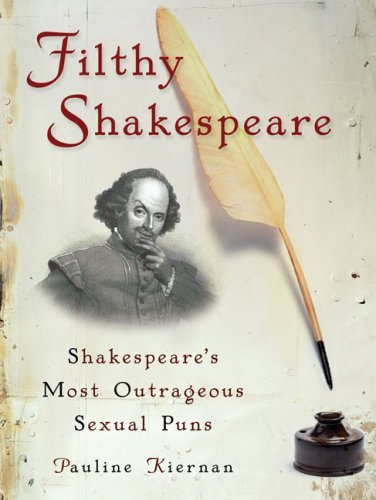
Celebrating the Bard in all his bawdy glory, a hilarious and insightful look into the down-and-dirty sexual puns lurking in Shakespeare’s body of work
London’s Elizabethan theaters were located in the seedy part of town, close to whorehouses but never far from Puritanical scorn. In that climate, Shakespeare became a master of the double entendre, crafting lines and scenes that unfolded in a variety of meanings—the wickedly funny, the suggestively erotic, and even hard-hitting send-ups of corrupt politicians and clerics.
From The Two Gentlemen of Verona to The Tempest and King Lear, the plays and poems pulsate with puns on body parts and what they do, and reveal shocking meanings beneath the brilliant codes.
Shakespeare’s genius lies in his matchless understanding of the human condition, but for centuries we’ve been deprived of the full extent of one of his most brilliant dramatic devices. Finally, acclaimed Shakespearean scholar Pauline Kiernan unlocks the meaning behind the coded words. FILTHY SHAKESPEARE presents more than 70 examples of the Bard at his raunchiest, with each passage translated into modern English and the hidden meanings of the original words explained. A fascinating introduction shows how Shakespeare’s amazing range of wordplay had its roots in the social and political reality of Elizabethan and Jacobean England.
Revealing and riotously funny, FILTHY SHAKESPEARE is the perfect gift for anyone who wants to rediscover the master of the sexual pun at his most inventive, and an intriguing look into the richness and complexity of Shakespeare’s language and his world.
Finally finished. Despite its minimal word count, this took awhile to read because it got boring and repetitive. Okay--so every word has a double (sexual) meaning. Some seemed far-fetched, others didn't really need explaining as the double meaning is still clear today, and a few were eye-openers. I had some long-standing questions about the lyrics of a few Steeleye Span songs answered, and I will never look at the song "Pop Goes the Weasel" the same way again. (It was like when I learned the origins of "Ring Around the Rosy") And we teach it to pre-schoolers.
The blurb says bawdy, hilarious, insightful. Two outa three ain't bad (Meatloaf, if you're old enough to recognize the quote). Bawdy, yeah, and Kiernan calls a spade a spade, and other instruments by their name too; insightful is an understatement, and reading the 'decoded' text opens up incredible avenues. Food for thought really, and insight into sex and the sexes, genders and orientation, which help understand not only Elizabethan times but also our own. If we take today's euphemism, for instance, we all understand that 'sleeping with' someone is very much a wakeful activity. Two hundred years ago, it wouldn't have been: people routinely shared not only rooms but bed with total strangers, without ambiguity (eg. "No more than 5 guests per bed" at Michie Tavern, here in Piedmont). In two hundred years, 'sleeping' might no longer have any sexual connotation either, and might indeed have become quite virginal, a la Twilight: imagine the misunderstandings then when reading 20C novels? In the 16C, words like: dance, pit, wit, lend, articles, knob, foot, &c. had another meaning they have since lost, and the unsuspecting reader might not 'get it' (this last one meant 'become pregnant' in the days of the Bard). See if you get this one (Twelfth, 2:5): "By my life, t'is my lady's hand. These be her very c's, her u's, 'n' her t's and thus makes she her great p's." Hilarious, it may have been, in the puritan days of the Virgin Queen; not anymore, I'd say, but I'll settle for insightful and bawdy. Good clean fun?
At first I enjoyed the concept of this novel, it was funny and enlightening at points. But after getting a few sections into it it became hard not to think that the author was grasping for straws. As she said in the beginning it's important to know when the double meanings come into play, and I don't really think she's got that quite down to a practice yet. Because some of this are so outrageous they just don't make any sort of contextual sense at all... It is a goofy read, so I recommend it for maybe some very light reading. Nothing committal or you'll get fed up like I did
*snerk* Everyone needs to be able to talk filthy in Elizabethean slang. This book is an excellent reference.
It presents passages from the Bard with a glossary and a modern translation - though often reading the original with the glossary is far more satisfying than the translations, many of which devolve into meaningless strings of "vagina", "fuck" and "cunt".
The most interesting parts of this book are actually the explanatory text. The author provides lots of history of the passages being edited, social commentary on the mores of the day, and history about the plays themselves and Shakespeare's life. Good, if very quick, read.
I knew of some of the sexual puns in Shakespeare, but I had no idea of the extent. Double entendres everywhere! English class would get a lot more interesting, and students would be more engaged, if even some of this was covered. But then, here in the USA, we are descended from hypocritical puritans...
Hilarious read for nerds and Shakespeare lovers. The farther along I got, I got better at "interpreting" his verse. Reading this made me think of the constant sexual puns at renaissance faires, and my favorite bands there (the Poxy Boggards and The Merry Wives of Windsor)
The basic gist of this book, written by a British Shakespeare scholar, is that Shakespeare's work is absolutely loaded with bawdy sleight-of-hand wordplay that his audience understood but that modern audiences miss amid all of the other archaic language and the boring, Victorian way that Shakespeare is usually taught in schools. Accordingly, the book largely consists of obscene scene fragments from various plays "translated" into modern English.
First, let me say this: if this aspect of Shakespeare were taught in schools, I can guarantee that thousands of prudish parents would be outraged, outraged, I say!.....but what better way to hold the interest of a teenager than to point out the number of vagina jokes in Romeo and Juliet , probably Shakespeare's dirtiest play, and ironically the one that most often gets taught (incorrectly) in American high schools? (Well, except for maybe Hamlet, which is loaded with references to rape).
With that said, though, this book is seriously flawed in its execution. The scenes are presented out of context pertaining to a topic ("fornication", "balls", "dildos", etc.), so there's really no continuity between sections and finding all of the references for one particular play takes a lot of flipping around. The "translations" are also way too literal and unnecessarily lacking in subtlety, as though the author thinks she needs to spell out everything because we're morons - as such, it destroys any poetry existing in those passages for the sake of being as clearly vulgar as possible - ironic for someone who claims to idolize Shakespeare as much as the author does.
I appreciated that this book refuted all of the uptight political correctness and weird "Earl of Oxford" conspiracy theories that came out of my high school and collegiate Shakespeare education, and that it gives context of the period that's important for understanding the theatrical tradition of Shakespeare's time. If you've read Shakespeare and found it boring and are willing to keep an open mind, this guide to Shakespeare's smutty bits might be useful. Just be prepared for a lot of vulgarity all at once.
The Title says it well enough: people sensitive to some of the coarser words in the English Language should wear polaroid sunglasses... (A minor example: Shakespeare's name itself is a double pun: Will (willy) = 'penis', and Spear (also is a pun for the male member) so Shake-Spear 'implies' masturbator...: So 'Will Shakespeare' = 'penis masturbator'...)
This is truly an eye-opening book, funny as well as dirty, which is most revealing about the times and mores of Elizabethan England in Shakespeare's time. Kearnan's technique is to cause a certain kind of shock through her confronting use of modern words to explicate the underlying puns and double entendres found throughout Shakespeare; but she advises us that, once one sees the context in 'modern' language, one should then go back to the original words (assuming your text has not been bowdlerised, or some passages even excised) and re-read them: the underlying context gives one a truer insight into the times and the plays. And it works!
Even more interesting are the introductions to the various sections, and the extra notes within each section which provide the reader with more extensive knowledge that places Shakespeare well and truly within his Elizabethan milieu: apparently all the playwrights of the time were also doing it! And there were dictionaries produced by those in the know (which the author refers to) which also provide a certain authority to the author's interpretations, however outrageous one might think they might be.
This is a book which should be added to anyone's library of Shakespeare's plays and to Elizabethan literature in general. Enjoy!
You can tell by the way this was edited that there was absolutely zero intention for this to ever a. be anything other than an impulse buy and b. be read from cover to cover. Sometimes the same information WORD FOR WORD is repeated in chapters. For example - bits and pieces from the introduction were copy pasted to the blurbs at the end of any given chapter. That's just lazy with a capital L if you ask me. I think the intention here was to write a book where people would open to the table of contents, browse until they found their vice of choice, then read that chapter and never pick up the book again until they were cleaning out their book shelves.
In addition to the incredibly annoying repetitious bits, some of the research and conjectures Kiernan makes about certain slang is questionable to say the least, and at times doesn't seem to be supported when context is added back into the equation. And while I certainly agree with her that there are many sexual innuendos that frequently get overlooked or edited out of certain Shakespearean productions, to simply go back and say "screw it - let's just call shenanigan's on all of it" isn't good either.
Over all I feel like this would be a good book for those who enjoy compilations of unusual trivia, or for people who are having a hard time getting into Shakespeare and would like some ideas for new approaches to his texts to get them interested again. For anybody looking for something approaching good editing, solid research and quality reading material pass on.
This book is difficult to review, especially as I read through large parts of it a while ago. It isn't the sort of book meant to be read from cover to cover (hence the noted repetition in other reviews), but something a reader picks up and puts down as the whim moves her. Perhaps that's why it got to be over the top for me, leaving me a little nauseous and Shakespeare tainted. While it's true that as I've gotten older and seen more Shakespeare performances that I've picked up a lot more on the double entendres and sexual puns, it's also true that I've found them appropriately funny or salacious within the context of his drama. And my respect for his talent and art has grown commensurately.
However, reading snippets from multiple plays quoted to support various interpretations -- interpretations emphatically as explicit and blunt as Ms. Kiernan could make them -- almost killed my joy in Shakespeare's language and storytelling. It's not that I question whether he was as bravely bawdy as she gleefully insists. It's just that the greatness of Shakespeare lies in the totality of his poetry and playwriting. Shakespeare might have indulged his and his audiences' need for sex, magic, and murder, but he never pandered only to those needs, which is what Filthy Shakespeare seems to do.
My solution for the icky feeling reading this book gave me? Why, to go out and watch Shakespeare.
Kiernan's book has something for both bardolator and filthy perv. The appendix alone with its alphabetical listing of the hundreds of Elizabethan synonyms for the genitals and the sex act is worth taking a look at. And Kiernan's bardcore translations of Shakespeare will make you stop and rethink much of what you've read in the past. However, at times I think the author herself has "a wit of cheveril that stretches from an inch narrow to an ell broad" as some of her paraphrases really stretch way further than the context suggests. I would have also liked to see some citations for source material; Kiernan provides none, and it would be beneficial to see some. Partridge's Shakespeare's Bawdy and Rubinstein's Dictionary of Shakespeare's Sexual Puns and Their Significance are much more thorough in this area, although far less pornographic.
The book lives up to its name: it is very filth, and definitely not for the faint of heart. Shakespeare scholar Kiernan gives a comprehensive introduction to the treatment of different sexual topics in Elizabethan England before moving into passages from most (32) of the Bard's plays and breaking them down with translations included. Many of the passages were already familiar to me, but many others were very new and fresh. Kiernan's frank discussion is a great read for anyone who wants to really get at some of the meanings behind the texts, and I will never read Shakespeare the same way again.
The notion that Shakespeare disguised a large volume of sexual references in his plays is intriguing, to a point. The first few chapters explains the author's view that much of the language used by Shakespeare referred to crude sex and that the audiences of that time recognized the puns and references. I guess it makes sense, but all of the examples in the later chapters get boring. I'll see if I feel differently the next time I go to a Shakespeare play.
In truth, I expected more from a PhD. Footnotes and citation, documentation and proof. It's been a while since I've touched this book, and there was some good information in it (mostly more examples of the more obvious puns). Some of her connections seemed more like wishful thinking than actual intended or proven double meanings.
An "okay" read, but in the end, disappointing, especially as much as I love Shakespeare.
Definitely entertaining but I have to say a lot of the translations seem like they're reaching in the "filthy" aspects. Random references to sex and genitals are added in seemingly arbitrarily.
It's a fun thing to have and mildly interesting if you like Shakespeare but I don't think it's anything to take too seriously.
Filthy Shakespeare: Shakespeare's Most Outrageous Sexual Puns is a very good and genuinely eye-opening look into the bawdy side of the Bard. This book successfully strips away the often-perceived image of Shakespeare’s work as purely sanitised and haute wordsmithery, revealing a surprising and hilarious amount of hidden vulgarity and sexual double-entendres.
The book’s greatest strength is its ability to highlight the sheer volume of puns and innuendo that modern readers (and even some scholars) overlook. It serves as a fantastic manual for unlocking a layer of humor that was clearly enjoyed by Shakespeare’s contemporary audience, making the plays feel immediately more vibrant and accessible. It’s great fun to flip through, perfect for a casual read, and the format makes it exceptionally easy to pick up and put down.
However, the structure that makes it so easy to dip into is also its main hurdle. When attempting to read it for extended periods, the book struggled to maintain momentum. The rapid-fire nature of the excerpts, while entertaining, often felt like it lacked a deeper anchor. More expanded history detailing the social and linguistic context of the Elizabethan era between the chapters and featured excerpts would have helped ground the material more and provided a necessary bridge between the academic and the purely entertaining.
In summary, this is a highly recommended read for anyone who enjoys the plays or who wants a fresher, funnier perspective on the world's most famous playwright. It's a fantastic, very good book that is slightly hampered by a structure that prioritizes quick enjoyment over sustained historical context.
It was entertaining and in places informative. I'll never understand Shakespeare in the same way after reading this. I suppose it depends on the reader, if they think that is a good thing. The book consists of a series of excerpts from the Bard's plays and sonnets, with annotations highlighting the modern meaning of various raunchy puns, which the author argues would have been noticed by audiences back when the works were penned. Each excerpt is also accompanied by a 'translation' into modern English. These are filled with profanity, which is understandable considering the nature of the book; I didn't mind it and mostly just found them titillating. It is true that in some of the excerpts, the double meaning was still obvious to modern audiences, while in others it seemed that the author was making a bit of a stretch, as if she were trying to pad the book. However, others proved to be quite amusing and illuminating. I wouldn't call it a work of scholarship; the writer's first and foremost purpose is clearly to entertain. However, I recommend it for those who are interested in culture while not taking it too seriously, and can have somewhat dirty senses of humor.
Honestly, it's good to see other readers calling out this book as it is: a bit of stretch when it comes to some puns (the author herself would've just claimed that sentence itself to be a sexual pun) and it also feels like a good excuse to swear and go on about using vulgarity. While some puns seem legitimate, others seem far fetched and like an excuse to grab at straws. If one is literate in the works and plays of The Bard, one would know that when Katherine and Petruchio are discussing her gown they are genuinely doing such, not having a dissertation about how her lady parts look. Other puns seem genuine, and Hamelt's seem well described and almost obvious. However, one of the many things that threw me was the lengthy prelude to the book which one ended up seeing throughout the book anyway after the explanation of the pun. Overall, I wouldn't read it again, but it gave some insight, though minimal.
I found this book on PaperBackSwap for my boyfriend, who's done a bit of Shakespeare in his acting days. I ended up reading it myself! Who knew to extent of the sexual punning that Shakespeare used? Much of the sexual subtext that his audience would have gotten (some of it was blatant, some more subtle) has been lost over the years to modern audiences. Wow! Filthy, and very funny. You'll never look at the Bard the same way!
I belong to the small but significant subsection of Bardoloters who like to write erotic fanfiction of Shakespeare's works, and to do that it really helps to know the slashy subtext. This book is delightful and invaluable.
A riotus, yet informative book. I can't believe some of these translations. Shakespeare was naaassssty! as was everybody else in the world at that time. I consider this more of a guilty pleasure read than anything else though. Pretty entertaining.
It is filthy, and it does clear up some passages that were difficult to understand otherwise. I think the fun comes in being able to understand more naughty jokes on one's own, because the book, for all the bad language, wasn't that amusing.
As it turns out, every single word that Shakespeare wrote is a sexual pun. Not just a sexual pun, but a coarse jape designed to make third-graders snigger. Or so it might seem after you've read Filthy Shakespeare, Pauline Kiernan's lively and learned selection of some of Shakespeare's best, most obscure, or misunderstood dirty passages. You'll rarely have a chance to read such a collection of obscenity with such high purpose; this is definitely the kind of book you want to leave open on a kitchen table or hold out for maximum viewing on a crowded bus.
Of course, one problem with the double-entendre is that it's often not clear whether a double meaning is really intended. I know that when Howling Wolf sings "I eats mo' chicken than any man ever seen," he's not really talking about his favorite summer poultry dishes; but what about when Kurt Cobain sings, "Come as you are"? I have no idea if that's supposed to be raunchy or not (my guess: no). So it is with Will Shake-speare, whose first and last names were themselves Elizabethan sex terms. Mostly, Kiernan's interpretations--translations, almost--are convincing, but some exegeses definitely seem like stretches, and which, by virtue of the passages in question working perfectly fine in their obvious, non-sexual contexts, just don't need to be read as 16th-century versions of phone-sex transcripts. (What did they have instead of phone sex back then? Bugle sex?) Still, even in those relatively few cases where I felt the case was weak, I came away with a deeper and better understanding of Shakespeare and his world, so I give Kiernan high marks. I especially found it tickling to know that the ultra-modern slang for wanting to have sex with someone--"I'd hit it"--shows up in Shakespeare repeatedly.
Word of warning: Kiernan has chosen to write in as frank and direct a way as possible, so plenty of cuss words dot each page. Overall, it's a sound enough strategy, but by book's end you do want to take a shower.
I will never read Shakespeare the same way; I wish I had this book to reference when I took my Shakespeare class as an undergraduate, as I might have read the plays more closely.
This book certainly is not for the faint of heart, since Kiernan's translations are literal so as to be understandable (so not using archaic clinical terms but ones with which we're familiar). It also, on the other hand, is not comprehensive, since Kiernan writes that whole books can be written on just the use of double-entendres of certain plays or even certain characters. What I really appreciate, though, is that reading these second meanings of some of Shakespeare's most famous lines (or Kiernan's translations of them, at least) given me so much more insight into characters and situations that I never had considered before.
I may not necessarily agree with every single sexual innuendo pointed out by Kiernan, but I at least am able to reconsider what I originally thought of as straightforward statements (although, honestly, I should have known better considering I was dealing with Shakespeare) and see further complexities and layers in Shakespeare's works. Also, there are useful introductions to each set of lines examined (and translated into today's English) as well as a wealth of cultural information that makes the more subtle contexts make sense. This book is a really useful tool (no pun intended) for those who wish to study Shakespeare more closely, or even for those who simply want to find a reason to read his works (both plays and poems) in the first place.
This really is a 3.5 in my world. Shakespeare was a talented writer, we all know this, but we tend to forget to read the layers. We also lose a lot of understanding because we forget that certain words meant different things back then. Shakespeare's plays entertained audience of varying wealth and class standings, so not only did he have to keep the rich entertained with elevated writing but he had to entertain those in the pits with in jokes and hilarity. Everyone laughs, whether aloud or no, at sex jokes.
A few of these I'd seen before, a few I'd never considered, and a few I think was just ridiculous. Kiernan, for an academic, doesn't give you much in the way of evidence to back up her findings. Sure she gives an overview of works she's consulted but there are no footnotes, proper appendices, nothing. Rather odd. I get that the book was trying to be successful but as an English major (and a Library and Info Science major) I find that troublesome. If you're going to try and tell me that all these plays are just giant penis and vagina jokes you should at least give me compelling reasons why I should read it that way.
It's a great and funny read. It's a riot to giggle at and enjoy but if you're looking for something scholarly I wouldn't use this at all.