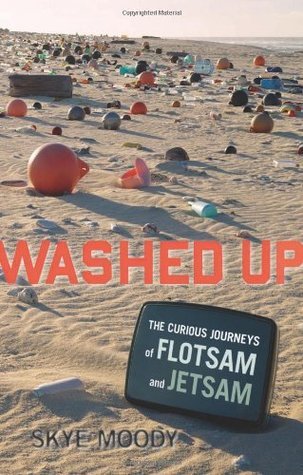
The ocean gives up many prizes, just setting them on our beaches for us to find. From rubber ducks that started out somewhere in Indonesia to land Venice Beach, to an intact refrigerator makes it way to the Jersey Shore. Chunks of beeswax found on the Oregon coast are the packing remnants of 18th century Spanish gold. Author Skye Moody walks the coast, dons her wet suit, and heads out to sea to understand the excellent debris that accrues along the tideline. There she finds advanced military technology applied to locating buried Rolexes, hardcore competitive beachcombing conventions, and isolated beach communities whose residents are like flotsam congregated at the slightest obstacle on the coastline. This book confirms that the world is a mysterious place and that treasure is out there to be found.
This was a short little book, only about 230 pages, about the flotsam and jetsam in the oceans and the differences between the two. The author is one serious beachcomber and spends a lot of her time at the beach or in the ocean and has a lot of souvenirs to show for it and here writes about other people's experiences with things washing up on the beach. Everything from seashells to deceased whales and left Nike shoes and more are covered in this book (and why only Left Nike shoes). I found this to be interesting and at times witty and at times educational. She also writes about pirates and whale vomit too. I liked this book.
Fun read about the human, and sometimes animal, garbage that floats the seas. The author is a collector of found treasure and interviews some like minded folks for the book.
The cover implies this might be a serious book about human damage, but really only one chapter touches on that. It was a reminder that plastic tampon applicators really need to not exist.
I am by no means a proficient or particularly skilled beachcomber, but as a fond student of logistics [1], flotsam and jetsam (and lagan) are of some personal interest to me. This book was a mixed bag for me. Like the washed up remnants of whales or amber or cargo, this book has some worthy finds and some aspects that are just odd and strange and not particularly enjoyable. I suppose if I was a part of the beachcombing community that the author represents herself as part of and who she seeks legitimacy from, I would have found this book to be more enjoyable and perhaps even endearing as a labor of love, but since I am not such a person and since I expected something that was more factual and less self-referential, I must admit that this book was a bit disappointing. As is the case often in life and in reading, this book's failings were a matter of improper expectations, and not really on anything that the author did wrong herself. Had I been looking for a satirical and comical and personal look at oceanic junk, this book would have been more appreciated.
The slightly more than 200 pages of this book are made up of five chapters. Before any of them is an introduction to the subject matter. After this comes a discussion of the noble origins of flotsam in the shipping that has taken place over the last few centuries, which has encouraged the cargo cults of Oceania and other places. The second chapter looks at what happens to goods that remain adrift at sea stuck in becalmed areas of the Atlantic and Pacific Oceans. The third chapter looks at the evolution of flotsam over time. After this the author discusses the science of flotsam and a the meanings and implications by what can be found on beaches. After this comes some acknowledgements and suggestions for further reading for those who appreciate the author's perspective. This book was certainly alright, but not all of the jokes the author makes were appreciated and I'm not sure this is an author that I would ever read again. I certainly have no plans to look out for her books and read them in the future, although if her other books are less jokey I might enjoy them a lot more.
Ultimately, this book is of most use to those who like collecting the junk that comes up on the beach. In fact, this book may be described as a love letter to those who collect and study the waste of our logistical routes and who care about the damage that we are doing to the oceans as a result of our carelessness in shipping. All of this is well and good, but the author spends too much time talking about her obsession with a rock, her visits to a therapist who seems bored to hear about her obsession with objects found on the beach, and making jokes about scaring guys away. While all of these may be interesting to read for someone who already likes or appreciates the author, as someone who has no particular strong feelings for or against, I found the oversharing a bit off-putting and awkward. The author does a good job at explaining and keeping track of the difference between flotsam (stuff that floats on the ocean), jetsam (stuff that falls off or is thrown off of boats), and lagan (stuff thrown off of boats that sinks to the bottom). If you want a good exploration of sea junk and even space junk that becomes sea junk, this is a book that has some value even for those who are not won over by the author's approach.
I love this book, I want to go beachcombing. My mother loved to beachcomb, we also went rock hunting in dry riverbeds. Actually I think the thrift shopping gene is related. It is the hunt for treasure. I have been looking for beachfront property. The dream, to walk out my front door and beachcomb. No lake, river or calm waters. The crashing, pounding surf, the joy and the search for treasure.
I wanted to like this. The idea of it was intriguing. But it was a slog to get through, and I gave up about halfway. The moment it lost me? When the plot of The Goonies was presented as factual. I kept waiting for the "Haha, just kidding, that's the Goonies!" but it didn't come. I don't like giving 1 star reviews, but there was just no shred of credibility left at that point.
A quick, interesting read, but it lacks a good narrative. It's really a collection of unsourced anecdotes, many of them historical, of the various types of flotsam and jetsam found on beaches around the world. I found it confusing to follow at times, since each short paragraph was a different anecdote, without much reflection and the lack of sources was a disappointment. The last quarter of the book was the most interesting, having to do with currents, gyres, and unfortunately, the enormous garbage patches in our oceans. As an avid beachcomber and sea glass collector, I was disappointed that there was little to no mention of this hobby! There is a wonderful community of sea glass collectors out there and some truly amazing pieces and collections. I found the author's apparent distaste for sea glass amusing, since she evidently enjoys collecting bits of plastic on the beach. Also amusing was her patronizing use of "beachcomber", preferring to call herself a "flotsamist". At the end of the day, whatever we call ourselves, we enjoy collecting what many think is junk off the beaches. I just found her insistent distinction between the two a little grating.
It took me over a year to read this book. I read small sections so that I could absorb the information before moving on. The book focuses on flotsam and jetsam which then becomes a lesson in all things about the sea. I often read the book with my iphone handy so that I could look up definitions for words such as lagan and photos of species and other artifacts that were discussed such as ambergris.
It was a very interesting book. My one critique though is that it needs a glossary and many, many photographs for those of us who have little to no knowledge of marine life and history.
If you love nature, the ocean and the beach, you'll probably really enjoy this book. If you're a hard core beachcomber, especially a flotsam beachcomber, you'll love this book. As I, loved it! Lots and lots of humor in this book; tales of laying in the wrackline of seaweed, to try a little beauty treatment just one of the many humorous and relatable stories in this work. Thank you, Skye Moody. I hope you are continuing to enjoy life and nature and the beach. I was sorry you were not able to join the SBS 2016 in Texas. Hope to meet you sometime.
I was fascinated by what I learned in this book. Skye Moody does a wonderful job of relating facts about flotsam, jetsam and lagan, along with poking fun at her own relentless search for something she threw back on the beach and later wished she hadn't. She delves into such items as ambergris, messages in bottles, cargo lost at sea, scientists who use flotsam to map ocean currents and her own obsession with the stuff thrown onto the sand by the sea.
Like talking to a smart person who happens to be slightly drunk. Scary facts are woven in with silly anecdotes. The stories are fun and in some cases outrageous - I had to confirm the beach whistles with a friend who grew up in Jersey. The environmental impact is described, but from a casual observer's perspective, without the doom and gloom that you might expect.
A fun read for someone who loves to walk the beaches wondering how these "treasures" got there.
Amusing journey through the worlds oceans and waterways as the detritus and evidence of human life gets strewn around the world. Particularly interesting when coupled the The Journey of the Whaleship Essex and Getting Stoned with Savages. Launches you into a complete new understanding of the ocean, environmental issues, and man's inability to cope with natural disasters and those created by men themselves.
I really enjoyed this book. Always quirky, at times it was very serious and sometimes just plain funny. I haven't lived near the ocean in 33 years and miss it terribly, but I never did much beach combing other than for shells. Now I desperately want to revisit Seattle and Cape Cod and go flotsam-ing. I also want EVERYONE to read this book and read about how we are slowly killing all the life in the sea.
An entertaining foray into the world of flotsamists (as opposed to the more casual beachcomber). Chatty, informative and never dull, it introduces the reader to a bewildering array of flotsam, jetsam and lagan, and proves, once and for all, that beauty is indeed in the eye of the beholder. It also (finally) clears up the mystery of the floating stone. Recommend!
What a great idea ! Shame the author was only able to line up the contents of her treasure trove like so many fact-lets. The book contains plenty of interesting, lovely, funny and curious detail but a better narrative would've made it a good read.
About what washes up on shores, where it comes from, the journey it takes to get there, and the people that collect these flotsam as a hobby. Not a genre I'd normally read and not a topic I'd ever really considered, but it was surprisingly interesting.
I enjoyed most of this book but it seemed to drag over long in spots. I found myself bored about half way through but the ending did pick up, all in all just an ok read.
This book is a great reminder of the numerous sub-cultures that exist in the world. I had no idea that "beach glass" collecting was a hobby until I read this book.
I nearly abandoned this one as it felt so slow going at the start, but really liked it by the end. It turned in to more of the book I was expecting, I think.