Jump to ratings and reviews
Rate this book

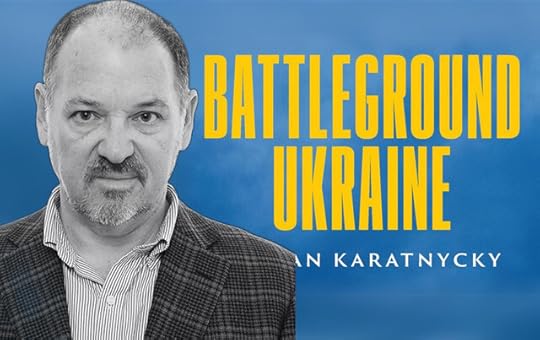
Battleground Ukraine: From Independence to the War with Russia

Rate this book
The first major English-language history of Ukraine from its emergence after the demise of the Soviet Union through the current Russian invasion
 
In 1991, after seventy years of imperial Soviet rule, Ukraine became an independent country. Since 2022, it has been fighting for its survival by resisting an unprovoked, brutal, and ongoing invasion by Russia. At the center of its resistance is the resilience of a united people.
 
Adrian Karatnycky tells the history of how the Ukrainian state and nation gradually emerged through the tenures of the six presidents who have led Ukraine since the collapse of the USSR, including Volodymyr Zelensky, elected in 2019. Karatnycky shows that despite the influence of corrupt oligarchs, pressures from Russia, and the legacies of Soviet rule, a disparate but inclusive Ukrainian nation has emerged that inspires the world as it defends the principle that states have the right to their national sovereignty.

320 pages, Hardcover

First published June 4, 2024

10 people are currently reading
186 people want to read

About the author

Adrian Karatnycky

21 books3 followers

Ratings & Reviews

What do you think?
Rate this book

Friends & Following

Create a free account to discover what your friends think of this book!

Community Reviews

5 stars
16 (43%)
4 stars
13 (35%)
3 stars
6 (16%)
2 stars
1 (2%)
1 star
1 (2%)
Displaying 1 - 7 of 7 reviews
32 reviews
September 20, 2024
Outstanding book for those whose work requires knowledge of the principals (oligarchs, presidents, party leaders, etc.and political, societal and military dynamics of Ukraine since independence in 1991. Very readable and not overly long. I am very grateful to my work colleague who recommended it. Great ongoing resource.
Profile Image for Cav.
911 reviews209 followers
March 4, 2025
"Over the period 1989 until the present day, I have cumulatively spent more than four years of my life in Kyiv or traveling within Ukraine. My direct observations, augmented by reliable news sources, eyewitness accounts, interviews, and readings, have given me what I hope readers will find are helpful insights into the processes and forces that shaped contemporary Ukraine, a nation that has emerged as a united force at a time of great peril issuing from Russia’s invasion."

I did not enjoy Battleground Ukraine. My main gripe was the slow and dry writing, although I had other criticisms; namely that the book has a sizable editorial problem. More below.

Author Adrian Karatnycky is a nonresident senior fellow with the Atlantic Council’s Eurasia Center. From 1993 to 2004, he was president and executive director of Freedom House, during which time he developed programs of assistance to democratic and human rights movements in Belarus, Serbia, Russia, and Ukraine.

Adrian Karatnycky:
karatnycky-when-ukraine-was-invisible

The book gets off to a shaky start, and opens with a very dry intro. This proved a harbinger of the writing that was to follow. Karatnycky spends most of his time here telling the reader how much time he spent in Ukraine over the years, instead of the conventional approach of giving a primer on the book's thesis.

He drops this quote, outlining the contents of the book:
"This book’s chapters focus on the six presidencies (with a discussion of an “acting president” in 2014) since Ukraine’s independence.
There is one chapter for each president, with two devoted to Volodymyr Zelensky’s presidency—the first under hybrid, low-intensity Russian attack; the second during Russia’s full-scale war. An eighth chapter looks at the future of Ukraine. This organizing principle is well justified as Ukraine’s presidents have exerted deep influence over the state and often represented the social trends of their time.
Ukraine’s presidents have wielded significant influence through substantial constitutional powers and frequent success in shaping ruling majorities. In office, they have been a powerful—if not always dominant—force shaping domestic and foreign policy."
Curiously, Karatnycky says this about the Ukrainian language: "...Its language is misunderstood to be a close relative of Russian (in fact, Ukrainian is closer to Polish and Belarusian)." I speak a bit of Russian (non-fluently), and have have many friends who are Russian and Ukrainian. Interestingly, Ukrainian sounds exactly like Russian to me, and my Russian friends confirm as much. However, Ukrainians will usually tell you how completely different the two languages are.

Unfortunately, as mentioned above, I did not enjoy the delivery of this material. I am admittedly very picky about how readable my books are, and this one failed miserably toward that end. There is almost nothing I dislike more in my books than dry, long-winded prose. This book is pretty much only that. The author rattles off names, dates, and places. Names, dates, places - over and over again. Most of the book reads like a long-form encyclopedia article.

Also, Battleground Ukraine is a very long book. The audio version I have clocks in at a hefty ~13.5 hours. If you are going to write a book that long, then you had better make the writing decently engaging. Now, fault me all you like for my short attention span, but in my experience dry, long-winded prose causes my attention to wander, and I find I lose the forest for the trees. Book themes and narratives need to be straightforward and concise. When you rattle off names, dates and places over and over, without a strong focus on the overarching narrative, you end up both losing your audience as well as boring them to tears.

Finally, the author made no attempt to report this story from an objective, unbiased perspective. He mentions early on that his wife and stepdaughters are Ukrainian, and he spends quite a lot of the book fawning over Volodymyr Zelenskyy. At one point he even says: "...Zelensky had emerged as a compelling moral leader of the democratic West, a leader defending democratic values." I'm not sure why commentary like this was added to the book in the first place. Just stick to telling the story, and let the reader make up their own minds. The addition of narrative framing like this has the effect of making the book seem like a puff piece.

Early on in the conflict, Zelensky invoked his emergency powers under martial law to suppress several opposition political parties and implement a "unified information policy" that would nationalize the news. In an address to the nation delivered Sun, March 20, 2022, he announced a ban on "any activity" by 11 political parties. Zelensky's information policy involved "combining all national TV channels, the program content of which consists mainly of information and/or information-analytical programs, [into] a single information platform of strategic communication" to be called "United News." This does not sound particularly "democratic" to me and is questionably "moral.."

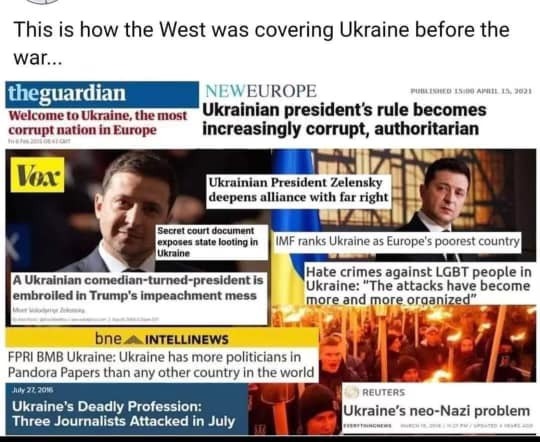
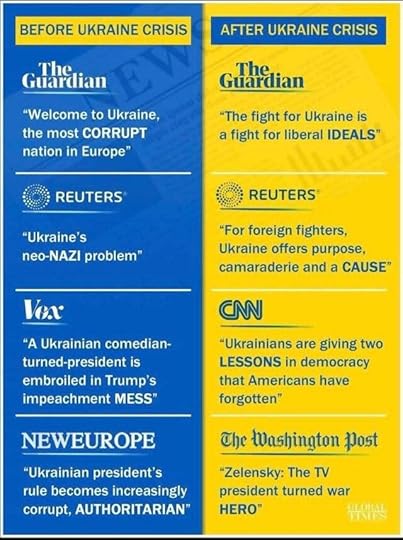
It's interesting that before the war began, Western media outlets and assorted pundits were increasingly sounding the alarm over Zelenskyy's regime and potential corruption. During the war and for the next three years, it became virtually impossible to find any Western media pieces critical of Zelenskyy's regime at all.

480617766-10109856896691995-4068493172098526935-n


481680034-2684943198562743-3448409170161687693-n


Further, amid a problematic manpower shortage the country's military has began a campaign of forced conscriptions. Men have been grabbed while they were out cycling, or even taking the dog for a walk. This video shows a group of men being grabbed as they try to flee the country. This is a compilation of some of the forced conscriptions that have been caught on video.

Modern-day Ukraine also has a disturbing Neo-Nazi problem, and many soldiers have been photographed wearing Nazi emblems. See here and here for more. The author glosses over this here, and says that this can't be true, because Zelenskyy is Jewish. LOL, ok...

Of course the 2022 Russian invasion of Ukraine was a horrible act of aggression, by a corrupt and murderous Vladimir Putin. I read somewhere that ~10 million Ukrainians have been displaced by this war; the largest exodus of people since WW2. Untold hundreds of thousands of men (on both sides) and women and children in Ukraine have lost their lives. This war is one of the greatest manmade wholesale tragedies in recent history. It is unimaginably terrible. But this war didn't happen in a vacuum, and the Americans have played a causal role in this escalation for years. I don't feel the book properly gave the reader this contextual background, and instead just chose to focus the story on: Zelenskkyy = GOOD and Putin = BAD. For a book so long, I expected a more careful examination of the story.

********************

I didn't like Battleground Ukraine. The writing was long-winded and boring, and the book was too long. I also did not appreciate the author's editorializing.
I would not recommend it.
1.5 stars.
Profile Image for Dmitry.
1,292 reviews100 followers
January 13, 2025
(The English review is placed beneath the Russian one)

Перед нами очередная книга по истории современной Украины и о современных российско-украинских отношениях. В книге мы встречаем все те темы, что встречаются почти в каждой книге про современную Украину: распад СССР и появление независимой Украины, президентство Кравчука, Кучмы (включая дело об убийстве журналиста Гонгадзе), Ющенко (включая "Оранжевую революцию"), приход Януковича и его свержение, военное противостояние с Россией в 2014 и потеря Крыма и Донбасса и заканчивается это сегодняшним противостоянием Зеленского и Путина. Если говорить в целом, то большинство фактов указанно верно, однако детали, а что самое главное дух книги, имеет явно предубеждённую направленность. В заключительной части книги автор описывает Зеленского как нового Черчилля, что сегодня скорее вызывает недоумение. Автор так же не задаётся вопросом, стоило ли НЕ подписывать Минские договорённости, сориться с Россией начиная с правления Ющенко, воевать с российским влиянием (язык и культура) и не рассматривает реальные шансы Украины на вступление в ЕС и НАТО. Это печально, т.к. большая часть книги выглядит как вполне здравый обзор современной украинской истории. Я не говорю, что нужно использовать путинские нарративы о дружбе народов, но ведь можно было бы подойти к украинской истории точно так же как это делают англоязычные авторы. Однако на самом деле автор и не мог поступить по-другому, т.е. автор не мог не использовать сегодняшнюю украинскую провластную (патриотическую?) пропаганду просто по одной причине, о которой он и пишет в этой книге.

The war inevitably came to my Ukrainian family.
<…>
One such was my fifty-year-old brother-in-law, a professional violinist, who joined the territorial defense, initially patrol-ling checkpoints in the Kyiv region.

Интересно, что в самом начале автор упоминает речь Буша в Киеве во времена ещё существования СССР. Примечательно тут то, что в каком-то смысле Буш смог заглянуть в будущее.

In what was dubbed the “Chicken Kiev” speech, the U.S. president lectured Ukrainians about the dangers of “ethnic hatred,” “local despotism,” and “suicidal nationalism” while sounding the praises of Gorbachev.

Как я отмечал во всех отзывах на книги о современной украинской истории, вышеперечисленное Бушем послужило той бомбой замедленного действия, которая поспособствовало тому, что сегодня происходит в Украине (притом, что эти вопросы являются на самом деле второстепенным). В книге Ukraine in Transformation: From Soviet Republic to European Society, мы видим социологические исследования, которые говорят о том, что на самом деле желало украинское общество - борьбу с коррупцией, соблюдение закона, экономическое процветание. Конечно, танго танцуют двое и поэтому действия и риторику РФ (такая же агрессивная) не стоит сбрасывать со счетов.

Privatization was implemented without civic monitoring, open media scrutiny, and the rule of law, creating vast wealth for a narrow group of insiders.

Чем больше вглядываешься в украинскую элиту, которая, как и российская сформировалась в 90-ых, тем больше замечаешь общего между ними.

Russia’s policy toward the young Ukrainian state was never entirely friendly.

Как будто украинская политика в отношении РФ была дружественной. Отношения между двумя странами начали ухудшаться сразу после развала СССР. Одни хотели показать, что они уже не "младший брат" и в каком-то смысле более успешны (большие европейцы, чем русские) нежели бывшая метрополия, а другим нужно было создавать иллюзию имперскости, т.е. что они продолжают влиять на постсоветские страны (которые совсем недавно были перифериями империи). На самом деле обеим странам нужна была новая политика взаимоуважения и партнёрства (пусть и не совсем равного, учитывая размер и силу РФ).

In particular, influenced in part by Russian Nobel laureate Aleksandr Solzhenitsyn, Putin believed Ukraine was an artificial construct; instead, the country was an integral part of the larger Russkiy narod (Russian nation).

Откуда у автора такая уверенность, во что верит Путин? Политику язык дан не для того чтобы выражать свои истинные мысли, а для того чтобы влиять и/или манипулировать окружающими. Во-вторых можно услышать иногда о европейцах как о едином европейском народе, но почему-то ни у кого эти слова не вызывают отторжения. Вот примерно то же самое и в нашем случаи, что выражается во фразе «братский народ», т.е. похожие (славянские) народы, но не более.

During that visit, Yushchenko told me years later, he informed Putin of his intention to press ahead with Ukraine’s aspirations to join the European Union and NATO. But he also proposed to Putin the idea of a treaty that would assure that no NATO troops would have bases or a permanent presence on Ukrainian soil. “There was no reaction.

Я думаю, Ющенко прекрасно понимал, что дело не солдатах НАТО, а в том, что это показывало бы всему миру, что Россия не то что не может влиять на Ближний Восток, но она даже не может контролировать самых ближайших и культурно близких соседей. Это как если бы США потеряли контроль над Мексикой и там бы появились военные базы Китая. А что? Мексика является суверенным государством, которое на своей территории может делать что угодно, следовательно, любые солдаты любой страны могут там находиться, не так ли? В реальности такого не может быть в принципе. Примерно то же самое и с Украиной. И такая ситуация вряд ли изменится, даже если вместо Путина в РФ будет очень либеральный президент.

Many in his inner circle themselves were uncertain. Some genuinely believed—or hoped—Ukraine would sign the agreement with the EU and break free of its excessive dependency on a hegemonic Russia.

Не понятно на чём основывается это утверждение времён правления Януковича. Если Россия была готова поставлять газ по сниженным ценам, то я что-то не помню, чтобы ЕС делал что-то бесплатно. Впрочем, возможно автор имеет в виду, что если бы Украина вошла бы в ЕС, то её бы финансировали так же как Грецию. Другими словами, Украина пусть и оставалась бы дотационной страной, но зато тех обязательств, что были перед имперской Россией, у неё не было бы (типа, равный партнёр, а не «младший брат»). Плюс, ЕС помог бы побороть коррупцию в Украине. Теоретически возможно, но практически крайне сомнительно.

Russian tactics aimed to reeducate Ukrainians in order to rob them of their ethnic identity.

Хороший пример того как работает перенос собственных мыслей на оппонента. Если в Украине все помешаны на украинском языке, это вовсе не значит что и Россия помешана на уничтожении украинского языка и пример Грузии это хорошо показывает. Путину нужно только одно - политическая лояльность, а на каком языке это будет выражено, его не интересует. Беларусь, тоже хороший пример, в которой все говорят на русском, но при этом всё население ассоциирует себя именно с Беларусью, а не с Россией (да и в самой РФ белорусов считают братским народом, но не частью русского). Впрочем, Белоруссии стоит более активно продвигать свою культу и язык в РФ.

Plainspoken, tough, courageous, and decisive—Zelensky was the ideal leader for a country at war: a tough and determined everyman, embodying and energized by the civic and martial heroism that was deepening the consolidation of his nation.

Такой подход был актуален до 2023 года, но сегодня (книга издана в 2024 году) такое описание Зеленского всё меньше и меньше убеждает мировую общественность. Как мне кажется, даже в Украине появились сомнения в актуальности такой льстивой характеристики.

This state of affairs makes a Russian victory and Russian domination over the Ukrainian people an unlikely scenario.

Опять же, до 2023 года я так же думал, а сегодня тот же пример Грузии показывает альтернативный сценарий. Всё зависит от решения крупнейших мировых игроков, а также от итога военного конфликта между РФ и Украиной. В частности, кто будет платить, т.е. не только восстанавливать разрушенные украинские регионы, но и финансово содержать Украину на протяжении нескольких лет.

Far more likely is that Ukrainians will preserve their statehood and succeed in their aim of integrating into Europe. And this means that, with the help of the world’s democracies, Ukraine will eventually have an important opportunity for a postwar recovery...

Если в 2022 году, когда я прочитал книгу End Times Elites, Counter-Elites, and the Path of Political Disintegration, я с автором был не согласен, то теперь наоборот солидаризируюсь в прогнозе о будущем Украины, а он в книге End Times Elites очень и очень мрачный (впрочем, будущее РФ так же не светлое).

This is another book on the history of modern Ukraine and contemporary Russian-Ukrainian relations. In the book, we meet all those themes that are found in almost every book about modern Ukraine: the collapse of the USSR and the emergence of independent Ukraine, the presidencies of Kravchuk, Kuchma (including the case of the murder of journalist Gongadze), Yushchenko (including the “Orange Revolution”), the arrival of Yanukovych and his overthrow, the military confrontation with Russia in 2014 and the loss of Crimea and Donbass and ends with today's confrontation between Zelensky and Putin. In general, most of the facts are correct, but the details, and most importantly, the spirit of the book, are clearly biased. In the final part of the book, the author describes Zelensky as a new Churchill, which is rather perplexing today. The author also does not ask whether it was worth NOT signing the Minsk agreements, quarreling with Russia since Yushchenko's reign, fighting Russian influence (language and culture), and does not consider Ukraine's real chances of joining the EU and NATO. This is unfortunate, as most of the book looks like a sensible overview of modern Ukrainian history. I am not saying that one should use Putin's narrative of the friendship of nations, but one could approach Ukrainian history in the same way as English-speaking authors do. However, the author could not do otherwise, i.e., the author could not avoid using today's Ukrainian pro-government (patriotic?) propaganda simply for one reason, which he writes about in this book.

The war inevitably came to my Ukrainian family.
<…>
One such was my fifty-year-old brother-in-law, a professional violinist, who joined the territorial defense, initially patrol-ling checkpoints in the Kyiv region.


It is interesting that at the very beginning, the author mentions Bush's speech in Kiev in the times when the USSR still existed. What is remarkable here is that, in a sense, Bush was able to see into the future.

In what was dubbed the “Chicken Kiev” speech, the U.S. president lectured Ukrainians about the dangers of “ethnic hatred,” “local despotism,” and “suicidal nationalism” while sounding the praises of Gorbachev.

As I have noted in all the reviews of books on modern Ukrainian history, Bush's above points served as the time bomb that contributed to what is happening in Ukraine today (while these issues are really secondary). In Ukraine in Transformation: From Soviet Republic to European Society, we see sociological studies that tell us what Ukrainian society really wanted - anti-corruption, respect for the law, and economic prosperity. Of course, two dances the tango, and so the actions and rhetoric of the Russian Federation (just as aggressive) should not be discounted.

Privatization was implemented without civic monitoring, open media scrutiny, and the rule of law, creating vast wealth for a narrow group of insiders.

The more you look at the Ukrainian elite, which, like the Russian elite, was formed in the 90s, the more you notice the commonalities between them.

Russia’s policy toward the young Ukrainian state was never entirely friendly.

As if the Ukrainian policy towards the Russian Federation was friendly. Relations between the two countries began to deteriorate immediately after the collapse of the USSR. One wanted to show that they were no longer the “little brother” and, in some sense, more successful (more European than Russian) than the former metropolis, while the other needed to create an illusion of imperialism, i.e., that they continued to influence the post-Soviet countries (which had recently been peripheries of the empire). In fact, both countries needed a new policy of mutual respect and partnership (albeit not exactly equal, given the size and strength of the Russian Federation).

In particular, influenced in part by Russian Nobel laureate Aleksandr Solzhenitsyn, Putin believed Ukraine was an artificial construct; instead, the country was an integral part of the larger Russkiy narod (Russian nation).

How can the author be so sure of what Putin believes? A politician is not given a language to express his true thoughts but to influence and/or manipulate others. Secondly, one can sometimes hear about Europeans as a single European nation, but for some reason, no one is repulsed by these words. It is approximately the same in our case, which is expressed in the phrase “brotherly people”, i.e., similar (Slavic) peoples, but no one.

During that visit, Yushchenko told me years later, he informed Putin of his intention to press ahead with Ukraine’s aspirations to join the European Union and NATO. But he also proposed to Putin the idea of a treaty that would assure that no NATO troops would have bases or a permanent presence on Ukrainian soil. “There was no reaction.

I think Yushchenko understood perfectly well that it wasn't about NATO soldiers, but that it would show the world that Russia not only can't influence the Middle East, but, it can't even control its closest and most culturally close neighbors. It's as if the US lost control of Mexico, and China's military bases appeared there. Why not? Mexico is a sovereign nation that can do whatever it wants on its territory, hence any soldiers from any country can be there, right? In reality, this can't happen. It is approximately the same with Ukraine. And this situation is unlikely to change, even if a very liberal president replaces Putin in the Russian Federation.

Many in his inner circle themselves were uncertain. Some genuinely believed—or hoped—Ukraine would sign the agreement with the EU and break free of its excessive dependency on a hegemonic Russia.

It is not clear what this statement from the Yanukovych era is based on. If Russia was ready to supply gas at reduced prices, I don't remember the EU doing anything for free. However, perhaps the author means that if Ukraine were to join the EU, it would be financed in the same way as Greece. In other words, Ukraine would remain a subsidized country, but it would not have the obligations it had to imperial Russia (like an equal partner, not a “little brother”). Plus, the EU would help fight corruption in Ukraine. Theoretically possible, but practically highly doubtful.

Russian tactics aimed to reeducate Ukrainians in order to rob them of their ethnic identity.

It's a good example of how transferring your own thoughts onto your opponent works. If everyone in Ukraine is obsessed with the Ukrainian language, it does not mean that Russia is obsessed with the destruction of the Ukrainian language, and the example of Georgia shows it well. Putin needs only one thing - political loyalty and he is not interested in what language it will be expressed in. Belarus is also a good example, where everyone speaks Russian, but the whole population associates itself with Belarus and not with Russia (and in Russia itself Belarusians are considered a brotherly people, but not a part of Russian). However, Belarus should more actively promote its culture and language in the Russian Federation.

Plainspoken, tough, courageous, and decisive—Zelensky was the ideal leader for a country at war: a tough and determined everyman, embodying and energized by the civic and martial heroism that was deepening the consolidation of his nation.

This approach was relevant until 2023, but today (the book is published in 2024) such a description of Zelensky is less and less convincing to the world community. It seems to me that even in Ukraine there are doubts about the relevance of such a flattering characterization.

This state of affairs makes a Russian victory and Russian domination over the Ukrainian people an unlikely scenario.

Again, until 2023, I thought the same way, but today, the same example of Georgia shows an alternative scenario. Everything depends on the decision of the major world players, as well as on the outcome of the military conflict between Russia and Ukraine, in particular, who will pay, i.e., not only to restore the destroyed Ukrainian regions but also to financially support Ukraine for several years.

Far more likely is that Ukrainians will preserve their statehood and succeed in their aim of integrating into Europe. And this means that, with the help of the world’s democracies, Ukraine will eventually have an important opportunity for a postwar recovery...

If in 2022, when I read the book End Times Elites, Counter-Elites, and the Path of Political Disintegration, I disagreed with the author, then now, on the contrary, I solidarize in the forecast about the future of Ukraine, and it is very and very gloomy in the book End Times Elites (however, the future of Russia is not bright either).
Profile Image for Colleen Green.
108 reviews
December 8, 2025
Having worked in Ukraine sporadically over the past 25 years, I was eager to read this book to fill in the holes from the periods when I didn’t work there (especially during the Yushenko and Yanukovich years). I enjoyed the book… it was easy to digest and covered many of the periods I didn’t know pretty thoroughly. I am however increasingly mindful of the bent with which books are written. I wondered how this book might have been written if you wrote a chapter right after the period ended and didn’t revisit it.

Let me preface this by saying I am pro-Ukraine and despise what Putin has tried to do to Ukraine. I admire the resilience of Ukrainians through all of this especially the war of the past three years. It is a place I have had the privilege of visiting and working in on dozens of trips. But I felt parts of the book seem revisionist when it comes to Ukrainification and a simplification at times that Ukraine = good; Russia = bad. I’m not sure it is that simple and certainly it’s important to separate Russia from its political leaders. (God knows, I would hope the same of the US.) My impressions is that the evolution of identity politics was just that - an evolution, especially over the past 10 years and in a way it seems that many Russian-speaking Ukrainians themselves have only recently come to understand.

All said, a recommended read for anyone working in Ukraine or coming to Ukraine for the first time.
Profile Image for Stephen Hoffman.
614 reviews3 followers
December 1, 2024
(4.5 out of 5 stars)

An excellent book about modern Ukraine apart from parts of the last chapter.
53 reviews
June 11, 2025
A very versed and researched book. A recommended read for those wanting to learn about Ukrainian politics and important characters from Ukrainian independence onwards
26 reviews
November 23, 2025
Have owned the book for a year ... started it once before and stopped because I realized it wasn't fiction and that I would want to take notes.
Have finally restarted it with a paper and pen at hand. Well written but you can't zip through it. Reading it at a 10 page/hour clip.

The value of the book is that it provides a lot of detailed, blow-by-blow political events in the years up to 2024. So it's a nice reference and is well written.

Displaying 1 - 7 of 7 reviews

Can't find what you're looking for?

Get help and learn more about the design.