In July 1947, India's last Viceroy, Lord Louis Mountbatten, stood before New Delhi's Chamber of Princes to deliver the most important speech of his career. He had just three weeks to convince over 550 sovereign princely states--some tiny, some the size of Britain--to become part of a free India. Once Britain's most faithful allies, the princes could choose between joining India or Pakistan, or declaring independence.
This is a saga of intrigue, brinkmanship and broken promises, wrought by Mountbatten and two of independent India's founding the country's most senior civil servant, V.P. Menon, and Congress strongman Vallabhbhai Patel. What India's architects described as a "bloodless revolution" was anything but, as violence engulfed Kashmir and Indian troops crushed Hyderabad's dreams of independence.
Most princes accepted the inevitable, exchanging their power for guarantees of privileges and titles in perpetuity. But these dynasties were still led to extinction--not by the sword, but by political expediency--leaving them with little more than fading memories of a glorified past.
John Zubrzycki is an award-winning journalist whose long association with India has included stints as a Hindi student, diplomat, consultant and foreign correspondent. He is the world commentary editor at the Australian newspaper and lives in Sydney.
The story of how India's 565-odd princely states were integrated into the union is a critical, yet often overlooked, chapter of our independence history. John Zubrzycki's "Dethroned" does a masterful job of filling this gap, documenting the monumental challenge that lay before the newly formed nation in 1947. The book chronicles the astute and relentless partnership of Sardar Patel and V.P. Menon, who, with tactical support from Mountbatten, raced against time to prevent the balkanization of the country. The narrative is rich with detailed accounts of the complex negotiations and standoffs with major states like Hyderabad, Kashmir, Jodhpur, Bhopal, and Travancore, some of whom conspired to join Pakistan or remain independent. From the curious case of Junagadh to the final abolition of the Privy Purses, the book uncovers the sheer scale and complexity of a political masterstroke that shaped modern India's map.
While Zubrzycki’s research is impeccable and the subject matter is gripping, the narrative occasionally suffers from repetition, as the accession stories of various states can blend into one another. The author’s attempt at maintaining a strictly impartial tone at times feels a bit forced, slightly dulling the inherent drama and high-stakes tension of the events. Nevertheless, its an incredibly informative and essential read for anyone interested in the birth of modern India and the masterminds who pieced it together against formidable odds.
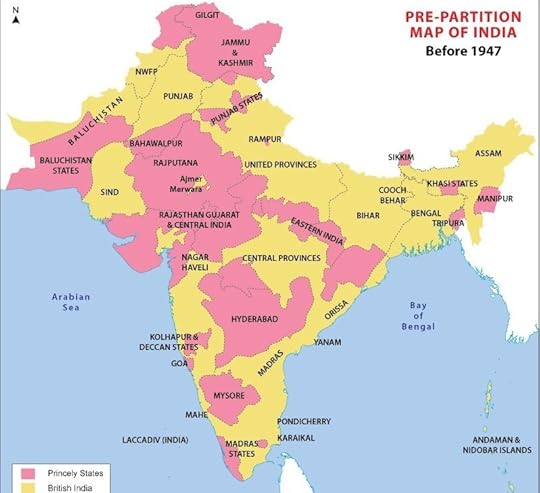
“My own personal wish is to abdicate and to serve Islam. I have not amassed a fortune but that does not matter as long as I can serve Islam and Pakistan. I am prepared to serve Pakistan in any capacity”. This excerpt is from a letter written by Hamidullah Khan, the Nawab (king) of Bhopal to Jinnah on Aug 2, 1947, hardly two weeks before freedom dawned on India. A cursory glance at the map would convince any political novice that the Bhopal ruler’s wish to join Pakistan was physically impossible, yet it contained a political dynamite that was sure to wreck the unity of India. There were around 565 native states in undivided India, of which only ten states came inside the geographical boundary of Pakistan which easily acceded to it with the exception of Kalat in Baluchistan. The situation in India was different. All the Muslim rulers and even some of the Hindu rulers did not want to join India for various reasons, most of them religious or selfish. The native states were too dispersed geographically and too interconnected economically with British India for having any chance ever to become truly autonomous. Sardar Vallabhbhai Patel and V P Menon achieved their integration with India in an astonishingly short time. This book tells the story of India’s native princes from the arrival of Lord Mountbatten as the viceroy in March 1947 until the abolition of the former rulers’ titles, privileges and privy purses in Dec 1971. John Zubrzycki is the author of several books on Indian royalty of the twentieth century. He majored in South Asian history and Hindi at the Australian National University and has a PhD in Indian history. He had worked in India as a diplomat and as foreign correspondent of The Australian newspaper. My review of his earlier book ‘The Last Nizam’ can be read here.
The author makes an analysis of how the native states were managed by the rulers. There were large states such as Hyderabad which equalled France in geographical area but most were very small and the titular rulers were practically nothing more than zamindars. Some states – such as Mysore, Travancore and Baroda – were administered better than British India, but most of the others were backward fiefs. Whatever laws existed in many princely states were a jumble of personal decrees, British Indian laws and local customs. Britain, being the paramount power, did not interfere in their administrative affairs in return for cooperation and support of the princes when they needed it. The India Office in London was the final authority on recognizing successions and determining when to hand over powers in the case of minors. The system of gun salutes tied the princes to a feudal hierarchy. Out of the 565-odd states, only 149 were privileged to have gun salutes ranging from 9 to 21. By comparison, the Viceroy was entitled to 31 gun salutes and the King Emperor 101. Personal misrule freely occurred in many states. The proclivity of the princes towards sexual perversions reached gross proportions in some cases. In the summer of 1947, four tons of paper containing correspondence between the local British resident and the political department in Delhi regarding the secret affairs of the princes were clandestinely confined to flames so as not to reach the hands of the leaders of independent India. Congress withdrew its earlier stand-offish stance in the 1938 Haripura AICC session. It declared that the Congress stood for the same political, social and economic freedom in the states as in the rest of India and considered the states as integral parts of India which cannot be separated.
The book includes the fabulous intrigues and machinations undertaken by the Congress, Muslim League and the British in the run up to and immediately after independence. Most white officials had no qualms to see India disintegrating into a multitude of small, independent nations. Some of them even cherished the idea, while some others came around to embrace a nationalist outlook later on. Conrad Corfield, the political secretary to the Viceroy, was of the former type and he gave the rulers the assurance that their states would become independent once the British left, as was promised earlier by the Cabinet Mission plan. Mountbatten also toyed with the concept of disintegration at first. He was having a Balkanizing plan for independent India. Eleven provinces of British India would become free along with most of the native states which would negotiate with the provinces regarding accession. Nehru was furious at this callous proposal which would forever put India’s political unification to doom. It was on May 10, 1947 that V P Menon articulated a plan to Mountbatten which eventually materialized. On May 18, Menon and Mountbatten flew to London with the plan and convinced the British cabinet. This established Menon as an irreplaceable factor in the States ministry. An interesting anecdote is told in the book that exemplifies Jinnah’s subterfuges to destabilise India after he got assurance of Pakistan. The Patiala kingdom was reluctant to join India while entertaining hopes for an independent existence. Jinnah quickly seized the opportunity and in May 1947 urged Yadavindra Singh, the ruler of Patiala, to join Pakistan and offered an array of carrots. Singh refused. Undeterred, Jinnah invited him to his residence in Delhi two days later for an informal chat where his sister Fatima ‘made excellent tea’ while Jinnah repeated his offers. Once more, the Maharaja remained unmoved, but Pakistan’s reputation for preparing excellent tea for ‘Indian guests’ (remember Abhinandan Varthaman) appears to be long established.
The author covers most of the contentious cases where the rulers had to be forced to see reason and fall in line. It is to be remembered that not a drop of royal blood was spilt in the process. That was why Khrushchev once remarked that ‘India liquidated the princely states without liquidating the princes’. Patel’s powerful personality, which mixed fury with charm and persuasion with coercion complemented Menon’s skills as a tactician. Most rulers held Patel in awe and esteem. Menon cleverly handled this to his advantage. Even a mere hint from him that a point of contention might have to be referred to Sardar was sufficient to bring the rulers around. Menon and Patel thus achieved their wonderful goal of creating a politically cohesive India and of extending responsible, democratically elected government to the people of the states. No longer could the ruling princes run their states like fiefdoms. Rulers surrendered all their governing powers in return for a guaranteed privy purse amounting to ten per cent of the revenue of their states in 1947. This money was tax-free and this was an important concession considering the exorbitant levels of taxation at that time. Princes were allowed to retain their palaces, personal privileges and titles. Integration yielded, in addition to territory and population, cash and investments worth almost Rs. 100 crores, half of which had come from the bonds of just one state – Gwalior. In return, the government of India committed itself to paying privy purses costing around Rs. 4.5 crores in the first year, which would shrink with each succeeding year.
This book is unique because of two reasons. One is that it describes how the native states acceded to Pakistan while the same process was going on in India. Fortunately for them, they had to handle only ten states out of the 565. Even then, the accession of Kalat in Baluchistan was a coercive one that totally alienated the sentiments of Baloch nationalists. Pakistan is still paying a bloody price for disregarding the wishes of Baloch people in the form of a thriving freedom movement and militancy. It is interesting to note that Pakistan too revoked the privy purses shortly after India did so. The second noteworthy feature of the book is the clear exposition of Indira Gandhi’s rationale in rescinding the privy purses. After their states were merged to the union and their powers conceded, many rulers had taken to electoral politics cashing in on their immense clout with the local populace. The former rulers had begun to unite on the political front and tried to influence electoral outcomes in many constituencies. Indira Gandhi was not someone who would acquiesce in to such encroachment on territory which she deemed sacrosanct for popular politicians. One thing led to another and with a showdown with judiciary, Indira achieved what she wanted in taking away the incomes of the former princes. Whatever may be the democratic justifications, readers feel that the abrupt cancellation of princely privileges was a breach of promise Nehru and Patel had vowed to them while merging their territories voluntarily with India.
While the book is an enjoyable read, it presents the most blatant one-sided and pro-Pakistan outlook coming from a Western author. The accounts of even Pakistani authors such as Ayesha Jalal are much more balanced than this one which has completely gone over the fence as far as neutral readers are concerned. Zubrzycki’s narration is a totally partisan account of atrocities as if the Muslims alone were at the receiving end. He justifies the Pakistani attack on Kashmir in 1947 that propelled its king Hari Singh into the arms of India as a justifiable outrage of Pashtun tribals at the ill-treatment of Muslims in Kashmir. He alleges that Patel sanctioned ethnic cleansing of Muslims in Alwar by the state forces. He again stoops so low as to mimic the Pakistani propaganda piece that the atrocities committed by Razakars in Hyderabad were fake and fabricated by K M Munshi, India’s agent in that state. It is as If this author was asked to prepare an account on the losses of World War II, he would come up with only German losses suffered subsequent to Allied bombings while claiming the Holocaust as ‘fake and fabricated’. This book’s handling of the situation in Jammu and Kashmir is terribly off-balance by propping up a biased overview of the alleged violence on Muslims of Kashmir by the Dogra ruler. Plain communal disturbances are portrayed as ‘anti-monarchical protests’. He accuses the minority Kashmiri Pandit community of having 78 per cent representation in state services as a valid justification of the jihadi violence on them. By the same token, we would expect that this author would mention that Muslims cornered 85 per cent of the state services in the Nizam-ruled Hyderabad, but he maintains a stoic silence on this issue. Moreover, atrocities on Hindus are just ‘sectarian violence’ for him (p.222). This book also attempts to whitewash the Bhopal Nawab’s bigoted overtures to join Pakistan with a dubious allegation that the preference of a handful of fellow princes to the Hindu Mahasabha had driven Nawab Hamidullah Khan into the folds of the Muslim League and Pakistan (p.55). This kind of an argument would come only from a hard-line Muslim League supporter and Zubrzycki’s parroting of this line only proves his incompetence and ignorance of Indian politics and society.
Since this book is just a Pakistani propaganda piece, it is not recommended for general readers.
On the 25th of July 1947, Lord Mountbatten addressed the Chamber of Princes (COP) at Delhi in the Council House which was to become the Parliament of India. Mountbatten had already decided the date of India being granted dominion status and the agenda of the meeting was to present options to the Princely states to accede to India or Pakistan. Laying out the foundation of accession he informed that Princely states would have to cede ground on three subjects – defence, foreign affairs, and communication. He asserted that “The States are theoretically free to link their future with whichever Dominion they may care [to]. But when I say that they are at liberty to link up with either of the Dominions, may I point out that there are certain geographical compulsions which cannot be evaded. Out of something like 565 States, the vast majority are irretrievably linked . . . with the Dominion of India”. The book is a remarkable tale of how 562 princely states were strung together to create the map of modern India and the central role of Patel and Menon in achieving this near-impossible task. Zubrzycki begins his tale with the arrival of Mountbatten as the Viceroy in March 1947 and ends with the abolition of titles, privileges, and privy purses in December 1971.
During the British Raj, the Princely states were kept under a tight leash of coercion. Every princely state had a British political representative who assured them of their continued monarchy for the price of their support. This effort was led by Conrad Corfield, the viceroy’s adviser on the princely states who championed the cause of the princes and was often accused by the Congress and others of planning to balkanise India on independence. As he left for England in 1947, his final act of loyalty to the princes was the destruction of thousands of secret files maintained by the British on the often scandalous private lives of India’s potentates. These files were used by the British to blackmail the princes into submission. Meanwhile, the Congress considered the princely states as bastions of debauchery and decay. Nehru termed them as ‘sinks of reaction and incompetence and unrestrained autocratic power, sometimes exercised by vicious and degraded individuals’.
While most states fell in line, others staked a claim for independence or a better deal. Interspersed with anecdotal gems, the trials and tribulations of amalgamating Hyderabad, Kashmir, Junagadh, Travancore, Kashmir, and Alwar are emotively narrated. Zubrzycki paints a vivid picture of how Menon and Patel as a tag team coaxed and coerced the Princely states. Although Patel managed to enshrine the grant of privy purse in the constitution, we find, that guarantees given to the princes were consistently abandoned. Similarly, the states were assured their boundaries would be respected, but beginning with tiny principalities in Odisha, by 1949-50 even major states were erased from the maps via “integration”. In many cases, the states were better ruled before independence. Post-independence, the collapse of the erstwhile governance machinery even drove some states to economic bankruptcy. The constitutional safeguards for granting privy purses to the Princely states were amended under the leadership of Indira Gandhi. In a politically motivated sleight of hand, the bill to derecognise the princes and abolish their privy purse and privileges became law on 28 December 1971. “Patel’s private secretary, V. Shankar, wrote that abolishing the privy purses without compensation was ‘an unprecedented act in the annals of India’s constitutional history . . . The utter impropriety, immorality, unconstitutionality, lack of chivalry . . . and ingratitude of the transaction begs description.” As Indian politicians became the power brokers of a new India, the royals took to politics themselves or supported candidates to retain their regional clout. Zubrzycki highlights the sharp political and ideological divide between Nehru and Patel as violent fissures of partition swept across the nation. Jawaharlal Nehru declared him a “communalist” and Dethroned chronicles this controversial discourse. For all his immense achievements, Zubrzycki argues that Patel often used the princely states for ulterior motives. For instance, in Punjab, where the Congress decried Sikh princes as relics, Patel looked away as the maharajas armed Sikhs to expel Muslims. The Sardar also turned a blind eye to the communal violence targeting the Meos in Alwar. The annexations of Junagadh and Hyderabad were also followed by communal strife aided by administrative inaction. The reports of communal violence in Hyderabad after the annexation led to Nehru commissioning a confidential report led by Pandit Sunderlal and Qazi Abdulghaffar. The report was so damning that Nehru and Patel together suppressed it. The report was eventually first published as an appendix to A.G. Noorani’s The Destruction of Hyderabad in 2013. However, in fairness, Zubrzycki is not unduly harsh on Patel or Menon or sympathetic to the princes. Another interesting segment in the book is the happenings leading to the integration of Kalat in Pakistan. The state’s quest for sovereignty amongst the allegations of inaction on the Indian side, the validity of treaty obligations, and accusations of cross-border meddling led to the debate on whether Khan signed the Instrument of Accession with Pakistan voluntarily or was forced to at gunpoint. The journey of the princes in democratic India began with them surrendering their kingdoms for privy purses while retaining limited sovereignty as figureheads of their provinces and eventually ended with them being reduced to ordinary citizens after the amendment of the constitutional provisions. While Menon’s justification for speeding up the process of integration was to avert an escalation of the chaos that had engulfed the subcontinent after the transfer of power. Zubrzycki examines the accession-versus-chaos theory arguing that the theory ignores the sharp reality of small states living in the shadows of large countries with powerful militaries such as India and Pakistan. He postulates that any form of independence would have been short-lived. The biographers of both Menon and Patel have argued against the theory of them having betrayed the Princely states. Narayani Basu reasons that “It is perfectly true that V.P. and Patel were not above – when neither their powers of persuasion or offers of empty honours worked – engaging in a judicious mix of arm-twisting and veiled threats. But they did not set out to betray the princes. Nor is there the slightest evidence to prove these charges.” However, Zubrzycki informs that that many states were transitioning to modern administrations and were repeatedly promised by Menon that they would stay as separate entities, however, even they were coercively amalgamated into larger states. Interestingly, the problems of integration in Pakistan and the efforts of Jinnah in such a critical nation-building exercise were surprisingly limited. There are other so-called seminal books on the integration of the princely states such as K.M. Panikkar’s Relations of Indian States with the Government of India (1927) and Menon’s Post-retirement Story of Integration of Indian States (1957). Panikkar was the Dewan of Bikaner and Menon was the right-hand man of Patel so their tales are weighed down by the baggage of justifying the past. Zubrzycki offers a fresh perspective based on multiple first-person accounts, primary sources, and now declassified archives. The tale is skilfully told and is an admirable example of narrative history. A very fine book that should be a worthy read for anyone who wants to engage with the journey of the making of India as a Union of States.
This books covers a period and events that are not very well documented in popular history or school curriculum. I guess for most of my generation, the Independence-related context we are aware of would be that India was ruled by the British and we secured independence thus forming the Indian nation; the presence of the Princely States and their relation to Britain, and how they posed hurdle to the full integration of the Indian nation is not something I was familiar about. This books fills me in.
Facts and Notes:
* Sardar Patel was from a landlord family, a barrister and after starting to get involved with Gandhi, climbed to the leadership of Congress. VP Menon (Vappala Pangunni Menon) on the other hand, ran away from his Palakkad home, worked as manually laborer doing many odd jobs until he became a stenographer at the reforms commission, eventually became its head and then worked in the Secretary of the states department.
* The largest state Princely state was Kashmir, followed by Hyderabad.
* In exchange for guaranteed protection against internal unrest or attacks by enemies, the ruler of the Princely states would have to accept a British resident or political agent at his court and, in the case of the largest States, they have to pay for a subsidiary military force commanded by British officers.
* To constitute the Princes into a Feudal hierarchy the British devised a system of gun salutes, ranging from 21 for the five largest States down to 9. Only five states enjoyed 21 Gun status -Hyderabad, Kashmir, Mysore, Gwalior and Baroda.
* While Pakistan was prepared to negotiate with each state individually, India, because of the large number of rulers involved, would do so only collectively, based on the draft instrument of accession. All they were being asked to surrender were three subjects-defense, external affairs and communications. In no other matters would the central government have any authority to encroach on their internal autonomy or sovereignty.
* Travancore is rich in monazite that produces thorium, a crucial ingredient in the operation of nuclear reactors and the manufacturer of nuclear weapons. CP Ramaswami Iyer's declaration that it's state would become independent once power was transferred rattled Mountbatten, Nehru and the congress leadership. He insisted his position was final and that there could be no negotiations as the state was ruled 'In the name and on the behalf of the tutelary diety, Sri Padmanabha'.
* In June 1947, Savarkar wrote to Aiyar backing the Maharaja and his 'courageous and foresighted determination ' to seek independence. 'The Nizam, Muslim ruler of Hyderabad, has already proclaimed his independence and other Muslim states are likely to do so. Hindu states are bold enough to assert they have the same rights'.
* On 25 July, as CP was leaving a music concert in Trivandrum, he was attacked by a knife-wielding activist from the Kerala Socialist Party. Bleeding heavily from wounds to his head, he was rushed to hospital. Fearing that the forces behind that were capable of ever greater violence he wrote to the Maharaja from his hospital bed, advising him to follow the path of compromise. The Maharaja telegraphed his acceptance of the Instrument of Accession to the viceroy personally.
* Osman Ali Khan, Hyderabad's 7th nizam and India's Premier Muslim Prince had many achievements to his credit, including the founding of the Osmania university. Kashmir's Maharaja Hari Singh spent much of his time abroad, got involved in a sex scandal and there were demonstrations against the Maharaja in 1931.
* Hyderabad refused to accede to India. Hari Sing was indecisive and according to Mountbatten, Patel had assured him that if Kashmir joins Pakistan this would not be regarded as unfriendly by the government of India. Amongst the Punjab rulers, there was deliberation in the formation of Sikhistan.
* Hamidullah, the leader of the Princely states grouping, with help from Jinnah tried to convince Jodhpur (Hanwant), Udaipur (Bhupal Singhji) kings. These states could provide a link to Indore (Yeshwant Rao Holkar) and Bhopal (Hamidullah), which Patel described would be a dagger through India, but the plan foiled.
* Junagadh (Mahabat Khan) and Manavadar initially acceded to Pakistan, but was later coerced back to India.
* In 1947, Jammu and Kashmir comprised of the Districts of Giljit, Baltistan and Skardu, each with its own brand of Shia Islam; the Kashmir Valley with its name Muslim majority, where Hindu Dogras and brahmin pandits dominated and controlled the bureaucracy and administration; the southern district of Jammu, where Muslims constituted around 60% of the population; and in the east, Ladak which was largely Buddhist and had traditionally owed its religious and political allegiance to Lhasa.
* In the 1950s Sheik Abdullah of National conference pandered to his Muslim constituency and it appeared that he would declare independence, but India pre-empted and jailed him. Bakshi Ghulam Mohammed assumed the post of prime minister and his decade old reign is remembered today as the most ruthless and he is considered to be the most corrupt chief minister Kashmir has ever known - his Reign setting the stage for years of repression, dysfunction and increasing alienation of the Kashmiri population from the rest of India.
* Regarding the Kashmir solution, the opportunity for holding a plebiscite had passed and is unlikely to present itself again. The near impossible precondition of a Pakistani withdrawal gives India an excuse to renege on its commitment indefinitely. Similarly, decades of brutal repression means that the chances of the states population voting for accession to India is almost zero, further diluting the promises made by Nehru more than 70 years ago.
* The refusal of Hyderabad to accede led to military confrontations. Osman Ali khan (who sided with allies in WW I and II) was supported by the Ittihad ul-Musslimeen group led by Kasim Rizvi, which had around 100,000 volunteers called Razakars. Sidney Cotton, an Australian supplied guns to the Hyderabad in their fight with the Indian army.
* A while after the independence and accession, the merging of smaller states to form bigger ones happened. For all future mergers, under the new agreement the rulers would surrender all their governing powers in return for guaranteed privy purse amounting to approximately 10% of the revenues of that state as it stood in 1947 subject to a maximum of 1 million rupees.
* Gwalior and Indore merged into Madhya Bharat, the Western states into Rajasthan. By 1950, only Mysore, Hyderabad and Kashmir remained separate.
* Bahawalpur toyed with the idea of acceding to India or autonomy until it finally acceded to Pakistan. Kalat state in Baluchistan was a pain for Pakistan. They demanded independence which was initially accepted by Jinnah but was then later forced to accede. The resentment of the Baluchi nationalists still pester.
* After Independence many of the princes and kings and queens stood for elections and got elected to the Lok sabha and Rajya sabha. A faction within the congress, especially Yashwantrao Chavan proposed bills to abolish the privy purse. The first attempt to pass it in the parliament failed by a whisker, which prompted Indira to derecognize the rulers which was stayed by the supreme court and finally she called for an election in which she won a thumping majority thus abolishing the privy purse. Following her lead, Zulfikar Ali Bhutto would also do it.
India, geographically and politically, that is being seen today would not be the same India, if Sardar Patel and VP Menon had not merged princely states to the Indian union. Princely states have been controlling the 1/3rd of india, had their treaties with the crown, and their own laws and rituals. This page-turner book aptly describes the whole saga in great details.
Some new information in this book, but I enjoyed his works on palace intrigue and princely gossip more than this work. This book felt a bit dry, and the most enjoyable parts were when the author was talking about gossip rather than fact. But a good starting point for anyone interested in the history of princely integration into India.
Reality check on the complexities that Nehru and Patel had to grapple with to integrate the various princely states into the Union of an independent India ,post independence. Must read
Although this is an excellent account of the end of India's princely states I have to admit to being disappointed that the author hasn't added anything of real substance to what was already available in popular histories or the memoirs and biographies of the participants.
Maybe my disaffection arises from the failure of the book to examine areas that the author would rightly say are outside his remit. What do I mean? well as an Irish person, and someone who has read a great deal about Britain's torturous response to Ireland's quest for independence, I cannot help drawing parallels with the way in both colonial situations the problem/obligations towards minority groups were used as delaying tactics to avoid dealing with the demands of the majority population to cease being governed by a foreign power. In India the Princely states and Britain's treaty obligations to them as well as 'moral' obligations to groups like the Anglo-Indians were used again and again by official and unofficial (Winston Churchill being the most notorious backstairs operator between WWI and WWII) panjandrums to delay, obfuscate and hinder any moves towards India's self government.
You will notice that no one is writing books about the fate of the Anglo-Indians and Britain's concern for them, like Southern Irish Unionists, was something that was easily discarded once they no longer had any use as a delaying tactic. The most extraordinary thing about the Indian princely states is not what happened in 1947 but that they still existed in 1947. If ever you want an example of the empire being organised to suit the needs of Britain rather than those it ruled India, and the princely states, are a prime example. The 520 odd princely states ensured that any sort of independence would be greatly complicated by their existence while in the meantime providing absolutely no hindrance to Britain's absolute control of India. Although not examined in any detail at one point a comparison is made with the mediatisation of the smaller states of the Holy Roman Empire by Napoleon. This is instructive if only to remind us that the Holy Roman Empire disappeared in 1806 while India's princely states only disappeared in 1947.
The princely states were a grotesque anachronism and considering how little real power or popularity they had one can't help feeling that they got off lightly. That the rulers were so deluded and of touch is almost impossible to believe now - but they were the petted, powerless, toys of their imperial masters who deluded them into imagining they had real purpose. That so many imagined they could actually become independent states is almost pathetically sad. Their betrayal by Britain was absolute, like all colonial elites who worked with and backed colonial rule, and their end neither surprising nor to be regretted.
Dethroned presents itself as a sober, neutral account of the final days of British rule and the uneasy absorption of the princely states into independent India. On the surface, it succeeds: the narrative is lucid, the archival material impressive, and several uncomfortable episodes—often glossed over in popular Indian histories—are brought into the open.
Yet, read carefully, the book becomes a lesson in how emphasis and omission can quietly distort a larger picture. Incidents not spoken of much in present-day India, such as the atrocities committed against Meo Muslims in present-day Rajasthan, with the complicity of some princely rulers and Hindu right-wing groups, are rightly highlighted. However, the overwhelming focus on Muslim victims—in Rajasthan, Punjab, and Hyderabad—comes at the cost of near-silence on the comparable violence suffered by non-Muslims during the same period. In isolation, this imbalance might be defensible; cumulatively, it begins to feel selective.
This pattern recurs elsewhere. The tribal incursions into Kashmir in 1947 are treated with studied ambiguity, despite broad scholarly consensus—including from Pakistani historians—that these were instigated and joined by regular army personnel. Similarly, the brutalities committed by the Razakars in Hyderabad receive cursory treatment, while disproportionate attention is paid to Muslim casualties during Operation Polo.
Running through the book is a faint but persistent snark when discussing Sardar Patel and VP Menon, as if they were executing a cynical grand design to swindle hereditary rulers of their kingdoms. By the end, the princes emerge as the story’s enduring victims—first of Patel, Menon, and Mountbatten, and later of Indira Gandhi.
That framing is debatable. Given global precedents—where royalty was often (and quite mercilessly) eliminated outright—the Indian princes were treated remarkably well. Managing 562 states amid Partition’s chaos and the birth of a desperately poor nation required patience and pragmatism, qualities Patel and Menon displayed in abundance. It also bears remembering that many princely rulers had enabled British rule to endure as long as it did. So, the inheritors of the Indian governing mechanism were unlikely to be particularly enamored of these rulers.
Despite its biases, Dethroned is worth reading—for what it reveals and for what it unintentionally obscures. I would strongly recommend pairing it with Menon’s own account (The Story of the Integration of the Indian States) to restore balance.
'India protests new laws disenfranchising minorities in Bhopal and Kathiawar' or 'Indian government exhorts Hyderabad and Bikaner to update age of consent for women to 18'. Imagine the headlines in an India where states such as Hyderabad, Jammu and Kashmir, Bhopal and hundreds of others co-exist under alongside 'India'. India being the newly independent erstwhile British India. This was not only a plausible scenario but also a highly probable one. As a matter of fact the 'Instrument of Accession' that the princely states signed with the independent India gave control of only 3 spheres to 'India' - foreign affairs, defence and communications.
The Indian subcontinent that the British ruled had two main systems of government. The British crown directly ruled the so called 'British India', which was approximately three fifths of the land mass. A substantial two fifths was divided among almost 550 princely states. These states managed their own internal affairs under the crown's protection. Their fiefs ranged from a few square kilometers to hundreds of thousands of kilometers in the case of Hyderabad and 'Jammu and Kashmir'. The rulers of these states fully expected to be independent once the British packed their bags and left. Congress leadership realised that having hundreds of these 'independent states' would be a nightmare to manage. This would also have deprived the citizens of these princely states the full benefits of Independence. The task of assimilating these states fell to the unlikely pairing of Vallabhbhai Patel and VP Menon. As the name suggests , this book covers the few months in 1947-48 within which this project was completed with an epilogue of subsequent events.
Sardar Patel was a london trained barrister from Gujrat who traded his suits for dhoti kurta when he answered Gandhi's call. He was one of the towering leaders of Congress with a huge mass following of his own. The lessor know VP Menon from Kerala was a man of many experiences. While starting his professional life as a teenage labourer at Kolar mine fields he then rose to be at the top ranks of the British administration in India. These two used every one of the old 'sam - dam - dand - bhed' to assimilate the princely states. They lulled them into a false sense of security, painted lurid pictures of people's revolt and if all failed threatened with direct use of force to ensure that the princely states fell in line. In my view the two them did the dirty work required to ensure that India came out of the British rule as one cohesive geographical unit. Specially knotty issues emerged in the case of some princely states. Kashmir and Hyderabad had muslim rulers but largely Hindu populations while the scenario was reversed in the case of Junagadh.
Zubrzycki does a good job of throwing light on this very significant part of the Indian history. He covers biographical aspects of Patel, Menon and the major princes interspersed with a taut narrative of the events. A major source for the book is Menon's own book on the subject 'Story of the Integration of Indian states'
This is not only a good read but one of the more important books that I have read in some time.
Other book reviews at singhharshvardhan.blogspot.com
John is a master story teller of historical accounts. His acquaintance to the royal and princely houses of the country particularly exhibited by his emphatic accounts of the House of Jaipur and the House of Hyderabad, positions him ideally to undertake such a mammoth task of analysing the princely India. In the syllabi of history and polity in India, the integration of states post independence is succinctly written off as a combination of skilful negotiation and occasional 'police action'. What is often understated in the aftermath of the partition is the colossal and morally grey area of national integration. Little do Indians know, their independence was not just from the British but also the monarchial rule at the micro level. The book for the first time brings the story to mainstream narrative.
What makes John special is his anecdotal storytelling. Curating the right mix of hard facts and intriguing stories he skilfully plays around with prose that can excite a regular reader. He uses palace intrigues and documented rumours well to create an air of thrill and excitement almost similar to a fictional account. This makes his readings even more joyous giving a broad overview of the affairs covered. For a more depth-oriented reader, the secondary sources are mentioned at the end to dive further into the more academic and scholarly accounts of the events.
This book is a must-read for anyone interested in knowing about India and its history. It beautifully covers a major loophole in the historical education of the citizens of the country. And needless to say it's a fun and thrilling read.
The integration of the princely states is a familiar story. One of the men instrumental in bringing about the integration, V.P. Menon, has himself left an account. Zubrzycki tells the story from the perspective of the Princes. From this perspective, integration of states turns out to be a story of perfidy and promises not kept. When the Princes signed the instrument of accession to the Dominion of India, they conceded only defence, foreign affairs and communications. In all the other spheres they were to remain sovereign. But soon enough, smaller states were integrated with each other and isolated small states were merged with nearby provinces. The larger states hoped to maintain their integrity. But that was not to be. All the states were forced to accept the new Constitution and in return were promised Privy purses and titles. Within quarter of a century, these promises were violated and privy purses were abolished. The Princes were not paragons of virtue nor their rule exemplary. Nevertheless they deserved a more graceful exit rather than the unceremonious shutting out that they got. Zubrzycki also brings to light some of the lesser known facts of history. How many of us know that in the violence accompanying Hyderabad integration no less than 50,000 people died making it one of the bloodiest communal incidents in independent India. I also found the story of the reluctant integration of Kalat (Balochistan) into the Dominion of Pakistan, very interesting.
The book is a brilliant take on one of the most challenging problems faced by the newly independent India in 1940s i.e. the integration of princely states. This book takes you through the history of those troubled times and then also covers the later episodes of the story with the Indira Gandhi abolishing the privy purses and kings entering the democratic electoral contests. The book tries to take an impartial view of all the protagonists and antagonists and calls a spade a spade by pointing out various errors made by Nehru, Patel or Menon. Most of the books on the subject are one sided account of how this great feat was achieved by the Indian government in a small amount of time, this book also points out how morals were side casted, minorities massacred, solemn promises broken and betrayal were carried out to achieve the same but also talks about the necessity of the same. The books also tried to cover the similar problems faced by the Pakistan government in merging their share of 10-15 odd states. In short this book is a balanced account of the one of the most tumultuous period of the history of south asia.
The integration of Indian States, an exercise done to prevent the balkanisation of India once the British left is an oft overlooked chapter of the post independence Indian history. This was a massive feat of diplomacy and political acumen, an exercise bringing in 562 states into the fold of Indian republic.
John Zubrycki starts with the problems faced by VP Menon and Sardar Patel during the process, how they recruited Mountbatten and dealt with Nehru as well as a cast of eccentric rulers, all about to be convinced to lose the states they consider dearest to them. There are different chapters dedicated to the special cases of Kashmir, Jamnagar, Hyderabad, and what happened once the instrument of ascension was signed.
This book also contained passage about the integration exercise carried in Pakistan, and the events leading to the abolition of the Privy Purses in 1973.
This is a wonderfully engaging account of the merger of the over 500 princely states into independent India. The architects of the gigantic project were Sardar Patel and a bureaucrat, V P Menon. The author has thoroughly researched the history of pre and post-independent India to produce an authoritative account that reads like a work of great fiction. Each dramatic personae - Mountbatten, Nehru, Jinnah, the maharajas of states big and tiny, and, of course, Patel and Menon - are described without garnish, warts and moles visible. Indira Gandhi appears in the end to drive the last nail in the coffin by abolishing the privy purses, thus bringing the curtain down on the saga of princely states. This is an important work and a must for students of contemporary Indian history and even political strategy.
This is one aspect of modern Indian history that is rarely talked about or discussed. We simply know that Sardar Patel and V. P. Menon accomplished the arduous task of unifying the princely states with India. Yet the process involved cajoling, veiled threats and arm-twisting in equal measure.
Dethroned, tells the fascinating story of how the maharajas, once powerful rulers, were gradually reduced to figureheads and, finally, became ordinary citizens in 1971. Although their former glory and privy purses are now things of the past, the maharajas have never quite lost their brand value.
The selective accounts when compared between Hyderabad and Kashmir clearly show the author's biased narrative. It attempts at whitewashing Razakaar atrocities on Hindus in Hyderabad while justifying communal killings by muslims in Kashmir. It tries to vividly highlight the plight of muslims during the partition by presenting certain accounts and ommited the similar viloence faced by Sikhs and Hindus. This unbalanced and misguided narrative is visible throughout the book.
Not recommended if you're looking for a balanced view.
The writing is a bit biased especially in the communal aspects yet it provides a different perspective on the integration of Indian states, a topic that is mostly overshadowed by the Independence event & the aftermath of that. The book does get dry in some parts but is worth the read if you want to get a better understanding of the life of the Indian royalty & its downfall.
The book is well researched and written. It contains good references for fact checking and smoothly details out the tough issues faced by Patel and Menon for integrating India. Great read if anyone is interested in Indian history.
Book full of diplomacy on bringing princely states together to form a strong united India. Appreciate the work by the author in recognising the role of Sardar Patel & VP Menon in convincing numerous princely states to join Indian Union in a short time frame.