«AQUESTES DONES CAMINAVEN PER TROBAR-SE A SI MATEIXES. CAMINAVEN PER REFER-SE EMOCIONALMENT. CAMINAVEN PER COMPRENDRE DE QUÈ ERA CAPAÇ EL SEU COS. CAMINAVEN PER REIVINDICAR LA SEVA INDEPENDÈNCIA. CAMINAVEN PER TRANSFORMAR-SE.» Durant segles els territoris salvatges i naturals es van considerar reservats als homes, mentre que les dones quedaven confinades a la llar. Però algunes dones van creuar aquesta frontera a la recerca d'inspiració, consol o llibertat. Annabel Abbs documenta apassionadament les excursions per espais naturals de grans artistes com Shepherd, Du Maurier, O'Keeffe o Beauvoir, entre d'altres. Un aspecte fins ara molt poc conegut de les seves vides i que aporta nova llum a les seves obres. Abbs torna a recórrer aquests camins feréstecs -les planures buides de Texas, les muntanyes d'Escòcia, els rius i els boscos de França-, en una extraordinària aproximació a dones pioneres que, exposant-se als vents i a la crítica social, van conquerir els seus espais propis, tant en l'art com en el caminar. * Clara Vyvyan * Gwen John * Nan Shepherd * Georgia O'Keeffe * Daphne du Maurier * Frieda von Richthofen * Simone de Beauvoir
Her first novel, The Joyce Girl, was published in 2016 and tells a fictionalised story of Lucia Joyce, daughter of James Joyce. It won the Impress Prize for New Writers, the Spotlight First Novel Award, was longlisted for the Bath Novel Award, the Caledonia Novel Award and the Waverton Good Read Award. The Joyce Girl was a Reader Pick in The Guardian 2016 and was one of ten books selected for presentation at the 2017 Berlin Film Festival, where it was given Five Stars by the Hollywood Reporter.
“… the early twentieth-century liberation of women was about infinitely more than winning the vote. It was about a change of mindset, a new awareness of sexuality, a fresh audacity, a new willingness and desire to explore the outside world, whether through working or walking. In their altered consciousness, women began viewing themselves differently within the landscape. They began reclaiming it.”
This was an excellent work of non-fiction. I don’t know how long it would have taken me to discover Windswept if it hadn’t passed through the hands of a coworker friend that knows me quite well: “This looks like a Candi book.” How right she was! This was another book that I packed in my bags on that trip to the mountains. While Canoe Lake was adequately entertaining, this one got me really jazzed up. It’s essentially a book about historical women figures who walked for pleasure among other things. It’s also about the author’s adventures to follow in the footsteps of those women. Annabel Abbs explains it best:
“… I have defined a walking woman as one who walked for pleasure, not drudgery, and who was able to make something of her walking rather than simply doing it of necessity. Sadly, this made it difficult to find historic women of colour or women who walked with their children or impoverished women. These women rarely had the opportunity to head off into the wilds for catharsis, adventure, or pleasure.”
Several women are included in this collection: Frieda von Richthofen (D.H. Lawrence’s lover), Gwen John (the painter), Clara Vyvyan and Daphne du Maurier (Clara was du Maurier’s friend and neighbor), Nan Shepherd, Simone de Beauvoir, and Georgia O’Keefe. The story is rich in the details of these women’s lives as well as their walking journeys. I’m not sure how many thousands of hours and miles of walking were clocked between them all, but it was a significant number! Walking for these women was perilous in many ways. They risked not only physical harm but social scorn as well. Women walking alone or in pairs, in places other than the garden, were perceived as quite odd. So why did they do it? It wasn’t for physical exercise alone that they ventured out.
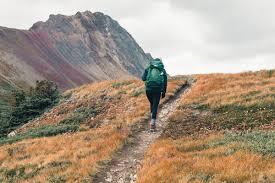
“These women walked in order to find minds of their own. They walked for emotional restitution. They walked to understand the capabilities of their own bodies. They walked to assert their independence. They walked to become.”
I thought a lot about these women as I strode out the door of my little lakeside cottage on that trip. In my mind, they walked alongside me as I hiked a (minor) mountain peak and traversed some bike and nature trails. As I walked alone, I noted that not once did I run into a solitary woman walking. I observed only families, men paired with women, and women paired with one another, and men hiking alone. Naturally, I’m sure other solitary women were out there somewhere, but my point is that it seemed a rare occurrence. When making my way to the summit of this particular mountain, a couple of women on their way back down greeted me with: “Good morning! Just so you know, there’s a man walking alone a little bit farther ahead of you. You will probably run into him when you reach the top.” I knew they were giving me a heads-up for safety reasons. All was well, but the little warning really resonated with me after reading sections of this book.
“Being alone in remote places makes us feel vulnerable. It’s one more anxiety we juggle as we walk, another emotion in a complicated series of emotions peculiar to women. Will I be harassed or assaulted? Will I arrive before dark? Is this area safe? Can I stop here or should I keep marching? Where can I go to the toilet?”
I’m not going to go into detail about each of these women, but as per my usual habit, I’ll share some of my favorite tidbits. Before I do, however, I have to say that Annabel Abbs not only did her research expertly, but she also writes beautifully. This is a highly recommended piece of narrative non-fiction!
“… backpacking reminds us of the modesty of our needs. Raising the question: If we need so little, why do we spend so long accumulating so much?”
“Remember this: a self is not a thing, but a becoming – on and on until we die."
“… we mustn’t be duped by age-old notions of home, notions readily perpetuated by an industry determined to sell us more and more home trappings… It seems to me that we should think of home not as a castle but as a nest, a place for walking to and from, for rebuilding and relocating when necessary. A place that is simultaneously safe and open. Open to change, to chance, to escape, to return.”
And then there’s this one, which I could imagine Annabel Abbs penning for me (and perhaps for you, too!) Thank you, Annabel, for those valuable words of encouragement.
“And finally, I think about the home I’ve left behind. The empty bedrooms with their neatly made beds, the eerie quietness, the end of motherhood. But in the crease of every ending lies the seed of a new beginning. In the process of casting off, we find a new fortitude, a tentative courage, a renewed curiosity.”
‘I’ll walk where my own nature would be leading:it vexes me to choose another guide’ Emily Bronte
‘A dreamer, I walked enchanted and nothing held me back’ Daphne du Maurier.
This was partially a memoir and partly the author following in the footsteps of walking women which I daresay I downloaded on a whim as I’m missing my walking holidays but I’m so glad I did. This was a fascinating book which was great to read in small chunks.
The insights into the authors life growing up without modern amenities in Wales and the pull she felt for open spaces especially when domesticity contained her in four walls and how she related this to these walking women was inspiring. There were two women that came across particularly strongly were the artists and you felt the authors passion as they meant something to her. Gwen John (1876-1939) renowned artist, sister of Augustus and one time lover of August Rodin is exceptionally well done as you got insights into their lives and Gwen’s walks especially from Bordeaux to Rome which the author partially recreated. Georgia O’Keeffe (1889-1986) was also brilliantly done with the artist, like the author, finding solace in empty spaces in which she walked for miles. It was excellent on O’Keefe’s background especially with photographer Alfred Stieglitz whom she married. The authors descriptions of the Texas panhandle were wonderful as it similarly spoke to her as she followed in the artists footsteps. O’Keeffe’s paintings of her time in Texas and New Mexico captured her love of the landscapes.
Another one I enjoyed for personal reasons was Frieda Lawrence (1879-1956) the German born wife and muse of DH Lawrence whose books I devoured and relished as an A Level student especially resonated as I was born in Nottinghamshire. Frieda like many other women walked in search of freedom and adventure from the Bavarian Uplands through the Austrian Tyrol to the Italian Lakes and it’s fair to say that’s the closest she got to real freedom. Other women covered are Clara Vyvyan (1885-1976) and her friend Daphne du Maurier (1907-1989). Vyvyan walked from source to the mouth of the Rhône to try to bring peace and order to her life, she also walked in Canada, Alaska and Greece with the Daphne often accompanying her. Included also was Nan Shepherd (1893-1981) author, poet and writer of ‘The Living Mountain ‘ which recounted her Cairngorm walks which the author also retraced with her son and Simone de Beauvoir(1887-1986) hiked in Provence, The Dolomites and The Alps to reset, probably very necessary because of her relationship with who was well known for his wandering eye! Finally, Emma Gatewood (1887-1973) who was the first woman to solo walk the Appalachian Trail but she was not dealt with in any great depth.
I enjoyed this book very much gaining some very good insights into these women who yearned for liberty from the constraints that society placed on them at that time. By putting one foot in front of the other they found the freedom for which they yearned.
With thanks to NetGalley and John Murray Press : Two Roads for the arc in return for an honest review.
(3.5) After a fall landed her in hospital with a cracked skull, Abbs couldn’t wait to roam again and vowed all her future holidays would be walking ones. What time she had for pleasure reading while raising children was devoted to travel books; looking at her stacks, she realized they were all by men. Her challenge to self was to find the women and recreate their journeys. I was drawn to this because I’d enjoyed Abbs’s novel about Frieda Lawrence and knew she was the subject of the first chapter here. During research for Frieda, Abbs omitted the Lawrences’ six-week honeymoon in the German mountains, so now she makes it a family cycling holiday, imitating Frieda’s experience by walking in a skirt and sunbathing nude. Other chapters follow Welsh painter Gwen John in Bordeaux, Nan Shepherd in Scotland, Georgia O’Keeffe in the American Southwest, and so on. Questions of risk and compulsion recur as Abbs asks how these women sought to achieve liberation. The interplay between biographical information and travel narrative is carefully controlled, but somehow this never quite came together for me in the way that, for instance, Sara Wheeler’s O My America! did.
"Quand’è che camminare smette di essere una cosa che fai e diventa parte di quello che sei?
Sei donne più o meno note. Sei camminatrici a cui Annabel Abbs, scrittrice anglosassone, si unisce ripercorrendo itinerari da loro intrapresi.
La prima è Frieda von Richtofen meglio nota come Frieda Lawrence per aver sposato H.D. Lawrence e come autrice di un mémoir, Non io, ma il vento... La mia vita con D.H. Lawrence A lei la Abbs aveva già dedicato un romanzo, , per l’appunto Frieda.
La seconda è Gwen John, pittrice britannica che visse in parte all’ombra del fratello Augustus John.
La terza è la dimenticata Clara Vyvyan, scrittrice di origini australiane cresciuta in Inghilterra che condividerà una parte del suo cammino con la più famosa Daphne du Maurier.
La quarta una tra le maggiori figure della letteratura scozzese: Ann, meglio nota come Nan Shepherd.
La quinta non ha bisogno di presentazioni; il suo nome è Simone De Beauvoir, qui ritratta in una veste insolita.
La sesta una famosa pittrice americana: Georgia O’Keeffe.
In tempi e luoghi diversi queste donne hanno sfidato non solo le convenzioni sociali ma anche gli ostacoli stessi della natura.
Annabel Abbs segue un filo che la porta a riattraversare sentieri impervi con l’idea che immergendosi negli stessi luoghi avrebbe potuto entrare in sintonia con le emozioni ma, soprattutto, le motivazioni che hanno spinto queste donne fuori di casa abbandonando gli agi borghesi. Camminare è un atto di riappropriazione della propria libertà, identità, bisogno di solitudine, del proprio spazio ma anche un riconoscimento del proprio corpo fisico.
” Queste donne camminavano per imparare a pensare autonomamente. Camminavano per trovare una compensazione emotiva. Camminavano per comprendere le capacità dei loro corpi. Camminavano per affermare la loro indipendenza. Camminavano per divenire.”
(
Tutto ciò è possibile solo se si cammina nella Natura, infatti:
"(...) la natura influenza il nostro corpo, il cervello e le nostre emozioni. Si ritiene che le tonalità di azzurro e verde ci rendano meno ansiosi, più calmi. Secondo una certa teoria, la presenza di questi colori ci avverte della vicinanza di cibo e acqua, e di conseguenza il nostro corpo si rilassa."
e ancora:
Decine di ricerche confermano che il tempo trascorso in mezzo alla natura abbassa la pressione sanguigna, stimola il sistema immunitario, allevia la depressione, aumenta le energie e diminuisce i livelli di zuccheri nel sangue, oltre a renderci meno inclini a rimuginare sui problemi.
Opera ricchissima di contenuti e riflessioni.
Il fatto che l’autrice stessa s’inoltri nei luoghi attraversati da queste donne fa sì che si sviluppi un racconto bifronte dove le storie di queste donne si intrecciano con la vita stessa dell’autrice in un interessante gioco di specchi.
"Una delle gioie di viaggiare con uno zaino in spalla non è proprio questa? Scoprire di quanto poco abbiamo bisogno? Sapere che per esistere nel corpo e nello spirito ci bastano una confezione di cerotti, una saponetta e un cambio d’abiti? In ogni caso, l’escursionismo ci ricorda la modestia dei nostri bisogni. E solleva un interrogativo: se ci serve così poco, perché dedichiamo tanto tempo ad accumulare un sacco di cose?
Just glorious!! I found this book to be inspiring, thought provoking, educational, fascinating and just wonderful!
The author uses her own life experiences, especially when she found herself in hospital unable to walk, to explore the art of walking and the fact that there was very few books around by women about walking and their adventures, when there are so many by men. With extensive research she uncovers some amazing characters - many of whom I had heard nothing about - and has brought their stories to life by challenging herself to walk the routes they did in the past, and this really just makes this book so immersive and inspiring.
The women she features are Frieda Lawrence, Gwen John, Clara Vyvyan, Nan Shepherd, Simone de Beauvoir, Georgia O'Keefe, but there is also reference to Daphne Du Maurier and Emma Gatewood. All very different women but all sharing a deep passion for walking, exploring - and shockingly for women - walking by themselves!! The shame!! But in their adventures they enjoyed the freedom it gave them and allowed them to find their own minds, and the author shared these feelings as she uses each chapter to share her walk, alongside that of the woman she was walking in the footsteps of. There's a look back in time to the lives of these amazing women, their trials and tribulations, the scandals, alongside her own experiences and thoughts on the changes over time as to the attitudes towards a variety of different topics.
It explores the benefits to your health of walking, the stories of the kindness of strangers met along the way, the pitfalls and reality of walking in the middle of nowhere by yourself, and the overwhelming sense of achievement and confidence these women had when they had finished a walk. And how eager they were to go on other adventures. Some weren't afraid to go against convention, some lost their families over their actions, but most were just inspired by the solace they felt while walking, despite all of them having a real strong attachment to 'home' and realising just how little they needed in their lives.
I learnt so much about these women as the author relayed their stories, alongside her own walking experiences and how that time alone gave her time to think over her life choices. Reading about these women, inspired me to research a little more about them and their work and it's been enlightening to learn more about these amazing women. The way the author connected with each woman also made this more of an experience as she wanted to feel what
It is one of those books that inspires, educates and just makes you want to walk!! To use your time wisely, and when you get the chance to grab that time for yourself and go out exploring, no matter how near or far!
In Windswept: Walking the Paths of Trailblazing Women, Annabel Abbs retraces the steps of exceptional women who had a passion for walking. Her selection of women is international: Frieda Lawrence, the German wife and muse of D.H. Lawrence; Gwen John, a Welsh artist; Clara Vyvyan, an Australian author; Daphne Du Maurier, an English author; Nan Shepherd, a Scottish author; Simone de Beauvoir, a French writer and feminist theorist; and Georgia O’Keeffe, an American artist.
Abbs provides brief sketches of the lives of each of these women and conducts extensive research on their writing to determine where they walked, when they walked, why they walked, and how walking impacted their lives. Some ventured to exotic locations far from home, while others preferred to walk closer to home. But they all experience the same exhilaration of simply putting one foot in front of the other and walking.
Their reasons for walking primarily had to do with the need to assert themselves, take pride in their physical prowess, and claim their autonomy. Unfortunately, some of them had latched on to men who dominated and confined them while toying with their affections. Walking became a release, a freedom from the cloying atmosphere of male domination.
The book is also part memoir since Abbs interjects details about her personal life and the challenges she faces as a mother whose children will soon be leaving home. She uses the lives and walking experience of these women to serve as her platform for sharing her experiences, exploring her thoughts, and working through some of her challenges. Although these interjections can be interesting and insightful, they interrupt the narrative flow. One minute we are experiencing Frieda’s exhilaration in the Alps; the next minute we are invited to observe the Abbs’ family quibbling about toads in a concrete bunker. The effect is jarring, the juxtaposition incongruous.
Abbs performs a valuable service by focusing her lens on these extraordinary women. To learn about their lives, to hear them speak in their own voices, to applaud their accomplishments, and to witness the transformative impact walking had on their lives make this an interesting and worthwhile read. It’s unfortunate the effect has been marred somewhat by personal interjections.
Abbs’ book title Windswept: Walking the Paths of Trailblazing Women is somewhat deceptive. Had she stuck with the women she uses as examples and the science she has researched to make her points, the book would have suited me more. Her choice of women walkers is very idiosyncratic. They seem to be chosen to suit issues in the authors own walking and life.
Abbs concentrates on six more or less famous women of the twentieth century who were walkers. The reader follows Frieda Lawrence, Gwen Johns, Simone de Beauvoir, Georgia O’Keeffe and a few others that are less well known. Abbs describes the type of rigorous walks the women did and speculates on why they walked. There are writers, artists, muses, women who only became famous after their deaths, and philosopher/academics.
The women walked for a variety of reasons—freedom, breaking away, escape from dominating men, conquering limitations and to seek maturity and creativity. Abbs also spends a good deal of the book introducing how science now validates what they were doing. We hear how walking in the wild lowers blood pressure, is therapeutic mentally and physically, is calming, restores balance etc. A tough walk and a little adversity aids creativity, diminishes self pity and stimulates the immune system.
These physically ordinary women took brave walks and physical risks. My biggest issue with the book is the author herself. She writes very well but has inserted herself into the book to an annoying degree. There are continual interruptions when discussing her notable walkers comparing their experiences to her own. Some of that would have been acceptable but her own story is included to a distracting and not very interesting degree.
Si après avoir refermé ce livre, vous n'avez pas l'envie obsédante de chausser vos bottines de randonnée, je ne sais pas ce qu'il vous faut ! ;)
Très bel essai, intimiste, qui nous raconte l'histoire de 5 artistes qui ont pratiqué la marche tout au long de leur vie, pour s'émanciper, trouver la liberté qu'on ressent à travers leurs œuvres.
C'est terriblement inspirant.
Le tout est ponctué de réflexions et d'analyses qui expliquent pourquoi les femmes ont cessé de marcher à moment donné, quelles sont les difficultés auxquelles elles doivent régulièrement faire face quand elles décident de partir à l'aventure, etc. Clairement les marcheuses sont 1000x plus badass que les marcheurs ! ;)
I listened to this book and the narrator was quite good.
This is a feminist, historical, discussion of women who have found themselves, or found freedom from societal expectations, through walking. It includes some well-known women such as Georgia O’Keeffe, Daphne Du Maurier and Simone de Beauvoir, and some lesser known. I especially liked learning about Nan Shepherd a great Scottish walker and nature writer whom I had never heard of before and now hope to find some of her books.
The author is Welsh and now lives in London. She also enjoys walking, and she follows the paths of the women she writes about and so there is also a memoir aspect to the book.
I have done a number of solo long distance walks and found much to appreciate in this book.
Interestingly, the author has a great fear of heights as do I. She tries to overcome it, as have I, and I was fascinated to hear that she learned that inner ear problems can contribute to this phobia developing. She mentions having had many ear infections as a child - as did I. Never before had I made this connection. Of course I also have a mother with severe acrophobia so it could be due to other factors. Still, I really related both to her terror and her determination to overcome it.
As a fan of a slow travelogue, I was excited to read this about following the footpaths of women who loved to walk and were unafraid to forge their own way walking and in their various fields.
As Abbs vows to return to walking, she notices the lack of reading material by female hikers:
"One evening, as I turned off my lamp, my eye was caught by the books on my bedside table. I looked at the spines and noticed something I’d never noticed before: every book carried the name of a man. I felt a baffled surprise, because although I considered myself a feminist, I’d never paid much attention to the gender of an author when I bought or borrowed a book.
Seeing them stacked, spine by spine, a line of men, made me pause. I wondered if this was why I felt an odd disconnect, if this was why my reading felt more like medication than inspiration.
The juxtaposition between the compressed, constricted space of female domesticity and the vast vistas through which these unburdened men roved hung vividly and disruptively in my wide-awake mind. These “walking men” had mothers, wives, even children. But where were they? Why were they so rarely mentioned? Could it be that the absent women were creating the very homes that enabled these men to step out with such nonchalance and exuberance?
I wasn’t angry with these men (most of whom were dead anyway), but I was angry at their unexamined dominance. And I was angry with myself for not expending more effort in seeking out books by women. For surely women had walked—and written about their experiences of walking?"
In Windswept she discusses the foot journeys of Frieda Lawrence, wife of D.H. Lawrence; Welsh artist Gwen John ; Clara Vyvyan, an Australian author;noted author, Daphne Du Maurierr who traveled with Vyvyan; Nan Shepherd, a Scottish author; author and feminist Simone de Beauvoir, ; and the great American artist, Georgia O’Keeffe. These women were ardent hikers and were not afraid to set off a path of their own. I was interested to find how many of these women had to struggle to find their own voice, because they were somehow overshadowed or obstructed by men from reaching their full capacity.
In each chapter she highlights one of the women, discusses both their life and the paths which they chose to walk and concludes with following their trails.
Abbs is a thorough researcher and we learn about walking and its effect on both mind and body as well as being immersed in nature. She tackles issues of fear and danger and many other issues surrounding the journeys, she and these women tackled.
I found this to be an absolutely absorbing read and if it sounds at all interesting to you, I would recommend it.
Si on zoome à fond sur mon adn, il doit être écrit, quelque part, de manière bien lisible: "adore les essais qui parlent de femmes qui font des trucs de badass parce que c'est dans leur nature tout en critiquant pas du tout subtilement les hommes". Ou un truc similaire.
This was a lovely read. Partly autobiography and partly biography of six women, some who are not known very well and a couple who are, all are artists. All went on journeys, mostly long hikes or walks, usually alone. Abbs goes to these places, tries to connect to these women of the past. She finds points where they match, such as fear of walking in the forest alone and overcoming that fear. The book is somewhat literary and could sustain another reading. Gorgeous writing in places.
The women discussed: • Frieda Von Richthofen • Gwen John (painter) • Clara Vyvyan (with Daphne du Maurier) • Nan Shepherd • Simone de Beauvoir • Georgia O’Keeffe
Thanks to Tin House Books/W.W. Norton and NetGalley for an uncorrected electronic advance review copy of this book.
i LOVED this book when i first started it. some of my new favorite quotes come from the beginning of this book. however, as i read on, it felt like each chapter just said the same thing over and over. it got super long and it took me forever to read
Windswept is a wondrous and provocative work, acclaimed writer Annabel Abbs follows the footsteps of extraordinary women who walked in wild landscapes throughout history. Annabel Abbs’s Windswept: Walking the Paths of Trailblazing Women is a beautifully written meditation and memoir that reflects on that most fundamental way of connecting with the outdoors: the simple act of walking. In absorbing and transporting prose, Abbs follows in the footsteps of groundbreaking women, including Georgia O’Keeffe in the empty plains of Texas and New Mexico, Nan Shepherd in the mountains of Scotland, Gwen John following the French River Garonne, Daphne du Maurier following the River Rhône, and Simone de Beauvoir—who walked as much as twenty-five miles a day in a skirt and espadrilles—in the mountains and forests of France. These trailblazing women were reclaiming what had historically been considered male domains.
The stories of these incredible women and artists are laced together by the wilderness walking in Abbs’s own life, beginning with her poet father who raised her in the Welsh countryside as an “experiment,” according to the principles of Rousseau. Windswept is an inventive retrospective and an arresting look forward to the way walking brings about a kind of clarity of thought not found in any other activity, and how it has allowed women throughout history to reimagine their lives and break free from convention. As Abbs traces the paths of these exceptional women, she realizes that she, too, is walking away from, and towards, a very different future. Windswept crosses continents and centuries in an arresting and stirring reflection on the power of walking in nature. A captivating, thoughtful & richly described read highlighting the redemptive power of nature and how it has the beauty to ground and guide. Highly recommended.
It isn’t until the very end of WINDSWEPT --- in her Acknowledgments, actually --- that UK writer Annabel Abbs references the onset of COVID-19 and its impact on the final trek in her ambitious project to physically trace the routes of eight extraordinary walking women of the 19th and 20th centuries.
Yet there could be no better mental and muscular challenge to the inertia, apathy and sedentary despair that so many of us have experienced as this global pandemic stretches into its second full year. Health experts and social scientists have seen a hopeful rise in solo walking as an intentional activity with demonstrable benefits for both psychological and physical health and few, if any, social distancing limitations. Abbs also points out the bodily demands (sometimes overwhelming) and benefits (sometimes surprising) of experiencing other women’s lives through her feet. But the real journey began in her head.
Like the iconic American social historian and intrepid walker Rebecca Solnit, whose writings on her own foot journeys helped fuel her determination to put a female stamp on the oldest form of human locomotion, Abbs found herself increasingly frustrated by the near-invisibility of women who walked not only out of necessity, but on purpose.
With her children all nearing adulthood and faced with the prospect of being an “empty nester,” Abbs became emotionally and intellectually invested in understanding the inner drive of eight famous and lesser-known women who chose walking in order to experience a universe beyond motherhood and homemaking --- Frieda von Richthofen, Gwen John, Clara Vyvyan, Daphne du Maurier, Nan Shepherd, Simone de Beauvoir, Emma Gatewood and Georgia O’Keefe.
Raised in rural Wales by parents who for years disdained car ownership and other “mod cons,” Abbs had walking ingrained in her almost from the time she could stand on her own. As she grew up, went away to school, worked, married, raised a family and achieved success as an award-winning journalist, magazine writer and novelist, walking as a pursuit in and of itself receded into the background. Her epiphany happened as she recovered from a serious fall and head injury; she again would take up long-distance walking as a personal passion and involve her family as well.
While her partner and children were supportive, if not always as enthusiastic on the ground, Abbs soldiered on, building stamina and endurance. But more importantly, she steadily deepened her inner knowledge of how other women used their feet to nurture and expand their identities.
After reading numerous hiking, trekking and walking memoirs nearly all by men, she gathered this small but powerful group of female writers, artists, teachers, poets and philosophers, all of whom left scattered paper trails of their personal journeys. Over years of painstaking research, including getting access to documents never before published, Abbs focused her efforts on bringing their journeys to light in WINDSWEPT.
She simply could have created a series of thumbnail biographies around their little-known (or totally unknown) walking escapades, but the project became much more personal than that. Abbs resolved to follow, as best she could, some of the main rural and urban routes each of these eight women had travelled and reflect on them as more than mere historical events.
And she would do so with the bare minimum of equipment and supplies, just as they had done in previous centuries. That in itself was a big ask for someone used to 21st-century high-tech outdoor clothing and electronic GPS gadgetry. It would not be a 100% “pure” historical re-creation, but she never short-changed the actual walking, even when time had erased many of the landmarks her historical mentors would have known.
Travelling, often alone, through Britain, southern Europe and the harsh desert landscapes of the southwestern United States, Abbs noticed a fascinating intersection of her precursors’ experiences with 21st-century realities. Then and now, there was gratification, fear, wonder, relief, fatigue, exhilaration, despair and fulfilment. She notes emphatically that men who write walking memoirs never mention fear; women, she surmises, are the braver for doing so.
Especially compelling about the book’s prose is its clarity and frankness about the vulnerability of the unaccompanied female body on foot. Abbs doesn’t shy away from commenting on the same challenges faced by her historic walking mentors, who had to deal with menstruation, relieving themselves, finding safe places to sleep, or avoiding predatory male attention. None were postmenopausal when they undertook their legendary journeys.
If I could be allowed one “nitpick” in WINDSWEPT, it’s the book’s total lack of maps or pictures of the women and places Abbs writes about. But as a timely inspiration for all of us to get off the couch and walk --- somewhere, anywhere --- just for the sake of it, it’s one of the most exhilarating and masterful reflections ever on how to meaningfully move on our own feet and the remarkable women who made this a unique expression of their being.
3,5* Knyga apie garsias moteris (Georgia O'Keeffe, Frieda Lawrence, Daphne du Maurier, Simone de Beauvoir ir kt.), kurios gelbėjosi, ieškojo/rado kūrybinio įkvėpimo, atradinėjo save per solo žygius pėsčiomis. Ir kaip tai buvo nenormalu - net norėti vaikščioti vienai. Kas nepatiko, o ir dažnai man kliūva negrožinėse knygose - tai per dažni autorių intarpai apie save ir savo patirtis. Jie čia mane labai erzino ir blaškė. Visa kita buvo puiku.
Beje, Fridos Lawrence pomėgį vaikščioti vienai turi ir Konstancija D. H. Lawrence romane "Ledi Čaterli meilužis".
Women have been walking for centuries, and for centuries we have walked with purpose, but also with a lot of fear, and a lot to fear.
This was a side read from my nature literature book club and I think I enjoyed it more as our conversations and discussions surrounding the women featured have been very helpful (and also lovely to have shared our own experiences and perspectives on walking as women).
The book is about a selection of women who walked and hiked for miles, including Daphne du Maurier, Georgia O’Keefe, Simone de Beauvoir, Gwen John’s, Frieda Lawrence et al. The author, who is also fond of walking, tries to walk in their footsteps while figuring out what these women were in search for, especially at a time when women were confined in certain societal expectations.
Whilst we mostly agreed that the author’s selection of lady walkers have been quite random, I can see why Abbs chose them now (albeit vaguely). In the end, with the comparison of O'Keefe & Frieda, it feels that the author tries to return full circle.
Somehow the similarities of these women's experiences align with her own and I think it was quite the cathartic experiment for the author. She wove in a lot of her own experiences (often very randomly timed). In a way the insertion of the author's memoirs just made the book drag a little. If not annoying.
The Beauvoir & O'Keefe chapters were my favourite chapters.
The theme of fear has consistently fared in the book and I dream of a time when women can actually feel free to walk wherever and whenever without feeling scared for their lives.
Un libro che mi è stato consigliato da una cara amica che vorrebbe camminare un po' di più ma che purtroppo vari legacci al momento glielo impediscono. Abbs con questo libro ci conduce per cammini conosciuti o meno seguendo le tracce di sei camminatrici, più o meno note, che hanno scelto, da sole o insieme ad altre donne e uomini, di scoprire o riscoprire se stesse attraverso un'azione che fino a qualche decennio fa era assolutamente naturale e necessaria: camminare. Io sento la necessità di camminare, almeno un po', ogni giorno; il camminare sul di me ha un effetto positivo perché è come se "mi lavasse il cervello ". Quindi ben venga scoprire nuove vie attraverso donne magari già incontrate su altre strade o in altre occasioni. Avevo fatto la conoscenza di Frieda, insieme al marito D. H. Lawrence in Sardegna con il libro "Mare e Sardegna", considerato ancora oggi uno dei migliori libri/guide sull'isola, e nei quadri di O'Keeffe, e negli scritti di Daphne du Maurier e di Simone de Beauvoir. Ma è stata anche l'occasione per conoscere il libro che non conoscevo di Nan Shepherd, la "Montagna vivente", un inno gioioso alla montagna, una vera chicca. Un bel libro che riflette, fra le varie cose, sul significato per una donna di voler camminare sola, per chilometri e chilometri e cercare di tenere a bada le paure e le angosce che a volte si affacciano alla mente e sull'immergersi pienamente nella natura, o come scrive Sheperd, nella montagna. Pagine che descrivono in modo nuovo e autentico aspetti sconosciuti o meno di donne che hanno mostrato al mondo un volto diverso di se stesse, magari più mondane, più esposte.
..."Per qualche ragione, abbiamo consentito che i nostri corpi venissero distaccati dalla terra. A un certo punto, dopo la rivoluzione industriale che ha trasferito milioni di persone dai campi alle fabbriche, e più di recente sull’autostrada digitale, abbiamo dimenticato il profondo bisogno fisiologico che abbiamo di immergere i nostri corpi nella natura. Abbiamo dimenticato che i nostri geni sono stati codificati per consentirci di camminare, piegarci, allungarci, sollevare, girare, scalare. Ci sono voluti sette milioni di anni per evolverci negli esseri umani che siamo oggi. Abbiamo dedicato una porzione infinitesimale di questo tempo (lo 0,01 per cento, per l’esattezza) a vivere come facciamo adesso, ricurvi in giungle di cemento dalla complessità estranea. Per gran parte della nostra vita evolutiva abbiamo abitato in mezzo agli elementi, con l’acqua, il vento, gli alberi a portata d’occhio e di orecchio. A metà fra terra e cielo. Muovendoci, muovendoci in continuazione. Come cacciatori-raccoglitori percorrevamo chilometri a piedi, con neonati e bambini piccoli appesi addosso e le braccia cariche di legna da ardere, acqua, carcasse di animali. Secondo le stime degli antropologi, percorrevamo tra i sei e i sedici chilometri al giorno, le donne non meno degli uomini. La madre cacciatrice-raccoglitrice si sobbarcava il peso dei figli fino all’età di quattro anni, percorrendo in quell’arco di tempo oltre 4800 chilometri."...
Windswept excavates the lives of some well known women writer/artists and some lesser known women through the prism of walking. While many of these women led emotionally tumultuous lives, they all had the commonality of finding solace, peace, independence, and autonomy through walking. Blending memoir into her research, Abbs discovered new vantages of these women as she literally stepped into the walking paths of Gwen John, Georgia O'Keefe, and Simone de Beauvoir. She had to experience O'Keefe's Amarillo, Texas for herself. Walking offered these women expansive space, clarity, and a place of one's own which fostered their rich interior landscapes.
One of the best books I’ve read this year. I love how the author approached walking not as a form of exercise, but as a way towards freedom and liberation for women. Eloquently written, I did not devour it like a juicy cheeseburger, instead, I savored it like an expensive fine wine. Highly recommend this book.
I liked a lot of aspects of this book. I appreciated learning about these interesting women from the unique perspective of their relationship with walking and the wilderness. These parts of the book were 4.5 stars.
I also enjoyed the author's reflection on her own life and relationship with the outdoors. However, her desire to connect with her subjects felt reachy, like she was projecting her own struggles onto the women she was researching. While not an unbiased account, still interesting and worthwhile.
Une incroyable lecture qui donne envie de marcher n'importe où et n'importe quand ! On en découvre plus sur les femmes qui ont vécu avant nous, des femmes connus et d'autres moins ! Une culture de la marche plus approfondie et l'imagination remplis de paysage !
On the one hand, it is beautifully written with passion and intentionality. Tracing the steps and diaries and writings of women who dared to step from the confines of domestic life and walk into the mountains. Annabel Abbs reflects on her own journey through health complications to finally being able to walk and gain independence again. This book discusses walking in relationship to art, healing, trauma, sexuality and the female body. All subjects that are deeply interested.
On the other hand, wilderness itself is a concept I have some difficulty with. It completely erases Indigenous peoples, nations, cultures, and technology. While most of this book mostly regards walks in Europe, there are quite a few that Abbs writes about in Canada and the US. Yet she fails to acknowledge any Indigenous nation specifically, instead having a dismissive line about, “the Native Americans and buffalos are gone.” That is A) Incorrect and B) a very lame way to side step ongoing discussions of Indigenous nations and outdoor recreation. I understand that is not what this book is about, but I was troubled by how it was so wantonly dismissed. This stayed w me throughput the book, and also made me realize that every woman that Abbs writes about in these pages are white.
While I enjoyed reading about nature, the history of walking and of women, underlining several interesting or prosaic passages, I found myself zoning out through much of the dense philosophical transcendental pages. If you are interested in the subject of walking women, nature, philosophy and art but is more self aware, try reading Rebecca Solnit’s “Wanderlust: A History of Walking,” or Janae Davis “Black Faces, Black Spaces: Rethinking African American Underrepresentation in Wildland Spaces and Recreation.” I also recommend Robin Wall Kimmerer’s “Braiding Sweetgrass,” for a more ecological, nature-centers perspective.
Hmm. I tried so hard to like this book. It’s everything I should like in a nonfiction book—historical, reflective, a focus on women, a focus on nature, and, obviously, a central theme of hiking/walking/backpacking. I enjoyed the premise immensely; I loved the accounts and selections that described these famous women and how walking in the wild impacted their life and work.
What killed it for me was the narrator. Her personal life interjected far too often, and it felt a bit forced as she constantly compared her journeys and experiences to the likes of Beauvoir, Shepard, O’Keeffe.. I think I would have far preferred her analysis, insights and summaries of the famous women as the focus, and while traveling to their locations is a fun addition, the majority of her personal anecdotes nearly kept me from finishing the book.
The only section of purely her prose and reflection that I liked, was one of the closing chapters—Home. It was beautifully written, insightful, and provided really wonderful connection between her life in the famous women she studied in a tasteful way. Overall interesting, but oof, 150 pages too long.
J'ai pris tant de plaisir à lire cet essai chaque matin, avant de commencer ma journée. Moi qui n'ai pas randonné depuis 9 mois, il m'a donné immédiatement envie de m'y remettre. C'est décidé, je repars marcher demain.
La Britannique Annabel Abbs fait le portrait - par la marche - de six artistes voyageuses qui ont parcouru des longues distances à pied, aux XIXe et XXe siècles. Simone de Beauvoir, Georgia O'Keeffe et d'autres femmes que je ne connaissais pas avant de lire le livre. Dommage qu'elle ne mentionne que des personnes blanches et occidentales...
Cet essai m'a redonné confiance en mon corps et en le pouvoir de la marche pour préserver ma liberté et mon bonheur. Il est résolument optimiste. Je le conseille à toutes les personnes qui hésitent à sortir seules dans les bois. Nous pouvons lutter contre la peur, et partir à l'aventure pour le meilleur.
Annabel Abbs follows in the footsteps of six creative women, including Simone de Beauvoir, Daphne du Maurier and Georgia O’Keeffe, who were compelled to break from their home boundedness by walking…and walking.
In the home, these women, as many others, suffered control, denigration and violence. Yet, by searching for a space of their own, travelling alone or in female company, they were continually confronted by the risk of assault.
Through walking, the women transgressed societal boundaries, re-evaluated their worth, reinvented, transformed, and realised their sensuality.
Feeling inspired by this book. The author has researched the lives and walking experiences of women who have taken to the wilds before her. My favourites are the sections on Gwen John, Simone de Beauvoir and Georgia O’ Keefe. The results of walking on these women’s lives are numerous and include personal growth and transformation, recuperation and especially liberation from patriarchal oppression in its many forms. Abbs treads the paths herself and her own personal life and journey is entwined in the stories of the remarkable women before her. Loved it.




 (
(


