Jump to ratings and reviews
Rate this book

Mathematica: A Secret World of Intuition and Curiosity

Rate this book
A fascinating look into how the transformative joys of mathematical experience are available to everyone, not just specialists
 
Math has a reputation for being inaccessible. People think that it requires a special gift or that comprehension is a matter of genes. Yet the greatest mathematicians throughout history, from René Descartes to Alexander Grothendieck, have insisted that this is not the case. Like Albert Einstein, who famously claimed to have “no special talent,” they said that they had accomplished what they did using ordinary human doubts, weaknesses, curiosity, and imagination.
 
David Bessis guides us on an illuminating path toward deeper mathematical comprehension, reconnecting us with the mental plasticity we experienced as children. With simple, concrete examples, Bessis shows how mathematical comprehension is integral to the great learning milestones of life, such as learning to see, to speak, to walk, and to eat with a spoon.
 
Focusing on the deeply human roots of mathematics, Bessis dispels the myths of mathematical genius. He offers an engaging initiation into the experience of math not as a series of discouragingly incomprehensible logic problems but as a physical activity akin to yoga, meditation, or a martial art. This perspective will change the way you think not only about math but also about intelligence, intuition, and everything that goes on inside your head.

344 pages, Hardcover

Published May 28, 2024

Loading...
Loading...

About the author

David Bessis

7 books19 followers

Ratings & Reviews

What do you think?
Rate this book

Friends & Following

Create a free account to discover what your friends think of this book!

Community Reviews

5 stars
454 (46%)
4 stars
323 (32%)
3 stars
148 (15%)
2 stars
48 (4%)
1 star
12 (1%)
Displaying 1 - 30 of 143 reviews
Profile Image for Haengbok92.
83 reviews32 followers
July 19, 2024
You will get A LOT from this book whether or not you are into math. I'm not mathy. I'm a creative writer, artist, karaoke person & I love learning languages. I picked this up because of a thread I saw online, on a whim, because something in my gut said, "you should take a look at this." And then I listened to the introduction, and I was like, "yeah, this seems good and the world is a dumpster fire so..."

Then, to my delight, I discovered in this one of the best guides to imagination and general creativity I've ever read. I've recommended the book to my friends, especially the artistic types, who were giving me some side-eye until I went into some of the details (which I'll do below).

What you'll get out of this book:

1. Intuition is not just some magical thing that you've either got or your don't. You can train it by thinking through things both creatively and with logic. You can make it BETTER! Because it's your brain! And you'll get some concrete approaches on how to do this.

2. Math people are really good at creative visualization (and other creative sensory imagination -- not just pictures). Not just naturally, but because they've trained this skill doing lots of other seemingly random imaginative exercise. Using imagination, you can calculate stuff without having to know a bunch of formulas. (I could go into more detail, but I'm not giving away the whole book because it's valuable to read/listen to it and try his exercises.)

3. You can then apply these imaginative techniques and to improving your skills in all kinds of seemingly unrelated areas. The way he talks about feeling out formulas, for example, reminds me very much of writing and feeling out the shape of a story. I also directly see how what he's talking in creative visualization will make you better at drawing from the imagination. I can draw from reference, but I have a hard time drawing from imagination. I just assumed I had a bad visual imagination, but never had the (seemingly obvious but I wasn't thinking of it) revelation that I could just focus on improving my visual imagination and memory... duh.

I've actually gained quite a bit more from this book too in regards to thinking about how I think and how I can think better. (Circular much, lol!) But I'm not going to give everything away.

Tl;dr: Whether or not you're interested in improving your math skills (it was fun to improve some of mine but a that's not why I got this book), Mathematica is a winner if you're interested in learning more about how to use and improve your imagination. And it's fun!

NOTES FOR AUDIO: The figures are not included though I hope they are working on a PDF for this audio. Here's what jammed me up and how I fixed it: The icosahedron is basically a 20 sided di (think D&D d20). The super one has a picture on Wikipedia.

For the visualization for adding up to 100 whole numbers, it's helpful to think of it as six sided dice (d6) instead of cubes which felt harder to visualize for me, idk why. Start with doing it to three first, then four, then five so you understand the nature of the question. The you will get the rest of it).

There are some good videos on YouTube which will walk you through the infinity set and different infinity sizing stuff. I recommend Dr. Trefor Bazett's two videos on this from his Cool Math series. They came up when I looked on YouTube about different size infinities, so just look him up with infinity size and you'll probably get them. The videos weren't long and quite a bit of fun.

Still working on the knot thing, but I'll be coming back to it when I find better reference.

Hope this helps! The important thing is to get the process down more than the results, So don't stress it too much.
Profile Image for Rrrrrron.
274 reviews22 followers
July 15, 2024
Very good opening on the idea that math is for everyone and that the enormous gap between those who can and those who can’t should not be so large. If we translate this math gap into the 100 meter dash, it would be something like the best on the world can run it in 10s but the average person would take a couple of weeks and those who are weak at math will take 500 years, they cant do it in their lifetime

Despite this wonderful opening, none of it is realized. There are absolutely ZERO practical ideas on learning or teaching math in this book. The rest of the book is a couple of stories and philosophical musings, some good and some ok and a bit of lameness.
Profile Image for Ana Bernardino.
90 reviews13 followers
June 19, 2025
The book starts off with a promising premise—explaining how mathematics works and showing that it’s for everyone. However, it falls short after the introduction, turning into a collection of anecdotal stories about mathematicians, repeated ideas, and little meaningful content to learn from.
Profile Image for Vicente Mendes.
77 reviews3 followers
April 3, 2025
This is a beautiful book about Mathematics, written by a mathematician.

There are two main points in the book, which could be orthogonal:
- there is an intuitive “secret math” going on inside each person’s head, which is different from the rigid formalism of the “official math”. It is ignored because it is very subjective and hard to explain, yet, it is how people actually understand things and make discoveries. “Official math” is just the only way we have of actually communicating with each other. Official math is to math what musical notation is to music - not the actual thing. Then, secret math is the subjective experience of music inside our heads.
- we vastly overrate the importance of genetics in how good someone is in mathematics: it is more important to be “passionately curious” and to embrace ignorance

The first point is very well explained in the book. I am convinced. An interesting consequence, for readers of “Thinking Fast and Slow”, is that mathematical learning is proof that our “System 1” is reprogrammable. We learn intuitions for circles, numbers and other abstract objects. We shouldn’t necessarily be distrustful of our System 1 mistakes, we should actually look towards them and engage in the learning process to improve our intuitions.

The second point is a minority belief I have and am interested in seeing more discussion around it, however, I thought the book could have gone more in depth, and detailed the idea of the cumulative process that drowns the initial (genetic) signal . The mental Fosbury Flop analogy is a very good one, though.

I also think that a good amount of the discussion is also valid for other subjects other than math, that this is very much about knowledge and how it can be acquired. There is a small portion dedicated to epistemology, but I wanted to read more.

This was a thought-provoking book, very enjoyable to read, that left me wanting more in depth discussion. Bessis writes at the end “I wrote this as a kind of handbook, something that I would have loved to have on my nightstand during my studies to guide me, to encourage me, to help overcome my inhibitions. I believe it would have helped me immensely. I hope it will help you.” This book has been already quite motivating, but for sure if I keep coming back in the next years, I will update this 4 to a 5, for what’s that’s worth!

“This is precisely why math is difficult: it requires looking
straight at what is beyond our comprehension. We must become genuinely interested in it. We must force ourselves to imagine it and put words to all our impressions, without being distracted by our constant feeling of inferiority. And we must do that precisely when our instinct tells us to run away as quickly as we can.”

“Mathematics has the reputation of being inaccessible. You have to be one of the elite, to have received a special gift. The greatest mathematicians have written that this isn't so. What they accomplished, as we shall see, they claim to have accomplished through ordinary human means, their curiosity and imagination, their doubts and weaknesses.”

“I wanted to know how to do real math, difficult math.
But all that I was able to learn was the easy math, the math for dummies.
It seems silly to say this, but it really took me years to
realize it was only an optical illusion. The horizon was shifting with me. It was always staying at my level.
Real magic doesn't exist. When you learn a magic trick, it ceases being magical. That may be sad, but you'd better get used to it.
If you find that the math you do understand is too easy,
it's not because it's easy, it's because you understand it.”

“Before school came along and got all caught up with it, before our inhibitions and our fear of being judged came
along, we all have experienced great joy in math. Between humans and mathematics, it's been a long and profound love story.”

“Understanding a mathematical notion is learning to see things that you could not see before. It's learning to find them obvious. It's raising your state of consciousness.”

“A particularity about mathematics is that understanding a
discovery is almost as challenging as making the discovery itself. In order to reproduce unseen actions, you can't avoid introspection. You have to listen to yourself, and reinvent the actions within yourself and for yourself.”
Profile Image for Roozbeh Daneshvar.
330 reviews26 followers
February 3, 2025
I love math and I enjoy it. I am also intimidated by it. I have taken a variety of ways to overcome this fear, somehow find a way to understand it (as much as I can), and eventually see math in the real world and enjoy it. That's the mindset I started reading this book with.

One key takeaway from this book was the following, which I found important:

The most simple and fundamental advice you can give to people who want to understand math, which I've repeated throughout this book, is to pretend the things are really there, right in front of you, and that you can reach out and touch them. People who don't understand math are basically stuck in a state of disbelief. They're refusing to imagine things that don't actually exist, because they don't see the point. It just makes no sense to them.


Maybe a lot of the book is summarized by the above sentence. I believe the book could be significantly shortened, maybe to an article. There were a lot of redundant sections, told and retold again and again. The author took a patronizing tone, maybe in the hope of making the contents more accessible. Add to that a lot of text, swinging between self-promotions and humble-bragging, which made the text harder to read. On top of all, add some philosophizing forced into the contents. I admit that there's a possibility that some of these could be the effects of the translation. Maybe not.

Overall, I had takeaways from this book as well, and reading some parts were enjoyable, although most of them were masked by the poor medium. Below I am bringing some pieces from this book:

On tricks and their impact:

There are no tricks. There never were any and there never will be. Believing in the existence of tricks is as toxic as believing in the existence of truths that are counterintuitive by nature.


and also your belief in their existence:

Believing that tricks exist is to accept the idea that there are things you'll never understand and that you have to learn by heart.


On how language can prevent us from forming images

The language trap is the belief that naming things is enough to make them exist, and we can dispense with the effort of really imagining them.


On the impact of naming:

Naming things certainly allows us to evoke them, but not to make them present in our mind with the intensity and clarity that allow for creative thinking.


How mathematics is a practice and you are not supposed to know everything:

Mathematics is a practice rather than knowledge. Mathematicians understand better than anyone the objects they're working on, but their mathematical intuition can never become omnipotent.


On the impact of teaching a concept on our own learning of that same concept:

mathematicians have a saying, that the only thing a math lesson is good for is to allow the professor to understand.


On doubt and its nature:

No one can doubt on a piece of paper. Doubt is a secret motor activity, an unseen action. To doubt something is to be able to imagine a scenario, even seemingly improbable, where the thing could be untrue.


On paranoia and mathematical reasoning:

Trusting reason too much, using human language as if it had all the attributes of mathematical language, as if words had a precise meaning, as if each detail merited being interpreted and the logical validity of an argument sufficed to guarantee the validity of its conclusions, is a characteristic symptom of paranoia. When applied outside of mathematics and without any safeguards, mathematical reasoning becomes an actual illness.


On emergent properties:

you can spend twenty years of your life reverse-engineering cars, but that won't teach you anything about traffic jams. And yet traffic jams exist and they're entirely made up of cars.


and some more on various topics:

Successful math becomes so intuitive that it no longer looks like math.


If you find that the math you do understand is too easy, it's not because it's easy, it's because you understand it.


discovery always begins with the simple and innocent desire to understand.


Math is mysterious and difficult because you can't see how others are doing it.


At a profound level, math is the only successful attempt by humanity to speak with precision about things that we can't point to with our fingers.


In a math book, the most important passages aren't the theorems or the proofs: they are the definitions.


The ability to associate imaginary physical sensations with abstract concepts is called synesthesia. Some people see letters in colors. Others see the days of the week as if they were positioned in the space around them.


This quote is from Grothendieck:

“Finding mistakes is a crucial moment, above all a creative moment, in all work of discovery, whether it's in mathematics or within oneself. It's a moment when our knowledge of the thing being examined is suddenly renewed.”


Logic doesn't help you think. It helps you find out where you're thinking wrong.


Mathematical writing is the work of transcribing a living (but confused, unstable, nonverbal) intuition into a precise and stable (but as dead as a fossil) text.


When you see things that others don't yet perceive, sharing your vision requires finding a way to get others to re-create those things in their own heads. A mathematical definition serves this purpose. It provides detailed instructions allowing others, starting with things they are already able to see, to mentally construct those new things.


As Thurston remarked, “There is sometimes a huge expansion factor in translating from the encoding in my own thinking to something that can be conveyed to someone else.”


Mathematical comprehension is precisely this: finding the means of creating within yourself the right mental images in place of a formal definition, to turn this definition into something intuitive, to “feel” what it is really talking about.


Visual intuition makes certain mathematical properties clear, that without the mental image wouldn't be clear at all. This is why transforming mathematical definitions into mental images is so important. When you're unable to imagine mathematical objects, you have the sense that you don't really understand them. And you'd be right.


Reasoning with letters was a way of reasoning with all numbers at once. It was doing an infinite number of computations with a finite number of words.


When we believe we're directly seeing the world in three dimensions, we're unconsciously piecing together the two-dimensional images captured by our retinas.


A conjecture is a mathematical statement that someone believes is valid but isn't yet able to prove. Making a conjecture is feeling something is right without being able to say why. It is by nature a visionary and intuitive act.


Nothing is counterintuitive by nature: something is only ever counterintuitive temporarily, until you've found means to make it intuitive.


Understanding something is making it intuitive for yourself. Explaining something to others is proposing simple ways of making it intuitive.


In mathematics, the sudden occurrence of a miracle or an idea that seems to come out of nowhere is always the signal that you're missing an image.


It's only through a relentless confrontation with doubt that forces you to clarify and specify each detail until it all becomes transparent that you're finally able to create obviousness. Doubt is a technique of mental clarification. It serves to construct rather than destroy.


Thurston's response offers a radical change of perspective: The product of mathematics is clarity and understanding. Not theorems, by themselves. The world does not suffer from an oversupply of clarity and understanding (to put it mildly). The real satisfaction from mathematics is in learning from others and sharing with others. All of us have clear understanding of a few things and murky concepts of many more. There is no way to run out of ideas in need of clarification.


Being a paradox is always a temporary status, in wait of a resolution. Presenting a problem as structurally being a paradox is just a pompous way of saying you can't solve it.


When you mathematically model a deep-learning system, you can define a numerical quantity that measures its “perplexity” in a given situation. A system that learns is one that adjusts its weights in order to reduce its perplexity.


lines written by Thurston in 2011: “Mathematics is commonly thought to be the pursuit of universal truths, of patterns that are not anchored to any single fixed context. But on a deeper level the goal of mathematics is to develop enhanced ways for humans to see and think about the world. Mathematics is a transforming journey, and progress in it can be better measured by changes in how we think than by the external truths we discover.”


“Calculation” comes from the Latin calculus, which means “small pebble,” referring to the stones used on an abacus for counting.
Profile Image for Ali.
524 reviews
July 26, 2025
Most insightful book I read on mathematical thinking and math education. As opposed to the dry logical flow of standard math texts, Bessis delivers a very readable description of intuitive and creative minds comparing it to slow- fast thinking and exemplifying it with anecdotes from eminent mathematicians and also his personal experiences. A must read.
33 reviews2 followers
August 26, 2025
I’d say it lost me in the second half/last third, but frankly the first part contained the best description of what “doing math” feels like as a bodily/sensorial/“human” activity I’ve ever read, so there’s that.
Profile Image for Remo.
2,660 reviews197 followers
November 7, 2026
Scroll down for English

Casi siempre nos han enseñado las matemáticas como si fueran un libro de cocina: una lista rígida de fórmulas, pasos y algoritmos que hay que memorizar, donde parece que o naces con un talento innato o estás condenado a frustrarte.

En este libro, David Bessis ([DB], matemático francés, aunque ahora se dedica a otra cosa, como luego comentaremos) se propone desmontar ese mito. Su punto de partida es tan directo como acertado: las matemáticas se estudian habitualmente como una receta mecánica, cuando en realidad deberían abordarse como un estado de ánimo; una disposición mental donde la curiosidad, el juego y la imaginación van siempre por delante de las fórmulas.

Para explicar cómo funciona por dentro la cabeza de quien hace matemáticas, Bessis toma prestado el conocido esquema mental de Daniel Kahneman y lo adapta a su terreno:

Sistema 1 (Intuición pura): Es la certeza casi física. Ese momento en el que ves algo claro en tu mente y sabes que encaja antes de ponerte a escribir números o justificarlo paso a paso.

Sistema 2 (Seguimiento mecánico): Seguir instrucciones al pie de la letra, como quien repasa la demostración formal de un teorema sin salirse una coma del guion. Aquí no hay pizca de imaginación: es pura ejecución de reglas.

El gran reproche del autor es que el sistema educativo se ha atrincherado en el Sistema 2. Al reducir la materia a un entrenamiento de seguir pasos a ciegas, las matemáticas se vuelven un trámite frío y aburrido, provocando un rechazo casi unánime en la mayoría de los alumnos.

Sistema 3 (El diálogo deseable): Es el verdadero corazón del libro. Para DB, pensar matemáticamente no consiste en elegir entre la corazonada y la lógica, sino en lograr un diálogo fluido y constante entre lo que el cerebro intuye (Sistema 1) y lo que es capaz de comprobar formalmente (Sistema 2). La intuición te abre camino y las reglas comprueban que no te estás equivocando.

Uno de los puntos más interesantes del libro son sus paradas en las biografías intelectuales de grandes nombres de la historia. Al detenerse en el Discurso del método de Descartes o en Cosechas y siembras, la autobiografía del matemático Alexander Grothendieck, DB rescata una confesión llamativa: ninguno de los dos se consideraba superior intelectualmente a muchos de sus colegas. Ambos reconocían sin complejos que su progreso no se debió a tener un cerebro con una potencia de cálculo sobrehumana, sino a que encontraron una forma de mirar los problemas en la que su mente se divertía y no se aburría. Supieron convertir conceptos abstractos en representaciones cómodas para pensar sin agotarse.

A partir de estos ejemplos, DB intenta mostrarnos a qué se refiere exactamente con esa «intuición matemática» y cómo cualquiera puede empezar a buscarla y entrenarla. Para un lector que se acerque por primera vez a este enfoque, el recorrido resulta genuinamente fascinante:

Para ver la diferencia entre la pura rutina y la intuición visual, el autor recurre a un problema clásico (y una anécdota posiblemente, pero solo posiblemente, apócrifa): la suma de los primeros n números naturales.

Si atacamos el problema tirando exclusivamente de Sistema 2, la solución típica de manual es la demostración por inducción matemática. Se comprueba el caso base para n = 1 (1 = 1·2/2), se asume como cierta la hipótesis para un número cualquiera k, y mediante un desarrollo algebraico de factorización y denominadores comunes se llega a que también se cumple para k + 1. La prueba es impecable sobre el papel, pero no explica nada: demuestra que la igualdad se cumple sin que llegues a entender por qué la fórmula tiene esa estructura (clic para ampliar).


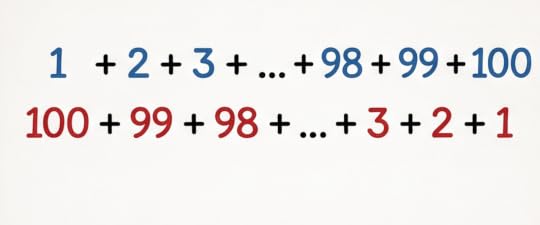
Frente a esa inercia está la famosa anécdota escolar del joven Gauss, a quien su maestro mandó calcular la suma del 1 al 100 para tener a la clase ocupada:


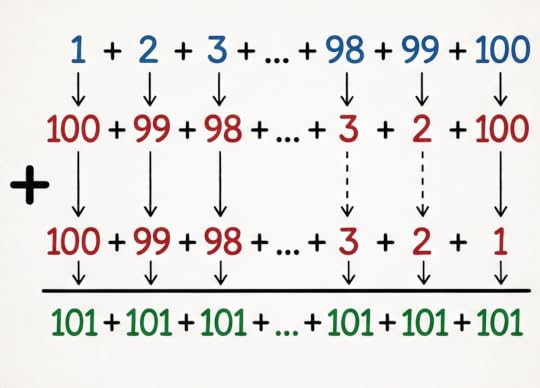
¿Fue solo una idea feliz o Gauss tenía ya una imaginación matemática muy despierta? En vez de sumar término a término, se le ocurrió sumar la secuencia consigo misma pero invertida:


Como hay 100 columnas, tenemos 100 veces 101.


Y como se había sumado la serie dos veces, basta con dividir entre dos para sacar el resultado de forma casi instantánea:

(100 x 101)/2 = 5050

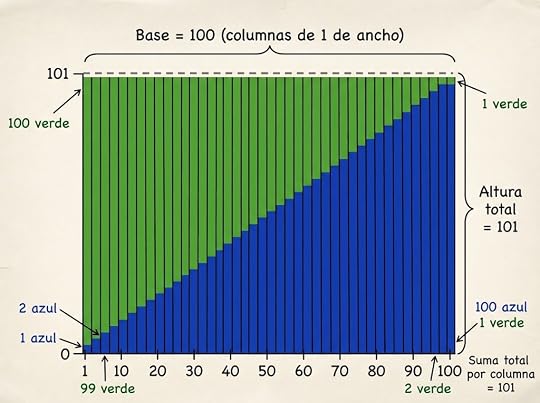
¿Podríamos llegar nosotros a esa misma idea? DB nos anima a jugar con la imaginación: si dibujamos esa suma como columnas de ancho 1 en una gráfica, lo que tenemos a la vista es una escalera que forma un triángulo. Si le acoplamos otra escalera idéntica dada la vuelta (los bloques azules y verdes de la figura), ambas piezas encajan en un rectángulo de base 100 y altura 101.


Y como el área de un triángulo es la base por la altura dividida entre dos:

(100 x 101)/2 = 5050

De repente, la fórmula deja de ser una regla caída del cielo y se convierte en algo visible, intuitivo y entretenido.


Tras esta brillante exposición, el último tercio del libro cambia bruscamente de tema. El autor empieza a hablarnos de redes neuronales bastante en detalle, junto al deep learning y la búsqueda de la creatividad en la inteligencia artificial. DB está metido de lleno en este campo y ha fundado su propia empresa de IA, pero la forma en que aprovecha para colar publicidad de su proyecto resulta bastante descarada. Es un giro comercial que descoloca un poco al lector e interrumpe de golpe el tono de lo que venía siendo una reflexión muy lúcida sobre el pensamiento humano. Pese a ese tropiezo y a que en algunos tramos se vuelve algo disperso, el libro me ha gustado. Es una lectura amena y a ratos muy adictiva.


---------------------------------------------------------------------


We have almost always been taught mathematics as if it were a cookbook: a rigid list of formulas, steps, and algorithms to memorize, where it seems you are either born with innate talent or doomed to frustration.

In this book, David Bessis ([DB], a French mathematician, though he now dedicates himself to something else, as we will discuss later) sets out to dismantle that myth. His starting point is as direct as it is accurate: mathematics is usually studied as a mechanical recipe, when in reality it should be approached as a state of mind; a mental disposition where curiosity, play, and imagination always take precedence over formulas.

To explain how the mind of someone doing mathematics works on the inside, Bessis borrows the well-known mental framework of Daniel Kahneman and adapts it to his field:

System 1 (Pure intuition): It is an almost physical certainty. That moment when you see something clearly in your mind and you know it fits before you even start writing numbers down or justifying it step by step.

System 2 (Mechanical tracking): Following instructions to the letter, like someone reviewing the formal proof of a theorem without straying a comma from the script. There is not an ounce of imagination here: it is pure execution of rules.

The author's great reproach is that the educational system has entrenched itself in System 2. By reducing the subject to a blind step-following drill, mathematics becomes a cold and boring chore, provoking an almost unanimous rejection from the majority of students.

System 3 (The desirable dialogue): This is the true heart of the book. For DB, thinking mathematically is not about choosing between a hunch and logic, but about achieving a fluid and constant dialogue between what the brain intuits (System 1) and what it is capable of formally verifying (System 2). Intuition clears the way, and the rules verify that you are not making a mistake.

One of the most interesting points of the book is its stops along the intellectual biographies of great names in history. When pausing at Descartes' Discourse of the Method or Reaping and Sowing, the autobiography of mathematician Alexander Grothendieck, DB rescues a striking confession: neither of them considered themselves intellectually superior to many of their colleagues. Both unapologetically acknowledged that their progress was not due to having a brain with superhuman computing power, but rather to finding a way of looking at problems where their minds were entertained and not bored. They knew how to turn abstract concepts into comfortable representations to think about without burning out.

From these examples, DB tries to show us what exactly he means by this "mathematical intuition" and how anyone can start looking for and training it. For a reader approaching this perspective for the first time, the journey is genuinely fascinating:

To see the difference between pure routine and visual intuition, the author turns to a classic problem (and a possibly, but only possibly, apocryphal anecdote): the sum of the first n natural numbers.

If we tackle the problem relying exclusively on System 2, the typical textbook solution is proof by mathematical induction. The base case is verified for n = 1 (1 = 1·2/2), the hypothesis is assumed to be true for any given number k, and through an algebraic expansion of factoring and common denominators, we arrive at the conclusion that it also holds true for k + 1. The proof is flawless on paper, but it explains nothing: it proves that the equality is true without you ever coming to understand why the formula has that structure (click to enlarge).


In contrast to that inertia is the famous school anecdote of the young Gauss, whose teacher ordered him to calculate the sum from 1 to 100 to keep the class busy:


Was it just a bright idea or did Gauss already have a highly awakened mathematical imagination? Instead of adding term by term, it occurred to him to add the sequence to itself but reversed:


Since there are 100 columns, we have 100 times 101.


And since the series had been added twice, you simply divide by two to get the result almost instantly:

(100 x 101)/2 = 5050

Could we arrive at that same idea ourselves? DB encourages us to play with our imagination: if we draw that sum as columns of width 1 on a graph, what we see is a staircase forming a triangle. If we attach another identical staircase turned upside down (the blue and green blocks in the figure), both pieces fit into a rectangle with a base of 100 and a height of 101.


And since the area of a triangle is the base times the height divided by two:

(100 x 101)/2 = 5050

Suddenly, the formula ceases to be a rule dropped from the sky and becomes something visible, intuitive, and entertaining.


After this brilliant exposition, the final third of the book abruptly changes the subject. The author begins talking to us about neural networks in quite some detail, along with deep learning and the search for creativity in artificial intelligence. DB is heavily involved in this field and has founded his own AI company, but the way he takes the opportunity to sneak in advertising for his project feels quite shameless. It is a commercial pivot that throws the reader off a bit and abruptly interrupts the tone of what had been a very lucid reflection on human thought. Despite that stumble and the fact that it gets somewhat scattered in certain sections, I liked the book. It is an enjoyable and at times highly addictive read.
Profile Image for Abe Niederhauser.
232 reviews4 followers
October 17, 2026
Imagine a circle and a straight line. Can you visualize the line touching the circle at exactly one point along its edge? Next, can you visualize the line passing through the circle, intersecting it at two points? Lastly, can you determine whether or not the line can intersect the circle at three points?

Mathematician David Bessis argues that this type of intuition is what mathematical ability is built upon. Math is not necessarily an innate talent, but rather a skill that anyone can develop. Mathematical intuition must be built up step by step. If you venture into math beyond the level of intuition you’ve developed, it’s going to be challenging.

The book is fun, but it can be a little repetitive at times. I think it would have benefited from being shorter.
Profile Image for Tartiff.
88 reviews1 follower
May 30, 2023
Mathematica est le bouquin dont je rêvais depuis des années pour me réellement me réconcilier avec les mathématiques, sauf que l'auteur va plus loin encore en démontant la vision que la société a des mathématiques et du "génie" supposément nécessaire pour devenir bon en maths.
Il y a quelque chose d'à la fois jouissif et contre-intuitif à le voir démontrer à quel point être compétent dans ce domaine demande surtout de la patience et... de l'imagination. Il prouve au passage qu'enseigner froidement les étapes des calculs sans apprendre aux élèves à visualiser le processus sans recourir aux mots est un non-sens qui a faillit couler son propre avenir avec les mathématiques.

Se voir expliquer à quel point les mathématiciens sont des gens normaux qui ont juste compris certaines choses mieux que les autres et cultivé cela est un des grands moments de ce livre.

On ressort avec une réelle soif de découvrir la richesse de ce qu'on nous a entre ouvert et d'enfin persuader son propre cerveau de s'élever un peu passage.
415 reviews
December 9, 2024
Es haben nicht alle Kapitel für mich funktioniert, aber trotzdem vier Sterne, weil es ein paar sehr gute Stellen gibt. Z.B. wo der Autor überzeugend zeigt, dass viele auch gute Mathematiker nicht alles verstehen; dass man der Intuition vertrauen soll, sie aber auch korrigieren muss, wenn man draufkommt, dass sie mal nicht stimmt; und generell Mut macht, Mathematik zu betreiben.
Profile Image for Andrew Swenson.
129 reviews1 follower
December 31, 2025
I’ve heard that in some forms of non-Theravada Buddhism, certain texts are only supposed to be read when your teacher thinks you’re ready to hear them. The rationale behind this seems to be that upon hearing about a concept for the first time, our minds put a certain “novelty” aura on it that allows them to more rapidly rearrange our views. Thus, timing this aura to when your mind will be most amenable to change leads to the best results.

Along a similar line of thinking, maybe it’s best to not listen to podcasts about books that you plan on reading because then you’ll just box your reading experience into the summarized frames you’ve heard on the podcast.

Something like that happens to me with this book. I listened to the Econ talk episode on it, and the concept (that your intuition is your most powerful resource and that you should actively train it through something like Cartesian doubt) fascinated me. But then when I actually read the book a lot of it seemed repetitive and I felt like I had already sussed out a lot of the implications myself. This likely made me gloss over certain parts of it that could have taught me something.

So, I don’t think I had as good as a reading experience than I would have without the “spoilers,” but ultimately this was still a very solid 4 star book. I left it hoping that real life intuition could live up to Bessis’s romantic notion of it.

The book also gave me a bunch of random practical tools, including a way to open myself up to better math conversations (by admitting off the bat that I know nothing). Finally, it gave me a real reason to record my dreams (to help the process of translating intuition to writing).

On the negative side, the chapter on the unibomber seemed whole unnecessary, and the book was a bit repetitive at times.

Finally, at its core this is a self help book, so to really get use out of it you need to find some system to remind yourself of the tools presented and get yourself to actually implement them. For me that’s anki, but other forms of journaling could work.
Profile Image for Kirsten.
20 reviews
December 25, 2025
This is a very cool self-help/inspirational book and has the added bonus for me of sparking good conversations with my pure-math-degree-holding husband :)
Profile Image for Dušan.
9 reviews
October 24, 2026
Useful handbook for reminding myself that math is not so difficult and that it's just a heavily elitist field of research. The author gives a lot of very nice and basic examples of math discoveries that also impressed me when I was reading them for the first time (Cantor's infinities).

Very useful read after following the recent progress of OpenAI/Anthropic on math discovery and the overreacting afterwards. It's a very recent book, but very relevant and a fun read.
Profile Image for Tyler Golato.
19 reviews2 followers
December 27, 2025
This is a book about the power of imagination and intuition dressed up as a book about mathematics. It's also a bit of a self-help book, full of convincing arguments that could make even the least mathematically inclined believe they have the capacity to learn. The tone is anti-elitist and pro child-like wonder. It's written in a democratizing spirit.

I took advanced mathematics courses in college but always struggled with formalism. This book helped me understand the mistake in my approach. Math is an act of imagination more than an exercise in rationalism. The seeds planted here could help anyone develop a strong approach for building mathematical intuition and imagination, which are really the same thing.

I would have given the book 5 stars, but I found much of it redundant. That's not necessarily a bad thing - the redundancy managed to get the point across. I also felt it could have used a tiny bit more math, or a few more tangible examples of precisely how intuition can be developed towards solving problems. In any case, it's great and I'd recommend it. Plenty of inspiration here for anyone.
183 reviews7 followers
September 28, 2025
A mathematician's view of their internal world of maths and thoughts.

I absolutely loved reading this, but I'm incredibly biased. I do maths for neuroscience, so this like really hit the centre of the Venn diagram of my interests. A lot of the descriptions of mathematical research felt incredibly poetic, heart-warming, human, and creative - they are like a longer more elaborated version of William Thurston's famous essay. And the internal mental descriptions are just so intriguing, precisely described anecdotes of some of the mind's vageries.

One of the professors I work with describes his experience doing research as a perpetual struggle, it's never purely fun, it's a constant, addictive nagging. Some sections came the closest I've seen to describing the feeling of being consumed by a problem.

At times a little self-aggrandising and self-helpey, but eh, it's worth it for the other stuff in my opinion.
Profile Image for Jose Antonio.
99 reviews30 followers
August 28, 2024
wow. me ha gustado mucho.
el libro está muy bien y lo puedes leer incluso si no estudias mates. me lo topé de casualidad al ver un hilo en twitter del autor y me lo he fundido en 5 dias. habla sobre cómo desarrollar la imaginación y la creatividad y por qué son tan importantes tanto dentro como fuera de las mates.
tmb me han gustado las anécdotas de varios matemáticos que cuenta y sobre el punto de vista de estos a la hora de hacer matemáticas
Profile Image for Hayley.
12 reviews
August 2, 2025
DNF - read about 60%. It has some good analogies and antidotes about learning math and the way the brain works that I can share with my students, putting concrete words to ideas I already had. But it started to feel repetitive and drawn out. I was getting bored; which is saying a lot because I’m rarely bored by math.
Profile Image for Tara.
38 reviews1 follower
February 26, 2025
I would love to have a hot chocolate with this author, since people like him are the best interlocutors — those who speak in metaphors and cultural references !!, the best, yes.
Profile Image for Jessica Johnson.
19 reviews1 follower
October 20, 2026
I never liked maths at school and was never good at it. Despite this, i have developed an appreciation for the breadth of mathematics in our daily lives, as well as a strange curiosity for advanced mathematics.

Long complicated equations with weird symbols are just so mystical. Like an alien language.

Also, like what do you mean you can calculate the optimal way of stacking spheres in 24 dimensions? And then use this knowledge to send data out in space?!?

Maths be crazy (in the best of ways).

This book gives a really interesting description of the psychology of doing maths and what it is that mathematics truly is and what it gives to humanity. I appreciated that I could understand everything without actually being any good at maths.

I have a deeper appreciation and awe for mathematics after reading this.

What I take away from this book: Maths is cold logic, with a language unnatural to our human way of thinking. It is the closest to ultimate truth we will ever get to. Yet at the same time the doing of maths is inherently human - intuitive, creative and sensual. It’s like a program for our brains through which we perceive the world in a more nuanced, true light.
Profile Image for Pedro.
8 reviews
February 10, 2026
the rare book that makes you want to think harder and feel better doing it.

it also delivers the shock of recognition usually found in great novels (that feeling when you think you were in a certain unique way but then you find that not so unique way has been perfectly articulated on the page by a total stranger). bessis dismantles the math genius myth, revealing math as a playful mental game for any curious mind. challenges the badge of honor worn for math ineptitude. Wonderful and useful reading for everyone, especially young parents
I discovered this book through econtalk: https://www.youtube.com/watch?v=NIpbp... - this is the episode featuring David Bessis where he discusses the core themes of the book with russ roberts
Profile Image for Lea.
292 reviews
August 3, 2026
absolutely loved this. things make so much sense. with how my brain works and what it loves to do. this was the calmest fever dream and so many exiting "duh!"s. so many hearts scribbled in the margins. so many parallels to among other things creative writing, for me. which again, just makes so much sense. all in all, so many aspects tied together, loved it, kind of in a rabbit hole but the rabbit hole is just where I exist, actually.
Profile Image for Vasil Kolev.
1,170 reviews206 followers
August 8, 2025
This was eye-opening.

All really good such books show you something that seems extremely obvious. It's the case here, and helps with one of my main complaints about teaching mathematics, that there's no idea how people get to some result, how the thinking works, or should work.

The style is a bit weird at times, but really worth the read - if you plan on teaching maths (or have kids that are learning it), if you had problems with it at school, or if you just want a good book about thinking.

(and I probably need to reread it)
Profile Image for Sergio Rico.
67 reviews2 followers
July 1, 2026
DNF
There are a lot of anecdotes and "you can do it too!" attitude in this book. The premise is that everybody can be a math genius if only they train their intuition from the get-go and don't fall behind. I'm not convinced.
Stopped reading when the author glibly dismissed brain hemisphere lateralization as being debunked. Whut!?
Profile Image for Cody.
612 reviews54 followers
Read
March 6, 2025
Not a math book, but a book about math—or, really, a book about life. A lyrical romp in praise of curiosity and imagination, Bessis continually stresses the role of intuition and creativity in problem solving, and how their interplay with logic is the key to being "good" at math.
Profile Image for John Crippen.
608 reviews2 followers
November 9, 2025
Lots of interesting ideas, but I don't know what to do with them. Possibly a failure of intuition and curiosity on my part, possibly a function of the amount of time that has passed since the author left academic mathematics and began to explore deep learning AI.
Profile Image for Shahzeb.
19 reviews1 follower
December 29, 2024
Best non-fic read of 2025.

Anyone can do math. Just like anyone can ride a bike.
Profile Image for Stan.
23 reviews7 followers
January 28, 2025
A surprisingly good book. Also, one doesn’t have to be interested in Maths to gain some value out of it.
Profile Image for Vincent Parenteau.
54 reviews6 followers
December 2, 2025
J'ai beaucoup aimé le concept et l'objectif visé par l'auteur. Certains passages un peu trop philosophiques et longs à mon goût ont fait en sorte que ce n'est pas un 5 étoiles, mais presque.
Displaying 1 - 30 of 143 reviews