

What do you think?
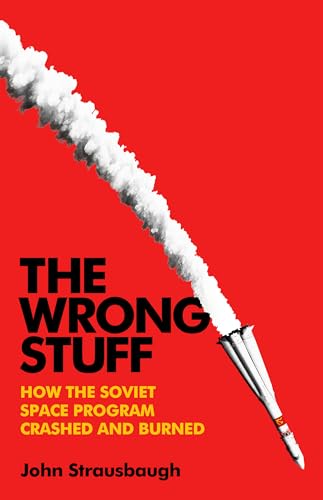
The Wrong Stuff: How the Soviet Space Program Crashed and Burned
A witty, deeply researched history of the surprisingly ramshackle Soviet space program, and how its success was more spin than science.
In the wake of World War II, with America ascendant and the Soviet Union devastated by the conflict, the Space Race should have been over before it started. But the underdog Soviets scored a series of victories--starting with the 1957 launch of Sputnik and continuing in the years following--that seemed to achieve the impossible. It was proof, it seemed, that the USSR had manpower and collective will that went beyond America's material advantages. They had asserted themselves as a world power.
But in The Wrong Stuff , John Strausbaugh tells a different story. These achievements were amazing, yes, but they were also PR victories as much as scientific ones. The world saw a Potemkin spaceport; the internal facts were much sloppier, less impressive, more dysfunctional. The Soviet supply chain was a disaster, and many of its machines barely worked. The cosmonauts aboard its iconic launch of the Vostok 1 rocket had to go on a special diet, and take off their space suits, just to fit inside without causing a failure. Soviet scientists, under intense government pressure, had essentially made their rocket out of spit and band aids, and hurried to hide their work as soon as their worldwide demonstration was complete.
With a witty eye for detail and a gift for storytelling, John Strausbaugh takes us behind the Iron Curtain, and shows just how little there was to find there.
In the wake of World War II, with America ascendant and the Soviet Union devastated by the conflict, the Space Race should have been over before it started. But the underdog Soviets scored a series of victories--starting with the 1957 launch of Sputnik and continuing in the years following--that seemed to achieve the impossible. It was proof, it seemed, that the USSR had manpower and collective will that went beyond America's material advantages. They had asserted themselves as a world power.
But in The Wrong Stuff , John Strausbaugh tells a different story. These achievements were amazing, yes, but they were also PR victories as much as scientific ones. The world saw a Potemkin spaceport; the internal facts were much sloppier, less impressive, more dysfunctional. The Soviet supply chain was a disaster, and many of its machines barely worked. The cosmonauts aboard its iconic launch of the Vostok 1 rocket had to go on a special diet, and take off their space suits, just to fit inside without causing a failure. Soviet scientists, under intense government pressure, had essentially made their rocket out of spit and band aids, and hurried to hide their work as soon as their worldwide demonstration was complete.
With a witty eye for detail and a gift for storytelling, John Strausbaugh takes us behind the Iron Curtain, and shows just how little there was to find there.
272 pages, Hardcover
Published June 4, 2024
Ratings & Reviews
Friends & Following
Create a free account to discover what your friends think of this book!
Community Reviews
Displaying 1 - 30 of 173 reviews

July 25, 2024
It turns out you can judge a book by its cover! The Wrong Stuff: How the Soviet Space Program Crashed and Burned by John Strausbaugh tells you everything you need to know about what's inside and it does not disappoint. The falling rocket picture is also a wonderful touch.
This is actually a harder book to write than one would expect. Strausbaugh needs to tell the story of the Soviet space program, but it would be bad form to celebrate too hard as a not insignificant amount of people died due to shoddy Soviet workmanship (or lack thereof). I think the author nails the tone, though. Strausbaugh drops in funny comments, points out ridiculous lapses in basic safety, but at the same time is almost in awe that people would work like this in life and death scenarios. There is a begrudging respect for these communist cowboys, but let's not take it too far. There is way more mockery which is well deserved.
If you are a purist who does not want humor in your history, then this book is not for you. I think you are missing out, though. I laughed, but I learned. Most importantly, I had a heck of a lot of fun reading it.
(This book was provided as a review copy by the publisher.)
This is actually a harder book to write than one would expect. Strausbaugh needs to tell the story of the Soviet space program, but it would be bad form to celebrate too hard as a not insignificant amount of people died due to shoddy Soviet workmanship (or lack thereof). I think the author nails the tone, though. Strausbaugh drops in funny comments, points out ridiculous lapses in basic safety, but at the same time is almost in awe that people would work like this in life and death scenarios. There is a begrudging respect for these communist cowboys, but let's not take it too far. There is way more mockery which is well deserved.
If you are a purist who does not want humor in your history, then this book is not for you. I think you are missing out, though. I laughed, but I learned. Most importantly, I had a heck of a lot of fun reading it.
(This book was provided as a review copy by the publisher.)
July 5, 2024
This book was disappointing. The subject matter, a popular history of the Soviet space program, was interesting, but the author, who appears to have no Russia expertise and to have just cribbed from memoirs and other histories, chose to tell it as a witless low brow comedy. The author constantly traffics in bland Soviet stereotypes--there are countless jokes about poor quality Soviet cigarettes--and tropes about Communism that belong in a 80's movie. The author's decision to frame everything about the Soviet space program as a lackadaisical "wrong stuff" endeavor means he provides little explanation of how the Soviets were able to accomplish so much despite their technological shortcomings. The framing is also odd in the context of how many Astronauts the shuttle killed and the fact that we relied on the Russian space program to get astronauts to ISS for the better part of a decade. It also leaves the reader wondering how the Soviets kept failing up--going from tragedies to launching Mir. Two stars because it led me to a lot of interesting Wikipedia articles--Soyuz 11, yikes.

July 21, 2024
3.5 stars. Breezy, and overly reliant on secondary sources. An enjoyable read, though, and I learned a good deal. The bullet point: the Soviet space program was an embarrassingly under-funded, fly-by-the-seat-of-your-pants operation that put international one-upsmanship over crew safety or design refinement. Despite their run of early successes, their secretive and analog operation plateaued by the mid-to-late 1960s.
Some of the stories are truly harrowing, and it's shocking that the Soviet program didn't leave a larger trail of dead in its wake.
Some of the stories are truly harrowing, and it's shocking that the Soviet program didn't leave a larger trail of dead in its wake.

September 1, 2024
Just finished:
"The Wrong Stuff: How the Soviet Space Program Crashed and Burned"
By: John Strausbaugh
New York: Public Affairs, 2024.
Chronicles the Soviet space program how it did the impossible with poor technical skill and antiquated materials. The author argues that the cosmonauts were the true cowboys compared to their American counterparts. While I didn't like it that there weren't end notes or an index, the writing style was terrific.
"The Wrong Stuff: How the Soviet Space Program Crashed and Burned"
By: John Strausbaugh
New York: Public Affairs, 2024.
Chronicles the Soviet space program how it did the impossible with poor technical skill and antiquated materials. The author argues that the cosmonauts were the true cowboys compared to their American counterparts. While I didn't like it that there weren't end notes or an index, the writing style was terrific.

July 19, 2025
4 1/2 stars, rounded up.
The title pretty well says it all. It was astonishing how haphazard the Soviet space program was. I was also a little surprised at how closely the space race was tied to the Cold War and arms race. Perhaps because most of the books I've read about the American side of space exploration were written after the fall of the Soviet Union, the Soviet role seems to get downplayed.
The author is frequently flippant. While he can be entertaining, it also gets annoying after a while, hence the 1/2 star deduction.
The title pretty well says it all. It was astonishing how haphazard the Soviet space program was. I was also a little surprised at how closely the space race was tied to the Cold War and arms race. Perhaps because most of the books I've read about the American side of space exploration were written after the fall of the Soviet Union, the Soviet role seems to get downplayed.
The author is frequently flippant. While he can be entertaining, it also gets annoying after a while, hence the 1/2 star deduction.

October 11, 2024
What a really wonderful and interesting book, and thanks to Hank Stuever for the tip. A fascinating look at the old Soviet era space program, and really the old Soviet Union in general. It confirms a lot of suspicions I felt about that part of the world over the years... Certainly a country that can't keep grocery shelves stocked, and produces truly terrible cars is taking shortcuts to get to space, right?
Yep. They sure were!
Very enjoyable read.
Yep. They sure were!
Very enjoyable read.

July 19, 2024
I listened to the Audible audiobook version.
John Strausbaugh has written an excellent history of the remarkably lucky Soviet space program. I mention lucky, because while I'm sure there were talented engineers, scientists, and cosmonauts that were part of the program, it seems that they're success was always muddled by controversy, looming disaster, and injury and death.
The dysfunctions of Soviet governance are on full display in The Wrong Stuff. I read The Right Stuff by Tom Wolfe earlier this year and this was an fun companion piece to Strausbaugh's work. Whereas the Americans were admittedly slow but methodical and technically proficient, the Soviets were fast and reckless. More than a few people were killed due to preventable catastrophes in the Soviet space program. This book is a great overview of those catastrophes, and the incredible successes that somehow occurred through the constant explosions and failures.
This book is also surprisingly lighthearted and funny a times, despite the somewhat dark material, so it was actually an enjoyable book as well. Soviet resignation to their crappy tech is marked with excellent dark humor that humanizes them. But around every corner, the seriousness of their endeavor is shown, if not by death in space, then by removal on Earth in Soviet bureacracy.
A high recommend from me for any space history enthusiasts!
John Strausbaugh has written an excellent history of the remarkably lucky Soviet space program. I mention lucky, because while I'm sure there were talented engineers, scientists, and cosmonauts that were part of the program, it seems that they're success was always muddled by controversy, looming disaster, and injury and death.
The dysfunctions of Soviet governance are on full display in The Wrong Stuff. I read The Right Stuff by Tom Wolfe earlier this year and this was an fun companion piece to Strausbaugh's work. Whereas the Americans were admittedly slow but methodical and technically proficient, the Soviets were fast and reckless. More than a few people were killed due to preventable catastrophes in the Soviet space program. This book is a great overview of those catastrophes, and the incredible successes that somehow occurred through the constant explosions and failures.
This book is also surprisingly lighthearted and funny a times, despite the somewhat dark material, so it was actually an enjoyable book as well. Soviet resignation to their crappy tech is marked with excellent dark humor that humanizes them. But around every corner, the seriousness of their endeavor is shown, if not by death in space, then by removal on Earth in Soviet bureacracy.
A high recommend from me for any space history enthusiasts!

May 30, 2024
An excellent history of the Soviet space program, in all its shambolic, ramshackle "glory". The book was an interesting double-bill with Challenger: A True Story of Heroism and Disaster on the Edge of Space, touching on the history (and failures) of parallel space programs, except where Challenger leans on pathos and human tragedy, The Wrong Stuff is often written with a more humorous, even sometimes colloquial tone. It's never outright comedic, necessarily, in the way of the film The Death of Stalin, but there's something of the black comedy about the dysfunction of the Soviet state, and at times you have a "laugh to keep from crying" kind of situation (most emblematized by the Soyuz 11 disaster, where ground control's response to a warning light about a faulty pressure seal was to tape a piece of paper over the light and proceed with reentry and three people died). Worth reading for any space-history enthusiast.
Thanks to NetGalley and Public Affairs for the ARC.
Thanks to NetGalley and Public Affairs for the ARC.
July 22, 2024
This is not historical work or journalism. It's a series of anecdotes and bad copies of some other sources, sometimes quite questionable. It's full of small factual errors (no, Irkutsk is not and never was a part of Jewish Autonomous Region). I don't look back to Soviet Union through rose-colored glasses, but author's attitude borders on ridiculous. Just one example, describing Khruschev arrival to the US... "He stepped down ....... trailing his sturdy common-law wife Nina and other stout females". WTF?
August 25, 2025
I was really excited for this book and it had potential. Unfortunately, most of the book reads like an editor never did a pass over it. Names are misspelled, dates are wrong, and the later chapters are full of grammatical errors. The way the author jumps around in time and compares and contrasts events can make it appear like events that happened years later influenced the decision-making of the past. Much like the author says of the Soviet space program, the entire book seems to be filled with The Wrong Stuff.

September 6, 2024
An alternately entertaining, alarming, and surprising history of the Soviet space program. Well written and engaging throughout.
September 24, 2025
A decent high level summary/timeline of some of the highlights and lowlights of Soviet space program, although spent too much time story telling with personal interjections and strayed a bit too far from a more factual, unbiased retelling.
I would be remiss to not point out a mistake regarding Wally Funk’s flight in 2021. She reached over 100km on her flight and did indeed cross the Karmen line, despite the author’s claim to the contrary.
It was a bit ironic the author criticized the lack of recognition of the Mercury 13 women, while not doing the precursory research to prevent himself from doing the same thing. As a wise man once said "He could save others from [institutional minimization], but not himself"
I would be remiss to not point out a mistake regarding Wally Funk’s flight in 2021. She reached over 100km on her flight and did indeed cross the Karmen line, despite the author’s claim to the contrary.
It was a bit ironic the author criticized the lack of recognition of the Mercury 13 women, while not doing the precursory research to prevent himself from doing the same thing. As a wise man once said "He could save others from [institutional minimization], but not himself"

April 27, 2026
What the heck was that?? 🤯 This "Ancient History" was also part of my lifetime. Sure, it's not the bulk of these misadventures but I was alive for the Challenger and Columbia tragedies and it was humbling to know the hefty amount of lives lost with the pressure by the Soviet Space Program in order to win a race that they had arbitrarily set from world relationships. You feel the push of "We cannot afford to lose" while they do their best. Speed and secrecy was a higher priority than fixing known issues, but records were set and history was made.
This book definitely illuminated a piece of history that seems far more like fantasy than fact: space exploration. 🌌 The wonder came with a high cost as man looked to the sky and tried to access the unforgiving vacuum of space.
And yet... From the lessons of yesterday, Artemis II safely launched, finished its orbit, and the astronauts are home. It's a great time to read this book and understand that the legacy of space travel lives on, rising from the ashes of many lessons learned, some the hard way, and some by planning for the worst and hoping for the best.
This book definitely illuminated a piece of history that seems far more like fantasy than fact: space exploration. 🌌 The wonder came with a high cost as man looked to the sky and tried to access the unforgiving vacuum of space.
And yet... From the lessons of yesterday, Artemis II safely launched, finished its orbit, and the astronauts are home. It's a great time to read this book and understand that the legacy of space travel lives on, rising from the ashes of many lessons learned, some the hard way, and some by planning for the worst and hoping for the best.

September 8, 2026
Overall not a bad book. 2 stars off because it's super ham-fisted at points with the anti soviet sentiments. I dislike the USSR as much as most Americans, but in a biography about the USSR's space program I'd hope for a more unbiased telling.
That being said I did learn some fascinating stuff. Like the earliest cosmonauts were launched into space using modified ICBM rockets. Or that the fact Yuri Gagarin's service module failed to separate cleanly from the re-entry capsule and only separated because the cables connecting them burnt up on re-entry... and that problem was pretty much never fixed.
It was fairly informative and entertaining but like I said before it went too hard on anti soviet propaganda and couldn't even acknowledge the scientific achievements that had been made. Playing every single one off as a fluke or a pr stunt.
That being said I did learn some fascinating stuff. Like the earliest cosmonauts were launched into space using modified ICBM rockets. Or that the fact Yuri Gagarin's service module failed to separate cleanly from the re-entry capsule and only separated because the cables connecting them burnt up on re-entry... and that problem was pretty much never fixed.
It was fairly informative and entertaining but like I said before it went too hard on anti soviet propaganda and couldn't even acknowledge the scientific achievements that had been made. Playing every single one off as a fluke or a pr stunt.

August 16, 2026
Most of what I know about the Soviet space program, I learned from reading books about the American space program. In American histories of space exploration the Soviets come off as supermen in the early years. They kept surprising the world with one amazing announcement after another. They were the first to launch a satellite into orbit! The first to send a man into space! The first to perform a spacewalk!
All these accomplishments were real and legitimately impressive, and the title of this book, "The Wrong Stuff" is unfair to the courageous cosmonauts of the Soviet program. And yet, when you take a closer look, the Soviet space program was ridiculously sketchy.
The reason Soviets never announced what they were going to do beforehand was that they wanted to be able to cover up their failures. One great example of this is the Nedelin catastrophe, when a rocket exploded on the launch pad and killed 165 people. The Russians just pretended that no rocket launch had ever been planned and told the families that their loved ones had been killed in airplane crashes. They did the same with an explosion that killed eight people a couple years later. My favorite is when, in 1972, they launched a probe to Venus but it failed to escape the Earth's orbit, so they just claimed it was a satellite that had always been intended to go into orbit around the Earth (this Venus probe burned up in our atmosphere only last year). So while Russian accomplishments were impressive and real, they looked much better than they were because all the failures were covered up. In an open society like the United States, NASA had to announce how tax dollars were being spent before each mission and they had to deal with a free press when there was a failure. Even with NASA's disasters, this made for a better program in the long run.
Over time, the Soviet way of doing things wasn't healthy. They would do dangerous things to beat the Americans to milestones, such as when they sent up three Cosmonauts without spacesuits because there wasn't room for three men wearing spacesuits in their capsule but they wanted to get three into space before America could get two. This would come back to haunt them later, on a different mission, when three astronauts without spacesuits were killed by an instant decompression in their capsule. In that mission, as the Soviet cosmonauts were decoupling their capsule from a space station the warning light saying the hatch wasn't sealed would not turn off and mission control told them to just tape over the light and go anyway. Now, that's the wrong stuff.
This book is filled with one hair raising space story after another. It was eye opening and never boring.
All these accomplishments were real and legitimately impressive, and the title of this book, "The Wrong Stuff" is unfair to the courageous cosmonauts of the Soviet program. And yet, when you take a closer look, the Soviet space program was ridiculously sketchy.
The reason Soviets never announced what they were going to do beforehand was that they wanted to be able to cover up their failures. One great example of this is the Nedelin catastrophe, when a rocket exploded on the launch pad and killed 165 people. The Russians just pretended that no rocket launch had ever been planned and told the families that their loved ones had been killed in airplane crashes. They did the same with an explosion that killed eight people a couple years later. My favorite is when, in 1972, they launched a probe to Venus but it failed to escape the Earth's orbit, so they just claimed it was a satellite that had always been intended to go into orbit around the Earth (this Venus probe burned up in our atmosphere only last year). So while Russian accomplishments were impressive and real, they looked much better than they were because all the failures were covered up. In an open society like the United States, NASA had to announce how tax dollars were being spent before each mission and they had to deal with a free press when there was a failure. Even with NASA's disasters, this made for a better program in the long run.
Over time, the Soviet way of doing things wasn't healthy. They would do dangerous things to beat the Americans to milestones, such as when they sent up three Cosmonauts without spacesuits because there wasn't room for three men wearing spacesuits in their capsule but they wanted to get three into space before America could get two. This would come back to haunt them later, on a different mission, when three astronauts without spacesuits were killed by an instant decompression in their capsule. In that mission, as the Soviet cosmonauts were decoupling their capsule from a space station the warning light saying the hatch wasn't sealed would not turn off and mission control told them to just tape over the light and go anyway. Now, that's the wrong stuff.
This book is filled with one hair raising space story after another. It was eye opening and never boring.

July 21, 2025
I feel a little disappointed by this book, even though it's pretty good. A popular history of the Soviet space program it's a decent, if brief overview. There's some humour or tongue-in-cheek writing here and it appears the author relied a lot on secondary sources. I think more primary research would have made this a more informative book.
Overall decent, but I was hoping for more.
Overall decent, but I was hoping for more.

March 29, 2026
Listened on audiobook at normal speed.
Humorous take on Soviet space history. No real new information if you’re a space enthusiast but definitely a well done compilation from the start of space flight through the early Soyuz program.
Humorous take on Soviet space history. No real new information if you’re a space enthusiast but definitely a well done compilation from the start of space flight through the early Soyuz program.

August 29, 2025
“Typical Wrong-stuff” then proceeds to list a success.
Also this guy is allergic to doing his own research. Wow
Also this guy is allergic to doing his own research. Wow
April 4, 2026
wow I learned so much about the Society space program

June 23, 2024
A humorous look at the Soviet space program in all its tragedies and cover ups. Also highlights some of the American miss steps and messaging.

August 16, 2024
If, like me, you spent your childhood attending space camp, playing Buzz Aldrin's Race into Space, and writing academic essays about extraplanetary monkeys, then this is almost certainly the book for you!


January 17, 2026
They didn’t have anything like the resources the Americans could put into their space program. They jerry-rigged and improvised like mad to work around inferior equipment, parts that were never delivered, intramural squabbling among departments.
WHAT’S THIS BOOK ABOUT?
- A witty, deeply researched history of the surprisingly ramshackle Soviet space program, and how its success was more spin than science.
- Even in their leisure suits the trio still couldn’t be squeezed into the capsule, so Korolev asked for another sacrifice. The capsule’s cosmonaut-ejecting apparatus had to go.
BOOK TITLE
- If the American program set out to prove, with meticulous care, that it had the Right Stuff, the rash, slapdash, yet undeniably successful efforts of the Soviet program demonstrated the reverse. Call it the Wrong Stuff.
SAFETY LAST
- Three small Soviet men in leisure suits waiting to be fired into space without helmets, without space suits, with a limited supply of oxygen, with virtually no safety gear, and with no way to exit the capsule quickly if the launch went wrong.
- The Americans, being Americans, spent wads of cash on high-tech electronic pyrotechnic devices. The Soviets, being Soviets, used what Popular Mechanics once described as “an oversized wooden match.” When the R-7 was standing on the pad, techies scrambled under it and shoved broomstick-length rods of birch wood up into all of the combustion chambers.
DIFFERENT APPROACH TO OPENNESS THAN THE U.S.
- Operating their space program in secrecy had obvious propaganda advantages. They could exaggerate successes, like Voskhod, and hide all but the most obvious failures, while NASA ran its program out in the open, with many public embarrassments.
AD HOC DEVELOPMENT
- Sputnik was built quick, on the fly, by hand and ad hoc.
POLITICAL INFIGHTING AND SHORT-TERM OBJECTIVES
- Where the Americans concentrated all their civilian space activities in the one entity NASA, Soviet leaders acted almost whimsically in spreading their support out among jealous rivals.
- Instead of long-term goals, they lurched forward to satisfy their political leaders’ hunger for bragging rights.
ABSURD TIMELINES
- Khrushchev was so pleased with Sputnik that he asked Korolev to launch something even bigger and better into orbit for the November 7 anniversary of the Revolution—three weeks away. Thinking on his feet, as dealing with Khrushchev often required, Korolev said he could put a dog into orbit next. Khrushchev loved it.
RUSSIAN HISTORY OF STEALING TECH TO GET AHEAD
- But he was also following Russian tradition. As far back as Peter the Great in the 1600s the Russians had borrowed, bought, or stolen technology from the more advanced West. When the Soviets were developing their own atomic bomb, Stalin insisted that his scientists precisely follow the stolen blueprints of the American ones. No innovations, no deviation. For a long-range bomber to deliver this bomb, he ordered Tupolev to recreate down to the last rivet a B-29 that had fallen into Russian hands at the end of the war. Tupolev glumly complied. The result was the Tu-4. Displaying the bleak sarcasm Soviet intellectuals often relied on, Tupolev called the Tu-4 “a locally built Boeing product.” Years later, the supersonic Tu-144 would be an inferior copy of the Concorde, duly nicknamed the Concordski. The Soviets would even build a knockoff Space Shuttle.
BRUTE FORCE AND REDUNDANCY TO COMPENSATE FOR POOR TECH
- How were the Soviets dwarfing American rockets? The truth was another close-held secret: the Soviets were years behind their competition in the development of strong, lightweight alloys, and in computers, and in the miniaturization of instruments.
- It’s a stunning marker of Soviet dysfunction that no cosmonauts flew with onboard digital computers until 1980.
- Instruments were so unreliable that one or two backup systems were built in, adding to the weight. Also, to make up for their imprecise targeting, they packed as much explosive as possible into the warhead, adding yet more weight. Soviet rockets had to be so big and strong just to get themselves and their payloads off the pad.
INSTITUTIONAL CULTURE OF NOT REPORTING PROBLEMS
- Titov dutifully reported all his problems—and his career suffered for it. Some people in the program believed that it showed “a lack of character” for him to say anything. Cosmonauts, like fighter pilots, weren’t supposed to admit when they felt ill. They were supposed to man up and shut up. Because he admitted to having so many problems on this flight, his mental and physical fitness for future missions was called into question.
THE PROJECTED IMAGE OF FEMALE EQUALITY WAS A FARCE
- The truth is that the first woman in space, Valentina Tereshkova, got to go because, once again, the Soviets were worried that the Americans were going to beat them to it. It was another one of Khrushchev’s publicity stunts. Had the Soviets known the truth—that NASA was way, way far from even entertaining the idea of female astronauts, much less letting one of them go to outer space—it’s highly unlikely that Tereshkova would have flown either.
- Around the world Tereshkova’s flight was hailed as a great leap forward for women. Except, not surprisingly, in America.
SOVIET SPACE SHUTTLE (BURAN)
- But there was another transportation problem: how to get the Buran from Glushko’s shop outside of Moscow to Baikonur in the wilderness of the Kazakhstan steppe. It was too big and heavy to go by rail or road. The answer was yet another piece of gargantuan engineering, the Antonov An-225, a jet that would fly the Buran piggyback to the Cosmodrome.
- The An-225 was built at the Antonov shop in Kyiv and given a Ukrainian name, Mriya, Ukrainian for Dream. It was a behemoth, the biggest aircraft ever built, with six engines, thirty-two wheels of landing gear, and wings wider than the Statue of Liberty is tall. It’s been noted that the cargo hold was so long (142 feet) that the Wright brothers could have made their first flight (120 feet) entirely inside it.
- That February, as one of the first acts of the invasion, missiles fired by Russian forces smashed Mriya, the [An-225], where it sat at the airfield.
“WHAT DID I MISS WHILE I WAS AWAY?”
- Krikalev and Volkov were up there when Gorbachev announced the end of the Soviet Union on December 25, 1991, leaving the two citizens hanging, literally. They were suddenly men without a country, holding useless passports and Communist Party membership cards.
*** *** *** *** ***
FACTOIDS
- the Laika-inspired Soviet dogsmonaut in Guardians of the Galaxy 3;
- Finnish freedom fighters desperately defending their country against Soviet invasion forces in the Winter War of 1941 threw homemade petrol bombs at Soviet tanks. Molotov, the Soviet foreign minister, outrageously claimed that Soviet bombers were not dropping ordnance on the Finns, but food parcels. The Finns sarcastically nicknamed their petrol bombs Molotov cocktails, a drink to wash down the fictious food.
- America in 1959 was also very much One Nation Under God—the phrase had just been added to the Pledge of Allegiance in 1954.
- Gagarin went into the history books as the first human to orbit the Earth, but in fact where he dusted down was a bit short of a full orbit. The real first human to fully orbit the planet would be Gherman Titov, but he would spend his life relegated to being Gagarin’s also-ran.
- Khrushchev and his generals wanted spy satellites because they knew the Americans were mapping Soviet territory practically inch by inch with their own very successful one, code-named CORONA. That’s not an acronym for Collecting Orbital Reconnaissance… or such. It was just a name a project planner came up with as he gazed down at his Smith-Corona typewriter.
- the most-nuked region on the planet is a zone of Kazakhstan called by the appropriately sci-fi name the Semipalatinsk Polygon. From the very first Soviet atom bomb test in 1949 to 1989, no fewer than 483 nuclear devices were detonated there.
- Leonov revealed that his helmet was equipped with a suicide pill that he could have taken as an alternative to suffocating when his oxygen ran out.
- When Soviet spies in the US got wind of this program and reported it, the Soviet military weren’t fooled for a second by the “laboratory” bluff. They asked Chelomei to develop their own top secret counter-MOL, called Almaz (Diamond). According to space historian Brian Harvey in The New Russian Space Programme, his design included “crew quarters, radar remote-sensing equipment, cameras, two small re-entry capsules for sending data back to Earth and even… rapid-fire cannon to defend the station against attacking American spaceplanes!”
- It “began to fall like a stone” the 192 kilometers to Earth, scoring a fiery trail downward at ballistic speed and at a terrifyingly steep angle, with a force of up to 21 g’s crushing the cosmonauts, who said it felt like having a car sitting on your chest. (Fighter pilots experience up to 10 g’s max.)
HAHA
- The smaller Vaz was a knockoff of a Fiat, but cost the Soviet worker the equivalent of a Lamborghini, and you had to wait nine or ten years to get it. Russians told a joke when there were no KGB snitches around. Ronald Reagan enjoyed repeating it. A Soviet worker puts his rubles down for a car and is told to come back to pick it up in ten years. He says, “Morning or afternoon?” The guy behind the counter says, “What difference will that make?” The worker replies, “The plumber is coming in the morning.”
- The pipes that fed the supercooled liquid oxygen to the rockets’ tanks frequently sprung leaks. The fuel was so touchy that once fueling had begun, turning off the supply to seal a leak could lead to a disastrous explosion. Voskresensky would walk over to the leak, wrap his jaunty red beret around it, unzip his trousers, take out his penis, and piss on the beret. “The minus 297-degree liquid oxygen would freeze the urine on contact, sealing the leak.”
- converting a bomber into the Tu-104, the world’s first passenger jet. It was infamously unsafe. A Soviet joke went: “Tu-104 is the fastest plane in the world. In just five minutes it will carry you to the grave.” His supersonic Tu-22 bomber was even scarier. Rushed into production with a typical Soviet attitude of fly-it-now-fix-it-later, it killed so many crews that they called it the Maneater and the Errorplane. The only thing pilots liked about it was that it used an alcohol coolant, which they drained off and drank to toast their luck if they survived a flight.
- Khrushchev was just as ignorant about the US. When told that Eisenhower wanted them to spend a few days at Camp David, he replied suspiciously, “Kemp David? What sort of camp is it?” He hadn’t evaded getting put in any of Stalin and Beria’s camps to fly halfway across the world and get put in another.
- “Mykola!” “Yes!” “The moskali [derogatory slang for Russians] have flown to the Moon!” “All of them?” “No, just one.” “So why are you bothering me?”
- “The hatch isn’t pressurized! What should we do? What should we do?” Obviously they couldn’t disengage if the hatch wasn’t completely sealed, unless they were in their spacesuits and helmets. They tried various procedures suggested by the techies on the ground. Nothing worked. Ground control finally advised them to tape a piece of paper over the warning light and proceed.
- About the size of two school buses, [Sky Lab] broke into harmless chunks as it fell. When pieces of it littered the ground around the Australian town of Esperance, Esperance cheekily fined NASA $400 for littering. NASA never paid.
- At a dinner in Houston, Leonov stood to make a toast. He wanted to say, “To a successful future.” But because he was still learning English, and maybe because it was not the first toast of the evening, it came out more like “To a sex-full future.” In a heartbeat of silence the Americans all looked at one another, then shrugged and said, yeah, we’ll drink to that.
- The Americans were sure their rooms were bugged, as all their accommodations surely were. So Stafford stood in the middle of his room and loudly proclaimed to no one, “The Russians are very wonderful and hospitable people, but it’s too bad they decided to be so cheap about this hotel. There’s not even a fly swatter.” Coming back a few hours later, they found that “every room had a fly swatter. Better yet, every fly in my room had been killed and dumped in the unflushed toilet.” After that they started “talking to the walls” whenever they wanted something. They complained to the walls about the lousy Russian beer, and superior Czech, East German, and Egyptian beers appeared that afternoon. “‘Talking to the walls’ worked better than room service.”
*** *** *** *** ***
BONUS
- Sergei Korolev, Chief Designer: https://youtu.be/YQfy5u3yOZQ?si=wKP8R...
- R7 Semyorka rocket (put Gregarin and Sputnik into orbit): https://youtu.be/vZLYFZqCMzE?si=9wtKU...
- Sputnik satellite (1957): https://youtu.be/g2WaJdflqT0?si=rcpLH...
- What Sputnik broadcast sounded like: https://youtu.be/lfnfNe31fmY?si=Dxe6z...
- What happened to Sputnik?: https://youtu.be/tMzrbzYWA1U?si=ZzpRg...
- Luna 2 (first ever probe to moon, 1959): https://youtu.be/OKqLNI1kCnI?si=t3_rA...
- Nedelin launch pad disaster (1960): https://youtu.be/8RZzYNo8HO4?si=Vny70...
- Yuri Gagarin (first man in space, 1961): https://youtu.be/KANuFlelQ5k?si=GhT17...
- Vostok: The World’s First Spaceship: https://youtu.be/JALjtQnSEg4?si=yfd-M...
- Voskhod 1 (a space flight with no space suits): https://youtu.be/DGH72f1rQiM?si=S1Zkj...
- Town in Wisconsin has yearly ‘Sputnikfest’: https://youtu.be/8xTj5NIft9A?si=arv6A...
- First space walk (1965): https://youtu.be/c5ZtBhQQPjM?si=ayuCr...
- TP-82 (survival gun given to astronauts for re-entry): https://www.19fortyfive.com/2022/01/t...
- Movie trailer for Russian film ‘The Spacewalker’ (2017 film about first space walk): https://youtu.be/zp8_4RXuDdk?si=WrYH4...
- Luna 9 probe sends pictures back from the Moon (1966): https://youtu.be/a9GpfR2vpSs?si=KppPQ...
- Death of Komarov during Soyuz 1 mission (1967): https://youtu.be/617lH8IfL-U?si=dHcSh...
- Plaque left on Moon by Apollo 15 (U.S.) to commemorate fallen astronauts (1971): https://youtu.be/ZJXvteSRUcQ?si=MVAB1...
- Space adaptation syndrome (space sickness): https://youtu.be/qJf_Nci_Ezg?si=nFJCJ...
- Point Nemo (most remote place at sea; satellite graveyard): https://youtu.be/T3bkyOxiqXE?si=hsNuD...
- Death of the An-225 (world’s largest plane) in Ukraine invasion: https://youtu.be/pi2J72kin2U?si=Ob8Sy...
WHAT’S THIS BOOK ABOUT?
- A witty, deeply researched history of the surprisingly ramshackle Soviet space program, and how its success was more spin than science.
- Even in their leisure suits the trio still couldn’t be squeezed into the capsule, so Korolev asked for another sacrifice. The capsule’s cosmonaut-ejecting apparatus had to go.
BOOK TITLE
- If the American program set out to prove, with meticulous care, that it had the Right Stuff, the rash, slapdash, yet undeniably successful efforts of the Soviet program demonstrated the reverse. Call it the Wrong Stuff.
SAFETY LAST
- Three small Soviet men in leisure suits waiting to be fired into space without helmets, without space suits, with a limited supply of oxygen, with virtually no safety gear, and with no way to exit the capsule quickly if the launch went wrong.
- The Americans, being Americans, spent wads of cash on high-tech electronic pyrotechnic devices. The Soviets, being Soviets, used what Popular Mechanics once described as “an oversized wooden match.” When the R-7 was standing on the pad, techies scrambled under it and shoved broomstick-length rods of birch wood up into all of the combustion chambers.
DIFFERENT APPROACH TO OPENNESS THAN THE U.S.
- Operating their space program in secrecy had obvious propaganda advantages. They could exaggerate successes, like Voskhod, and hide all but the most obvious failures, while NASA ran its program out in the open, with many public embarrassments.
AD HOC DEVELOPMENT
- Sputnik was built quick, on the fly, by hand and ad hoc.
POLITICAL INFIGHTING AND SHORT-TERM OBJECTIVES
- Where the Americans concentrated all their civilian space activities in the one entity NASA, Soviet leaders acted almost whimsically in spreading their support out among jealous rivals.
- Instead of long-term goals, they lurched forward to satisfy their political leaders’ hunger for bragging rights.
ABSURD TIMELINES
- Khrushchev was so pleased with Sputnik that he asked Korolev to launch something even bigger and better into orbit for the November 7 anniversary of the Revolution—three weeks away. Thinking on his feet, as dealing with Khrushchev often required, Korolev said he could put a dog into orbit next. Khrushchev loved it.
RUSSIAN HISTORY OF STEALING TECH TO GET AHEAD
- But he was also following Russian tradition. As far back as Peter the Great in the 1600s the Russians had borrowed, bought, or stolen technology from the more advanced West. When the Soviets were developing their own atomic bomb, Stalin insisted that his scientists precisely follow the stolen blueprints of the American ones. No innovations, no deviation. For a long-range bomber to deliver this bomb, he ordered Tupolev to recreate down to the last rivet a B-29 that had fallen into Russian hands at the end of the war. Tupolev glumly complied. The result was the Tu-4. Displaying the bleak sarcasm Soviet intellectuals often relied on, Tupolev called the Tu-4 “a locally built Boeing product.” Years later, the supersonic Tu-144 would be an inferior copy of the Concorde, duly nicknamed the Concordski. The Soviets would even build a knockoff Space Shuttle.
BRUTE FORCE AND REDUNDANCY TO COMPENSATE FOR POOR TECH
- How were the Soviets dwarfing American rockets? The truth was another close-held secret: the Soviets were years behind their competition in the development of strong, lightweight alloys, and in computers, and in the miniaturization of instruments.
- It’s a stunning marker of Soviet dysfunction that no cosmonauts flew with onboard digital computers until 1980.
- Instruments were so unreliable that one or two backup systems were built in, adding to the weight. Also, to make up for their imprecise targeting, they packed as much explosive as possible into the warhead, adding yet more weight. Soviet rockets had to be so big and strong just to get themselves and their payloads off the pad.
INSTITUTIONAL CULTURE OF NOT REPORTING PROBLEMS
- Titov dutifully reported all his problems—and his career suffered for it. Some people in the program believed that it showed “a lack of character” for him to say anything. Cosmonauts, like fighter pilots, weren’t supposed to admit when they felt ill. They were supposed to man up and shut up. Because he admitted to having so many problems on this flight, his mental and physical fitness for future missions was called into question.
THE PROJECTED IMAGE OF FEMALE EQUALITY WAS A FARCE
- The truth is that the first woman in space, Valentina Tereshkova, got to go because, once again, the Soviets were worried that the Americans were going to beat them to it. It was another one of Khrushchev’s publicity stunts. Had the Soviets known the truth—that NASA was way, way far from even entertaining the idea of female astronauts, much less letting one of them go to outer space—it’s highly unlikely that Tereshkova would have flown either.
- Around the world Tereshkova’s flight was hailed as a great leap forward for women. Except, not surprisingly, in America.
SOVIET SPACE SHUTTLE (BURAN)
- But there was another transportation problem: how to get the Buran from Glushko’s shop outside of Moscow to Baikonur in the wilderness of the Kazakhstan steppe. It was too big and heavy to go by rail or road. The answer was yet another piece of gargantuan engineering, the Antonov An-225, a jet that would fly the Buran piggyback to the Cosmodrome.
- The An-225 was built at the Antonov shop in Kyiv and given a Ukrainian name, Mriya, Ukrainian for Dream. It was a behemoth, the biggest aircraft ever built, with six engines, thirty-two wheels of landing gear, and wings wider than the Statue of Liberty is tall. It’s been noted that the cargo hold was so long (142 feet) that the Wright brothers could have made their first flight (120 feet) entirely inside it.
- That February, as one of the first acts of the invasion, missiles fired by Russian forces smashed Mriya, the [An-225], where it sat at the airfield.
“WHAT DID I MISS WHILE I WAS AWAY?”
- Krikalev and Volkov were up there when Gorbachev announced the end of the Soviet Union on December 25, 1991, leaving the two citizens hanging, literally. They were suddenly men without a country, holding useless passports and Communist Party membership cards.
*** *** *** *** ***
FACTOIDS
- the Laika-inspired Soviet dogsmonaut in Guardians of the Galaxy 3;
- Finnish freedom fighters desperately defending their country against Soviet invasion forces in the Winter War of 1941 threw homemade petrol bombs at Soviet tanks. Molotov, the Soviet foreign minister, outrageously claimed that Soviet bombers were not dropping ordnance on the Finns, but food parcels. The Finns sarcastically nicknamed their petrol bombs Molotov cocktails, a drink to wash down the fictious food.
- America in 1959 was also very much One Nation Under God—the phrase had just been added to the Pledge of Allegiance in 1954.
- Gagarin went into the history books as the first human to orbit the Earth, but in fact where he dusted down was a bit short of a full orbit. The real first human to fully orbit the planet would be Gherman Titov, but he would spend his life relegated to being Gagarin’s also-ran.
- Khrushchev and his generals wanted spy satellites because they knew the Americans were mapping Soviet territory practically inch by inch with their own very successful one, code-named CORONA. That’s not an acronym for Collecting Orbital Reconnaissance… or such. It was just a name a project planner came up with as he gazed down at his Smith-Corona typewriter.
- the most-nuked region on the planet is a zone of Kazakhstan called by the appropriately sci-fi name the Semipalatinsk Polygon. From the very first Soviet atom bomb test in 1949 to 1989, no fewer than 483 nuclear devices were detonated there.
- Leonov revealed that his helmet was equipped with a suicide pill that he could have taken as an alternative to suffocating when his oxygen ran out.
- When Soviet spies in the US got wind of this program and reported it, the Soviet military weren’t fooled for a second by the “laboratory” bluff. They asked Chelomei to develop their own top secret counter-MOL, called Almaz (Diamond). According to space historian Brian Harvey in The New Russian Space Programme, his design included “crew quarters, radar remote-sensing equipment, cameras, two small re-entry capsules for sending data back to Earth and even… rapid-fire cannon to defend the station against attacking American spaceplanes!”
- It “began to fall like a stone” the 192 kilometers to Earth, scoring a fiery trail downward at ballistic speed and at a terrifyingly steep angle, with a force of up to 21 g’s crushing the cosmonauts, who said it felt like having a car sitting on your chest. (Fighter pilots experience up to 10 g’s max.)
HAHA
- The smaller Vaz was a knockoff of a Fiat, but cost the Soviet worker the equivalent of a Lamborghini, and you had to wait nine or ten years to get it. Russians told a joke when there were no KGB snitches around. Ronald Reagan enjoyed repeating it. A Soviet worker puts his rubles down for a car and is told to come back to pick it up in ten years. He says, “Morning or afternoon?” The guy behind the counter says, “What difference will that make?” The worker replies, “The plumber is coming in the morning.”
- The pipes that fed the supercooled liquid oxygen to the rockets’ tanks frequently sprung leaks. The fuel was so touchy that once fueling had begun, turning off the supply to seal a leak could lead to a disastrous explosion. Voskresensky would walk over to the leak, wrap his jaunty red beret around it, unzip his trousers, take out his penis, and piss on the beret. “The minus 297-degree liquid oxygen would freeze the urine on contact, sealing the leak.”
- converting a bomber into the Tu-104, the world’s first passenger jet. It was infamously unsafe. A Soviet joke went: “Tu-104 is the fastest plane in the world. In just five minutes it will carry you to the grave.” His supersonic Tu-22 bomber was even scarier. Rushed into production with a typical Soviet attitude of fly-it-now-fix-it-later, it killed so many crews that they called it the Maneater and the Errorplane. The only thing pilots liked about it was that it used an alcohol coolant, which they drained off and drank to toast their luck if they survived a flight.
- Khrushchev was just as ignorant about the US. When told that Eisenhower wanted them to spend a few days at Camp David, he replied suspiciously, “Kemp David? What sort of camp is it?” He hadn’t evaded getting put in any of Stalin and Beria’s camps to fly halfway across the world and get put in another.
- “Mykola!” “Yes!” “The moskali [derogatory slang for Russians] have flown to the Moon!” “All of them?” “No, just one.” “So why are you bothering me?”
- “The hatch isn’t pressurized! What should we do? What should we do?” Obviously they couldn’t disengage if the hatch wasn’t completely sealed, unless they were in their spacesuits and helmets. They tried various procedures suggested by the techies on the ground. Nothing worked. Ground control finally advised them to tape a piece of paper over the warning light and proceed.
- About the size of two school buses, [Sky Lab] broke into harmless chunks as it fell. When pieces of it littered the ground around the Australian town of Esperance, Esperance cheekily fined NASA $400 for littering. NASA never paid.
- At a dinner in Houston, Leonov stood to make a toast. He wanted to say, “To a successful future.” But because he was still learning English, and maybe because it was not the first toast of the evening, it came out more like “To a sex-full future.” In a heartbeat of silence the Americans all looked at one another, then shrugged and said, yeah, we’ll drink to that.
- The Americans were sure their rooms were bugged, as all their accommodations surely were. So Stafford stood in the middle of his room and loudly proclaimed to no one, “The Russians are very wonderful and hospitable people, but it’s too bad they decided to be so cheap about this hotel. There’s not even a fly swatter.” Coming back a few hours later, they found that “every room had a fly swatter. Better yet, every fly in my room had been killed and dumped in the unflushed toilet.” After that they started “talking to the walls” whenever they wanted something. They complained to the walls about the lousy Russian beer, and superior Czech, East German, and Egyptian beers appeared that afternoon. “‘Talking to the walls’ worked better than room service.”
*** *** *** *** ***
BONUS
- Sergei Korolev, Chief Designer: https://youtu.be/YQfy5u3yOZQ?si=wKP8R...
- R7 Semyorka rocket (put Gregarin and Sputnik into orbit): https://youtu.be/vZLYFZqCMzE?si=9wtKU...
- Sputnik satellite (1957): https://youtu.be/g2WaJdflqT0?si=rcpLH...
- What Sputnik broadcast sounded like: https://youtu.be/lfnfNe31fmY?si=Dxe6z...
- What happened to Sputnik?: https://youtu.be/tMzrbzYWA1U?si=ZzpRg...
- Luna 2 (first ever probe to moon, 1959): https://youtu.be/OKqLNI1kCnI?si=t3_rA...
- Nedelin launch pad disaster (1960): https://youtu.be/8RZzYNo8HO4?si=Vny70...
- Yuri Gagarin (first man in space, 1961): https://youtu.be/KANuFlelQ5k?si=GhT17...
- Vostok: The World’s First Spaceship: https://youtu.be/JALjtQnSEg4?si=yfd-M...
- Voskhod 1 (a space flight with no space suits): https://youtu.be/DGH72f1rQiM?si=S1Zkj...
- Town in Wisconsin has yearly ‘Sputnikfest’: https://youtu.be/8xTj5NIft9A?si=arv6A...
- First space walk (1965): https://youtu.be/c5ZtBhQQPjM?si=ayuCr...
- TP-82 (survival gun given to astronauts for re-entry): https://www.19fortyfive.com/2022/01/t...
- Movie trailer for Russian film ‘The Spacewalker’ (2017 film about first space walk): https://youtu.be/zp8_4RXuDdk?si=WrYH4...
- Luna 9 probe sends pictures back from the Moon (1966): https://youtu.be/a9GpfR2vpSs?si=KppPQ...
- Death of Komarov during Soyuz 1 mission (1967): https://youtu.be/617lH8IfL-U?si=dHcSh...
- Plaque left on Moon by Apollo 15 (U.S.) to commemorate fallen astronauts (1971): https://youtu.be/ZJXvteSRUcQ?si=MVAB1...
- Space adaptation syndrome (space sickness): https://youtu.be/qJf_Nci_Ezg?si=nFJCJ...
- Point Nemo (most remote place at sea; satellite graveyard): https://youtu.be/T3bkyOxiqXE?si=hsNuD...
- Death of the An-225 (world’s largest plane) in Ukraine invasion: https://youtu.be/pi2J72kin2U?si=Ob8Sy...

July 21, 2024
Funny, well written nonfiction about Soviets in space? Utter catnip.
December 24, 2025
Really enjoyed this one! Quick read and a great look into the Soviet mindset
February 20, 2025
Pretty funny overall, may be good reading for anyone that's still fooled by Russian propaganda.
April 6, 2025
In a chapter about the first female to space the author drones on about how it was just a publicity stunt and how much the Soviet PR team pumped up facts while NASA was full of “Ralph Crampton” types who discounted women. And at the end of the chapter I can’t tell if he is just channeling Ralph Crampton when he dismisses Wally Funk’s flight to space in 2021 or is he channeling the Soviet PR team when He makes the claim that she did not actually achieve space flight because her flight peaked at “86,000 km” well below the 100,000 km well short of the international accepted definition of space. Well if the author or his publisher had bothered to do basic fact checking he would they would find that Wally Funk and the rest of the passengers on NS-16 at a peak apogee of 107 km well above the required international definition of space. One, if they were so inclined, could guess that he was playing fast and loose with his facts and simply used the Virgin Galactic’s Unity 22’s peak apogee of 86 km. Now did he do this because like so many Soviet PR people before him, he used the “better” story, was he channeling Ralph Crampton and just not giving credit to a woman, or was it a simple error he made researching the book? None of these situations make him look very good; and I’d like to give him credit and say he just got confused during research or read the wrong set of notes, but this might be the worst explination because how can we trust anything in the book if he can’t even get contemporary facts correct.
January 8, 2025
Sadly really disappointing. Author is too busy harping on bland soviet stereotypes and trying to convince you that every single person in the USSR was incompetent.
Rather than talking about soviet craft or missions in much detail beyond that they were bad - or ever exploring how they were able to accomplish so much despite their technological shortcomings - we get stuff like:
- Khrushchev was a poor swimmer and Mao made fun of him
- Khrushchev’s hat described as «too small for his bulb of a skull, a silly hat, a clown’s hat»
- Khrushchev’s wife was fat
- All soviet sigaretts were shitty
- All the cosmonauts of either gender were ugly
- Brezhnev described as looking like a «thousand-year-old lizardman»
- A million references to everyone being a drunk
If you are writing a history book with some humor in it you have to actually be funny
Rather than talking about soviet craft or missions in much detail beyond that they were bad - or ever exploring how they were able to accomplish so much despite their technological shortcomings - we get stuff like:
- Khrushchev was a poor swimmer and Mao made fun of him
- Khrushchev’s hat described as «too small for his bulb of a skull, a silly hat, a clown’s hat»
- Khrushchev’s wife was fat
- All soviet sigaretts were shitty
- All the cosmonauts of either gender were ugly
- Brezhnev described as looking like a «thousand-year-old lizardman»
- A million references to everyone being a drunk
If you are writing a history book with some humor in it you have to actually be funny

July 8, 2026
The Wrong Stuff contained a pretty decent history of the Soviet vs US space race, and their brash acts to win by any means necessary... but the authorship of the book was lacking.
The timeline is all over the place, making it hard to keep up with the natural progression and timeline of the Soviet space program development and failures.
Overall, the book contained interesting information. How could it not? But it was written very poorly.
The timeline is all over the place, making it hard to keep up with the natural progression and timeline of the Soviet space program development and failures.
Overall, the book contained interesting information. How could it not? But it was written very poorly.
July 21, 2024
I had greater expectations for this book. Had a hard time discerning the author's opinion from actual facts. The author treated series subjects like Cosmonaut deaths rather glibly. Illustrations and pictures of Soviet rockets and scientists would have helped.
Displaying 1 - 30 of 173 reviews