

What do you think?
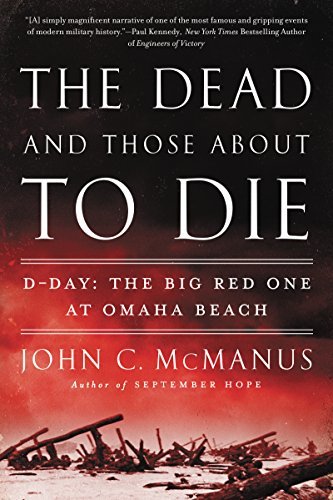
The Dead and Those About to Die: D-Day: The Big Red One at Omaha Beach
From the author of Fire and Fortitude and Island Infernos, a white-knuckle account of the 1st Infantry Division’s harrowing D-Day assault on the eastern sector of Omaha Beach—acclaimed historian John C. McManus has written a gripping history that will stand as the last word on this titanic World War II battle. Nicknamed the Big Red One, 1st Division had fought from North Africa to Sicily, earning a reputation as stalwart warriors on the front lines and rabble-rousers in the rear. Yet on D-Day, these jaded combat veterans melded with fresh-faced replacements to accomplish one of the most challenging and deadly missions ever. As the men hit the beach, their equipment destroyed or washed away, soldiers cut down by the dozens, courageous heroes men such as Sergeant Raymond Strojny, who grabbed a bazooka and engaged in a death duel with a fortified German antitank gun; T/5 Joe Pinder, a former minor-league pitcher who braved enemy fire to save a vital radio; Lieutenant John Spalding, a former sportswriter, and Sergeant Phil Streczyk, a truck driver, who together demolished a German strong point overlooking Easy Red, where hundreds of Americans had landed. Along the way, McManus explores the Gap Assault Team engineers who dealt with the extensive mines and obstacles, suffering nearly a fifty percent casualty rate; highlights officers such as Brigadier General Willard Wyman and Colonel George Taylor, who led the way to victory; and punctures scores of myths surrounding this long-misunderstood battle. The Dead and Those About to Die draws on a rich array of new or recently unearthed sources, including interviews with veterans. The result is history at its finest, the unforgettable story of the Big Red One’s nineteen hours of hell—and their ultimate triumph—on June 6, 1944.
385 pages, Kindle Edition
First published January 1, 2014
About the author
John C. McManus
26 books207 followersJohn C. McManus is an author, military historian and award-winning professor of military history at the Missouri University of Science and Technology. He is one of America’s leading experts on the history of modern American soldiers in combat.
Ratings & Reviews
Friends & Following
Create a free account to discover what your friends think of this book!
Community Reviews
Displaying 1 - 30 of 203 reviews

June 7, 2019
Omaha Beach was a nightmare (there is no doubt about that) this book give a great perspective on this focusing on the 1st Division assault of Omaha Beach during the D-Day landings.
I found that this book was really easy to follow the sequence of event from the preparations for D-Day to the end of the first day. This was helped by practical and clear maps that was spread out through the book relating to each set of action and events being described. The individual stories of the soldiers who fought gave this book real substance.
This book didn't cover all of the actions of D-Day but it was great to hear of the Big Red One's experience and getting to know the Division part deeper. There is alway a battles within a battle and this book showed some of these individual battle in a thought provoking way that honoured the men and their deeds. I really loved the author's tribute to the Medics and Engineers.
If you are looking for a book that describes a units action on D-Day in a clear and chronological order that looks at the human factor of war in meaning and honourable way this book is a great place to start. Clear 5 Stars for me!
I found that this book was really easy to follow the sequence of event from the preparations for D-Day to the end of the first day. This was helped by practical and clear maps that was spread out through the book relating to each set of action and events being described. The individual stories of the soldiers who fought gave this book real substance.
This book didn't cover all of the actions of D-Day but it was great to hear of the Big Red One's experience and getting to know the Division part deeper. There is alway a battles within a battle and this book showed some of these individual battle in a thought provoking way that honoured the men and their deeds. I really loved the author's tribute to the Medics and Engineers.
If you are looking for a book that describes a units action on D-Day in a clear and chronological order that looks at the human factor of war in meaning and honourable way this book is a great place to start. Clear 5 Stars for me!

May 21, 2023
Very good, outstanding maps. I imagined he was on the beach and could just stop time and review a participant's background and current situation, before letting the battle continue while telling the conclusion of the story. Both sides, invader and defender, covered with attention to detail when possible. Impressive maps of small unit actions aligned with the action. Very moved by his section on the medics and the engineers.
Condition Black, how would you handle yourself during the first wave?
Many acts of bravery will get the men off that killing zone...but not all heroes will be acknowledged:
Easy 4 Star account of D-Day and I really enjoyed his writing style. Have a few more of his books on the shelf and won’t delay reading them.
Condition Black, how would you handle yourself during the first wave?
Many acts of bravery will get the men off that killing zone...but not all heroes will be acknowledged:
Easy 4 Star account of D-Day and I really enjoyed his writing style. Have a few more of his books on the shelf and won’t delay reading them.
April 29, 2014
If you've ever watched the beginning of the movie "Saving Private Ryan" and wondered how it really was storming Omaha Beach during the Normandy invasion, then you need to read this book.
The U.S. Army's 1st Infantry Division, "The Big Red One", had served with distinction in Africa and Sicily and thus was tabbed to spearhead the liberation of Europe on the most crucial invasion beach. While there was a prodigious amount of planning which went into the invasion, the actual execution left much to be desired. The pre-invasion bombardments by aerial and naval forces were almost completely useless and the German obstacles and defenses remained virtually untouched. Into this well-prepared meatgrinder came the 1st. Troops overloaded with too much equipment and placed in the wrong spots on the beach were thrust into a hell on earth which many did not survive.
Piecing together interviews, after-action reports and personal correspondence, John McManus has done a masterful job of chronicling the action as the 1st struggled to secure the Omaha beachhead. It's a tremendously compelling read, full of tragedy, triumph, bravery and ingenuity. I don't think I've ever said this before, but when I finished this book I actually felt like reading it again--IT'S THAT GOOD.
Buy this book. Read this book. You will not be disappointed.
The U.S. Army's 1st Infantry Division, "The Big Red One", had served with distinction in Africa and Sicily and thus was tabbed to spearhead the liberation of Europe on the most crucial invasion beach. While there was a prodigious amount of planning which went into the invasion, the actual execution left much to be desired. The pre-invasion bombardments by aerial and naval forces were almost completely useless and the German obstacles and defenses remained virtually untouched. Into this well-prepared meatgrinder came the 1st. Troops overloaded with too much equipment and placed in the wrong spots on the beach were thrust into a hell on earth which many did not survive.
Piecing together interviews, after-action reports and personal correspondence, John McManus has done a masterful job of chronicling the action as the 1st struggled to secure the Omaha beachhead. It's a tremendously compelling read, full of tragedy, triumph, bravery and ingenuity. I don't think I've ever said this before, but when I finished this book I actually felt like reading it again--IT'S THAT GOOD.
Buy this book. Read this book. You will not be disappointed.

July 11, 2019
“Two kinds of people are staying on this beach: the dead and those who are going to die! Now let’s get the hell out of here!” So said Colonel Taylor on Omaha Beach, June 6, 1944 (or some variation of that quote), urging his men to get off the beach and move inland. His rally, and the landing, were a success, but it was hardly a sure thing. This book focuses on the lead up to D-Day and the day itself for the US 1st Infantry Division. It was hard, it was costly, and the men who fought there were forever changed, even if they survived. I’m grateful for books like this that keep the memory and sacrifices of those soldiers and sailors alive.
This was my D-day read, and I got to it a little late, but I enjoyed it. It's a solid read and the narrator for the audiobook was pleasant to listen to. It focuses on the 1st Division, so it pairs nicely with books like The Bedford Boys: One American Town's Ultimate D-Day Sacrifice (about the 29th Division) or Dog Company: The Boys of Pointe Du Hoc--The Rangers Who Accomplished D-Day's Toughest Mission and Led the Way Across Europe (about the Rangers who took Pointe du Huc) to give readers a good view of all the main American infantry units who fought on Omaha beach on D-Day.
This was my D-day read, and I got to it a little late, but I enjoyed it. It's a solid read and the narrator for the audiobook was pleasant to listen to. It focuses on the 1st Division, so it pairs nicely with books like The Bedford Boys: One American Town's Ultimate D-Day Sacrifice (about the 29th Division) or Dog Company: The Boys of Pointe Du Hoc--The Rangers Who Accomplished D-Day's Toughest Mission and Led the Way Across Europe (about the Rangers who took Pointe du Huc) to give readers a good view of all the main American infantry units who fought on Omaha beach on D-Day.

May 23, 2024
If I'd wanted a to watch Saving Private Ryan, I'd be watching the TV right now...
OK, the good...
there were some nuggets of gold in there, especially once the fight gets off the beach. It's all pretty well written, and engaging enough but....
the not so good
I think the decision to focus on just the one division doesn't do the story any favours. If you can get past the eye-rolling introduction (go 'Murica!!!) you might stand a chance but you'll be hit with a series of identical stories for most of the rest of the book.
Additionally, these stories are it - there's precious little commentary, so although you're kept fully informed of the First's shingle shifting, there's no context of anything happening elsewhere, giving the impression that the Big Red One did all the work. The book constantly tells you exactly which type of weapon felled a man (I very much doubt it, given the life or death struggle to get off the sand that was going on) and some odd suppositions, like this one:
There are also a number of curious omissions or grey areas - a lot of suppositions and perhaps, which is perhaps understandable given the confusion of the day, but it does jar with the absolute certainty of the author in believing every veteran's story (although the contradictions that spring up are interesting in themselves).
Overall, it's good on the events of the day, but light on background any and non-existent on the wider context, either of Omaha beach, or the landings in general. For me it's further confirmation that D-Day has to be looked at as a day rather than separate beachheads.
OK, the good...
there were some nuggets of gold in there, especially once the fight gets off the beach. It's all pretty well written, and engaging enough but....
the not so good
I think the decision to focus on just the one division doesn't do the story any favours. If you can get past the eye-rolling introduction (go 'Murica!!!) you might stand a chance but you'll be hit with a series of identical stories for most of the rest of the book.
Additionally, these stories are it - there's precious little commentary, so although you're kept fully informed of the First's shingle shifting, there's no context of anything happening elsewhere, giving the impression that the Big Red One did all the work. The book constantly tells you exactly which type of weapon felled a man (I very much doubt it, given the life or death struggle to get off the sand that was going on) and some odd suppositions, like this one:
With fire support from a machine gun, and possibly the destroyer USS Doyle, Mansfield’s squad went forward into the trees and captured some fifteen prisoners.You might not be able to tell what calibre was coming in, but I'm sure you'd be aware if you had naval gunfire in support. Although Doyle wasn't on divisional strength, so....
There are also a number of curious omissions or grey areas - a lot of suppositions and perhaps, which is perhaps understandable given the confusion of the day, but it does jar with the absolute certainty of the author in believing every veteran's story (although the contradictions that spring up are interesting in themselves).
Overall, it's good on the events of the day, but light on background any and non-existent on the wider context, either of Omaha beach, or the landings in general. For me it's further confirmation that D-Day has to be looked at as a day rather than separate beachheads.

October 12, 2015
During (one of) the Great War(s), on one of the most horrific and bloody of days, battles were won and lost far from the rooms where generals envisioned strategies, made plans, established timetables, allocated resources, and hoped for the best. This books celebrates the efforts, and bemoans the sacrifices, made once the human pawns took the stage and began playing their roles on the frenetic, kinetic, blood-soaked, and ravaged chessboard of Normandy Beach.
This newish books adds a fresh perspective to a well-studied time and place, but I wouldn't recommend it as first immersion into the D-Day literature - it might make more sense, for example, to start with Cornelius Ryan's classic The Longest Day, which I believe deserves its now-iconic status.
Ultimately, this is a well-researched, detail laden, poignant homage to the men that undertook the daunting task of opening the door to Europe that would lead to the eventual collapse of Hitler's occupation. It's not a happy book, and I expect as many will find it as depressing as others find it inspirational.
But it is a dramatic tale, worth telling, and well told.
This newish books adds a fresh perspective to a well-studied time and place, but I wouldn't recommend it as first immersion into the D-Day literature - it might make more sense, for example, to start with Cornelius Ryan's classic The Longest Day, which I believe deserves its now-iconic status.
Ultimately, this is a well-researched, detail laden, poignant homage to the men that undertook the daunting task of opening the door to Europe that would lead to the eventual collapse of Hitler's occupation. It's not a happy book, and I expect as many will find it as depressing as others find it inspirational.
But it is a dramatic tale, worth telling, and well told.

June 7, 2023
After a AMERICA FUCK YEAH! introduction, Manus hits his stride as he puts us squarely in the surf, the explosions, the body parts and the freezing fear.
The meddle among the peddles approach can overwhelm more general observations ex. Too many vehicles planned for disembarkment on day 1. I also want to cross-reference on the unexpected presence of the German 352nd infantry division. As in completely, supposed to be a day's march away.
Sometimes you'll want to flip a page. We get a limited German POV thanks to the famous private Seveloh of WN 62.
The meddle among the peddles approach can overwhelm more general observations ex. Too many vehicles planned for disembarkment on day 1. I also want to cross-reference on the unexpected presence of the German 352nd infantry division. As in completely, supposed to be a day's march away.
Sometimes you'll want to flip a page. We get a limited German POV thanks to the famous private Seveloh of WN 62.

May 21, 2014
My dad went ashore on D-Day with the 1st Infantry, and there has been relatively little written specifically about this division. In this book, John McManus focuses on the Big Red One on Omaha Beach, so it was very personal to me. His isn't the first book that has had me wondering how those kids (face it, most were kids) could make themselves do what needed to be done in the face of such withering fire. Why didn't more of them just freeze? But with his many first person accounts, he helps you feel, as much as possible in a comfortable chair, what they faced. I know I'm biased because of a personal connection, but I recommend it.

June 4, 2024
This was a gory, violent, and depressing story about D-day. It had a large number of individual accounts, often referring to other people who died there. The military strategy statements were interesting. But this wasn’t the best WW2 book I’ve read.

March 23, 2019
“Only two kinds of people are going to be on this beach, the dead and those who are going to die. Now get moving!” Col. George Taylor, lead assault regiment commander
D-Day up close and personal. A significant addition to the record of the sacrifice made by thousands of Americans to free Europe from the tyranny of Adolph Hitler. Closely researched and described to put the reader right among the soldiers dying in the water, on the sand, and on the slopes of Fortress Europa.
“All the beauty of the world was gone. Nothing mattered now except this brutal moment, and survival.”
The only way to make sense out of the senseless mess that the invasion became was to follow individuals through it. That’s what McManus does. And well. Unfortunately, there are too many people and too many stories for the reader to follow his many, necessary changes of focus.
“Men all around, falling--some out of breath, some out of life.”
In fact, the thread of narrative is soon lost in the tangle of mind-numbing repetition and details. Every fact about every person does not need to be included, and even if it does, it need not be repeated.
“The plan for Operation NEPTUNE was a good one but it didn’t work! It was the individual courage and heroism of the American soldier that won the Beaches EAST RED and FOX GREEN on 6 June 1944.” Major Carl Pitt, operations officer of the 16th Infantry Regiment
D-Day up close and personal. A significant addition to the record of the sacrifice made by thousands of Americans to free Europe from the tyranny of Adolph Hitler. Closely researched and described to put the reader right among the soldiers dying in the water, on the sand, and on the slopes of Fortress Europa.
“All the beauty of the world was gone. Nothing mattered now except this brutal moment, and survival.”
The only way to make sense out of the senseless mess that the invasion became was to follow individuals through it. That’s what McManus does. And well. Unfortunately, there are too many people and too many stories for the reader to follow his many, necessary changes of focus.
“Men all around, falling--some out of breath, some out of life.”
In fact, the thread of narrative is soon lost in the tangle of mind-numbing repetition and details. Every fact about every person does not need to be included, and even if it does, it need not be repeated.
“The plan for Operation NEPTUNE was a good one but it didn’t work! It was the individual courage and heroism of the American soldier that won the Beaches EAST RED and FOX GREEN on 6 June 1944.” Major Carl Pitt, operations officer of the 16th Infantry Regiment

October 22, 2023
This book is a sobering, detailed account of the invasion on Omaha Beach, including everything that went wrong and everything that right. Moreover, though, it’s a memorial to the men who fought and lost their lives that day. It’s written with both precision and compassion, and I learned a lot.

July 10, 2020
When Hilary Mantel wrote Wolf Hall, a critic asked, “Do we really need another book about Henry the VIII?” My answer was, “Yes, Mantel’s book.” I can say the same for John C. McManus’s book about D-Day. Again, some might ask, haven’t we seen enough movies, television specials, and documentaries and read enough books about that day, now seventy-five years ago? My answer? No. Not when there is such an outstanding telling of the events as in The Dead and Those About to Die.
The author acknowledges the contribution Steven Spielberg’s film Saving Private Ryan did for bringing the horrific saga of what transpired at the water’s edge on Normandy into everyone’s consciousness. But then, in the chapter H-Hour, McManus makes us look at the scene again. This time not through the eyes of the soldiers of the 29th Infantry Division, but the 1st—the Big Red One. Reading that chapter is as if you were on the beach of Saving Private Ryan, but hitting the pause button every few seconds and zooming in to crouch beside Joe Zukowski, Frank DeBellis, and Howard Pearre, among so many others, crawl, try to walk laden with far too much equipment, likely bleeding from machine-gun fire that pierced knees and arms and chests, and ultimately fall. Mentally exhausted though you might be when you reach the end of H-Hour and turn to the chapter on the survivors, although you wonder how anyone survived, you will marvel at the unimaginable courage of many of the soldiers, sailors, and marines in Normandy on June 6, 1944.
McManus says that D-Day is “much better known than understood.” He is right and goes on to explain the what, why, and how. He pounds home the tendency of Americans with their array of warships, bombers, fighters, their amphibious tanks, and their Higgins boats to overestimate the effectiveness of that power and technology. That bias led to a dangerous underestimation of the firepower the Germans salvaged and to rain down on the beach. It led to the underestimation of the German tactics of mining the beach obstacles and peppering the draws leading from the beach with “Bouncing Betties” and Schu mines.
Were it not for the infinite courageous actions across Omaha, many more men would have been lost. One, McManus cites forms the title of the book, Col. George Taylor’s inspirational admonition, “Two kinds of people are staying on this beach: the dead and those about to die. Now let’s get the hell out of here.” His words allowed many of the 1st Infantry Division to overcome their fear, exhaustion, and injuries to persevere, gather up their arms and move forward. There were heroes at all ranks that day, but through it all, McManus attributes the 1st Infantry’s success to training and leadership but also to the unit’s culture of “personal accountability at the basic human level. . . . the soldiers of the Big Red One were willing to sacrifice themselves and risk death, not just for their cause, not just for the pride of their unit, but in the end, for one another.”
In one of the most profound statements the author uses to help explain the significance of D-Day, he quotes the war correspondent, Don Whitehead, who said, “It was as though man for centuries had lived, begotten offspring and labored toward this moment which would shape the world’s history for all time to come.”
The author acknowledges the contribution Steven Spielberg’s film Saving Private Ryan did for bringing the horrific saga of what transpired at the water’s edge on Normandy into everyone’s consciousness. But then, in the chapter H-Hour, McManus makes us look at the scene again. This time not through the eyes of the soldiers of the 29th Infantry Division, but the 1st—the Big Red One. Reading that chapter is as if you were on the beach of Saving Private Ryan, but hitting the pause button every few seconds and zooming in to crouch beside Joe Zukowski, Frank DeBellis, and Howard Pearre, among so many others, crawl, try to walk laden with far too much equipment, likely bleeding from machine-gun fire that pierced knees and arms and chests, and ultimately fall. Mentally exhausted though you might be when you reach the end of H-Hour and turn to the chapter on the survivors, although you wonder how anyone survived, you will marvel at the unimaginable courage of many of the soldiers, sailors, and marines in Normandy on June 6, 1944.
McManus says that D-Day is “much better known than understood.” He is right and goes on to explain the what, why, and how. He pounds home the tendency of Americans with their array of warships, bombers, fighters, their amphibious tanks, and their Higgins boats to overestimate the effectiveness of that power and technology. That bias led to a dangerous underestimation of the firepower the Germans salvaged and to rain down on the beach. It led to the underestimation of the German tactics of mining the beach obstacles and peppering the draws leading from the beach with “Bouncing Betties” and Schu mines.
Were it not for the infinite courageous actions across Omaha, many more men would have been lost. One, McManus cites forms the title of the book, Col. George Taylor’s inspirational admonition, “Two kinds of people are staying on this beach: the dead and those about to die. Now let’s get the hell out of here.” His words allowed many of the 1st Infantry Division to overcome their fear, exhaustion, and injuries to persevere, gather up their arms and move forward. There were heroes at all ranks that day, but through it all, McManus attributes the 1st Infantry’s success to training and leadership but also to the unit’s culture of “personal accountability at the basic human level. . . . the soldiers of the Big Red One were willing to sacrifice themselves and risk death, not just for their cause, not just for the pride of their unit, but in the end, for one another.”
In one of the most profound statements the author uses to help explain the significance of D-Day, he quotes the war correspondent, Don Whitehead, who said, “It was as though man for centuries had lived, begotten offspring and labored toward this moment which would shape the world’s history for all time to come.”

September 6, 2022
There are so many books written about World War 2 that sometimes they seem repetitive and become background noise. This book focuses on one unit...the 1st Infantry Division.....referred to as "The Big Red One" and its role in the invasion of Normandy. In fact, it really focuses almost exclusively on the first day of the invasion. As a result, you get a more focused look with the opportunity to drill down on specific acts of heroism, competence and sometimes recklessness. It is amazing to me what people are willing to do especially in the military. As I said, so many books about his war and so many great stories but for some reason this resonated more because you felt connected to one group. If you have a particular interest in either D-Day, amphibious warfare or World War II I highly recommend this to you. If you're just curious about what happened this is a great lens with which to view the events of that day. I was impressed by this book an found it a worthy addition to the WWII catalog.

December 29, 2015
Well this one proved it: ANYTIME you see John C. McManus' name on a history: READ IT!
Professor McManus writes in a very easy to read style, the characters take life, and this helps to tell the story. "Bloody Omaha" is well-known and this book makes the accomplishment of the American 1st Infantry Division almost EPIC...perhaps a chapter in an updated "Book of Invasions".
He really grabbed my attention with "Alamo in the Ardennes" in 2007, about the early hours of the Battle of the Bulge, a gripping narrative about a little known chapter of one of World War II's most famous battles, but that is his style, and why I look forward to each new release.
Simply said, if you are a World War II scholar (I hesitate to say "fan" or "buff), read "The Dead...", you will not be disappointed. Then you can thank me, if you have never read a McManus history, because now you have a lot to catch up on.... https://en.wikipedia.org/wiki/John_C....
Professor McManus writes in a very easy to read style, the characters take life, and this helps to tell the story. "Bloody Omaha" is well-known and this book makes the accomplishment of the American 1st Infantry Division almost EPIC...perhaps a chapter in an updated "Book of Invasions".
He really grabbed my attention with "Alamo in the Ardennes" in 2007, about the early hours of the Battle of the Bulge, a gripping narrative about a little known chapter of one of World War II's most famous battles, but that is his style, and why I look forward to each new release.
Simply said, if you are a World War II scholar (I hesitate to say "fan" or "buff), read "The Dead...", you will not be disappointed. Then you can thank me, if you have never read a McManus history, because now you have a lot to catch up on.... https://en.wikipedia.org/wiki/John_C....

June 15, 2017
One of my favorite D-Day books. Unlike broader scope books like Stephen Ambrose's book or The Longest Day, this book focuses on one division. As a result, the narrative is tighter focused and gave me a much better sense of how the battle went from start to finish. I was surprised how much of the major initiative on D-Day was the result of squads of only a few men.
I was impressed by the descriptions of the logistics of getting a division on shore and fighting, the bravery and leadership of the junior officers, and the heroic actions of the engineers (building roads under fire) and the medics (saving lives under fire).
Compared to other D-Day books I've read, this book covered more about the absolute destruction and devastation of the D-Day landings and the fear and terror experienced by all, veterans and green soldiers alike.
I was impressed by the descriptions of the logistics of getting a division on shore and fighting, the bravery and leadership of the junior officers, and the heroic actions of the engineers (building roads under fire) and the medics (saving lives under fire).
Compared to other D-Day books I've read, this book covered more about the absolute destruction and devastation of the D-Day landings and the fear and terror experienced by all, veterans and green soldiers alike.

September 29, 2016
Interesting read, but ultimately to specific. I understand we were focusing on the Big Red One, and that is good, but the we had, at times, a step by step account of men walking of the beach, and for a couple that is interesting, but MCManus spends too much time on that level of specificity. He needed to pull back. The book succeeds in telling that story, but it lost me when we were on out eighth or ninth solider coming up the beach.
He succeeds best when he moved around and told us about the leaders on the beach and what they did, the medics, the equipment. There is a lot here to like, and it only fails when it bogs down specificity.
He succeeds best when he moved around and told us about the leaders on the beach and what they did, the medics, the equipment. There is a lot here to like, and it only fails when it bogs down specificity.

October 2, 2019
D-Day is a popular topic for books on WW2. With 160,000 Allied men involved on that day, there is lots to tell.
This book focused on the 1st Infantry Division, and even more so on the 16th Infantry Regiment which next to the 116th Infantry Regiment of the 29th Infantry Division, had the tough assignment to landing on Omaha Beach.
McManus successfully tells the story of the men who landed on the beach that morning and the actions they took to make it off the beach under terrible conditions. If you want to know what happened that day at Omaha Beach on the company level this book will tell the story.
This book focused on the 1st Infantry Division, and even more so on the 16th Infantry Regiment which next to the 116th Infantry Regiment of the 29th Infantry Division, had the tough assignment to landing on Omaha Beach.
McManus successfully tells the story of the men who landed on the beach that morning and the actions they took to make it off the beach under terrible conditions. If you want to know what happened that day at Omaha Beach on the company level this book will tell the story.

June 15, 2016
It was tough at times to read. I can't begin to imagine what it must've been like to have been on LC when the door opened. What fear, anxiety, and adrenalin rush.
I'm so humbled and proud of their service. We owe our troops our gratitude.
I'm so humbled and proud of their service. We owe our troops our gratitude.
June 17, 2019
A well-researched account of D-Day on Omaha Beach specifically. McManus paints a true, if difficult to stomach, picture of the gallantry of the troops, officers, medics, and Navy in the face of overwhelming odds and plans gone-wrong, and includes some of the reasons the men did it (paramount was "the man on one's left and the man on his right").
One incredible tidbit is when a threesome of soldiers that still happened to have their heavy weapons stormed a bunker where they found two Polish conscripts who hurriedly threw their hands in the air and yelled, "Don't shoot! Me Pol." Amazingly, Sgt. Menza knew one of the Polish conscripts because he had gone to school with Menza's step-brother.
One incredible tidbit is when a threesome of soldiers that still happened to have their heavy weapons stormed a bunker where they found two Polish conscripts who hurriedly threw their hands in the air and yelled, "Don't shoot! Me Pol." Amazingly, Sgt. Menza knew one of the Polish conscripts because he had gone to school with Menza's step-brother.

February 23, 2017
John C. McManus, Ph.D., is Professor of U.S. Military History at Missouri University of Science and Technology, Rolla Missouri, and a recognized authority on the Normandy invasion of World War II. His 2014 book The Dead and Those About to Die: D-Day: The Big Red One at Omaha Beach is at once both a well-researched scholarly account and an engaging, sometimes riveting, story of the U.S. Army's First Division (aka, "The Big Red One") at Omaha Beach on June 6, 1944. "Bloody Omaha" as that beach came to be known to history was a place of great horror and amazing bravery.
Landed into the teeth of German defenses on a thoroughly mined beach, the men of the First Division were at this point in the war skilled and decorated veterans of the North Africa and Sicily campaigns. Yet at this beach, the Big Red One faced stronger defenses and fiercer soldiers than they had fought up to this point. Overcoming terror and paralyzing shock, they rallied and then went about their job of taking the beaches away from its German defenders, thus giving the Allies an opening in France, putting further pressure on Nazi Germany's already crumbling defenses.
McManus tells this story in a way that leaves the reader feeling sometimes as if he or she were there and at other times as if the story is being told by a beloved grandfather who was on that deadly beach when sand and shingle rock turned red with blood and the debris of war was scattered freely across the entire landing area. This is a very accessible book for the average reader who is interested in history. Yet, true to his scholarly inclinations, the book is thoroughly researched, and the thick section of endnotes gives evidence of just how much thought and effort Dr. McManus put into writing this history. It is an impressive work.
McManus makes the point that not many accounts of the invasion of Normandy focus exclusively on the Big Red One. This alone makes this book worth reading by anyone who is interested in the history of World War 2.
If you are interested in the history of World War 2, I highly recommend that you read The Dead and Those About to Die: D-Day: The Big Red One at Omaha Beach. I commend Dr. John McManus for a well written book that is both accessible and scholarly.
Landed into the teeth of German defenses on a thoroughly mined beach, the men of the First Division were at this point in the war skilled and decorated veterans of the North Africa and Sicily campaigns. Yet at this beach, the Big Red One faced stronger defenses and fiercer soldiers than they had fought up to this point. Overcoming terror and paralyzing shock, they rallied and then went about their job of taking the beaches away from its German defenders, thus giving the Allies an opening in France, putting further pressure on Nazi Germany's already crumbling defenses.
McManus tells this story in a way that leaves the reader feeling sometimes as if he or she were there and at other times as if the story is being told by a beloved grandfather who was on that deadly beach when sand and shingle rock turned red with blood and the debris of war was scattered freely across the entire landing area. This is a very accessible book for the average reader who is interested in history. Yet, true to his scholarly inclinations, the book is thoroughly researched, and the thick section of endnotes gives evidence of just how much thought and effort Dr. McManus put into writing this history. It is an impressive work.
McManus makes the point that not many accounts of the invasion of Normandy focus exclusively on the Big Red One. This alone makes this book worth reading by anyone who is interested in the history of World War 2.
If you are interested in the history of World War 2, I highly recommend that you read The Dead and Those About to Die: D-Day: The Big Red One at Omaha Beach. I commend Dr. John McManus for a well written book that is both accessible and scholarly.

August 4, 2016
Being a creature of a few habits, one being reading before sleep, I found this book to go against my typical 'read a chapter or two before lights out'.
It was that good.
Not so much a page turner in the typical sense of wanting to see what happens next...it was D-Day 6 June, 1944....pretty much know how this turned out - but rather the many small and gargantuan events that all came together...for better or worse....on Omaha Beach.
The author does an exceptional job of not only telling this story in such a well crafted way but he also employs the personally appreciated method of first person accounts from those who were there.
For those who may not think they are history buffs or even less so military history buffs.....try this book anyway - why you ask...because even if you think of history as dry, ponderous and uninteresting I think you will find the individual stories of these once young men in the prime of their lives to be ones of such amazing resiliency, horror and eventual triumph. Not triumph in the 'we won' side of life...but that of 'how did I live through that'.....and maybe even a bit of 'why'...
Granted I might be a bit of an over appreciative reviewer as I too wore the Big Red One combat patch on my own uniform as a young man who went to war with the most storied combat division in the United States Army....but maybe it's also because this book tells it from the perspective of those who were there.
I hope you read this book...but if you don't at least do this: The next time the old guy in front of you at the grocery store or Wal-Mart fumbles a bit for his money to pay....or maybe moves a bit slower than you would like in the aisle, cut him a bit of slack and remember that he might have moved a bit faster, crouched low, with a heavy pack and water logged boots and clothes as he clawed his way across a bloody, gore strewn beach, mountain, desert or rice paddy to save nations and liberate people he never met. These men and women who you think of as ancient beings with nothing to offer you in your modern day life - already have.
It was that good.
Not so much a page turner in the typical sense of wanting to see what happens next...it was D-Day 6 June, 1944....pretty much know how this turned out - but rather the many small and gargantuan events that all came together...for better or worse....on Omaha Beach.
The author does an exceptional job of not only telling this story in such a well crafted way but he also employs the personally appreciated method of first person accounts from those who were there.
For those who may not think they are history buffs or even less so military history buffs.....try this book anyway - why you ask...because even if you think of history as dry, ponderous and uninteresting I think you will find the individual stories of these once young men in the prime of their lives to be ones of such amazing resiliency, horror and eventual triumph. Not triumph in the 'we won' side of life...but that of 'how did I live through that'.....and maybe even a bit of 'why'...
Granted I might be a bit of an over appreciative reviewer as I too wore the Big Red One combat patch on my own uniform as a young man who went to war with the most storied combat division in the United States Army....but maybe it's also because this book tells it from the perspective of those who were there.
I hope you read this book...but if you don't at least do this: The next time the old guy in front of you at the grocery store or Wal-Mart fumbles a bit for his money to pay....or maybe moves a bit slower than you would like in the aisle, cut him a bit of slack and remember that he might have moved a bit faster, crouched low, with a heavy pack and water logged boots and clothes as he clawed his way across a bloody, gore strewn beach, mountain, desert or rice paddy to save nations and liberate people he never met. These men and women who you think of as ancient beings with nothing to offer you in your modern day life - already have.

July 31, 2015
A very detailed look at the struggle to take Omaha beach on D-day. Aside from some background on The Big Red One and their fighting in Africa along with the background of the key leaders, this focuses almost exclusively on the details of what happened on the day itself with little broad explanation of the purpose of the invasion in the grand scheme of the war. It gets fairly technical, so if you're looking for a more personal account of what it was like on the beach that day I wouldn't recommend this. But if you're curious about the strategies, weapons, and materials employed in the invasion this is a good start. It's detailed but not overwhelming for someone like myself who's fairly unfamiliar with military weapons, strategies, etc.
The technicality doesn't take away from the reader's realization of how horrifying it was for those who were there. It's just that McManus doesn't focus on any one individual's experience for long. Instead there are a great number of snapshots of individuals and the part they played. There are too many names to remember, but it would be difficult to forget the magnitude of what they endured.

August 13, 2017
A very well done history of the 1st Infantry Division's participation in the D-Day invasion. McManus notes that other units have had much more historical coverage, so this is his attempt to make a systematic, scholarly study of this unit's efforts. His coverage begins with a short section on the training and organization of the 1st Division, but the majority of the book is on just one day, June 6, 1944.
McManus incorporates unit histories, after-action reports and first-hand accounts, but weaves them together in a way that they don't come off sounding like a list of quotes. The story incorporates a large cast of characters, and he mixes up how much background info about each that he gives. Some of those people are killed off almost immediately while others make it through the day. Some other authors only spend time developing characters who survive, but that's not what McManus does. The effect here is that the reader never really knows who is going to get hit until they get hit, which really adds to the real feeling to the story.
The book is fast paced and visceral and would appeal to anyone interested in D-Day or military history in general.
McManus incorporates unit histories, after-action reports and first-hand accounts, but weaves them together in a way that they don't come off sounding like a list of quotes. The story incorporates a large cast of characters, and he mixes up how much background info about each that he gives. Some of those people are killed off almost immediately while others make it through the day. Some other authors only spend time developing characters who survive, but that's not what McManus does. The effect here is that the reader never really knows who is going to get hit until they get hit, which really adds to the real feeling to the story.
The book is fast paced and visceral and would appeal to anyone interested in D-Day or military history in general.

November 16, 2016
Dr. McManus does an excellent job in covering the events of June 6, 1944 as it relates to the 1st U.S. Infantry Division sector on Omaha Beach. This book is very in-depth and shows both the heroic nature of some of the participants along with the tragedies. I was very impressed with how well researched this book is.
However, the timeline of the narrative skips around a bit. By that, I mean it wasn't until 3/4 of the way through the book when he is writing about support elements that I truly understood exactly how crowded the beach was at that time. If this book were to be re-written, I would recommend taking the battle sequence including the support elements in chronological order. Still, this should not detract from the read, though you may get confused at times with all the moving parts to the narrative.
Above all, you will gain a deeper appreciation of the service and sacrifice of those who fought for the Big Red One when you finish this journey. Highly recommend this book for all who have an interest in World War II history.
However, the timeline of the narrative skips around a bit. By that, I mean it wasn't until 3/4 of the way through the book when he is writing about support elements that I truly understood exactly how crowded the beach was at that time. If this book were to be re-written, I would recommend taking the battle sequence including the support elements in chronological order. Still, this should not detract from the read, though you may get confused at times with all the moving parts to the narrative.
Above all, you will gain a deeper appreciation of the service and sacrifice of those who fought for the Big Red One when you finish this journey. Highly recommend this book for all who have an interest in World War II history.
May 21, 2014
This is an amazingly detailed account of the 1st Division's taking of Omaha beach. I fortuitously read this during the Memorial Day weekend (which is about 2 weeks from the anniversary of the D-Day invasion), which heightened my awareness of the spirit of the holiday.
I've read other books on the invasion, but through reading this book gave some amazing insights (or as much as you can get without being there) into what the soldiers in the Big Red One experienced. The names, places, locations, etc. were a little dizzying. I kept referring to the maps in the book, the photographs and the index to cross-reference.
I have always had a deep and profound respect for the US GIs who stepped off of those boats that day (or who step into any combat situation, for that matter), but this book put faces, names and personalities to some of those people who took those terrible, but fateful steps and for that, I'm glad to have read it.
I've read other books on the invasion, but through reading this book gave some amazing insights (or as much as you can get without being there) into what the soldiers in the Big Red One experienced. The names, places, locations, etc. were a little dizzying. I kept referring to the maps in the book, the photographs and the index to cross-reference.
I have always had a deep and profound respect for the US GIs who stepped off of those boats that day (or who step into any combat situation, for that matter), but this book put faces, names and personalities to some of those people who took those terrible, but fateful steps and for that, I'm glad to have read it.

August 18, 2014
The1st Infantry Division (the Big Red One) took very heavy losses on Omaha Beach, but most of the Army historians' interviews with survivors were conducted with 29th Infantry and Rangers soldiers (327 pp. to 300 pp. to 87 pp. for the Big Red One). McManus corrects that imbalance with a highly detailed account of the experience of the 1st Infantry. It is harrowing stuff (just as were the experiences of the 29th and the Rangers). H Hour on Omaha Beach ranks with the experiences of soldiers and Marines at Okinawa and Peleliu: It is amazing that anyone lived through the experience or that they were the same afterwards. McManus makes clear that the present book also makes up for his disregard for the 1st. in his earlier D-Day writing.

December 22, 2017
I listened to the audio book and it was horrible. The narrator chosen was awful and spoke in such a monotone voice and matter-of-fact style he made this book boring.
This book is about the Big Red One Infantry Division and their Invasion at Omaha Beach on D-Day. What is arguably one of the most important and well known military invasions was made boring by this book and/or by the narrator.
I have read or listened to many war history books and I have found most to be fast paced, written with action and/or suspense, and this one was written as if to merely recount the facts in as dry a manner as possible.
The final chapter, Chapter 10, was the best chapter when the author recounted the fates of the men talked about during the book.
I cannot recommend this book.
This book is about the Big Red One Infantry Division and their Invasion at Omaha Beach on D-Day. What is arguably one of the most important and well known military invasions was made boring by this book and/or by the narrator.
I have read or listened to many war history books and I have found most to be fast paced, written with action and/or suspense, and this one was written as if to merely recount the facts in as dry a manner as possible.
The final chapter, Chapter 10, was the best chapter when the author recounted the fates of the men talked about during the book.
I cannot recommend this book.

October 31, 2015
A good account of the 1st Divisions assault on Omaha Beach. The left flank of Omaha has been overshadowed by the 29th's assault on the right due to the casualties of the 116th regiment especially the Boys from Bedford Virginia. One can only imagine the horror of that morning when the 1st Division struggled to hold on to that portion of the beachhead. I have stood stood 3 times on Omaha beach and each time I have been overwhelmed at low tide of the distance from the waters edge to the shingle and to the bluffs leading inland. This is again a good solid account with some insights overlooked in other books... Good read!

June 7, 2015
Book is packed with incredible, brutal and heroic accounts of soldiers taking part in the D-Day invasion. Unfortunately there are just too many incredible accounts, and it begins to sag under its own weight. Maybe this won't bother others, but I found the pacing combined with the exacting detail regarding numbered combat zones and weaponry grating after about the halfway point. Narrator's drone doesn't help, though I'm not sure how much he can be blamed. Overall it's a worthy read for the scenes within, I just think it could be more cohesive as a work.
[AUDIBLE]
[AUDIBLE]

March 7, 2016
This is a real triumph in telling what happened and why events unfolded as they did in the 1st Infantry Division sector on D-Day. For an account of small unit infantry action at the platoon level this book has no superior. It is also very well written.
If anyone is interested, I wrote an essay review of McManus' _The Dead and Those About To Die_ in volume 3 of _U.S. Military History Review_. It is located at https://docs.google.com/a/usmhg.org/v...
reply | edit | delete | flag *
If anyone is interested, I wrote an essay review of McManus' _The Dead and Those About To Die_ in volume 3 of _U.S. Military History Review_. It is located at https://docs.google.com/a/usmhg.org/v...
reply | edit | delete | flag *
Displaying 1 - 30 of 203 reviews