East meets West in this innovative and very smart graphic novel by Barry Lyga, illustrated by Colleen Doran. Sci-fi adventure meets love story—and East meets West—in Mangaman, an originalgraphic novel for teens.Ryoko, a manga character from a manga world, falls through the Rip into the “real” world—the western world—and tries to survive as the ultimate outsider at a typical American high school.When Ryoko falls in love with Marissa Montaigne, the most beautiful girl in the school, his eyes turn to hearts and comic tension tightens as his way of being drawn and expressing himself clashes with this different Western world in which he is stuck in. “Panel-holed” for being different, Ryoko has to figure out how to get back to his manga world, back through the Rip . . . all while he has hearts for eyes for a girl from the wrong kind of comic book.Barry Lyga writes a metafictive masterpiece as manga meets traditional Western comic book style, while Colleen Doran combines manga techniques and conventions with Western comic book
Barry Lyga is a recovering comic book geek. According to Kirkus, he's also a "YA rebel-author." Somehow, the two just don't seem to go together to him.
When he was a kid, everyone told him that comic books were garbage and would rot his brain, but he had the last laugh. Raised on a steady diet of comics, he worked in the comic book industry for ten years, but now writes full-time because, well, wouldn't you?
The Astonishing Adventures of Fanboy & Goth Girl is his first novel. Unsoul'd is his latest. There are a whole bunch in between, featuring everything from the aftermath of child abuse to pre-teens with superpowers to serial killers. He clearly does not know how to stick to one subject.
Actual rating: 3.5 stars. Four stars for the initial premise and the hilarious and clever parody of manga techniques, 2 stars for the wispy plot and minimal resolution.
Yo, man, this book is so awesomely meta.
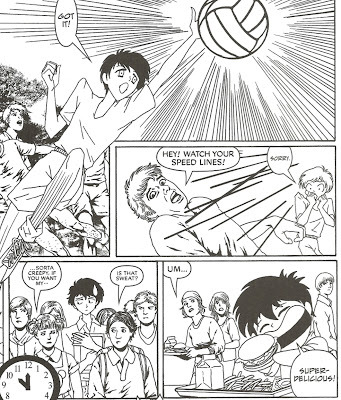
Ryoko, a bishonen (beautiful boy), is from a typical manga world, where the norm is demon attacks, high school rumbles, and dudes dressed as girls because they magically change sexes. He accidentally falls through a Rip and ends up in our world, where he’s baffled by the different (Western) narrative techniques evident in the high school he’s forced to attend. Suddenly, everything he does is either wrong or downright off-putting: when he turns into the overly cute chibi version of himself; when he sees a pretty girl and his eyes turn into hearts that pop out; when he thinks of a person and has their head appear over his shoulder (causing cries of “OMG is that a disembodied head?”); when he moves too quickly and the action lines he leaves in his wake poke people and then fall to the ground and the janitor has to sweep them up; where he sweat drops and everybody is grossed out. In one particularly hilarious scene, he gets in a fight with a boy at school and is baffled when the boy ends up hospitalized, because nobody in his universe ever sustains any real lasting injuries.
So, a lot of the fun of this graphic novel is looking for all of the manga techniques Lyga and Doran parody (some totally obvious and some very subtle) and seeing how they play in the so-called “real” world (which is drawn in a hyper-realistic style). It’s pure genius. And it’s trippy, because even in this world, Ryoko is still aware of the interstitial spaces between panels (finally, I can use the word “interstitial” in a review!) that are the norm in all comics, and is able to convince his love interest Marissa that her world, despite the differences, is just like his. She is at first freaked out, thinking her world is not real, but eventually, like him, learns to use the space between panels to travel (for example, using the interstitial spaces to step from her bedroom to her friend’s bedroom, a kind of inter-dimensional shortcut).
It’s a cool premise and, like I said, a lot of fun. The story itself is barely there, existing only to fuel the meta: there’s a romance between Ryoko and Marissa and the brief conflict with her ex-boyfriend; meanwhile, Ryoko’s guardian (I forget his exact job, but he’s basically a secret government agent) attempts to fix the Rip, as a bunch of manga-style demons are attempting to cross over as well, and then send Ryoko home before it closes completely. Since Ryoko and Marissa fall in love, then they have to decide what to do about their different worlds. The resolution is disappointing and doesn’t entirely make sense (maybe because it happens in two seconds), and the characters are, ya know, flat (Flat! Get it! Hahahaha!), but this is totally worth a read, particularly for manga/anime fans. I only wish it could have been longer, long enough to actually develop the characters and plot so it could be more than just a clever and hilarious exercise in comparing Eastern and Western comic book techniques.
I really didn't like this. I am honestly surprised by how much this just missed every mark it was aiming for.
We start off with an interesting concept. Creating a story about a manga style teenage boy in a comic book style world after he accidentally crosses a dimensional gateway. But the execution of this concept fell flat on its face.
When I read graphic novels, manga, or comics the first thing I judge the book by is the art, then the characters, then the plot. In Mangaman none of these aspects grabbed me and I kept wondering why this wasn't done better.
ART: Combining the classic manga style art and classic American comic book style art was overall a success. However, looking past the style and to the art itself I found it difficult to look at. It was all crisp black and white lines with intense shading that was overly harsh. It had no balance to it, and when the characters referred to the depth of the "three dimensional" comic world I got no sense of what they were talking about. It was missing a spectrum that having softer lines, patterns, and shades of gray would have provided for it.
CHARACTERS: None of the characters every get past the surface layer of what they need to be for the story. They play a part, speak when it's their turn and really nothing else. A positive is that the character Marissa, the female lead, was actually an interesting person. She was quirky, and a little rebellious but so many things about her were just told to us instead of shown which is a major no-no in a visual medium.
PLOT: The concept mentioned above is basic enough to give a lot of room to shape a story. You can take this idea in so many different directions that I think the writing got to scattered. It felt like this was an outline for a story and not a fleshed out idea. A check list of events rather then a flowing plot.
The dialog isn't very well planned and there are random additions of out of place technology, with an iPhone and tablet making almost unscripted appearances.
The ending was the point where you could really do something cool, I mean what happened with those monsters that were constantly mentioned? What about the other world? What was causing the rip? What will Ryoko decide?
OVERALL: This is not a bad book, it's not terrible, and I'm sure people will like it. I just don't like it. I think it's a waste of story, and honestly wonder why this was the final product. I know that both the writer and the artist could have done better. I'm just so disappointed in what had the potential to be a really great idea.
Ryoko Kiyama is sent into the real world of western comics when he stumbles into an inter-dimention rip from a government machine. Can this manga man return to his own universe before he is stuck there forever? Read on and find out for yourself.
This was an interesting concept mixing Japanese manga with western comics. The artwork was great and I loved the story in this. If you enjoy graphic novels, check this out at your local library and wherever graphic novels are sold.
So for Banned Books Week I decided to read some controversial comic books that my local library had available because it sounded fun and fuck censorship. So far, I’d say it was a good idea.
What’s it about? Ryoko, a character from a manga comic book shows up in the “real” world. While a science guy is trying to set up a portal so Ryoko can go back to his world, a beautiful girl named Marissa catches his attention... and he catches everyone’s attention.
Pros: The story is really interesting, creative and fun! The art is wonderful! The mix of manga style and more American style comic book art is so damn good! The comedy is very well done. Lots of funny moments throughout that really can only be done in comics. The romantic element is well written and cute. This book is very strange and meta. I really like the way this book does it though because it makes everything really interesting, more fun and very unique!
Cons: The characters... I honestly didn’t care about them too much. I mean, they aren’t bad but for how into the story I was, I thought the characters are kinda meh. The story is a tad predictable. I mean other than the reveal that and a couple of other SUPER MINOR things towards the end, yeah mostly predictable. Some of the dialogue is honestly kinda terrible. Most notably people saying “BTW” and “LOL” in actual speaking... like... do people really think teens talk like that outside of internet posts and texts? The ending is rushed and really doesn’t make much sense.
Mixed thoughts: The action. So this is not meant to be a real action tale and a couple bits towards the end are a bit more intense but at the same time there were some obvious opportunities for action (I mean Ryoko’s backstory involves kaiju fighting yet we don’t actually see that and when we don’t see that either, it just ends. That seemed like real wasted opportunity.
Why it was banned/challenged and my thoughts about that: Why it was challenged- Sexual content (brief references and pixelated genitals in a joke about manga censorship). Thoughts- That’s stupid. First of all, kinda funny that the main scene that made some want to ban it from libraries pokes fun at censorship. Second, the scene in question and couple of quick references are milder than some of the sexual content that is allowed in a lot of PG-13 rated films and this book wouldn’t even appeal to most kids under 12 so really kinda stupid. Whoever challenged this is obviously a super-prude who really... I don’t know how they handle the crazy world we live in if they’re trying to shelter teens from something as mild as a humorously censored dick in a comic book.
Overall: This book is fun and unique... that being said it’s still in the good but not great category because there is a noticeable amount of problems I had. The story is very creative, the romance is very cute, the humor is very well done and the art is outstanding! Unfortunately the ending is rushed and nonsensical and I would have liked more suspense and better dialogue. Overall I did enjoy this quite a bit so I would say if you are in the mood for something unique it’s worth reading.
I'm going to be up front with you, the reader. This is worth reading but I'd check it out from the library rather than purchasing it sight unseen. There's some great jokes in here but like others have said, the story is very thin.
Let's start off with what I liked. I enjoyed the art style & I loved the little jokes here & there about how various manga antics would be portrayed in the real world. The art really is wonderful to look at. The manga does tend to suffer from "Drawn by an American-itis" (if you're a big manga reader you'll know what I'm referring to) but it's still pretty well done. Where the art really takes off is with the ultra detailed & realistic characters. It's a bit jarring to look at the difference between the characters' different styles, but that's half of the point of the different styles.
Where everything sort of goes a little wrong is with the story. It's not that it's a bad idea, it's just that it's barely there. If the writing team had spent as much time on the story as they did on the jokes & artwork then this would have been a great read. What makes everything worse is that there really isn't an ending to anything in the book. There's one of sorts but if you're looking for any actual answers or resolution then you'll end up being disappointed. If this is the first volume in a series then great. If not then it's just a very disappointing & flat ending. I don't need to have everything tied up in a neat little bow but I do like it when my books have a better ending than this.
If this book was a pizza then I'd be sending it back for another 10-20 minutes in the oven. I can't help but think that a little more planning would have turned this book into what it really wants to & deserves to be. This is an entertaining but ultimately lukewarm read. Again, I'd recommend it as a library read but I'm glad I didn't spend money on it.
The premise sounded fascinating, but the execution left me cold and uninterested. Perhaps I am entirely the wrong audience, and is better suited for newcomers to the world of manga, rather than someone who's been involved since the 90s and is no longer amused by wacky manga conventions.
I've followed Colleen Doran's blog for some time, and while I admire her work ethic and knowledge garnered from years of experience, I don't particularly like her attempts to play chameleon with her art style. I easily see where she appropriated stylizations from prominent manga art styles from the 90s (dated CLAMP, usually), but they are hack imitations with no inspiration, flow, or true feeling that I would have expected from an artist of her caliber.
A huge component of graphic media is the ability of the artwork to portray the story, and many times I've had fabulous art lift up an otherwise mediocre storyline. But poorly suited art does just as much to drag down the written word, and Mangaman is not written well enough to transcend that.
I see what the author was going for with this, but ultimately this book fell flat for me. What should have been hilarious, exciting, and fun is dark, boring, and disappointing.
C'mon! A manga/real world crossover almost writes itself. This book missed the mark completely.
The female lead, in particular, is probably one of the book's weakest points. She's a bored, beautiful, popular white girl with no problems other than that she's...bored? Too many people love her? Ho hum.
"Mangaman" himself is just as flat (literally and figuratively) as Bored Pretty White Girl. Instead of exploring how this kind of alien outsider would behave when thrust into "reality" he spends the majority of the book pining over Bored Pretty White Girl or apologizing for all of his "manga effects" - speed lines, thought bubbles, etc. - because they freak people out.
Which brings me to a more nitpicky point, but I feel I must bring it up. Anyone who's read, let's say, a good variety of manga may be irked by the Mangaman's appearance. He's definitely drawn in a 90's "shoujo style" (i.e. Clamp, Yuu Watase, etc.) but it is implied that his world is more of a "shounen" comic. Nitpicky, yes, but it shows a lack of knowledge of the medium on the author's part. Write what you know, right?
Yet another irking point is the implication that Mangaman's look is the end-all-be-all way all manga characters look. As most manga fans know, art styles are as varied in manga as they are in American comics. It just reeks of ignorance and comes off as somewhat insulting to manga in general.
That said, I do think the "real" world is actually drawn very well, if ironically flat in some places. For instance, sometimes characters will have shading on their bodies but the backgrounds will be completely without shadows or shading. Still, overall, I think Colleen Doran is a great artist and she did a decent job with what she had to work with.
When all is said and done, though, I feel like Manga Man is a great concept that misses the point. There's just...not much going on in it, besides, "oh, look how different manga and reality are." Even the romantic plot is handled with little to no drama. Mangaman and Bored Pretty White Girl hook up almost immediately. Her ex and parents get pissy about it and before you know it the book is over without ever really exploring all the cool things it should have explored.
This was my own fault - the audience for this book is obviously younger than me, and I don't mean that as a derogatory comment. I think this would be a real delight for someone who is new to the Japanse comics genre or to the idea of metafiction; unfortunately, I am neither. Actually, given Doran's old school manga influence - the Mangaman character's design stems from the pre-1990 romance manga style - it might even be a nice hit of nostalgia for some readers who are quite familiar with that history.
However, the story left me completely cold. It was awkward in places, unexplained in others, and more of a drive-by homage than a detailed trip into either concept. Lyga's work has no real there there, and while a light read is just fine, I was hoping for something - I'm not sure what, just something more. If I had to guess, I'd say he's a relatively new author, but even a quick check here says he most certainly isn't. I'm not going to make a catty, caustic comment; I'm going to say with absolute sincerity that he must have a better grasp of what a Young Adult novel's limitations must be, and that the bulk of the problem lies with me as a jaded reader. Reaching for more depth might be nice, but presumably, you risk losing a large segment of your target audience, so one can't blame the author for not pleasing an additional audience at the expense of his intended readers.
I'm not going to lie and say that I'm not actually tired of Doran's art, either. Again, there's absolutely nothing *wrong* with it, and anyone seeing it for the first time will be as blown away as anyone who had their first glimpse of her work in A Distant Soil's first preview pages. But it hasn't changed, and the story she tells with it hasn't, either, whether she's the author or pairs with someone else.
In the end, I can't say it was a bad book. I simply did not like it at all. That's no reflection on its merits for others, especially tweens and teens. My own preferences run so counter to it that I can't judge the quality of what it does have. Maybe I should stick with this: if you are the kind of person who likes this thing, then this will be the kind of thing that you like.
The good: Clever premise and interesting idea about "the world between the panels."
The bad: There is so much yellow face in here. While some of this is all in good fun, like Mar wearing a kimono in the beginning, mostly it felt like out of touch pandering from creators who only understand manga and Japan on a surface level. I have never read a Japanese comic where all these motifs were used together (or at all) or the character talked like that. The windows we got into the "otherworld" of manga made it look like a crazy Warner Bros cartoon with everything but the kitchen sink thrown in: magical girls, mecha, shounen fights, chibis running amok. Felt more like the lyrics from "Turning Japanese" than a tongue in cheek take on Japanese comics.
The ugly: When our hero is looking pretty, he looks really pretty. When he doesn't look pretty, he looks damn awful, like a kid drew him--not like the masculine fighting heroes from the pen of Tite Kubo and co. So many cliches and reaction shots interrupting what, in a real manga world, would be touching or revelatory moments. One of the more interesting ideas about seeing the future being likened to reading from right-to-left in a left-to-right world was so poorly executed because of sloppy panel layouts that I had to flip back and forth between parts of the book a few times to sorta get it. PANEL LAYOUTS. The first thing you show each other in the comic creation process. Was there some massive communication breakdown mid-project?
Verdict: This felt like a good idea that would have worked in a color comic with creators who really GOT many genres of manga and American comics on a deep level. But it felt like the creators or the editor fell in love with the idea and stopped it from reaching full potential. Coupled with an immature perspective on Japanese comics, this was just barely worth the forty-five minutes I spent reading it in the bathtub, and I'm sorry that this is the first I've experienced of Colleen Doran's work, a comics creator who I've been lead to expect great things from.
To repeat: This is why I don't read American comics.
Oh, now this is clever: take a manga character and drop him into an American comic world. Said character not only looks like he's ripped straight out of a manga, he even embodies many of the conventions used in the manga format. He's referred to as an "extra-scientific event" by scientists, viewed as a threat to his fellow male high-schoolers, and simply can't seem to find a way to fit in. I suppose that's to be expected when giant drops of sweat appear on your forehead when you're embarrassed or when sound effects become visible. That can't be easy. Fortunately, he quickly becomes friends with the most popular girl in school who finds his quirks to be refreshing, if a bit unsettling. I love anything that messes with the "fourth wall" (as those in theater might say). The characters become aware that they are in a comic, but are forced to acknowledge the differences in their "worlds". There's a bit of action, a lot of humor and a charming little love story. What more can you ask for?
A scifi/manga retelling of Romeo and Juliet? With a nod to Flat Stanley? If you are a manga fan, try to imaginge a manga character rocketed into our world from the two dimensional pages of a comic book world. Every thought bubble actually appears beside his head. Motion lines appear when he runs, then fall to the ground. And that thing they do with their eyes! Clever, fun, and beautifully drawn.
I loved this book - and the fine mix of storytelling art styles - once I finally began to read the first few pages. The author(s) effectively use blank space, between panel borders as well as chapters, to tell a story of a Japanese cartoon hero crossing into a conventional comics world. Highly recommended!
Cute idea, interesting to look at, but feels somewhat unfinished. Setting us up for a sequel? Also not sure why we need a "graphic" sex scene between high school students in a graphic novel that is labeled "middle grade," because now I need my 9 yr old nephew to get a little older before I pass it on.
This was fun and imaginative. The story was very YA, very fast faced, a little superficial, but good. The art is great. Yay, Houghton Mifflin Harcourt for putting out a graphic novel!
Okay - it definitely didn't go where I was expecting it to. Mostly though it made me want to dig out my old "Distant Soil"s and catch up on the ones that came out after I stopped collecting comics.
This was so bizarre but in all the best ways!! Honestly, this reads like it should be the introduction to a kick ass graphic novel series (which unfortunately I don't think it is).
Manga Man is a manga book authored by Barry Lyga and illustrated by Colleen Doran. This manga is about a kid from another world that is supposed to integrate and make friends but is very different because he is a manga character in a western comic. The two main characters are Ryoku the manga character and Marissa the popular and hot girl that Ryoku likes. In essence Manga Man is a book about love and achieving love but is also a very “Meta” book. It is meta because is points out all the differences in manga from the point of view of western comics and this is a very humorous thing to see. I think this was the best part of the comic but this is all I can really praise. This comic really lacks content. The only thing that is alright is the jokes about the differences in between manga and western comics and that is kind of appalling. The only story that really happens is the semi love story that just pops out of thin air after awhile and only half way makes sense. The adversity Ryoku faces is almost non existent as well as the back story on how he gets to earth in the first place. Overall I think this comic relies on a single joke instead of focusing on a good story in the first place. For this I have to rate it 1 star out of 5 because of fairly bad storytelling and wasting the 15 minutes of my valuable time. I would not recommend this to anyone.
Writer Barry Lyga has created some wonderful characters and a great story. What if a boy from a world that looks and acts like a manga somehow came to a reality much like ours? How would he or could he fit in and what happens if he falls in love with a girl from this world?
Ryoko was a teenager growing up in a world of speedlines, kaiju and giant mecha. When a warp opens he finds himself on a world where the physical restraints are quite different. However, he doesn't follow those new limitations. Marissa was the most popular girl in high school, dating the most popular guy, but one day she decides that it isn't enough. When the two meet it isn't a surprise that some folks, including her parents, aren't too happy about the situation. Also, the government is a little concerned that the kaiju that can also travel through the warp might decide to visit.
I can't think of an artist besides Colleen Doran (A Distant Soil) who would have been a better choice. She not only brings her beautiful style to the characters of this world, but brilliantly captures the look of Ryoko and his world as well.
I don't think you have to be a manga fan, or even a comics fan to enjoy this story of romance and tragedy.
Barry Lyga and Colleen Doran present a unique look at the world of Western art with their collaboration Mangaman. A mysterious rift traps the Japanese character Ryoko in the “normal” world. Possessing flowing hair, expressive eyes, action and sound effects, and a naive personality, Ryoko is a living embodiment of manga. While his military handler Capeletti works on a portal to send the lost boy home, he is given the chance to attend the local high school. There Ryoko is smitten with the popular girl - Marissa - who just happens to find the oddball endearing. With a choice to be made between finally going back and staying with his dream girl, Ryoko is torn between two very different worlds. Barry Lyga pens a humorous love note to his favorite genre, doing so by upending the Japanese world of comics into the American version. The quirky plot is funny and heartfelt, with enough surprises to keep the story going; the lack of full resolution or explanation for Ryoko’s arrival does tend to frustrate the ultimate tale however. Colleen Doran mixes Eastern and Western styles well, showing both worlds as fictitious yet functional. Mangaman bridges the gap between comic styles for a fun and enjoyable experience.
Ryoko is a typical manga character - ultra skinny, shiny eyes, sweat beads, blush marks and surprise lines shooting off of him wherever he goes. And where he goes in this book is through a rip into a typical American high school. This is exciting because Ryoko has always wanted to be a stereotypical teenager, and in this world he meets and falls instantly in love with the beautiful, blonde Marissa. But it's also a problem, because he's a manga character! He's the butt of jokes (some very funny visual jokes!) and is very much a fish out of water. But just as things are settling down and he learns that his love interest is as enamored with manga and anime as he is with her world, he is confronted with a major decision. Does he want to stay here in this world, or travel back to his own. And if he goes, does he take Marissa with him? Filled with campy manga humor, existential angst and evocative black and white drawing, this book is a hit. I recommend it to manga fans (even though it's not manga) and comics fans and anyone who appreciates the absurd, especially the absurdity of adolescence.
Alright basically this book is very enjoyable but when you think too hard about the plot you see the flaws.
Art: The art's black and white but it looks really good. The mix of manga and comic is just really fun. I like the style in general. Everything looks detailed and of course unique.
Character: The leads have a bit of a creative flair to them, and there is an attempt to give them some depth. It's a bit flawed, which I'll be mention later. I think Ryoko's pretty cute and endearing, he does have a bit of depth. Marissa is also quite unique, I like her strange outfits. Both the lead's arcs kinda end a bit messily though.
Story: Right so the story starts off quite fun, but it's flaws is it's messy attempt to add depth. Ryoko has an ex that's brought up and the arc around it is very messy and a bit questionable with it's relation to theme of you know not judging people. Marissa's arc feels a bit messier as her quirk kinda dissapears for no clear reason. That's really the main flaw, it's junk food that tries to be healthy food. It's very fun though.
The book starts off with a boy named Ryoko. A manga character, falls through a mysterious hole in the space time continuum or a "rip" to enter the real world of high schooler. In this school he is a total outsider and he contently apologizes for being different. Even though its not really his fault. While in this school Ryoko meets this girl, Ryoko's eyes turn to hearts for Marissa Montaigne, the most popular, beautiful girl in the school, who just so happens to have a very popular, very jealous ex boyfriend ready to beat up ryoko. this girl also finds herself attracted to the new boy in town who in this case, happens to be from another dimension where life resembles a Japanese comic book. This book was a good read. at first the book to me was a little confusing and weird but it was pretty good and a book that i do recommend to other that like graphic novels
This is a cute little graphic novel about a manga character getting sent to the "real" world via some science experiment mishap. Its a quick read and well written though its romance overshadows the majority of book. The novel feels more like a soap opera than anything else but because its so short its tolerable. Its one of those " worth reading but not worth buying" books. Its clean enough for children but there is one scene where the main character gets naked and the reader is treated to a pixilated male genitalia. Even so the book's content is PG and nothing to get excited about.
What happens when a manga character falls into the world of American comics? Confusion, nuttiness and hilarity ensures! Think Who Framed Roger Rabbit? meets the A-Ha video “Take on Me” whipped into The Purple Rose of Cairo. Feelings manifest themselves like rainclouds that actually drip on the floor, thought bubbles can be seen by everybody else and laugh words become literal lines that drape across people’s shoulders.
Ryoko has to adjust to American ways but he can’t and no one else can deal with his actual screwy mannerisms (he has to learn to walk left to right, e.g.). There is likely a subtle message about the problem of assimilation for foreigners who must try to accept the ways of hostile natives.
This graphic novel had me grinning and hooting at all the manga and comic book details we take for granted. Thrown into this is a tender love story coming face to face with a Chthulian nightmare. Somehow the pieces all add up as characters break the fourth wall and monsters seek to invade from another dimension. It’s pandelirium and a sheer delight. For lovers of comics and/or manga, this is a visual delight.
I mean - it’s not like nothing like it has ever been done. But it was just presented in such a fresh way.
I’ve never been much of a Manga fan (I still don’t know if it’s pronounced with a long or short a), but I fell in love with this story pretty quick. I guess I have read enough Manga to get some of the hilarity.
It was funny, and interesting, and just really engrossing.