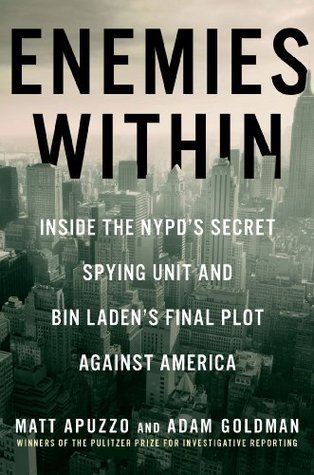
Two Pulitzer Prize–winning journalists take an unbridled look into one of the most sensitive post-9/11 national security investigations—a breathtaking race to stop a second devastating terrorist attack on American soil.In Enemies Within, Matt Apuzzo and Adam Goldman “reveal how New York really works” (James Risen, author of State of War) and lay bare the complex and often contradictory state of counterterrorism and intelligence in America through the pursuit of Najibullah Zazi, a terrorist bomber who trained under one of bin Laden’s most trusted deputies. Zazi and his co-conspirators represented America’s greatest a terrorist cell operating inside America. This real-life spy story—uncovered in previously unpublished secret NYPD documents and interviews with intelligence sources—shows that while many of our counterterrorism programs are more invasive than ever, they are often counterproductive at best. After 9/11, New York Police Commissioner Ray Kelly initiated an audacious plan for the Big dispatch a vast network of plainclothes officers and paid informants—called “rakers” and “mosque crawlers”—into Muslim neighborhoods to infiltrate religious communities and eavesdrop on college campuses. Police amassed data on innocent people, often for their religious and political beliefs. But when it mattered most, these strategies failed to identify the most imminent threats. In Enemies Within, Appuzo and Goldman tackle the tough questions about the measures that we take to protect ourselves from real and perceived threats. They take you inside America’s sprawling counterterrorism machine while it operates at full throttle. They reveal what works, what doesn’t, and what Americans have unknowingly given up. “Did the Snowden leaks trouble you? You ain’t seen nothing yet” (Dan Bigman, Forbes editor).
Read like a joint FBI and ACLU hit piece against the NYPD. A great number of factual inaccuracies and half-truths. You would think that Pulitzer prize winners would get basic facts and full thoughts across without trying to shape a dialog for a disengeuniness agenda. The book read like closing arguments of a criminal trial to influence, shape and spoon feed an ignorant audience.
Matt Apuzzo and Adam Goldman weave together a thrilling narrative in the way that only savvy journalists who really know their beats could do. Using court records, internal FBI and NYPD documents, and interviews with current and former officials — a surprising number of them named, on the record — this book builds on the reporters’ investigative series into NYPD Intelligence’s super-secret “Demographics Unit,” a force of hundreds of cops and paid informants who spent years in the aftermath of 9/11 passing along info from mostly Muslim areas of New York, a lot of which had nothing to do with terrorism or crime. It weaves that together with the inside story of how authorities took down a plot by a trio of would-be terrorists from Queens to bomb the NYC subway in 2009, with little help (and arguably a hinderance) from NYPD Intel.
This book was a real page-turner. It offered and interesting look into the investigative capabilities (and excesses) of U.S. law enforcement in the post-9/11 era. It was also a study in contrasts between the FBI and the NYPD, which comes off looking bad here. I don’t get the sense that the book was unfair; the authors stop short of calling the work of the Demographics Unit illegal, as some civil libertarians have. But the authors also aren’t afraid to call a spade a spade: the NYPD, its then-commissioner Raymond Kelly and NYC’s former mayor Michael Bloomberg all repeatedly lied about police surveillance of Muslims, they note.
Enemies Within-Inside the NYPD’s secret spying unit & Bin Laden’s final plot against America is a interesting look at the police departments use of intelligence gathering & how it pertains to catching a terrorist. Some of these techniques were explicitly banned at times during the last hundred years and some have been recycled with some of the same disaterous effects for which they were banned in the first place. What freedoms do we give up in order to be safe? I’m not sure. But alienating communities which in turn closes them off and makes them more distrustful of the people whose job it is and who are paid to protect, doesn’t seem to benefit anyone. This book puts forth the account of both sides to this debate with the investigation of a group of men intent on harming innocents in a jihadi’s act of violence. Besides the politics, the story of how the NYPD, CIA, FBI and other agencies work sometimes together and sometimes not to catch the people responsible, is an eye-opening, thrilling and illuminating adventure. A book worthy of a spy novel, except it all true.
Enemies Within follows two threads -- the story of Najibullah Zazi, a member of al-Qaeda caught planning suicide bombings on the Subway system, and the story of those tasked with investigating him. Painting a horrifying picture of the NYPD's lack of oversight and immense surveillance capabilities, Enemies Within credits David Cohen with creating an intelligence wing of the NYPD with resources rivaling the FBI, while simultaneously attacking the red tape put in place to protect the privacy of Americans. Was the NYPD's behavior constitutional? Were these surveillance programs even useful? How did the NYPD evade scrutiny for its actions? These questions are all asked (and answered to the best of their ability) by Matt Apuzzo and Adam Goldman, whose reporting chops are on full display throughout this gripping narrative. A great read!
In the wake of the January riot at the Capitol there has been a lot of talk about a "domestic war on terror." It's probably a good time to remember that the original war on terror--in addition to being unethical and unconstitutional and racist--*didn't work.* In this book, Matt Apuzzo and Adam Goldman detail the wildly intrusive surveillance network that violated the civil rights and humanity of countless Muslims in New York in the early 2000s, and how it completely failed to detect an imminent terrorist plot. This is what we want to bring back?
Two books: one trash, one insanely interesting yet underreported. The half of the book dedicated to the guy in Colorado and his two friends is insane propaganda. The half of the book dedicated to the NYPD’s spying unit is wild and should alarm any New Yorker as it still continues to this day and has never been held accountable.
Menceritakan tentang beberapa hasil investigasi mengenai apa yang terjadi. Beberapa terasa seperti pertanyaan besar tentang bagaimana pemerintah seharusnya melindungi rakyatnya. Jalan tengah antara keamanan dan pelanggaran privasi. Apakah kita bisa benar benar memiliki kehendak bebas untuk mencegah kekacauan? atau kebenaran bagi segelintir orang?
I came across this book through a strange circumstance. The brother of Adam Apuzzo was our contractor for a bathroom remodel, and in the course of talking to him, he mentioned his brother, a Pulitzer Prize winning investigative reporter, had co-written a bok about one aspect of the aftermath of 9-11. He was it was pretty interesting, and I said I’d read it, without having tooo many any expectations.
To my surprise, it was fascinating. Apuzzo and Goldman interweave the activities of the New York City Police Department’s anti-terrorism unit and an actual terrorist plot to blow up a portion of the New York subway system. Ironically, the anti-terrorism unit completely miss this plot, and it is the FBI which manages to foil it, and even then a good deal of luck is involved.
What explains this intelligence failure on the part of the NYPD? It had a budget of millions and innumerable operatives whose sole purpose was to be one step ahead of any terrorists and pre-empt any strikes they might have been planning. Unlike the FBI, CIA, and other federal intelligence agencies which have independent oversight, not to mention congressional scrutiny, the NYPD had carte blanche as to what it wanted to do with no external oversight of any kind. There were some legal and constitutional questions at first about its activities, but after the trauma of 9-11 which after all occurred in New York, the police dept. received judicial permission to essentially do whatever it felt was necessary to prevent another attack. But what was the best method to foil and interrupt terrorist plots? Mostly, it was a technique of “raking the coals,” sending out undercover agents and informants to hang out in mostly Muslim neighborhoods, in mosques, bars, restaurants, barbershops, anywhere that people gathered and take down names of anyone who expressed any kind of anti-American, or anti-Israel sentiments. Extensive files were compiled and this surveillance went on for years. Was it effective? Did this type of “raking” (a lot of dead leads, or “cold coals” to be sure, but the logic was that if just one good lead (a “live coal”) turned up, it would have all been worthwhile. No such leads ever turned up, but the fall-back logic was that potential terrorists know they’re being watched, and so they didn’t plan anything. Besides, there were no more “attacks” in NYC, so the program must have worked. The reality was, though, that Muslims and other minorities were effectively isolated, and their alienation from the main stream society might well have made them more resentful and angry. Interwoven with this description of the NYPD tactics is a running narrative which creates suspense about the serious subway bombing terrorist plot, hatched by several young Aghans, one living in Denver. The FBI was mostly responsible for foiling this plot, and only at the very end, did the NYPD get involved. As you might expect,t here was considerable friction between the two agencies. In an epilogue, , the Boston Marathon bombings come up, and the NYPD, along with Mayor Blomburg, were quick to point out that if Boston had had such a program as New York had, this tragedy could have been averted. Of course, they failed to mention that their own program not only failed to find any terrorists, but was a non factor in uncovering a plot that was being hatched under their watch. When these reporters asked city officials about the surveillance of mosques and Islamic locations, officials simply refused to admit that they existed, called Apuzzo and Goldman’s information “fiction.” The book concentrates on New York City, but raises issues, even more pressing now with the Snowden revelations about the NSA universal gathering of phone records, about the extent to which Americans are willing to tolerate intrusive and secretive domestic spying, all in the name of “security,” which in this case was not even effective.
The book, I think, is a warning which amplifies a beginning epigraph from Voltaire, “Beware the words, INTERNAL SECURITY, for they are the eternal cry of the oppressor.”
If there's one thing that's clear after reading this book, it's that the United States is pretty bad at spying. A lot of it is understandable from a certain perspective. After 9/11, the NYPD, along with the FBI, the CIA and the NSA were given a mandate never to let such a thing happen again. That mandate, however, didn't come with the training or the knowhow to do it.
The NYPD, which had been previously tasked with tracking down different kinds of criminal enterprises, decided to begin collecting profiles of neighborhoods. Because New York City, particularly Queens, is an extraordinarily diverse place, all of the immigrant communities, rightly or (mostly) wrongly, became subject to scrutiny following the fear of stateless terrorist groups infiltrating the United States. The Afghan community living in NYC in particular, knew they would be profiled.
This book tells the story of the various people at the NYPD, some with good intentions, others less so, who tried to carry out that mandate in the decade or so after the World Trade Center attacks. Often, the police officers were instructed to gather intelligence without much regard to briefing them on the particularities of the law. The extra layer of complexity is that the FBI was supposed to be overseeing this effort, but much got lost in translation between these two very different kind of agencies. Hilariously, the detectives tasked with investigating various neighborhoods kept writing up reports on a particular kabob house in Queens. It turns out they just had really good food.
The combination of ineptness, sinister creeping racism, and unilateral permission given to spying efforts resulted in essentially racial profiling, even though initially the NYPD was just supposed to be collecting behavioral or criminal profiles. But then they forgot to include the criminal evidence.
Ultimately this book left me feeling depressed about the prospect of preventing a future attack. The epilogue reminds the reader that some of the worst situations since 9/11 like the Boston Bombing, don't fit the profile that the NYPD is looking for.
“Enemies Within” by Matt Apuzzo and Adam Goldman, published by Touchstone Books.
Category – History Publication Date – September 03, 2013
This is an investigative report by two Pulitzer Prize winning journalists. It is a report on intelligence gathering in the New York Police Department after 9/11.
It is a story of how the Police Department was able to carry out questionable investigative tactics that were approved by law. A report that dovetails these investigative tactics is the story of 3 young Muslim men their ties to al-Quida.
The questionable tactics included spying not only on individuals but targeting mosques, collecting information on college campuses, and listening in on phone conversations.
The real crux of the matter lies in the fact that all of this spying proved to be relatively worthless as the information was either incorrect, insufficient and in most cases was either overlooked or completely missed by authorities.
It brings up the question as to just how good and effective are these tactics, especially when authorities are being given such a wide range of measures that they can use to infiltrate the Muslim community.
This book will only be interesting to those who really love investigative reporting. The book is very detailed and lacks energy.
Inter-agency beefs, bugged places of worship, would-be jihadists, all that and more. The authors' drawing light on the lengths the NYPD's spy department has gone to in the name of keeping the city safe is pretty damn freaky. And they make the point repeatedly that all this failed to stop the would-be jihadists in question--there are several instances when folks from the FBI or the CIA say, "Wow, all this data you've collected is pretty involved. How many cases have you made out of it?" and the NYPD's response is, "So yeah, did you see all the data we collected? How about that?" And as others have noted, the book moves along at a brisk, summer-government-conspiracy-thriller pace. Surprised by a bunch of typos throughout, but that's an unfair thing to bring up. Even though I just did. Totally worth reading nonetheless.
Enemies Within reads like a great thriller, all the more exciting because it is true! THe whole book played out like an action movie, and I couldn't put it down. I followed this story as the authors broke it in their Pulitzer winning investigative series for the AP, so I was expecting the book to be more or less a retelling of those shorter pieces with maybe a few more juicy anecdotes and unnamed sources thrown in. But this book is so much more. The narrative is exciting and suspenseful, and the careful examination of the NYPD's intelligence division is well researched and sourced. While the book raises important questions about the central question of our times--liberty vs. security--it is by no means a partisan takedown or diatribe against the powers that be. It is in reality a history book, albeit one that feels like it was written by a great crime writer. I can't wait for the movie!
The authors cannot seem to make up their mind what kind of book this was to be. On the one hand, in the early part of the book they seem to glorify the NYPD and their illegal monitoring of ALL Muslims. In the second half of the book they finally start to exhibit just the slightest doubt regarding the unaccountability of the leader of the surveillance unit, whose sole justification seems to be that New York hasn't been the target of a terrorist attack since the unit was formed. Well, I drink orange juice for breakfast and think happy thoughts; the causality is equally as valid.
Nothing new is reported here that those that make an attempt to stay informed (certainly by not reading the main stream media) didn't already know.
This book includes a real life terror plot, the NYPD's intelligence department, profiling, what I would consider to be rights violations, and the changing nature of what has been allowed after 9/11. Fascinating book.
I would recommend listening to a sample to see if it is disagreeable to you if you are considering the audiobook. There are a lot of breath noises. I found it very distracting, but I think it partially depends on how you are listening to it and how high your threshold is for that kind of thing.
The authors use the story of Najibullah Zazi's plot to attack NY to indict the NYPD Intelligence Division for arrogance, incompetence, refusal to share information with the rest of the department (let alone the FBI), and violating the rights of Muslim American citizens without even getting any results.
It's a good read, but I have to wonder about the authors' bias. The FBI infiltrated churches during the civil rights and nuclear freeze movements. It strains belief that they're not ding the same to mosques. The NYPD Intel are not the only bad guys.
The FBI answers to the Department of Justice. Who does the NYPD answer to? Apparently, no one. This work is brings to light the highly unorthodox and likely illegal methods the NYPD "Demographic Unit" utilized in the years following 9/11 to gather and analyze terror threats. It's faced paced, informative but will leave you wanting more.
I had to read this book for work purposes. It reads very quickly, like a criminal thriller but other than that the writing was not that great. Their newspaper articles which the book was based on are much more well-written.
Surprised me. Never thought that I would get all the way through. It was interesting to see the work that goes into these investigations. Was not that surprised at how the government does not have to provide a value for the services it provides.
Interesting story. Somewhat engagingly told, although too long for what it was. Also, because of how it was written, it was difficult to be sure of how the account was sourced.
Amazing details and focus on personalities. There is so much research that it's head-spinning. The amount of arrogance and waste is startling and inexcusable. Well done sirs.