A deep dive into a contentious and dramatic period in Canadian history―the rise of a militant separatist group whose effects still reverberate today.
It started in 1963, when a dozen mailboxes in a wealthy Montreal neighborhood were blown to bits by handmade bombs. By the following year, a guerrilla army camp was set up deep in the woods, with would-be soldiers training for armed revolt. Then, in 1966, two high-school students dropped off bombs at factories, causing fatalities. What was behind these concerted, often bungled acts of terrorism, and how did they last for nearly eight years?
In Are You Willing to Die for the Cause? , Quebec-born cartoonist Chris Oliveros sets out to dispel common misconceptions about the birth and early years of a movement that, while now defunct, still holds a tight grip on the hearts and minds of Quebec citizenry and Canadian politics. There are no initials more volatile in Quebec history than FLQ―the Front de libération du Québec (or, in English, the Quebec Liberation Front). The original goal of this socialist movement was to fight for workers' rights of the French majority who found their rights trampled on by English bosses. The goal became ridding the province of its English oppression by means of violent revolution.
Using dozens of obscure and long-forgotten sources, Oliveros skillfully weaves a comics oral history where the activists, employers, politicians, and secretaries piece together the sequence of events. At times humorous, other times dramatic, and always informative, Are You Willing to Die for the Cause? shines a light on just how little it takes to organize dissent and who people trust to overthrow the government.
Absorbing and interesting graphic novel about the rise of Quebec separatism in the 60s, built around 3 main figures and their corresponding stages in the movement. This is all prior to the October crisis in 1970 that led to the imposition of the War Measures Act, which is where the bulk of my limited knowledge about the FLQ lies, so it was really interesting to learn more. The format was very digestible, and the illustrations, set in and around Montreal, were good. Also excellent endnotes for more info! Sadly, there was a cliffhanger so we never got to 1970 - I’m looking forward to the next one. 3.5.
Torn between giving this 2 or 3 stars. The research that went into this is really impressive and I think Oliveros uses his medium really well to both place the reader as a spectator while making the characters and events feel a little more tangible than they might in a purely written work. What knocks it down for me though is the pages of notes at the end where it's revealed that the frame introduced at the beginning, which is that this work is based off a collection of interviews from a lost documentary, is actually just a narrative device. Many of the characters, events, and quotes were compiled, compressed, or reconstructed by Oliveros. And there were no interview transcriptions. On one hand, it makes sense why the narrative voice was so consistent throughout the entire work despite how many people were quoted. On the other hand, I'm now confused who the audience is meant to be. Oliveros has condensed many of the events pre-October Crisis into an accessible text, perhaps for casual readers. But has also included 20 pages of written footnotes and citations which I would expect history buffs to be more inclined to read. I have no prior knowledge of the FLQ and generally don't read history, so maybe I balk out of unfamiliarity with the genre, but I found the reveal disorienting. That critique is not meant to discount the amount of research and skill that went into creating this work. I'm looking forward to the next volume.
An utterly fascinating and nuanced exploration of the beginnings of the FLQ. As someone who had family living in Montréal during the time period covered, I think Oliveros did a really good job capturing what I understood to be the atmosphere at the time. The cartooning was also top-notch!!
Quel travail de recherche et de vulgarisation énorme qu'a accompli Chris Oliveros avec son roman graphique. Mourir pour la cause raconte la naissance du FLQ sous trois itérations principales, actives dans un Québec des années 60 tout juste sorti de la Grande Noirceur, dont certains citoyens ressentent un besoin ardent de se séparer de la dominance linguistique, sociale et financière de la classe anglaise.
On se concentrera donc sur trois époques distinctes, menées respectivement par Georges Schoeters, François Schirm et Pierre Vallières, lequel est également connu pour son roman «N- blancs d'Amérique», manifeste qu'il aura écrit en prison à la suite de son arrestation.
Le roman ne louange absolument pas les actions violentes du FLQ, mais ne les dénonce pas non plus. Oliveros réussit à vulgariser différents moments essentiels à la compréhension du mouvement et de la société québécoise de l'époque, et une section de notes renvoie à certains détails qu'on aurait pu manquer, dans les cases de la bande dessinée. Le tout est un ouvrage complet, doublé d'une bibilographie charnue si on veut se plonger davantage dans cet univers révolutionnaire.
J'en ai personnellement appris énormément sur ce groupe social, que je connais principalement à cause de ce qui arrivera en Octobre 70 (qui fera apparement l'objet de la prochaine oeuvre de l'auteur, excellente nouvelle). L'attrait historique du roman est énorme, et est comparame en guise du travail de recherche au Louis Riel de Chester Brown, qui était également d'une énorme importance littéraire.
This book is a shining example of why I love graphic non-fiction. Did you know that Quebec was roiled by separatist groups in the 60s and 70s? Allow Are You Willing to Die for the Cause to inform then.
Using a documentary format, the book explores the multiple French-language resistance groups planting bombs around Montreal. Each had a vivid, strange leader, a lackluster crew (often teenagers), and a goal they completely failed to achieve. Yet their whole deal is extremely fascinating in Chris Oliveros's skilled hands. He covers more than just the groups: you get Quebec/Canadian history, Communist leanings in North America, a whole bunch of labor relations stuff. Etc etc etc!
This is a small, dense tome that I highly recommend to those interested in eccentric histories. You know you've hit the jackpot when the footnotes too are thick with fun facts.
Reading this right after the dual biography of Diefenbaker and Pearson, but now I’m reading history of a time I remember. This is a beautifully written oral history of the FLQ in graphic form (that is, cartoons - no trigger warnings for dead bodies). It takes no sides, but simply illustrates the words of various figures like Jean Drapeau, Mayor of Montreal, and George Scoeters, the Belgian ‘mastermind/idiot’ whose home became the meeting point of the teenaged terrorists. It vividly recreates the world of 1960s Montreal. Very evocative.
Loved the "found footage" device to tell the story. Loved how Oliveros uses the 💬. Every sound has a "voice". Even the smoke has character. It's a superb page work. Loved how the notes are in line with the story. They are light and informative.
A meticulously researched work presented in a clear, concise and easy to understand format. Highly recommended for history buffs or nonfiction comic enthusiasts. It does use some narrative tools that make it diverge from reality, but overall I think it serves the purpose of making it more comprehensible for those with little or no knowledge of this period in Quebec's history. Must admit I didn't get through all the notes at the end though, they were in a much more scholarly and factual tone that differed drastically from the rest of the book.
Personally found this really interesting as someone living in Quebec but without a solid understanding of the more modern history here. Both the art and narrative style were engaging and I found myself wishing I didn’t have to put the book down to go to work haha
I think it is important to note that the last 20 or so pages is a more researched based text that includes clarifications on events (often with short quotes, but not full interview transcripts, although I would’ve preferred that). It also explains what modifications were made to events/the timeline to create a more succinct narrative overall (for example combining two kidnappings into one, etc).
The second best graphic novel about a feckless struggle against the Canadian government I’ve read.
The Lynda Barryesque drawings depicting lethal violence struck an odd chord, but the three stages of the fledgling FLQ seem to be as quirky as the cartoonish portraits.
Excellent petit bouquin sur la genèse du mouvement révolutionnaire avant la crise d’octobre 1970. L’appendice est un complément d’information à la bande dessinée et c’est très intéressant pour quiconque souhaite apprendre sur cette époque du Québec des années ‘60!
A really fascinating and accessible account of the dramatic events leading up to the October Crisis, with so many details that I'd never learned about before.
A fascinating look at a turbulent and controversial moment in Québec history, this meticulously researched non-fiction graphic novel from author Chris Oliveros (the founder of comics publisher Drawn & Quarterly) takes a deep dive into the early years of the Québec Liberation Front (FLQ). Taking the form of archival interviews with former members of the FLQ, government officials, journalists, and other witness to the events (in the notes following the narrative Oliveros makes it clear that these interviews did not actually exist, but that the information in them was based on many sources, an authorial sleight-of-hand that makes for a great narrative but may raise eyebrows, mine included), "Are You Willing to Die for the Cause?" chronicles the rise of separatist actions in Québec during the early 1960s, which might surprise many readers; if you know anything about the FLQ it will be the infamous "October Crisis" in 1970, where a series of high-profile kidnappings of government officials eventually saw soldiers marching in the streets of Montréal and civil liberties suspended by Prime Minister Pierre Trudeau.
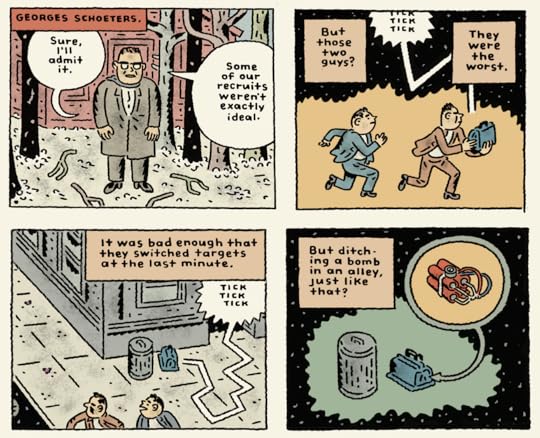
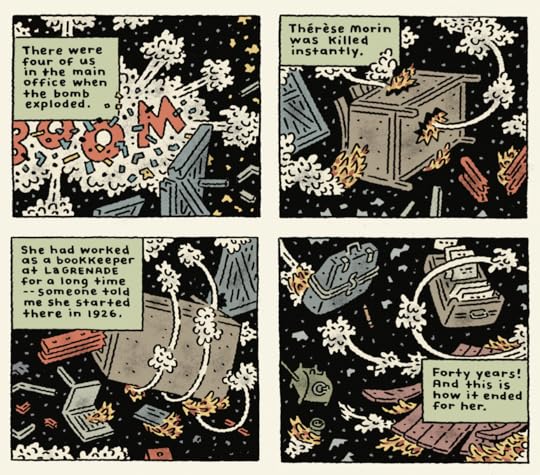
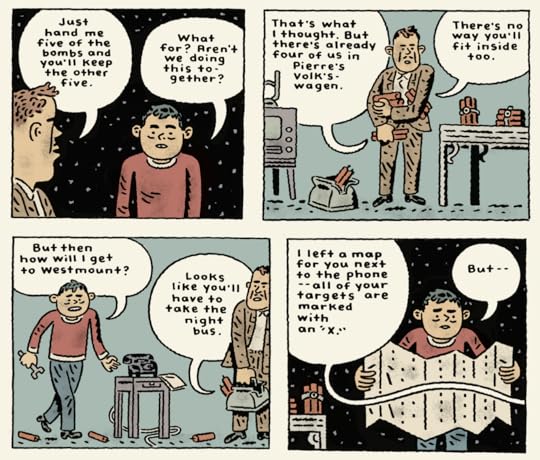
Oliveros leaves the October Crisis for a later volume, and wisely makes the decision to go deeper into the history of the FLQ, exploring figures from the early years of their campaign of bombings and revolutionary violence such as Georges Schoeters, François Schirm, and Pierre Vallières. The narrative situates the rise of separatism in Québec within the global context of the 1960s, including a fleeting (and perhaps fantastical) cameo by Fidel Castro. In Oliveros's telling the founders and early leaders of the FLQ largely come across as comically bumbling and foolish, which is emphasized by the author's extraordinarily precise yet extremely expressive drawing style that renders lethal explosions and shootouts in a cartoony, almost goofy style, including outsized onomatopoeia such as "BOOM" and "BLAM BLAM."
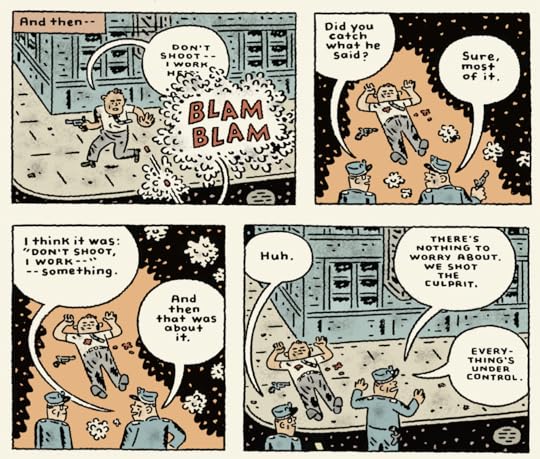
Oliveros never shys away from the very real human cost of the FLQ's actions (and, on occasion, the over-zealous reactions of the police, one of the saddest and most pertinent moments in the book is a scene in which the cops shoot down an innocent man in the street during a robbery gone wrong). Despite the FLQ's ostensible goal of jump-starting a revolution by destroying symbols of colonialism, from the start their campaign of bombings creates unintended victims, from a night watchman who comes across a bomb on the street at the wrong moment and Thérèse Morin, a bookkeeper who dies in an explosion in the offices of a shoe factory, to Jean Corbo, a young member of the FLQ who was blown up at the age of just 16. As the death count mounts, the reader is brought face-to-face with the very real human costs of a burgeoning revolution.
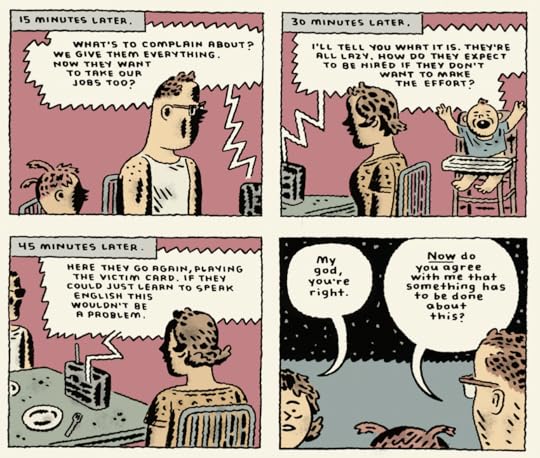
If Oliveros comes up short in this graphic novel, it perhaps in painting a picture of the sort of everyday oppression and casual prejudice that created the conditions for the rise of the FLQ and seperatist thought in the first place. There are scenes that make the generalized anti-francophone and anti-worker biases of big business (run almost entirely by anglophone bosses) clear, and an early moment where a revolutionary plays anglophone talk radio for his wife and she is overwhelmed by the blatant and virulent anti-francophone sentiments on display feels like a clear precursor to the increasing break down of social discourse we are living through today.
But the reader who only has a superficial familiarity with the period (such as myself) will definitely come away with the impression that the FLQ are "just a bunch of two-bit thugs" as Montréal mayor Jean Drapeau calls them in the opening chapter of this book (authority figures, and particularly the violent police force, come across almost as badly). "Are You Willing to Die for the Cause?" showcases the growth of the FLQ, but I'm not sure if the narrative does enough to describe the soil that it sprang from. Only in the thoughtful appendix does the reader get little tidbits of information such as the fact that in 1961 "francophones were earning barely half of their anglophone counterparts," or that "the signage in the centre of Montreal was only in English, de-spite the fact that the anglophone share of the Quebec population was just 13% at the time." These are bits of background information that would have been great to have had folded more directly into the story, but Oliveros is tackling a very big and convoluted period of history in this ambitious book, so his decision to include this information in the paratext of the graphic novel is certainly understandable. Like Alan Moore and Eddie Campbell's "From Hell," this is a dense graphic narrative that demands that the reader make the additional effort to carefully read through the notes, which shed light on the overall context of the era and the creative licence that Oliveros applied to the history to make the story flow smoothly across the pages.
What can't be denied is that this graphic novel clearly situates Oliveros as a major cartooning talent. Every element of this book is meticulously and precisely marshalled for maximum effect, from the cartoony character designs and often hilarious dialogue to Oliveros' inhumanly precise hand-lettering. After many years of running the publisher Drawn & Quarterly, Oliveros has retired and is now focused on his personal creative work. "Are You Ready to Die for the Cause?" is the work of an artist who has processed decades worth of cartooning and publishing history and come out with a wholly unique voice. I didn't know what to expect from Oliveros as a creator and this book left me deeply impressed... He is an author in control of every aspect of his art, and I honestly don't think it is any exaggeration to say that Oliveros claims a place in the pantheon of other intensely precise creators such as Seth, Chester Brown, and Chris Ware.
Overall this is a wonderful, impressive, and educational book that is never less than a page-turner. Oliveros keeps the narrative building and the tensions high all the way to the end, where the police find letters from the FLQ that detail plans to kidnap government officials. The cops laugh it off, "As if they could pull any of it off!" But the reader knows that another dark twist remains in this tale, and that the October Crisis is looming. I for one can't wait to read Oliveros' take on that chapter of Québec history.
Album intéressant qui retourne aux origines du mouvement révolutionnaire au Québec et du FLQ, regroupant les portraits et initiatives autour de trois figures : Georges Schoeters, François Schirm et Pierre Vallières. Le procédé narratif est intéressant : il part d’enregistrements oubliés d’un documentaire qu’aurait produit la CBC, dans lequel les principales personnalités associées au FLQ et à la crise d’Octobre étaient interviewées. Bien qu’il s’agisse d’une mise en scène fictive (ce documentaire n’a jamais existé), ça permet de donner un élan à la narration. La recherche historique qui soutient cet album est aussi impressionnante. Toutes les précisions, notes et références à la fin du livre donnent une profondeur supplémentaire au récit. J’ai toutefois trouvé que les personnages eux-mêmes manquaient de détail et de finition. On les présente surtout comme des gens un peu simplets, aux personnalités fortes, mais qui manquent de nuances et de profondeur. On passe ainsi à côté de la dimension intellectuelle du mouvement, mais cela est peut-être induit par les limites du format. Ça demeure une belle illustration de l’usage d’un médium différent pour aborder et transmettre l’histoire.
Une excellente bd documentaire sur les premières années du Front de libération du Québec, mouvement terroriste créé dans les années 1960 et surtout actif dans la région de Montréal. Dans Mourir pour la cause, Chris Oliveros présente les premières années du mouvement clandestin, en expliquant comment se faisait le recrutement et qui furent les leaders des différentes vagues du FLQ. À la lecture de ce recueil de bandes dessinées, présenté comme un documentaire fictif de la CBC, on se rend compte de la fragilité des bases de ce mouvement créé afin de défendre les ouvrier francophones et de s’opposer au patronat anglais.
J’ai beaucoup aimé la lecture de ce livre de Chris Oliveros, connu également comme étant le fondateur de l’excellente maison d’éditions Drawn and Quaterly. Comme Mourir pour la cause s’arrête avant la crise d’Octobre de 1970, j’ai déjà hâte à un deuxième tome! Bravo à Chris Oliveros pour l’immense travail de recherche et bravo également à Luc Bossé et aux Éditions Pow Pow pour ce tour de force.
Excerpts from this fine work of graphic history by D&Q founder Oliveros appear in this blog page on the Drawn & Quarterly publishing website, here: https://drawnandquarterly.com/news/ar... May 2005: I finally read the whole book this week, and it makes huge sense, opening a window into a rarely discussed set of violent protests in our neighbors to the north. Oliveros uses voices of different narrators involved, and cites each incident from the history, includes a bibliography, and promises a second volume with the stuff I might remember (but mostly don't) from around 1970. Oliveros cartooning art style is serviceable, and does justice to this set of stories. After reading Drawn & Quarterly since its inception as a quarterly magazine, I am pleased to recommend this book whole-heartedly. Thanks to Woodruff Library at Emory University for the loan.
I don't always know what to make of graphic media that include thorough endnotes. From Hell, one of the greatest achievements of the comic medium written, has pages and pages of endnotes in which Alan Moore elaborates on the crackpot theories that the story is based on, as well as diving further into the psychogeography that constructs the story. It makes the reading a long, drawn out process, but it enriches the story to an incredible degree. Here, I appreciate that Oliveros always makes sure to note when he has taken creative liberties with the facts and to provide his sources for every event and scene. It does, unfortunately, make for a pretty disjointed reading experience, especially when just about every panel has some form of elaboration. Flipping back and forth made it difficult to feel any sense of continuity in the story. Of course, nobody (except for my own neuroses) was forcing me to read all the endnotes, so I certainly don't hold this against the book.
The contents of this book are a tremendously interesting story. Oliveros depicts successive leaders of the FLQ who lack anything in the way of logistical management, repeatedly make rash and morally compromising decisions, and seem more invested in personal glory (through martyrdom if necessary) than the plight of the francophone Quebecois who they ostensibly fight for. Unfortunately, there is little in the way of visual differentiation between most of the characters, which made each leader of the FLQ all morph into a single monolith. Their biographical details were different, but they were each so similarly incompetent and indifferent to the suffering they might cause that the small differences in how they were drawn were not nearly enough to make them each into their own person. There might be a narrative message here, but for what is broadly a work of history, I think that has to count as a mark against the book.
There is much to like about this book though. The art style reflected the immature approach that the FLQ took to glorious revolution. The format of a cancelled CBC documentary was an intelligent and appropriate way to structure the narrative. There's one sequence of panels near the end that were exceptionally well constructed--the ones that detail the botched bombing that killed 17 year old Jean Corbo. The build-up shows how FLQ leadership sought idealistic teenagers to do the dangerous dirty work for them while they hid in the wings. Rather than showing the bombing being carried out, as he had before, Oliveros depicts the whole affair from the co-conspirator's perspective, showing him realizing that the bomb went off prematurely, fleeing the scene to warn the rest of the FLQ at their compound, frantically seeking updates from the news, and finally, in the finest panel of the whole book, hearing from the radio a graphic description of what happened to Jean Corbo when the bomb exploded. There is substantial emotional weight to this scene, as other members of the FLQ realize that they sent a teenager to his death--horrific, regardless of how competent and self-possessed he seemed.
I eagerly await the second volume that will detail the October crisis!
Are You Willing to Die for the Cause? Revolution in 1960s Quebec is book one (which I didn't know going in) of a two-part, long-term labour of love by the founder of Montreal publisher Drawn & Quarterly. I guess I would classify it as creative non-fiction, as Oliveros makes up a narrative structure featuring a fictional lost CBC documentary (though he later found out that a similar real lost CBC documentary did exist), changes people's names, and takes a few other creative liberties. The book focuses on the FLQ (Front de libération du Québec), but only on three key members and periods of the group. That said, he also includes an extensive appendix explaining his decisions, summarizing other historical tidbits, elaborating on various plot points, and noting the various sources consulted for this eight-year historical project.
Oliveros tells a great historical tale, and his writing and artistry manage to be serious and a bit funny at the same time. The FLQ comes across as strange, clumsy, fractured, and a reactionary product of oppression combined with new revolutionary ideals thanks to, ironically, the Quebec Liberal Party weakening the Catholic Church and trying to equalize and normalize the linguistic-financial divide to an extent. The fact that the FLQ was started by recent immigrants who were more aggressively-patriotic than native Québecois may seem strange until you consider historical figures like Hitler and Stalin, neither of whom belonged to the racial or national group they championed and ruled (Hitler was Austrian and Stalin Georgian), but I digress. I look forward to book two, though I'm disappointed I have to wait for it.
A fascinating look at a turbulent and controversial moment in Québec history, this meticulously researched non-fiction graphic novel from author Chris Oliveros (the founder of comics publisher Drawn & Quarterly) takes a deep dive into the early years of the Québec Liberation Front (FLQ). Taking the form of archival interviews with former members of the FLQ, government officials, journalists, and other witness to the events (in the notes following the narrative Oliveros makes it clear that these interviews did not actually exist, but that the information in them was based on many sources, an authorial sleight-of-hand that makes for a great narrative but may raise eyebrows, mine included), "Are You Willing to Die for the Cause?" chronicles the rise of separatist actions in Québec during the early 1960s, which might surprise many readers; if you know anything about the FLQ it will be the infamous "October Crisis" in 1970, where a series of high-profile kidnappings of government officials eventually saw soldiers marching in the streets of Montréal and civil liberties suspended by Prime Minister Pierre Trudeau.
Oliveros leaves the October Crisis for a later volume, and wisely makes the decision to go deeper into the history of the FLQ, exploring figures from the early years of their campaign of bombings and revolutionary violence such as Georges Schoeters, François Schirm, and Pierre Vallières. The narrative situates the rise of separatism in Québec within the global context of the 1960s, including a fleeting (and perhaps fantastical) cameo by Fidel Castro. In Oliveros's telling the founders and early leaders of the FLQ largely come across as comically bumbling and foolish, which is emphasized by the author's extraordinarily precise yet extremely expressive drawing style that renders lethal explosions and shootouts in a cartoony, almost goofy style, including outsized onomatopoeia such as "BOOM" and "BLAM BLAM."
Oliveros never shys away from the very real human cost of the FLQ's actions (and, on occasion, the over-zealous reactions of the police, one of the saddest and most pertinent moments in the book is a scene in which the cops shoot down an innocent man in the street during a robbery gone wrong). Despite the FLQ's ostensible goal of jump-starting a revolution by destroying symbols of colonialism, from the start their campaign of bombings creates unintended victims, from a night watchman who comes across a bomb on the street at the wrong moment and Thérèse Morin, a bookkeeper who dies in an explosion in the offices of a shoe factory, to Jean Corbo, a young member of the FLQ who was blown up at the age of just 16. As the death count mounts, the reader is brought face-to-face with the very real human costs of a burgeoning revolution.
If Oliveros comes up short in this graphic novel, it perhaps in painting a picture of the sort of everyday oppression and casual prejudice that create the conditions for the rise of the FLQ and seperatist thought in the first place. There are scenes that make the generalized anti-francophone and anti-worker biases of big business (run almost entirely by anglophone bosses) clear, and an early moment where a revolutionary plays anglophone talk radio for his wife and she is overwhelmed by the blatant and virulent anti-francophone sentiments on display feels like a clear precursor to the increasing break down of social discourse we are living through today.
But the reader who only has a superficial familiarity with the period (such as myself) will definitely come away with the impression that the FLQ are "just a bunch of two-bit thugs" as Montréal mayor Jean Drapeau calls them in the opening chapter of this book (authority figures, and particularly the violent police force, come across almost as badly). "Are You Willing to Die for the Cause?" showcases the growth of the FLQ, but I'm not sure if the narrative does enough to describe the soil that it sprang from. Only in the thoughtful appendix does the reader get little tidbits of information such as the fact that in 1961 "francophones were earning barely half of their anglophone counterparts," or that "the signage in the centre of Montreal was only in English, de-spite the fact that the anglophone share of the Quebec population was just 13% at the time." These are bits of background information that would have been great to have had folded more directly into the story, but Oliveros is tackling a very big and convoluted period of history in this ambitious book, so his decision to include this information in the paratext of the graphic novel is certainly understandable. Like Alan Moore and Eddie Campbell's "From Hell," this is a dense graphic narrative that demands that the reader make the additional effort to carefully read through the notes, which shed light on the overall context of the era and the creative licence that Oliveros applied to the history to make the story flow smoothly across the pages.
What can't be denied is that this graphic novel clearly situates Oliveros as a major cartooning talent. Every element of this book is meticulously and precisely marshalled for maximum effect, from the cartoony character designs and often hilarious dialogue to Oliveros' inhumanely precise hand-lettering. After many years of running the publisher Drawn & Quarterly, Oliveros has retired and is now focused on his personal creative work. "Are You Ready to Die for the Cause?" is the work of an artist who has processed decades worth of cartooning and publishing history and come out with a wholly unique voice. I didn't know what to expect from Oliveros as a creator and this book left me deeply impressed... He is an author in control of every aspect of his art, and I honestly don't think it is any exaggeration to say that Oliveros claims a place in the pantheon of other intensely precise creators such as Seth, Chester Brown, and Chris Ware.
Overall this is a wonderful, impressive, and educational book that is never less than a page-turner. Oliveros keeps the narrative building and the tensions high all the way to the end, where the police find letters from the FLQ that detail plans to kidnap government officials. The cops laugh it off, "As if they could pull any of it off!" But the reader knows that another dark twist remains in this tale, and that the October Crisis is looming. I for one can't wait to read Oliveros' take on that chapter of Québec history.
I seldom read graphic novels, but I downloaded an electronic copy when I saw this listed on several trusted sites as one of the best Canadian books of 2023. After reading it, I ordered the hardback version as a gift. This is the first book in a two-part series. It is informative, dramatic, and with a touch of humour.
Having recently moved to Quebec to be near my bilingual son and his French wife, I was interested in reading about the beginning of the FLQ (Front de Liberation du Quebec). It started by demanding equal rights for French citizens in the workplace but developed the goal of ridding Quebec of English oppression by violent revolution. This deals with the difficulty of forming a militant separatist group and recruiting what soon came to be labelled terrorists. At its beginning in the early 1960s, there was a lot of bungling, poor preparation, and a lack of suitable recruits for the cause.
Being unable to speak or understand the language and read French has presented problems for me, but people are very kind. I had a summer job here before the formation of the FLQ, and English was dominant, although the French were in the majority. Significant changes have occurred.
Chris Oliveros is now writing and illustrating a second book about the October Crisis, the time the FLQ gained national attention due to a couple of prominent kidnappings and increased recruitment and terror, and how their threat ended after a decade. I will be awaiting the publication of the sequel.
Mourir pour la cause nous plonge dans les années 60 au Québec en plein coeur de la Révolution tranquille.
Son auteur, Chris Oliveros, est le fondateur de Drawn & Quarterly. Il aime tellement le monde de la BD qu’il a décidé depuis 2015 de faire ses propres oeuvres. Dans cette première oeuvre, nous suivons au cours de trois chapitres, trois évènements incluant trois personnages majeurs de cette période relativement violente dans l’Histoire du Québec qui ont permis de transitionner d’une société francophone opprimée par la population anglophone à une société où les francophones ont su acquérir plus de pouvoir pour préserver leur culture et devenir plus souverain.
On suit l’histoire sous un angle faussement journalistique avec en guise d’introduction le début d’un (faux) documentaire de Radio-Canada et différentes interviews qui rythment le récit. Cependant, l’aspect journalistique de cette oeuvre est bien réel ! En effet, tout ce qui est dessiné et raconté est documenté dans les notes à la fin du livre qui sont également très très complémentaire. J’ai trouvé le tout vraiment passionnant, bien résumé, et permet de découvrir des détails peu connus du grand public.
L’aspect graphique est plaisant. C’est très académique d’une certaine façon, avec plein de couleurs pastel. Le style de dessin rend l’ouvrage abordable au plus grand nombre.
Un ouvrage qui se lit assez rapidement et qui permet de couvrir des évènement de l’histoire du Québec trop oubliés.
Écrire sur le FLQ en 2023, c'est courageux. Oliveros montre bien que le récit des forces policières vient en contradiction avec celui des militants, ainsi que des journaux sensationnalistes, et incite ainsi à nous faire notre propre compréhension des faits, de la perception de ceux-ci par les différents points de vue. Ce n'est pas un parti pris pour l'un ou l'autre, comme ce à quoi je m'attendais en achetant le livre. C'est un devoir de mémoire, de remettre en perspective quels étaient les objectifs des militants, comment le fanatisme et le manque d'expérience a fait dérailler le mouvement hors de contrôle ou même d'être pris au sérieux. Que ce soit le fondateur de la très grande et réputée maison d'édition Drawn & Quarterly qui s'essaie à remettre les pièces aux bons endroits, ça fait franchement plaisir. Et de couper le récit en deux volumes, ça laisse respirer. En revanche, ça nous force à attendre le prochain volume! Pour la forme, c'est un peu convenu, mais c'est le contenu qui dirige la forme. Un style trop éclaté aurait peut-être fait de l'ombre au propos. Lu d'un trait, alors je suggère fortement la lecture!
Bande-dessinée qui dresse un portrait éloquent et nuancé de l'époque tumultueuse de la Révolution Tranquille, empreinte des dissidents de la FLQ. À travers un récit à la fois ludique et réfléchi, l’auteur explore les vagues felquistes des années 60, mettant en lumière des aspects souvent méconnus du mouvement, comme l’implication de combattants étrangers (un Belge et un Hongrois), l’influence de la révolution cubaine sur la guérilla québécoise et la moyenne d'âge des combattants de 20 ans. Chris Oliveiros sait raconter avec brio l'histoire des tentatives révolutionnaires souvent (accidentellement) mortelles, de la FLQ précédant la crise d'octobre.
J'y accorde toutefois 4 étoiles plutôt que 5, car, malgré sa richesse, l’ouvrage souffre parfois d’un rythme un peu inégal, notamment à cause de scènes peu diversifiées. Une plus grande variété dans la mise en scène et les situations auraient pu dynamiser davantage l’ensemble.
En dépit de ces réserves, belle lecture pour les amateurs de bande-dessinées, d'histoire et de politique !
Chris Oliveros's "Are You Willing to Die for the Cause?" is an incredible comic covering the early rise of the Front de libération du Québec (or in English, the Quebec Liberation Front). I knew only very little about this history (maybe only from discussions surround the film Mesrine (2008 film)) and was blown away by the detail and historical reach of Olivero's research. I actually was hoodwinked into believing that the narration device-that the story is taken from a documentary that had been long lost-was real!! I thought maybe it was like the footage that was discovered that was then turned into "The Black Power Mixtape" and "Concerning Violence" documentaries.
In any case, Oliveros does an amazing job of drawing a compelling comic story and history of a revolutionary group and time that I knew very little about. I'm a bit curious of the authors perspective and analysis of the group and politics more general, but perhaps that will emerge in the follow up book. I hope that more political comic books like this emerge.
This was super interesting! I love history, so when I found this at my library, I was really into it. Turns out I know a lot less Quebec (and Canadian) history than I thought I did.
As someone who's lived in MTL, I never realized how much it's changed. It's kind of funny that the time period of this book the French Canadians felt the way I did while living there, there's been a complete reversal in terms of language priority in the province that I never would have known without this book, and it makes me appreciate Quebec a bit more.
Regardless of my personal ideas, this would be an excellent teaching tool. It's in a format that accessible to kids and adults, nothing is too graphic while also being VERY clear about what was going on, and it's all based on factual information. There's even details in the back about each person, events and the FLQ for people who want to know more.
Anyways, if you like history, read it. I'm just disappointed that the next one about the October Crisis doesn't exist yet.
maybe 2.5. i'm a huge fan of graphic novels but i actually don't think this format was the best way to represent this story -- or more that i don't think oliveros used it in the right way. eg. the art was too simplistic that i don't think it really added anything to the delivery of the information. still hard to tell apart characters (honestly probably more so than normal written fiction), there were just these massive blocks of text. i don't get why the choice of graphic novel for it to be done like this. also i don't think this book dove enough into it's titular question and the themes/morals that come out of revolution, particularly the FLQ. i couldn't really tell how non-fiction this was trying to be. how faithful to real sources is it? hard to tell. however the endnotes at the end of the book were lovely so i have to give kudos to that. i don't know that i learned as much as i thought i was going to coming into this. and i don't know how seriously it treated the subject matter at hand.