Jump to ratings and reviews
Rate this book

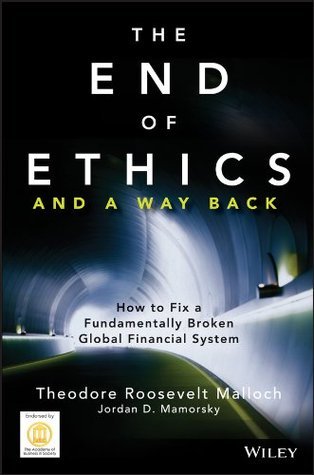
The End of Ethics and A Way Back: How To Fix A Fundamentally Broken Global Financial System

Rate this book

Bestselling author and professor Ted Malloch calls for real financial reform to restore confidence and fairness to a broken system

From Ponzi schemes to the credit crisis to the real estate bubble, the financial industry seems to have lost its way on the road to riches. As private greed continues to undermine the public good, one might wonder what ever happened to business ethics. And how can we reform the global financial system to benefit everyone, rather than just the very lucky few? In The End of Ethics and the Way Back, the bestselling author of Doing Virtuous Business teams up with attorney and Yale University Postdoctoral Fellow, Jordan Mamorsky to examine the most recent failures of business virtue, prudence, and governance—from Bernie Madoff to Jon Corzine and MF Global—before offering a set of structural and holistic solutions for our current ethical crisis in global finance.

Features compelling case studies that reveal the saturation of economic vice in global finance Suggests structural reforms to the global financial system that would increase confidence among consumers and encourage ethical behavior among finance professionals Written by Ted Malloch, author of the bestseller Doing Virtuous Business with attorney Jordan Mamorsky Ideal for financial regulators, business students and academics, and professionals in the finance industry

309 pages, Kindle Edition

First published February 22, 2013

3 people are currently reading
17 people want to read

About the author

Theodore Roosevelt Malloch

25 books8 followers

Ratings & Reviews

What do you think?
Rate this book

Friends & Following

Create a free account to discover what your friends think of this book!

Community Reviews

5 stars
3 (42%)
4 stars
2 (28%)
3 stars
0 (0%)
2 stars
0 (0%)
1 star
2 (28%)
Displaying 1 of 1 review
Profile Image for Rama Rao.
835 reviews145 followers
February 2, 2014
An ethical approach to the tackling of current economic crisis

This is a mesmerizing tale about a failed financial system where corporate greed dominates the accepted norms of the society. Accountability, oversight, and the overall decline in the ethical values led to the fall of the global economic empire in 2008. The authors, scholars from Yale University, are successful in convincing the readers that a wholesome human value that calls for ethics and not mere compliance is the key in solving the current financial crisis.

The first part of the book describes as how this crisis started with heavy-handedness of the financial giants like Bernie Madoff, John Corzini's MF Global and Tyco's Ponzi schemes. In the second half of the book, the author's propose a solution to fix the deep-rooted problems of the corporate world; restructuring SEC, and devise new rules that would prevent off-balance sheet risks, better oversight of commodity markets and stronger standard for corporate governance.

There are many interesting accounts of corporate mismanagement in this book. An hour by hour account, as how over a weakened, the stock value of the giant Bear Stearns dropped from $30 per share to $2, when it was bought by JP Morgan. Few months later, the collapse of Lehman brothers, Merrill Lynch, Washington Mutual, and AIG was hastened. The short-term creditors of Wall Street decided to back off for an overnight loan since the collateral offered, mortgage backed securities, had significant risks. This crisis also revealed the monstrosity of corporate compensation system. The executives were rewarded handsomely for risking the lives of investors, and retirees. The bankers, who participated in highly immoral and unethical business of packaging toxic mortgages into securities, and selling them to unsuspecting investors, were paid generous bonuses. The irony of the whole game was that bankers should not have made those mortgages to home buyers who did not have the means to pay it back.

After pumping trillions of dollars into the Wall Street banks through bailouts and Federal Reserve's monetary easing at the expense of tax payers, we would expect everything would be "cool" with the financial system. But we are wrong to assume that, says the authors. As recently as the spring of 2012, an executive of JP Morgan lost $6 billion in a risky debt index. In late 2011, MF Global filed for bankruptcy protection and liquidated. The company could not account for $1.6 billion that disappeared mysteriously days before the liquidation.

Dennis Kelleher, president and CEO of Better Markets Inc., during a conference on Sep 12, 2013, in Washington, D.C called the federal bailouts "crazy." Fed Chair Ben Bernanke and Bank of England head Mark Carney have said that our banks are too big to fail. But they have grown even bigger since 2008 and too interconnected with the economy. Corporate boardrooms filled with greed can make this elephant fall and the economic chaos will ensue all over again. University of Vermont Law School professor, Jennifer Taub is concerned that giant firms are permitted to borrow excessively, up to $97 for every $100 in assets they own. In addition to the size and leverage, banks are still dangerously interconnected and prone to wholesale runs due to their excessive dependence on short-term, often overnight lending. She suggests that restrictions on short-term funding throughout the system are essential. Columbia University professor, John Coffee observes that the financial services lobby is most powerful interest group in the United States and doing everything possible to slow down the pace of change in the financial system. Lobbyists have prevented regulatory action to support financial stability by influencing Congress, which oversees federal agencies like SEC.

It is time that Congress, and the Wall Street executives show leadership and accountability. Their decision must be prudent and they stop gambling with investors' money.

Displaying 1 of 1 review

Can't find what you're looking for?

Get help and learn more about the design.