Before I begin this review, I want to thank Net Galley and Deadbolt Books for allowing me to access On the Threshold by M. Laszlo. The expected publication date is February 14, 2024, so check it when it is released!
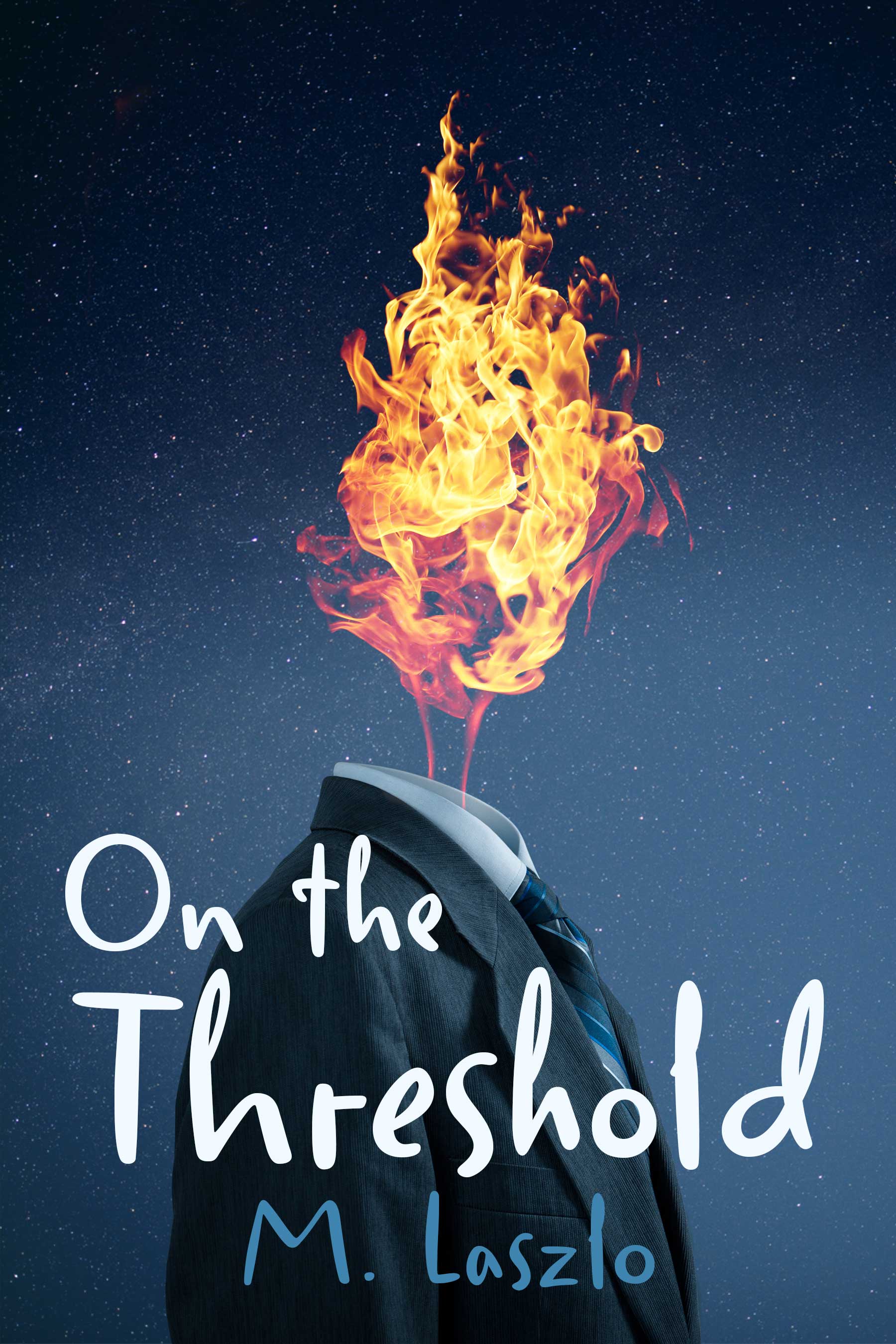
Laszlo made an intriguing story of a mad scientist who goes too far when he creates the burning man—keen on manipulating and killing innocent people. While Laszlo has a writing style that perfectly sets up the setting and allows readers to delve deep into the characters' minds and their worlds, there are times when the story falls flat or is just too hard to read.
While I never got fully invested in the book and its characters, I still thought that the world and the character's endeavors were compelling and intriguing enough to keep me reading and pushing through.
The characters aren't bad, but they feel distant, making them feel flat and underdeveloped. However, they are still eccentric enough to make you want to learn more about them.
Fingal is a Scottish man who is obsessed with Plato's beliefs revolving around innate knowledge. He goes so far as to create another version of himself that manifests as a burning man. While Fingal is fun to read about, there were times when it was too difficult to completely understand his perspective or even the 'why' behind his actions.
Jean is another prominent character. She is an American woman who loves film. Honestly, I didn't care much for Jean, but I enjoyed seeing how she contrasted with other characters.
The most memorable character was Fraulein Wunderwaffe, a German girl who believed she would one day transform into a leopard. Fingal thought so much about this girl throughout the book that I thought eventually her character would come around again, and it would be a full circle moment, but that wasn't the case, which really was sort of a letdown.
As for the book's plot, it is essentially Fingal trying to capture the burning man and return him to where he belongs. There is constant talk throughout the book about how dangerous the burning man is. There is even a point in the story where the burning man supposedly convinced a man to light himself on fire. This part helps set up the dangers of the burning man, but as the story continues, the burning man starts to feel less dangerous and not that significant to the story as a whole.
Laszlo did a fantastic job setting up the story and detailing the settings through imagery, character dialect, and evidence of the passage of time. The setting varies throughout the story. The book starts in 1907 in Scotland and ends in 1967 in California. The way Laszlo presents the setting is my favorite part of the story. Readers really get a sense of Scotland through how Fingal speaks and thinks. Jean and the other characters really help show this contrast throughout the story. This is especially evident when reading about teenagers in California during the 1960s. Their dialects are different, so the environment and characters' actions feel different.
M. Laszlo uses character dialogue, language, and scenery to capture the setting and culture in which his characters are from or where they live. His writing captures the viewpoints and dialogue of each character exceptionally well. It doesn't take much to know who spoke or whose perspective a chapter is in! Even as the periods shift, seeing how an old southern American like Jean compares to a teenager from California in the sixties is interesting. With these things said, the writing is redundant. The story is also hard to follow because of the flowery language. But some of these things may have been on purpose, considering the story's era.
Overall, the writing style and setting of the book are impeccable in that Laszlo did a great job of establishing the characters, settings, and cultural differences in the book. The plot and characters felt underdeveloped, and the flowery language used throughout the book is not for everyone. I recommend this book to anyone who loves historical fiction, especially one involving science.
This review will be posted on my blog on Friday, December 22, 2023.