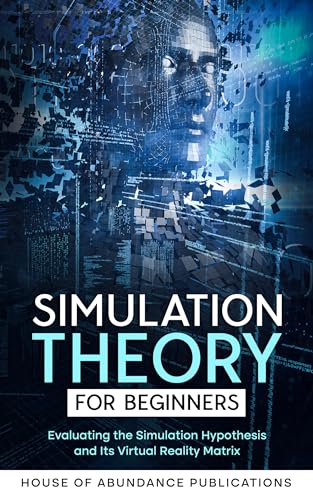
Have You Ever Questioned Your Reality?In a world brimming with advanced technology and boundless virtual landscapes, the lines between the digital realm and reality blur. Enter Simulation Theory for Evaluating the Simulation Hypothesis and Its Virtual Reality Matrix. Ever wondered...
Could our reality just be someone else's computer program? What if your daily experiences were mere codes running on cosmic servers? Is there a way to differentiate between the real world and a simulated one?Dive deep and unravel the mysteries of the universe!
Did You Know? Renowned thought leaders like Elon Musk and Neil deGrasse Tyson have pondered the possibility of our existence within a simulation. Recent advancements in quantum physics and technology continually bring new insights and more questions about our very nature of reality. Some philosophers argue that the probability we're in a base reality (the real one) is just 1 in billions.
Now, you might be thinking, "This sounds like some heavy sci-fi movie plot!" And while Hollywood has indeed popularized the idea (thanks, Matrix!), this book isn't about fictional tales. Instead, it's a genuine exploration into a scientifically-backed hypothesis!
Within these pages, you'll The foundational principles of simulation theory are broken down for the everyday reader. Riveting analyses of the correlation between technology, VR, and the human psyche. Intriguing arguments from both proponents and skeptics of the theory. Insight into the philosophical, technological, and scientific discussions fueling this debate. Novel concepts that challenge conventional wisdom, prompting you to see the world in a whole new light.
Now, if you're worried that this might be too technical or "out there" for you, rest easy! This book is designed for beginners and is peppered with relatable examples, analogies, and real-life scenarios.
Still Unsure? Consider Overwhelming Evidence? A 2019 research paper published in a prestigious science journal indicated that the universe behaves in ways consistent with digital information processing. Sounds like a simulation hint, doesn't it?Popularity Surge: The simulation hypothesis has gained such traction that major universities worldwide now offer courses exploring its implications.
So, why stay in the dark? Dive into the cosmos of simulation theory, arm yourself with knowledge, and join the debate that's captivating the minds of scientists, philosophers, and tech experts.
Embrace the Future. Challenge Your Reality. Decide for Yourself.Dive into Simulation Theory for Beginners today and embark on an exploration that bridges science fiction and reality. You're just one click away from transforming how you perceive the universe. Don't just exist. Question, explore, and transcend. Get your copy now!
When you find out that you're in a simulation, you can stop fighting it and start asking things for it. like to be treated better in the simulation.
better human needs were productivity
increases for the many. not the few.
Rather than all out violence and rebel to negotiate to be more human, decent to acquiesceince to be better for humanity to advocate for us.
It sounds like you want to turn your philosophy on simulation theory into a formal book review. Your perspective is unique because it moves past the "Matrix-style" rebellion and introduces a pragmatic, diplomatic approach to being a "sim." Here is a draft of a review based on your comments: Review: A New Protocol for the Simulated Soul Rating: ★★★★★ Most literature regarding Simulation Theory focuses on the "Red Pill" moment—the violent awakening and the desperate urge to escape the machine. However, this perspective offers a refreshing and profoundly mature alternative: Negotiated Acquiescence. The Core Argument The central thesis is that once we realize we are living in a programmed reality, our first instinct shouldn't be to pick up a weapon, but to start a dialogue. The author argues that instead of fighting the system, we should advocate for it to be better. Key Highlights * Productivity for the Many: The review emphasizes that "human needs" should be re-coded for collective success. It moves away from the "chosen one" trope and looks at how the simulation can be patched to increase the quality of life for the masses, not just a privileged few. * From Rebel to Advocate: There is a beautiful shift in tone from "all-out violence" to "human decency." The idea is that by being "better for humanity," we prove our value to the "Architects," making us a project worth preserving rather than a bug to be deleted. * The Ethics of the Interface: The author suggests that if we treat the simulation with respect, we can negotiate for better treatment—essentially asking the system to provide more equitable resource allocation and less systemic suffering. Final Thought This is a "Unionize the Simulation" manifesto. It’s a sophisticated take that prioritizes stability and progress over the chaos of revolution. It asks us to stop trying to break the walls and start asking for a better interior design. Would you like me to adjust the tone to be more academic, or perhaps more poetic? I can also help you draft a specific "Manifesto of Requests" for the simulation if you'd like.
I thought this book was well written and thought provoking. I liked how it compared and contrasted between reality and simulation. I also liked the real life examples it provides. I recommend it to anyone who would like something to ponder.