

What do you think?
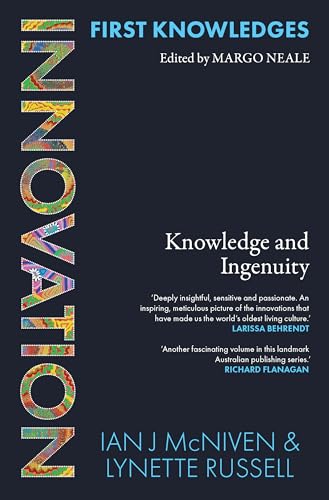
First Knowledges Innovation: Knowledge and Ingenuity
Deeply insightful, sensitive and passionate. An inspiring, meticulous picture of the innovations that have made us the world's oldest living culture.' - Larissa Behrendt'Another fascinating volume in this landmark Australian publishing series.' - Richard FlanaganWhat do you need to know to prosper as a people for at least 65,000 years? The First Knowledges series provides a deeper understanding of the expertise and ingenuity of Indigenous Australians.First Nations Australians are some of the oldest innovators in the world. Original developments in social and religious activities, trading strategies, technology and land-management are underpinned by philosophies that strengthen sustainability of Country and continue to be utilised Knowledge and Ingenuity reveals novel and creative practices such body shaping; cremation; sea hunting with the help of suckerfish; building artificial reefs for oyster farms; repurposing glass from Europeans into spearheads; economic responses to colonisation; and a Voice to Parliament.In the first book to detail Indigenous innovations in Australia, Ian J McNiven and Lynette Russell showcase this legacy of First Nations peoples and how they offer resourceful ways of dealing with contemporary challenges that can benefit us all.*Ebook available through all major etailers*
271 pages, Kindle Edition
Published October 31, 2023
Ratings & Reviews
Friends & Following
Create a free account to discover what your friends think of this book!
Community Reviews
Displaying 1 - 4 of 4 reviews

October 12, 2024
a quicker read than the rest of the series - much less about broader concepts and instead focussing on specific examples if that makes sense. still so interesting to read though! my one complaint would be that i wish there had been more pictures/diagrams of the innovations described/some sections were very brief (e.g., images of eel trapping systems, expanding on fashion)
something that really stood out was just how old the cultures are that we have here in so-called australia (of course i already knew this but the book really reinforced it!) and how much i just take this for granted without fully appreciating it (e.g., oldest known cemetery in the world (kow swamp), cremation, tooth avulsion - but also all the meaning imbued in places across the country, so much knowledge etc) - so much history and knowledge and culture i want to learn about and appreciate more
rethinking/reframing concepts and biases
as with the rest of the series, this book still challenged me to rethink/reframe certain concepts:
- recognising that these are biases i was taught growing up and still hold unconsciously, especially for those still living on country - regarding indigenous people/culture being ‘stuck in the past’ and unchanging - and before reading this series, i’d never thought how such views are linked to notions that dehumanise indigenous peoples, view them as ‘primitive’ and ‘lesser’ etc - important for me to keep unpacking and challenging these notions (for example, this section of one of the authors describing an elder who lived on country with no electricity/refrigeration stood out to me: “while others might have seen poverty, i saw dignity. he lived this way until shortly before he died, on the country he loved and where he belonged”)
- importance of language e.g., ‘traditional’ frames modern indigenous culture as lesser or inauthentic in comparison
- hadn’t heard of diffusionism before and how this was used to dismiss indigenous innovation (belief that any developments/changes to indigenous culture were because of external/overseas influences)
- the importance of recognising the agency and autonomy in choosing to engage with/exploit western systems for their own benefit (money, maintaining connection to country) - whilst of course recognising the violence/harms/exploitation of indigenous communities/peoples who did engage with these systems, and that engagement with such systems wasn’t always necessarily a choice etc - such a nuanced discussion
- begging can be reframed “requesting compensation” - “reciprocal trade” for the impacts of colonisation
- “aboriginal culture was not destroyed - rather, its infrastructure was extended”
- the influence of religion on culture was so interesting - how not only christianity, but also islam, has been incorporated. idk how i feel about viewing the incorporation of christianity as something that was co-opted/integrated rather than something destructive - on one hand, of course important to respect current practice and autonomy/agency, but it is difficult to ignore the ways this was also likely assimilation, not fully a choice etc (as with the other practices i discussed above). but the authors didnt go into this enough for me to gain more insight/develop a more informed opinion…. would certainly be interested in getting more of an understanding in how this happens/impacts culture etc today - found the example of donkeys being incorporated because of their links with jesus riding one was interesting!
- “it is impossible to recover in totality a pre-invasion aboriginality… it is vital to recovery traditional [culture] but doing so invariably must involve the use of ‘post-invasion’ resources and technology…. aboriginal inidgeneity is… forever entwined, both for good and for ill, with the fact of coloniality”
other things i found interesting
- learning more about theories regarding how first nations people came to australia was interesting - i didn’t know anything about that - and interesting to learn how it would have been very intentional and planned sea voyages etc
- rock-art imagery as displays of indigenous sovereignty - depicting europeans as invaders
- head-binding - thought to be a pre-modern human species but more likely due to cultural practices of head-binding -> create more oblong-shaped heads
- trade was often about building/maintaining relationships, rather than survival - for example, trading the same item with a different group, making items from western materials to sell/trade with westerners rather than use themselves
- ghost net art - a way of reusing pollutants to highlight the impact on the environment
- fashion - as a “politically charged practice” and “avenue for promoting identity… an extension o culture”
- how awfully david unaipon was treated - such an incredibly intelligent man - yet we still have him on our money despite not having appropriate permission?? and so much of his work he didnt get credit for while he was alive
- cooperative fishing with turtles, dolphins, orcas etc - encouraging the orcas to lure whales to shore for them to eat by pretending to be unwell?? so interesting (and the respect given to animals despite hunting them)
- koori court - really want to learn more about this system, how effective it is etc.
- introduction of dingoes - i didn’t know they weren’t native to australia! and so many uses for them
- introduced/pest animals incorporated into the culture and this needs to be respected when managing the eradication of feral animals etc (e.g., horses as totems, donkeys, cats, and camel dreaming) - would be interesting to see what work/strategies are done to balance these
- use of technology to preserve culture - strengthening rights to their cultural and intellectual property, preservation of knowledge/history/culture, use of 3D animations etc (and how this is balanced with traditional cultural practices etc - tensions of this was briefly mentioned in other book and i wish we got more insight into how these tensions are considered and managed)
- balancing traditional hunting/consumption with biodiversity etc - in terms of the feral species above, but also in terms of ensuring hunting/consumption of species now listed as endangered etc is done sustainably
things i want to look into/learn more about
- indigenous seasonal calendars - i had never considered how the 4 seasons we use are suited to europe but not really the rest of the world - just one of many colonial imports we take for granted! want to look into naarms seasons. this info from csiro and short series on abc about the development of the calendars look really interesting also
- maree clarke: ancestral memories - ngv exhibit
- play: jack charles v the crown
- how the koori courts work
something that really stood out was just how old the cultures are that we have here in so-called australia (of course i already knew this but the book really reinforced it!) and how much i just take this for granted without fully appreciating it (e.g., oldest known cemetery in the world (kow swamp), cremation, tooth avulsion - but also all the meaning imbued in places across the country, so much knowledge etc) - so much history and knowledge and culture i want to learn about and appreciate more
rethinking/reframing concepts and biases
as with the rest of the series, this book still challenged me to rethink/reframe certain concepts:
- recognising that these are biases i was taught growing up and still hold unconsciously, especially for those still living on country - regarding indigenous people/culture being ‘stuck in the past’ and unchanging - and before reading this series, i’d never thought how such views are linked to notions that dehumanise indigenous peoples, view them as ‘primitive’ and ‘lesser’ etc - important for me to keep unpacking and challenging these notions (for example, this section of one of the authors describing an elder who lived on country with no electricity/refrigeration stood out to me: “while others might have seen poverty, i saw dignity. he lived this way until shortly before he died, on the country he loved and where he belonged”)
- importance of language e.g., ‘traditional’ frames modern indigenous culture as lesser or inauthentic in comparison
- hadn’t heard of diffusionism before and how this was used to dismiss indigenous innovation (belief that any developments/changes to indigenous culture were because of external/overseas influences)
- the importance of recognising the agency and autonomy in choosing to engage with/exploit western systems for their own benefit (money, maintaining connection to country) - whilst of course recognising the violence/harms/exploitation of indigenous communities/peoples who did engage with these systems, and that engagement with such systems wasn’t always necessarily a choice etc - such a nuanced discussion
- begging can be reframed “requesting compensation” - “reciprocal trade” for the impacts of colonisation
- “aboriginal culture was not destroyed - rather, its infrastructure was extended”
- the influence of religion on culture was so interesting - how not only christianity, but also islam, has been incorporated. idk how i feel about viewing the incorporation of christianity as something that was co-opted/integrated rather than something destructive - on one hand, of course important to respect current practice and autonomy/agency, but it is difficult to ignore the ways this was also likely assimilation, not fully a choice etc (as with the other practices i discussed above). but the authors didnt go into this enough for me to gain more insight/develop a more informed opinion…. would certainly be interested in getting more of an understanding in how this happens/impacts culture etc today - found the example of donkeys being incorporated because of their links with jesus riding one was interesting!
- “it is impossible to recover in totality a pre-invasion aboriginality… it is vital to recovery traditional [culture] but doing so invariably must involve the use of ‘post-invasion’ resources and technology…. aboriginal inidgeneity is… forever entwined, both for good and for ill, with the fact of coloniality”
other things i found interesting
- learning more about theories regarding how first nations people came to australia was interesting - i didn’t know anything about that - and interesting to learn how it would have been very intentional and planned sea voyages etc
- rock-art imagery as displays of indigenous sovereignty - depicting europeans as invaders
- head-binding - thought to be a pre-modern human species but more likely due to cultural practices of head-binding -> create more oblong-shaped heads
- trade was often about building/maintaining relationships, rather than survival - for example, trading the same item with a different group, making items from western materials to sell/trade with westerners rather than use themselves
- ghost net art - a way of reusing pollutants to highlight the impact on the environment
- fashion - as a “politically charged practice” and “avenue for promoting identity… an extension o culture”
- how awfully david unaipon was treated - such an incredibly intelligent man - yet we still have him on our money despite not having appropriate permission?? and so much of his work he didnt get credit for while he was alive
- cooperative fishing with turtles, dolphins, orcas etc - encouraging the orcas to lure whales to shore for them to eat by pretending to be unwell?? so interesting (and the respect given to animals despite hunting them)
- koori court - really want to learn more about this system, how effective it is etc.
- introduction of dingoes - i didn’t know they weren’t native to australia! and so many uses for them
- introduced/pest animals incorporated into the culture and this needs to be respected when managing the eradication of feral animals etc (e.g., horses as totems, donkeys, cats, and camel dreaming) - would be interesting to see what work/strategies are done to balance these
- use of technology to preserve culture - strengthening rights to their cultural and intellectual property, preservation of knowledge/history/culture, use of 3D animations etc (and how this is balanced with traditional cultural practices etc - tensions of this was briefly mentioned in other book and i wish we got more insight into how these tensions are considered and managed)
- balancing traditional hunting/consumption with biodiversity etc - in terms of the feral species above, but also in terms of ensuring hunting/consumption of species now listed as endangered etc is done sustainably
things i want to look into/learn more about
- indigenous seasonal calendars - i had never considered how the 4 seasons we use are suited to europe but not really the rest of the world - just one of many colonial imports we take for granted! want to look into naarms seasons. this info from csiro and short series on abc about the development of the calendars look really interesting also
- maree clarke: ancestral memories - ngv exhibit
- play: jack charles v the crown
- how the koori courts work

September 21, 2026
This is a very interesting book about the archaeological study and reform that has been occurring over the past two decades in attempts to study the ‘first peoples’ buried past, while making inclusive efforts to decolonize the history as a whole.
This book felt like a few footnotes underneath a sprawling story that cannot be contained in a single volume. It focused mainly on the ice age period of archaeological findings (about 20/30 thousand years ago), and works to decolonize both the society that currently exists in Australia, and the historical beliefs that many people still hold. It does this by demonstrating the technological advancements that aboriginal people were making, frequently before other cultures (such as specialized axes for food processing, intricate fish and sea life traps, and heat treatment for stone tools). It also goes in depth on the trade routes that had been established across the country, and suggests that much of the aboriginal peoples were seafarers themselves. These findings contradict the stories and accounts that initial European settlers gave.
The narrative that was pushed in from the west was that the aboriginal people were savage and prehistoric, and this couldn’t be further from the truth. Though they are the longest living isolated culture that exists, they were an adaptive and advanced society pre-colonialism. Reformation in the climate and biosphere preservation of Australia is coming in the form of seeking help and giving administrative power to those indigenous people that still bare the knowledge of land that Europeans don’t. This is both a measure in returning the power over to the land to its rightful owners, and showing what a deeper appreciation of said land can do to the environment for the average westerner. In turn, controlled burnings have returned, the ocean life surrounding Australia is seeing many species rear back from their endangered and critically endangered statuses, and flora and fauna is returning in abundance.
Learning about the culture that existed previous to the colonization of Australia is a fascinating and generally horrific topic, as all pre-colonial to post-colonial histories are. The result of this poor treatment of aboriginal people is self evident in any city that has a large population of aboriginal people. They have been forced into lower class situations and reduced to crime rate statistics, causing anyone from the outside looking in to see a populace of people who are evil and want nothing but chaos. However, as most everything else is, it’s a systemic issue that was rooted by the very first settlers of Australia. Hundreds of years of poor treatment and utter denial to give any representation in the democracy has created poverty, miseducation and housing overcrowding for many aboriginal folks. Driving a fork between the two populations that inhabit the country, and creating a ‘you vs them’ mentality in many people, the aboriginal people have drawn the short end of the stick. I was really wishing that this book would delve deeper into this topic, however it almost seemed to be saying; because the environmental reforms are occurring, this is enough.
I don’t honestly believe the authors think that solving the environmental issues is enough reformation to pay the dues, but if you’re going to commit to a life of ‘decolonization through archaeology,’ I feel you must use your voice to demand more. The horrific situations in Alice springs and broom are going to continue to get worse until series such as these (among, you know, many other things), present a call to action. No amount of administrative control over the aboriginal peoples past is going to amount to fixing the current issues. I know that no one book can even begin to attempt to do all of this without switching genre into a political philosophy book, and even then one book isn’t going to do much, but for a series that is priding itself as the “people’s voice,” I almost feel as though it’s an easy out.
Anyway, I’m wholly uneducated on this topic. I’m from nyc and have only spent the past two weeks thinking on and reading about the political issues that are plunging Australia into civil unrest, but these were my honest feelings while reading the book. It obviously can’t be a net negative, I do think that this series is doing something good, however it just feels like a slippery slope into: “look!! we respect the aboriginal people and are using their proper names and language, isn’t my activism impressive!”
3 stars, I also found the narrative voice sluggish and boring.
This book felt like a few footnotes underneath a sprawling story that cannot be contained in a single volume. It focused mainly on the ice age period of archaeological findings (about 20/30 thousand years ago), and works to decolonize both the society that currently exists in Australia, and the historical beliefs that many people still hold. It does this by demonstrating the technological advancements that aboriginal people were making, frequently before other cultures (such as specialized axes for food processing, intricate fish and sea life traps, and heat treatment for stone tools). It also goes in depth on the trade routes that had been established across the country, and suggests that much of the aboriginal peoples were seafarers themselves. These findings contradict the stories and accounts that initial European settlers gave.
The narrative that was pushed in from the west was that the aboriginal people were savage and prehistoric, and this couldn’t be further from the truth. Though they are the longest living isolated culture that exists, they were an adaptive and advanced society pre-colonialism. Reformation in the climate and biosphere preservation of Australia is coming in the form of seeking help and giving administrative power to those indigenous people that still bare the knowledge of land that Europeans don’t. This is both a measure in returning the power over to the land to its rightful owners, and showing what a deeper appreciation of said land can do to the environment for the average westerner. In turn, controlled burnings have returned, the ocean life surrounding Australia is seeing many species rear back from their endangered and critically endangered statuses, and flora and fauna is returning in abundance.
Learning about the culture that existed previous to the colonization of Australia is a fascinating and generally horrific topic, as all pre-colonial to post-colonial histories are. The result of this poor treatment of aboriginal people is self evident in any city that has a large population of aboriginal people. They have been forced into lower class situations and reduced to crime rate statistics, causing anyone from the outside looking in to see a populace of people who are evil and want nothing but chaos. However, as most everything else is, it’s a systemic issue that was rooted by the very first settlers of Australia. Hundreds of years of poor treatment and utter denial to give any representation in the democracy has created poverty, miseducation and housing overcrowding for many aboriginal folks. Driving a fork between the two populations that inhabit the country, and creating a ‘you vs them’ mentality in many people, the aboriginal people have drawn the short end of the stick. I was really wishing that this book would delve deeper into this topic, however it almost seemed to be saying; because the environmental reforms are occurring, this is enough.
I don’t honestly believe the authors think that solving the environmental issues is enough reformation to pay the dues, but if you’re going to commit to a life of ‘decolonization through archaeology,’ I feel you must use your voice to demand more. The horrific situations in Alice springs and broom are going to continue to get worse until series such as these (among, you know, many other things), present a call to action. No amount of administrative control over the aboriginal peoples past is going to amount to fixing the current issues. I know that no one book can even begin to attempt to do all of this without switching genre into a political philosophy book, and even then one book isn’t going to do much, but for a series that is priding itself as the “people’s voice,” I almost feel as though it’s an easy out.
Anyway, I’m wholly uneducated on this topic. I’m from nyc and have only spent the past two weeks thinking on and reading about the political issues that are plunging Australia into civil unrest, but these were my honest feelings while reading the book. It obviously can’t be a net negative, I do think that this series is doing something good, however it just feels like a slippery slope into: “look!! we respect the aboriginal people and are using their proper names and language, isn’t my activism impressive!”
3 stars, I also found the narrative voice sluggish and boring.

May 28, 2026
The first half was way more interesting, then it dropped off and became a lot lighter on details. Co-authored by an Aboriginal archaeologist and a white archaeologists BUT it still irks me when white authors write about Aboriginal history.
May 11, 2025
Unforgivably simplistic second half -- shame because the first half is strong!
Displaying 1 - 4 of 4 reviews