

What do you think?

Rogers v. Rogers: The Battle for Control of Canada's Telecom Empire
A riveting, deeply reported account that takes us inside the dramatic battle for control of Canada’s largest wireless carrier, and paints a broader picture of the cutthroat telecom industry, the labyrinth of regulatory and political systems that govern it, and the high-stakes corporate games played by the Canadian establishment.
Alexandra Posadzki’s ground-breaking coverage in the Globe and Mail exposed one of the most spectacular boardroom and family dramas in Canadian corporate history—one that has pitted the company’s extraordinarily powerful chairman and controlling shareholder, Edward Rogers, against not only his own management team but also the wishes of his mother and two of his sisters. Hanging in the balance is no less than the pending $20 billion acquisition of Shaw Communications, a historic deal that promises to transform Rogers into the truly national telecom empire that its late founder, Ted Rogers, always envisioned.
Based on deeply sourced, investigative reporting of the iconic $30 billion publicly traded telecom and media giant, Posadzki takes us inside a company that touches the lives of millions of Canadians, challenging what we thought we knew about corporate governance and who really holds the power. Rogers v. Rogers is also a story of family legacy and succession, of an old guard pushing back at the new guard, and of a company struggling to find its footing in the wake of its legendary founder’s death. At the heart of it all is a dispute between warring factions of the family over how they each interpret the desires of the late patriarch and the very identity of the company that bears their name.
Alexandra Posadzki’s ground-breaking coverage in the Globe and Mail exposed one of the most spectacular boardroom and family dramas in Canadian corporate history—one that has pitted the company’s extraordinarily powerful chairman and controlling shareholder, Edward Rogers, against not only his own management team but also the wishes of his mother and two of his sisters. Hanging in the balance is no less than the pending $20 billion acquisition of Shaw Communications, a historic deal that promises to transform Rogers into the truly national telecom empire that its late founder, Ted Rogers, always envisioned.
Based on deeply sourced, investigative reporting of the iconic $30 billion publicly traded telecom and media giant, Posadzki takes us inside a company that touches the lives of millions of Canadians, challenging what we thought we knew about corporate governance and who really holds the power. Rogers v. Rogers is also a story of family legacy and succession, of an old guard pushing back at the new guard, and of a company struggling to find its footing in the wake of its legendary founder’s death. At the heart of it all is a dispute between warring factions of the family over how they each interpret the desires of the late patriarch and the very identity of the company that bears their name.
416 pages, Hardcover
Published February 13, 2024
Ratings & Reviews
Friends & Following
Create a free account to discover what your friends think of this book!
Community Reviews
Displaying 1 - 30 of 49 reviews

January 9, 2026
Before the Stage Play 🍁
A review of the McClelland & Stewart hardcover (February 13, 2024) released simultaneously with the ebook / audiobook.
I recently saw Michael Healey's stage adaptation of this book at Crow's Theatre in Toronto. As the playscript Rogers v. Rogers is not expected to be published before February 17, 2026 I was curious to read the source material in advance of that.
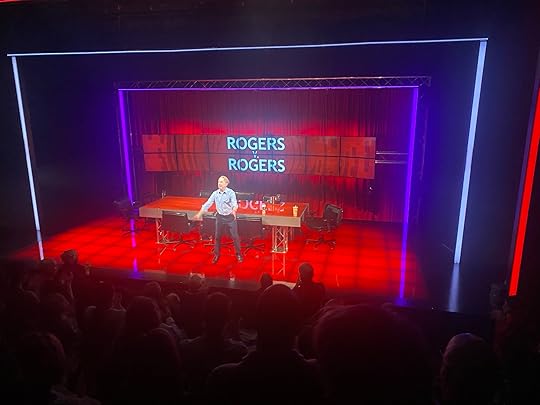
Curtain call for actor Tom Rooney who plays all the parts in the stage adaptation of Rogers v. Rogers. Image sourced from own photo.
I don't normally read non-fiction business books (in fact this might be the only one I've ever read), but the story of Rogers v. Rogers has enough drama and comedy to keep me interested throughout. Healey's stage adaptation extracts mostly only the comic elements, making for a rollicking laugh-filled evening. Posadzki's real-life telling is of course more matter-of-fact although the various faux-pas along the way are all in there to be found.
So basically you get the story of how Ted Rogers (1933-2008) built up Rogers Communications to be the dominating force that it is in Canadian telecommunications and how he manoeuvred to maintain control of the company from inside his family even after his death. That resulted in rivalries between the wife and the various children, especially with the son Edward who felt entitled to be the ruling hand in the future. You get the stories of the notorious butt-dial where one Rogers executive learned in advance of his firing via a misplaced call. There is sister Martha's twitter storm denigrating Edward's takeover efforts. etc. etc.
In the stage-play, the head of the Canadian Competition Bureau plays a major role as the main force attempting to block Rogers takeover of Shaw Communications. In the source book, that character is barely mentioned, although that was his position. Still, this was an entertaining background to the machinations that went on behind the scenes which led to only a few companies having the monopoly of telecommunications in Canada. Bell and Telus being the other survivors now.
Trivia and Links
Those unfamiliar with Rogers Communications and its power struggles can get a reasonable summary from articles such as Rogers family drama: These are the key players as court hearing approaches from Global News October 28, 2021.
Playwright Michael Healey often adapts real-life Canadian stories for the theatre. I am only familiar with his The Master Plan (2023) which was based on Sideways: The City Google Couldn't Buy (2022) about Google's failed takeover of Toronto's waterfront. If rumours are true, Prime Minister Stephen Harper's forces were able to stop the staging of Healey's Proud (2013) at the Tarragon Theatre in 2012, although not its publication. It is likely difficult to source now though.
A review of the McClelland & Stewart hardcover (February 13, 2024) released simultaneously with the ebook / audiobook.
I recently saw Michael Healey's stage adaptation of this book at Crow's Theatre in Toronto. As the playscript Rogers v. Rogers is not expected to be published before February 17, 2026 I was curious to read the source material in advance of that.
Curtain call for actor Tom Rooney who plays all the parts in the stage adaptation of Rogers v. Rogers. Image sourced from own photo.
I don't normally read non-fiction business books (in fact this might be the only one I've ever read), but the story of Rogers v. Rogers has enough drama and comedy to keep me interested throughout. Healey's stage adaptation extracts mostly only the comic elements, making for a rollicking laugh-filled evening. Posadzki's real-life telling is of course more matter-of-fact although the various faux-pas along the way are all in there to be found.
So basically you get the story of how Ted Rogers (1933-2008) built up Rogers Communications to be the dominating force that it is in Canadian telecommunications and how he manoeuvred to maintain control of the company from inside his family even after his death. That resulted in rivalries between the wife and the various children, especially with the son Edward who felt entitled to be the ruling hand in the future. You get the stories of the notorious butt-dial where one Rogers executive learned in advance of his firing via a misplaced call. There is sister Martha's twitter storm denigrating Edward's takeover efforts. etc. etc.
In the stage-play, the head of the Canadian Competition Bureau plays a major role as the main force attempting to block Rogers takeover of Shaw Communications. In the source book, that character is barely mentioned, although that was his position. Still, this was an entertaining background to the machinations that went on behind the scenes which led to only a few companies having the monopoly of telecommunications in Canada. Bell and Telus being the other survivors now.
Trivia and Links
Those unfamiliar with Rogers Communications and its power struggles can get a reasonable summary from articles such as Rogers family drama: These are the key players as court hearing approaches from Global News October 28, 2021.
Playwright Michael Healey often adapts real-life Canadian stories for the theatre. I am only familiar with his The Master Plan (2023) which was based on Sideways: The City Google Couldn't Buy (2022) about Google's failed takeover of Toronto's waterfront. If rumours are true, Prime Minister Stephen Harper's forces were able to stop the staging of Healey's Proud (2013) at the Tarragon Theatre in 2012, although not its publication. It is likely difficult to source now though.

February 24, 2024
Lived the full tenure of the major events that played out in this book. I was skeptical going in that I would enjoy this read, but i’m happy to report that I did. Great narrative building from the author. It certainly added a wonderful layer of cathartic colour to what was a long and protracted part of my life. Happy to have closed the cover on this one so I can move on, figuratively and literally.
January 23, 2024
This book isn't just a story of one of the biggest business deals in Canada or a butt dial. It's about the people behind the scenes that make such big decisions. A deep dive into the world of corporate governance and the families that run the these corporations. Filled with colorful details about the lives of the employers and employees that reads like Canada's own Succession.

December 29, 2025
While it was hard to follow at times, this was a fantastic non-fiction narrative of the chaos entangled in the history of Rogers. I remember Rogers's most recent history but appreciate the hard work Posadzki has put into laying it out for those interested.
The beginning was a bit hard to follow as Posadzki jumps between dates and characters to try and set the stage - as a journalist myself, I can see the techniques she used to tell the story, but I think further clarification could help when mentioning specific persons or a point in the timeline (i.e. when a month and day had no year, I sometimes had to flip back to confirm what year the event actually happened). I also found I had to look up some of the legal terminologies that weren't explained (especially near the end of the book when it just went into litigation madness), and thought these could have been flushed out a bit more since Posadzki's audience is more than just lawyers.
Despite any shortcomings, I was glued to Rogers v. Rogers until the very end. While it is my first read about a Canadian telecom company, it was a great place to start as Posadzki briefly dives into the histories of Bell, Telus, Quebecor, and Shaw to show not only how they factor into Rogers's dealings, but also the importance of competition in a still fairly new industry.
The beginning was a bit hard to follow as Posadzki jumps between dates and characters to try and set the stage - as a journalist myself, I can see the techniques she used to tell the story, but I think further clarification could help when mentioning specific persons or a point in the timeline (i.e. when a month and day had no year, I sometimes had to flip back to confirm what year the event actually happened). I also found I had to look up some of the legal terminologies that weren't explained (especially near the end of the book when it just went into litigation madness), and thought these could have been flushed out a bit more since Posadzki's audience is more than just lawyers.
Despite any shortcomings, I was glued to Rogers v. Rogers until the very end. While it is my first read about a Canadian telecom company, it was a great place to start as Posadzki briefly dives into the histories of Bell, Telus, Quebecor, and Shaw to show not only how they factor into Rogers's dealings, but also the importance of competition in a still fairly new industry.

July 25, 2026
I plead the fifth
January 6, 2026
couldn't put it down!

May 24, 2024
This was a pretty great book. The very first pages set the tone for the rest of the book and instantly hooked you with the question; "What could Edward have done that was so egregious as not to be at his mother's deathbed?"
I knew virtually nothing about this story going in, and I've emerged with a newfound perspective on Rogers. I honestly never really thought of them - I'm almost embarrassed to admit that I never even connected the Rogers Centre with the company Rogers!
Anyways, here are some fascinating things I learned of...
- Rogers does not seem like a very well-run company, as it's success as an innovator hinged on the patriarch, Ted Rogers. Micro-managing leadership style is very bad - do not do this!
- The butt dial! Crazy turn of event that seems almost unreal; imagine finding out a ploy to oust you from your job through an illicit conversation. Movie type stuff
- Having 4 CEO's in 13 years is EXTREMELY POOR LEADERSHIP! You need more time than this to actually see how things are changing.
- Trying to change the corporate culture in so many different ways in such a short period of time is not effective; it just creates a whiplash effect for all employees
- Dual Class Share Structures need to have some sort of limitation imp0sed; no one should that much power. I can understand the debate in terms of it providing a long-term perspective, but I think that argument is antiquated as technology is advancing much more rapidly and the economy experiences greater swings of volatility. Positioning one, or a select few individuals as the de factor rulers of these companies doesn't allow for fresh blood to bring in new insights, ultimately hindering the ability to project into the future
- Why does someone like Edward Rogers get to be the controller of a multi-billion dollar corporation! That man wouldn't be able to manage a Dairy Queen effectively let alone a 22,000 thousand employee enterprise...
- While the Roger/Shaw merger trial was a bit dense, I did find the debate on anti-competitive/competitive practices fascinating. They both have merit in their arguments, but I think I would lean towards the merger being anti-competitive, simply as it removes choices for the consumer. While Rogers may be able to offer competitive rates for the short-term, over a longer span of time the base price will simply increase across the three giants
This was quite a review, but the sheer volume of books I read means I forget mostly everything I read! Which is quite honestly alarming me as my memory seems to be getting weaker, so writing it all down helps
I knew virtually nothing about this story going in, and I've emerged with a newfound perspective on Rogers. I honestly never really thought of them - I'm almost embarrassed to admit that I never even connected the Rogers Centre with the company Rogers!
Anyways, here are some fascinating things I learned of...
- Rogers does not seem like a very well-run company, as it's success as an innovator hinged on the patriarch, Ted Rogers. Micro-managing leadership style is very bad - do not do this!
- The butt dial! Crazy turn of event that seems almost unreal; imagine finding out a ploy to oust you from your job through an illicit conversation. Movie type stuff
- Having 4 CEO's in 13 years is EXTREMELY POOR LEADERSHIP! You need more time than this to actually see how things are changing.
- Trying to change the corporate culture in so many different ways in such a short period of time is not effective; it just creates a whiplash effect for all employees
- Dual Class Share Structures need to have some sort of limitation imp0sed; no one should that much power. I can understand the debate in terms of it providing a long-term perspective, but I think that argument is antiquated as technology is advancing much more rapidly and the economy experiences greater swings of volatility. Positioning one, or a select few individuals as the de factor rulers of these companies doesn't allow for fresh blood to bring in new insights, ultimately hindering the ability to project into the future
- Why does someone like Edward Rogers get to be the controller of a multi-billion dollar corporation! That man wouldn't be able to manage a Dairy Queen effectively let alone a 22,000 thousand employee enterprise...
- While the Roger/Shaw merger trial was a bit dense, I did find the debate on anti-competitive/competitive practices fascinating. They both have merit in their arguments, but I think I would lean towards the merger being anti-competitive, simply as it removes choices for the consumer. While Rogers may be able to offer competitive rates for the short-term, over a longer span of time the base price will simply increase across the three giants
This was quite a review, but the sheer volume of books I read means I forget mostly everything I read! Which is quite honestly alarming me as my memory seems to be getting weaker, so writing it all down helps

March 6, 2024
Fascinating, thorough and meticulously researched.
Loved getting a behind the scenes glimpse on Rogers Communications and the wealthy and powerful family that runs it. It was shocking the length Canada’s elite will go to gain power and control.
Well done!
Loved getting a behind the scenes glimpse on Rogers Communications and the wealthy and powerful family that runs it. It was shocking the length Canada’s elite will go to gain power and control.
Well done!

April 23, 2024
I enjoyed this book by investigative reporter Alexandra Posadzki. I especially enjoy supporting a female voice in such a male-dominated arena.

January 22, 2025
This was way more interesting than I expected. The Roger’s debacle was one of those stories I didn’t fully tune into when it was happening and now I’m glad I waited for this retelling. Posadzki really draws you in and I think does a great job of showing just how insular Canada’s corporate world really is. I was shocked at some of the connections that she revealed and also loved the insight into her reporting process.
May 6, 2024
Rogers v. Rogers, the succession feud for the control of the company wasn't really interesting, hamstrung by the lack of access into the mind of Edward Rogers or the rest of the C-suite. Similarly missing was a lack of presentation of the strategic challenges faced by a major telecom provider until the end where the threat of cord-cutting looms.
However, the book's coverage of the history of the Rogers company was excellent. I especially enjoyed the seeing the development of the company's relationship with regulators and its competitors over the years. It was surprising to find how Rogers, a behemoth from the outside, is often outclassed by Telus-Bell, its main competitors who are shrewder businesses.
Would also be interesting to read why telecom companies around the world seek to enter the content creation business, that seems like a money pit. Let someone else do it.
While this book can't truly be filed under boards unable to supervise their CEOs, the lack technical expertise in telecommunications of the board's independent directors meant they couldn't really supervise their CEO.
Wish more time was spent on the hiring of Navdeep Bains by Rogers; on the other hand François-Philippe Champagne comes off quite well.
However, the book's coverage of the history of the Rogers company was excellent. I especially enjoyed the seeing the development of the company's relationship with regulators and its competitors over the years. It was surprising to find how Rogers, a behemoth from the outside, is often outclassed by Telus-Bell, its main competitors who are shrewder businesses.
Would also be interesting to read why telecom companies around the world seek to enter the content creation business, that seems like a money pit. Let someone else do it.
While this book can't truly be filed under boards unable to supervise their CEOs, the lack technical expertise in telecommunications of the board's independent directors meant they couldn't really supervise their CEO.
Wish more time was spent on the hiring of Navdeep Bains by Rogers; on the other hand François-Philippe Champagne comes off quite well.

January 12, 2025
It's an interesting concept, and there were some good tidbits of information, but this book lacked a critical lens about power and capital in society, it often felt deferential to its subject matter and it was super repetitive. An editor could've fixed some of that. But referring to someone as the most intelligent sibling because they have an MBA (lmao) suggests the author and I live in divergent and irreconcilable realities.

August 4, 2024
There’s nothing riveting about this book. It was a solid did not finish. It was boring. “This happened and then this happened” is literally how this book reads.
There’s zero character development. Just no.
There’s zero character development. Just no.

October 15, 2024
When they said it was “Succession” but in real life, they weren’t kidding! The rich are so petty even when it comes to family. A nice deep dive into a huge Canadian empire!

June 9, 2024
Are you someone that enjoyed Succession but thought it would have been more interesting without all of the murder, sex and drugs? Then this book about Canada’s communications industry is certainly for you. Well researched, balanced and thorough without being painfully explanatory, I really enjoyed this read. Is it a book written exclusively for business/legal wonks? Maybe, but I think the author does their best to serve the reader who is looking to get into the weeds on the subject. I think the title is a bit misleading as the book is more of a global overview of the players and dynamics of the communications industry as a whole, rather than a profile the Rogers family, but I appreciate it’s hard to get a comprehensive picture of RCI without discussing the companies it grew up alongside. Great book that I think the right reader would really enjoy.

September 1, 2024
CW: billionaires, greed, oligopoly
Canada’s telecom industry is notoriously shady with several very wealthy families prioritizing their wealth above and beyond the needs of their customers. This book accounts for some of the absurdity of that extreme privilege in a battle for control over a company that offers a service many see as essential. If the book raised one question for me, it’s how can we let this public service be held by private interests? Regulation of this sector is clearly lacking and is primarily back door deals and gentleman’s agreements between the ultra wealthy to always ensure a tidy profit.
Canada’s telecom industry is notoriously shady with several very wealthy families prioritizing their wealth above and beyond the needs of their customers. This book accounts for some of the absurdity of that extreme privilege in a battle for control over a company that offers a service many see as essential. If the book raised one question for me, it’s how can we let this public service be held by private interests? Regulation of this sector is clearly lacking and is primarily back door deals and gentleman’s agreements between the ultra wealthy to always ensure a tidy profit.

May 24, 2024
This book does a good job describing the history of Roger's communication and the battle for control of Rogers which developed between Ted Rogers Jr and his mother and sisters. Ted Rogers Jr was able to use the power of dual class voting stocks and his position as President of Rogers trust to gain the upper hand against his family and board of directors to exert his power to reorganize the C-suite structure of Rogers without any apparent benefit other than to show everyone that he was in control. A good reason not to invest in Rogers telecommunications.

May 30, 2026
A great book that presents a clear, well-paced account of one of the most controversial sagas in Canadian history. As events unfold, the final pages ultimately capture the essence of the entire story: it’s all about money.
When a former CEO—already having received $20 million in severance—sues for an additional $25 million, and the company counters with a $15 million claim, it’s hard not to feel disheartened. For everyday Canadians working hard just to afford internet and cell phone services, the contrast feels especially frustrating—almost as though their efforts are in vain.
When a former CEO—already having received $20 million in severance—sues for an additional $25 million, and the company counters with a $15 million claim, it’s hard not to feel disheartened. For everyday Canadians working hard just to afford internet and cell phone services, the contrast feels especially frustrating—almost as though their efforts are in vain.

January 18, 2024
I was lucky enough to be able to go through a draft of Alexandra Posadzki's debut book ahead of publication, and I have to say it is an absolutely fantastic read. It gets into the nitty-gritty and behind-the-scenes of the Rogers-Shaw deal in a way that's easy to understand even if you don't know the first thing about the telecom industry. This blend of accessibility and incredible detail made for a very compelling read that only got better as it went along!

February 7, 2026
If you don’t already hate the family behind Canada’s largest telecom corp, you will after this book. In an engaging, non fiction narrative, Posadzki gives a play by play of the battle between the Rogers children, and their fight for control over the telecom giant. The look inside the corporation during the turmoil also gives context to many of their actions during the time, especially for people who watched it play out in the news or even from inside Rogers.
May 26, 2026
As a non-Canadian, I found the story fascinating, even though the corporate struggle for control of Rogers doesn’t directly impact me. The book offered an interesting look into the dynamics of power, family conflict, and business influence within a major telecom empire. Overall, I’m very glad I took the recommendation to listen to this book. It was engaging, informative, and held my interest throughout in a way I wasn’t necessarily expecting.

April 1, 2024
Fantastic inside account of the Rogers/Shaw deal, along with details of the Rogers family squabbles leading up to it. If you thought Magat Edward was a piece of work, & that Matthew Boswell is an incompetent vendetta fueled idiot, this book will confirm those beliefs. A great journalistic accomplishment.

May 23, 2024
I got bogged down in the business jargon, but this book was a great reminder of how much Rogers actually owns and operates. Just when you think you can say you aren’t a Rogers customer, I guarantee you that you use at least one of their services (or possibly see/enter one of their many properties) a day.
January 18, 2025
I have only heard about a few families that behave the way the Rogers have. I guess when you inherit immense amounts of wealth and do not have any real world experience to rely upon, you behave like this. This was a sad story to read. so much wasted potential, and these people control a huge stake in our communications. Frightening!

April 7, 2025
I loved the deep dive into Canada's telecom landscape including the regulatory and competition aspects. It was so interesting to see the insight into the people behind the decisions. I was shocked at many of the leadership and governance choices at Rogers and the influence from the grave of the founder. The author brought life to what can be a dense topic including her colorful descriptions.

September 7, 2026
An interesting and insightful look at the Rogers corporation. This is not something I would typically be drawn to, given how business oriented it was, but it was quite interesting to see how a family success story turned into a nightmare. I wish the family dynamic was fleshed out more, as that was the most interesting element for me, but this was good read.

April 8, 2024
An excellent deep dive into Canada’s telecom industry, one of the largest acquisitions in Canadian history, and the corporate governance concerns stemming from Rogers’ unique dual-class share structure. I highly recommend this book!
April 28, 2024
Lots of background (telecom, tech, families, personalities) makes this book stand out and go well beyond the promise of its title. Beleaguered Canadian telecom consumers may enjoy some schadenfreude.

November 20, 2024
A bit hard to get in to, and sometimes difficult to fully wrap my head around as someone with literally no legal experience, but completely fascinating. Once I hit a certain point I couldn’t put it down. Canada really is just three companies in a trench coat.
October 14, 2025
Finally read the book. Breezy and entertaining. Tough to gauge which side of each story was the correct one but it cast a rare light in the inner workings of a large Canadian corporation’s decision makings at the highest level.
Displaying 1 - 30 of 49 reviews