

What do you think?

The Horse: A Galloping History of Humanity
THE NATIONAL BESTSELLER
An International Bestseller
Winner 2025 High Plains International Book Award for Non-Fiction
An Amazon Best Book of 2024
From New York Times bestselling author of The Mosquito, the incredible story of how the horse shaped human history
The Horse is an epic history unlike any other. Its story begins more than 5,500 years ago on the windswept grasslands of the Eurasian Steppe. When one human tamed one horse, an unbreakable bond was forged and the future of humanity was instantly rewritten, placing the reins of destiny firmly in human hands.
Since that pivotal day, the horse has carried the fate of civilizations on its powerful back. For millennia it was the primary mode of transportation, an essential farming machine, a steadfast companion, and a formidable weapon of war. Possessing a unique combination of size, speed, strength, and stamina, the horse dominated every facet of human life and shaped the very scope of human ambition. And we still live among its galloping shadows.
From the thundering cavalry charges of Alexander the Great to the streets of New York during the Great Manure Crisis of 1894 and beyond, horses have shaped both the grand arc of history and our everyday lives. Horses revolutionized the way we hunted, traded, traveled, farmed, fought, worshipped, and interacted. They fundamentally reshaped the human genome and the world's linguistic map. They determined international borders, molded cultures, fueled economies, and built global superpowers. They decided the destinies of conquerors and empires. They were vectors of lethal disease, and contributed to lifesaving medical innovations. Horses even inspired architecture, invention, furniture, and fashion.
Driven by fascinating revelations and fast-paced storytelling, The Horse is a riveting narrative of this noble animal's unrivaled and enduring reign across human history. To know the horse is to understand the world.
An International Bestseller
Winner 2025 High Plains International Book Award for Non-Fiction
An Amazon Best Book of 2024
From New York Times bestselling author of The Mosquito, the incredible story of how the horse shaped human history
The Horse is an epic history unlike any other. Its story begins more than 5,500 years ago on the windswept grasslands of the Eurasian Steppe. When one human tamed one horse, an unbreakable bond was forged and the future of humanity was instantly rewritten, placing the reins of destiny firmly in human hands.
Since that pivotal day, the horse has carried the fate of civilizations on its powerful back. For millennia it was the primary mode of transportation, an essential farming machine, a steadfast companion, and a formidable weapon of war. Possessing a unique combination of size, speed, strength, and stamina, the horse dominated every facet of human life and shaped the very scope of human ambition. And we still live among its galloping shadows.
From the thundering cavalry charges of Alexander the Great to the streets of New York during the Great Manure Crisis of 1894 and beyond, horses have shaped both the grand arc of history and our everyday lives. Horses revolutionized the way we hunted, traded, traveled, farmed, fought, worshipped, and interacted. They fundamentally reshaped the human genome and the world's linguistic map. They determined international borders, molded cultures, fueled economies, and built global superpowers. They decided the destinies of conquerors and empires. They were vectors of lethal disease, and contributed to lifesaving medical innovations. Horses even inspired architecture, invention, furniture, and fashion.
Driven by fascinating revelations and fast-paced storytelling, The Horse is a riveting narrative of this noble animal's unrivaled and enduring reign across human history. To know the horse is to understand the world.
544 pages, Hardcover
First published July 30, 2024
Ratings & Reviews
Friends & Following
Create a free account to discover what your friends think of this book!
Community Reviews
Displaying 1 - 30 of 154 reviews

July 31, 2024
A kingdom for a horse.....book? Listen, I didn't see myself reading a book called The Horse by Timothy Winegard. Yet, here we are and I enjoyed it!
Winegard looks at the entirety of the existence of the horse and I mean all of its existence. Winegard begins with what would be considered the first horse or at least a horse ancestor and then examines the evolutionary mechanics which brought us to today's wonderful animal. The book is strongest in parts like this one. When the full attention is on the horse, Winegard's book is truly riveting and makes you wonder just how much we take the horse for granted as humans. Did you know horses were used to make vaccines? Yeah, me either!
My critique of the narrative would be the times where the horse falls to the background. Winegard is an excellent writer so when he digs into a famous battle, it's never a bad time. However, I found myself wanting the spotlight back on the title of the book or to at least make a more concerted effort to break down how vital horses were during specific battles. Also, at over 450 pages it feels like a good amount could be cut to make this a slimmer tome. That said, it's still a good time and I recommend it.
(This book was provided as an advanced copy by the publisher.)
Winegard looks at the entirety of the existence of the horse and I mean all of its existence. Winegard begins with what would be considered the first horse or at least a horse ancestor and then examines the evolutionary mechanics which brought us to today's wonderful animal. The book is strongest in parts like this one. When the full attention is on the horse, Winegard's book is truly riveting and makes you wonder just how much we take the horse for granted as humans. Did you know horses were used to make vaccines? Yeah, me either!
My critique of the narrative would be the times where the horse falls to the background. Winegard is an excellent writer so when he digs into a famous battle, it's never a bad time. However, I found myself wanting the spotlight back on the title of the book or to at least make a more concerted effort to break down how vital horses were during specific battles. Also, at over 450 pages it feels like a good amount could be cut to make this a slimmer tome. That said, it's still a good time and I recommend it.
(This book was provided as an advanced copy by the publisher.)

Read
August 15, 2025No rating because DNF. Some parts of it were good, towards the beginning. Then, it seemed, we got away from the horse and into general world history. The exact line when you go from the horse to its impact on human history to just history without much mention of the horse, is not easy to pin down, but somewhere in there we crossed it. The time spent on the Battle of Tours was an odd choice, given that the victor (the Franks under Charles Martel) had little heavy cavalry compared to their opponents. As the wikipedia article on the battle says, "The well-trained Frankish soldiers accomplished what was not thought possible at that time: infantry withstanding a heavy cavalry charge." Winegard rightly considers the battle to be important in human history, but there's no apparent reason why it should get so much attention in a horse-centered one, and if it does then at least it should be discussed that the more horse-dependent side actually lost this one.
This is just one example, but my impression was that Winegard just wanted to write a history of Eurasian humanity, and the horse was his entry point but not particularly his focus. I liked the idea of a "galloping history of humanity", but this did not appear to be it, and after a couple hundred pages I decided to move on.
This is just one example, but my impression was that Winegard just wanted to write a history of Eurasian humanity, and the horse was his entry point but not particularly his focus. I liked the idea of a "galloping history of humanity", but this did not appear to be it, and after a couple hundred pages I decided to move on.

August 31, 2024
There is a lot of history in this book, but do not expect it to be a history of the Horse. This book is about the Infulence of the horse on Human History (pg 178). So at its core, its a human history were the horse is involved.
September 23, 2024
DNF.
Author is evidently a graduate of a community college creative writing course: “Don’t clearly say with 12 words what can be said with 20”.
Author is evidently a graduate of a community college creative writing course: “Don’t clearly say with 12 words what can be said with 20”.

April 24, 2026
3.5. Oddly enough, not enough horse at times. But still learned some very interesting things regardless.

February 22, 2026
I haven’t reviewed in a while, but I felt obligated here because I genuinely feel misled by this book.
I am a horse girl, and for us, this reads more like a series of horror stories than interesting nonfiction. I found myself asking if the author was a sadist at times because of the gratuitous detail he went into about just how badly humans have treated horses throughout history. There was no uplift. It never got better. Every chapter was rife with new examples of horrific abuse and mistreatment - even the chapter supposedly about modern equestrian sport and hippotherapy. I’m a realist, and I know bad things happen, but I would’ve appreciated some balance with positive stories and examples of friendliness or kinship between us and our ponies. I treat my horses well, and I know plenty of kind and ethical horsemen and women; yet not a single one made an appearance in The Horse.
There was also limited or zero discussion of a few topics that I was surprised to find omitted (I suppose the author ran out of space, and he preferred to discuss Horse Horror). There’s no discussion of how saddle technology was shaped by various equine activities, and the invention of the stirrup, one of history’s most pivotal inventions, got a measly sentence of airtime. Very limited description of breeding practices that led to the varied equine community we have now. Nothing about various bits and their purposes (except about how we can tell through fossils when bits were invented because of the wear and tear on jawbones). No reference to equine influence in society outside of war and conquest, despite ample evidence of such, especially in relation to women. I’m a jumper by training, and there was no mention of USEF, USHJA, the FEI, or any other governing bodies and the work they’re doing to advance horse and rider welfare. Literally nothing except war, misuse, and death. I’m wildly disappointed.
I am a horse girl, and for us, this reads more like a series of horror stories than interesting nonfiction. I found myself asking if the author was a sadist at times because of the gratuitous detail he went into about just how badly humans have treated horses throughout history. There was no uplift. It never got better. Every chapter was rife with new examples of horrific abuse and mistreatment - even the chapter supposedly about modern equestrian sport and hippotherapy. I’m a realist, and I know bad things happen, but I would’ve appreciated some balance with positive stories and examples of friendliness or kinship between us and our ponies. I treat my horses well, and I know plenty of kind and ethical horsemen and women; yet not a single one made an appearance in The Horse.
There was also limited or zero discussion of a few topics that I was surprised to find omitted (I suppose the author ran out of space, and he preferred to discuss Horse Horror). There’s no discussion of how saddle technology was shaped by various equine activities, and the invention of the stirrup, one of history’s most pivotal inventions, got a measly sentence of airtime. Very limited description of breeding practices that led to the varied equine community we have now. Nothing about various bits and their purposes (except about how we can tell through fossils when bits were invented because of the wear and tear on jawbones). No reference to equine influence in society outside of war and conquest, despite ample evidence of such, especially in relation to women. I’m a jumper by training, and there was no mention of USEF, USHJA, the FEI, or any other governing bodies and the work they’re doing to advance horse and rider welfare. Literally nothing except war, misuse, and death. I’m wildly disappointed.

December 9, 2024
Much of the scholarship is outdated and appears to rely upon mostly secondary sources.
This entire review has been hidden because of spoilers.

May 18, 2026
A bit too much random personal narrative for me but had some big claims about the importance of the horse which were worth pondering

December 27, 2024
A wondrous history of humanity through the eyes of our most important quadruped—the horse. While The Horse is by no means a complete history and aspects of the world are glossed over or overlooked almost entirely, you learn a great deal about the transcontinental journey of the horse from its earliest days millions of years ago as a short, four-toed creature in North America all the way to its mighty and bloody usefulness in the World Wars. Most of the book can feel like a military campaign history book, but I was most fascinated with the horse as a tool for agriculture, professional travel and exploration, and less as a means for slaughter. But, that is history and is integral to learn about when dealing with a beast as influential as the horse is. It’s fascinating insight into how our humanity is so linked with the horse and how such little advancement would have been made without this creature. I’ve always loved horses, and this year having had the pleasure of seeing Przewalski's horses in the wild in Mongolia, I continue to have a special place in my heart for these almost magical animals.

August 27, 2024
Truly fascinating!
February 22, 2025
For a book about horses, the amount of horse content was relatively low.

July 16, 2025
You don’t need to be a horse fanatic to devour this flowing history of the world. Winegard digs into stories behind the stories that we learned in the broadest, blandest ways as schoolkids, and fleshes out dynamics of growth and evolution on the scaffolding of horse/human relationships throughout time. This is not a sentimental tale. Winegarten is an eyes wide open observer of the ebb and flow of human civilizations as impacted by their equine partners, writing of both the horror and humor of our complicated existences. Highly recommend this page turning history of horses and humans.

August 19, 2024
The Horse is a survey-level history of, well, horses, from their earliest evolution to the present day. It's in a similar vein to human histories like Sapiens or The Silk Roads. The larger arc is familiar to anyone who's read those or similar, but with, of course, the singular focus on how horses have shaped history. There's a convincing body of evidence to support the argument that horses are the single most transformational thing to happen to humans....but a similar book might be written about any number of advancements (the author himself references Guns, Germs, and Steel in talking about the Columbian Exchange - but argues that horses were MORE crucial in subjugating indigenous peoples than any of those). On the whole, though, horses are an interesting window into world history (especially if you're a horse person).
The book itself is fairly long and drags in spots. It frequently felt repetitive or unnecessarily discursive. One gripe that is probably a personal dislike is the excessive use of modifiers - it often felt like every single noun had the most extreme adjective available applied to it, to no practical purpose (there is no reason to refer to the Nazi regime as sadistic, for example; they are essentially synonymous at this point. Multiply x thousands and you get my point).
Overall, though, a good read for anyone who wants to spend time on the big picture of horses + people. Thanks to netgalley and the publisher for the arc!
The book itself is fairly long and drags in spots. It frequently felt repetitive or unnecessarily discursive. One gripe that is probably a personal dislike is the excessive use of modifiers - it often felt like every single noun had the most extreme adjective available applied to it, to no practical purpose (there is no reason to refer to the Nazi regime as sadistic, for example; they are essentially synonymous at this point. Multiply x thousands and you get my point).
Overall, though, a good read for anyone who wants to spend time on the big picture of horses + people. Thanks to netgalley and the publisher for the arc!
September 24, 2024
Thanks to NetGalley and Dutton for the ARC.
I have never been a horse girl growing up, I'd say that I have a healthy dose of fear and respect for the absolute units that they are. I picked this up on a whim because I like to read nonfiction about very niche subjects. I balked at the page count (500 is a lot for me nowadays) and worried about how I'd get through it. Imagine my surprise at finding the history of the horse and its influence on civilization really engaging! Especially with the BC empires beyond Egypt and Greece, I don't know nearly enough on those, and this book devoted a whole section to how they expanded and fell along with how domesticated horses transformed their military strategies. Mind you, this is still a dense history book, and I was starting to get tired by the World Wars section. Otherwise, it's a fascinating deep dive into how much human history depended on our connection to the horse. It was well researched and explained the events really well for the average reader.
I have never been a horse girl growing up, I'd say that I have a healthy dose of fear and respect for the absolute units that they are. I picked this up on a whim because I like to read nonfiction about very niche subjects. I balked at the page count (500 is a lot for me nowadays) and worried about how I'd get through it. Imagine my surprise at finding the history of the horse and its influence on civilization really engaging! Especially with the BC empires beyond Egypt and Greece, I don't know nearly enough on those, and this book devoted a whole section to how they expanded and fell along with how domesticated horses transformed their military strategies. Mind you, this is still a dense history book, and I was starting to get tired by the World Wars section. Otherwise, it's a fascinating deep dive into how much human history depended on our connection to the horse. It was well researched and explained the events really well for the average reader.
September 16, 2024
Deserving of the title "A Brief History of Humankind", someone looking for a more refined book about horses may balk (shy, rear?) at my 5-star rating, however, in succinctly, effectively, and factually relating the story of the horse with the History of Humanity, this book is a clever and fact-filled charge through basically the entire History of the human race. A wonderful History book, a brief outline of all the big ticket items. A great summary. Loved it!

December 19, 2025
As a lifelong student of hippology and an avid reader/historian of all things equine, this book provided a surprising and interesting amount of new information to me. I found mention of new facts and anecdotes related to the history of the human-horse dyad throughout the book, and particularly enjoyed the thoroughness with which horse evolution, domestication, and ancient history were discussed. The Tarim basin mummies and the horse's role in the development of diphtheria and tetanus vaccines were particular highlights. The horse's key role to the entirety of human history is emphasized here, and it is a powerful message that I particularly relished. This book was an easy 5-star recommendation for me until it fell at the final hurdle.
The book loses one star for not taking an unbiased, critical look at the BLM and the role feral horse herds are playing on the environment in the modern United States. Winegard uncritically repeats many BLM talking points, without considering the effect that 'critical' growing cattle and sheep grazing lands are having on planet and environmental sustainability. Wild horses are just presented as a 'hot-button' issue, with activist advocates portrayed as too simplistically-minded 'bleeding hearts' while the folks at BLM offer a far more pragmatic look at the cost these surplus horses are having to the American taxpayer and the environment (nothing about the wealthy ranching interests the organization protects). I get that Winegard believes that humane euthanization and the sale of these horses for human (and his dog Steven's) consumption is the way to deal with these horses, and he is entitled to his (in my belief, somewhat ill-informed) opinion. It was deeply disheartening, however, to see him so plainly wear his own biases on his sleeve in the final chapter instead of taking the far more measured, critical look at the issue that the previous chapters provided.
The first sixteen chapters have abundant worth, and the notes provide excellent references for further reading on these different eras of human-horse history. The final chapter wasn't really worth the paper it was printed on and does the rest of the book a disservice.
The book loses one star for not taking an unbiased, critical look at the BLM and the role feral horse herds are playing on the environment in the modern United States. Winegard uncritically repeats many BLM talking points, without considering the effect that 'critical' growing cattle and sheep grazing lands are having on planet and environmental sustainability. Wild horses are just presented as a 'hot-button' issue, with activist advocates portrayed as too simplistically-minded 'bleeding hearts' while the folks at BLM offer a far more pragmatic look at the cost these surplus horses are having to the American taxpayer and the environment (nothing about the wealthy ranching interests the organization protects). I get that Winegard believes that humane euthanization and the sale of these horses for human (and his dog Steven's) consumption is the way to deal with these horses, and he is entitled to his (in my belief, somewhat ill-informed) opinion. It was deeply disheartening, however, to see him so plainly wear his own biases on his sleeve in the final chapter instead of taking the far more measured, critical look at the issue that the previous chapters provided.
The first sixteen chapters have abundant worth, and the notes provide excellent references for further reading on these different eras of human-horse history. The final chapter wasn't really worth the paper it was printed on and does the rest of the book a disservice.

June 8, 2025
This interesting nonfiction book covers the intertwined histories of the horse and the development of mankind.
Did you know that present day horses are descended from horses that evolved in North America, traveled to other continents, and then died off in North America? Or that horses in those other continents developed as "flight, not fight" smallish animals that also died off before being repopulated by the North American horses.
Both man and horse destinies changed when someone (likely a teenager responding to a dare) first rode a horse. Man provided safety to the horses, and the horses provided... well, horsepower... that provided power and speed to accelerate mankind's development.
Very interesting read!
Did you know that present day horses are descended from horses that evolved in North America, traveled to other continents, and then died off in North America? Or that horses in those other continents developed as "flight, not fight" smallish animals that also died off before being repopulated by the North American horses.
Both man and horse destinies changed when someone (likely a teenager responding to a dare) first rode a horse. Man provided safety to the horses, and the horses provided... well, horsepower... that provided power and speed to accelerate mankind's development.
Very interesting read!

September 17, 2025
I think sometimes the author forgot he was ostensibly writing about horses?
More of a "history of humanity that I personally find interesting and occasionally horses are there as tools of civilization". Interesting overall, but I wish it had spent more than about 4 minutes on modern horse sport in society, though I knew what I was in for when we were still on the horses that Christopher Columbus brought over at the 66% mark.
It also threw me off when we went from largely chronological to random factoid time at a few points, most of which would have fit nicely into a modern section had he chosen to include one.
More of a "history of humanity that I personally find interesting and occasionally horses are there as tools of civilization". Interesting overall, but I wish it had spent more than about 4 minutes on modern horse sport in society, though I knew what I was in for when we were still on the horses that Christopher Columbus brought over at the 66% mark.
It also threw me off when we went from largely chronological to random factoid time at a few points, most of which would have fit nicely into a modern section had he chosen to include one.

March 15, 2025
I’m never beating the horse girl allegations :P, but I guess even if you don’t like horses you might still like this book because it’s more about history, and horses just happened to be there too. regardless, it’s an interesting thought exercise to think about how different the world would be if horses hadn’t been there for most of civilization.
my favorite random fun fact from the book is that in 1855 the government spent $30000 (like 5 million today) establishing the US Camel Corps (and it’s exactly what it sounds like)
my favorite random fun fact from the book is that in 1855 the government spent $30000 (like 5 million today) establishing the US Camel Corps (and it’s exactly what it sounds like)
December 27, 2025
As a certified horse girl, I’m relieved this is over. A long and rambling book about the history of the world with basic side tones of horses. Parts were interesting, parts were said with double the amount of words needed. I stopped reading about 60% of the way through and finished it by listening which was a much better medium for this book.

July 4, 2026
Because one day someone dared their friend to get on the back of a wild horse, everything we know has been revolutionized. The domestication of horses changed humankind forever. And sadly, it was mostly because of war and the agricultural revolution.

September 5, 2024
The non-fiction I've been reading this year has been amazing. This book is for equestrians & history buffs. It will engage you & teach things you never knew about horses & how they are the key to our modern world. Yes I said modern world.

January 19, 2025
3.5 ⭐️ Emphasis on human history with horses liberally sprinkled in. This was a dense historical read that often had me running to a map to see where places were. I enjoyed the later parts of the book more than the more evolutionary and and ancient history chapters.

September 9, 2024
3.5 stars

January 27, 2025
Timothy C. Winegard provides an account of the last 5,500 years of human history, going in-depth into the influence of the horse on just about every facet of our existence. The animal has been so ubiquitous that it is easy to take it for granted. The author makes a strong case for the horse’s vital role in agriculture, war, trade, the spread of disease, and the spread of civilization. It’s a fascinating view of our world. Highly recommended.
***************************************************************************
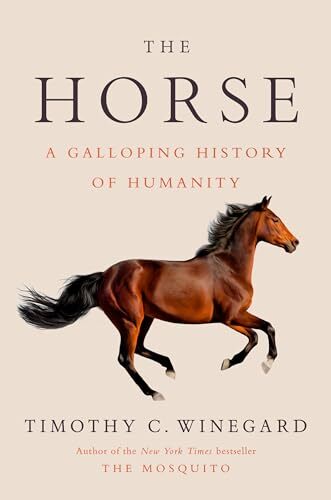
[Image: Book Cover]
Citation:
Winegard, T.C. (2024). The horse: A galloping history of humanity. Dutton.
Title: The Horse: A Galloping History of Humanity
Author(s): Timothy C. Winegard
Year: 2024
Genre: Nonfiction - History
Page count: 544 pages
Date(s) read: 1/16/25 - 1/27/25
Book 18 in 2025
***************************************************************************
QUOTES:
“Imagine for a moment our human odyssey and epic sagas without the historical power of horses. I can safely say that our modern world order and sociocultural configurations would be completely unrecognizable. We might as well live on another planet in a galaxy far, far away.” (p. 2)
*
“According to recent estimates, more than fifty billion, or 99.99 percent of all species that once occupied the terrestrial stage, have gone extinct….Most extinct species were victims of their own success—they had the misfortune of being supremely adapted to a niche that did not last.” (p. 19)
*
“For the average thousand-pound American quarter horse, this equates to fifteen to thirty pounds of grass per day, in addition to six to ten gallons (twenty-five to forty liters) of water. Benefiting human pursuits, horses can survive up to a month without food and six days without water.” (p. 39)
*
“Farming is a peculiar institution and intrinsically unnatural.” (p. 63)
*
“If we take [Jared] Diamond’s list one step further, roughly 90 percent of the world’s total caloric intake is still supplied by the original six major domesticates from between 9500 and 3500 BCE: wheat, barley, rice, millet, maize (corn), and potatoes. These crops birthed civilization, colonized the Earth, and continue to buttress its growth.” (p. 66)
*
“The earliest human writing (cuneiform) inscribed on clay tokens and tablets was a result of vocational specialization, trade, bookkeeping, and accounting for wealth. In fact, 90 percent of those recovered document some component of occupational administration or money management.” (p. 68)
*
“While farming flourished in South America and Central America as early as ten thousand years ago, as we will see, unlike the rest of the world, it was not accompanied by extensive domestication of livestock. As a result, Indigenous peoples of the Americas remained sheltered from the storm of all zoonotic diseases—for the time being.” (p. 88)
*
“Words are linguistic fossils, as important to the understanding of our past and our present as stones and bones, or books and DNA.” (p. 91)
*
“...[The Chinese’s] game-changing invention of the stirrup. Given the importance of the horse, it seems strange that it took so long for the stirrup to materialize; it was first represented in statuettes around 300 and in writing by 477. With the advent of stirrups, the human-horse centaur became an even more powerful killing machine within ever-swelling and gathering armies competing for commercial ascendancy…
“By the fifth century, the Chinese refined their invention into a cast-iron stirrup. This modification transformed cavalry. Disseminated by steppe nomads, including the Avars (also descendants of the Xiongnu), the use of stirrups spread across Eurasia and the Middle East between the sixth and ninth centuries…
“In fact, the stirrup allows the rider greater control of the horse while wielding larger, longer, and heavier weapons, as well as increasing velocity and accuracy with the bow—all without fear of becoming unseated during combat. In short, with the stirrup, the rider truly became one with the horse.” (pp. 235-6)
*
“The Prophet Muhammad made numerous references to horses and their emotional, spiritual, and military importance.” (p. 249)
*
“The horse and its medieval Agricultural Revolution transported the West to the threshold of the modern age. Europe, which had long been a splintered, impoverished, global backwater, finally caught up to the cosmopolitan and cultured polities of China, Southeast Asia, India, Japan, Persia, Anatolia, and Arabia.” (p. 274)
*
“In 1492, when Christopher Columbus was eight thousand miles lost, and the last vestige of al-Andalus Islam was expelled from Spain during the Reconquista, Europeans controlled a mere 15 percent of the Earth’s landmass. By 1800, they dominated more than 35 percent, and on the eve of the First World War in 1914, Europeans had colonized a staggering 84 percent of the world. As the requisite machine driving the arteries of agriculture, transportation, and war, the horse was not replaced until the rise of the machine at the dawn of the twentieth century.” (p. 274)
*
“Of the estimated one hundred million inhabitants on the eve of the Columbian Exchange, by 1750, only five million remained. During the worst per capita catastrophe in human history, roughly 95 percent of the Indigenous residents of the Americas—representing 20 percent of the global population—had been erased from the planet in a mere 250 years.” (p. 308)
*
“The stereotypical ‘noble savage’ image of the Indian with feathered headdress and spotted horse was cemented into American folklore and frontier mythology by Hollywood and its enduring Western genre starring immortal silver screen cowboys such as Tom Mix, John Wayne, Clint Eastwood, and Yosemite Sam mercilessly brutalizing ‘uncivilized’ Indians.” (p. 326)
*
“American cavalrymen acknowledged begrudgingly their Comanche enemy as ‘the finest light cavalry in the world.’” (p. 338)
*
“I want you to stop reading and pause for a moment after you mentally substitute horses for every aspect of our current motorized and mechanical farming, manufacturing, transport, distribution, services, war, and trade. It is a mind-numbing exercise. ‘Horses were ubiquitous, working in cities, towns, and factories, on farms and frontiers, on streets and roads, alongside canals, around forts, ports, and railroad depots,’ stresses Ann Norton Greene.” (p. 375).
*
“Across the United States between 1890 and 1900, for example, there were 750,000 annual horse-drawn traffic accidents causing injury or death. Serious traffic injuries were ten times greater than modern automobile levels, with death rates almost double. In 1900, for instance, horse accidents killed one out of every seventeen thousand New Yorkers. A century later, car accidents killed one out of every thirty thousand. Cities attempted to control horse traffic and its associated noise with bylaws.” (p. 383)
*
“Humanity owes the horse an immense debt of gratitude for its unheralded contribution to these miraculous lifesaving vaccines. Infants now receive the all-too-easy single-shot combination DTaP, or Tdap, (diphtheria, tetanus, and pertussis), sparing them from unimaginable suffering and death.” (p. 414)
*
“As a result of mass vaccination, these diseases, among others, including polio, measles, mumps, and rubella, have largely been eradicated across the world.” (p. 414)
*
“The Nazis had far more ponies than panzers. Blitzkrieg, as it turns out, was fueled not by oil but by oats…The German army that goose-stepped and galloped through Poland, Denmark, Norway, Belgium, the Netherlands, and France in 1939 and 1940 was only 15 percent mechanized at best.” (p. 418)
*
“While I was writing this chapter, my mind kept projecting a scene from the award-winning 2001 television miniseries Band of Brothers…
Following the unconditional German surrender in May 1945, Private David Webster (portrayed by Eion Bailey) is riding in the back of a truck passing an endless line of dejected German prisoners when he is suddenly overcome by a surge of anger and resentment…
“‘Say hello to Ford! Say hello to General fucking Motors! Look at you! You have horses! What were you thinking?!’ In a way, it was precisely the heavy use of those horses by the Germans that helped Webster and his band of brothers win the war and save the world from Hitler and his sadistic Nazi regime.” (pp. 436-7)
*
“There are approximately 64,600 horses and 17,800 burros (82,400) currently roaming twenty-seven million acres of protected lands across ten western states: Arizona, California, Colorado, Idaho, Montana, Nevada, New Mexico, Oregon, Utah, and Wyoming.” (p. 448)
*
“On a routine, everyday morning while driving to work, I saw a procession of kids walking to school. They were quickly outpaced and overtaken by my neighbors leisurely trotting past on horseback, who were summarily relegated to the rearview mirror of my car….
As I headed toward the university, I began thinking about the timeline shift in transportation from our feet to horses to the automobile—millions of years of bipedalism and an astounding 5,500 years of horsepower compared to a brief century with the internal combustion engine. This was a timely reminder of the unrivaled impact of horses on generations of global civilizations, I imagined the unsanitary conditions, foul stench, and fecal stew oozing through sprawling horse-powered cities such as London, Toronto, Paris, or New York around the turn of the twentieth century. As I came to find out, by the 1890s, the crowded, rubbish-strewn streets were alive with steaming, fly-buzzing stacks of horse manure, urine, equine carrion, and a festering compost of disease-ridden filth.” (p. 463)
*
The Contents of The Horse:
Maps
Everything Equus: Taxonomy and Terminology
Introduction
Part I: Early Interactions
Chapter 1: The Dawn of the Horse
Chapter 2: Straight from the Horse’s Mouth
Chapter 3: Eat Like a Horse
Chapter 4: Hold Your Horses
Chapter 5: A Horse by Any Other Name
Part II: Forge of Empires
Chapter 6: Behold a Pale Horse
Chapter 7: Rides on the Storm
Chapter 8: The Education of Alexander
Chapter 9: My Kingdom for a Horse
Chapter 10: Dark Horses
Chapter 11: Road Apples
Part III: Global Trails
Chapter 12: Shuttling the Silk Roads
Chapter 13: The Return of the Native
Chapter 14: Big Dogs of the Great Plains
Chapter 15: Spiritual Machines
Chapter 16: The Final Draft
Chapter 17: Equus Rising
Conclusion
***************************************************************************
[Image: Book Cover]
Citation:
Winegard, T.C. (2024). The horse: A galloping history of humanity. Dutton.
Title: The Horse: A Galloping History of Humanity
Author(s): Timothy C. Winegard
Year: 2024
Genre: Nonfiction - History
Page count: 544 pages
Date(s) read: 1/16/25 - 1/27/25
Book 18 in 2025
***************************************************************************

May 27, 2025
Really interesting but VERY long. I listened to about ten or 11 hours of it but didn’t actually finish it.

April 26, 2025
I think every college /university with Equine Degree should have this book as part of their curriculum.
Even non horse enthusiasts will find this fascinating.
Mankind would not be who are today without the horse. Read the book and find out why. Truly fascinating.
Even non horse enthusiasts will find this fascinating.
Mankind would not be who are today without the horse. Read the book and find out why. Truly fascinating.

December 22, 2024
Never beating the horse girl allegations and proud of it after reading this 🐴🐎🫡🤠

August 22, 2024
I was genuinely sad to finish The Horse. Winegard's research is without question mong the best I've encountered. I love horses. Parts were excruciating to read but part of the rich equine heritage.

July 3, 2025
Given that I grew up with horses and am still very fond of them, I am very much this book's target audience, and I wish I liked this book more than I did. There's a lot of interesting history here, but too often it feels padded with information that is only tangentially related to horses. A stronger editorial hand could have elevated this from a decent history book to a very good one.
Displaying 1 - 30 of 154 reviews