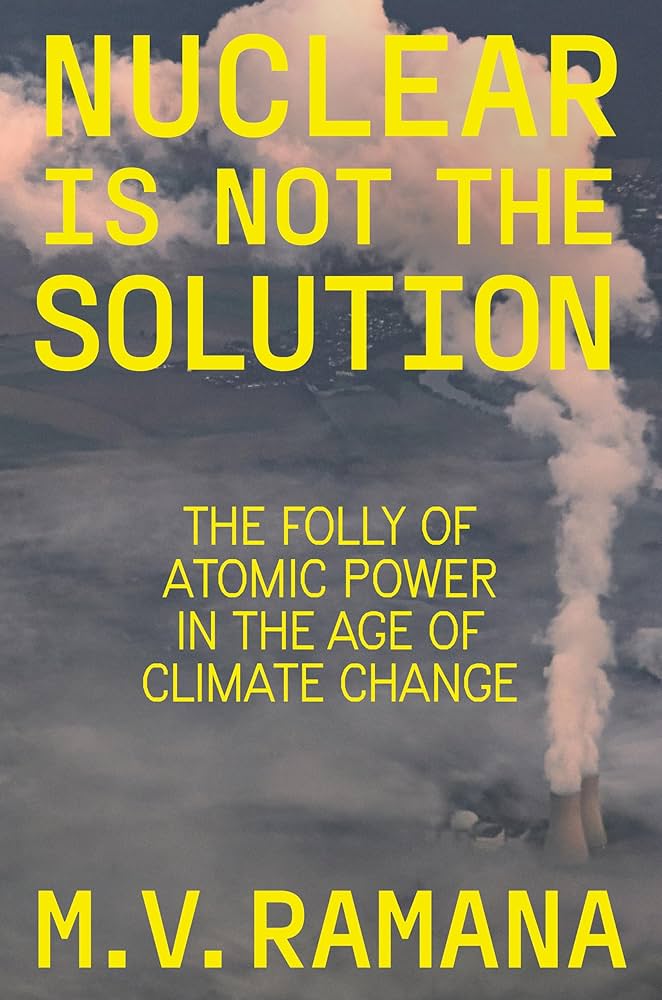
An urgent critique of nuclear power laid out in clear arguments with suggestions for decarbonizing our energy systems with renewable energy technologies.
The climate crisis has propelled nuclear energy back into fashion. Proponents of nuclear argue that we already have the technology of the green future and that it only needs perfection and deployment. Not a Solution demonstrates why this sort of thinking is not only naïve but dangerous.
Even beyond the horrific implications of meltdown and the intractable problem of waste disposal, nuclear is not feasible. Any appraisal of green energy technology depends on two important cost and time. Nuclear fails on both counts. It is more costly than its green competitors and thus a dollar spent on nuclear energy results in fewer megawatts than a dollar spent on wind or solar. And, importantly given the need for rapid transformation, by 2030, it is slow. A plant takes a decade to come online. If you include permits and fundraising, this adds another decade. And we should not forget the deep connection to the defense industry.
Ramana’s powerful book breaks any illusions in the hope of nuclear, untangling the technical elements into simple and sensible arguments. Importantly, Not a Solution also unmasks the powerful groups with deep interests in the maintenance of the status quo who have worked so hard to greenwash one of the dirtiest industries in the history of our species.
I started this feeling very skeptical, I always thought nuclear was as good as renewables. I have to say I am successfully convinced otherwise. The strongest argument against nuclear energy I think is that it’s very high price tag takes money away from renewables that are cheaper and faster to build, and considering the imminent climate crisis we are in, the faster the switch to renewables is complete the better. It’s just pointless to be advocating for nuclear in our current situation.
Ramana has given us quite a book. I came with an open mind and interested, and despite some odd diversions into easy errors (that might also be unfunny and pointed jokes) found the whole informative.
That said, and oddly, despite well-marshalled arguments and plentiful facts, the whole of the book is less than the sum of its parts, and despite Ramana's evident personality his writing lacks personality. Part of the problem could be the well-worn nature of the subject with its familiar dodges and follies. It certainly isn't a uniform truth: there are passages and entire chapters where the material is gripping, such as Ramana's illustration of why it is more lucrative to be always "building" a nuclear power plant than it would be to actually have that plant up and running!
So, mixed feelings, but a good book and worth reading if you want to enrich your understanding of the corporate side of the debate - this is where you'll find it.
Gives a good overview of the critiques of nuclear power. It’s written for a general audience so some of the more technical aspects are elided, which can be a benefit or a drawback. I thought it was, in general, easy to understand without knowing a ton about how nuclear really works, but at the same time, there were instances where further explanation could bolster the argument (such as why reactor designs that have passive safety systems are not always failsafe, or why complexity necessarily makes things more dangerous - makes sense logically, but a concrete example might help).
Basically, nuclear is expensive (and not getting cheaper) and takes a long time to build, meaning this isn’t the solution for climate change when renewables are cheaper and faster to spin up. Small module reactors (SMRs) meant to speed production and lower costs aren’t doing that either! With all that comes the power of the nuclear lobby and loosening regulations to attempt to make things “cheaper”, potentially at the cost of safety. And for this author, the safety aspect is just another reason why nuclear should be scrutinized - even barring accidents like Chernobyl or Fukushima, what do we do with the waste we need to take care of for thousands of years? That, and the revolving door between civilian nuclear and military nuclear is not very separate as nuclear proponents make out.
I don’t think this will or is meant to answer any and all questions about the limits of nuclear energy, but it’s a good starting point. I do think that at the end of this what it lacked was, if nuclear is NOT the solution, what is? That section was extremely short and I would’ve loved more.
a potent and multi-layered argument against nuclear energy (and capitalism) with a conclusion that aims at resetting the energy paradigm. i would consider this essential reading for those interested in degrowth, renewable energy, and moving away from a world founded on exploitation
While I found many of Ramana's points quite compelling, this book felt pretty scattered. It's fiery and jumped around a bit too much for me without going into much depth. The economic arguments were newer to me and held ground. Takeaways: nuclear is a distraction from solving climate change with renewables, government and private industry have been pushing nuclear propaganda because it is profitable and ratepayers and tax payers cover the costs, the technology hasn't really broken through even this far into its lifetime. Though I read Mahaffey's book for a pro-nuclear take, I almost found that book to give me more detailed reasons to oppose it.
There are some interesting aspects of the book, I particularly found their concerns about the costs of nuclear energy to be valid. But the rest of the book is filled with fallacies. I particularly found their argument on nuclear proliferation to be the most egregious. I feel like the author did well on things that were in their wheelhouse, but was more lazy on aspects of nuclear energy that wasn’t.
*Taylor Swift voice* But what if it is? (I'm always interested in hearing green arguments against nuclear. Everything I've heard from energy industry professionals says decarbonizing needs an "all of the above" approach, I wouldn't say I'm hugely committed for or against nuclear power, but I'm a bit skeptical about the mismatch between what experts and political groups say about it.)
Mostly, this book is a diatribe, it's not aiming to persuade anyone, it's written assuming you already agree with his position. It's hard to be convinced by a lot, because he isn't interested in giving a balanced view of the debate. There *are* some good arguments in here: That for nuclear to be effective as climate change mitigation, it needs to be available to everyone - if it's only for rich, stable countries with good human rights and industrial safety records and low proliferation risk, then it can't work as a solution. That the scale of rollout that would be needed, on a commercial basis, means the safety standard you have to worry about is whichever operator has the lowest standards, cuts the most corners, and whenever their business is going through its worst patch. Across thousands of reactors and centuries of use. That governments have motivations other than commercial viability to subsidize the nuclear industry - although I think that should be seen as a reason to be careful about how we take that investment as an indicator of credibility, whether we treat the nuclear industry as commercially proven technology. And that commercial investment in nuclear is dependent on risk-sharing agreements in which government has to take on *huge* liabilities, because the idea of an LLC owning infrastructure that needs hundred-thousand-year actions to safely decommission and government can't walk away from - that's an enormous risk to transfer.
Two things I would really have liked to hear more about: How the position has changed over time? Solar is really taking off now, but a few decades ago (and well within the timescales this book covers!) it was in the same "experimental technology making big claims about fixing climate change, but we need a lot of progress before it's viable". I think that's important context to people advocating nuclear pre-millennium, and I think something he misses by assuming everyone involved was just lying anyway. And about energy mixes - he mentions briefly in his conclusion that there is a "legitimate debate" about nuclear being used to balance variability in renewables, but then dismisses it ("but the debate has a legitimate conclusion: that there is no evidence for nuclear power being needed to make the grid reliable"). I'm not sure if that means his main argument was against nuclear *alone* as a solution to climate change, and if his whole argument up to that point was based on a false dichotomy? It kinda seems like that "legitimate debate" should have been the thing to write a book about, not just a one-line dismissal?
Even in environmental policy circles, I had found that it was easy for myself and others to be sold on the empty utopian dreams that are proliferated by the nuclear industry and its network of lobbyists and spokespeople. Yet the question had lingered in my mind: if modern nuclear really is much safer, cheaper, and environmentally friendly as it used to be, then why hasn’t it already been mass-deployed? The narrative from the nuclear crowd was that the industry carried too much baggage from the Cold War arms race and catastrophes like Chernobyl, and if people could see the light on the latest “advancements” then they would surely rally behind the power of the atom. But the industries of oil, gas, and coal have found little resistance from the public’s opposition to their externalities and decades of imagery portraying them as sources of nasty, greasy, Mother Nature-destroying gunk. The market forces behind them have overcome that, yet nuclear, with its backing from an 80-year industry, the US military-industrial complex, and billions of investment from venture capital has plummeted in its share of the energy market in the last 10 years. So what gives?
A lot, in fact. Ramana’s polemic has a lot of ground to cover in its 250 pages, and so the arguments strike the surface of issues such as economic infeasibility (and downright fraud), unavoidable public health and environmental risks, weapons proliferation, and a severe mismatch between the time for deployment and the urgency of addressing the climate crisis. Yet his writing and sourcing makes clear that for each of the claims that appears in the book, there’s a large amount of research and direct experience on the underside of the iceberg. Giving a fully comprehensive look at each of this issues is pretty much impossible for a book of this size, but it succeeds really well as a convincing overview that is elevated by the author interweaving a social science approach to the hard scientific and technical elements.
Very good rundown of all the problems with nuclear power plants. In short, they're expensive, take lots of time to build, and always finish late and over budget (often significantly so), they produce a lot of radioactive waste that last aeons with no viable way of disposing of them, and they make the proliferation of nuclear weapons much more likely. I wish I had a really good memory so I can cite all the arguments against, e.g., small modular reactors when someone brings up why they're necessary to fight climate change. As a technical challenge, nuclear power is just an overly complicated way to boil water and all the money and resources put into it would be better spent on renewables.
''Promoting nuclear power and other untested technologies serves to divert the public’s attention away from the larger systemic drivers— in particular, unabated capitalism and its need for never-ending economic growth—of the climate crisis. Pushing the nuclear agenda allows maintaining the false idea that the current pattern of development can continue indefinitely with no limits, while climate change is solved by using one more technology from the same toolbox responsible for the problem in the first place.''
“Promoting nuclear power and other untested technologies serves to divert the public's attention away from the larger systemic drivers— in particular, unabated capitalism and its need for never-ending economic growth—of the climate crisis. Pushing the nuclear agenda allows maintaining the false idea that the current pattern of development can continue indefinitely with no limits, while climate change is solved by using one more technology from the same toolbox responsible for the problem in the first place.”
***
Somewhat dry and in the weeds at times. Not a huge fan of Ramana's writing style. I liked the chapter dissecting the connection between nuclear power & nuclear weapons, as well as “Magical Thinking and Billionaire Messiahs”