Charles Darwin first visited the Galápagos Islands almost 200 years ago, only to discover a land filled with plants and animals that could not be found anywhere else on earth. How did they come to inhabit the island? How long will they remain?
Thoroughly researched and filled with intricate and beautiful paintings, this extraordinary book by Award-winning author and artist Jason Chin is an epic saga of the life of an island—born of fire, rising to greatness, its decline, and finally the emergence of life on new islands.
Jason chin creates a story out of the life of an island, the Galapagos Islands. How it started and the animals that lived on it. It’s well done and engaging. The artwork is beautiful and there are pages that are told in almost comic book like panels that show an animal change over time or the island grow or shrink over time.
I admit to being unaware of the history of these islands and I certainly didn’t understand that they sank back beneath the ocean eventually. It becomes a great story. It reminds me a little bit of the Pixar short - Lava about the islands.
There is a lot of information here and I feel it comes across as more story than mere facts, but the story is based on facts. It’s a story that becomes something easy to learn. The nephew thought the pictures were pretty from the start and then he became amazed by the story. He couldn’t believe that an island had a birth and basically a death. The story is told over 6 million years. He thought the iguanas looked monster-esk. He gave this 3 stars and told me the book was pretty good.
Since I had just read Kurt Vonnegut's fictional black comedy Galápagos I saw that Jason Chin, whose beautiful picture book about the Grand Canyon I had read, had also done this non-fictional picture book for children, so decided to order it. As with his Grand Canyon, he researches his subject thoroughly, illustrates it beautifully and creates a loose story so that young and old can get a better handle on a complicated subject.
The story here is one that spans six million years, from birth to the present "old age" of the islands, though he says that islands may have been growing in this area for up to 90 million years. While archaeology and evolution are among his chief foci, he also wants people to know what the islands are like today. There's lots of additional information on Charles Darwin and the Galápagos, more on the islands themselves, geology, flora, and fauna, water and land.
I'm of two minds about the book; it's pretty dense and text-heavy, which I personally like, though I think it would be a little too dense for smaller children. But this is a reason to have it around, I guess, so you can gain information from it as you re-read it, as you grow older. A Gryphon Award winner.
This book is well-researched and detailed with stunning , intricate illustrations. People of all ages would enjoy this introduction to the Galapagos Islands!
Although Jason Chin readily admits in his informative author's note that Island: A Story of the Galápagos is a bit speculative, it is still (in my humble opinion) absolutely based on scientifically sound concepts, it focusses on the actual fossil evidence (as well as on Charles Darwin's personal observations whilst he was visiting the Galápagos Islands as chief naturalist aboard the H.M.S. Beagle and before penning his seminal The Origin of Species) and of course and also naturally on the "written in stone" ancient geologic record of the Galápagos Islands and other volcanic islands that are formed due to a so-called hot spot. But of course, the very fact that Island: A Story of the Galápagos is a speculative science story might likely also be used by staunch creationists to discredit the entire concept of evolution even though there is now in fact more than ample both fossil and geologic evidence to show that the theory of evolution is generally considered to be the story of life on earth (and guess what, you can in my opinion still believe in God and also at the same time believe in science and in the theory of evolution).
An engagingly told text with brilliantly colourful and wonderfully descriptive accompanying illustrations, Island: A Story of the Galápagos is in my opinion a perfect introduction to both the Galápagos Islands themselves and to the general concept and theory of evolution in and of itself (and having the islands portrayed almost as humans, from birth to old age, but showing that because of the hot spot running deeply into the mantle of the death, there is also a constant continuation of new islands being formed and life populating these new islands, evolving, changing, living, this renders Island: A Story of the Galápagos as almost most a personal and emotionally relatable tale), most suitable for older children above the age of eight or nine (although yes, for a read-aloud, Island: A Story of the Galápagos would probably also work well enough with younger children, as while there is definitely a lot of text included in Island: A Story of the Galápagos, Jason Chin also never makes his narrative overly difficult or heavy with scientific vocabulary and jargon).
Five stars for the general concept of Island: A Story of the Galápagos (and for the in all ways wonderful and delightful combination of Jason Chin's printed words and his artwork), but lowered to a three star general ranking for me, since for one, I really do wish that the informative and educational supplemental information and details section (on Charles Darwin, on the Galápagos Islands and their endemic animal species) also contained a bibliography with suggestions for further reading and study and that for two, in the Kindle Edition of Island: A Story of the Galápagos (which is how I have read this book), especially the illustrations are rather small in circumference and sometimes a bit blurry (and the text also pretty tiny in size, which would make in particular reading Island: A Story of the Galápagos aloud to a child or to a group of children potentially rather difficult).
One of my huge lost chances was a high school biology class trip to the Galápagos Islands. I so wish I’d gone. I had wrongly assumed that there were many travel opportunities in my future. Ever since high school when I learned about this place, I’ve been interested in the area, even though I haven’t read that much about it, and since I’ve greatly enjoyed two other books by this author-illustrator, I was very excited to read this book.
I loved how the inside front cover has illustrations and names of species of animals & plants that live on the islands. I really enjoyed the map that’s on the inside back cover. I had no idea how many islands make up this chain; there are many.
This is a riveting story about this islands, from birth 6 million years ago due to volcanic activity, to how life might have started and how it spread, and then the reader finds out that the island (one of the chain of islands)
The illustrations are stellar, both the full page pictures and the miniatures. I thoroughly enjoyed them. The pictures really make the book.
The story would be most interesting to those interested in evolution and/or the Galápagos Islands. It does go on and on a bit. The account is presented in extremely short chapters: I. Birth : Six Million Years Ago, II. Childhood: Five Million Years Ago, III. Adulthood: Three Million Years Ago, IV. Old Age: One Million Years Ago, and V. Epilogue: 1835.
At the end of the book there are 4 illustrated but more text heavy pages of additional information on Charles Darwin and the Galápagos, on the Galápagos Islands, about Endemic Species fo the Galápagos, and an Author’s Note. I found the additional information fascinating. One piece of info is the thought that islands may have been growing in this hot spot area for 90 million years. Some numbers for species of animals and plants are given too. And the author-illustrator acknowledges that the account he gives is based on science but “brought to life through imagination” and I’m glad he clarified that.
Island: A Story of the Galápagos is a stellar nonfiction picturebook: captivating, informational, well-researched, beautifully illustrated, and cleverly designed:
Brilliant picture-book author and artist Jason Chin, whose previous works of natural history for younger children have examined such unique ecosystems as the coral reef and the redwood forest, presents a "biography" of a Galápagos island in this latest venture. Beginning with the birth of the island six million years ago, when an undersea volcano erupted, leading to its creation in the first place, the narrative follows the slow process whereby the island is colonized by both flora and fauna, and how that life evolved, in the relative isolation off the west coast of South America. The narrative concludes with the story of the island's gradual sinking back into the ocean, as newer islands take its place, while an informative afterword gives more details about the Galápagos in general, and about their role in inspiring Charles Darwin's theory of evolution.
Having greatly enjoyed Chin's Redwoods and Coral Reefs, I was quite excited to discover that Island: A Story of the Galápagos was forthcoming. All in all, I'd say that is lived up to my expectations, presenting an informative narrative in a coherent and engaging fashion. There is no fantasy storytelling device here, as there was in Chin's previous two books - no boy on a subway reading about the redwoods, and then finding himself amongst them; no girl picking up a library book about coral reefs and falling into a watery world - but that's OK, the notion of a "biography" of an island, with chapters devoted to the stages of its life, was entertaining enough to do the trick. The artwork, as is to be expected from Chin, was simply marvelous, beautifully capturing the wild charm of this very special part of the world. Highly recommended to all young naturalists, to anyone looking for a simple explanation of the concept of evolution for children, and to fans of Jason Chin's gorgeous artwork.
Tells the story of an island in the Galapagos, from its birth, childhood (when more species of plants and animals make their home there), through adulthood and to old age.
Love the varied perspectives of the paintings -- aerial overviews of the island, sequential closeups of the animals and plants and how they evolved.
Ends with the arrival of the Beagle.
Great authors note at the end, explaining what part is true and what part is speculation -- science "brought to life through my imagination." Also notes about Endemic Species, Darwin, and the Galapagos.
Wonderful example of engaging narrative nonfiction combined with real artistry.
Redwoods was my introduction to the wonderful Jason Chin a couple of years back, but it was a bit too fiction-y for the other Cybils panelists back then. Times have changed, though, and we readers are more open to a whisk here and there of fiction elements in our nonfiction. And (at least I think) it makes for a better world.
So then Island. Let's look at Island. Chin, panel by panel, takes us through the birth, growth, and eventually disappearance of an island in the Galápagos. We see the island and its inhabitants change, over years and years, in little ways that, as time passes, become big and helpful modifications. Chin pulls his characters, all the creatures who begin to populate the island, right to the center of his drawings, posing for us, where we can look closely at all the curious developments, and slowly, reading along, we are pulled into the story of this intriguing spot in the world. Perhaps for the first time, like the first people who visited the islands, we see the inevitability of slow evolution and change in our world. Beautiful.
Follow the birth of a group of islands to the present day in this book that beautifully documents the wonders of the Galapagos. Opening with the drama of a volcanic eruption six million years ago, the book shows how plants and animals arrive at a new island in the ocean. As time goes by, the island turns from barren rock to a place of lush green. Specific attention is paid to the evolution of creatures and plants that are found only on these islands. Young readers will fully understand why finch beaks grew larger, seagulls got larger eyes, and tortoise shells changed shape. The book ends with Darwin arriving on the shores of one of the islands. This book is a celebration of these islands and the wonders of nature.
Chin’s book offers information that is solid and fascinating packaged with illustrations that capture the details of what is being explained. It makes for a book that is bright and energized and that is clearly nonfiction as well. The story of the birth and life of an island makes for a magnificent tale that readers are sure to respond to.
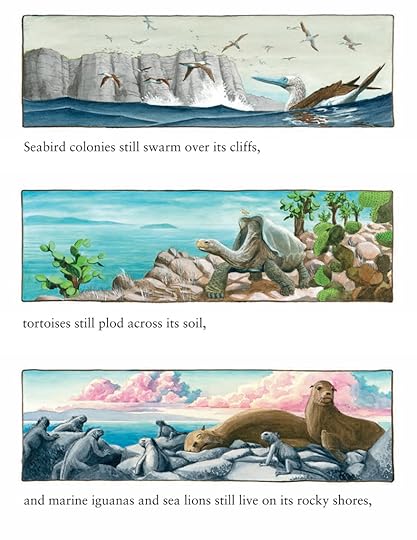
In his art, Chin brings the reader up close to what is happening on the island. We get to look between the mangrove roots at sharks, watch pelicans feast on fish in the lagoons, and see land iguanas float on logs to reach the island. Even better, as I mentioned earlier, the process of evolution is detailed so that readers can see the gradual but necessary changes that occurred.
This is one incredible nonfiction book that teachers, parents and students will enjoy looking through and learning from. Appropriate for ages 6-8.
Let's see.... How many picture books are there that discuss huge scientific concepts like natural selection and evolution, plate tectonics and island formation, species migration and colonization, and environmental change in an interesting way that little kids can understand all in the covers of one book? As far as I know, one. Island : A Story of the Galapagos is a fantastic book that covers all of these topics in a way that perfectly marries science and wonder. My nephew, who is five, let alone my nine year old niece, were fascinated with the parts of this book that discussed the evolution of Galapagos finches, blue-footed boobies, tortoises, and seagulls. They were completely captivated by the geological forces at work in the creation and destruction of islands. The pictures in this book were fantastically done, too, enabling kids to see the effects of evolution or geology in series. The end matter further discussed Charles Darwin and his theory of evolution and natural selection, and it broke down the geological forces behind island creation in even further detail. Jason Chin is a master at creating wonderful non-fiction picture books for kids. He can break complex topics down for them in a way that they can understand, and yet, he does it without dumbing anything down. This is a fantastic children's book by a fantastic children's author! Easily a five star book.
Well-done book explaining island formation and species evolution to children. Since reading a biography of Charles Darwin, I've been intrigued with the Galapagos. So I liked the information given, even if some was speculative based on fact. Lovely pictures. Well-explained. This will be a good choice when Common Core is in place.
This outstanding picture book takes us through the geological origins of one of the islands in the Galápagos archipelago. It then traces how life blossomed in its shores and how, ultimately, the island was reclaimed by the ocean and became a seamount.
Nonfiction picture about natural selection. Even though, this story mentions Charles Darwin in the appendix; it is not a story about evolution vs creationism.
Really well-done. Not the easiest subject matter to break down into a picture book for children but Chin succeeds in conveying the information effectively -- and the illustrations are stunning.
Jason Chin narrates the story of the Galápagos Islands from their volcanic birth to their discovery by Charles Darwin onboard the Beagle with rich and detailed illustrations and a wonderful sense of time and place.
There’s lots of information but the narrative never feels like it is just infodumping fact after fact. With younger children, looking at the illustrations and talking about them is sufficient but as the child grows older, this book will reward repeated re-readings.
A beautiful introduction to these wonderful islands and their unique environment.
Island: A Story of the Galapagos is a very unique and fascinating take on a nonfiction picturebook. From the very beginning, the author tells you this book is a biography of an island. That theme holds true as he details the geological and biological processes that evolve the island over millions of years through its "childhood, adolescence, and adulthood." Artistic renditions of an ancient volcano exploding and seagulls swarming near the island's shore are breathtaking and captivating. Individual species are shown in their journey to the island from near and faraway lands, and the evolution of these species is later shown in an engaging and condensed way. The Galapagos islands are famous for being the location of Charles Darwin's discovery of the theory of natural selection. Darwin and his team arrive in the epilogue to the story and begin their detailed portrait of the changing life of this unique spot in biological history. In the notes at the end of the book, the geological processes of the formation and reformation of the Galapagos islands are detailed along with more information about the how the process of evolution by natural selection works.
I think using this book to launch students into an investigation of evolution would be a fantastic idea. It seems that a vast majority of students go through the public education system without ever truly understanding this fundamental biological process. Even for nonscientists like myself, this theory is foundational to the understanding of how we relate to and connect with all of the other lifeforms on Earth, and an understanding of it can build strong empathy and care for our animal relatives. It is never too early to start learning about natural selection, and there are plenty of resources out there. Here are some favorites for older elementary students from a website that I recommend: https://educators.brainpop.com/bp-top...
Filled with luminous, detailed illustrations and engaging, accessible text, this marvelous book tells the story of the Galapagos Islands near Ecuador. Starting with the formation of an island six million years ago and moving through various stages of its lifespan, until it sinks beneath the sea to become a seamount, the book describes volcanic eruptions, rainfall, and species that made it their home. It also identifies many species found only on the Galapagos Islands and explains how species that were able to adapt to the changing living conditions were the ones that survived. The example the author uses of finches with slightly larger beaks being able to open the larger nuts for food while those with smaller beaks eventually died out is particularly effective. Although he admits that some of what he describes here is conjecture, it seems highly unlikely. One can only presume how astonishing all of these unique creatures must have been to Charles Darwin when he visited the islands, an event shown in the book's epilogue.
We've read several books by Jason Chin and we love the gorgeous illustrations and creative way of teaching without being boring or overwhelming the reader with details. I really love learning about the Galápagos Islands and would love to visit them one day. This book offers a great introduction to the islands and the science of evolution.
The narrative is entertaining and as usual, the illustrations are terrific. We really enjoyed reading this book together.
Charles Darwin first visited the Galápagos Islands almost 200 years ago, only to discover a land filled with plants and animals that could not be found anywhere else on earth. How did they come to inhabit the island? How long will they remain? Thoroughly researched and filled with intricate and beautiful paintings, this extraordinary book by Award-winning author and artist Jason Chin is an epic saga of the life of an island; born of fire, rising to greatness, its decline, and finally thenbsp;emergence of life on new islands.
Note - One of Kirkus Reviews' Best Children's Books of 2012
Subjects
Natural history -- Galapagos Islands -- Juvenile literature.
This book has so much to recommend it on different levels: science, imagination, maps and elevations, and detailed pencil sketches and paintings. This is a great introduction to the birth of islands, volcanic activity, geology, the theory of evolution and survival of the fittest, and Charles Darwin. And the value of is book is it sets all these elements into the physical boundaries of the Galápagos Islands, from its projected origin, geologic development, and discovery, to its ongoing transformation. This isn’t an easy reader, and may require an advanced interest in science, but Chin is careful and forthright about his intent in his Author’s Note. He excels in his visual style here and again makes good use of his appendices to provide more info as launching points for further study.
A solid narrative, illustrated rendition of six million years of evolution on a Galapagos island: from its first moment cresting the ocean, through slow arrival of various species and their even slower evolution, gradual growth and decrease of the size of the island, until finally it sinks beneath the waves again.
It's very difficult to capture enormous spans of time in such a short book... or perhaps I should say instead that it seems very difficult, based on the picture books I've read related to this topic. Chin does a very good job with that, probably the best I've seen in this format.
Outstanding presentation of the rise, and fall, of one island in the Galapagos. Art and information blend to provide the theory of how all this wildlife came to inhabit this collection of islands. The back includes information about Charles Darwin and the Galapagos, the endemic species of this ecosystem, but aside from a list of people who assisted the author, it lacks a bibliography.
Jason Chin does an exceptional job illustrating and telling the story of the formation and evolution of the Galapagos Islands in this beautiful book. Somehow, Chin is able to tell a story that spans 6 million years thoroughly and while keeping the reader's interest, even if that reader is a young child, in this picture book that won the 2013 Gryphon Award.
I don't know quite how to evaluate this for either Newbery or Caldecott consideration, but it's a great book and one I will definitely be giving as gifts. The art is strong--I love the little three-panel vignettes of the adapting animals and plants--and the text is clear and engaging.
Complex scientific processes such as plate tectonics and evolution are explained in an accessible and engaging way as Chin describes the birth and growth of the Galapagos Islands. Beautifully illustrated with additional historical and scientific information in the back.
Chin does an excellent presentation of evolution of the geology and flora and fauna of the Galapagos Islands, with superb art as well. I loved it so much, I'm going to buy it for the grandson of some friends of mine.
I love the Galapagos, and wanted a book to introduce Jen to a place I've always wanted to go. At the moment the text is still a bit dense for her but she loves pointing to all the different animals. Maybe I can convince her to do a mother daughter trip in a few years.