Jump to ratings and reviews
Rate this book
Rate this book
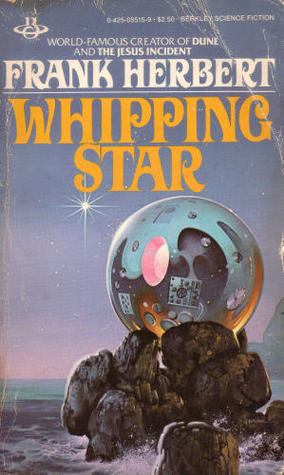
Jorj McKie finds the last of the powerful Caleban species, damaged and fading, who must be freed from a power threatening all sentient life.

192 pages, Paperback

First published November 30, 1969

94 people are currently reading
3392 people want to read

About the author

Frank Herbert

547 books16.5k followers
Franklin Patrick Herbert Jr. was an American science fiction author best known for the 1965 novel Dune and its five sequels. Though he became famous for his novels, he also wrote short stories and worked as a newspaper journalist, photographer, book reviewer, ecological consultant, and lecturer.
The Dune saga, set in the distant future, and taking place over millennia, explores complex themes, such as the long-term survival of the human species, human evolution, planetary science and ecology, and the intersection of religion, politics, economics and power in a future where humanity has long since developed interstellar travel and settled many thousands of worlds. Dune is the best-selling science fiction novel of all time, and the entire series is considered to be among the classics of the genre.

Ratings & Reviews

What do you think?
Rate this book

Friends & Following

Create a free account to discover what your friends think of this book!

Community Reviews

5 stars
838 (21%)
4 stars
1,385 (35%)
3 stars
1,320 (33%)
2 stars
309 (7%)
1 star
67 (1%)
Displaying 1 - 30 of 259 reviews
Profile Image for Lyn.
2,009 reviews17.6k followers
May 12, 2017
Original.

Whipping Star by Frank Herbert, first published in 1970, explores among many things the complexities of communication; heightened by hyperbole as between xenological species but also as an allegory for human relations.

I once cross-examined a troglodyte who was being intentionally evasive and it was maddening. Reading passages in this book was akin to that experience, yet Herbert uses it as an illustration of the frailty of relational semantics.

Another aspect of this book that was disconcerting was an undertone of absurdist humor. From reading other Herbert creations, I cannot believe that this was intentional, yet there it was, kind of a Monty Python sensibility. And all the more amazingly, Herbert pulls it off as a psychological instrument. This would have made a bizarre Doctor Who episode, or a CSI show written and produced by Terry Gilliam.

Fascinating, oddly hypnotic, weird and completely unique (except for the pseudo-sequel The Dosadi Experiment) Whipping Star is a short, strange trip.

Finally, Whipping Star represents a singularly jaw-dropping phenomenon, one that was not achieved by Heinlein’s Starman Jones or by Ursula K. LeGuin’s The Dispossessed. After decades of reading science fiction, I wish that I had paid more attention in math class.

description
Profile Image for Bradley.
Author 9 books4,866 followers
December 10, 2020
In today's SF market, I doubt we'd EVER see a novel like this get published.

After all, it's highly abstract, deals with n-space topologies and a macro-inversion of String Theory as tied to consciousness, and it happens to be a really neat IDEA. The blurb may be accurate, but it doesn't do the intelligence of the novel ANY justice.

Here's the thing: we're meant to be floundering in the water like the main human characters trying to make SENSE of the things this truly alien alien is saying. The fact that it may or may not be a 4th-dimensional creature (in the way that Arrival was) is hard to suss out because of the highly abstract but very logical word salads.

Add to that a completely misunderstood agreement that allows for instant portals, time-travel, and a really nasty side-effect of killing the alien, slowly, nastily, and we've got a novel that OUGHT to be more respected and read. It has a lot of fantastic ideas and the mystery fully engaged me to the hilt.

If I had read this not knowing it was Frank Herbert or that it had been written a while ago, I would have assumed I was reading a contemporary of Greg Egan or a companion to Peter Watts' Blindsight. These have a lot in common. If I had said he was a newcomer, I would have said, "Hey! This is like Robert Silverburg at his best!"

The fact is, this novel may be forgotten because so much attention is put on Dune. Whipping Star doesn't pretend to be anything but what it is: a very intelligent novel about language, understanding, and N-Space physics with a side dish of quantum.

I recommend it for anyone who despairs that SF is getting too stupid. :)

Profile Image for Scott Rhee.
2,310 reviews161 followers
November 18, 2024
This is an odd book, even for Frank Herbert, which is not to say I didn't like it.

The title "Whipping Star", I thought, was going to have some fascinating metaphorical meaning, but nope, it actually involves someone using a leather whip on a shining bright ball of gas in space. I'm not joking.

The ball of gas in question is actually a life-form called a Caleban, which exists on another plane or dimension of existence, and I'm still not quite clear as to why the character actually has a thing for whipping the creature. It's implied that there is some weird sexual thrill that comes from whipping a Caleban. I'm sure there is.

The problem is, with each lash of the whip, the Caleban gradually loses strength, and when it inevitably dies, so will every human being in the universe. How and why this is going to happen is unclear, but the protagonist, Jorj X. McKie, an agent of the Bureau of Sabotage, is pretty convinced of it. Oh, and the Caleban in question is named Fanny Mae, and she's in love with McKie.

I'm stifling laughter (badly) with every keystroke of this summary. I have no idea what Herbert was smoking or ingesting when he wrote this. It was the '60s at the time he was writing this, so that might explain a few things.

Regardless of how silly this sounds, i have to say I enjoyed it. Parts of it were pretty humorous, intentionally or not. I will definitely re-read it someday. I may try reading it high because it may make more sense that way...
Profile Image for Claudia.
1,013 reviews775 followers
dnf-not-my-cup-of-coffee
June 7, 2022
Another DNF. Hard to suspend disbelief with such a laughable premise. I could tell from the 50 pages I read that it's mostly philosophical and language based, but it wasn't enough to keep me going.
Profile Image for Benjamin Duffy.
148 reviews802 followers
August 30, 2013
Mind-blowing.

Like a lot of Herbert fans, I was introduced to Frank Herbert through Dune and its original quintet of sequels. And like a lot of Herbert fans, I kind of stopped there. It was only later, years later, that I bothered to read some of his other books. And while the Dune saga still represents his most complete vision and best storytelling (at least through the first four books), and is deservedly his best-known work, I've started to realize that some of his most truly impressive feats of imagination and intelligence lie within his books outside of the series. Destination: Void, with its penetrating insights on the nature of consciousness, is one such book. The Dosadi Experiment (actually a sequel to Whipping Star, but which I accidentally read first), which takes a much more detailed look than Dune at exactly how humans might evolve in a hyper-hostile environment, is another. And Whipping Star is absolutely in that same class.

Here's just one example of Herbert's genius: One thing that was shocking to me, in reading Whipping Star, is how deeply Herbert approached the idea of communication between humans and aliens. Extraterrestrial contact is such a basic staple of science fiction that it's amazing how little some SF authors seem to think it through. On the shallow end of the depth continuum you have the Star Trek and Star Wars universes, where the vast majority of aliens are just humans with weird bumps on their heads, and most of them happen to speak English as a second language for your convenience. Certainly there are cultural disconnects as humans deal with Klingons and Wookiees, but they're roughly on a par with "Crocodile Dundee making his way through New York City" in their severity. Slightly better thought through than those examples might be Larry Niven's aliens in Known Space: clearly, they think differently than humans, and understanding is rarely perfect, but everyone seems to have magic translator boxes and once again, the real problem of interspecies communication is hand-waved away. Closer yet to a realistic treatment would be Heinlein's Stranger in a Strange Land, where the Mars-raised human, Valentine Michael Smith, knew the words and syntax of English, but that was no guarantee of clear communication because his whole way of thinking and set of experiences was so vastly different than an Earthling's.

Heinlein is the first SF author who appears to have honestly thought the thing through, and Herbert takes it to a whole different level in Whipping Star. As the protagonist, Jorj X. McKie, attempts to communicate with the mysterious Caleban, the basic breakdown in understanding is evident, and the characters' frustration is palpable and believable. Herbert makes the reader think of what it would be like to deal with a creature that's as intelligent as a human, maybe more so, but not at all human. The dialogue between McKie and Fannie Mae alone makes this book worth the price of purchase, and the book is filled to bursting with other ideas besides that, in spite of being short and fast-paced. For one, it takes a unique and plausible stab at FTL travel and time travel.

An enormously impressive and enjoyable book. I give it four stars instead of five only because, much like Destination: Void, the story is a ramshackle thing, mostly meant to convey Herbert's ideas from Point A to Point Z. It's still more than worth the read, though, if you're into science fiction that makes you think.
Profile Image for Bryan Alexander.
Author 4 books318 followers
October 14, 2016
I picked this from the shelves on impulse. I wanted to reread it for pleasure, to confirm my memories of the book. Also, I continue my leisurely effort to remember and/or explore Frank Herbert's non-Dune books.

And what a fun novel!

It's a bit hard to describe. The story takes place in a future where humans and aliens coexist across the galaxy. The plot begins as a villain attempts to kill a Calebian, an alien with the power to teleport anyone across star systems. Our protagonist, Jorg McKie, is an agent of the delightfully conceived Bureau of Sabotage, whose purpose is to slow down the workings of government, and whose agents are a mixture of spies and diplomats.

The story is thus a kind of hybrid police procedural and space opera, which means tons of action (multiple transdimensional beheadings), scheming, investigation, alien worlds, aliens, and high technology. Since Frank Herbert wrote it, the novel is also focused on major philosophical issues: language and perception, sincerity and love, and how to deal with death.

So what's so good about it, then?

To begin with, Whipping Star might be the most entertaining Frank Herbert I've ever read. The BuSab agents are cards, sarcastic and wise-cracking, always complaining about life and frantically trying to out-do each other (you get to be boss of the agency by successfully sabotaging the current chief). The dialog nicely and refreshingly counterpoints the more traditional Herbert-style cryptic wisdom we see with his chapter-heading epigrams. Those are good as ever, too.

Whipping Star is also a fine example of world-building. Herbert offers very few infodumps. Instead he has characters name new things (aliens, technologies), then the action shows what they do. The names are often clear or cute: jumpdoor, sniggertrance. Herbert also drops some names and doesn't bother explaining what they represent, which is nice and realistic, as we normally discuss things people from other times wouldn't know. "Look at my internal-combustion car, friends!" - no.

I mentioned police procedural, and this really is one. The cops are the BuSab agents, and their setup has all of the subgenre's characteristics: bureaucracy to wade through, legal wrangling, forensics labs, media to use or evade, officers to deploy, canny adversaries exploiting structural weaknesses, intercultural conflicts, and, of course, a good mystery. Since this is a police-sf hybrid, the mystery naturally involves the nature of the universe. It's also a surprise in one way: .

Whipping Star is also very compact and focused. The plot kicks off on the second page, and is only resolved in the final paragraph. It races along with few digressions. This might be a weakness, as we get little information about characters - how can McKie marry that many times? what is Mliss Abnethe's story? - but that fits smoothly in the genres, and characters get good detail for all that.

There's also a nice level of surrealism and even fantasy. The crux of the plot - well, I can't say much without spoilers, but it's almost comic. It's also a striking (sorry) image, this surreal scene of a spherical room, where a semi-invisible being is regularly flogged by a disembodied hand from elsewhere in the universe, while characters peep in through windows carved in the air. There's a kind of gleeful invention, almost a lightheartedness, I don't recall from any other Herbert novel.

Now I'm off to reread Dosadi Experiment, the next book in this universe, and in good time. Let's see how it fares.
Profile Image for Ric.
396 reviews47 followers
September 13, 2013

The ultimate SF wordsmith, Frank Herbert takes on an ambitious project with the classic book Whipping Star.

In a universe made smaller by instantaneous travel, a mystery unfolds as the creatures who make such travel possible are disappearing. In fact, many have transferred their "connectives" such that there is just one, the Caleban named Fannie Mae. Jorj X. McGie of the Bureau of Sabotage (BuSab), an agency responsible for slowing down a hyper-efficient universal government, is specifically called to investigate. McGie uncovers a plot to kill the last Caleban which would trigger the "discontinuity" of all thinking beings (sentients) who have used the services of the Calebans. The means for Fannie Mae's "dissolution" is via a ritual flogging (the "whipping" part of the book title) whose nature McKie must understand in time to prevent the end of sentient life. If this sounds like a big pill of disbelief, it is, and needs much of the unguent of Herbert's story-telling ability for readers to swallow.

Although the overall framework of the book is that of a mystery, the bulk of the narrative focuses on the development of communications between McGie and Fannie Mae. Fannie Mae can perceive McGie only as the smallest component, an accelerated molecule. McGie must recognize the true nature of Fannie Mae despite the strange use of jargon by the alien (leaving readers with new appreciation for the use of "connectives", "discontinuity" and "dissolution"). Herbert shows great skill in depicting the growing understanding between the two. The topic of alien communication is seldom tackled well in SF. I would put forth as examples of good effort Sagan's Contact (using math as language) and Miéville's Embassytown (using action as language).

The preceding is perhaps the only part of the book which succeeds. The mystery, presented with Herbert's flair for the dramatic, is not as compelling as the villains are stock characters. The resolution seems abrupt and telegraphed. However, I say bravo for bravado. Herbert goes for yard and just misses. A high 3.5 stars. This book heightens the expectation for its sequel, The Dosadi Experiment, which I look forward to re-reading next.

Profile Image for Иван Величков.
1,076 reviews67 followers
October 24, 2020
КОгато я четох за първи път в гимназията, съм запомнил книгата като криминална фантастика доста под обичайното ниво за Франк Хърбърт.
Сега при препрочитането на "Фани Мае", както е преведена на български мнението ми се затвърди, но забелязах и доста други неща. Като начало Хърбърт поставя основите на света в който развива, според мен, най-добрата си книга "Експериментът Досейди", а криминалната основа е само фон върху който се развива една от радките и много любими мои "лингвистични фантастики". Комуникацията между Маккий и кейбланът Фани Мае е изключително добре предадена. Разговор с разум, живеещ в повече измерения от хората и виждащ времето и пространството по коренно различен начин. Това, заедно с типичните за Хърбърт фини алюзии към човешката история правят четивото предизвикателство за мозъка на читателя. Все пак книгата е малко дървена (предполагам от части заради превода, защото "Досейди" има коренно различно звучене, а и още от "Бога император на Дюн" съм се убедил, че Хърбърт трябва да се чете в оригинал... Другия път).
Йори Маккий е инзвънреден саботьор към Бюсаб - институция регулаторен орган, подчинен на Обединения разум, който контролира правителства и напомня доста анархистичните идеи в творчеството на ван Вогг . Маккий получава доста странна и много отговорна задача. Трябва да саботира договор подписан между садистична милиардерка и кейблан. Кейбланите са най-странната раса в обединерния разум. Никой не знае как точно изглеждат и комуникацията с тях се ограничава до договорни отношения. Те са отговорни за s-връзките - система свързваща населените планети, която, пак според мен, Симънс е изнинджил за телепорталите в своите Хипериони. Кейбланът се е съгласил да бъде бичуван, или поне формата му в нашите три измерения, с ясното съзнание, че след определен брой удари ще изгуби живота си. Проблемът е, че е последения кейблан в нашето измерение и след смъртта му всички, които са използвал;и телепортаторната система ще умрат, а това прави 99% от индивидите от всички разумни раси. Маккий трябва да се разбере със абсолютно нечовешкия разум, за да разбере къде/кога се е скрила мъчителката му. Опитите му са постоянно съботирани от милярдерката и екипът ѝ садисти, които имат свободен достъп до s-връзлите и могат да се появят във всеки един момент навсякъде.
Profile Image for Jim.
Author 7 books2,089 followers
October 25, 2015
I've only read some of his Dune books, so I thought to expand a bit. This wasn't really worth the effort. I think it's supposed to be a farce about communication. If so, the humor part mostly passed me by. What was left seemed more mental masturbation than story. There were some ingenious aliens, but that was about it.
June 4, 2020
This Frank Herbert fella wrote the book Dune which was a semi sleeper for me as it walked around this barren planet with some aristocracy stuff going on, got to try to read it again maybe I'm missing something?

This other "WHIPPING STAR" is swell though. Frank's little obtuse and abstract words and concepts hobble around and die and later get picked up and slapped back to life when you are completely confused and he nonchalantly needs to explain the word/concept for the story's sake which works most of the time in this book. Imagine (children) in the distant future people can instantly travel anywhere so there are planets for swimming, hospital hatcheries, entire planets of libraries etc. relying on these weird spheres who bend space to make it seem next door/through a door. Some old kooky dominatrix takes on any and many a sentient being to torture (with a whip for starters) for entertainment and discovers she can torture one of these weird spheres which house a formless mass that reacts to leather whips. She forms contracts with these sphere/mass things and one by one kills them off thru her one armed multi-legged hate servants who enjoy beating the hell out of anything.

It's so abstract in parts trying to talk to these sphere things since you have to be on some kinda drug to deal with them that it makes the book interesting, plus the idea of torturing a mass that's abstract makes me revel in the perversity panties on my head and cassette tape all over my toes. That's the beginning of the book folks, there's a fertile pile of concepts that go with each alien race introduced with the idea of if everyone was isolated to their own system what the hell would happen. The food and hospital supplies closed off from the rest of the worlds etc. The book is able to cover a lot of ground since the concept of bouncing around from system to system/world to world keeps it fresh and active.

A 4 and a half hour read for me, never set it down, and didn't eat. Wanna lose some weight? Read this five star joy buzz. Sorry. Five Black Holes!!

Review posted originally on sfbook.com
Profile Image for Josh.
283 reviews33 followers
October 26, 2007
Here's a basic premise of this novel: A seemingly divine being is discovered that allows instantaneous travel from any known point in the universe to any other. It is dying. If it dies, anyone who has used its abilities, which means nearly every known sentient being in the universe, will die with it because they are all now "connected." This sentient being has entered into a binding contract with a woman in order to learn about life in our dimension. Unfortunately, this woman is a sadist and wants to aid in its death for reasons of her own. It is up to intersteller saboteurs to stop her... Yeah, it's a damned weird book.

It's a really good book though. And at a short 180+ pages, you would think it would be a very fast read, but I found myself reading certain passages over again and thinking... "huh?" Herbert goes into many scenes where the main characters are trying to communicate with this being, and even after they seem to have deciphered their conversations, it's still confusing as hell. Still, the implications in this book are insane and as unlikely as it seems, it actually makes sense. If you've read Dune, you'll know that Frank Herbert is a great author and I doubt many other authors could have pulled off a book like this.

If you're in the mood for a short and just plain weird piece of sci-fi, I'd recommend Whipping Star. You'll just have to find it since, unfortunately, it is out of print.
Profile Image for Mariya Mincheva.
378 reviews29 followers
December 27, 2020
Хърбърт е прекрасен разказвач и за пореден път умело създава невероятни светове и форми на живот. Историята поставя и развива интересни въпроси и идеи. Най-впечатляваща е линията в която една интелигентна звезда се съгласява да заплаща за познанието на хуманоидната цивилизация с живота си. Както винаги развръзките и обратите са вълнуващи.
Profile Image for Stephen.
1,516 reviews12.4k followers
June 24, 2010
2.5 stars. Not in the same category as the Dune series (but what it). Overall, a decent to good story and some very good writing, especially in the conversations between the human and alien characters.
Profile Image for Jam.
18 reviews33 followers
November 9, 2011
The attraction of SF books is that they are like telescopes, looking at some point into the far future. They aren't hemmed in by the here and now, instead, in that tiny piece of glass at the very end, you get to see myriad possibilities tinted with a hint of reality, with some futures, of course, being far more realistic than others.

SF books come in different genres. You have military, political, biological, psychological, mystery, romance, etc, one common point being they are based on a futuristic society. Many elements are necessary for the creation of an SF book, however, one of my personal favorites is the ability of the author to create either a being, or a society, so alien that I find myself hard put to understand it. However, despite this communication gap, I still find myself immersed just enough that I cannot let go of said book. Knowing how to achieve such a fine balance between creating too much, or too little, induced confusion, is a difficult talent to cultivate.

And yet, despite the difficulty, some books have achieved the ability to walk on such a thin tightrope, and one of them is certainly Whipping Star by Frank Herbert. To understand the book, one must first look at the society on which it is based. A society composed of myriad planets, inhabited by several different sentient life-forms. Aliens are a norm of life. They may not be well understood by the humans, but they live among them, work with them, and even form friendly, sometimes sexual, relationships with them.

To lessen the chances of spoilers, I'll only give a tiny look at the plot. The main protagonist, McKie, elite operative of the Bureau of Sabotage, is chosen to solve the problem of the dying Caledans and the subsequent deaths or insanity of sentients connected to them. Caledans are the masters of the S'eye, jumpholes from one location to the next, enabling real-time travel from planet to planet. Sentients can go from one planet to the next as easily and speedily as walking from your house, to your neighbor's. The universe has been made tiny. However, Caledans die one after another, until only one is left among the sentients. As McKie learns that one Caledan is the only entity separating him and all the other races from certain death, he realizes that the only way to save everyone, is to understand one of the most un-human races of them all.

Transportation and communication are now available for usage in immediate time, no longer needing FTL drives and message lasers which may take hours or years depending on the distance, and this has come with the assistance of aliens, specifically the Taprisiots and Caledans. There are other sentient races as well, such as the Pan Spechis, Palenkis, Wreaves, Beautybarbers, Gowachin, etc. All these are races with their own set of rules and understanding. As is most obvious in such relationships between species, misunderstandings do occur, sometimes with grave results. This book plays exactly on that premise, blowing up the grave results that can come out of miscommunication into magnificent proportions. Misunderstandings between human and human, that's small potatoes. But between alien and human, aaah...that's truly where great potential world destroying results lie.

Here's an example of a human and Caledan conversation. McKie talks first.

"What is a connective?"
"That which extends from one to eight, that is a connective. Correct use of verb to be?"
"Huh?"
"Identity verb. Strange concept?"
"No, no! What did you mean there one to eight?"
"Unbinding stuff."
"You mean like a solvent?"
"Before solvent."
"What the devil could before have to do with solvents?"
"Perhaps more internal than solvents."
"Madness...Internal?"
"Unbounded place of connectives."
"We're right back where we started. What's a connective?"
"Uncontained opening between."
"Between what?"
"Between one and eight."
"Ohhh, no!"
"Also, between one and x."
...

And it just goes on from there. Infact, I find it quite amazing that I kept on reading the book. Something about it made me keep on reading, and I'm glad, because the ending was worth the headache I had trying to make sense of the dialogue.

Cheers!
Author 6 books253 followers
September 22, 2016
A galactic dominatrix flogs the last living member of a species that makes real-time travel across light-years possible. Thing is, if that thing dies under the perverse ministrations of the galactic dominatrix who is whipping it, everyone who has ever traveled using this creature (basically every sentient being in the galaxy) will die.
I am not kidding. That is the plot to this fantastic novel which might surpass even Herbert's own mighty "Dune" saga for its sheer alien weirdness and delightful whimsy. I don't want to give too much away, but it is also a great exploration of third forces in politics (there's a subculture of saboteurs that keep a little chaos injected into galactic government) and, with a sort of nonchalance atypical of science fiction, multi-species interactions. That's probably the meat of the book: how we interpret something utterly and alienally alien. And how it interprets us. Highly recommended.
Profile Image for Carl Barlow.
427 reviews6 followers
June 30, 2021
Reading Whipping Star, you kind of get the feeling that perhaps Herbert wanted to do something a tad lighter in tone than Dune. He succeeds admirably, creating a breathless Space Opera containing just a hint of silliness, yet still offering some intriguing concepts (even if it's some of these concepts that instil the air of Silly).

But what in Hell inspires a setting where an alien entity that cannot be seen squats inside its beach ball spaceship, calmly allowing another alien in the employ of a reformed sadomasochist to whip it through an interdimensional window in order to -when aforesaid entity dies- bring about the end of interstellar civilisation? As Sam Emerson once said, 'Enquiring minds want to know.'

More typical of its time in execution than the Dune books could ever be classed as, WS is nevertheless colourful, fun, and more than a bit daft.
Profile Image for Andrei Mocuţa.
Author 20 books132 followers
February 12, 2023
Un roman haotic și inegal. Știm din „Dune” că elementul forte al lui Herbert e dialogul, mereu imprevizibil, pe muchie de cuțit, plin de suspans, voalat, abscons. Unul în care nimeni nu spune cu adevărat ce gândește și își plănuiește viitoarea mutare sau lovitura de grație, fie ea doar verbală. În acest roman, primul din seria „Co-senzitivității”, tocmai dialogul e punctul slab. Replicile sunt o nebuloasă totală (nu pot da vina doar pe traducere), într-o mică parte justificat, fiind vorba de barierele de comunicare dintre două specii diferite, dar chiar m-am chinuit să-i deslușesc dedesubturile, însă tot ceea ce am găsit a fost stângăcie în exprimare și haos total. Cu atât mai de neînțeles, cu cât universul creat, premisa și speciile galactice care mai de care mai pestrițe și nemaiîntâlnite (vă puteți lămuri din acest scurt sinopsis ce ar fi putut ieși! - https://spacebattles-factions-databas...), ar fi putut fi o pistă de lansare pentru un scenariu spectaculos și unic. Mi-e ciudă de potențialul irosit.
114 reviews
March 17, 2024
Idk how Herbert thinks of this stuff man

3.5/5
Profile Image for Michael.
982 reviews175 followers
December 28, 2016
Having never read any of Herbert’s work besides Dune, I was very surprised (and a little disappointed) to find that he had written such a generic example of period science fiction as well. I always sort of imagine Dune springing forth fully-formed from his head, but it’s obvious just from reading this that he had a career as a sci fi author, and that much of the work he published was simply not of the same caliber. This one could almost have been re-written as an episode of “Star Trek: The Animated Series,” without any serious changes in the plot, just by toning down the kinkiness of the “whipping” part of the story.

The themes Herbert works with here are primarily: faster-than-light travel (both in its psychological and energy-requirement aspects), the possible sentience of stars, and the transcendent power of love. The three do not sit entirely comfortably with one another, and only at the end do we see how Herbert has intended to wed them. The resolution is reasonably clever, but the book as a whole leaves one feeling unsatisfied.

In order to make certain that the concepts are clear to the audience, Herbert uses the familiar formula of making his characters stupidly resist the obvious, so that it has to be spelled out over and over again. While I’ve seen this done worse, it does get annoying after a while. He also stretches out the plot by making the primary information-provider obscure and largely incapable of expressing ideas in humanoid language. This also gets annoying, although it’s clear enough that Herbert is trying to examine to limitations of linguistic communication and the possibility of sentient beings that exist without it. He does introduce an important concept through this convention, and by withholding the answer of its meaning until the end, effectively raises suspense and foregrounds the mystery.

Overall, this book reminds me of other alien-contact books that were in circulation at the time, and if 60s/70s sci fi is your thing, it’s quite possible you will like it. On the other hand, if you think Frank Herbert is a genius, this may take him down a notch in your estimation.
Profile Image for Sol.
698 reviews36 followers
November 20, 2024
No trial scene? No trial scene...

The blurb here tries to make the story sound more epic by keeping it vague, but it's really an absurd premise. A mysterious energy-being called a Caleban, Fannie Mae, has entered into a contract with a human woman that will lead her to being whipped to death. Calebans provide "jumpdoor" teleportation services to the multi-species ConSentiency civilization, and she just barely manages to communicate that her death will kill every being who has used a jumpdoor. Calebans have nearly no experiential commonality with any other species, so her speech is ungrammatical, uses words oddly, and is overall confused and confusing. Jorj repeatedly wonders if any communication has occurred at all after pages of dialogue. A large portion of the plot hinges on what she means by "connectives", and by the end this wasn't even entirely clear to me.
"Have you learned anything from me?" McKie asked.

"All mingled connectives instruct."

"Connectives," McKie muttered.  "I must be getting old."

"Explain old," the Caleban said.

"Never mind.  We should've discussed your contract first thing.  Maybe there's a way to break it.  Under what laws was it executed?"

"Explain laws."

"What honorable system of enforcement?" McKie blared.

"Under natural honor of sentient connectives."

"Abnethe doesn't know what honor means."

"I understand honor."

McKie sighed.  "Were there witnesses, signatures, that sort of thing?"

"All my fellow Calebans witness connectives.  Signatures not understood.  Explain."

McKie decided not to explore the concept of signatures.  Instead he asked, "Under what circumstances could you refuse to honor your contract with Abnethe?"

After a prolonged pause the Caleban said, "Changing circumstances convey variable relationships.  Should Abnethe fail in her connectives or attempt redefinition of essences, this could produce linearities open for my disentanglement."

"Sure," McKie said.  "That figures."

He shook his head, studied the empty air above the giant spoon.  Calebans!  You couldn't see them, couldn't hear them, couldn't understand them.
If page after page of this sounds like a good time, this is the book for you.

The other half of the story is a space opera police investigation as the Bureau of Sabotage tries to work the legal end of things and track down the contractor. What initially seems like a mere miscommunication between her and Fannie Mae proves to be much more sinister. This thread was arguably worse, since it just goes in circles with little movement independent of Jorj and Fannie's conversations. Despite the book's less than 200 pagecount, it could stand for some serious compression. It has good scenes. It has some twists, albeit none very mindblowing. While it may be a fundamentally bad story on some level, it could also probably be made a lot less bad just by having less of it.

All that said, I like the ConSentiency universe, and I'm sad that I'll get to read of it no more. I like its absurd and comic tone compared to Dune's suffocating seriousness, I like the world of weird alien races trying to not step on each other's emotional toes too much, I like the court and investigation theming (even this book has the Bureau trying to find a pretext to charge the villain with so they can move to discovery). I like everyone worrying about receiving telepathic phonecalls because it makes them semi-catatonic. I love the protagonist's stupid phonetic rendering of "George" name. I like the weird harem of mind-waifus that Jorj was accumulating. It all agrees with me so so much more than Dune.

Dosadi Experiment > "The Tactful Saboteur" > Whipping Star > "A Matter of Traces"

Summary:
Profile Image for Fantasy Literature.
3,226 reviews166 followers
February 20, 2015
Whipping Star is one of Frank Herbert’s non-Dune books that Tor has been reprinting in recent years. This 1970 novel is the first full novel in the ConSentiency universe, which up to this point consisted of only two short stories. Both of them are contained in the collection Eye and may very well be included in other short fiction collections. Like these short stories, Whipping Star features the unusually observant BuSab agent Jorj X. McKie as a main character. This universe is also the setting of what I consider to be Herbert’s best non-Dune book: Read More: http://www.fantasyliterature.com/revi...
Profile Image for Nick Kozel.
55 reviews1 follower
May 15, 2020
Didn't even know it was part of a series, don't have an interest in reading the rest anyway.

The lack of an ending and the overabundance of science fiction concepts being needlessly explained bog this book down a lot. Maybe it was revolutionary for the time, doubt it, but the concept of a creature that lives in our time but not of it, isn't exactly a new concept to me.
Profile Image for Shane Ver Meer.
234 reviews6 followers
November 10, 2023
Avoid comparing this directly to Dune (despite the chairdogs), and you'll be in for a wonderfully weird pulpy romp that explores meaning and being. Herbert's investigation of language was appealing to me, though it may be dry (or uninteresting, period) for some. Frank Herbert sold me with Dune, and there was nothing in here stranger than what we encounter in the latter Dune works. I'd give it 4 out of 5 chairdogs.
Profile Image for Bart.
450 reviews115 followers
November 11, 2016
I can’t explain how I feel about this book without this first paragraph. There are minor spoilers in it, but nearly all of them are made pretty clear early on in the novel. Whipping Star‘s plot more or less boils down to this: a sadistic, psychotic woman with vast amounts of wealth – who was obliged to undergo conditioning so she wouldn’t be able to tolerate seeing pain in others anymore – has her minions nonetheless whip (with an actual bullwhip) a godlike alien (visible to humans as a small star the size of a big football & the shape of a spoon) that has the power to transport everything across space & time in the blink of an eye. Our villain can do this because the alien shows no feelings of pain. The alien lets her do this because it willingly entered a contract with her: being whipped in exchange for knowledge about humanity. However, in the very near future, the alien (that calls itself Fanny Mae!) will die because of the whippings, and when it dies, it will cause all other sentient beings – including humanity and a host of other aliens – to die instantly. There’s a kind of government agent trying to solve the problem, but the alien has hidden the sadistic women on some planet in another dimension as part of the contract.

Well – and you thought giant sandworms were odd.

(...)

Whipping Star is definitely interesting for its goofiness. I’d even say this: as it isn’t a timeless classic like Dune, it might even be more interesting than Dune – that is, for those interested in the history of SF, and for scholars of the times in which it was published.

(...)

Please continue reading on Weighing A Pig...
Profile Image for Vivian.
538 reviews44 followers
September 14, 2011
I had started reading "The Dosadi Experiment," and realized that it was not the first book in the McKie (Saboteur Extraordinary) series. So since I was pretty darn lost (after 40+ pages), decided to back up and read "Whipping Star" to get a handle on the basic story/recurring characters. By the end of "Whipping Star," while I felt less lost, I still didn't get the impression I really grasped what the heck was happening in this story. When Frank Herbert wants to get into the minds of aliens, things can get very strange very quickly; witness any book in the original "Dune" series after the first. It's been many years since I read "Dune," so I thought I'd give this a go, but the novel was hard to enjoy when the reader has to work so hard to figure out what is happening, which is actually a reflection of what the main character is going through. Have I lost you yet? I finished the book, and went back to finish "The Dosadi Experiment," but would not recommend as an enjoyable read.
Profile Image for Amy-jo.
18 reviews
May 10, 2012
The idea of sentience is critical to understanding this story. What makes a being sentient? What truly is pain? How can we relate to something so vast; we can't even quantify it? Whipping Star is a life or death struggle to answer these questions and more.
Profile Image for Jacob.
711 reviews28 followers
January 5, 2016
I read this book as a part of Vintage SciFi Month and truly enjoyed it. Yet again Frank Herbert is proven to be a master at his craft. As with others of his books this one is primarily dialogue and quite philosophical. I will post more in the review on my website.
Profile Image for Xabi1990.
2,126 reviews1,386 followers
December 30, 2018
5/10. Media de los 9 libros leídos del autor : 7/10.

A ver, de Frank Herbert hay que leerse Dune, sí o sí. Al menos el primero de la saga (me gustaron casi todos, conste). ¿Y el resto?. Pues bien, pero no esperéis un nivelazo.
Profile Image for Molly.
109 reviews2 followers
October 13, 2023
This is the kind of stupidity masked as intelligence that only a man could accomplish. I regret ever taking a class that would make me read this.
Displaying 1 - 30 of 259 reviews

Can't find what you're looking for?

Get help and learn more about the design.