Edgar Rice Burroughs was an American author, best known for his creation of the jungle hero Tarzan and the heroic John Carter, although he produced works in many genres.
Born in 1875, as a youth Burroughs actually spent time working as a cowboy on a 19th-century Western ranch owned by his brother. Though that was in Idaho, while this novel is set in Arizona, his knowledge of basic ranch life and Western conditions in the frontier era was firsthand; and the descriptions here suggest that he had some personal familiarity with the landscape of the Southwest as well. So in this novel, he was following the axiomatic advice for authors, "Write about what you know;" his main weakness in much of his work, his disdain for research, is therefore largely moot here, while his main strengths --an ability to deliver adventurous plots and stirring depictions of action, creation of strong heroes who embody what are traditionally thought of as "masculine" virtues, moral clarity, and a masterful evocation of the theme of "primitivism" that can appeal to repressed and regimented readers-- are undiminished. I'm not typically a Western fan, because I think modern examples of the genre too often degenerate into cliche;' but the early Westerns produced by the writers of Burrough's generation (which also included Zane Grey, whose influence I think I may recognize here in some ways) preceded the modern cliches,' and possess a more original quality --even if some of the tropes were beaten to death by later writers.
In 1880s Arizona, the inhabitants of the Bar-Y Ranch and neighboring Hendersville have to contend with occasional lethal Apache attacks, and the stage carrying bullion from Elias Henders' mine is being held up with disconcerting regularity. Local suspicion pegs the principal masked culprit as Bar-Y cowboy Bull --but is local suspicion correct? And the plot will soon thicken, because both ranch and mine will face a suave menace that fights with the machinery of the law rather than with guns and tomahawks. The plot is genuinely exciting, with a strong narrative drive that kept me eagerly turning pages to see what would happen next, with an element of mystery; I guessed the culprit's identity before the denouement, but I didn't foresee everything that would happen. Part of the appeal is that Burroughs has created a hero and heroine that you strongly care about, and want to see come through their jeopardy; and even his secondary characters here come across as more vivid and lifelike than is usual for this writer. Bull is more flawed than some Burrough's heroes, because he has to struggle with a bit of an alcohol addiction; but that doesn't diminish him for me --he's a human being, with some human weakness as well as strength. Diana Henders is not a weak hot-house flower who functions solely as a damsel in distress --like any of us, she may find herself in need of a rescue sometime, but not through any weakness or incompetence on her part; and she's also ready to do some rescuing herself when it's needed. (Of any of the Burroughs heroines I've encountered --and that's been several-- she's the one I like the best, and that I find to be the most sharply-drawn, and most possessed of leadership and heroic qualities.) There's a well-drawn theme of conflict here between the effete, over-civilized, arrogant East that fights through dishonesty and wants to take from others (and the West that Burroughs saw was in many ways an oppressed colony of the U.S.-European industrialized world, as much as the hapless peoples of Asia and Africa were) vs. the primal, strong, down-to-earth West whose people look you in the eye and fight for what's theirs. And finally, the author knows that romance doesn't need to be sappy to be romantic. :-)
Like other regional writers of his day, Burroughs was careful to reproduce authentic dialect in the character's speech, indicated by unconventional spellings that reflect the pronunciations, not only of Western cowboy patois, but of a thick Irish brogue and a Chinese accent as well. This isn't done to ridicule anyone; indeed, some characters who exhibit each of these speech patterns prove to be very sympathetic. There's a bit of ethnic stereotyping, in that Wong the cook is knowledgeable about poisons, and an opium user (of course, a fair number of 19th-century Chinese were opium users, not very surprisingly, since the British forced the opium trade on China in two wars!) and there's no real attempt to understand or present the Apache viewpoint --though admittedly, even though their basic grievances were just and legitimate, when they're attacking you with the intention of imminently ending your life, fighting back IS your only short-range option. But the only real villains here are white; and while one character's comment, "Thet greaser's whiter'n some white men," clearly shows a mindset that's basically racist, the insight he's experiencing is subversive of racism. ("Greaser" is an ethnic slur some characters use for the Hispanic character, but he thinks of Anglos as "gringos" with just as little authorial censure; I think Burroughs here is only reflecting the common parlance of the day, as with his dialect speech, and when Wong is referred to as an "insolent Chink," it's by a creep whom the reader readily recognizes as Wong's inferior.) My award of four stars rather than five was less for these factors than for a very few logical slips in details, and for a few glossed-over points where plot developments were a tad dubious, IMO. But those are quibbles; this was a really good read, for any Western and/or adventure fan!
I have been reading Edgar Rice Burroughs since I was a teenager back in the 1960s. I've always considered him one of my favorite authors and I have loved his Tarzan, Mars, and Pellucidar series. I have a large collection of most of his books in hardcover. I had never read Bandit of Hell's Bend but after reading a good review by another Goodreads member, I decided to pull it off my shelf and dig in!
I actually really enjoyed this one. This is one of only a few Westerns that Burroughs wrote and although he was a huge success writing adventure and sci-fi/fantasy novels, I think he could have also been successful as a Western writer in the vein of Zane Grey and William McLeod Raine if he had focused only on that genre.
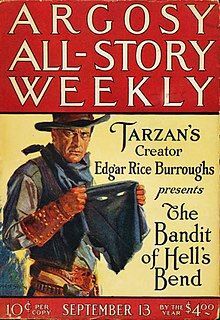
Bandit is a very typical Western of its time. It was originally published in the pulp magazine, Argosy All-Story Weekly in 1924 and then in book form in 1925. It is the story of a rancher and gold mine owner named Henders in Arizona with a beautiful daughter named Diana who is loved and admired by all the ranch hands. The foreman of the ranch, Bull, is betrayed by another rancher named Hal Colby who longed for his job. Hal purposely got Bull drunk so he would be fired by Henders. Colby takes over as foreman while Bull is thought to be a bandit who has been robbing the gold shipments at a pass called "Hell's Bend". The robber wears a black silk scarf and mask and is know as the "Black Coyote". Later in the story, Diana's cousin, Lillian, and her attorney arrive at the ranch and insist that the cousin is the heir to all of it after Diana's father and Lillian's father both die. So will Diana be able to save the ranch? Is Bull the notorious bandit, the Black Coyote? If not, then who is?
The novel as usual for the time was really a romance with Diana's love interests and the cowboys who want her. But it is also full of action, especially the last part of the novel. It is also filled with some very colorful side characters including the ranch hands (one is a singing cowboy), the Chinese cook, the Mexican bandit, and the renegade Apaches. And as typical for the time, the novel did have a few racial epithets describing the Mexicans and Chinese and the Indians were of course bad and should be shot on sight. But this was very prevalent for novels written in the early twentieth century. Overall, I enjoyed this and recommend it. I have a couple of Burroughs' other Western novels that I also hope to read at some point soon. I also need to read his Venus novels which I have never gotten around to. So much to read, so little time!
If I have any complaint about this book it's that the Amazon vendor who sold it advertised it as a trade paperback, which it is not. It's a normal size PB no different from any other.
BOHB is a wonderful book. Nothing deep, tragic, thought provoking, or politically significant. Just an old fashioned soap opera set in wild west Arizona with a dashing but misunderstood hero, a saintly sweetheart, and a bunch of no good thieves trying to cheat her out of her inheritance.
It centers around a bandit called the Black Coyote. BC robs stages of their gold shipments. He wears a black bandana over his face. Bull, the hero, also has a black bandana. That's all what's needed for everyone to believe he's the culprit. It's clear who BC really is, but no one else gloms onto it.
Two-faced cowboy Colby tricks Bull into losing his job as ranch foreman and Colby takes over. A big New York blowhard wants to buy the ranch. He knows there's a rich vein of silver on it, but so do Diana and her father and they refuse to sell. When both father and his business partner die, a shyster lawyer named Corson shows up with a woman claiming to be the deceased partner's daughter (she isn't) and says everything belongs to her. Colby sides with the crooks, who are all intent on double-crossing each other. They order Diana off the ranch. Much finagling goes on until the crooks are exposed and the real BC is unmasked.
Meanwhile there's Indian attacks, shootouts in saloons, heavy storms, floods, abductions, and attempted rape. No buffalo stampede though; guess ERB couldn't work one in.
It's not a deep plot, but it's well laid out and I couldn't find any holes in it. I liked that the hero is known only as 'Bull'. Like the Virginian he remains a mystery throughout. Also there's a ton of humor provided by the ranch hands, a widow lady, and an old gunslinger. Burroughs is a terrific humorist, something he doesn't get to do much in his otherworld novels.
ERB wrote only 4 westerns. This is a shame. I could easily have done without 'Girl From Hollywood' or the 'Mucker' series and had him write more of these in their place.
I give “The Bandit of Hell’s Bend” by Edgar Rice Burroughs five stars because if Burroughs had spent a little more time writing Westerns and a little less time with Tarzan, I am convinced that he could have given Louis L’amour a run for his money. This novel is at least as well written as anything I have read by L’amour or other noted Western authors, e.g. Zane Grey, Ernest Haycox, etc. Diana Henders inherits her father’s cattle ranch in 1880s Arizona after he is killed by Apaches. Diana has a problem that was likely common to all young ranch women, i.e. all of her ranch hands are infatuated with her. The fired foreman of the ranch, Bull, has to overcome his drinking problem in order to have a chance of winning Diana’s affection and love. The current foreman, Hal Colby, claims to love Diana—and, indeed, he means to have her no matter her lack of feelings for him—and he teams up with a group of shysters from New York who are scheming to take over Diana’s ranch and kick her out, along with taking over the rich mine on Diana’s property. Meanwhile, someone keeps robbing gold shipments intended for Diana’s ranch… This novel did have a couple of minor issues. First, the beginning is a little confusing, as Burroughs may have spent too much time describing a cowboy poet. Second, Burroughs seems to have fallen prey to a temptation common to too many authors, that is, trying too hard to convey drawls and ethnic accents. One important character is an elderly Irish immigrant lady who says things like “Git a move on ye inside there, ye ould woman…” or worse. That doesn’t make for an easy read. All in all, though, the plot could not have been better, as Diana Henders is determined to hold onto her ranch, and win the man she loves, working to overcome and assert her will against her enemies. Classic stuff, but it’s classic because it has worked to keep readers thoroughly entertained for a long time.
Well over half of Burroughs' plot lines are quite predictable in that boy meets girl, loses girl (or believes that he has) and finally wins the girl. The action and settings of the books vary considerably, which is why they are fun to read.
In The Bandit of Hell's Bend, one of his few westerns, the presumed hero is rarely the main point-of-view character and is quite mysterious. The girl thinks of him as a big brother and not until faced with devastation does she realize she loves him. The motives of the handsome dude are dubious at best. Throughout the book, there is never any one character who carries the point of view, and that is extremely unusual for Burroughs.
About halfway through the book, the story adopts a typical melodrama plot with several people trying to oust the young heroine from her ranch. Adding to the melodrama is not knowing who the bandit is, the presumed hero, who is a non-hero, or the handsome dude, or someone else, but all the circumstantial evidence points straight at the non-hero. I could not put this book down until I reached the last page.
When he wanted to take a break from Tarzan and Barsoom, ERB would occasionally try a Western. The Bandit of Hell’s Bend is one such. The theme is the classic one of stuffed shirt Easterners vs. Robust Westerners (a theme that I daresay underlies much if not most of ERB’s fiction). The foreman of the Slash Y ranch is Bull, a laconic and steady cowpoke in the traditional mode. But the Slash Y and its heiress, Diana Henders, must endure quite a bit before Bull’s finer characteristics are fully manifest. The dashing young cowpoke Colby seems to be the kind of vigorous man to save the ranch as outlaws and Apaches besiege it. Waiting in the wings to take over the Slash Y are a bumptious Yankee industrialist and Diana’s Eastern relations.
ERB was not as good a western writer as Louis L'Amour, but his traditional westerns, like this one, are fun reading. You know there's going to be adventure.
I had no idea Edgar Rice Burroughs, of science fiction and fantasy fame, had written four Westerns. "The Bandit of Hell's Bend" is fairly standard Western fare and light on scene and setting, but does a good job with the characters. This probably has to do with Burroughs limited time out West, during which he actually gained some experience working on a ranch.
My first Burroughs western! …my God he really goes full bore for all those Old West tropes too!
Although, this is set in frontier era Arizona, and Burroughs lived and worked there for a time and even ran a bookstore. People do usually associate Edgar Rice Burroughs with just pulling things out of his ass, like tigers in Africa among ancient Roman city states, but in this case I will give him some credit for first hand experience.
There is a masked bandit who robs gold from coaches, he's called The Black Coyote, nobody knows who he is, but most people think he is the former foreman of the Bar Y Ranch, a guy of few words named Bull. Bull is a right guy, but he gets a little wild when he drinks. Miss Diana, the daughter of the owner of the Bar Y might love Bull, but it is hard for her to tell because the town has basically no women but her and men are forever pledging their love to her. In short order, Diana's dad is dead from an attack by Indians and everybody is out to con her out of the ranch.
The players include The Wainrights, a Jr. and Sr. rich guy team from “over the hill” who want to get the ranch cheap, crafty fashion victim cousin Lillian and lawyer Corson, who pop over from New York to pretend to be supportive, then there's current foreman Hal Colby, who also wants Diana in the worst way, and Sheriff Gum Smith, a cowardly and ineffectual barkeep who never seems to be on the right side of anything.
At various points The Bandit of the title seems to be forgotten and the romance or the ranch take over, but ultimately this turns into a whodunnit. It breaks down to the real identity of The Black Coyote, since Diana keeps getting proposals, and she can't love a crook. Bull is sort of our main character, but he's a man of few words and we get more time with Diana since more of this concerns her.
We gets tons of John Ford style frontier characters, we get a lynch mod, grizzled prospectors, grizzled former gunfighters, grizzled ranch hands, a gold mine that might not be played out, fancy “dudes”, a Mexican bandit with a non-secret identity, indians, gold, boozing, shooting, and no shortage of villains. Of course we get the standard Burroughs abduction, but on the whole this is very light on action for him.
This book is well enough done to sustain itself, what with all the crafty villains and such, but you can tell why this didn't turn into a series for good old ERB. I do still have a few other Burroughs westerns lying around and I will read them.
I'm going to sound back-ass-ward here, but I have previously tried to read examples of the author's Tarzan stories and his John Carter series. I made it through neither book.
This book however, I found to be quite a page-turner. Much is said, both in academic reviews online and in the introduction/forward to the volumne I read, about Burroughs' first-hand knowledge of frontier life in the American Southwest of the 1880s and 1890s, but this came over as pure glorious pulp.
There's lots of misunderstandings, fiery women, taciturn men, tough hombres and Eastern dandies. There are also some (admittedly) racist portrayals--especially of the Asian cook--though I actually found both the Apache raiders and the Mexican bandit were shown to have quite a good sense of pride and honor (and even the cook was smart and loyal).
I thought the ending happened rather abruptly considering the tight spot the author worked his characters into, but it wasn't enough to diminish my enjoyment of this unexpected treasure!
I thoroughly enjoyed this book. It was not my first Edgar Rice Burroughs book, but my first 'western' and I finished it in one morning. In this story you'll find tenderness in the most unexpected places, covert gentleness in the most unlikely characters, loyalty and enough humor to keep you giggling at regular intervals. At least, that was my experience.
The older I get the more I appreciate the Classics. I have read Burroughs, Tarzan and John Carter and enjoyed both, so I thought I would try a western. Edgar is right up there with Zane Grey and Louis L'Amour. Nothing surprising about the story, good guys, bad guys, cowboys, Indians, the usual plot; bad guys from the east trying to steal the ranch, love triangle, and cowboy saving the damsel in distress. Even though stories with strong vernacular dialogue are not my favorite, I did not mind this one. So different from reading the "modern" western. One of my favorite actors has become a writer and he has written some westerns, which I did not like. The mechanics of the writing are great and the tale he tells is engrossing and entertaining, but he uses so much profanity I just wanted to get the book finished.
There is a quality about the classics in every genre which is lacking in many of today's novels. Instead of extolling the virtues they seem to wallow in the mire. It has been said "Profanity is the effort of a feeble brain to express itself forcibly." The death of decorum, the abuse of language, and the debasement of behavior have infiltrated every facet of our society to such an extent that reading the "classics" has become a cleansing of the mind. Sometimes, as a writer myself, I think we have thrown the baby out with the bath water.
Although I haven't read any of Burroughs's westerns before, I'm more than happy to have discovered this wonderous book. Although the plot did seem familiar, a wealthy landowner and his beloved daughter being threatened by masked bandits, menaced by rivals, and defended by a feckless sheriff, keep in mind, The Bandit of Hell's Bend was written in 1924 and was certainly a progenitor of many of these tropes.
I was a bit worried when the first chapter was presented in poetic narrative and wasn't sure if I would like reading an entire book with that in my head, but it was just the first chapter aside from the additions to a running cowboy song one of the characters was devising.
The dialogue had me laughing aloud many times throughout and , though I've read many other of Burroughs' works (mostly Tarzan), I was repeatedly amazed with his American western delivery and cadence of speech.
I can't suggest this book more. If not for the story, which was enjoyable, but for the beautiful narrative style.
Oh I couldn't get enough of this book! The cast of characters was utterly perfect; Texas Pete, Idaho, and Shorty, "cow-gentlemen" of the finest kind. Diana Henderson, the most lovable heroine. Completely human but all the more liked because of it. Bull, the ex-foreman. Staunch, stoic, and completely unreadable. Colby, good looking, dashing, nervy and by the end of the book... I'm not going to give a spoiler away without a warning, *******SPOILER ALERT I completely hated and loathed him. Didn't like him from the first chapter when he gained the foreman's position by dishonest means.*******
And there's many more but I won't try your patience.:) If you like classic westerns after the style of William McLeod Raine, slightly like Zane Grey, you'll love this one.
Not Burroughs' best, but he only has a few westerns, and they're all good. I read this several years ago, before I wrote my first western. I especially like the character of Texas Pete; he isn't the main character, but I like the personality that is developed. This is a great book for seeing how an author can keep the reader in the story by making the reader angry. Even though I knew it would all work out in the end, I found myself inwardly upset that potential solutions didn't work, or that the bad guys had done something else that was going to jeopardize the eventual happy ending.
I liked it quite a bit, in my opinion the best Burroughs novel front-to-back I’ve read since “Tarzan of the Apes.” Good character development, especially for a pulp western. The “mystery” behind who is the bandit was not much of a mystery; that’s not a knock, it wasn’t meant to be a mystery novel. It could have used another five pages to more neatly wrap up the loose ends, but the ending was not nearly as rushed as many other Burroughs’ novels. I give it 4.5 stars ( out of 5).
I like western fiction and I like Edgar Rice Burroughs.....but this one doesn't rank anymore than 2 stars. If it was about 200 pages instead of 280, I think it would have been great.....
The Bandit of Hell's Bend is only the first of four western novels written by E. R. Burroughs originally published in the pulp magazine Argosy All-Story Weekly from September to October in 1924. It was published in book form the following year 1925. It is evident to me that the writing is filled with the same adventure prose that made and continues to make Burroughs' literature a must, classic read.
Here the reader gets the daughter of a prosperous rancher, keeping a hold on a ranch that she might lose due to a mine that seems to be drying up; a ranch hand foreman who has a drinking problem, an underling crushing hard on the boss' daughter, and a bandit that might just be the Bar-Y foreman. Although the basic plot is as familiar as most western tropes, Burroughs' narrative is strong, lyrical, and wonderfully descriptive, building suspense, and creating heart-stopping action sequences that will stay with me for a long time.
Diana Henders' family from back East have arrived to takeover the operation from Diana since they have found affluent people who have come to purchase the ranch, and it is only because of her riders that her family hasn't just snatched the property away. Can Bull help her to keep the property or is Bull secretly the desperado that keeps robbing the stage coach?
There is some unfortunate misogynistic and cultural insensitivities endemic to most western novels written close to a hundred years ago, of which this book is not immune. I still consider this a classic because it fulfills my three criteria: longevity, paradigm altering, and exceptionalism. Loved it, although the mystery element is really easy to solve.
This is a very different type of book from ERB. Leaving the exotic locales of jungles, inner earth, Mars, or Venus behind, we find ourselves in the old west...Arizona, in the late 1800's.
This is a fairly predictable story, complete with outlaws, Indians, stagecoach robberies, and of course a damsel in distress. The dialect is a bit hard to follow sometimes but it captures the tenor of the story quite well. The suspense and danger does keep you engaged, and I have to say, I did enjoy this quite a bit.
A cracking Western that I enjoyed from start to finish. Burroughs's clear, vivid style keeps the pace up and brings to life a host of characters and evokes landscapes and settings with apparent ease. Social mores have changed - you wouldn't get away with the depiction of the Chinese cook these days - but what hasn't changed is the power of this cinematic, romantic adventure. It's also rather funny, which I didn't expect.