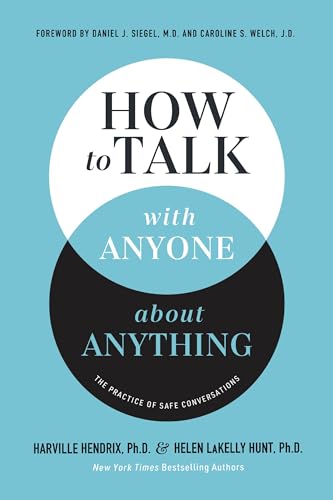
Relationships everywhere are in crisis due to our inability to talk about "difference" without polarizing. Since objection to difference is the core human problem, we need a skill that helps us connect beyond difference. That's just what New York Times bestselling authors Dr. Harville Hendrix and Dr. Helen LaKelly Hunt offer in their new book: How To Talk With Anyone About Anything. They call it the Safe Conversations Dialogue process, which everyone can learn and teach, that moves all relationships from danger to safety, making connecting possible. For centuries, most of us humans have talked to others in monologues, believing that the world is the way we see it, that what we say about it is the "truth" and we have assumed that everyone sees it "our" way. If they do not, we experience tension and conflict on many levels. On the other hand, few of us have ever listened to others while they are talking and tried to see the world from their point of view while retaining our own perspective. Instead of listening to understand and collaborate about our differences, we tend to replace their perspective with our own. This results in polarization, not only in our personal lives and work environments, but also in the political and religious arenas we inhabit. This has led to anxiety, frustration, anger, violence, and war. Clearly, the world needs a new way to talk that transcends difference and leads to collaboration, co-creation, and cooperation. Getting the Love You Want, teach that the practice of Safe Conversations Dialogue impacts the "physics of the Space Between." Here is what they mean: All of us live in and are a part of an energy field in which everything everywhere is connecting with everything everywhere. This energy field occupies the Space-Between us. When there is safety in the energy field that occupies the Space-Between us, we can connect. When there is anxiety in the Space Between, we defend ourselves. We cannot connect but tend to polarize. Anyone, if they decide to, can restore safety in the Space Between by using a structure conversation skill called the Safe Conversations Dialogue. In How to Talk with Anyone about Anything, Harville and Helen share the wisdom of the Safe Conversations process and the four structured and teachable skills that create safety and connection: Dialogue: Dialogue is two or more people taking turns talking and listening. Monologue is one person talking and expecting everyone else to listen. When two or more people shift from Monologue to Dialogue, they can transform any relationship from conflict to safety, connection and collaboration. Zero Negativity: Negativity disrupts safety and is non-negotiable for safe and thriving relationships. When Dialogue is practiced with Zero Negativity, criticism about what one does not have is replaced with a positive request for what one wants. This transforms conflict into safety and connecting. Empathy: Empathy is the capacity to experience or imagine how another person has gone through life. When Dialogue is practiced with empathy, one can more easily accept the different perspective of another person and maintain one's own perspective without polarizing. Affirmation: Affirmation is valuing another person because they exist rather than for what they have done for you. When Dialogue includes affirmation, the other person experiences themselves as human rather than as an "object" that is valued because of what they do. How to Talk with Anyone about Anything offers the keys to unlocking your ability to connect with others in a new and profoundly different way. And, as more of us hone that ability, together, we can bring about a fundamental shift in society away from our current focus on the "self" and polarization about difference towards safety and true connection that includes total personal freedom, universal equality, radical inclusion, and celebration of diversity—a society in which we all collaborate with each other without surrendering...
Harville Hendrix, Ph.D., is the author of Getting the Love You Want: A Guide for Couples, a New York Times bestseller that has sold more than two million copies. He has more than thirty years’ experience as an educator and therapist. He specializes in working with couples in private practice, teaching marital therapy to therapists, and conducting couples workshops across the country. Dr. Hendrix is the founder/director of the Imago Institute for Relationship Therapy. He lives in New Jersey and New Mexico.
The central ideas—listen, empathise, reflect back what the other person is saying, try to understand their perspective rather than immediately defending your own—are hardly revolutionary. They are fundamental principles of communication that most reasonably socialised adults have encountered in one form or another. Yet the book presents them with such certainty and repetition that they begin to feel less like useful tools and more like a universal solution to every interpersonal and even societal problem.
That is where the book really lost me. Its approach is extraordinarily utopian. It seems to assume that if people simply communicate properly, sufficiently empathise with one another and follow the prescribed method, conflict can be resolved. But human beings—and particularly groups of human beings with competing interests, histories, power imbalances and deeply entrenched grievances—are considerably more complicated than that.
I found myself wondering whether this approach could genuinely be applied to some of the world’s most intractable conflicts. Could we really expect opposing political factions, for example, for Israelis and Palestinians, to sit down, mirror one another and resolve decades of violence and competing claims through better communication? Empathy and communication are undoubtedly valuable, but pretending they are sufficient is profoundly lacking in nuance.
There was also something about the tone that bothered me. The authors occasionally adopt a rather self-congratulatory, almost evangelical certainty about their method. Some of the anecdotes, particularly those involving the authors’ work in Liberia, struck me as uncomfortable in their framing—at times bordering on a rather simplistic we arrived with the solution and helped these people discover it narrative. I found myself wishing for considerably more humility and self-awareness.
Ultimately, my problem isn’t that the advice is wrong. Much of it is perfectly sensible. It’s that the book takes relatively straightforward principles, repeats them relentlessly, presents them as something close to universally transformative, and leaves very little room for the complexity of actual human behaviour.
Perhaps that is precisely why it might work for someone who is completely new to thinking about communication. But for anyone who has already done some reading, thinking or living, I suspect it will feel less like discovering a new way of communicating and more like being repeatedly told something you already know.
If you’re already a half-decent communicator, I wouldn’t recommend
“Why oh why are we getting political, sir?” This was my thought while reading this highly repetitive book.
The core message is straightforward: listen actively, mirror what you've heard, validate the other person's reasoning (even when you disagree), and show empathy for their feelings.
Coulda Shoulda Woulda been a TED TALK.
Okay, maybe I’m being harsh. The real issue isn't with the methodology itself - which honestly seems pretty solid - but with how the book relies more on "trust me, this works" stories rather than diving into the psychological research that could really back up these claims. While the anecdotes are engaging, they leave you wondering whether this approach has been rigorously tested or if we're just hearing about the times it ~happened~ to work out well.
I'd give this a 3.5-4 star rating, I really liked the examples that were given, and appreciate the formula that they came up with. I don't know if I will fully integrate this into everyday life, however I think this emphasized the importance of conversation and how its multi-faceted. We need to listen to understand, put our personal biases aside, and tune into what the other person is saying. I think I sometimes struggle to put my own bias aside and fail to look further into someone's own experience (especially politically) and I think this helped me to understand that I need to see both perspectives. I may not explicitly tell them that I do not agree, but I do zone out when I am not fully invested.
I really wanted to like this book, but most of it seemed to be an advertisement for the author, not actually advice for how to talk to others.
There was really only one method discussed in this book and it felt like it should have only taken half of the time to discuss it. The whole theory is that you should mirror what the other person says and ask them to confirm what they are saying is accurate. The theory behind this is the break down miscommunication, however with a truly elevated person I have a feeling this would not help at all but rather escalate the situation. I really appreciated the concepts in this book, but wish that the result would have been more thorough and effective.
Repetitive and self-aggrandizing. Techniques are good, solid advice! A few examples are helpful, but it would have been just as useful at 10% of the length. Lots of the book (and the entire introduction) boils down to “we teach these great techniques and people benefit from them - including influential people”! (That is not an actual quote.) It’s essentially an infomercial for a book you already have in your hands. Their goals at the end are hilariously naive, including getting the tipping point threshold of the global population using this communication style. I agree that would benefit the world, but it’s so far-fetched as to be laughable.
Applicable. I listened to the audiobook and found it easy to listen to, but I think the paperback would be better in order to refer back to. That said, I will likely listen to this one again. Useful for skills and tools in talking to family, friends, colleagues, etc, especially when you have differing opinions. Teaches how to collaborate and understand and listen well rather than just getting ready to speak your piece. Have tried some skills and still need more practice but it solved a problem faster than my instincts would have!
This book is really good to read for those why are having trouble with talking, express themselves, bullying, feeling left out, and other things that can deal with talking. The authors are really helpful of how to make conversations Bette and how to have a healthy brain all the time. This book teaches me how to practice zero negativity, having a healthy brain, safe conversations, resolving a conflict, and many more things for people who are having trouble with conversations. This book is helpful for people who want to be a therapist or counselor.
This book is the epitome of it could of just been an email. Just soooo repetitive. It gives the vibe of selling you a product and showing you examples of how this product has been used successfully minus most of the advice. And why try to sneak in some very slanted politics on illegal immigration in a book about trying to connect better with people? Overall the methodology of conversation in this book is fine but did it have to be sooo long?
I listened to the audio book version of this title. It was narrated by Rick Adamson. Overall the narrator did a goob job but sometimes I felt like he had a monotone. As for the book - I think this is a good beginner's book for people trying to read more self help books. It was very clear & easy to understand. No technical jargon that confuses the reader.
Simple and easy to understand and start acting on it in ones life. I appreciate the topic of SD conversations and the importance of LISTENING when someone is talking not instantly trying to react to it.
I think the book could have been shorter but I think it is because it instantly made sense to me so it felt repetitive to me.
This book had many good tips and communication strategies that I found helpful. However, it was quite repetitive and at times a little political and idealistic. The audio book was tedious at times, but I am glad I listened to it.
Not what I was expecting. Based on the title, I Thought it would be about how to strike up conversations with strangers or make small talk at parties. This book was more about having conversations with people who disagree with you.
How to Talk to Anyone About Anything lacks the useful and helpful tips promised in the book’s synopsis. At one point, it became too political and too redundant. It’s definitely not as advertised, and I would not recommend it to anyone.
2.75 ⭐️ I especially liked the ending notes! The book overall was very insightful. The rating I gave is because I listened to the audiobook and listened while doing other tasks; may need to re-listen to get the whole message!
I wish this book would make magic on my way to talk… I don’t expect to change overnight, but there are great tips and I’ll for sure do my best from now on.
The book was more about praise for their framework than it was about the actual implementation. Only about a chapter was about their actual framework. Unfortunately it was a bit disappointing.
There were moments of this book that were great, and there were parts of this book that we patronizing. I finished mixed. I will not review this again.
Very interesting book. Lots of political examples were used and I understand how that can be off putting but I found it helped in bringing up difficult topics to loved ones.
This book has some good advice about remaining diplomatic in the face of controversy, but I feel that it for what it had to say, it could be just an hour long seminar. It feels a bit padded for length.
The gist of this book's lessons is to apply the following steps in conversation:
1. Listen to your conversation partner, engaging with them in dialogue and not monologue 2. Repeat back what you hear to them to reassure them that you've heard them (mirroring) 3. Validate their reasoning, even if you don't agree with them 4. Empathize with the feelings they've shared with you, again, even if you really don't want to
This is a good, intentional approach to navigating controversial topics, and I think that it's worth practicing.
What keeps this from being a great book is that this methodology attests to its validity mostly through repeated anecdotes of success rather than empirical data. For psychology related content like this, I believe we should have a high standard for long form content worthy of being published and studied.
My impression after reading this is that it seems like a good method for improving relationships, but I'm not wholeheartedly convinced that this was the best use of my time considering all of the other science out there regarding psychology.
I appreciate how they lay out easy talking points. I do see how this can be effective, but a certain amount of mirroring can become annoying. In order for this to work, both parties need to buy in, which is not always possible.