Vatican City, 29 September 1978: the world wakes to the shocking news that Pope John Paul I is dead, just a month after his accession.Thirty years later, in London, young journalist Sarah Monteiro receives a mysterious package. Enclosed is a list of names and a coded message.Moments later a masked assassin attempts to silence her for ever. It seems Sarah holds the key to unveiling a deadly secret - a plot that implicates unscrupulous mercenaries and crooked politicians, and which goes to the very heart of the Vatican. Sarah has no choice but to run, forced into a ruthless game of cat-and-mouse. She can trust no one, especially when her father's name appears on the incriminating list.Sarah finds herself at the centre of a world-wide conspiracy its keepers will stop at nothing to protect.
So, you want to know more about Luis? Well, he was born in Oporto, northern Portugal, in 1976. It was a sunny winter's day of February... at least that's what his mother says... Luis spent his childhood in Viana do Castelo, a small town north of Oporto. He devoted himself exclusively to writing while trying to be a citizen of the world. He was the author of The Last Pope, The Holy Bullet and The Pope's Assassin.
A Dan Brown-type thriller. The plot presumes that Pope John Paul I, who served for only 33 days before his death in 1978, was killed because he was going to clean up vast graft and corruption in the financial arm of the Vatican.
A Vatican scholar finds incriminating documents in the Library and sends copies to a Portuguese female new reporter. (The book is translated from Portuguese.) She and a smooth, Vatican “CIA-type” operative are now on the run from the bad guys who want the documents.
The plot become a Tom Hanks-type international thriller as they are chased from Lisbon to London to New York. The plot is a bit of a stretch, the characters are stereotypical, and it gets repetitive at times, but it’s a quick read. (Note that there are several books with “Last Pope” in the title.)
The Portuguese author wrote five books in his Vatican series - this was the first – and three other novels. It appears from GR that three of the Vatican series are the only ones translated into English. The author died from illness at age 39 (1976-2015).
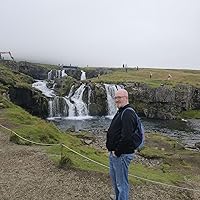
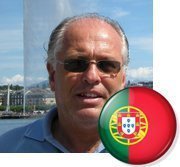
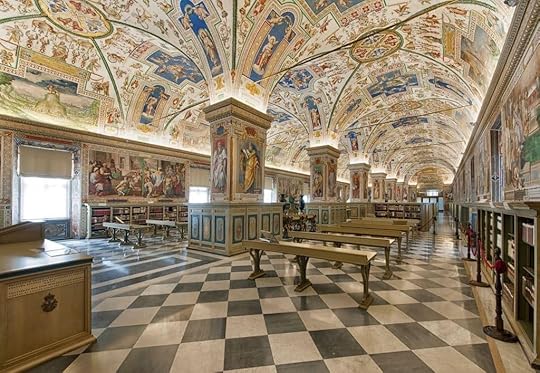
Photo of the Vatican library from visitvatican.info The author from binghamton.eu
I honestly have no idea what happened in this book. I feel bad because I read it cover-to-cover. I haven't read Dan Brown, but this is exactly what I expect Dan Brown's writing to be like. But because this author is Portuguese I hoped it might be better (for whatever reason; hi, welcome to my brain).
I just... it's not even worth reviewing. If there was a legitimate timeline to the story it might have had a chance. But if you label one chapter as taking place in 1978 I assume the following chapters (that are unlabeled) will also take place in 1978. I realized more than halfway through that was not the case, so I was wondering where the modern references were coming from.
I should have just reread Twilight.
Okay, no, that's a lie. I should have just taken a nap.
Rocha weaves a historical event with great action. He pulls no punches when it comes to the corrupt nature of the Vatican and presents a strong 'assassination' rationale for the death of Pope John Paul I. I thoroughly enjoyed the narrative and the interspersed historical explanations of key Vatican characters.
Here's the deal. I pride myself on finishing what I start. Part of my OCD, I guess. This book was in a bag that my mother gave me last time I visited.
I really really REALLY tried to get clear through this book. Took me two weeks of reading maybe 10 pages at a time. I could never even find anything interesting to help me with this goal. Finally on the weekend, I thought, ok, I can do this. With only 70 pages left, I can do this. Took all day Saturday to choke down 30 of the final 70. Then, I have to admit it, I gave up. Yep, me. Could not finish the book.
OK, you know a book is in trouble when it takes 50 pages to explain the denouement. Somewhere in this book is a fun thriller, but it gets bogged down in crummy writing and the attempt to be cinematic. Apparently this was a best seller in Europe. It must be better in Portuguese. Bottom line, its an easy read (if you don't get bogged down by too many characters with no names) and a convoluted mess.
A must read for someone to understand Vatican's most dark secrets and incomprensible facts. Luis shows an amazing knowledge on the subject, a deep research work and a fluid writing, very easy to follow and taking the reader on a pleasure journey we wouldn't like to end. Wonderful book.
This is a good spy/thriller novel and a very quick read. It's the kind of fast-paced book I like to read just for the fun of it, so I didn't go into it with any expectations, other than to be entertained by some "what ifs?" for a few hours.
It's written with a blend of historical fact and fiction - the facts being that Pope John Paul I died after only 33 days as pope in 1978 under circumstances that seem somewhat shady. The author uses this as a jumping off point for the fictional part of the story, setting up a conflict between a shadowy organization and a journalist 30 years later over documents relating to the pope's murder. If you like Dan Brown's novels or are a conspiracy theorist, you will like this one.
I liked the premise and thought this was an entertaining read, but like I said, I didn't go into this with expectations of it being some life-altering experience. Just something fun. I like stories that take well known facts and give them a twist to explore alternate worlds.
I liked that the characters had murky motivations, since I think that characters that are so up-front with their motives really don't belong in spy novels (coughcoughRobertLangdon) - they just don't fit what my idea of life as a spy is like. I imagine spy work to involve a lot of players whose motives aren't always clear and don't go around explaining themselves in great detail, so this book felt more honest than some other spy novels to me. Sarah's character also felt realistic to me, since she's supposed to be a reporter, she's the one that gets to be curious about everything. I liked that she didn't always get the answers she wanted, though.
I did think the book was a little short and that the ending was a little abrupt. I think this was the author's first novel, so I'm willing to forgive that. I have the second book featuring the main characters (it's substantially longer) and I won a copy of the third book from Goodreads, so I'm looking forward to seeing where he takes them next.
So-so thriller featuring flashbacks to the 'murder' of Pope John Paul 1 back in 1978. A poor imitation of a Dan Brown novel (which is a bad start), but then it has the audacity to claim that everything in the book is true. Even fans of conspiracy theories should steer clear of this book
Depois de muitos anos a ler JRS e Dan Brown, começava a achar que a formula do triller estava esgotada e estagnada, tanto na temática como na abordagem. Devo dizer que fiquei positivamente surpreendido com este livro, mesmo sem nunca ter lido mais nenhum do mesmo autor.
Para começar, gostei que abordasse a corrupção no Vaticano de um modo mais próximo da realidade que os outros livros do género. As personagens não são cliché, como nos últimos livros que tenho lido, e são multi-dimensionais. Como tive oportunidade de dizer ao autor, adorei o seu sentido de humor. Os únicos pontos menos bons foram as primeiras linhas, que não me parecem ser o melhor início para um livro, e alguns dos capítulos que tratam do passado ficaram aquém do que esperava.
Recomendo a todos os amantes de triller e/ou apaixonados por teorias da conspiração.
Adorei. Acção. Conspiração. Intriga. Suspense. Ficção e alguns factos históricos. Estes são os ingredientes que gosto num livro e neste caso estão cá todos. Recomendo.
If you liked the Da Vinci Code, you will like this book.
The Last Pope deals with the conspiracy theory around Pope John Paul I's death.
I enjoyed reading this, not so much for the spies and race against the bad guys to preserve good, but more so about the history around John Paul I's death. I was very intrigued by all that I learned. I was only 3 years old when he died so I don't remember any of the scandal but I find it all very intriguing now. It even has a Chicago connection.
I also find it interesting that I read it at the time yet another new Pope is named. I seem to have a eerie sense for reading books about the papacy at the time of a conclave. I was reading during the conclave that elected Pope Benedict.
"... é um título que não posso deixar de recomendar a quem gosta deste género de livro. Protagonistas interessantes, background histório cativante e ainda actual, uma escrita lírica mas não tediosa, querem melhor receita que esta para uma boa leitura? Pecado é ainda não terem lido um livro tão bom (a-ha!, cá está ela, a piadinha!)."
It’s only ok. I read it out of curiosity more than anything. And it was read in snatches in the early hours of Wednesday mornings while I was waiting for the late running 5:15 AM train to Melbourne before heading to the station. It didn’t require much in the way of concentration, and reading it in irregular periods wasn’t an impediment. If you had an interest in the underbelly of the Catholic Church or the death of the Pope John Paul I, you might find it more engaging.
Mystery stories are among the most difficult stories to write; this is especially true if the mystery is historically based on fact. The author needs to solve the mystery in a convincing fashion while working against any knowledge the reader might have of the facts in the case. The centerpiece of this story is the death of Pope John Paul I, or as the book would have you believe, the murder of John Paul I.
When Albino Luciani was elected Pope following the death of Paul VI, the world was taken with his persona. The "Smiling Pope" was seen as an energetic, creative leader for the Church. The contrast between him and Paul, who was often compared to Hamlet, was striking. Here was a man who wrote letters to great literary figures to discuss theological issues, a pope who did not bother with the papal trappings of the past, a pope who smiled and enjoyed people. When he died after 33 days, the shortest pontificate in modern times, the rumour mill went into overdrive: John Paul I was murdered because he was about to depose some eminent personages from power and root out corruption in the Church. As would later come to light, there was some truth in the rumours. The financial scandal between the Banco Ambrosiano and the Vatican Bank, the role of Archbishop Marcinkus in the drama, had a basis in fact. Did Roberto Calvi commit suicide under Blackfriars Bridge in London? The jury is still out on that one. The haste in which John Paul I was prepared for burial lends itself to suspicion of foul play. Conspiracy theories continue to exist, much like they still find adherents in the assassination of John F. Kennedy, long after they have been largely disproven. There's something in the popular imagination that refuses to accept the simple answer when dealing with the death of a beloved figure. In spite of John Cornwell's book about the death of John Paul I, A Thief in the Night, which examined the official version of the event and showed that the pope's death was an unhappy consequence of a failure to take his medicine properly, there are still some who insist on seeing a malevolent cabal behind it.
The story revolves around the papers that John Paul I was supposedly reqading when he was murdered. They were found in the Vatican Archives by someone who realises their importance and seeks to safeguard them by sending them outside the Vatican. Threatened by their revelation, the Masonic Lodge Propaganda Due (P2) motivates its forces to find them and eliminate those who have them. To do this, a mixture of players from the CIA, P2, and the Vatican are mobilised in the hunt for a Portuguese journalist and some others. The adventures of Sarah Monteiro and Rafael, her protector, read like James Bond without the gadgets and the path to the solution is littered with bodies (It's not just the Pope who dies).
Luis Miguel Rocha writes a good story which keeps one's interest to the very end. There is just enough verisimilitude to make the story believable. Like Dan Brown's The DaVinci Code, there will be those who believe the fiction over the facts. I think it is the mark of a good writer to create such faith in his readers. What adds to belief in this book is the list of real persons and their biographies at the end of the book. There is also a testimonial from the assassin (who remains nameless) telling how the book came to be written. It is, as a whole, a great entertainment for a few hours, but one should not take it too seriously. Rocha has another book, The Holy Bullet, about the attempted assassination of John Paul II; it will be interesting to see what he makes of that.
Foi o primeiro livro que li deste autor e não me parece que seja o último... Inicialmente tive alguma dificuldade em compreender o rumo da história pois esta desenrola-se em diferentes tempos, num constante vaivém entre o presente e diferentes momentos do passado. Ao mesmo tempo, esses momentos do passado são revelados às "pinguinhas" e nem sempre de forma cronológica (embora acabe por fazer sentido!), o que torna a história bastante confusa e difícil de acompanhar. Pouco a pouco este vaivém vai diminuindo e os acontecimentos no presente começam a sobrepor-se ao passado, o que torna a leitura mais fluída e apelativa. Mesmo assim, o livro não chega a entusiasmar-me pois acaba por parecer-se bastante com os livros do Dan Brown (demasiada ação a desenrolar-se em pouco tempo). De qualquer forma, o final acabou por surpreender-me pois considerava a história terminada e, afinal, ficam já lançadas algumas ideias sobre o volume que se segue. Uma vez que já tenho "A bala santa" na minha biblioteca, é muito provável que seja uma das próximas "vítimas" de leitura...
The story begins interestingly. A priest, who will die in the very first chapter, sent out a very secret document to a journalist Sarah Montero who will become the target of a secret organization that has infiltraded all agencies and most governments in the world. This document also involves the death of the Pope John Paul who died shortly after serving the office and deciding to unroot all dirty works inside the Vatican.
The writer brings us back and forth between the present and past. The story unveils as expected--chasing and chasing, more deaths of those involved, a mysterious guy coming to the rescue, etc.--along with many historical facts that are still 'cold case' today.
But if you are expecting Dan Brown, please don't. No spectacular discoveries will be found in this book. In fact, I'm a bit down by the way it ends. After all the preludes, it just ends easily and not very convincing for me. The characters are flat. And there's the last twist indicating it's not over yet--which is the kind of ending I don't like. Anyway, I picked this up without knowing that it the first in the series. So it's natural for this kind of ending.
Gee, what can I say ... it was an interesting enough book, with a combination of historical events with current-day repercussions/consequences, sort of. The unexpected death of His Holiness Pope John Paul I after only 33 DAYS as Pope has obviously been the fodder of all kinds of conspiracy theories. This book uses that event as the keystone of the storyline. I read this book as a piece of fiction that was reasonably-paced with the modern "oh, no, secret papers will bring the truth to light" storyline that was backstopped by what "really" happened in 1978. For that, the book deserves three to three-and-a-half stars. HOWEVER, the post-script interview with the author really blew it for me because he claims that only the current-day events are fiction and that his "what really happened in 1978" component are the actual events. At least that other author whose work was mistaken for true never actually claimed that it was (just allowed gullible readers to believe that). One star Senor Rocha, for such a cheap attempt to sell books. Thankfully, I didn't pay for this book (but my local library did).
Anyone who enjoyed The DaVinci Code or Angels and Demons should definitely read this one! The title caught my eye when browsing the World Literature collection at my local library, and. The Last Pope is historical fiction that reads like an action movie or TV show - in a good way ;-) Originally written by Rocha in 2006 and translated by Dolores M. Koch in 2008, I found The Last Pope to have a well paced plot and nice tension/suspense. The subject matter actually is relevant to the recent surprising retirement of Pope Benedict XVI, particularly in light of some of the comments the Pontiff made prior to stepping down. Don't miss this one!
(2006 Portuguese; English translation 2008) Historical fiction, this book is a blockbuster based on the murder, (yes, murder) of Pope John Paul I and the scandal of the Vatican bank in the late 1970's. Monsignor Firenzi sent some documents to the daughter of an old friend. This begins a serious pursuit by some unpleasant characters of Sarah. That part is fiction. The information and names of people associated with the bank scandal, is true. So is the information about John Paul 1 and Sister Lucia. Power and greed corrupts, and this was corruption of the highest order.
Rocha gave me a really wonderful adventure. He could smoothly combine facts from Catholic Churches in the past with some fiction characters. It creates such a terrific plots with knowledge (almost of them are history of the Church) which running inside my head every time I read it. Glad to find this book, proud to finish it. Fascinating.
Parecido com José Rodrigues dos Santos ou com San Brown ou Dan Brown com José Rodrigues dos Santos, etc....até me perdi, tal como no livro em que por vezes tem tanta acção que nunca se resolve a história, sobre algumas das actividades da igreja do Vaticano...
I am delighted about this Author. His books are incredibly thrilling and interesting. I am only sorry I discovered him after his death. I am now looking forward to reading his other books!
The thriller part felt a bit surreal I got lost a couple of times but made it to the back cover in the end. On the plus side it made me search a bit deeper into the church processing e.g. conclave and t discover more on John Paul I.
Año 1978. El 29 de septiembre, el mundo se despierta sobresaltado con la noticia de la repentina muerte del Papa Juan Pablo I, elegido Sumo Pontífice apenas treinta y tres días antes. La reacción oficial del Vaticano ataja de forma expeditiva cualquier duda que pudiera plantearse sobre la causa de tan inesperado suceso: el Papa, hombre de salud delicada, ha sufrido un ataque al corazón. Año 2006. La periodista Sarah Monteiro vuelve de vacaciones a su casa de Londres. Allí le está esperando un sobre en el que se encuentran dos extraños documentos: una lista de nombres y un mensaje cifrado. A partir de ese momento su vida correrá un grave peligro y se irá viendo inmersa en la vorágine de una trama en la que están implicados príncipes de la Iglesia sin escrúpulos, políticos corruptos y mercenarios dispuestos a vender su alma al mejor postor.




 during the conclave that elected Pope Benedict.