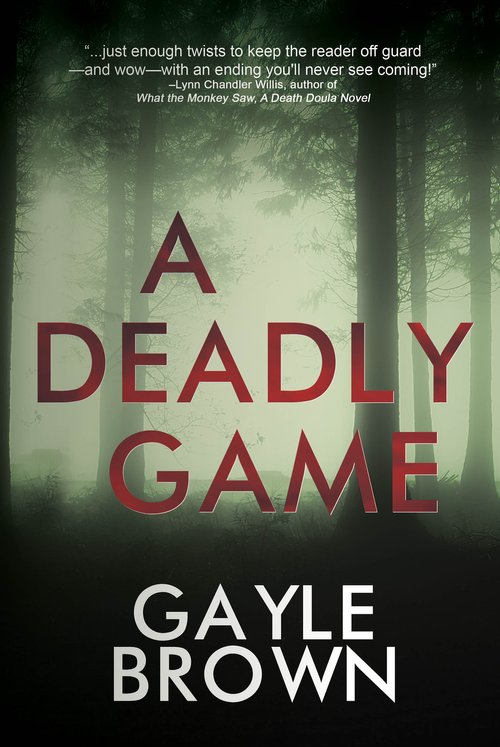
When local college student, Jaden Pierce, disappears one night playing 'Manhunt in the Woods' with his fraternity brothers, Nicole, an empathetic stay-at-home mom living a blissful life, joins the search party.
Combing through the wooded area, Nicole unearths her son Kyle's license and withholds this potential piece of evidence. She trusts him, but a sliver of doubt festers below the surface, thanks to one unresolved incident from middle school and his shady pastime. After he is officially named a person of interest, she must decide what to do next. Unsettled but determined to protect him, Nicole searches for the answers on her own.
While probing deeper, surprised by her unethical actions interfering with the investigation, Nicole realizes she's being followed. As the situation deteriorates, she is blindsided by the truth, suddenly shattering her trust in people as well as her entire belief system. Now, unsure who to believe and running out of time, Nicole faces her most challenging moral With someone's fate resting in her hands, will she reveal what she's learned or keep it to herself?
A Deadly Game is a fast-paced, action-packed thriller raising the question, "How far is a mother willing to go to protect her child?" The constant guessing and unexpected, riveting twists will keep you turning the pages. Don't miss out! Buy your copy today.
The way the author talked about Kyle’s parents drove me bonkers. Their bodies and their looks, which are irrelevant. Who cares. Nicole makes the dumbest decisions, just why? I skimmed through this just to be rid of it unfortunately. Thanks to the publisher and NetGalley for my ARC More like 2.5 ⭐️
A Deadly Game centres around a fraternity game played in the woods at night that is the catalyst for a series of events that start with one of the students going missing during the game.
After the news is announced, one of the parents, Nicole, feels strongly that she needs to investigate herself. She is concerned that her son Kyle played a part and she wants to get to the bottom of what happened before he gets into any serious trouble. As she looks deeper she makes some shocking discoveries that turn her whole world upside down.
The premise for the plot is a good one however the execution didn’t quite hit the mark for me. Within the first couple of pages the dialogue between the students is unbearable (the word “bruh” is written multiple times). Although I can appreciate the author attempting to give authenticity to modern day slang, it’s just not something I want to read in a book.
There’s a lot of mention that the main character is extremely unlikeable, but I’m a believer that if an author is able to elicit strong emotions based on the actions and personality in a fictional character then they did a good job.
There are a lot of twists throughout this book so if you like shocking revelations you will surely enjoy the conclusion to this story.
Thank you to NetGalley and black rose writing for a copy of this book
Wow—what a roller coaster ride! Packed with secrets, lies, and nonstop twists, this fast-paced, action-filled story made me question whether anyone in it knows how to tell the truth. It keeps you on the edge of your seat right up until the final page.
This started with a good premise, but it unfortunately did not hold my interest. The main character (Nicole) was a horrid, raging narcissist. The sheer lengths she went to in order to protect her son…I was rooting for her to do some serious jail time. Nicole was also so superficial and downright cruel in her appraisal of literally everyone around her. I just can’t get behind a person who acts like that. I wanted to drop kick her numerous times.
I received a complimentary copy of this book (thank you to NetGalley and Black Rose Writing) in exchange for my honest review.
This book had so many creepy moments and it was an interesting case study at times of "what would I do in the situation if it was my kid?" I would like to think I would NOT do any of the things the mother, Nicole, did, but you can't expect to know unless you're put in a perilous position.
(FYI this is a free ebook on Kindle Unlimited if you want to check it out!!)
This book is an absolute waste of time. The female lead character is a total idiot and utterly annoying. DO NOT BOTHER WITH THIS BOOK. I only finish it to rid of my Currently Reading books.
“The water she set to boil was not the only thing steaming —doubt, suspicion, and hurt also bubbled in that room.”
How well do we really know the people we love? And how far would we go to protect them?
Nicole Cunningham wants to believe her 19-year-old son, Kyle, had nothing to do with the disappearance of his fraternity brother, but she can sense he’s hiding something. As the investigation progresses, hinting at Kyle’s involvement, Nicole will do whatever it takes to keep him from being held responsible—even if it means crossing the line.
This thriller, with several twists you’ll never see coming, will keep you reading to the end to find out what actually happened the night the young man went missing.
This book is a gripping thriller that follows Nicole, a stay-at-home mom, as she becomes embroiled in a missing persons case involving her son Kyle. As she delves deeper into the investigation, she uncovers a web of secrets and lies that challenge her perception of her son and her own beliefs. The author masterfully crafts a narrative that raises questions about the complexity of maternal love, loyalty, and morality.
Nicole's journey is fraught with tension and uncertainty as she navigates a tangled web of clues, suspects, and motives. Gayle Brown’s skillful plotting keeps the reader guessing until the very end, as Nicole's search for the truth leads her down a dangerous path.
A deadly game is a thought-provoking exploration of the darker aspects of human nature, and the lengths to which a mother will go to protect her child. With its well-developed characters, intricate plot, and surprising twists, it is a compelling read that will appeal to fans of psychological thrillers.
I thought this debut novel was really good! I enjoyed the mystery plot of trying to find a killer in a small, college town, but found myself wanting things to pick up the pace just a little bit more throughout. I love books like these because they provide us with multiple suspects and I was still surprised at the end with the twist! I found the main character a bit unlikeable at times because of the way she would contradict herself.
Minor Spoilers Under This:
For example, she would say she wanted to help in the search party because she would want other families to do the same for her, and then would tell her son to withhold information from the police.
If you can get beyond the terrible editing job (constant run-on sentences, easy grammar mistakes), the book has some potential, I guess? I tried to give it a chance, anyway, and just kept getting disappointed the further in I got.
Nicole is a one-dimensional character who loves baking and the gym except never successfully bakes anything or completes a gym session without needing to cause more drama in the guise of "protecting her son."
I've read books centered around the questionable things mothers do to protect their children--there is a way to do it with nuance, fleshed-out motives, sympathy, etc. This book does none of those things. Descriptions and motives of characters and surroundings are overbroad, repetitive, and unimaginative. It's like having a crime drama on in the background while you scroll social media, and only picking up on the overly dramatic music of the episode but not the actual content.
To that end: why is Nicole an elder millennial who knows zero about how social media works or how the police work (hounding the detective in charge about volunteering?? Being mad he didn't get back to her while in the middle of a highly publicized investigation and then later being So Upset she can't volunteer any more???)
Tl;dr - I wasted my time on this book but you shouldn't.
In the prologue we have a group of fraternity brothers playing a game called Manhunt (perhaps the author thought readers would know what this game was? I do not know and it was never explained.) A brother named Jaden disappears.
Cut to, married couple Nicole and Craig discover that Jaden is missing and Nicole loses it because Jaden is in the same fraternity as Kyle, their son. She seems to feel this entitles her to all kinds of inside information so she proceeds to make a fool of herself. Ultimately she joins the search for Jaden where she finds what looks to be proof of Kyle’s involvement. What should she do? What is really going on here?
Nicole and Craig were two of the worst, most annoying characters I’ve encountered in a long time. Especially Nicole. I wanted to punch her. Anyone who has ever read a thriller will have a pretty clear idea of where this story is going, even if you aren’t sure exactly why. Predictable and banal.
The premise of this book sounded interesting and that's why I chose this one on Netgalley. I received a copy via Black Rose Writing and it came out on the 7th of December.
A local student, Jaden, disappears one night and Nicole, the mother of one of the fraternity brothers of Jaden, joins the search party. She gets much more involved than necessary and this of course leads to some inevitable events leading up to a finale.
Although the premise sounded interesting, the execution of the story failed miserably. The characters were all quite unlikable, horribly described and just plain stupid. The story itself, after having read the book, was just laughable. Extremely unrealistic and uninteresting. And than the ending... What was supposed to be a major twist I guess was nothing more than a 'seriously?' Unfortunately, this was a waste of time for me. And what is more, it is baffling to see this book getting such high ratings.
A highly engaging thriller about a mother who will risk everything to protect her son. A Deadly Game is a must read for all parents, especially those with young adult children. I was totally invested in Nicole’s trauma from start to finish.
Even as she considers the possibility that her son, Kyle, may be a killer, Nicole stands by him, setting herself on a destructive path. There’s nothing worse than having your child go missing, never knowing what happened, being forced to face the real possibility they are dead. But on the other side of that is being a parent to a boy who is a person of interest in the disappearance of the missing child. Every mother who reads this will relate to Nicole’s dilemma and her reaction to finding out her son, Kyle, was in the woods with his fraternity brother, Jaden, where he was last seen. Even though he is technically an adult, there is nothing Nicole will not do to protect Kyle from being taken into custody as the main suspect.
Nicole’s perfect marriage to Craig and her happy family of three are threatened not only by Kyle’s possible involvement with the disappearance of the college student, but also Craig’s stress level as he seeks a promotion at that same college, and Nicole’s meddling and deception as she tries to steer the police away from Kyle. When Nicole joins the police search party, a stalker and threatening notes telling to mind her own business add to the personal strain on her home life. As she struggles to hold her family together, Nicole uncovers lies and secrets that shatter her world.
One twist follows another in this suspense-filled tale of a college game gone wrong, right to the very end with its shocking revelation. Set aside a block of reading time. You won’t want to stop reading until all the pieces of this intricate puzzle come together.
Fraught with family secrets, A Deadly Lie delves into the mind of a woman whose world is turned upside down when what she believed to be true comes into question. Gayle Brown’s portrayal of a mother desperate to save her son will tug at your heartstrings as you follow her heart-pounding quest to find answers. An amazing debut domestic thriller!
Thank you to Black Rose Writing and Netgalley for giving me an ARC of this story to enjoy! I have such heavy mixed feelings about this story. I will start by saying that I loved the premise, I loved how it was written, and for the first 60% I really was interesting. I kept saying "one more chapter" again and again. The story was complex, but not too complex that I didn't find myself enjoying it or getting confused. At about the 65% mark I found myself disconnecting from the story as we discovered more about the characters, and skimmed about 25% of the book and jumped back in at 90%. I still wanted to know what happened, but didn't find myself wanting to stay as engaged in the story. I was able to pick up everything I needed to by skimming, though. I loved Kyle, I wish he had better parents. Our good ole lawyer really enhanced the story. For being a side character, I felt he was well developed and likable. I was happy every time his name came on the page because he was smart and witty. I found myself really not liking our main character very much, especially as the story went on. While she is ethically good I believe, some of her actions where really questionable and I felt like I never had any idea where her head was or what she was going to do next. She did some incredibly unlikable things in the name of protecting her son. She wants to help, but hides evidence. She feels so bad for the parents of Jaden, but not bad enough to not lie straight to their face about losing her own "daughter". Just many weird characteristics. Where it left a sour taste in my mouth was the very ending, the last chapter. It felt like it made no sense, I didn't find myself caring too much about this big "reveal" and it just kind of made me mad. Overall, it was, in my opinion, a very okay story. There are good things and bad, but the bad didn't make the story unreadable. I would recommend it to people who are maybe just getting started out in mystery/thriller and haven't read very many yet, as some of the turns were a little predictable to me, but wouldn't have been a year ago.
Nicole is a housewife who after staying home to raise her son, Kyle, continued to stay home while her husband Craig is a professor at the local university. While she fills her day with exercise and cooking, she feels drawn to help with the search party of missing college student Jaden.
Jaden went missing while playing a game in the wood with some fraternity brothers, including Kyle. As the investigation goes deeper, rumors circulate about who could have done this. Jaden's parents do not feel like the police are doing enough to investigate the fraternity but would that really bring answers.
Nicole starts receiving notes on her car and thinks she is being followed by a dark suv. But is this just her overactive imagination. While Craig is working longer hours at the college, her mind is racing with all the possibilities on what could have happened. Was Kyle involved? Did Jaden just leave on his own?
This book is definitely a super slow burn. It starts off with a bang but immediately screeches to a halt. Nicole is a bit annoying with how much she worries about the silliest things and doesn't seem to pay attention to bigger clues around her. There are times that she receives threats (that could be clues) and she basically ignores them. She's more worried about Kyle than if a killer is sending her threatening messages. Yet, she's also unstoppable at finding the answers to make sure Kyle is innocent of anything related to Jaden's disappearance.
The characters other than Nicole are not truly fleshed out. Although, at least 1 or 2 more characters are revealed more in depth by the end of the book but until then you get a feel for the supporting characters but that's about it. There was no real connection for me to any character. I did enjoy the plot even with the slow burn. The final 4 or 5 chapters almost make up for the slow speed of the book and also why Iit got bumped to 3 stars.
Nicole is a housewife who after staying home to raise her son, Kyle, continued to stay home while her husband Craig is a professor at the local university. While she fills her day with exercise and cooking, she feels drawn to help with the search party of missing college student Jaden.
Jaden went missing while playing a game in the wood with some fraternity brothers, including Kyle. As the investigation goes deeper, rumors circulate about who could have done this. Jaden's parents do not feel like the police are doing enough to investigate the fraternity but would that really bring answers.
Nicole starts receiving notes on her car and thinks she is being followed by a Dark sun. But is this just her overactive imagination. While Craig is working longer hours at the college, her mind is racing with all the possibilities on what could have happened. Was Kyle involved? Did Jaden just leave on his own?
This book is definitely a super slow burn. It starts off with a bang but immediately screeches to a halt. Nicole is a bit annoying with how much she worries about the silliest things and doesn't seem to pay attention to bigger clues around her. There are times that she receives threats (that could be clues) and she basically ignores them. She's more worried about Kyle than if a killer is sending her threatening messages.
The characters other than Nicole are not truly fleshed out. You get a feel for them but that's about it. There was no real connection for me to any character. I did enjoy the plot even with the slow burn. The final 4 or 5 chapters almost make up for the slow speed of the book and also why Iit got bumped to 3 stars.
Thanks to NetGalley for the opportunity to read and give an honest review of this novel.
What would you do if your son was a person of interest in the disappearance of one of his fraternity brothers? Hide possible incriminating evidence or encourage him to cooperate with police? Tell your husband your fears? Or take a vow of silence? What if you begin to suspect your husband is involved? This is the dilemma super mom and busy body, Nicole, faces in the thriller A Deadly Game, by Gayle Brown.
With little to stimulate Nicole beyond exercising and baking, she volunteers on the search committee. When she learns her son was one of the last people to see the missing student, she wants to believe in his innocence, as every parent world. Problem is, her son keeps changing his story. And asking her to keep secrets on his behalf. When Nicole starts being followed and receiving threatening notes, she lies and hides evidence—all in the name of searching for the truth.
With unexpected twists, multi-faceted characters, and lightning-quick pacing, Brown’s propulsive writing keeps the reader on their toes. Her vivid descriptions, both in atmosphere and emotional turmoil, ensure no one can be trusted. Brown skillfully blurs the boundaries of right and wrong, with the moral quandary of how far is too far to protect one’s family simmering beneath the words.
What happened to the missing student? Why haven’t the police found a body? Who is telling the truth? Get ready for a wild ride that will keep you up until late in the night searching for answers.
When Nicole & Craig Cunningham hear about a missing Fraternity member at the college, they are worried it could be their son Kyle. While they are relived when they find out it's one of his fraternity brothers, Nicole wonders if Kyle could have been involved. Nicole begins investigating Kyle's story and going as far to volunteer in the search for the missing person. When she finds Kyle's drivers license at the search site, she begins to wonder if he can be trusted.
I tried to like this book because of the interesting story twist. Not often is a parent able to influence an investigation where their child may be involved. Unfortunately A Deadly Game didn't deliver a compelling story. Mostly my complaints come down to two issues. First, Nicole, the main focus of the story, is just not likable at all. I've read books where this has occurred but still liked the story, but Nicole is so selfish and unlikeable that it made the story difficult to read. Some of actions she takes in the book range from illegal to cruel. My other complaint is in the writing style and editing. I understand that writing a novel is difficult but this book felt like an unpolished manuscript. Way too much details in some areas that felt like filler along with cliffhangers at the end of chapters that sometimes went unaddressed. There is some redemption for Nicole near the end of the book, but A Deadly Game was not the book for me.
A Deadly Game, by Gayle Brown, is a gripping thriller that consistently maintains a high level of intrigue and suspense. The story revolves around Nicole and Craig, a seemingly ideal couple, whose lives are disrupted when their son Kyle's friend, Jaden, mysteriously disappears during a fraternity game. Nicole finds herself embroiled in a complex web of uncertainty as she seeks the truth behind Jaden's fate.
Brown's novel excels in its portrayal of believable characters and a well-structured plot. The narrative, rich with unforeseen developments, keeps readers on their toes. The maternal bond Nicole shares with Kyle adds depth to the story, making it more relatable and emotionally resonant. Brown's meticulous attention to detail in describing police procedures adds a fantastic layer of authenticity to the narrative.
Gayle Brown's accessible writing style and the book's rapid pacing make it an enjoyable read for a wide audience, particularly those who appreciate thrillers with nuanced character perspectives. The final twist is cleverly executed, adding to the overall appeal of the narrative.
A Deadly Game is a compelling read, particularly recommended for fans of the thriller genre seeking a story that combines emotional depth with suspenseful storytelling. Brown's skillfully delivered narrative makes it a worthwhile addition to any thriller enthusiast's collection.
A Deadly Game pulls you in right from the start and doesn’t let go. When college student Jaden Pierce vanishes without a trace after a night playing a game with his fraternity brothers, Nicole Cunningham is terrified—for Jaden and for her son Kyle, Jaden’s friend and fellow fraternity member.
Heartsick for the missing boys’ parents and desperate to help the police find Jaden, Nicole joins the search team. But when the fingers of accusation point squarely at her son and his fraternity, Nicole races to uncover the truth of what happened that night.
As Nicole’s relentless pursuit intensifies, she finds herself entangled in a web of danger, betrayal, and hidden motives, discovering that the disappearance of her son’s friend might be tied closer to home than she ever could have imagined.
A Deadly Game is a gripping tale of a mother's unwavering determination to clear her son and uncover the truth when the line between guilt and innocence blurs. Brown tells a suspenseful tale that will keep you on the edge of your seat, rooting for Nicole every step of the way, while asking yourself, “How far will a mother go to protect her child?”
EC Quinn, author of Premonition: The Gift, release date 5/23/24
In the beginning we have a happily married couple who still fancy each other madly after 20 years. However, when their undergraduate son gets caught up in the disappearance of one of their classmates in the equivalent of a game of hide-and-seek in the woods, this idyliic family picture soon gets seriously challenged.
Nicole the mother acts to protect her cub at all costs, and starts making some pretty iffy moves, even while not being totally sure said cub is innocent. As she gets stalked by someone warning her to stay away, she begins to realise that secrets abound within her family.
Twists there are aplenty, right up to the very end, and it soon becomes clear that nothing will ever be the same again for Nicole and her family, as this panicking midlife individual continues to dig herself into an ever-deepening chasm.
As a whodunit, this debut novel works well, though it was difficult not to feel irritation at the protagonist's reactions to what happens to her. Yet possibly, this is no less than the foolishness that most people might display when having their perfect world torn asunder?
Definitely worth a read. It was fast paced, full of twists, and very entertaining. For easy thriller lovers, this one is perfect.
My only complaint was that, even though I appreciated having a type 1 Diabetic character represented (I was diagnosed 28 years ago with type 1 diabetes), I felt like the author did not thoroughly research type 1 diabetes. The author mentions insulin shock in the same paragraph where she talks about the diabetic being without insulin, and insulin SHOCK is from TOO MUCH insulin, not the lack thereof. Just a pet peeve since I actively try to raise awareness of my misunderstood disease.
Other than that, the book was well written and exciting. The main character annoyed me most of the time, as she made some stupid decisions. But, I figure she was supposed to be irrational to further move the plot along in a tense way.
For a debut thriller, it was satisfying. Easy to read. Easy to feel emotions while reading, and it kept me on my toes for the most part.
Gayle Brown's novel, A Deadly Game, grabs the reader on the first page by describing a night-time game of Manhunt gone very wrong when one of the players does not reappear at the end of the game. The participants, young frat brothers at a local college, don't seem to realize how dangerous this could be.
Enter Nicole, devoted mom (too devoted?) to Kyle, one of the young men. She immediately sees the suspicion Kyle and his frat brothers will face as the last people to have seen the missing young man. Despite her husband and Kyle's father's sense that she's overreacting, an opinion that the author invites the reader to share, Nicole gets involved in the search for Jaden.
From there, the suspense escalates in ways that stem logically from the beliefs and actions of the characters: How far is too far to go in protecting a child who is technically an adult? Conversely, how hands-off should a parent be when an adult child desperately needs a wake-up call? And what are the responsibilities of that man-child to the parents who raised and love him?
Gayle Brown's strongest characters, Nicole and Kyle are believable, if not always empathetic. I found myself irritated by Nicole's self-involvement and interfering but sympathetic to her growing isolation. Kyle's love for his mom and his resentment of her often over-the-top interference reveal a young man who is alternately patient, angry, careless, and perhaps dangerous. These emotion-driven strengths and flaws give compelling depth to these characters.
What stays with me most is how masterfully Brown's opening directs the course of the novel. The young men have lost a brother in a wood and realize they do not know where to find him, whom to trust, how to help, and whether they care enough to try. The author's understanding of game-playing works well at many levels Manhunt, the literal name of the game, is also the characters' metaphorical quest for logic, resilience, and empathy: the quest for their adult selves.
Brown relentlessly expands the quest theme to include the other characters. Despite what they believe, the grown-ups are as ill-equipped to handle this emergency as the young men. Their familiar strategies and paths are useless in this real version of the Manhunt game. Established patterns of trust become compromised by the need to protect, communications are misunderstood, personal safety is threatened. The ostensible adults- friends, parents, legal advisors, law enforcement- may be as lost, dangerous, and vulnerable as the young men in the woods.
This book sounded great from the back cover but it completely fell apart. The protagonist inserted herself in the investigation when she had no real stakes to do so. Her son had an alibi and a good one. There was no need for her to protect him. Who cares if she found his license if he admitted to playing manhunt and being there?
Her marriage was unbelievable. One minute they were hot the next cold and it was just splattered on the page. I never understood why one minute they were making love and the next he was snapping at her for no reason.
The dialogue didn’t flow well either. It sounded cliche and I knew what was coming next. It was predictable and didn’t fit the characters.
The bones were there but it wasn’t ready to be released. I’m probably an outlier or her friends wrote reviews but it didn’t work for me. The plot needed help, the stakes weren’t there, and the ending while good it didn’t pay off.
This entire review has been hidden because of spoilers.
Nicole and Craig appear to have the perfect marriage, an ideal life, and a wonderful son. However, everything changes when a college student goes missing, turning their idyllic life upside down.
Kyle, their son, was last seen with his fraternity brother on the night he disappeared. While Nicole wants to believe in Kyle's innocence, haunting memories from his childhood make her doubt. Craig, on the other hand, is less concerned, thinking the boys will eventually sort things out and that the missing student will turn up. But when Kyle is brought in for questioning, Nicole feels compelled to hire a lawyer.
Desperate to prove her son's innocence, Nicole embarks on her own investigation, only to uncover evidence that she must keep hidden.
This gripping mystery will keep readers turning the pages and reeling with unexpected twists and turns. As Nicole grapples with her conscience, she soon realizes that she may have been unaware of the truth all along
Yep, this one is hard to put down. "A Deadly Game" takes off from page one and never lets up - with twists and turns throughout to keep you wondering just what is going to happen next. A college student goes missing during some fraternity fun and it turns the town upside down, as well as the idyllic family life and marriage for Nicole and her loving college professor husband. And when their son becomes a person of interest - after all, he is a friend and fraternity brother to the missing student - their upside-down world is shaken even more. Well, all fairy tales must end, right? This thriller is no fairy tale, but a nonstop roller coaster ride with no slowing down in sight. Grab a ride on "A Deadly Game" by Gayle Brown. You won't be disappointed.
Didn't see this one coming. Check out Gayle Brown's "A Deadly Game" if you want to screw up your sleep cycle!
Nicole has the dream life--an attentive husband, an empty nest with her son Kyle attending college in the same town, and a killer workout routine at the gym. But her life takes a chilling turn when Kyle becomes a person of interest after a local college student disappears. Nicole, torn between trust and doubt, embarks on a journey--one she's not qualified to take--to uncover the truth. As her actions turn desperate and even unethical, she faces a moral dilemma that challenges the core of her beliefs.
Gayle Brown's debut is stunning! If a game has an infinite number of outcomes, you'll have to go "infinite plus one" to guess her wild ending!
Maternal Instincts…?How Far Mothers Go for Children…? When Wives Become Mothers…? Women Spurned…?
Unfortunately, initially the main character, a mother, over invested in pleasing others, unaware of her own dreams, capabilities, and needs, is not an admirable or likable character. And as the story proceeds, she becomes so driven to protect her son, fearing any connection he may have had in a missing fraternity member’s disappearance, she blurs lines of legality.
Expected twists occur, and while some are bigger than others, this mother has to consider evidence as it appears and make choices considering consequences.
It’s a fast read designed to have readers consider these circumstances and consider their own choices.
I thoroughly enjoyed Brown's debut novel; a tightly-plotted domestic thriller laden with twists and surprises. I particularly loved the way she explored the anxieties of a parent worrying that their child has committed a heinous crime, a theme I'm surprised isn't explored in fiction more often (I also adored Noah Hawley's The Good Father, which covered some similar territory.)
Her central protagonist, Nicole, is richly drawn and artfully imperfect. The plot runs at breakneck speed, I found myself tearing through the pages, actively annoyed when reality intruded and forced me to occasionally put it down.
A Deadly Game is a gripping and surprising novel from a promising new writer.