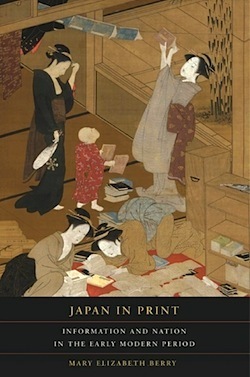
This book was similar to Berry’s other book which I read a few months ago in two important respects. On the one hand, in some ways I t is an impressive piece of scholarship. She clearly reviewed hundreds, if not thousands, of primary sources, many of which were in Japanese, to write a very comprehensive review of the topic.
On the other hand, this book, as was the case with her other book which I have read, this one was also not reader friendly. The author did use some narratives of people, places, traditions, etc which were engaging. But, as with the other book, the prose often contained long, complex, compound sentences. Sometimes these involved long lists of 6-8, even more, names, places, etc. (and some of those have sub lists of even more examples contained inside parentheses). For me anyway, all of this made it slow going, if not downright tedious at times. Because of this I found it hard to assimilate, let alone recall, the points which she was trying to make.
Chapters on maps and rosters included numerous sample maps and/or prints of drawings of various areas of Kyoyo or Edo (Tokyo in the pre-modern era). Likewise Berry’s chapter on the rosters of military men, aristocrats, etc contained many examples. While these rosters were informative, they were all in Japanese. Why not translate some, or at least part, of them into English for non-Japanese readers like me?
In regards to the maps the author made references to color coding or shading but black/white printing eliminated that info. I realize printing maps in books is expensive. But the manner in which these were presented were much less instructive than they could have been.
The chapter on cities described in great detail the various inventories and guides developed for Kyoto and Edo of various aspects of life there. While these were informative, lengthy descriptions and examples were provided to such an extent that it became tedious.
Between the prose and all of the detailed descriptions this book often became a matter of TMI, IMHO. Towards the end of the book I wondered why the editor allowed all of this to happen? Was it because Berry is a highly esteemed professor of history at UC Berkeley? So they let her pretty much have her way when it came to a finished manuscript? Or did the editor determine that this would be an academic treatise aimed at an audience of experts?
Overall, I would say that I was as much, if not more, relieved as I was satisfied at the completion of this book. The written text is only 250 pages long. But the ‘hard work’ of reading it was finally over. Thus, I would give it 3 stars.
Berry wrote a book on Hideyoshi, one of the three war lords responsible for the unification of Japan in the late 16th century. But after having struggled to get through two of her books I think I will look elsewhere if/when I want to read something about this important figure in Japan’s history. Maybe a break will make me more inclined to want to read something else by her. But I doubt it.