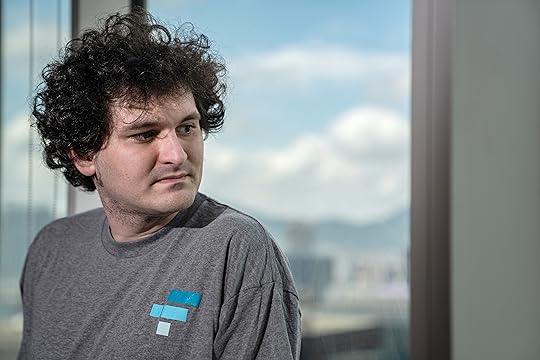
From the #1 best-selling author of The Big Short and Flash Boys, the story of FTX’s spectacular collapse and the enigmatic founder at its center.
When Michael Lewis first met him, Sam Bankman-Fried was the world’s youngest billionaire and crypto’s Gatsby. CEOs, celebrities, and leaders of small countries all vied for his time and cash after he catapulted, practically overnight, onto the Forbes billionaire list. Who was this rumpled guy in cargo shorts and limp white socks, whose eyes twitched across Zoom meetings as he played video games on the side?
In Going Infinite Lewis sets out to answer this question, taking readers into the mind of Bankman-Fried, whose rise and fall offers an education in high-frequency trading, cryptocurrencies, philanthropy, bankruptcy, and the justice system. Both psychological portrait and financial roller-coaster ride, Going Infinite is Michael Lewis at the top of his game, tracing the mind-bending trajectory of a character who never liked the rules and was allowed to live by his own―until it all came undone.
Michael Monroe Lewis is an American author and financial journalist. He has also been a contributing editor to Vanity Fair since 2009, writing mostly on business, finance, and economics. He is known for his nonfiction work, particularly his coverage of financial crises and behavioral finance. Lewis was born in New Orleans and attended Princeton University, from which he graduated with a degree in art history. After attending the London School of Economics, he began a career on Wall Street during the 1980s as a bond salesman at Salomon Brothers. The experience prompted him to write his first book, Liar's Poker (1989). Fourteen years later, Lewis wrote Moneyball: The Art of Winning an Unfair Game (2003), in which he investigated the success of Billy Beane and the Oakland Athletics. His 2006 book The Blind Side: Evolution of a Game was his first to be adapted into a film, The Blind Side (2009). In 2010, he released The Big Short: Inside the Doomsday Machine. The film adaptation of Moneyball was released in 2011, followed by The Big Short in 2015. Lewis's books have won two Los Angeles Times Book Prizes and several have reached number one on the New York Times Bestsellers Lists, including his most recent book, Going Infinite (2023).
In Michael Lewis’s Going Infinite, he compares FTX’s CEO-in-bankruptcy’s attempts to sift through the remains of the fallen FTX empire to an ignorant amateur archaeologist trying to fabricate believable explanations for artifacts beyond his understanding.
A writer of Lewis’s caliber presumably also knows of many parables about people who get too close to a subject to be able to view it objectively, too, but those don’t earn a place in the book. At no point does Lewis seem to reflect on whether the six months he spent shadowing Bankman-Fried prior to the CEO’s fall from grace — during which Lewis thought he was writing the story of a nerdy tycoon’s rise to unimaginable wealth and influence in a possible new sector of finance — may have influenced his own evaluation of the situation. The time Lewis spent observing Bankman-Fried in the company’s ritzy Bahamian offices, joining him on travels abroad, and even accompanying him to parties where they brushed elbows with the likes of Hillary Clinton and Leonardo DiCaprio certainly seems to have endeared the fallen billionaire and now accused fraudster to Lewis, who throughout the book continuously overlooks red flags and omits context that would paint a very different picture.
To this day, Bankman-Fried claims that the collapse of FTX, and the more than $8 billion in missing customer funds, is all the result of mismanagement and sloppy record-keeping, but not intentional fraud. By writing a book that largely backs up Bankman-Fried’s claims, Lewis seems to be staking his own substantial reputation on this being the truth — or, at least, on the government being unable to prove beyond a reasonable doubt that it isn’t. If Bankman-Fried is convicted in the upcoming trial, Lewis’s book will take an awkward place on the shelves of history.
Having heard Sam Bankman-Fried try to explain himself on multiple podcasts during the FTX collapse, I was struck by how unusual he was. He is not your typical conman. I have extensive training in psychology and still couldn't quite figure this guy out. That's what makes this book so undeniably crazy. Michael Lewis got sucked into the vortex. His account of Bankman-Fried is ultimately a defense of Bankman-Fried's assertion that FTX wasn't fraud and was simply a comedy of errors. The evidence doesn't support this.
Michael Lewis had direct access to Bankman-Fried during the rise of FTX and ultimately the collapse, so he paints a seemingly thorough picture of the man and what drives him. It's fascinating the way people were drawn to Fried, including Lewis. The story of Fried playing video games during the Sequoia Capital meeting where they agreed to give him hundreds of millions of dollars blows my mind. Amazing how smart people can be so dumb. The whole thing reminds me of Elizabeth Holmes and Theranos, though I find Fried infinitely more complicated than her (at least as a conman/woman).
The book provides a look at more then Fried. I did enjoy the elements of high-frequency trading, cryptocurrencies, philanthropy, bankruptcy, and the justice system.
I think Lewis was duped and he isn't self-aware enough to realize it. Perhaps he should read another big book that came out this fall that I gave five stars to, "Emotional Intelligence Habits" by Travis Bradberry.
I worked at a blockchain/cryptocurrency startup for three and a half years and was super interested in reading about Sam Bankman-Fried and the demise of FTX. I began reading Going Infinite: The Rise and Fall of a New Tycoon on the day it was released. Currently, the Sam Bankman-Fried trial is ongoing.
The book fell short for me. There is quite a bit of information about effective altruism which can make sense from the perspective of how to do the most good for the largest amount of people---however, if you're using other people's money illegally to do that---or if you're doing it to try to buy elections---it doesn't ring true to me.
Lewis is a masterful storyteller yet the character development/descriptions felt flat and one dimensional. In most books, there is a "so what." The "so what" is typically the key learning, major message, the need for reform/legislation, a powerful lesson about life, etc. There was no "so what" and I was left hanging.
I will still read other Michael Lewis books because he is an incredible journalist, but this one didn't do it for me.
If you have not paid much attention to the the Samuel Bankman-Fried saga this book is a terribly misleading place to start. If you have paid a lot of attention then this is a fascinating, page turning character portrait of Sam Bankman-Fried and the ups and inevitable down of his crazy gambling streak. While Michael Lewis persuaded me of nothing except possibly to reduce the (already lowish) trust I had in Michael Lewis, I am glad I read it.
On the good side, it filled in a lot of missing pieces on SBF's childhood, how he transitioned into finance, the role of Effective Altruism, the founding of Alameda Research, then FTX, and how it all developed.
Lewis almost completely trusts SBF's accounts of his own actions and his motives, although still presents an awful lot of damning careless recklessness. No where does Lewis engage with the large-scale lying and deception that SBF, at a bare minimum, practiced as FTX was imploding. Nor does he ask SBF to reflect on spending hundreds of millions of dollars trying to get young American men, and some women (don't forget Giselle) to be enticed into a pointless casino where the odds were always going to be stacked against them. Even if he did not steal his customer's money there would be an interesting story about how to reconcile what is basically a large-scale scam to benefit other causes that SBF considered more worthy.
Oddly, Lewis portrays SBF in childhood as a premature adult and in adulthood as a child who should not be expected to master the arcana of the adult world.
I was less bothered by the SBF hagiography than I was about the character assassination of the villains of the story: the bread crumbs planted throughout about Caroline Ellison, presenting her as somewhere between clueless and a possibly malevolent jilted ex lover who got to make all the decisions on her own, the CEO in bankruptcy John Ray and others.
And Lewis' attempt at forensic accounting are even more laughable than the random numbers that SBF spewed out on Twitter in the days after the collapse of FTX. As is his assertion that there was a sound business underlying all of this when it was clear that SBF was going to keep going double or nothing until he ended up with nothing.
I had intended to write a review about what I got out of this book and learned from it and why I enjoyed reading it, sorry, did not manage that (and I just write these reviews quickly and mostly for myself, so never particularly polished).
Update: Sam Bankman-Fried Is Found Guilty of 7 Counts of Fraud and Conspiracy The case against the founder of the failed FTX exchange had come to symbolize the excesses of the volatile cryptocurrency industry. New York Times, Nov. 3, 2023
“Sam Bankman-Fried, the fallen golden boy of crypto, is going on trial for what prosecutors are calling the largest financial fraud in recent history.” New York Times, Oct. 3, 2023
Michel Lewis is one of my favorite authors, but this is probably my least favorite of his books. It is okay to demystify and humanize an internet pioneer (The New New Thing), an eccentric investor (The Big Short), or an underappreciated baseball manager (Moneyball). But it is another thing to do so for someone who has been running a Ponzi scheme in the name of crypto-trading. Sam Bankman-Fried (SBF) started a crypto trading firm called Alameda Research and a crypto exchange (FTX).
In most of Michael Lewis books, someone is sorting through piles of data to gain some sort of edge and same is the case with 'Going Infinite' where SBF is looking for an edge in trading crypto currencies. He had a good run during the first two years of the pandemic during which crypto-trading reached the levels of tulip-mania. He was able to get funds from many celebrities, get politicians onboard and got a flattering profile from the Time magazine. But as crypto prices crashed through 2022, a run on FTX revealed that its customers’ deposits had been diverted to Alameda Research – and then into risky investments, various political donations, and luxurious property purchases.
As FTX spiraled downwards, Lewis was allowed to stay and observe. In the early chapters of the book, the author shows that SBF is addicted to computer games, has no social abilities, can barely relate to his own family, has no friends and is even devoid of normal feelings. The case against SBF is that he gambled with other people’s money, basically running a Ponzi scheme which, he said in an interview what crypto trading is all about. His partner called him “dishonest and manipulative.”
SBF was always going to crash and burn, it was just a matter of time.
As SBF goes on trial, this looks like an unfinished story. But I kept thinking throughout this book why Lewis got him so wrong. The book does better where Lewis describes the high-frequency trading of Jane Street (former employer of SBF). The author is no finance geek, but he is a good story teller. But this time he chooses a bad character and tries to show him in good light which does not really work. SBF may or may not get sentenced, but this book may damage the reputation of the author.
Like Michael Lewis's other books, Going Infinite is a fun read. The prose are clear and engaging, and he sprinkles in just the right amount of extraneous detail (like SBF's obsession with Storybook Brawl) to make the more nitty-gritty financial talk digestible. Unlike Lewis's other books, Going Infinite centers on a character who hurt a whole lot of people. But Going Infinite hardly makes that clear, instead taking an angle that's about as favorable to SBF as humanly possible.
To some extent, I sympathize with the conundrum in which Lewis likely found himself: he embedded himself in FTX prepared to write a story similar to his previous work — the unlikely tale of an underdog breaking free from the status quo and achieving the unthinkable — only to find his subject mired in controversy. But rather than delaying publication of Going Infinite to incorporate new information, or reworking the book to approach the character of SBF more critically, Lewis pushed ahead with a publication date conveniently aligned with the beginning of SBF's trial, and with a story conveniently sympathetic to SBF.
I approached Going Infinite wholly prepared (and looking forward) to gaining more insight into SBF's psyche. After all, that sort of inside information is one of the chief draws of a storyteller embedding himself with his subject. And Going Infinite definitely delivers — I learned a ton about how SBF chose to portray himself to the world. But rather than leaving it at that (or acknowledging that perhaps a gulf existed between SBF's public image and his private thoughts), Going Infinite maintains a positive image of SBF throughout, consistently referring to him and his close confidantes as "effective altruists" and engaging minimally, if at all, with allegations that SBF behaved with either nefarious intent or criminal recklessness. Further, Lewis portrays SBF's pursuers (most notably, bankruptcy attorney John Ray) as incompetent, unethical, or shortsighted.
It is abundantly clear that Lewis believes SBF to be a fundamentally good person, and Lewis's closing lines (about how all the money allegedly missing from FTX was in fact within FTX the whole time) suggests that he doesn't believe that FTX was a fatally flawed business. Lewis is entitled to his opinions — and SBF's trial may bear at least some of them out — but it strikes me as journalistic misconduct to ignore the contrary points of view, however unpersuasive Lewis finds them. Lewis claims to have received confirmation of almost all of SBF's factual assertions, but he still takes at face value the way in which SBF and his close confidantes portrayed themselves, and he doesn't engage with the concept that even pure intentions — if pursued recklessly — can transform somebody from a quixotic hero to a criminally reckless conman.
For those deeply interested in SBF's trial and the continuing fallout of FTX's collapse, Going Infinite is a worthwhile read insofar as it essentially provides the defense's argument in an easily accessible narrative. But I suspect that SBF's trial will soon render Lewis's narrative irrelevant, and I cannot suggest reading Going Infinite to those hoping to obtain a truly objective account of what went wrong at FTX.
Never ever thought that I'd be disappointed by a Michael Lewis book. But this one is pretty much a dud from the get go. Other reviewers have noted that Lewis largely fails to bring SBF to life in these pages and that's very true. Next to no insights here about his childhood, not much more about the teenage years other than he was a loner. Many reviewers posit that this illustrates how hard this elusive young man is to get your arms around. That could be true, too. If that's indeed the case, Lewis should have scrapped instead of published a half baked book. That's what this is. Sheds no light of consequence on crypto, FTX, SBF or any of the other characters. What's most troubling is the hand played by supposedly top flight universities and academics, including SBF's parents, which threads through this saga and all.of whom profited from this scam. Echos too of Bernie Madoff. Very troubling but you'll find little insight here.
Michael Lewis was shadowing SBF well before the FTX implosion, and clearly meant to write a book about crypto and why it had grown so much. And he did a great job at that. He was also perfectly situated to explain FTX's downfall, which has been well covered in the press but if you didn't follow that it was a good overview.
However, this book got a LOT of flak in the press and here on GR because on the BIG QUESTION of whether Sam was a crook or just an ignorant idiot who couldn't keep good records and over levered himself, he doesn't take a strong stance, and pretty much leads one to believe the latter. He never found a smoking gun saying Sam explicitly decided to invest customer funds. And yet he did, to the tune of $8B, half the deposits. And the end of the book he even states that the money was actually all there, just spread out in many different illiquid investments. Obviously just investing customer funds in all kinds of risky investments was itself fraud. But he more portrays Sam not as a person caught in a trap and making the decision to cross some moral line, but rather just such a weird, odd person that didn't pay attention to details as he was making so much money. This is the crazy thing - FTX was a highly profitable business - he didn't need to steal funds. It wasn't a pyramid scheme or anything like that. This left me with a unsatisfied feeling wanting to know more of his motivation. But his conclusion was kind of just: Sam is so odd, nobody can read him.
I have a new appreciation of what high frequency traders like Jane Street do in traditional markets, and why their algorithms applied to crypto were so profitable in the boom, because there were so many tokens and opportunities to find inefficiencies in the markets.
Sam was a weird dude, and really it's amazing so many people were so impressed by him. The fact that he would for instance play video games while on zoom calls with important people, is just disrespectful. Sam was clearly a person who had zero empathy for others.
It was interesting to learn that Alameda got its start with some loans that had 50% rates. And then once they were off the ground, they switched to borrowing money from crypto networks like Celsius, which promised people insanely high interest rates. This was a big piece of the house of cards.
One of the most interesting things I didn't know before this book was that FTX was founded by and backed by Effective Altruists (EA's). I guess if you are going to go into the business of making money in Wall Street or crypto and want to feel mission driven, this is what you do: you pledge to give a lot of it away to charity and thus the more you make the more impactful you are on saving the world. Thus, permission to go chase money. I'm knocking it a bit, I'm sure there are many legit EA's. But on the other hand, imagine what could have been invented if these smart kids had put their minds elsewhere.
"The smartest minds of our generation are either buying or selling stocks or predicting if you’ll click on an ad,” he said. “This is the tragedy of our generation."
“Let me tell you about the very rich. They are different from you and me.” —-F. Scott Fitzgerald
You know who Sam Bankman-Fried is. At least, you can recognize him when you see his face on the evening news. He’s young, always wearing a t-shirt and cargo shorts, and sports a Jew-fro. Seth Rogan is bound to play him in the inevitable biopic.
But you don’t know who Sam Bankman-Fried is. Nobody—-not his parents, not his brother, not his friends (a very small group, to be sure), not his numerous employees, not his lawyers, not the general public—-truly knows this kid. (And let’s not forget: he’s only 31.)
Even after spending a lot of time with him, and even after writing a book about him, Michael Lewis doesn’t even know who this kid is. Is he a financial criminal the likes of Bernie Madoff? Or is he just a socially-awkward (possibly on the spectrum?) financial genius nerd who got in way over his head?
“Going Infinite”, Lewis’s attempt to explain SBF and the whole weird world of crypto-currency, is 254 pages of fascinating and riveting information as only Lewis can write it. Unfortunately, after reading it, I felt that I learned absolutely nothing.
Crypto-currency is still a mystery to me. This was to be expected, honestly. I love reading all of Lewis’s books on the economy and the world of finance, but I rarely grasp any of it. If my brain was a pie chart of how much knowledge I take away and actually understand, the slice that illustrates my actual understanding would be paper-thin. The slice, however, that illustrates how much entertainment and enjoyment I get from reading a Lewis book would be about 75% of the pie. But, yeah, what I know about crypto-currency now, after reading the book: still not a lot.
But figuring out SBF is the real enigma. I’m not sure whether to hate this guy as a typical super-rich asshole who doesn’t understand how much his actions have hurt people or feel sorry for him as a kind of clueless dumbass who got lucky in a business that only an idiot savant would truly succeed in and then lost it all because of a lack of business savviness.
Because this guy is the very definition of “different”. Here’s a kid who did well in school and graduated from MIT, but hated reading books because they were “dumb”. He even admits that he only has the attention span to read blogs.
Here’s a kid who has never made any serious lasting friendships in his life. Even his so-called “romantic” relationships with women have been more business transactional than romantic.
Here’s a kid who claims he has never felt joy or pleasure in his life. It is an actual disorder called anhedonia. But imagine that: Never. Feeling. Pleasure.
Here’s a kid who admits that talking about his feelings is pointless because he has none.
I’m sorry, but does anyone else get the feeling that SBF is actually a robot? Or an AI in a human body?
The strange thing is, SBF is precisely the kind of real-life outlier that Lewis loves to write about. Out-of-box (way way out of box) thinking, genius level understanding of a field that a majority of people have absolutely no clue about, social outcast, unwilling to accept no for an answer.
As weird as SBF is, I think Lewis was rooting for him. Hell, a lot of people were. Which makes him a weirdly tragic figure.
Going Infinite provides an interesting glimpse into the challenges of the relatively quick rise of unregulated industries combined with a strong, unconventional personality - Sam Bankman-Fried. FTX was a a bit of a mess, and it will almost certainly happen again because technology advances are going to happen faster and faster and outpace our ability to respond.
I would have preferred a deeper dive into the forensic analysis of the Crypto market, but Going Infinite was published before the fallout settled. It focuses mainly on SBF and the lack of structure and transparency in his business practices.
I'm hoping the movie will be better than the book.
Judging people from afar without knowing much, if anything, about them, their character, and their motives is a favorite game of Americans. Most will not investigate SBF or FTX in any way (reading a book or books or even an article), but those same people will judge them as frauds because the government and the media portray them as such. Before reaching judgment, if judgment is required, I wish people would read this book. Perhaps SBF and FTX were frauds. I am unconvinced. Michael Lewis has done a wonderful job covering a complex subject and those who read this book will benefit from it by becoming more informed.
So, Michael Lewis (most famously the author of "The Big Short") apparently thought he was going to write a book about a rising young star of the cryptocurrency world. He "embedded" with Sam Bankman-Fried (SBF), who had done a few years trading at Jane Street before starting his own crypto hedge fund (Alameda Research) and exchange (FTX). It was, one imagines, a bit like if an author decided to write a book about the energy industry, and embedded with the CEO of Enron, just before things came apart. Lewis continued to interview SBF during the crash, the legal troubles, and so on.
Since the release of his book on the experience, several others have complained that his book is too lenient on SBF. I expect it probably is, because Lewis is human, presumably possessed of some empathy, and he was interviewing/hanging out with the guy for over a year. The question is, does the book shed any light on what happened, who SBF is, and how it all came about? I believe it does.
Wisely, Lewis does not try to explain how blockchain works, or other more fundamental details of what cryptocurrencies are. The reason he gives, is that this is a matter which has been well covered by several other authors. More importantly, in my opinion, this was the right call because what happened with FTX (and the various other cryptocompanies that have been cratering in the last few years) has little to do with the details of the software they were allegedly based on. SBF was not even a programmer. He was not particularly interested in using Bitcoin (or anything else) as a currency.
SBF was, unsurprisingly, not a typical child, student, or young adult. He was unusually uninterested in other people's opinions of what he should (or should not) do. This is probably not all that unusual among corporate CEO's, especially founders. If you listen too much to what other people think you should do, you do not found a company of your own, unless perhaps it is a carbon copy of twenty other already existing companies.
The more serious problem that SBF appears to have, comes from his embrace of an ideology called "effective altruism" (https://en.wikipedia.org/wiki/Effecti...). Essentially, it involves ideas like "make as much money as you can, so that you can donate it to good causes", and that if you pursue a career providing social services, but are not much better at it than the person who would have worked in that position if you had not gotten the job, then you are not really accomplishing much with your social work compared to what you could have accomplished if you had worked instead in something which paid enough that you could support charitable work with your donations. So, to review: trying to make obscene amounts of money good, toiling away in social services bad.
This, while it may raise interesting questions, is no way to make ethical decisions, not least because it offers far too much leeway to rationalize your way into (or out of) anything you want. The most likely result seems to be that you will be driven by baser urges, but have a highly refined method for excusing your selfish or destructive behavior. SBF does not appear, at least from Lewis' portrayal, to be a psychopath, but you could probably (with enough practice at sophistry) invent a justification for almost any kind of fraud or manipulation of others, once you buy into the ideas of Effective Altruism.
Worse, was the fact that FTX was run with more or less open disdain for the idea of corporate controls or proper accounting. It is a little odd that a company which, in reality, owned almost no assets other than its numbers (databases and bank accounts and financial models and so forth), was so unconcerned with keeping track of what it owned and where it kept it. This, at least, we do not have to take Lewis' word for, as the post-SBF CEO of FTX (appointed by the bankruptcy court) has explained in an unusually forceful manner in his testimony before the court.
The largest question, though, which Lewis mostly does not address, is: why did society think it was a good idea to give these people so much money to work with? They did not steal the money (though they certainly did commit fraud once they had been entrusted with it); investors came to them and said, more or less, "here, take this money of mine, I hope you are trustworthy". There was absolutely nothing in the background or makeup of FTX to suggest that they were trustworthy. They did not really even pretend to be.
SBF did not wear a business suit, carefully comb his hair, speak in a polished manner, and thus cajole people into thinking he was a good person to have custody of your money. Put images of Jamie Dimon and Sam Bankman-Fried together on the screen; which one seems more likely to steal your money, perhaps more-or-less accidentally through criminally poor accounting controls? As objectionable as establishment finance is, one can normally expect that they will work within the law, if only because they have so much influence over how those laws are written. More importantly, there is a certain amount of predictability to their actions, because they have a long track record. They may not be nice, but they are a known quantity, competent at what they do. What was there in SBF, or the organization he built, that was convincing to people (many of whom had a great deal of money) that he was someone who should be given control over billions of dollars?
Nothing. SBF, and FTX generally, were not even up to the task of keeping proper track of what the money had been spent on.
In essence, it is the same question that lies at the heart of "Bad Blood", the story of Theranos and Elizabeth Holmes. There was a certain archetype of a young genius, who (if you rode their coattails) could make you rich. The actual ideas they proposed for how to do this, were less important than the fact that a lot of people had way too much money to invest, and no good options to invest it safely (since interest rates for things like Treasury bills were near zero). The money, and other resources, that were poured into FTX did not ever have any realistic prospect of being productively used. There wasn't even really any UNrealistic prospect of it being productively used, unless you think that a Ponzi scheme can go on forever. In this respect, it is more appalling that SBF was given large investments than it was in the case of Theranos and Elizabeth Holmes, who at least had a semi-plausible story of how they were going to do something useful with it.
The story of how a young group of 20-somethings ended up being given billions of dollars to work with, and then more or less wholly failing to do anything sensible with it, turns out to be eminently readable, mostly because Lewis is a master of his craft (in a way that, say, SBF was not a master of his craft). I read it quickly, and enjoyed it a great deal. I only hope that the worst of the free-money excesses of that era are behind us. SBF probably could have been a reasonably productive, reasonably ethical person, if he were merely the eccentric trader in a well-managed, well-governed financial enterprise. It does not absolve him of blame that he should have been stopped from rationalizing his way into billion-dollar fraud, but it is equally a serious problem of our society that so many people with resources to spare, thought he was the person who they should trust with those resources.
I am a big fan of Micheal Lewis having read Liar’s Poker, Moneyball, and The Big Short. My curiosity was picked after seeing the 60 Minutes piece on FTX and featuring Lewis.
This is the first book of Lewis’ that I did not rate 5 stars. Lewis’ ability to describe complex financial concepts serves him well here. I was also impressed on his insights into SBF and his unusual personality and style. Some reviews here have accused Lewis being duped and getting too close by SBF. I think these criticisms false. He does not make a sympathetic figure out SBF, rather, I think he looks at him as a curiosity.
The trial of SBF is currently in progress, and I think this book may have been better if written after the trial,was over, and Lewis could have a more complete look back perspective. Still, it’s an interesting read if for no other reason to learn about the squirrelly nature of the crypto currency market.
Michael Lewis' trademark storytelling is here, but SBF, FTX and the crypto bros are boring to read about. I have no complaints about how Lewis constructed this narrative. He does a good job of telling the events through the eyes of the people involved, the problem is that the people involved are bland personalities. Two stars seems a bit unfair because the writing is solid, but this really is just an okay book. If you haven't read Lewis before, please don't start with this one.
I was looking forward to this but could not be more disappointed. With a front-row view of an adult man who professed publicly he would happily gamble away the earth, then did gamble away and frivolously spend billions, Lewis somehow decided to write this infantilizing hagiography. He passes the blame off on anyone but SBF in this bizarre, financially illiterate defense.
The book doesn’t even really include any details that weren’t already reported!
He wrote most of this book prior to the multiple (incredibly hard to deny) fraud allegations and didn't bother to turn his rags-to-riches biopic into something more accurate - the story of a convincing sociopathic fraudster.
He might hope that the jury will read this as a "jury's note", but it should merely serve as an example of how even great (finance) writers can get blindsided by the idea of someone - SBF can't do no wrong, he was an Effective Altruist, he didn't care about money, surely he didn't defraud anyone?
In any case, I'd say there are plenty of Michael Lewis books out there that are so much better and actually worth your while. So unless you care for a one-sided deep dive into the neuro-divergent minds behind one of the most pivotal fraud cases of recent memory, just follow the trial and watch some video essays.
I find the negative reviews of this book to miss the point, or at least what I think the point of any evaluation to be: was it a good book? The answer here is clearly YES! Michael Lewis is an amazing writer and I find it odd that folks claim he was duped by SBF when all he seemed to do was bring a human perspective to a guy who basically is inhuman. But is he intentionally malicious? After reading this I would say no. Now, I have lots of thoughts about the financial world in general and the weird additional layer of effective altruists that I'd never heard of before, but criticism of those people shouldn't extend to the book itself, at least in my view. I'm more bothered that people can make this much money at all. And how delicious that a book by a fairly literary non-fiction writer does for Sam what he could never do himself: elicit real empathy and understanding. I guess there is a role for English class after all!
Largely entertaining, but it does not give a full or proper picture of Sam Bankman-Fried and FTX at all. You came away from reading this as if it was a company run by pure incompetence, and as if there was no element of malice or scamming involved. Come on, this is crypto we're talking about! On that note, I don't feel like I'd recommend this book to people who don't know anything about crypto or much of the case. You come away thinking Bankman-Fried is merely a weirdo, not a fraud. As other reviewers have noticed, it seemed the author was very much charmed by him. It would have been nice to also have the trial included, but I understand that it made me more sense to get the book out asap while people were still interested.
I happen to be a consequentialist who, like people mentioned in the book, was deeply moved by reading Peter Singer as a teenager. I have a lot of sympathy for Effective Altruism and I was a little irriated by how these philosophical stances are portrayed in the book. EA, and even it's weirder offshot Longtermism, are not to blame for finance fraud and it's already very frustrating how many people seem to think the soundness of an argument is defined by who's espousing it. The book is very much not helping by making it seem like everyone who's an utilitarian has no emotions, just because the book's main subject seems to be a sociopath. FTX's problem was not that some of its employees were less crypto bro-y than others in the scene...
Going Infinite: The Rise and Fall of a New Tycoon is an intriguing psychological portrait of a convicted American cryptocurrency entrepreneur Sam Bankman-Fried and a unique behind-the-scenes look into his now-bankrupt cryptocurrency trading firm, Alameda Research, and his crypto exchange, FTX.
The entire story, as well as its many characters, are bizarrely engaging, to say the least. I especially appreciate Michael Lewis' storytelling skills and his ability to explain complex topics in an understandable and engaging manner. I don’t know anything about cryptocurrency, but I was able to enjoy the story without the urge to google everything, and that's high praise given my extremely low tolerance for confusion, uncertainty, and the unknown, haha!
I especially enjoyed the many insights into the eccentric personalities and unusual minds of Sam Bankman-Fried and his associates. In Going Infinite, you can encounter expected value calculations in daily activities and interactions, utilitarianism in action, effective altruism on Wall Street, intriguing Jane Street hiring process, love letters as business memos, infinity money, and a multi-billion dollar business with little to no appropriate management, corporate governance, or organizational structure.
However, I can't get rid of the feeling that Going Infinite was rushed to be published just in time for the beginning of Sam Bankman-Fried's trial in order to ride the wave of relevance. I think the book would be much more critical and rounded if the trial details, especially the testimonials and findings, were included in the story. As it is now, the story not only seems incomplete and rushed, but also rather biased. I haven't followed the trial, so after listening to Going Infinite, I had an impression that Sam Bankman-Fried is probably just a weirdo who was in over his head, not necessarily a cold-blooded fraud. Apparently, there is more to this story, but unfortunately, you won't find it in Going Infinite.
I can't quite call this a good book. Michael Lewis isn't the person to write the story of Sam Bankman-Fried. He had the luck—you decide if it's good or bad—to be in the room when FTX collapsed. Although Lewis has financial chops, he's primarily a teller of stories about people, and someday a better book, written by someone with investigative chops, will be written.
Instead, what we get is a portrait of Sam Bankman-Fried (hereafter known as SBF). Lewis plays it straight, never fully giving his opinion of SBF—you have to guess. I would not call the portrait flattering, though some have called this a hagiography. Whether that was Lewis' intent, or because his portrait unintentionally played into all of my preexisting prejudices, is an open question. What I will say is that if the last chapter or two of the book had played out differently—if the FTX house of cards hadn't fallen apart—people would be hailing SBF as an eccentric genius. (I wouldn't, but more on that later.) I will say that the book reads a bit like Lewis started writing it liking SBF, and then the "oh shit" came in during the editing process. Based on interviews I've read, he was entirely too credulous about both SBF and crypto in general.
The short version of the book is that SBF is a major fucking asshole who has no regard for anyone but himself. His childhood vignettes could be viewed as cute and quirky. I didn't see them that way. Lewis almost sets him up as a "look maybe he's autistic!" in the way that's always applied to white men who have bad social skills. (I would question if he has some other pathology going on, but I don't diagnose.) SBF is so much more than that, though. He's the coddled son of Stanford professors whose self-regard is barely punctured till he's not the smartest kid at math camp. He decides literary analysis is bullshit because he doesn't get it.
SBF is the perfect synopsis of the paradigm that is the Rational Man: He claims to be deciding everything via data and logic, while ignoring that he's actually manipulating logic to produce the result he already wants, or that ethical claims cannot be entirely decided via statistics. Everything, to SBF, is just a puzzle that needs to be solved. Nothing is real, and there are no human stakes to consider.
The apparent exception to this rule is his belief in Effective Altruism, which holds that people should maximize the utility of their giving. That sounds great, but it breaks down quickly. For example, using EA logic, one should try to earn the most money possible, to give away: the perfect conscience-salve for working in finance. In reality, people don't necessarily have such a choice, and it only works as long as a minority of people do it. But the real hole at the heart of EA comes later, when it's all about all the money they will give, but never actually do... and when they use their logic to persuade themselves that the best use of their money is long-termism, or investing in highly improbable scenarios like preventing an asteroid from hitting the earth. It's a very convoluted way of avoiding having to help people today: having to take moral responsibility for choices.
Incidentally, the finance industry and academia don't come off very well: the best goal for MIT physics majors is apparently to go work for firms like Jane Street so they can play games with other people's money.
In the end, as much as I hated SBF at the end of the book, I also felt Lewis hadn't actually given me anything solid. Why did SBF do anything he did? Was it all just a game? An employee accurately sums him up as entirely lacking in empathy, and that's probably correct. Is there more there? I don't know.
The reviews on this have been so 👀 that I went in expecting to hate it and was pleasantly surprised!
Yes, Lewis is *so* credulous when it comes to SBF — on the big stuff like whether he misplaced $8 billion, and also on the small stuff like whether his views on the effective value of abortion were first developed in the seventh grade (sure). He tries valiantly to turn SBF’s lack of empathy and disinterest in human decency into a personality quirk instead of a liability.
BUT: The fact that Lewis is a bit enamored of SBF, a bit hung up on the idea that “his brain just works differently,” is moot in terms of finding Going Infinite interesting. The book still reads like a compendium of ways in which governance of FTX/SBF was garbage. Liiike, there was no CFO. They’d misplaced money before. The entire management team had once quit. Almost every anecdote Lewis has doubles as a red flag.
Of course, hindsight is 20/20. But that *we* can see all the red flags when Lewis appears to be missing them almost makes for a funnier book. By the time it turns out that SBF — the guy who plays video games during meetings, doesn’t listen to colleagues and shrugs off human emotion — is in fact not a wunderkind… it’s frankly validating. It feels right. And that Lewis seems surprised by this development is only awkward for him.
After reading The Blind Side and Moneyball I knew that Michael Lewis was a fantastic storyteller. And from reading The Big Short and Flash Boys I discovered that he had a knack for making complex financial issues understandable and interesting.
This time Lewis turns his attention to the story of Sam Bankman-Fried. Yeah, the FTX cryptocurrency guy who just this week was convicted of multiple counts of financial fraud. He’s definitely an interesting character, and Lewis takes a fairly sympathetic view of him. I’m not sure whether details from the recent trial would change his opinion.
What I found to be most fascinating was the movement called Effective Altruism. It was this utilitarian principle that supposedly motivated many of these socially awkward math geeks to strive to amass huge sums of money in order to then donate as much of it as possible to organizations that would be most effective at saving lives around the globe. At least that was the idea initially. Over time, it mutated enough that the current world’s population was completely ignored so that money could instead be funneled into solving potential problems that may affect even more people in the future. Or not. Things like asteroid strikes, climate change, or pandemics.
Overall, this wasn’t my favorite Lewis book, but I’d still give it 3 stars for “good.”
Going Infinite : The Rise and Fall of a New Tycoon (2023) by Michael Lewis is the latest book from the master of narrative nonfiction. Lewis continues his incredible run of finding extremely interesting characters and situations to write about. Lewis also writes well and his books are entertaining reading.
This time around Lewis writes about Sam Bankman-Fried (SBF) and the creation of the crypto exchange FTX and it’s incredible fall. The book’s publication also coincides with the trial of SBF.
Lewis generally finds people who he can write about as heroes. His characters typically have an insight and have faith in their own ideas and show the world. In Going Infinite this is far from the case.
SBF’s story is incredible. He is a highly intelligent child of two Stanford academics. As a child he was odd and was passionate about games with an appropriate degree of randomness. He was highly rational and had problems with more subjective subjects like English. SBF was very good at math and went to MIT to study physics. At MIT SBF became acquainted with the Effective Altruist (EA) movement. SBF quickly got a job as a trader at a secretive trading firm called Jane Street. There he did very well and was on track to earn millions.
But instead he decided that crypto offered great opportunities to people with trading skills. He founded Alameda Research. He founded the firm with a number of ex Jane Street people and also with a number of Effective Altruists. First Alameda failed but then SBF kept the firm and kept it going and making profits. He went to Hong Kong and met other crypto enthusiasts including Changpeng Zhao (CZ) the co-founder of Binance. CZ is currently worth 13 Bn. SBF then decided to found an exchange which became FTX.
FTX became incredibly successful and SBF became one of the richest people on the planet. He spent prolifically and started to try and funds were dispersed for Effective Altruism projects.
Eventually things turned south and a crypto crash caused FTX, which was making wild amounts of money, to collapse. Alameda Research and FTX had their finances intertwined. FTX was extremely chaotic and poorly run.
Going Infinite is a fun read. There are caveats however. Perhaps, for the first time Lewis has been conned. Lewis is also aware of this and make astute comments. But still, Going Infinite is engrossing.
This book is a front row seat to a wild, greed-fueled rollercoaster ride in the insane world of crypto. Michael Lewis is a wizard when it comes to making something as tedious as financial markets and crypto not only understandable but actually fun to read.
Reading Lewis’s books is always a treat. They’ve got this delightful whimsy that just makes them super digestible. It’s like listening to a good friend who happens to be really smart and a little bit cheeky. And with "Going Infinite," Lewis delivers that in spades. He takes us on this rapturous romp through the worst excesses of greed and capitalism as seen in the crypto world. It's like watching a high-stakes drama unfold and you can’t help but munch on your popcorn, eagerly waiting to see what crazy thing will happen next.
This book is an adventure tale that spans the globe. We're following Sam Bankman-Fried, who's basically the pirate captain of a cryptocurrency treasure ship. Unfortunately for Sam, he’s on the spectum for sociopathy, uncomfortably tone death to other’s feelings. However, Sam knows he’s crazy, but despite this, or maybe because of it, you end up pulling for the guy. He’s this unapologetically blunt dude, strolling through the chaos of financial ruins in his hoodie, totally unfazed. No clean shirts, no small talk, just brutal honesty. It’s refreshingly genuine in a particularly weird way.
What made it really delightful? The fact that all this madness is actually true. You’ve got Sam, a character so out there, making moves that you can barely believe, and yet, it’s all real. It’s this blend of bizarre reality and captivating storytelling that keeps the pages turning.
So yeah, I really enjoyed this book. It’s like a classic adventure story, but all the treasure and monsters are replaced by Bitcoin and financial tycoons. You never quite know what Sam is going to do next, and that unpredictability makes this read an exciting, albeit sometimes overwhelming book.
In a nutshell, Michael Lewis has done it again. He's taken a topic that could have been dry as dust and turned it into a story full of life, laughs, and lessons. Definitely worth picking up, especially if you’re into stories about high stakes and wild personalities.
I'm one of (relatively) few people who do not enjoy Michael Lewis's books - it's something about his style that always puts me off. But when I discovered his latest one is about SBF & FTX, there was no way to stop me from reading it.
Truth be told, I had mixed feelings after the lecture. On the one hand, ML was trying to portray SBF as a person - how did it happen that he has created such an empire, what were the motivations behind his decisions, how did he operate & interact with other people (inside or outside FTX/Alameda Research). But sadly, this image is ... not so credible. There are too many shortcuts - e.g., HOW WAS IT POSSIBLE that a person with such difficulties in communication & social interactions was able to raise so much money? OR what was so unique about crypto trading in FTX/AR that FTX stood out (& generated such revenue)? It all seemed like a completely unrealistic fairy tale - e.g., if someone had created a fictional movie with such a story, I'd find it childish & completely unrealistic. Unfortunately, ML does dive deep enough - by far.
What is even worse, this stays true also for the collapse of FTX. Yes, many facts are presented, but ML skips some essential considerations (did it all happen on purpose, was there an organized fraud behind FTX, how much SBF knew about missing funds / potential issues with liquidity) AND presents SBF nearly as a victim here - seriously, I'm not buying that ...
And there's the story behind ML's interactions with SBF - apparently, they had interactions for six months (ML was planning to write a completely different book about SBF), and ML failed to "read" SBF - didn't spot the bullshit behind all of that, has also fallen under some sort of charm/spell/illusion - this book looks a bit like he's whitewashing his name, justifying his own ignorance.
I think the book is worth getting familiar with, but I really hope that the investigation will bring far more data.
Riding shotgun why didn’t author alert the authorities. He is one of them who came to the trough and benefit from the overnight tycoon’s wealth. In the u Teri we he kept making fun of his subject. You ant babe it both ways author.
I’m a big fan of Michael Lewis and the kinds of stories he tells, especially when finance sits at the centre. Unfortunately this one didn’t quite fire for me. Although the story of the collapse of FSX is particularly interesting, the way the rise and fall of Sam Bankman-Fried is narrated here lacked a bit of coherency for me. Too much focus on observational quirks and less than I’d have liked on fraud. Okay, but not great.