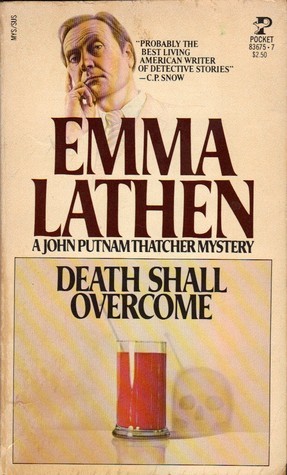
Emma Lathen is the pen name of two American businesswomen: an attorney Mary Jane Latsis (July 12, 1927 -October 29, 1997) and an economic analyst Martha Henissart (b. 1929),who received her B.A. in physics from Mount Holyoke College in 1950.
For a book set and written in the 60s, this manages to be remarkably topical, covering the reaction to the first African-American man, Parry, to apply to buy a seat on the Wall Street Stock Exchange. [Apparently individual seats are no longer sold, but when they were, only one African-American held a seat, and that not until the 1970s.]
Lathen's books are more mild humorous satire than primarily focused on the murder, and so this story focuses very much on the circus of protest and counter-protest - and some very ugly exhibitions of racism - rather than the fine detail of alibi and motive. I wasn't overly keen on the portrayal of the opportunistic Simpson, who gets the most speaking-time for the AA characters outside the Parrys, but overall I think the story worked.
At one point, our POV Thatcher and his daughter are witness to a nasty display of racism and violence, and he says to her: "Just a passing ugliness", which is a statement I spent some time considering, given how reluctant that ugliness is to pass.
On another note, this is the 60s, and in all the drama about Parry acquiring a seat on the Stock Exchange, there is a passing sentence that brings home that this is one battle among many battles. For "women aren't allowed on the floor."
[Looking at other reviews, I guess the ebook has been edited for word use, so content warning for outdated racial references.]
This is a mystery that takes place on Wall Street. This is a mystery that involves the Civil Rights movement: there are ministers, spirituals, lots of singing (including the Sloan Glee Club and chapter titles from spirituals and Civil Rights songs), rallies, marches, and speeches. There are racists. There are red herrings. There are stalking horses.
The Sloan gang are all here. John Putnam Thatcher, just returned from a trip to Poona that included wearing a detested furry hat, is full of action. He visits several New York City landmarks in the course off this mystery. It was fun! Mr. Thatcher was masterful in using his team at the Sloan to ferret out all the clues he needed to solve the mystery of the murder of Arthur Foote.
Lots of extremely witty lines in this one. I could not stop highlighting one zinger after another. Though a 20th century mystery, it is still immensely enjoyable and rousing (especially the singing).
Remember, dear readers, in Emma Lathen mysteries, it is always about the money.
Emma Lathen was the pen name of Mary Jane Latsis and Martha Hennisart who wrote twenty four books featuring the detective skills of a Wall Street banker. (Under the name of RB Dominic they also wrote seven books featuring the detective skills of a Congressman.) I first came across their books in 1981 and I read fourteen of the books in this series back then but this is the first time I have read this one.
This was first published in 1966 and deals with racism as some people can't handle the possibility of a millionaire joining the New York Stock Exchange because of the colour of his skin. The story starts with a poisoning then a shooting attempt but the story is told with a lot of humour.
Perhaps 3.5. My main reservation is about how dated it is, written and set in the civil rights movement in the 1960s. An African-American joins a stockbroking firm who apply to the New York Stock Exchange for membership for this man. Murder and mayhem follow as one might expect from a John Putman Thatcher book by Emma Lathen. Be prepared if reading for some language that is now very outdated.
That central theme, with its weaknesses, apart it is a highly enjoyable book worth the re-reading. It has its humorous moments and the characters are a pleasure to read about.
Wonderful traditional mystery that follows banker/sleuth John Putnam Thatcher as he solves a case involving racist reprisals against a black financier who is proposed for a seat on the New York Stock Exchange. The 1966 novel shows its age in a few places but its attitude toward racial politics doesn’t seem very dated. It’s wonderful to travel back in time to mid-1960s Wall Street. Thatcher is a sophisticated Manhattan sleuth in the same league as Nero Wolfe.
John Thatcher, vice president of the Sloan Guarantee Trust, faces with laugh-out-loud, cynical humor a March on Wall Street triggered partly by misunderstanding and partly by a rabblerouser's ego. Of course, there is a murder, but the way it fits into the picture of racial reform isn't clear. As we expect from Emma Lathen, we get cleverness of plotting and characterization.
I gave this low score because it seemed dull and boring. I think it might be because it was dated—published 1966. Death occurs at a time on Wall Street where things are changing. For the first time a black partner is hired.
I found the characters in this one a little harder to follow than usual, and the mystery a little more obvious. But it's still very funny and generally entertaining.
A rollicking and witty adventure about a Wall Street brokerage firm that puts up its first African-American partner to buy the first seat on the New York Stock Exchange to be held by a Black American. As usual, Banker John Putnam Thatcher unravels the plot against the purchase.
I have to say frankly that the fact that I love Emma Lathen's books has nothing to do with the mysteries "she" (actually a pseudonym for two women co-authors) presents. The books are, frankly, dated, probably because they were so topical when written. For instance, Death Shall Overcome involves the reaction on Wall Street to the installation of a man of color (a black millionaire) as a partner in a prominent firm of traders. Old news, right? Secondly, I have never found the "mysteries" themselves to be that satisfying when revealed. The puzzles are not boring, certainly, but don't have that zing of "omigosh!" at the revelation. However, what the Misses Lathen ;) DO have is a great knack for characterization. Their reluctant detective, banker John Putnam Thatcher, has a dry sense of humor and keen nose for absurdity. Charlie Trinkam is always charming and raffish, Everett Gabler prudish but with a surprising sense of humor, Tom Robichaux's endless parade of trophy wives is always entertaining and Thatcher's secretary, Miss Corsa, a symphony of efficiency and nonironic sensibility. I always enjoy the characters--both recurring and occurring--their conversations and how they get out of whatever pickle they've found themselves in. The set-up in Death Shall Overcome is, as I said, dated, but aside from the partnership issue, how they deal with regulatory issues and bad publicity has a ring of topicality. If you prize characterization in your mystery novels, here's a good place to find it.
This story ran in the NYT on 10/31/97 upon the death of M.J.Latsis, one of the two authors: article in NYT on authors
This book is, in many ways, a bit dated. The vocabulary prompted me to check and find an interesting evolution of language: In 1966, when this was written, "Negro" was considered polite and inoffensive, while "Black" was considered more offensive, and "African American" was still a new terminology.
The story is set among the battles of the Civil Rights Movement, and you would wish it to be entirely obsolete. Instead the reader gets a grim sense of recognition when finding back personages in 1966 that, alas, could still be encountered in 2016.
The plot is simple enough: Mayhem and murder ensue when the brokerage firm of Schuyler & Schuyler decides to select a black millionaire as new partner in the firm. Reactions in Wall Street offer ample opportunity for satire, from mild to sharp and anything in between--
"But for God's sake, what does colour matter when a man has fourteen million dollars-that's the way I see it." "I'm sure you do," said Thatcher. There was much to be said for an uncomplicated outlook.
In this case, the whodunnit takes a back seat, as the reconstruction of the crime is a bit hard to follow and heavy hints are dropped along the way. For the most part, this is social satire, distributing its blows pretty much evenly all around, and with Thatcher at his mischievous and grumpy best.
Another John Putnam Thatcher mystery, where he solves murders partly by examining bank records, and stock broker sales. In this book,which takes place in the 1960's, a black man is proposed for a seat on the stock exchange, setting a controversy which people today would have trouble understanding. Of course, one person is murdered, and another nearly so, but John thinks it through and determines who the culprit is. Some of the language is not politically correct for today, at the time this book was mostly using language that was considered correct.
Once you get rolling into the story you can't put the book down. You think that one event can't be topped by another, you're wrong. The ladies of Lathen do a great job here.
A young "negro" is getting an application to a seat on the exchange! (The book is written 1966.) People are appalled. Well certain people are, others don't care really. Murder, riots, drinking, singing... Thatcher does it all and by keeping tidbits of events in his mind, figures out who dun it.
Wow. Great look at the time period, and about civil rights, and human behavior.
It is the early 60s and the older brokerage house of Schuyler & Schuyler announce a new partner -- a black millionaire named Edward Parry -- and a proposal for him to take a seat on the Stock Exchange. The announcement kicks off several chain reactions, not the least a murder, a murder attempt, protests and a march on the Exchange. It all calls for a clear head and only John Putnam Thacker is using it despite the challenges and upheavals. Once again, Emma Lathen has created a memorable situation with Thacker tackling the puzzle and the solution.
There's an uproar on Wall Street when a brokerage firm wants to add its new member, a black millionaire named Parry, to the Stock Exchange. One of its other members is poisoned at a party, possibly because his drink is mistaken for Parry's. This book was written in 1966, so instead of using the current term "blacks", all references are to "Negroes", making it seem a bit anachronistic. I did figure out the killer, but not his motive. This is usual for me and Lathen.
Another great Emma Lathen mystery, this one melding current events at the time of writing (ending segregation among the Wall Street elite by soliciting a seat on the Stock Exchange for a black millionaire) with the author's customary low key humor and clever murder mystery. Highly recommended. (Note: if you aren't used to reading books from this time period, please keep in mind that "Negro" was a polite term on the level of today's "African American." Otherwise you might find it a bit jarring.)
The Sloan enters the Civil Rights fray in this entry into an entertaining series. The brokerage house of Schuyler and Schuyler announce a new partner with a seat on the stock exchange - black millionaire Edward Parry. One of my very favorites in this series. The sit-in is really great. Lots of fun.
Another excellent John Putnam Thatcher book, well worth re-reading. A middle-aged partner at a brokerage firm making headlines for introducing a black multimillionaire to the New York stock exchange (remember this was the sixties) is poisoned at an exclusive welcome party for the new black partner. But who was the intended victim - the middle-aged partner or the new black partner? And why would either of them be a target?