Winner of the 2024 Christianity Today Book of the Year Award and Popular Theology category; Winner of Credo Magazine’s Award in Theological Retrieval
There's a movement among evangelicals of exploring the more sacramental, liturgical, and historically-conscious church traditions, including Roman Catholicism and Eastern Orthodoxy. This hunger for historical rootedness is welcome—but unfortunately, many assume that this need can only be met outside of Protestant contexts.
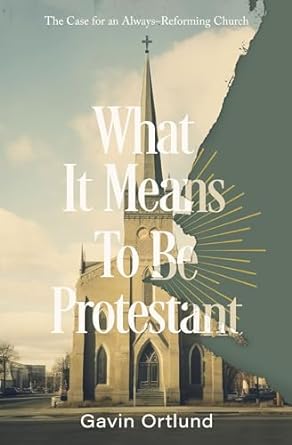
In What it Means to Be Protestant, Gavin Ortlund draws from both his scholarly work in church history and his personal experience in ecumenical engagement to offer a much-needed defense of the Protestant tradition.
Retrieving classical Protestant texts and arguments, he exposes how many of the contemporary objections leveled against Protestants are rooted in caricature. He shows how historic Protestantism offers the best pathway forward and to historical rootedness for Christians today.
In his charitable style, Ortlund demonstrates that the 16th century Reformation represented a genuine renewal of the gospel. This does not entail that Protestantism is without faults. But because it is built upon the principle of semper reformanda (always reforming), Protestantism is capable of reforming itself according to Scripture as the ultimate authority.
"I find it hard to overstate the importance of this book for every pastor/minister, elder, and serious Bible student that I know. . .This book automatically becomes my new go-to resource explaining Protestantism. It is fantastic, and I thank God for it. . ." —Bobby Harrington, co-founder of RENEW.org and Discipleship.org, founding pastor Harpeth Christian Church
Gavin Ortlund (PhD, Fuller Theological Seminary) is senior pastor at First Baptist Church of Ojai in Ojai, California. He was previously a research fellow for the Creation Project at the Carl F. H. Henry Center for Theological Understanding at Trinity Evangelical Divinity School. He is the author of Finding the Right Hills to Die On, Theological Retrieval for Evangelicals, and Anselm's Pursuit of Joy.
It's increasingly common to come across evangelicals who've convert to Eastern Orthodoxy and Roman Catholicism (some might even be part of one of your favourite bands or a classmate). Many have conducted rigorous and prayerful investigations into the depths of the Christian tradition and have become convicted and convinced that they must leave behind their Protestantism. Testimonies of these intra-Christian conversions abound on Twitter and the blogosphere. Family, friends, and fellow churchgoers may express concern that a loved one or congregant is leaving Methodism or Pentecostalism to swim the Bosporus or the Tiber but the former are often ill-equipped to grapple with church history and arguments based upon tradition and doctrinal development. For evangelical Protestants, the Bible alone is the only infallible authority but this reverence for Scripture has often led to an almost total neglect of other areas of theological authority.
Last year I came across Gavin Ortlund's video ministry. I was impressed with his well-produced videos where he charitably and constructively engaged in intra-Christian apologetics representing a Protestant perspective. I listened to several of his debates and dialogues with apologists of other streams of Christianity such as Trent Horn. Here was an evangelical Protestant who closely examined biblical exegesis, tradition, and church history and could cite church fathers back at detractors of Protestantism. When I learned Gavin was going to be releasing a book that resembled a lot of the content on his TruthUnites channel it became one of my most-anticipated books of the year and it did not disappoint.
'What It Means to be Protestant' is an excellent introduction to what divides Protestantism from Eastern Orthodoxy and Roman Catholicism. Gavin generally builds his arguments based upon the insights of the magisterial Reformation (Luther, Calvin, and John Jewel are cited but the Anabaptists and pentecostals do not make much of an appearance if at all). He also specifically draws inspiration from the Mercersburg theology (he makes the astute observation that it was highly ironic for John Henry Newman to quip that "to be deep in history is to cease to be Protestant" when his contemporary across the Atlantic in America, Philip Schaff, was working on the Nicene and Post-Nicene Fathers collection).
Gavin presents some fairly typical Protestant apologetics such as the scandals and corruptions endemic in the medieval Church and arguments against the papacy alongside a positive championing of "sola Scriptura." One of Gavin's key arguments for Protestantism is that it is the most irenic of the major streams of Christianity. For instance, he conducts two case studies (the Assumption of Mary for Catholicism and the veneration of icons for Orthodoxy) and not only demonstrates how these are later accretions to tradition but also critiques Rome and the East for condemning those who reject these doctrines and practices. Gavin builds his cases based upon recent scholarship (such as Stephen J. Shoemaker's work on the Virgin Mary) as well as on the teachings of the church fathers (who, it turns out, often vigorously disagreed with each other and even contradicted themselves as their thought evolved).
Not that I expect an Orthodox or Catholic Christian to convert to Presbyterianism or Methodism by reading this book but I was surprised that all of the endorsements in the book seemingly come from Protestants; surely an irenic Catholic scholar could have been solicited for a blurb? As well, as I mentioned, this is an introductory book for a wide audience; it is not Stanley Hauerwas and Matthew Levering slugging out esoteric tenets). Still, I think any Christian reader will benefit from this book though I also suspect most of its readership will the "very online" Christian who inhabits Twitter and YouTube. Gavin is irenic and pastoral, cautioning readers to avoid triumphalism, to listen to the best of both sides (i.e. don't let Mark Driscoll and Eric Metaxas represent evangelical Protestantism on the one side and Henri de Lubac and Pope John Paul II represent Rome on the other side) and to deeply and prayerfully reflect if they feel called to change churches.
A great entry-level book on the value of Protestantism over and against its ecclesiastical alternatives (eg. Roman Catholicism and Eastern Orthodoxy).
Ortlund argues for the thesis that Protestantism is "the tradition best positioned to retain and cultivate catholicity", because it can affirm the good in the pre-reformation church and non-Protestant traditions, acknowledge its own errors, can continually reform itself, and holds fast to sola fide and sola scriptura (the former being "a material component of the apostolic deposit recovered by the Reformation", and the latter being "a formal principle by which we remain accountable to that apostolic deposit.") (Chapter 1). Protestantism's claim that Christ's "visible church coheres within multiple institutions" stands against the claims of various ecclesiastical traditions, each of whom claim to be the "one true church". It is therefore best placed to "see the fruits of the church in multiple institutional expressions of the church" (eg. worship of the Trinity and Jesus Christ, exorcisms, and spiritual transformation) and affirm that true church of Christ wherever she is (Chapter 2).
Ortlund's next two chapters (ch 3–4) proceed to cover the impetuses of the Reformation – indulgences, persecution (eg. of Jan Hus and the Hussites that came after him), and the need to recover sola fide. Chapter 4, which covers sola fide, is one of the weak points of the book in my opinion, as it only offers a brief survey of the doctrine. However, I understand that that might be because this book is meant to be pitched at an entry level, and not meant to function as an exhaustive defence of Protestantism and doctrines such as sola fide. Still, I think I would have preferred if the chapter had included more analysis of the patristic material.
In the next 4 chapters, Ortlund covers the question of authority – defending sola scriptura (that Scripture is the sole infallible rule of faith), answering its objections, exploring and pushing back against the Papacy, and addressing the claim of some ecclesiastical traditions that an unbroken line of bishops (the office being distinct from presbyters jure divino) laying hands on one another in succession is necessary for valid ordained ministry and efficacious sacraments.
First concerning sola scriptura, Ortlund clarifies that sola scriptura does not claim that Scripture is one's only authority, nor does it make any bold claims, since even ecclesiastical traditions agree that Scripture is God-breathed and inspired in a way that tradition (which they also claim is infallible) is not. The burden thus lies on the ecclesiastical traditions to explain why something else apart from Scripture, which is ontologically different from it (i.e. not God-breathed and inspired), can somehow also be said to be infallible as well (i.e. identical to it in authority). Ortlund then answers critics from a number of angles, such as appealing to Christ's practice against the Phrarisees (who similar taught that they possessed an unwritten oral divine law in the form of the traditions they taught), the lack of any hint of any other infallible authority apart from Scripture in the New Testament, whether the church forming the canon of Scripture means that it too is infallible equal to (if not above) Scripture, and from church history. This leads me to another part I found weak in this book – one of the objections that Ortlund answers briefly is the objection that "Sola Scriptura Depends on Private Judgment, Leading to Anarchy", which I thought that he could have dedicated more time and space to, considering the frequency of this objection among those new to this debate (as opposed to, say, the argument from church history, since the average catechumen would not be sufficiently well-versed in patristics to make the claim that sola scriptura is unknown in the early church).
Ortlund then addresses the Papacy in Chapter 7, pointing both to early church sources and scholarship (including Roman Catholic scholars, going back to scholars contemporary to Vatican I) to make the point that papal infallibility, contrary to what Vatican I claims, is unknown to any part of the church's tradition prior to the middle ages.
In Chapter 8, Ortlund then addresses a strict and technical definition of 'apostolic succession' by pointing to early church evidence that the offices of bishop and presbyter were one and the same (thus lacking any ontological differences), that early churches were governed by councils of elders rather than diocesan bishops, and the development of the claim that such a 'succession' is necessary for valid ordination and sacraments.
In the last three chapters, Ortlund deals with more concrete and technical analysis of church history. He first establishes the intention of the Reformers (in Chapter 9) by looking to their writings, demonstrating that far from resurrecting a dead church, the Reformers only ever intended their movement as a retrieval of the "ancient form of the church", and thus Protestantism is better placed to be loyal to the historical catholic church compared to its ecclesiastical alternatives, who are 'locked' into their positions due to allegedly infallible pronouncements.
In chapters 10 and 11, in my opinion the strongest chapters of the book, Ortlund goes through two doctrines which ecclesiastical traditions have infallibly defined: the Assumption of Mary and Icon Veneration. He demonstrates from church history how these positions are completely unfounded in the early church, and scholars from different stripes are almost (if not completely) unanimous in agreement on this point. His arguments cannot be summarised here, but they are presented in popular video form in the YouTube videos here and here. This forms a problem for ecclesiasticism, as the infallible pronouncements of these two doctrines assert that they are historical and that anyone who does not hold to them is rejecting the ancient catholic church. If these doctrines are therefore unknown to church history contrary to their (allegedly infallible) pronouncements, the entire ecclesiastical system that promulgates 'infallible' doctrines cannot stand.
Final Thoughts I found this book a good read – sufficiently detailed for the reader interested in the issues at hand, yet simple enough for the new reader. While there are parts of the book I wished could be bolstered, the book in its present state still makes for a general defence of Protestantism over and against its ecclesiastical counterparts and the objections they commonly hurl. Ortlund also writes in a pastoral and charitable manner, not pulling punches when presenting his case and evidence, but yet writing with a view to encourage the reader rather than show himself smarter than them. This can be seen clearly in how he ends the book, with an appeal to the reader to take their time, slowly read and engage with the best of each tradition, avoid triumphalism, and most importantly, "remember that the most important part of the process are prayer and simple trust in God." He ends with these words: "Trust God. If you have sought the truth to the best of your ability and made the best decision you can before God, you can rest in a posture of simple faith. Do not be anxious. God has no desire to damn you and is not looking to deceive you. He loves you. As you trust in him, he will never abandon you—to all eternity." A pastor through and through, Ortlund is!
Ortlund’s framing of Protestantism as a “renewal effort within the one true church” is a conception far too uncommon within Protestant churches. The vast unfamiliarity with such a conception simply shows how diminished modern Protestantism is.
I greatly appreciate Ortlund’s burden for the classical Protestant tradition, as well as his charity towards Rome and the East. Ortlund demonstrates a willingness to engage with and understand non-Protestant traditions, rather than cast them out as a whole (a posture common among Protestants). He is able to model a charitable spirit towards them while also attacking their blatant biblical and historical accretions. He clearly draws lines (as he should) but does not turn in disdain.
I deeply desire to see this kind of Protestantism revive again (or should I simply say the ONLY kind of true Protestantism?)
I hope to see the church continue its work of renewal, retrieval, and reform. I hope to see Protestants embrace their “tradition” and mine all its richness (not as an infallible source of authority, but as a framework and lens for their worship, preaching, and mission). I hope to see Protestants not tremble at the word “Catholic” (especially when they recite the Nicene Creed). And I greatly hope (as do all my “reformed-Thomistic friends”) that Protestants will again appreciate the medieval theological tradition.
Excellent. This is a more robust treatment than R.C. Sproul's excellent primer "Are We Together?" This is an incredibly timely book, and I am in vigorous agreement with Ortlund's assessment that there is a paucity of Protestant attention to this topic, even as various factors contribute to an increasing trend among young Protestants to move toward Catholicism. Ortlund's charity only serves to make his arguments more devastating. I am very grateful for this work, and will be recommending it often.
I believe the Lord used Gavin Ortlund to keep me from, as the old timers say, drifting too far from the shore. Oddly enough, I am very much his target audience here. As one who began to be convinced of Eastern Orthodox teachings and on the verge of looking into becoming a catechumen, in his book and online teachings, Gavin (and some others) helped me to pause and see some serious errors in the developments that have occurred in the history of the Church.
This subject and my experiences with it are far too vast to cover here, but please, if you find yourself questioning your Protestant roots, or being swayed in another direction, please read this book. And do so prayerfully with an open Bible. I’m also convinced folks from other traditions could benefit from reading this as well.
I learned a ton, lots of things about our history that I had no idea. I’m very thankful for Gavin’s labor and research, I owe him a great debt of gratitude for his work.
Given the number of high profile conversions from Protestantism to Roman Catholicism and Eastern Orthodoxy in the last couple decades, it’s surprising we didn’t get a book like this sooner. We needed it, and Ortlund delivered.
I’m reviewing this for Books at a Glance, so I won’t say more here.
Note: I received a complementary copy from the publisher but was not required to write a positive review.
To preface: I grew up in a non-denominational church with a strongly reformed identity. After experiencing years of the cognitive dissonance that is borne within a individualist approach to faith and church life, I began to form an Anglican understanding of theology and ecclesiology without even fully realizing it. My husband and I have been Anglican for the past year and a half, on our way to confirmation. I feel wholly at home in this tradition and happy to be a Protestant.
I deeply value the Anglican church (ACNA) particularly for its ecumenicalism. Protestantism is uniquely positioned to uphold a generous vision for what the Universal Church might look like in a way that Eastern Orthodoxy and Roman Catholicism are unable to. This was the argument I aligned with most in Ortlund's book, and perhaps the strongest argument for Protestantism broadly speaking. But I'm afraid that's where my confidence in his arguments ended.
Ortlund's supposed goal in writing this book is to speak to the recent surge of Protestants who are being drawn to Orthodoxy and Catholicism and to argue for the historicity of Protestantism. I was eager and ready to follow Ortlund's argument, as someone who has found deep assurance in the historicity of Anglicanism (and in other historic Protestant sects: namely, Lutheranism and Presbyterianism). Ortlund's actual approach in writing this book, I fear, was horribly misdirected.
Instead of correcting the ways in which modern Protestant expressions have detoured into innovations by neglecting the witness of the Church historic, Ortlund instead divulges in some of the easiest components of Catholicism and Orthodoxy for even a questioning Protestant to reject (namely: the ascension of Mary, the papacy, and iconography.) Even in my most doubtful moments, these were never tenets of either tradition that appealed to or allured me away from Protestantism. While I understand he was using these arguments as examples for how these traditions don't hold to faithful historic and scriptural witness, I feel as if Ortlund was falling into the same trap he was pleading with readers not to fall into when it comes to Protestantism: using the weakest examples as a means of debunking the whole substance.
In his introduction (preface?), Ortlund briefly mentions two of the main objectional innovations bred within Protestantism—believer's baptism and memorialist communion—and yet never returns to these topics. If there were any two ideas that would have led me away from Protestantism, it was these! They are a HUGE DEAL as the two Gospel sacraments that are of upmost importance. They are being horribly underemphasized and misrepresented in Protestant churches (particularly of the non-denominational sort), which is rightfully sparking deep concern and distaste in its members. And yet somehow Ortlund doesn't think these are worth revisiting—and I am skeptical that it is because he comes from a Baptist background, although I hope I am wrong on that assumption.
In neglecting these two absolutely crucial theological standpoints, Ortlund's assertion that Protestantism is a historic tradition and worth fighting for crumbles. In refusing to correct these detours from the historic witness of the Church and the authority of Scripture, Ortlund misses the mark in actually addressing where modern deviations of Protestantism are failing. To deal with these issues would have been the actually Protestant thing to do, and would have practically embodied the always-reforming characteristic that Ortlund continually vouches for.
Ortlund's characterization of Protestantism is exclusionary where it ought to be hospitable, his logic faulty and contradictory, and his argument tone-deaf to what is actually concerning questioning Protestants today. He ties it all up with the overly-simplistic "It's all about the Gospel" as if the Gospel has nothing to do the life and breath of the Church in the details of sacraments and liturgical life. If this is what it means to be Protestant... I'm not sure I want to be Protestant.
This book was fantastic. I have been following Gavin’s work for some time. He actually graciously signed my copy of this book while speaking at my seminary: Covenant Theological Seminary at the Francis Schaeffer Lectures. He is just as irenic and humble in person as he is online.
Personally, this book helped me with a lot of ecclesiastical angst I had been experiencing. I have never felt more confidently Protestant than after reading this. Maybe to Gavin’s chagrin, also very Presbyterian.
As I have come to expect from Gavin Ortlund, this is a humble, charitable, and historically rich case for Protestantism.
For anyone considering becoming Roman Catholic or Orthodox, this is essential reading. For Protestants discouraged by the seemingly shallow waters of history in your tradition, this is a great entryway to understanding Protestantism as a renewal movement within the Great Tradition.
This an excellent book on a timely topic. I do not know of many lay level books on the topic of the historicity of Protestantism, defended against RC and Eastern churches, and I am thrilled to be able to recommend this.
Many today are seeing the faults in their religious framework, as well as the real faults of modern day Protestantism. Ortlund book is addressed primarily to these people, and to others who are anxious about being in the One True Church. He writes convincingly and decisively, and, at the same, with an irenic spirit. I suspect (and hope) that for many, a major takeaway from this book will be the ugliness of the extreme exclusivism of other traditions, as well as the beauty of Protestantism’s Sola Scriptura as a mechanism that allows us to be always reforming, especially when we have gone astray from the ancient paths.
A gracious, cogent, and well-researched apologetic! Ortlund engages on the terms of his non-Protestant brothers and sisters, drawing deeply on church history to argue that the Protestant tradition has stronger claims to catholicity and unity than does Rome or Constantinople, and that Protestantism ultimately accords more closely with apostolic and patristic thought. He also argues that because Protestantism (thanks to Sola Scriptura) is not irrevocably bound to history and tradition, it is able to self-correct errors and accretions, and thus be semper reformanda, seeking continual renewal in the Church.
"This is the single greatest contribution of Protestantism to the Christian church: its insight into the gracious heart of God revealed in the gospel, by which God offers to us a free gift of righteousness we cannot attain through our own efforts."
As always with Gavin, there’s a lot of insight and wisdom here. I agreed with much of what he presented, though at times I wished it delved deeper into the nuances between positions. That said, it’s an excellent introduction.
I found that many of the arguments regarding Protestantism, Catholicism, and Orthodoxy tended to lean toward a continual reformation into low-church environments. This book will be highly accessible to the pop evangelical interested in learning more about Protestant apologetics.
Listened in one foul swoop. Gavin is a massively important voice within Protestant apologetics, and this book, like his YouTube channel, is outstanding. My only real complaint is that until part 3 of the book, there was not that much new content that regular watchers would not be familiar with. Nonetheless, I am eager to buy a physical copy and am sure this book will serve me as a reference.
I read this as a gift, for a friend asking for reflection. I attempted to be charitable and equitable, but this book is fraught with falsehoods that a simple search can disprove. Additionally, the reputable author continuously exhibits a tendency to contradict his own logic, sometimes page by page, other times chapter by chapter. To his benefit, I appreciate his clarification of sola scriptura as not simple nuda scriptura, and he makes a fine case for "Protestant catholicity", though he overplays it to the ignorance of early (and even modern) inter-Reformation anathemas and *major* doctrinal division.
Brief examples and spoilers below:
-The two chapters on the papacy and Apostolic succession, along with the previous chapter on "theological retrieval" among Protestants, is where the book gets a bit logically schizophrenic. Ortlund (himself a Baptist) honestly and respectfully admits that the early pre-Nicene Church universally accepted the real presence, Apostolic succesion, and the primacy of the Roman Church, even from the first century. But only pages away from such claims he then essentially says "we don't know if the early Church, in practicing Apostolic succession, practiced ordination" and "we don't know how often Rome, as the prime church, had a bishop or existed at all in the first centuries". I try to be kind in examining these contradicting views, but perhaps they were an editorial oversight. He then fails to address truly why "Protestant catholics" can reject such views and retain Christianity.
-In the Sola Scriptura section, he does wonderfully in educating people on what actual Reformed doctrine teaches on hierarchy of truth. Yet, again, he only attmepts to use reason, and has no direct verses (odd, as he cites Scripture frequently enough), to support sole infallability of Scripture; further, he skips discussion on the Bible's comments on tradition as equal to written word, on the inspiration of councils, and on the Church (which one?) being named a pillar of truth. Seem like large oversights.
-Biggest "problem section": In the "case study" on icons, he falsely claims no religious art is truly seen until late in Church history(art in 3rd century, vemeration in 7th-ish), ignoring comments by Tertullian and archaeological evidence in Roman catacombs and Megiddo church; further, he ignores 1st/2nd century saint veneration (he earlier in the book concedes it was an early Christian practice) and the supporting clear writings in support of both image/relic use by Theodoret, Sts. Chrysostom, Mary of Egypt, Ambrose, Jerome, Augustine, Gregory of Nyssa, and in Polycarp and Lucy's martyrdom accounts. Ortlund then cites the clearly anti-pagan accounts of numerous condemned heretics (Philoxenus of Mabbug, Origen, Tertullian, Lactantius) and declares that they show the "triumphant" support of the early Christians in favor of iconoclasm. He further claims that the West didn't support Nicea II until later (in favor of a Protestant-friendly regional Frankish council) but that is also flatly false, as Pope Adrian readily accepted the Council upon hearing; further claims that Nicea II has limited Patriarchal representation similar to Hieria are also false, as any simple objective search shows it was presided by a Patriarch and Papal legate, along with representatives of the other major sees. I don't want to claim he is being intentionally dishonest or misleading, but this section is far from true to anyone with basic primary source knowledge, and Ortlund is an intelligent man.
-Similarly, with the Assumption, he makes the odd points that no sources are seen before the 5th century to attest to the bodily Assumption of Mary, then cites non-heterodox sources from 206 AD as seemingly exceptional. He then, in contrast to the icon study, refutes early 3rd century sources of the Assumption as the authors were "heterodox". Hmm
-Ortlund openly admits that the earliest Fathers had a modern Catholic canon of Scripture, but rules it as “insignificant” (!), meaning the canon, and hence “sole” source of infallible truth according to him, is subject to change as well (under a Protestant guise, of course).
-His logic on utilization of heterodox persons in the icon section, along with stating that we should (seemingly, like Occam) strive for Christian inclusivism/ catholicity and the simplist doctrine, are easily arguments towards anti-Trinitarianism and Universalism. He states that of course Mormons are not in the Christian fold, but his appeals to pure Nicene Christianity fall flat once he denied both Nicea II and what he admits as clear 1st/2nd century Roman ecclesiology.
-He extensively seeks to oppose Apostolic succession with his "mental exercises" in explaining how an unreached tribe, if somehow exposed to the Nicene faith (in two different scenarios), would be a true Church, yet that contradicts the experience of the Samaritans and Ephesians in Acts, who clearly were believers yet needed Apostolic sacrament of Confirmation. No treatment provided on this.
-Among other times, he misquotes Fathers and makes a false conflict; for example, on page 66 he says that while St. Augustine has a Roman view of continuing justification, St. Chrystostom has an instantaneous, faith-alone view. Among numerous quotes, I leave this to redeem the Saint from the reformed heresy: "Then in order that not even these should put confidence in their faith alone, He discourses unto them also concerning the judgment to be passed upon wicked actions", from homily #69 on Matthew concerning Christ discoursing with sinners.
-Overall, Ortlund intends well (I hope), yet sends mixed views: he, with no Scriptural support, says the Church is merely present where sacrament and faith are rightly taught, and then clearly states the early Church had a faith and sacramentology distinct from his specific Reformation sects (and more in line with the Catholic Church), yet insists that Protestantism "makes more sense". He still is yet to provide a specific sect which is more sensible, and conveniently counts extremely ancient doctrines as "accretions to the gospel" while not viewing 16th-century innovations like sola fide and sola scriptura, both of which were held by no Fathers, as such.
-He states that a "tree is judged by it's fruit" to benefit the shrinking minority sects of Protestants, and yet ignores Eucharistic miracles, continuous core doctrinal unity, the benefits of Councils, and the current statistical evangelization of the world seen only in the Catholic Church.
This entire review has been hidden because of spoilers.
I read this because I have some friends who are flirting with the RCC and I was unsure how to respond. After reading this book, I'm now looking for the right opportunity to respond... by buying them this book. Ortlund's arguments are well crafted and forceful, but presented graciously enough to make this an effective book for actually changing hearts and minds.
I totally agree with Ortlund's argument in the introduction that this is the next great challenge for apologetics - more than a defense against new atheism (not so new anymore) right now the church needs to defend Protestantism, and this book is a worthy place to start.
Gavin Goatlund does it again. The clearest and most helpful articulation of the distinction between Protestantism and other Christian traditions, and why its ability to always be reforming (semper reformanda) does not make it innovative/novel/alien to church history, but allows it to pursue the treasures of faith in God that have existed since the apostles and which are sometimes lost. Couldn’t recommend more highly.
It means that we are the renewal movement within the One True Church. We are the heirs of the reformation working relentlessly to this end: the reformation and renewal of the One Holy, Catholic, and Apostolic Church. This is our mission. This is our end.
In this book, Ortlund makes a remarkable case for the beauty, goodness, and truth of Protestantism. The beauty of Protestantism is its innate potential for catholicity. The goodness of Protestantism is its vigorous commitment to the supremacy of Holy Scripture. And the truth of Protestantism is its righteous rejection of historic accretions which have inevitably led to the fracturing of Christendom.
In short, What It Means to Be Protestant is essentially a book-length treatment of Leithart's argument in "Too Catholic to Be Catholic".
It's a worthy read, historically illuminating, and overall good medicine for those poor and weary souls struggling with ecclesial anxiety.
This is one of my favorite theological/Protestant reads in a long time. I've always desired an simple book to demonstrate why Protestantism over/against the RCC and EO.
This is it. Ortlund is one of those rare combinations of someone who is deeply rooted in Scripture, knows his history, and charitable in his Apologetic.
It's also my 30th book of the year, which means I've hit my goal (woo!)
Gavin has once again done excellent work. This book is charitable and firm on a very contentious issue. Gavin paves the way for healthier ecumenical dialogue for the future while simultaneously providing deep historical roots for those thinking of leaving Protestantism. I would encourage anyone who is thinking of converting from a Protestant tradition to Roman Catholicism or Eastern Orthodoxy, or even those who already have, to pick up this book. Gavin is not only a careful retriever of pre-modern theology, he is also a faithful translator for the lay audience he is targeting. Personally, I feel more grounded in my own tradition after reading "What It Means To Be Protestant."
Ortlund is the man of the hour and I only hope to listen and read more of him. Ortlund steelmans charitably and gracefully. He disagrees so well and so specifically. Hand this book to your Catholic or Orthodox friend. Read for yourself as a Protestant, strengthen your arguments, and learn from the other side. If anything, pick this book up for all the sources he cites that can make you a better student. I certainly plan to do so! His conclusion to those considering ecclesial changes is worth the price of the book. He suggests:
1. Take your time. 2. Read the best of each tradition. 3. Avoid triumphalism. "If you you think you can defeat the other side in ten seconds, you probably haven't fully understood their position" (224). "Unfortunately, each tradition has various spokespeople and advocated who will portray the differences as though all the intelligent and good people are (obviously!) on their side. It is best not to listen too much to those voices, or at least to balance them out with other voices that more accurately reflect the truth" (ibid). 4. Pray and trust in God.
He successfully defends that Protestantism is:
- A renewal effort - A return to the authority of Scripture - A removal of historical accretions
Favorite quotes:
"When it comes to explaining why we are Protestant, we have our work cut out for us" (xiii).
"There is a gap that needs to be filled. It's like there is a gash in the side of the Protestant boat, and water is pouring in–yet too few people are fixing the hole" (ibid).
" I do not maintain that these various non-Protestant traditions have entirely lost the gospel, but I do believe, with conviction, that the gospel has been both obscured and added on to them" (xxiii).
"Sola fide is the 'what' of the Reformation; sola Scriptura, the 'how.' The first is an object, the second a method. The first is a precious jewel; the second, the safe that protects it" (11).
"Protestantism is prepared to discern the true church wherever Christ is present in word and sacrament" (37).
"There is simply nothing on the Protestant side that compares to the quantity and organization of late medieval Roman Catholic violence" (47).
"The pre-Reformation church did no speak with one voice about justification" (67).
"All that is infallible is authoritative, but not all that is authoritative is infallible" (73).
"Sola Scriptura is a summons to place our ultimate trust in God alone rather than in fallible, human claims" (101).
Speaking of the the papacy: "It's not hard to go back and find positive statements about the primacy, stature, and significance of Rome and her bishops. The problem is that primary doesn't necessarily entail supremacy and infallibility" (111).
Speaking of retrieval of sources: "The Protestant position is that the majority must be measured by the ancient, not vice vera" (151).
"The idea that bodily assumption [of Mary] was universally accepted by the church when it did arise is simply false. Over a after Mary lived, it was still not a settled matter in the church" (182).
"In actual practice, it is impossible to tell the difference between a person who is bowing before a nonliving object in veneration, and a person who is doing so in idolatrous worship" (215).
"Protestantism is the most catholic and the most biblical of all the major streams of Christianity" (221).
Mixing it up and reading a Protestant! Somehow this book was both better and worse than I thought it would be. As a disclaimer to everything that follows, I read it exclusively on a treadmill at OneLife and therefore cannot be held overly accountable for my impressions.
Ortlund says very little in this book directly about what it actually means to be Protestant. Instead, he spends 80% of the text making historical and theological arguments against various Catholic doctrines, from the assumption of Mary to papal infallibility to the veneration of icons. Through these criticisms, he’s implicitly making his case that these doctrines are aberrations from Scripture and Church history, and that Protestantism is a retrieval of the true Gospel of Christ.
His approach is effective in one way. Taken together, it blows a fair amount of smoke on the central Catholic claim that Rome necessarily has the authority and exclusivity it says it does. But, a reader hoping to learn about what Protestantism is, rather than what it objects to about Catholicism, will likely come away with less than the title promises. And, this Protestant rather likes several of the doctrines he argues against anyways. Part of the trouble is that these questions are so difficult to adjudicate. It’s one church father’s writing against another’s.
My other thought is that Ortlund’s project would be easier if Protestantism had stayed a bit closer to where the early reformers were: a sacramental faith, an anchoring in Church history, and dare I say even a bit of veneration of Mary and the saints. I think the trajectory of Protestantism today offers the strongest evidence against Ortlund’s prizing of Protestantism’s ability to be “semper reformanda.” He means this as a retrieval of the sources, not progress for its own sake, but in reality it has just wrought endless fragmentation. As a working principle, it has functioned more like liberal democracy’s virtue of tolerance than the banner over the ancient Church of Christ.
Anyways, back to my regularly scheduled programming of Texas history audiobooks. I wonder how many more I can squeeze in before the October 1 deadline Ashlyn imposed on me to start War and Peace.
Ortlund’s theological and apologetic ministry is such a gift. This book captures many of the reasons why. Each chapter is historically-informed, graciously-nuanced, and theologically-insightful.
Even though I’ve studied the history and theology of both Catholicism and Protestantism a fair amount, I learned much from this book and grew in my understanding of areas I previously studied. I especially appreciated Ortlund’s interaction with Eastern Orthodoxy. This is a subject I want to learn more about and this work helpfully shows where the points of departure and dialogue are between the Eastern, Roman, and Protestant traditions.
Also: Ortlund’s use of patristic sources is superb. We need more of this kind of familiarity with the church fathers in the contemporary Evangelical-Protestant world.
My only critique is that I wish Ortlund would’ve taken the gloves off a little more with respect to Justification, but that could also be the RC Sproul coming out in me. Nevertheless, Ortlund provides a firm word when he says, “The matter of the formal cause of justification can seem like a technicality, but it is foundational — it bears upon the question of how we are actually acceptable to God” (Pg. 63).
In the end, Ortlund concludes with the following statements that aptly summarize the message and major takeaways of the book:
“Protestantism does not reject tradition or other authoritative norms in the church. It simply subordinates them under the superior authority of Scripture” (Pg. 220).
“Protestantism is not the creation of a new church, but simply the ancient faith in the posture of dynamic change and reform” (Pg. 220).
“Protestantism is the most catholic and the most biblical of all the major streams of christianity” (Pg. 221).
Introduction Website and YouTube channel xii–xv: Four background points: 1) Currently, there's a heavy online interest in church history. 2) Evangelical Protestants are often unaware of how energetic the online debates are. 3) Protestant understandings of RCC or EO beliefs are often caricatures. 4) Caricatures go both ways, and often the worst of Protestantism gets compared to the best of non-Protestant traditions. xv–xvii: Ortlund shows how Chan unfairly represents Protestant beliefs on the Eucharist by 1) oversimplifying 1,500 years of church history, 2) misframing the Reformers' concern, which was the medieval development of the substance-accidents distinction, and 3) falsely claiming that the Reformation replaced the Eucharist with a pulpit (e.g., it was common for medieval Catholic parishioners to take communion annually, and just the bread). xx: "In sum, I commend Protestantism as first, a renewal of the gospel in the church; second, a return to the authority of Scripture; and third, a removal of historical accretions. Or, stated in terms of negations: part 1 opposes the assertion that any one institutional hierarchy comprises the 'one true church'; part 2 opposes claims that the postapostolic church can act infallibly; and part 3 opposes the sentiment that Protestantism is a departure from ancient Christianity." xxii-xxiii: We can be conciliatory while maintaining that non-Protestant traditions have obscured and added on to the gospel.
Part 1: Protestantism and Catholicity Ch. 1: Protestantism's Core Identity 3–4: Protestants are unified around the 5 solas, the 2 sacraments, the priesthood of all believers, a shorter OT canon, church discipline as a mark of the church, an emphasis on preaching in worship, a celebration of lay participation in communion in both kinds, an affirmation of the right of clergy to marry, etc. 4: Schaff shows how Protestantism was a renewal movement within the church. 5–14: 4 principles of Mercersburg Theology: 1) Protestants can affirm the good in the pre-Reformation church and in non-Protestant traditions (e.g., the spiritual wealth of the Middle Ages does not belong exclusively to the RCC). The RCC has diminished catholicity in its increased required doctrinal adherence on pain of anathema. 2) Protestants can acknowledge its own problems (e.g., rationalism and sectarianism), although such self-awareness uniquely gives Protestantism internal resources for addressing errors (see #3). 3) Protestantism has a built-in capacity for course correction (continual reforming). 4) Reforming principles are Sola Fide (what/object) and Sola Scriptura (how/method). Because the RCC is the infallible interpreter of Scripture, the church practically has a superior authority over Scripture. 15–17: Luther, Calvin, Turretin, and Hooker viewed the Roman church as a true church. 17–20: Luther and Calvin viewed EO churches as true churches. 20: No major Protestant tradition views itself as the one true church—institutional inclusivism (transition to ch. 2).
Ch. 2: "The One True Church" 22: The true church cannot be limited to one institution. 22–27: EO anathematizes everyone who affirms the filioque, as late as the 19c. No formal changes to this EO doctrine have ever been made. 27–30: The RCC restricts salvation to those who submit to the pope's authority (see the 14c "Unam Sanctum" of Boniface VIII). Even with the ecumenism of Vatican 2 (1960s), no formal changes to this RCC doctrine have ever been made. Significantly, if it's okay to 1) change or 2) reinterpret Unam Sanctum, it raises the problems of 1) the infallibility of the magisterium or 2) the value of a magisterium that changes interpretations. Re: #2, the magisterium clearly cannot be the solution to the "problem" of interpreting Scripture, because we now have the added problem of interpreting the magisterium itself. 30–32: Protestantism, which rejects an exclusive visible church hierarchy, has the resources for catholicity (and could affirm an extraordinary community as a valid church). 32–37: The NT helps us discern the presence of Christ (in true churches): 1) good fruit, and 2) Christocentric exclusivism. Because of its willingness to affirm true churches wherever these principles are found, Protestantism is better equipped to cultivate and pursue catholicity.
Ch. 3: Catalysts for Reformation
Ch. 4: The Recovery of Sola Fide
Part 2: Protestantism and Authority Ch. 5: The Case for Sola Scriptura
Ch. 6: Objections to Sola Scriptura
Ch. 7: The Papacy
Ch. 8: Apostolic Succession
Part 3: Protestantism and History Ch. 9: Protestantism as Retrieval 135: famous Newman quip about being deep in history [The best response is that "to be deep in history is to remember that once there were three popes at the same time.]
Ch. 10: Case Study: Mary's Assumption
Ch. 11: Case Study: Icon Veneration
Conclusion: To Those Considering Ecclesial Changes
“Protestantism is the most catholic and the most biblical of all the major streams of Christianity.” (221)
This is, I think, the thesis of Gavin’s latest work. I could probably add “most historically consistent” as well, based on the last two chapters regarding the assumption of Mary and icon veneration, but history as a whole is more complicated than that. The nature of History, actually, captures well what Gavin seems to mean by “Catholic.”
In short, catholicity recognizes unity-in-diversity rather than unity as uniformity. Protestantism is not simply the retrieval of the early church copy and pasted into the modern day, but an effort to pursue unity amidst the diversity that is present throughout church history—a diversity that exists for many reasons (politics, culture, economics, social norms, etc). Protestantism is, in short, best suited to pursue catholicity because Protestantism is built to embody the unity-in-diversity that we see in the Church throughout her history. Non-Protestant traditions have to argue for a view of unity that looks more like uniformity, holding to “infallible rulings” across time that cannot be undone without undercutting the entire institution of the Church. That is not catholicity—it’s a false unity that looks more like an extended struggle for power in professing who the “true church” really is.
Catholicity and Biblical fidelity combine to serve as the heartbeat of the book, and thus, the centerpiece of what it means to be Protestant. Protestants, at least in the Magisterial sense, actively seek rootedness in the ancient heritage of the Church while allowing this pursuit of historic tradition to be governed by the Holy Scriptures. There is real unity and real diversity which can exist together under the roof of fidelity to the Word of God as the “norming norm” which binds consciences in different ways without (in every case) severing the unity which can truly belong to the Church. Catholicity and Biblical fidelity may sometimes make a messy combo, but the remarkable beauty of the Church is (arguably) not her uniformity in outward expression across the ages but her unity under the Lordship Christ and His gospel amidst her great diversity.
I realize such a claim is far from novel. For those who are a part of non-Protestant traditions, I’d imagine what’s been shared here has already been either monotonous or maybe even annoying. But, just for a moment, hear me out.
What Gavin attempts to do here (largely through a conceptual framework provided by Phillip Schaff) is simply argue for the validity and value of Magisterial Protestantism in its best possible light. Gavin doesn’t take shortcuts. Most of the footnotes are from non-Protestant scholars. And when hard lines are drawn, it’s not only carefully done but also in a spirit of catholicity that does not demonize other traditions within Christendom because that’s more than half the point of catholicity in a Protestant sense.
I don’t know that this one will convince otherwise the already convinced. But I do believe, quite firmly, that those wrestling with a perceived thinness in Protestantism, or feeling impressed by the apparent unity of the Roman Catholic Church, or being in wonder at the transcendence and beauty of the liturgy in Eastern Orthodoxy - if this is you, this book is one that is well worth your time. And while I’d like to talk about all the careful work that’s gone into the book, I think the main reason is more simple (and powerful) than that.
Namely, this book is deeply and strikingly *pastoral.* Gavin so clearly *cares* about all who would take up and read. It is so evident that the burden of this book is the preeminence of Christ and the flourishing of His Church. You may read “What It Means to be Protestant” and come say thinking the book falls short of these two pursuits. That’s fine. What I’m certain of is that the pursuit of these things - of Christ’s glory and the Church’s health - is unmistakable from start to finish.
These days, it’s easy to find people with strong opinions. It’s common to come across strawmen and rhetorical showmanship. What is increasingly rare is epistemic humility, let alone genuine sincerity and true charity. You will find it here in Gavin’s work, no matter how his arguments land with you. And that, in and of itself, makes the book worth your time. This is how theological appeals ought to be made across traditions.
A job well-done. And for many, I’m sure, a well-timed help.
Ortlund presents a fantastic and clear case for being Protestant. Here are a few quotes I appreciated:
"This is the single greatest contribution of Protestantism to the Christian church: its insight into the gracious heart of God revealed in the gospel, by which God offers to us as a free gift the righteousness we cannot attain through our own efforts." (68)
"Stated responsibly, sola Scriptura is a modest doctrine. The core idea is that Scripture is the church’s only infallible rule. A rule is a standard that governs the church’s faith and practice. Infallible means being incapable of error. So sola Scriptura is essentially the claim that Scripture is the only authority standing over the church that is incapable of error." (72)
On arguments from silence and how they can be helpful (specifically as it relates to the Bible’s deafening silence regarding the assumption of Mary): "To consider the legitimate role some arguments from silence can have with respect to plausibility, consider the following scenario: You hear on the radio that a shooting has occurred at a local school (but the radio doesn’t specify which one). Worried, you drive onto the nearby campus where your child attends and walk around campus, asking if anyone has heard of a shooting happening there. If the entire school has a thousand students, and you interviewed twenty-five students, and none had heard of such a thing, that would make it less plausible that a shooting happened there. You would likely be relieved. Now, if you go on to interview fifty more people from different locations on campus over the next hour, including several teachers and staff, and none of them had heard of a shooting happening, your confidence and relief would then increase further. Of course, the fact that none of them heard of it doesn’t logically demand that it didn’t happen there. It’s possible, however unlikely, that the shooting was somehow kept very quiet, and you had rotten luck in that the people you chose to interview didn’t know about it. But the point is clear: Silence affects plausibility to the degree that you expect the sources not to be silent." (174)