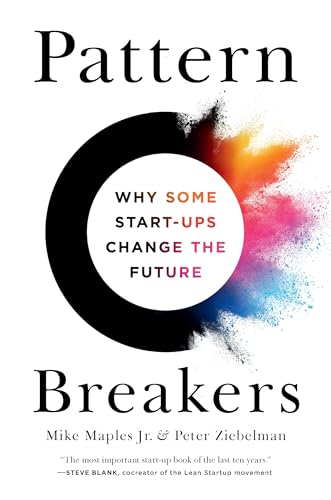
A radical set of new ideas for how entrepreneurs, investors, and corporate leaders can use the pattern-breaking mindset to dominate the future
The breakthrough concepts of Pattern Breakers come from the observations of Mike Maples Jr., a seasoned venture capitalist, who noticed something strange. Start-ups like Twitter, Twitch, and Lyft had achieved extraordinary success despite their disregard for “best practices.” In contrast, other startups deemed highly promising often failed, even when they seemed to do everything right.
Seeking answers, Maples and coauthor Peter Ziebelman set out to discover the hidden forces that drive extraordinary start-up success. Pattern-breaking success, they reveal, demands a different mindset and actions to harness developments others miss or that may, at first, seem crazy.
Pattern Breakers is filled with firsthand storytelling about initial interactions with some of the most transformative start-ups of recent times. Maples and Ziebelman vividly illustrate an unexpected world where chaos is welcome, naysayers are a positive signal, movements galvanize believers—but one that ultimately change the future. They challenge us to rethink how to transcend the ordinary and achieve the extraordinary.
"A radical set of new ideas for how entrepreneurs, investors, and corporate leaders can use the pattern-breaking mindset to dominate the future." - that's the promise I've found in the description. Sadly, it's quite far from the truth. There's nothing "radical" or even "new" in this book - it pretty much re-iterates some common statements that have been said about startups zillion times: - think from the 1st principles - look for disruptions, not incremental improvement - focus on a value prop, instead of creating featuresteins people won't understand - timing is essential - your core team is essential, make sure it consists of people with proper qualities - etc.
The book isn't very practical, the pieces of advice are rather high-level and aimed to be inspiring. Yes, there are examples coming from some "big names" (mostly: Lyft, Okta, Airbnb), but they are very generic and honestly - the author could have switched the names w/o changing pretty much anything else: the readers would not realize.
It doesn't mean the book doesn't make sense - the ideas presented here do make sense and are still applicable (even in post-ZIRP world where blitzscaling isn't the way to go anymore), but sometimes the way they were presented were ... cringe'y. E.g., those references to "Oceans Eleven" or even "Start Wars" - c'mon ...
In the end: a short, quite pleasant read. Far from enlightening, but maybe it will pump someone up. I didn't have too much fun, and I made zero notes. 3 stars for someone who hasn't read many classics on startups (Hoffman, Gil, Cagan). 2 stars if you've gone through all of those already.
I started writing a review and it came out more negative than I’m comfortable publicly posting. Happy to share with anyone who’s interested!
I’ll suffice this to say that this book is the equivalent of a TV meteorologist going over their years of forecasting and finding the patterns underpinning when they were right and wrong, then using those insights to determine how to make weather.
I totally understand why a VC would want to analyze their track record to find why and when they’re successful. But the truth is that the conditions are far too complex and this fairly useless framework of inflection points, insights and ideas only serves to retroactively explain successes rather than predict. It also doesn’t really explain successes either but that’s where I get too rant-y.
Overall this is completely useless for a founder, uninteresting to a technologist, and probably fun for someone who’s in an industry other than tech.
I had more negative ratings for the first half of the book; almost abandoned halfway.
TL;DR The pattern breaking formula described in this book felt like 'making up words' and force fitting (with the examples given) - awkward. It could be just a one hour podcast instead of a book. Maybe it would have been a more enjoyable format.
One of the best books I've read recently about startup, entrepreneurship and creativity.
A strong and new (imho) framework with relevant, real life examples (although using the same five to six examples throughout the whole book becomes a little boring).
Disclaimer: I had the opportunity to meet Mike M. who listened to my previous startup 's pitch and engaged in such a positive and constructive way. Hence I trust his insights and credibility.
There were especially a few chapters that hit home so strongly for me hence I'm sure I will revisit them from time to time during my entrepreneurial journey.
I think part of me wanted to dislike this book, because it felt like VCs turning what could’ve been a 5-10 min substack post into a 20+ dollar hardback book, but I found there to be plenty of genuinely good tidbits of wisdom and interesting examples on what makes a breakthrough startup.
TLDR: it’s not about doing something better, it’s about doing something entirely new and different. The most successful startups succeed because they combine an insight with an inflection. In other words, they identify a radical change that has occurred, and find a way to capitalize on it to completely alter the status quo. GPS integration in phones enabled Lyft and Uber to compete with taxis in a completely new way. They didn’t just try to eke out slightly greater efficiency with a slightly better business model, they identified a technological shift and built an entirely new business around it that completely altered people’s behavior.
Implementation prototype > immediately building MVP. Easier to build and can be used to gauge feedback more effectively and enable a quick pivot if necessary, since you haven’t actually had to build out entire functionality.
“The people who are crazy enough to think they can change the world are the ones who do”
Main takeaways: - The central message is entrepreneurs who live in the future and avoids conformity can make great breakthroughs and avoid competition. - The basics of the inflection theory: an external event with the potential to significantly alter how people think, feel, and act. A good example is the introduction of an embedded GPS locator chip in the iPhone 4s in 2011. - Here’s a little mental exercise to flex your pattern-breaking muscles: Pick a thorny problem in your industry or everyday life – one that seems like a tough nut to crack. Now, throw all constraints out the window – money’s no object, technology knows no bounds. How would you tackle the problem with fresh eyes? What wild and wacky solutions pop into your head? By shaking off the shackles of established patterns, you might just stumble upon your own breakthrough moment.
Notes: - routine habits drive our social fabric - In the corporate world, this pattern-matching instinct crystallizes into what are known as best practices. These are the go-to playbook for success in various domains – they’re past trends that big-shot executives pore over to crystal-ball the future. It’s when hiring managers size up candidates based on their track record. Even the financial reports of public companies march to the beat of generally accepted accounting principles. - the same talent for spotting patterns can be a roadblock to groundbreaking innovation. - You should also consider how these changes (or inflection point see earlier note) might intersect with your industry or idea. Can you use a new technology to solve an existing problem in a revolutionary way? Or perhaps a shifting social trend creates an entirely new market? - assess your timing. Are the necessary supporting technologies in place? Is there evidence that consumers are ready for this change? If you're too early, can you afford to wait and refine your idea further? If you’re late to the party, do you have a unique angle that distinguishes you from existing players? - Unlike a minimum viable product or MVP, which is a functioning version of your product, an implementation prototype is a simulation created to gauge interest and identify your most eager customers. - Implementation prototypes excel at helping you validate two key aspects of your business: the strength of your idea and the existence of a customer base that desperately wants your solution. By presenting your prototype to potential users, you can swiftly determine if your concept resonates with them and if they’re ready to become early adopters. - To put all this into practice, start by clearly defining your vision and the problem you’re tackling. Then, sketch out the traits of your ideal early believers. Who are the people who will be most fired up about the future you’re creating? Where can you find them? Craft a plan to reach out to these potential allies and engage them in meaningful conversations about your shared vision.
Quotes: - “Discovering breakthrough ideas is challenging, not because they’re hidden secrets, but because we’re conditioned to notice the familiar, while overlooking what might be.” - “Many of us consider these pattern-breaking ideas impossible or unthinkable—at first. Ironically, the experts we respect most are often the least able to see the potential for a break from the past. Often it is the outsider, unburdened by the past, who becomes the pattern-breaking person behind a pattern-breaking idea.”
Innovation often requires a departure from established norms, as explored in "Pattern Breakers: Why Some Start-Ups Change the Future" by Mike Maples Jr. and Peter Ziebelman. The book introduces the idea that our natural talent for recognizing patterns can hinder creativity and limit our ability to think beyond existing frameworks. Humans are inherently pattern-seekers, relying on habits and routines to navigate life and make decisions. This pattern-matching extends to the corporate world, where best practices are revered and often followed. However, while these patterns offer a sense of security and predictability, they can also stifle innovation. True breakthroughs demand the ability to challenge norms and think beyond traditional approaches.
The Wright brothers serve as an iconic example of pattern breakers. Despite not being formally trained in physics or aeronautics, they were able to revolutionize flight by applying their knowledge of bicycle mechanics to the problem of human flight. Their ability to think outside the box and combine seemingly unrelated ideas led to one of the most groundbreaking innovations in history. This highlights the importance of diverse experiences in fostering creativity and the need to challenge conventional wisdom in order to create transformative ideas.
As aspiring innovators, it's crucial to recognize that while pattern recognition is valuable in many aspects of life, it can be a hindrance to discovering breakthrough opportunities. To succeed, one must develop the skill of challenging norms, drawing from diverse experiences, and exploring unconventional ideas. This ability to think differently and connect disparate concepts is key to driving meaningful change and achieving extraordinary outcomes.
Beyond pattern-breaking, timing plays a pivotal role in the success of startups. Introducing innovative ideas at the right moment when the market is ready is essential. The concept of market inflections is central to this idea, as significant shifts in technology, consumer behavior, or economic conditions create opportunities for startups to thrive. Companies like Twitter, Twitch, and Lyft capitalized on these market inflections by launching at the perfect time, seizing the moment when technological advancements and changing consumer behaviors aligned with their innovative ideas.
However, timing is not just about being first; it's about being prepared when the market is ready. Airbnb, for instance, wasn't the first to propose the idea of staying in someone's home instead of a hotel, but it launched at a time when the sharing economy was gaining traction and online reviews were building trust. The company's success was not just about the concept itself but about launching at the right moment when the market was ripe for disruption.
For startups, this means staying vigilant to emerging technologies and societal shifts, identifying potential inflections, and positioning themselves to capitalize on these opportunities. By mastering the art of timing, startups can increase their chances of success and create transformative innovations that reshape industries.
Another crucial aspect of startup success is the concept of crossing the Rubicon with implementation prototypes. Before diving into full product development, startups must validate their bold ideas with prototypes that engage potential early adopters and gather critical feedback. Implementation prototypes are streamlined versions of the product concept, designed to test the idea and gauge interest without requiring extensive resources. Unlike a fully functional minimum viable product (MVP), these prototypes are simulations that allow startups to assess the viability of their idea before committing to full-scale development.
Chegg's approach to testing its textbook rental concept is a prime example of the effectiveness of implementation prototypes. By creating a mock website that allowed students to "rent" textbooks, Chegg was able to gauge interest and gather valuable insights without actually completing the transaction. This approach allowed the company to validate its idea, secure funding, and pivot its business model, leading to rapid growth and success in the education technology sector.
For startups, the key to using implementation prototypes effectively is to focus on the core value proposition and identify potential early adopters. By presenting a simple prototype that communicates the concept and gathers feedback, startups can validate their ideas quickly and refine their approach based on user reactions. This iterative process minimizes risk and allows startups to make informed decisions about whether to move forward with full product development.
Finding the right early adopters, or true believers, is another critical factor in startup success. These are not just ordinary customers but individuals who share the startup's vision and believe in the future it aims to create. True believers are willing to take risks and join the startup's mission because they see the potential for a transformative impact. Tesla's strategy with its first Roadster is a perfect example of this. The company wasn't trying to compete with luxury cars on traditional features but instead aimed to prove to electric vehicle enthusiasts that such a car – and company – was possible. Tesla's success was driven by its ability to inspire and engage true believers who shared its vision for the future of transportation.
For startups, finding these true believers requires careful consideration and a focus on quality rather than quantity. These individuals will be the driving force behind the startup's movement, guiding others toward the future it envisions. Startups must stay true to their vision and seek out those who genuinely believe in their mission, rather than trying to please everyone or dilute their ideas to attract more customers.
In essence, creating a successful startup that reshapes industries is about more than just introducing innovative products or services. It's about igniting a movement and inspiring true believers who share the startup's vision for the future. By focusing on pattern-breaking, mastering timing, using implementation prototypes, and finding the right early adopters, startups can position themselves to create transformative innovations that have a lasting impact on the world.
"Pattern Breakers" by Mike Maples Jr. and Peter Ziebelman provides valuable insights into the mindset and strategies needed to drive innovation and create startups that change the future. By embracing the principles outlined in the book, entrepreneurs can challenge norms, capitalize on market opportunities, validate their ideas with prototypes, and build a community of true believers who are ready to join them on their journey to revolutionize industries and shape the future.
The authors have had great success as investors. They invested in companies such as Lyft, Twitter, Twitch, among others.
This book might be helpful for young folks interested in become a venture capitalist. I don't think it will be insightful for entrepreneurs. The concepts are simple, already understood and the book doesn't add anything beyond a few interesting stories.
There is nothing here that is new. Insights or market catalysts are discussed as if they are a new idea, it isn't. There are many other books with more novel insights that will be more helpful.
Unfortunately I have to recommend you pass on this book.
This book is terrible. The author mostly repeats himself like Kamala Harris, trying to somehow get to a point but fails, over and over again. This is a short book which could have easily been 30% shorter if there was somebody called an Editor who simply removed the repeated sentences from a single page. Plus, the authors try very hard to appear to be some Gurus who are ordaining the new era of startup insights through this book while in reality, all they have done is to paraphrase some stupid management keywords over and over again. This can very well be an MBA textbook, and that to me is the biggest insult to an intelligent author!
Not the best book I've read so far. In a universe of a billion startups, discussing anything with three or four examples just looks like cherry picking. The author may have valid points, but the way he structures his content just sounds like they are massaging their ego and trying to logically reason out why they got lucky. The book should just have one page - We got extremely lucky.
You may be able to found a successful company based on one insight, but a book of this length should have a lot more to offer. They took a Twitter thread and beat it to death for 265 pages.
The best thing about this book is that I found an unknown unknown - CATEGORY DESIGN
The author refers a book - PLAYING BIG - while explaining about INSIGHTS and INFLECTION points.
The author talks about the need for the founders to be able to live in the future and have insights that are extremely uncommon and unintuitive.
The world must be ready to accept their ideas or it must be teetering on the edge with critical mass and tipping point eagerly waiting for this future.
This edge is what he defines as the INFLECTION POINT.
I think this should be used as the criteria to select a startup or startup founders.
Startup founders must have the ability to not just see the future but also live in it before anyone could.
This Book has very few insights, it can actually be summed up in a sentence or a phrase.
NON-OBVIOUS INSIGHTS - INFLECTION POINTS AND LIVING IN THE FUTURE.
The rest of the book is acutally dedicated to giving real life examples of these startups
But one must understand that this is an necessary but not sufficient condition to startup success.
Startups that don't ride on the inflection points might perish but would be a mistake to assume that all startups that ride the inflection points will become successful.
For a startup to be successful a million things must be align but for it to go belly up one mis alignment is enough.
The author was able to capture one such insight i.e. he has observed that many startups have understood how to break the pattern not with brute force.
But by simply by flapping a butterfly wing to trigger a STORM.
After giving examples, the author then talks about his own experience of missing out on a great startup AIRBNB, because it felt like a weird thing that nobody would even consider doing - A NON OBVIOUS INSIGHT.
One other example he gave about the need for the startup founders to be living in the future is the case study about LIVING CARBON
About how Maddie Hall decided to work with Sam Altman, to get sneak peak at the future.
She was able to look into the future and solve for problems in the future., by growing super trees for carbon sequestration and carbon credits.
This book offers INSIGHT STRESS TESTS AND INFLECTION POINT STRESS TESTS
These are nothing but thermometers to check the temperature of your idea.
I have seen these ideas else where, in PRETOTYPE book by Albert Savio as an effective way to test the reception for your idea i.e. demand for your idea and to check if it would actually make some money. The CHEGG Case study is given for this.
This paragraph in particular about why building without testing your INSIGHTS and INFLECTION POINTS is a very bad thing - actually hit the nail
Many jump too quickly to raise funding before confirming the power of their insight and identifying an initial set of passionate early believers. Having obtained the money, they hire developers, rent their first office space, and start developing a minimum viable product. And why not, since this is the standard recipe? Only later do many of these founders come to the realization they are trapped. They now have employees who took huge risks and likely pay cuts to join the cause. They have investors with expectations. They might have early customers who believed in them, even if not as many as they would like. They have followed all the best practices around agile development, getting out of the building to talk to customers, and mapping their ideas against the state-of-the-art frameworks for pricing and business model design. They even defined their culture proactively. They embraced all the tenets of disciplined entrepreneurship. But, still, something’s missing. They aren’t getting the traction they expected. Why? Because customers are interested in what they have built, but they are not desperate for it. Suddenly you realize that your idea isn’t big enough. You followed the best practices for good execution, yet you’ve encountered the pitfall mentioned earlier in this chapter: settling for a limited upside, the dreaded local maximum. Knowing what you now know, you wouldn’t have pursued this idea. But you feel like you can’t abandon your commitments to employees, customers, investors—or even to your internal sense of not quitting. You are stuck. Only now do you realize the true way to fail in a start-up. It is not about failure—or success—as most people describe it. The only way to truly fail in a start-up is to lose your time, especially after the point when you know the start-up was never worthy of it. The only thing you can never get back is that time.
There is definitely more in the book, except the last one or two chapters the book is extremely well written and it won't bore you .
The basics of the inflection theory: 1. It all begins with an inflection - an external event with the potential to significantly alter how people think, feel, and act. A good example is the introduction of an embedded GPS locator chip in the iPhone 4s in 2011.
2. Then comes the insight - “a way to use inflections in a nonobvious way to radically alter human capabilities and behaviors”. An example of insight was the realization by start-ups like Uber and Lyft that the new embedded GPS location capabilities of smartphones could enable people to share their location to allow ridesharing between drivers and passengers.
3. And last is an idea - a product or service that uses the insight (and inflection).
The interesting part that Maples found out is that your initial idea doesn’t have to be right. That idea is just a first attempt, which can miss the mark.
Figuring out a way - or the best way - to embody an insight and harness an inflection’s power might take some experimentation. However many false starts there are, the insight persists while the founders tinkers with the idea, leveraging the ongoing feedback of early believers in their insight.
Eventually, the founders create the correct solution with their early believers, based on relentless refinement.
Let’s take the example of Twitch.
In the 2010s, there was a big increase in internet speeds, an improvement in video compression technologies, and a rise in user-generated content platforms like YouTube. Together, these advancements made live video streaming more accessible and appealing to the general audience.
The insight can be formulated like this (my own interpretation):
“Live-streaming will create a unique and engaging experience that pre-recorded video content could not. There is potential for real-time interaction between streamers and viewers, creating a strong sense of community and higher engagement.”
The initial idea sucked - live streaming of Justin Kan’s life, called Justin.tv. He basically went everywhere with a camera on his head… But the inflection and insight behind it were right - paving the way for Twitch.
Same with Okta, which used the rise of SaaS apps each company consumed (inflection) to create a secure way to manage user identities and access across multiple cloud services.
My own thoughts - the limits of the theory:
Honestly? I enjoyed reading that book, but I didn’t agree with some parts of it. The main missing part was the lack of data - it discussed the same few startups in different examples. I would have expected a deeper analysis of hundreds of startups, but maybe they wanted to keep some secrets for themselves :)
Here is my take, in 3 parts:
1. Inflections are not a must Let’s take as an example a few famous companies:
- Tesla ($690B) - we can say that the rising environmental awareness was the inflection, but I think that Musk could have succeeded also if he had started in 2001, or 2006. The first electrical car was invented in the 19th century! - SpaceX ($210B) - what inflection allowed SpaceX to become what it is? Maybe SpaceX created an inflection, making space travel tens of times cheaper. - Monday ($12B) - started in 2012, 10(!) years after Atlassian and Basecamp. Nothing really new there, just like Jira (but a bit better). - Canva ($26B) - started in 2013, no obvious inflection here too.
There was nothing very original in any of those companies, but they are still huge successes.
2. Inflections are not enough Let’s take WeWork as the classic example. There was definitely an inflection in the 2010s - many small companies were founded, and in parallel freelancers needed an office space to work quietly.
After raising $13B, WeWork completely crashed.
This leads me to the last point:
3. What’s good for VCs, might not be as good for you For a VC to make money, they need a few HUGE winners. A profitable business, with $10M in revenue, growing slowly every year is NOT a very good outcome for a VC. So it makes sense that VCs would search for companies that would change the world, riding on the waves of inflections.
At times it felt like this book was trying to force a line of best fit through four or so data points (Airbnb, Lyft, Twitch, et. al.). If pattern breakers were so easily able to fit into a framework, then they wouldn’t exactly be pattern breakers (as the book itself says). That being said, it’s well written and contains some enjoyable stories and helpful stress tests for founders. Some interesting takeaways:
-Incumbents benefit from the status quo and seek to preserve the status quo. Trying to make incremental improvements over incumbent products will get them to notice you and likely crush you with their built-in advantages. Instead of playing by the rules of the existing game, startups should play a different game with different rules, that often turn incumbent strengths into weaknesses. Example: Marriott strength of delivering a consistent hotel experience globally was turned into a weakness by Airbnb offering people the ability to immerse more fully into localized culture by living in people’s homes.
-Large companies reward success and punish failure, which means people take extremely small risks they can succeed at while forgoing the risks that would bring actual upside.
-Humans develop habits and build up conditioning that makes them stick to the familiar. Behavior change is hard. Make people make choices instead of comparisons. Instead of trying to sell people on abandoning Marriott to go with a moderately better or cheaper hotel room, sell them on an entirely different experience. Some will hate it, and some will love it. But you’re forcing people to make a choice, which is more likely to override conditioning relative to comparing marginal benefits.
-Try to leave room for surprises. Chegg founders thought people would pay $35 for rental textbooks. Instead of testing whether this is true or false, they designed their experiment to present a series of random prices to different people and found that people were actually willing to pay $75.
-Ideas with pattern breaking potential are likely to experience pushback from people who dislike the idea. If everyone nods their head and thinks an idea makes sense, the odds are it’s not likely to be very groundbreaking and is more likely an incremental improvement.
-In order for an insight to be valuable, it needs to be both right AND non-consensus.
-The future is already here, but it’s unevenly distributed. People don’t adopt technologies at the same rate. The building blocks for future successful companies are out there in the form of inflections (external events that impact how people think, feel, and act). The best way to generate insights (nonobvious truths for how to harness these inflections to impact how people behave) is to spend time “living in the future” — which you can do by interacting with the cutting edge technologies and their early adopters. The most successful startups require an inflection and an insight (that is nonobvious and true).
This isn’t your typical startup book. Pattern Breakers doesn’t give you a playbook — it rewires how you think about startups, innovation, and timing. Mike Maples Jr. isn’t telling you how to launch your product faster or raise your next round. He’s teaching you how to see the future before it becomes obvious, and more importantly, how to build it.
Here’s what stood out:
🔹 Pre-vision over planning The book opens with a bold idea: Great founders don’t start with business plans — they start with a “pre‑vision” of a world that doesn’t exist yet. They don’t respond to the market; they create the market.
🔹 Break the pattern or follow the herd Startups that truly shift the world (Uber, Twitter, Figma, etc.) didn’t improve an existing model — they broke something fundamental. The book outlines how to identify patterns in the world… and then deliberately break them.
🔹 Inflection points are where revolutions begin The best founders act when most people are frozen — during moments of deep uncertainty or change. If something big is happening (technological, regulatory, cultural), it’s a signal: The ground is shifting. That’s your cue.
🔹 You don’t need validation — you need conviction One of my favorite ideas: if your startup makes perfect sense to everyone in the early days, you’re probably not building something bold enough. Pattern breakers often seem “weird” at first — and that’s exactly the point.
🔹 Pattern recognition isn’t enough — you need pattern creation VCs often talk about pattern recognition. Founders should obsess about pattern creation — imagining entirely new ways people behave, decide, buy, connect, or live.
This book is essential reading for any founder who isn’t satisfied with just launching “yet another SaaS.” If you’re trying to build something non-obvious, counter-intuitive, and hard to explain in a pitch deck — Pattern Breakers gives you the language, structure, and mental models to move forward.
It’s not tactical. It’s strategic thinking at the edge. And in a world flooded with derivative ideas, this book is a breath of clarity.
My reading ground to a halt this past month as I recovered from a minor back injury. But, my work’s book club rekindled my enthusiasm. The future doesn’t happen to us, it happens because of us. This is Pattern Breakers by Mike Maples Jr. and Peter Ziebelman.
The success of start-ups isn’t just dumb luck. There’s a method that celebrates the madness rather than trying to avoid it. The lessons learned are easily applicable to any aspect of life. If you want the future that should be rather than the one that could be, you have to make it happen. Don’t try to be better, but harness the benefits of being different. Find the people who want the future you do, and make them the heroes of the story. This really inspired me to get back to writing my own novels. I have to stop comparing myself to others or trying to come up with the next great story. I have to believe in my story, and in others who will believe in it too.
I don’t know how much I really connect to people who are praising people like Elon Musk who abandoned their personal integrity when wealth became extreme. The sentiment seems to be that selling your company or ideas is the ultimate goal, not actually changing the world for the better. It also makes it seem like taking the safe or comfortable route is a bad thing, which I couldn’t disagree with more. I think it is quite obtuse to think that every dreamer has the means to just go for it like they suggest. There are real and significant problems in this world and our country that systemically hinder certain people from achieving their dreams. This book arrogantly assumes we’re all wearing luxury sneakers on the starting line after a proper breakfast and good night’s sleep. Not one story in the book talks about anyone average who through grit and “pattern breaking” rose above to achieve great success. These were people with access to money, tech, and other advantages. Found that disappointing.
Definitely some thought-provoking content that made me think differently about a few things. I just wish it wasn’t quite so cliche and blind to the struggles of people with great ideas that have neither the time nor the funds for a seminar. 2 out of 5 stars.
citEști ”Pattern Breakers” Mike Maples Jr, Peter Ziebelman: Succesul cu care începi „Concentrează-te pe un grup restrâns de persoane care are legătură cu previziunile tale” p.163 Mike Maples Jr, Peter Ziebelman, ”Pattern Breakers: The Secrets Behind The World's Most Successful Start-Ups”, Macmillan Business, 2024 https://www.youtube.com/watch?v=K0n6J... Cum reușesc unele start-up-uri și altele se pierd în fundal? Ai o bibliotecă întreagă de volume pe tema aceasta și nu întotdeauna te alegi cu prea multe repere. Excepția este carte "Pattern Breakers: Why Some Start-Ups Change the Future" de Mike Maples Jr. și Peter Ziebelman. Ei își dezvoltă teoria lor: Inflection Theory bazată pe identificarea și exploatarea schimbărilor majore în tehnologie, societate sau în normele industriale. Aceste modulări creează noi posibilități și permit startup-urilor să redefinească regulile în diverse domenii. Transformarea Justin.tv în Twitch, sau dezvoltarea industriei de ridesharing arată cum recunoașterea și capitalizarea acestor transformări poate să ducă la succes. Altă idee esențială este crearea de mișcări, nu doar de produse. Vorbim de adevărate sisteme de credințe care atrag utilizatori, investitori și angajați care se alătură viziunii tale. „Provocarea este să recunoști un client vizionar atunci când îl întâlnești” p.184 Mike Maples Jr, Peter Ziebelman, ”Pattern Breakers: The Secrets Behind The World's Most Successful Start-Ups”, Macmillan Business, 2024 „Ceea ce era odată trecut cu vederea ori respins, e acum îmbrățișat drept normă” p.34 Mike Maples Jr, Peter Ziebelman, ”Pattern Breakers: The Secrets Behind The World's Most Successful Start-Ups”, Macmillan Business, 2024
68%. 'This is a very broad overview of a lot of different startups, and the idea is to be a disruptor. I understand that. I very much so resonate with the Silicon Valley perspective. I think it's comical that he is so proud of X Twitter when that and Facebook currently are having so much exposure problems and over-saturation because it is making people to feel so disenfranchised. I have over 2,000 followers on X and almost no one sees my posts. People are not checked in. It is one of the worst places you can be. Even if you're commenting on the top posts, etc., there is like no exposure. It is very much so a pay-to-play platform now. People are not happy, and he's so proud of it, and it makes me laugh. I'm like, oh, do you not go on there? I bet you don't go on there because recently it's become a very powerful far-right extremist platform. Beyond that, though, we get to talk about some other cool startups like Uber, Lyft, Airbnb, Couchsurfer, and the Silicon Valley motto paired with Elon Musk's perspective. This is all pretty cool stuff. It's a very general overview. There's some actionable advice in here. It's hard to get nuanced into these types of things, but people really do want a nuanced perspective and more actionable advice than is provided in this book. It's cool to hear people talk about these things, especially when they were semi-personally involved in the area like an angel investor, but that's it. There's better books about startups for sure. Guy Kawasaki, I highly recommend.
the worst book on startups I have ever read; a couple of facts from wikipedia, known by everyone in the world, literally; everyone interested already read a tone of articles on Uber, Airbnb and others, these are book-like fables that are 15-20 years old; some 'takeaways' are extremely questionable, some of them have literally no sense.
the author tries to sell his 'ideas' but at times fails even to articulate them, his writing tends to be deceivably complex to hide the lack of meaning.
don't buy, this brochure has no value and won't bring anything good to the table;
note: the quality of Lenny's podcast has been going down for months now; the guests he invites & the core of their conversations is a watery goo I stopped listening to some time ago; this book's "author" has been on a podcast recently so I went on to buy the 'advertised' product (as I tried to touch the water again, the podcast didn't change, it is as useless as before).
One of the very successful venture capitalist of our time wrote down some of the principles he's learned about what makes for a breakthrough company. Most of the ideas in this book you can find in other books from similar authors. There were multiple times when I started thinking that maybe reading on was getting to be redundant and then the author would drop a new idea, or a new way of framing an idea that I heard before, and I thought that it would still be good to keep reading.
This was the first book you've read on this topic, then you would probably give this book super high rating. It's got a lot of really good insights and stories from some of the biggest breakout hits of our last 20 years. But if you have read a whole bunch of books in this category, you might find only a few new ideas.
The innovation often requires breaking away from established patterns. While pattern-matching abilities serve you well in many aspects of life, they can hinder groundbreaking ideas. True innovators, like the Wright brothers, succeed by combining diverse experiences and challenging conventional wisdom. Remember that timing is crucial for your startup, as it must align with market inflections to thrive. Implementation prototypes will help you validate radical ideas before full development. Finding true believers who share your vision is essential for transformative startups. By mastering these concepts, you can cultivate creativity, drive meaningful change, and potentially develop innovations that reshape industries and open up new possibilities
Inflection theory: 1. Start with Inflection: an External even that creates the potential for radical change in how people think, feel and act. 2. Create Insight(s): Non-obvious truth(s) about how one or more inflections can be harnessed to radically change human capacities and behaviour. 3. Genetare Idea(s): An attempt to conceive of some specific product or services, based on insights. In the example of Lyft, their:
Inflection- smartphones with built-in GPS Insight- riders will trust that they can get a ride with a stranger just as they trust getting into a taxi Original Idea- Zimride for facilitating carpooling at colleges and companies. Final (Current) Idea- Lyft for ridesharing
This entire review has been hidden because of spoilers.
I think the core insight of this book is that entrepreneurs need to spend as much time thinking about the problem as they spend solving the problem. This means that you have to understand societal and technological trends that make solving a particular problem really important and viable for someone with your background of education and training. He shares several examples of entrepreneurs who developed break through ideas tapping into larger inflection points, developing core insights about customer behaviour and living in the future. I enjoyed the podcast by this author and this book explores a lot of the same ideas from the podcast. I think it is a really interesting read for anyone interested in the philosophy of entrepreneurship.
The core idea of the book is identifying the breakthrough idea from an inflection point identified through patterns and insights. The patterns can be technology, emotions or products or concerns that have an inflection points. These ideas needs to be stress tested before it can be converted into MVP for startup formation. The authors provide a structured approach for the startup from identification, stress testing, team building etc. In short: Pattern Breakers is a playbook for disciplined innovation, guiding entrepreneurs from the spark of an inflection point to the formation of a resilient startup
Pretty solid book of advice on how to think about startups. Don't do something that just sounds like a good business model. You really need to "live in the future" and look for some key insight to build off. I liked the book, and some of his heterodoxical advice like about being disagreeable. The case studies he used were a little too simplistic for my taste, but probably the right amount of accessible for someone who hasn't been a founder before. I would recommend this book to first-time founders.
Legend in the space. I think the examples used in the book were repetitive and didn’t actually provide that much insight after some point (I listened to like 8 podcasts about it and a fireside chat with him before reading). The key ideas of inflection, insight and fit are interesting and a great way to audit ideation. I thought some of the later chapters were the most valuable though. Topics like co-conspirators, creating heroes using storytelling, and being disagreeable are general buzzwords but are well explained in this book (more or less).
I enjoyed Pattern Breakers.It is more than a startup guide - it is a manifesto for audacious entrepreneurship. It challenges readers to embrace discomfort, defy conventional wisdom, and pursue ideas that may seem impossible at first glance. For aspiring founders, investors, and anyone interested in innovation, this book offers both a roadmap and a rallying cry: break the patterns, and the future is yours to create.
While I found the book insightful, and do recommend it, at moments inevitably some of the advice and anecdotes sounded familiar. Overall, worth the read though.
Inspirational, educational, and information-packed read for startup founders about a powerful/pragmatic strategy that's not only stood the test of time but is also more relevant than ever today. The authors - both seasoned early-stage venture capitalists - provide illustrative stories and actionable advice based on their long history of observing why some startups succeed while so many others don't.