

What do you think?

Dazzled and Deceived
Nature has perfected the art of deception. Thousands of creatures all over the world—including butterflies, moths, fish, birds, insects and snakes—have honed and practiced camouflage over hundreds of millions of years. Imitating other animals or their surroundings, nature’s fakers use mimicry to protect themselves, to attract and repel, to bluff and warn, to forage, and to hide. The advantages of mimicry are obvious—but how does “blind” nature do it? And how has humanity learned to profit from nature’s ploys?
Dazzled and Deceived tells the unique and fascinating story of mimicry and camouflage in science, art, warfare, and the natural world. Discovered in the 1850s by the young English naturalists Henry Walter Bates and Alfred Russel Wallace in the Amazonian rainforest, the phenomenon of mimicry was seized upon as the first independent validation of Darwin’s theory of natural selection. But mimicry and camouflage also created a huge impact outside the laboratory walls. Peter Forbes’s cultural history links mimicry and camouflage to art, literature, military tactics, and medical cures across the twentieth century, and charts its intricate involvement with the perennial dispute between evolution and creationism.
As Dazzled and Deceived unravels the concept of mimicry, Forbes introduces colorful stories and a dazzling cast of characters—Roosevelt, Picasso, Nabokov, Churchill, and Darwin himself, to name a few—whom its mystery influenced and enthralled. Illuminating and lively, Dazzled and Deceived sheds new light on the greatest to understand the processes of life at its deepest level.
Dazzled and Deceived tells the unique and fascinating story of mimicry and camouflage in science, art, warfare, and the natural world. Discovered in the 1850s by the young English naturalists Henry Walter Bates and Alfred Russel Wallace in the Amazonian rainforest, the phenomenon of mimicry was seized upon as the first independent validation of Darwin’s theory of natural selection. But mimicry and camouflage also created a huge impact outside the laboratory walls. Peter Forbes’s cultural history links mimicry and camouflage to art, literature, military tactics, and medical cures across the twentieth century, and charts its intricate involvement with the perennial dispute between evolution and creationism.
As Dazzled and Deceived unravels the concept of mimicry, Forbes introduces colorful stories and a dazzling cast of characters—Roosevelt, Picasso, Nabokov, Churchill, and Darwin himself, to name a few—whom its mystery influenced and enthralled. Illuminating and lively, Dazzled and Deceived sheds new light on the greatest to understand the processes of life at its deepest level.
310 pages, Kindle Edition
First published January 1, 2009
About the author
Peter Forbes
98 books10 followersPeter Forbes (born 1960) is a Scottish actor known for his roles in West End musicals, including Follies in 2017 to 2019, and for his audio recording work.
Ratings & Reviews
Friends & Following
Create a free account to discover what your friends think of this book!
Community Reviews
Displaying 1 - 16 of 16 reviews

Read
January 20, 2013I found it slow going and not terribly well written. Maybe because wherever we went we ended up discussing butterflies, and even if not, then we were jumping from anecdote to anecdote and always coming back to the same butterflies anyway.
Anyhow, I haven't finished it and I probably won't. I have had a problem with some of the interpretations as well. At least as far as I got to. It seemed to me that the approach was overly anthropomorphic and looked at camouflage mainly from the point of view of our senses. I also had a problem with the interpretation of cubism as a deconstruction of reality similar to mimicry. There may be something in it, but it's not exactly it.
You may find something interesting there, but I found it more of a chore than pleasure.
Anyhow, I haven't finished it and I probably won't. I have had a problem with some of the interpretations as well. At least as far as I got to. It seemed to me that the approach was overly anthropomorphic and looked at camouflage mainly from the point of view of our senses. I also had a problem with the interpretation of cubism as a deconstruction of reality similar to mimicry. There may be something in it, but it's not exactly it.
You may find something interesting there, but I found it more of a chore than pleasure.

February 3, 2014
eh, it was Ok. Hard to know why I didn't like it more. I just found the writing a little ponderous, I guess. It was fine, but didn't grab me. Eg. the ideas about the Use of camouflage In war time were great, but the details of what meeting this person attended, and what group they were attached to , and the committee meetings involved , well, I found that dull as can be.
Also, More skinks would have been nice. We had a Lot of butterflies.
Also, More skinks would have been nice. We had a Lot of butterflies.

January 7, 2013
Learned some interesting things but not a hugely engaging book, despite my interest in the subject matter.

May 29, 2018
This book was so incredibly boring. The cover of the book leads you to believe the book is about a variety of species that use camouflage and mimicry- instead it only really expounds on butterflies and war machines. This book jumped around so badly that it was hard to stay focused, and it really felt like the author loves his subject so much that he can't decide what to write about in what order. Would not recommend unless you really have a thing for butterflies or the failures of different kinds of war camouflage.

January 8, 2012
Thanks to a recent British library membership acquisition, I got hold of this book by Peter Forbes - Dazzled and deceived: Mimicry and Camouflage. The book effortlessly leads the reader through a journey that begins in earnest with the comma butterfly flying across a garden and slowly winding its way through personal lives of luminaries in biology, through the private struggles and public lives of the proponents of various sorts of camouflage for both sides in the two world wars, artists and naturalists. In fact, there has been much talk about the role of camouflage nets in the winning of the Second battle of El Alamein has been much talked about. The battle was quite important - it got Churchill to apparently ring bells all over Britan, signifying the impending end to the war.
[caption id="" align="alignright" width="370" caption="A disguised truck during the Battle of El Alamein. Disguise and camouflage supposedly played a major role, and so did artists, naturalists and biologists"] [image error] [/caption]
Some of these people are very well-known, at least to biologists. The correspondence between Henry Walter Bates and Alfred Russel Wallace and their journeys together and apart in the Amazons and their pre-occupation with trying to explain why among such a diversity of butterflies (over 700 species), there was uncanny similarities between apparently unrelated species of butterflies.
[caption id="" align="alignleft" width="210" caption="The Viceroy butterfly (above) which is non-poisonous and "bland tasting" and potentially a prey is also avoided because it is similar to the toxic and bitter tasting Monarch butterfly (below) - one of the best known examples of Batesian mimicry"] [image error] [/caption]
Here begins an interesting question that fascinated biologists on one side and inspired artists on the other. Many such models of mimicry are found in nature and our own Kallima is perhaps the best ones among butterflies, often unspottable among the leaf litter. Darwin and Bates had hypothesised based on their observations that the “odourless and palatable” Leptalis might be mimicking the boldly patterned and brightly coloured Heliconius, which advertised their bad taste with their bright colours and patters. Much before genes were known of, or even named such, the explanations and experiments to understand the evolution of such mimicry progressed fast. Tempers ran high in those days - biologists even tasted a few Heliconius to prove their point, with a bitter taste in their mouth. One of these was Thayer, whom Forbes dedicates at least two chapters to. Apparently, Thayer is the only(?) artist to have a law named after him - Thayer’s law of countershading. This Thayer turns out to be a very interesting character. Suffering from what he called “Abbott’s pendulum”, he had terrible mood swings (because of his bipolar disorder) and these moods often catching him in the middle of passionate wartime advocacy did not help matters. His passion for “finding camouflage” became so severe that he was publicly rubbished by (among others) Theodore Roosevelt. Here’s one such response to Roosevelt by Thayer.
[caption id="" align="alignright" width="302" caption="The underside of the Orange Oakleaf, found in many parts of India is a superb example of disguise"]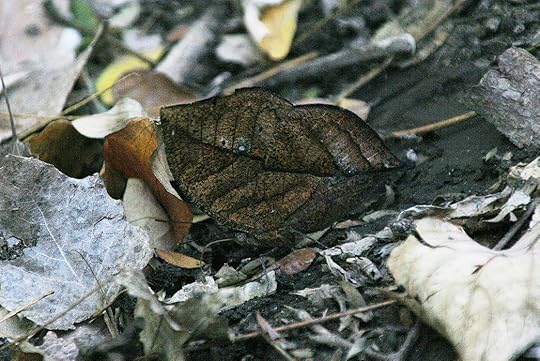 [/caption]
It turns out that Thayer was extremely convinced that white upper coloration is one of the best camouflages to provide to anything in the sun. Roosevelt brought to this debate, his own hunting experience from African trips and indeed was invoking sexual selection arguments in days when it was out of fashion - as summarised by Norman Johnson here.
[caption id="" align="alignleft" width="313" caption="The countershaded bird on the right is not seen, as opposed to the "comouflaged" left one that is visible - From Thayer's experiments to prove countercolouration"][image error][/caption]
The two world wars provided plenty of opportunity for biologists and artists to cross swords at war offices, where they invoked various laws and rules of nature to help hide ships or disguise buildings. A British artist, Norman Wilkinson has been credited with being the first to show how to hide ships using dazzle camouflage, although he had to win this recognition after a legal battle. His painting Plymouth harbour sank with the Titanic. Initially, devised to decrease ship damage from torpedo attacks from German U-boats, the coloration was inspired by the sort of patterns seen on zebras. Apparently, the discuption caused by the lines and patterns which breaks the shape of the object makes it very difficult to even predict which direction the object is moving making it difficult to target during wars. See this boat from Arnhem for example. More recent work by marine biologists has confirmed similar observations in cuttlefish and other marine fauna.
The book has so many other colourful descriptions of colourful characters - people included. Peter Scott, John Cott, Jonathan Kerr and of course the “other” mimicry scientist (other than Bates), Fritz Muller, of the Mullerian mimicry fame. Interesting accounts of Vladamir Nabokov and his early history are also provided, as are the details of letter exchanges between Bates and Darwin. Hugh Bamford Cott is credited with coining the term “arms race” to denote the adaptations and counter adaptations such as in predator-prey who are engaged in a continuous shruggle of “bettering” the other. Cott’s explanation of mimicry and camouflage is indeed simple and elegant. He saw three main categories - concealment, disguise and advertisement. His application of these categories to explain a lot of observations across diverse species is apparently still the best available book on the topic - Adaptive cooluration in animals. The work of Miriam Rothschild, a code breaker for Enigma based out of Blethley Park in unravelling the origin of the toxicity of many of the butterflies through exploring which plants they got it from in the first place. She found that the imperviousness of butterflies to the toxins they imbibe from plants is species specific and this she found through rather difficult experiments of feeding some plant substances to unsuspecting starlings. Madam Rothschild’s contributions are many - finding out the mechanism of jumping among flies, setting up Schizophrenia research fund, and campaigning for the legalisation of homosexuality - and in the meanwhile writing 350 papers on entomology and zoology!
All in all an amazing book that sends the reader in multiple directions - there are many I did not pursue - the cubists and their role in this discourse for example. Amazing research and scholarship and no surprises in the book bagging many awards and good reviews. Peter Forbes’ Warwick memorial lecture “Science morphing into Art” is a good teaser if you are considering the book. The link is http://www.youtube.com/embed/iQ0XEsxm...
And on a lighter note, if you want to try some dazzle for your scooter, here’s how it will look. As one of the comments says, this could be one perhaps to “confuse the navel artillery”. :p
[caption id="" align="alignright" width="370" caption="A disguised truck during the Battle of El Alamein. Disguise and camouflage supposedly played a major role, and so did artists, naturalists and biologists"] [image error] [/caption]
Some of these people are very well-known, at least to biologists. The correspondence between Henry Walter Bates and Alfred Russel Wallace and their journeys together and apart in the Amazons and their pre-occupation with trying to explain why among such a diversity of butterflies (over 700 species), there was uncanny similarities between apparently unrelated species of butterflies.
[caption id="" align="alignleft" width="210" caption="The Viceroy butterfly (above) which is non-poisonous and "bland tasting" and potentially a prey is also avoided because it is similar to the toxic and bitter tasting Monarch butterfly (below) - one of the best known examples of Batesian mimicry"] [image error] [/caption]
Here begins an interesting question that fascinated biologists on one side and inspired artists on the other. Many such models of mimicry are found in nature and our own Kallima is perhaps the best ones among butterflies, often unspottable among the leaf litter. Darwin and Bates had hypothesised based on their observations that the “odourless and palatable” Leptalis might be mimicking the boldly patterned and brightly coloured Heliconius, which advertised their bad taste with their bright colours and patters. Much before genes were known of, or even named such, the explanations and experiments to understand the evolution of such mimicry progressed fast. Tempers ran high in those days - biologists even tasted a few Heliconius to prove their point, with a bitter taste in their mouth. One of these was Thayer, whom Forbes dedicates at least two chapters to. Apparently, Thayer is the only(?) artist to have a law named after him - Thayer’s law of countershading. This Thayer turns out to be a very interesting character. Suffering from what he called “Abbott’s pendulum”, he had terrible mood swings (because of his bipolar disorder) and these moods often catching him in the middle of passionate wartime advocacy did not help matters. His passion for “finding camouflage” became so severe that he was publicly rubbished by (among others) Theodore Roosevelt. Here’s one such response to Roosevelt by Thayer.
[caption id="" align="alignright" width="302" caption="The underside of the Orange Oakleaf, found in many parts of India is a superb example of disguise"]
[/caption]For my assertion that white on objects' upper slopes, under an open starry sky without the moon or any artificial light far or near, is an absolute match for the sky, Col. Roosevelt can hardly find words to express his contempt, saying many things which must some day look very funny to him when he finds out his error.
It turns out that Thayer was extremely convinced that white upper coloration is one of the best camouflages to provide to anything in the sun. Roosevelt brought to this debate, his own hunting experience from African trips and indeed was invoking sexual selection arguments in days when it was out of fashion - as summarised by Norman Johnson here.
[caption id="" align="alignleft" width="313" caption="The countershaded bird on the right is not seen, as opposed to the "comouflaged" left one that is visible - From Thayer's experiments to prove countercolouration"][image error][/caption]
The two world wars provided plenty of opportunity for biologists and artists to cross swords at war offices, where they invoked various laws and rules of nature to help hide ships or disguise buildings. A British artist, Norman Wilkinson has been credited with being the first to show how to hide ships using dazzle camouflage, although he had to win this recognition after a legal battle. His painting Plymouth harbour sank with the Titanic. Initially, devised to decrease ship damage from torpedo attacks from German U-boats, the coloration was inspired by the sort of patterns seen on zebras. Apparently, the discuption caused by the lines and patterns which breaks the shape of the object makes it very difficult to even predict which direction the object is moving making it difficult to target during wars. See this boat from Arnhem for example. More recent work by marine biologists has confirmed similar observations in cuttlefish and other marine fauna.
The book has so many other colourful descriptions of colourful characters - people included. Peter Scott, John Cott, Jonathan Kerr and of course the “other” mimicry scientist (other than Bates), Fritz Muller, of the Mullerian mimicry fame. Interesting accounts of Vladamir Nabokov and his early history are also provided, as are the details of letter exchanges between Bates and Darwin. Hugh Bamford Cott is credited with coining the term “arms race” to denote the adaptations and counter adaptations such as in predator-prey who are engaged in a continuous shruggle of “bettering” the other. Cott’s explanation of mimicry and camouflage is indeed simple and elegant. He saw three main categories - concealment, disguise and advertisement. His application of these categories to explain a lot of observations across diverse species is apparently still the best available book on the topic - Adaptive cooluration in animals. The work of Miriam Rothschild, a code breaker for Enigma based out of Blethley Park in unravelling the origin of the toxicity of many of the butterflies through exploring which plants they got it from in the first place. She found that the imperviousness of butterflies to the toxins they imbibe from plants is species specific and this she found through rather difficult experiments of feeding some plant substances to unsuspecting starlings. Madam Rothschild’s contributions are many - finding out the mechanism of jumping among flies, setting up Schizophrenia research fund, and campaigning for the legalisation of homosexuality - and in the meanwhile writing 350 papers on entomology and zoology!
All in all an amazing book that sends the reader in multiple directions - there are many I did not pursue - the cubists and their role in this discourse for example. Amazing research and scholarship and no surprises in the book bagging many awards and good reviews. Peter Forbes’ Warwick memorial lecture “Science morphing into Art” is a good teaser if you are considering the book. The link is http://www.youtube.com/embed/iQ0XEsxm...
And on a lighter note, if you want to try some dazzle for your scooter, here’s how it will look. As one of the comments says, this could be one perhaps to “confuse the navel artillery”. :p

October 7, 2023
Published by Yale University Press, I thought this book was going to be more in depth and more academic than it was. It does an alright job of covering the basics of mimicry and camouflage. For example, Chapter 3 goes through some of the terms created to classify relevant phenomena but even this is very basic and could have been expounded upon in much greater detail. In contrast to that, there was great detail included about people and events that could have been left out to make room for more relevant information.
Page 70 mentions "many questions about mimicry that are still wrestled with today". These questions are never illuminated. There is no endnote that tells what these questions are, who is asking them, or where they're being asked.
Page 111 has a typo in the name Faulkner. Page 216 is missing a period in the first sentence of the last paragraph.
Page 235 has a declaration about the content of newer works in this field but no mention of what these works are is included.
It was difficult to figure out who the target audience was for this book. If I had to guess, I'd say maybe grade school students who are looking for an introductory book about the evolutionary roots of mimicry and camouflage and how these two things have been adapted by humans.
In conclusion, there was some information I found interesting but the presentation was not good.
It has endnotes, a bibliography, and an index.
Page 70 mentions "many questions about mimicry that are still wrestled with today". These questions are never illuminated. There is no endnote that tells what these questions are, who is asking them, or where they're being asked.
Page 111 has a typo in the name Faulkner. Page 216 is missing a period in the first sentence of the last paragraph.
Page 235 has a declaration about the content of newer works in this field but no mention of what these works are is included.
It was difficult to figure out who the target audience was for this book. If I had to guess, I'd say maybe grade school students who are looking for an introductory book about the evolutionary roots of mimicry and camouflage and how these two things have been adapted by humans.
In conclusion, there was some information I found interesting but the presentation was not good.
It has endnotes, a bibliography, and an index.
April 10, 2024
It's always fun when multiple disciplines intersect and influence each other, and here we have a work involving biology, art, and war. The core of the book is on the evolution of butterflies in employing mimicry, and all of the great figures of biology are present from Darwin to Rothschild.
The use of colours and countershading was also noticed by artists, and Thayer especially is given much attention here. All of this culminated in Hugh Cott's work on Camouflage in Animals, and the work of strategic deception in the Second World War, including Operation Bertram and the use of paint schemes on ships.
It's a good reminder that humans have much to learn from even the simplest creatures, and that it pays to think outside of the box.
The use of colours and countershading was also noticed by artists, and Thayer especially is given much attention here. All of this culminated in Hugh Cott's work on Camouflage in Animals, and the work of strategic deception in the Second World War, including Operation Bertram and the use of paint schemes on ships.
It's a good reminder that humans have much to learn from even the simplest creatures, and that it pays to think outside of the box.

July 25, 2019
This took me forever to get through. Kids at work have been wild so I had no free time and didn’t do much reading at home either. Can’t even tell you how many times I read the same page over and over on this one. But, got through it. Not because it wasn’t good but I’ve just been busy and there are lots of names. This book is mostly about butterflies and war, in case you are in to those kinds of things.

September 7, 2024
The role of colours and patterns in predator avoidance and prey deception is explored in this in-depth look at the history of mimicry and camouflage in war, nature, and art.
A thorough recount of the progress and milestones in the developing field of mimicry and camouflage research that delved too deeply into war and got stuck in the petty arguments between scientists.
A thorough recount of the progress and milestones in the developing field of mimicry and camouflage research that delved too deeply into war and got stuck in the petty arguments between scientists.
May 10, 2026
unfocused. editorial comments that author adds chosen based on whims instead of relevance to topic at hand, grating after a while. decent otherwise.

February 24, 2010
“Dazzled and Deceived” by Peter Forbes examines many of the mimicry and camouflage schemes animals have evolved to aid in their survival and reproduction and how human understanding of these designs has been applied for military purposes.
Mimicry and camouflage in the natural world has been a fascinating area of study for biologists from Darwin’s time to the present day and is used by both animals and plants as a survival strategy. Some of these strategies include: coloration to blend into surroundings (white polar bear on white snow), disruption using a blend of patterns intended to confuse predators (the stripes on a zebra), disguise (such as a stick insect), smoke screens (like a squid), mis-direction such as eye spots on butterflies, mimicking of an unpalatable or poisonous creature (such as a king snakes mimicry of a coral snake) and others. All are wonderful examples of natural selection at work.
Humans have taken lessons learned from nature and applied it to our everyday lives by making items stand out (such as traffic signs – which employ the same color nature uses to advertise dangerous creatures) or fade into the background (such as military camouflage).
Mimicry and camouflage in the natural world has been a fascinating area of study for biologists from Darwin’s time to the present day and is used by both animals and plants as a survival strategy. Some of these strategies include: coloration to blend into surroundings (white polar bear on white snow), disruption using a blend of patterns intended to confuse predators (the stripes on a zebra), disguise (such as a stick insect), smoke screens (like a squid), mis-direction such as eye spots on butterflies, mimicking of an unpalatable or poisonous creature (such as a king snakes mimicry of a coral snake) and others. All are wonderful examples of natural selection at work.
Humans have taken lessons learned from nature and applied it to our everyday lives by making items stand out (such as traffic signs – which employ the same color nature uses to advertise dangerous creatures) or fade into the background (such as military camouflage).

April 23, 2011
This is a book about mimicry and camouflage; principally in nature but also in human use — i.e. the military. I heard about it because it won the Warwick Prize for Writing 2011, and the subject sounded interesting, so I thought I'd give it a go.
It's certainly pretty good, but I wasn't blown away by it. It didn't help that I was familiar with many of the examples already.
My other slight gripe is that it spends a lot of time using examples of mimicry and camouflage as a way to shed light on deeper ideas about evolution. Which is, obviously, a valuable exercise, and not in itself a Bad Thing. But I've read loads of stuff about evolution already, thank you, and so reading yet another explanation of evo-devo is not enormously exciting. I would much rather have been reading about extra examples of strange and curious animal mimicry.
So, you know, a good book; but I am not its perfect audience.
It's certainly pretty good, but I wasn't blown away by it. It didn't help that I was familiar with many of the examples already.
My other slight gripe is that it spends a lot of time using examples of mimicry and camouflage as a way to shed light on deeper ideas about evolution. Which is, obviously, a valuable exercise, and not in itself a Bad Thing. But I've read loads of stuff about evolution already, thank you, and so reading yet another explanation of evo-devo is not enormously exciting. I would much rather have been reading about extra examples of strange and curious animal mimicry.
So, you know, a good book; but I am not its perfect audience.

October 23, 2013
I really enjoyed this book, which tells the story of how scientific understanding of mimicry and camouflage grew, how artists came to appreciate them, and how the findings of both disciplines were given practical application in situations of war. Although the narratives of scientific discovery and battle are very different, the combination works well as the book is cohesively and engrossingly written. I gleaned two especially delightful pieces of knowledge from it: that passion flowers are named after the crucifixion mythos and that Vladimir Nabokov was obsessed with butterflies. It also forms an interesting complement to an exhibition on dazzle camouflage that I saw in the London Imperial War Museum about seven years ago. That exhibition displayed the variety and aesthetic delight of dazzle, but was more reticent about its effectiveness. This book covers the debates during the first and second world wars over whether dazzle actually worked. The most likely answer was 'sometimes'.

February 14, 2011
The first two impressions I had of this book where that it was somewhat slow to start, and that it was obsessed with butterflies. Despite a small butterfly being just one illustration among many on book’s dust jacket the coverage of butterflies was relentless. For brief moments one seemed to escape them but they just kept coming back.
Thankfully they seemed to recede somewhat in the middle part of the book which digs into dazzle stripes and disputes over wartime camouflage, but that’s just a ruse, suddenly they are back and dominate the book again till the end.
There is in fact a point to their dominance and if you can put up with them swarming through the book you will be rewarded – but a little bit more warning in the title, or in the cover design, as to their importance to the book would have made me a little less impatient with their constant appearances.
Thankfully they seemed to recede somewhat in the middle part of the book which digs into dazzle stripes and disputes over wartime camouflage, but that’s just a ruse, suddenly they are back and dominate the book again till the end.
There is in fact a point to their dominance and if you can put up with them swarming through the book you will be rewarded – but a little bit more warning in the title, or in the cover design, as to their importance to the book would have made me a little less impatient with their constant appearances.

June 5, 2012
The title was so promising that I was a bit disappointed! I was waiting more facts and unknown aspects of the kingdom of animals!

July 30, 2016
For such an interesting premise – drawing lines between Darwin and dazzleships, caterpillars and Cubism – this was a stodgy read that I couldn't finish.
Displaying 1 - 16 of 16 reviews