آواز در باران یکی از آن مشهورترینهای همهٔ تاریخ سینماست از جنس «بربادرفته»، «جنگ ستارگان» و ... که البته بهعکس بسیاری از نمونههای فیلمهای جریان اصلی و عامهپسند، بهواقع فیلم بزرگ و یگانهایست. فیلمی که «جین کلی» با نبوغ تکرارنشدنیاش مجموعهای تماموکمال از موسیقی، رقص، آواز و داستانگویی را کنار هم قرار داد و به معنای تمامش «سینما» خلق کرد! «پیتر وولن»، این نظریهپرداز و منتقد سینهفیل که جزو منتقد-مولفان تاریخ سینماست و سپهر نوشتاریاش دامنهای وسیع، دقیق و بینظیر دارد، در کتاب «آواز در باران» تکنگاری موجز اما پر از جزئیاتی را دربارهٔ این فیلم نوشته که فقط از منتقد صاحبسبکی اینچنین برمیآید. آواز در باران از آن دسته فیلمهاست که بر دامنهٔ بزرگی از فیلمهای پسازخودش تا همین امروز تأثیر گذاشته و این یکی از جلوههای اهمیتش است و وولن نیز این مهم را خوب میداند و در نوشتن تکنگاریاش تاریخ رقص در قرن بیستم، رقص آمریکایی، هالیوود در دوران طلاییاش و ... را پیشروی مخاطبی میگذارد که فکر میکند چیزی نیست که دربارهٔ این فیلم وجود داشته باشد و نداند. درواقع شرح و تحلیلهای درست و دور از انتظار این منتقد بزرگ است که کتاب را برای خوانندهاش اینچنین خواندنی و راهگشا میکند و به فهم این فیلم عزیز و بیتکرار، رنگوبوی دیگری میدهد.
Peter Wollen was an English film theorist and filmmaker. He studied English at Christ Church, Oxford. Both political journalist and film theorist, Wollen's Signs and Meaning in the Cinema (1969) helped to transform the discipline of film studies by incorporating the methodology of structuralism and semiotics. He taught film at a number of universities and was Professor Emeritus at the University of California, Los Angeles, at the time of his retirement.
so eloquent and well written, and loved that it contextualised singin in the rain in the events happening in america at the time, and also how it dived into dance as an art form. and of course i will always love to read about gene kelly that's my GOAT !!
This thoughtful and, at times, brilliant meditation on the film is marred by devoting a disproportionate amount of space to the Hollywood blacklisting of the 1950s, but it should not be passed over.
I would venture to suggest that 'Singin' in the Rain' is the greatest film musical of all time, and in light of this status it would be appropriate for there to be a comprehensive and insightful published study of the movie released by such an august body as the British Film Institute. This monograph from Peter Wollen in the BFI series of 'Film Classics' is not bad, but I don't believe it really does justice to its subject. Admittedly, the edition I have read is not the latest, so perhaps the more recent text has been expanded. Be that as it may, whilst Wollen has some valuable and interesting things to say, I don't think his book really is adequate as a history and assessment of the classic movie.
Wollen's examination of the movie starts more or less with the iconic scene of Kelly "singin', and dancin', in the rain", and then builds up and outwards from that analysis to contemplate other aspects of the movie. The focus on Kelly's dancing skills and aesthetic, and how that informed both his overall film making process and this movie specifically, is all good. One can't complain about how the author quotes Kelly as per the following:
"I realised that there was no character — whether a sailor or a truck driver or a gangster — that couldn’t be interpreted through dancing, if one found the correct choreographic language. What you can’t have is a truck driver coming on stage and doing an entrechat. Because that would be incongruous — like a lady opening her mouth and singing bass. But there was a way of getting that truck driver to dance that would not be incongruous — just as there was a way of making Harry the Hoofer, a saloon bum, look convincing. It may seem obvious now, but at the time it was an important discovery for me."
It's important to understand, as Wollen signifies, that Kelly's philosophy of dancing was built around two unique foundations; the ability to use dance as an expression of everyday masculinity and as a narrative device. In Singin' in the Rain (BFI Film Classics) these ideas of Kelly's are documented and explored not just in the titular film, but in his other films as well. It's an important and valuable consideration that underscores how insightful Wollen's work is. The author affirms this when he states:
"However, unlike the conventional ‘putting on a show’ musical, in Singin’ in the Rain the musical numbers are not limited to the film within the film but also occur at regular intervals within the framing story, built round the relationships between the major characters. They are stitched into the dramatic action. The ‘Singin’ in the Rain’ sequence is not just an entertainment interlude, it is conceived as an expression of Don Lockwood’s feelings at a particular point in both his professional and his personal life."
Wollen reinforces his discussion of Kelly's approach to dance and film with the following:
"This last line of the song serves, as Kelly puts it, to ‘state the thesis’ of the dance which is to follow. ‘Unless you’re in a ballet, you can’t just begin to dance. You have to state your “thesis” in a song first, and then go into the dance. Take the number “Singin’ in the Rain”. I tell the audience in a song what I’m going to do, and then I do it."
Through his considered and detailed evaluation of Kelly's aesthetic Wollen makes sure one understands much of what underpins 'Singin' in the Rain' from a creative perspective. As a result he presents the movie as very much the apogee of what the Hollywood star, dancer, director and choreographer achieved on screen. He includes a significant evaluation of Kelly's role as co-director of 'Singin' in the Rain', placing him as at least a co-eval with Stanley Donan, if not his 'superior':
"This complex collaboration is sometimes taken as refuting the auteur theory, the thesis that films can be interpreted as structures whose consistency of style and theme derives from a single auteur. Yet it is clear that ‘Singin’ in the Rain’ is a summation of Gene Kelly’s own work up to that point, echoing and developing numbers he had done in earlier films, crystallising the principles and ideas about dance and film which he had been forming, consciously or unconsciously, since early childhood, more intensely still since his arrival in Hollywood. This is not to deny the crucial role played by his collaborators. Auteur structures can be superimposed in the same film and, though Kelly’s ‘presence’ may be the most prominent, this certainly does not mean that we should overlook the contribution of others. ‘Singin’ in the Rain’ can be seen in terms of Donen’s career too, and indeed that of Edens, but, in any one instance, there is an implicit hierarchy among auteurs and, in the end, a threshold below which individual input becomes increasingly difficult to distinguish and single out."
The problem with such a focus on Gene Kelly's work in the film, which is admittedly understandable, is that other cast members as well as production team members are somewhat marginalised. There is some commentary and history provided as to the work of Kelly's co-stars, including Donald O'Connor, Debbie Reynolds, Jean Hagen and Cyd Charisse, however they are not given perhaps the attention they deserve. Yes, these cast members are more or less supporting actors to the central role of Gene Kelly as Don Lockwood, but they each deserve more in my opinion. Jean Hagen particularly seems to have been left behind in Wollen's account which is in no way commensurate to the value of her performance in the film or her overall career in Hollywood. Donen is also given perhaps short shrift, whereas the key musical contribution of Betty Comden and Adolf Green are treated a bit better. Personally, I would've loved more on more members of the team behind 'Singin' in the Rain'.
Also, and perhaps I'm asking for too much, Wollen could have made more of the way in which the movie treats the historical period of Hollywood's transition from silent films to 'talkies'. This is a crucial element of the movie, and for that matter 'Singin' in the Rain' is one of the most 'meta' movies about film making and celebrity one can see from the so-called Golden Era of Hollywood. From the beginning of the movie, with the opening of Don Lockwood's most recent silent swashbuckler, through to the end of the film it makes great play with popular constructs of movie making. This is a key reason why the movie is so great, and for Wollen not to do more with this aspect of his subject is a bit of a miss.
There are some other things that the author provides in his text that are rewarding for the reader. For example, Wollen does very well to bring out the contemporary political situation that can be seen to have informed or influenced the movie:
"It is tempting to try to interpret Singin’ in the Rain in terms of the political climate in which it was made: to note, for example, that the story hinges on the thwarting of a plot to blacklist Kathy Selden, launched by an informer and enforced by using the media to pressure a weak-willed studio, which ultimately puts profit before principle, until finally the situation is resolved and virtue triumphs in a wishful happy ending."
This is complemented by a consideration of how Kelly et al were positioned in the era of the Hollywood 10 and the HUAC hearings:
"Whatever the real political allegiance of this group of friends and colleagues, who had all known each other since 1940 and whose careers remain linked in the public memory because of films like 'On the Town' and 'Singin’ in the Rain', it is clear that, in the words of Malcolm Goldstein, they formed ‘a durable part of Popular Front culture’. "
Then there is this rather exciting obervsation made by Wollen as to the mythic nature of the film's narrative:
" First, it has a fairy-tale foundation. The kernel of its story is basically a variant on that of Hans Christian Andersen’s The Little Mermaid, plus a trick and counter-trick, and coupled with a typical romance plot consisting of a series of real and threatened separations and reunions between a couple. The heroine has her voice taken from her by a wicked witch and cannot marry the hero unless it has been recovered."
I must admit this reading of 'Singin' in the Rain' struck me as being perfect, and I appreciate how insightful Wollen is in this case. I just wish he had applied this approach to a more broad appreciation of the movie.
All up Singin' in the Rain (BFI Film Classics) is a very useful tome that has a very decent stab and exploring the iconic MGM Gene Kelly musical. It is a brief study that will certainly find an appreciative audience among fans of the movie and students of film history in general. However, for such a brilliant piece of cinema that is so important to the way in which movie musicals have been appreciated and produced since its release, Peter Wollen has not provided the definitive study. This is a good reead, but surely a better one on the movie awaits...
My first introduction to "Singing In The Rain" was when Alex was raping a woman in "A Clockwork Orange." My second visit to "Singing..." is Peter Wollen's small book length study of the Gene Kelly/Stanley Donen film. Strange enough, for a hardcore cinema fan like myself I have never ever seen this film. Yes, I have seen every Fred Astaire movie at least twice, but "Singing In The Rain" never! Yet, that didn't stop me from enjoying this critical adventure into the world of Gene Kelly.
I read this book today, in one gulp on my couch, in a temperture that is around 90. Therefore by an open window with a slight breeze I was taken into an artificial world that Gene Kelly made - a world that was beautiful. At least conveyed in the text. This book works on many levels. One Wollen argues the importance of dance as an art, but also as an equal companion to the cinema art. Griffith to Chaplin and of course the Kelly/Astaire world had made a language for the film world that was and is totally open to dance. Wollen writes about the beauty of this combination, but with a strong critical eye. Also his in depth almost frame-by-frame look at the famous Kelly dance of the leading song here, is playful and informative. On top of that the reader also gets the political world of the early 1950's and how that played out in the Gene Kelly world. The book is an enlarged 70mm snapshot of a specific time with a very specific film with an iconic artist. Strange enough there isn't that many critical studies on Gene Kelly's work, which is a shame. But with this back in print....
And Wollen adds a kick-ass annotated bibliography that's extremely informative. It is sort of like him taking you by the hand and showing you the book titles that are important. For Dancers who need information regarding the dance history, this is a good book to pick up. For everyone else... well I am going to see the film! Peter Wollen wrote a beautiful tribute, analysis, and dance/film history in one slim 87 page book that has no wasted space. Essential!
After reading Salman Rushdie's outstanding BFI Film Classic monograph on The Wizard of Oz, this was a mild disappointment -- although by no means a bad book. Peter Wollen starts with a quite good shot-by-shot analysis of the Gene Kelly dance to the title tune. Then we get some history about the making of the movie, followed by some new-to-me material regarding the role of the 1950s anti-communist blacklist in the careers of the cast and crew, including Gene Kelly. It's the author's theory that the blacklist was the real reason behind the demise of the Arthur Freed unit at MGM (I think people just got tired of musicals). Finally, in the weakest section of the monograph, Wollen attempts to explain why Singin in the Rain is regarded as such a great movie. He resorts to a bit more film theory and jargon than I care for, and seems to forget just how funny and entertaining this film is.
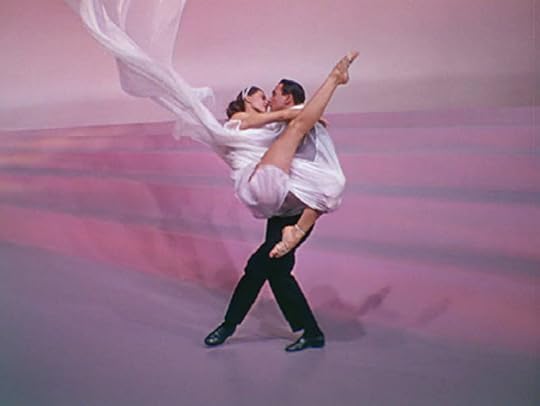
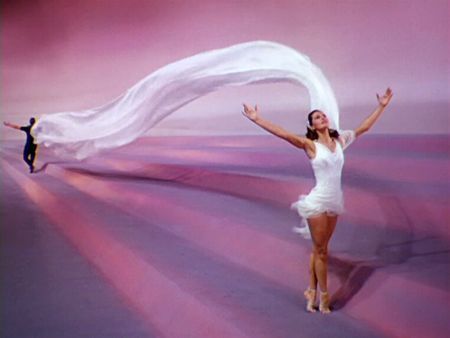
This essay on Singin' in the Rain focuses especially on the challenges of filming dance. It brings in discussion of Cover Girl, The Red Shoes, Hermes Pan, the Nicholas Brothers and Fred Astaire. The author's deep knowledge of film history is evident throughout. A detail that will stick with me is that they used aeroplane engines (did I read that right?) to make Cyd Charisse's white scarf blow around as she was dancing with Gene Kelly in one spectacular sequence.
Photos: Gene Kelly and Cyd Charisse in Singin' in the Rain
The first two sections are pretty good, they get into the timelines of how the movie was made and what was going on in the world. I didn't know Gene Kelly left the country for Europe 19 months after Singin' in the Rain premiered to make movie overseas to take advantage of a tax break and to possibly avoid Blacklist witch hunt back home.
The third section got more into analysis and dance and it simply went over my head a lot of the time. Perhaps that section will interest you more than I. I still recommend the book if you're a fan of the movie, quick read with solid detail and check out the bibliography for even more books to read.
I loved Wollen's book on images in movies, and I've loved other books in BFI's classics series. At first, this is just a cut and dry analysis of the movie laced with historical tidbits. By midway through chapter 2 though, wollen lets loose and gets in deep at what is happening on the screen, how it mirrors what was going on behind the scenes, and what it can tell us about culture and art at this time. so happy i read this one!
Organised into three parts: a load of stuff about dance, a load of stuff about Kelly, and a load of academic stuff (but not especially filmic stuff). I was interested in how it was made and its critical appreciation, and there was some of this but not enough for my liking.
Well I read the script and I'm in the show but as part of the show we have to do theory lessons so in order to do my theory lessons on monday I have to read the book so I was very stressed out thinking that this book wouldn't be fun to read but now I am hooked and I had to struggle myself to write about it right now but I just had to tell my friends about it!
My show information: August 1-8 (red cast performances only) -at The JCAA to buy tickets go to: www.shalomaustin.org to get directions visit google maps!
The book is fabulous and the show will be even better!
Interesting book. The first two chapters are very dutiful about the way the movie grafts dance history into film, but:
(1) Pretty much neglects the overt silent -> talkie story, and its meaning; (2) While narrating the political context of Kelly's relationship to HUAC etc., doesn't delve into the film's politics; (3) Makes a very lite "theoretical" intervention into the film (using Derridean language but with no investment).
On the whole, a most read, but more for context than for changing your mind about the film.