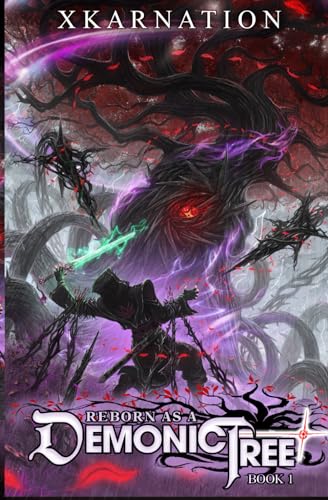
'Reborn as a Demonic Tree' is probably the best title for a book I’ve ever come across.
My criteria for excellent titles have evolved over time, but are essentially:
I. The title should create an image.
II. The title should suggest the genre or kind of experience.
III. The title should be unique to the individual work of art.
If all of these things are accomplished, then I feel the title will interest the right kind of audience.
(For these reasons, ‘Bring Me the Head of Alfredo Garcia’ is my favorite movie title of all time, even though it’s not even my favorite Sam Peckinpah movie.)
So…when I saw the title ‘Reborn as a Demonic Tree,’ I had hoped that the reviews would be good (and they were), because I felt I had to put aside what I planned on reading next and dive immediately into this superbly named tome. The gorgeous artwork by Kukuruyo (that reminds me of Todd Lockwood’s awesome Drizzt paintings) is also very compelling and further garnered my interest.
I am new to LitRPG, and I admit to being a bit disappointed when I learned that 'Reborn as a Demonic Tree' was an example of this fantasy subgenre. For those unfamiliar with this term, LitRPG books are ones in which the author explicitly uses the mechanics found in computer Role Playing Games (and the tabletop RPGs whence they sprang). So, characters in these stories are checking their statistics (Health, Hit Points, Strength, etc.) and experience points and looking in their loot bags and are leveling up as they do in Dungeons & Dragons or Legend of Zelda or Monster Hunter. My favorite fantasy authors are very old-school guys like Clark Ashton Smith, J.R.R. Tolkien, Lord Dunsany, and Robert E. Howard, and people who write in similar styles like Lin Carter and Schuyler Hernstrom. The LitRPG genre may have extra appeal for some gamers, but for me, it rides the edge of breaking the story's immersion, if not the fourth wall with its continual allusions to game systems and modern day authorial voice.
I recently had a very good experience reading a bunch of Creepypasta horror stories and seeing what younger generations were doing with that genre, and I want to keep an open mind with evolutions in the fantasy genre and all art that interests me, from Black Metal to Rap to Country Music to books and music and movies and pop art and outsider art.
My first foray into LitRPG was The Land: Founding by Aleron Kong. This book was fine, though not all that different from typical fantasy stories apart from the repeated deaths of the main character, various statistics discussions, and the modern day authorial voice that felt geared toward young adult readers. I appreciated some of the game mechanics, battle tactics, moral ambiguity, and humor found Matt Dinniman's LitRPG novel Dungeon Crawler Carl (especially the whole Ball of Swine and Rage Elemental sequences). This book is obviously very indebted to The Hunger Games and lacked tension because of its overall silliness, but was mostly enjoyable, especially from a gamer's perspective, since it is often about exploiting the rules of the game system. The setup for J.F. Brink's Defiance of the Fall was interesting and more seriously handled, but the protagonist Zac was massively overpowered very early on in this huge tome and made the book an okay, but repetitive grind, not aided by the lack of character interactions.
I am happy to report ‘Reborn as a Demonic Tree’ is superior to any of these books.
In ‘Reborn as a Demonic Tree,’ author Xkarnation created something new and distinct by rendering his original premise with brushes dipped in various gaming, anime, and scientific inks. And while I prefer traditionally told fantasy over LitRPG, this book felt newer and fresher than about all of the fantasy tomes I've read written during the last three decades. Thus, it seems like the parameters of LitRPG freed Xkarnation from traditionalism and rehash. I’d much rather read fiction this idiosyncratic than another book by Jordan, Abercrombie, Goodkind, Rowling, Sanderson, or Hobb.
Xkarnation came up with a premise unlike anything I’ve read in a full-length book. Sure, Dunsany and Lovecraft and others have personified hills and buildings and other inanimate objects in their short fiction, but this is a weighty tome in which a person awakens inside a tree and tries to understand himself and the warring and segregated world into which he has been transported. The portal (isekai) aspect here largely seems to exist so that the main character can have the relatable perspective of an Earthling and serves as a lens rather than an ongoing topic of discussion, for the reborn person’s previous life is not of particular importance nor greatly detailed.
This book is a thick 600 pages, and I’d estimate no less than 150 pages of the book centers around various characters contemplating and discussing Qi, the Chi/Mana/magic that powers the cultivators (sorcerers) in this world. This technical, scientifically rigorous investigation of supernatural power could be tedious, but rarely is, because it allows the author to dig deep into the greater physics of his world as well as the characters’ hopes, goals, and flaws and relationships with each other.
The titular tree is named Ashlock. His perspective is the central one for the tale, and also the most interesting. His gradual development from a nearly blind and helpless sapling into a demonic tree is very well done. Ashlock's internal upgrades, acquired items, and various discoveries exemplify author Xkarnation best assets: his creativity and attention to detail. The botanical engineering is extremely smart and done with a scientific mindset that takes into account sap, growth, and transpiration.
Here’s a cool example of the author’s clever engineering: Early on in the book, Ashlock starts draining the blood and life out of corpses to gain Sacrificial Credits with which he can upgrade his abilities. He eventually becomes strong enough to create seeds for new saplings, but he needs to figure out how to disperse these seeds--a difficult task for a firmly rooted tree. Ashlock grows poisonous fruit and adjusts the dosage of toxins inside each one so that a bird eating the fruit will be able to fly an appropriate distance away from him before it dies, falls to earth, and becomes the fertilizer within which the seed grows.
Author Xkarnation comes up with tons of clever and resourceful things for his inert protagonist Ashlock to do in this story: the aforementioned poisoned fruit, Spellcasting with no hands, and root puppeteering are but three highlights. And the conflicts with 'heaven' are quite interestingly conceived.
The definition of magic in this book similar to Alistair Crowley’s, and the Qi system of colors and elements tells me the author probably plays Magic the Gathering (I do). The cute squirrel Maple...that may be terrifying creature...alludes to the excellent anime Puella Magi Madoka Magica, and the side quest in the cavern reminded me of the open world video game Stardew Valley. Most obviously, the fighting and power ups recall Dragonball Z and Avatar: the Last Airbender. And I’m sure there are scores of others inspirations I just don’t recognize…
I am not pointing out these influences as a criticism, but rather to illustrate that something new is happening here.
Fantasists have been trying for decades to recreate the best-known works by J.R.R. Tolkien and Robert E. Howard and (more recently) J.K. Rowling and George R.R. Martin, but ‘Reborn as a Demonic Tree’ is not any of these things, nor is it trying to be. The core concepts and all of the wonderfully detailed little evolutions Ashlock experiences felt new to me even though I’ve been reading the genre for nearly 40 years. I look forward to the next installment of this series and will seek out other works in this subgenre.