

What do you think?
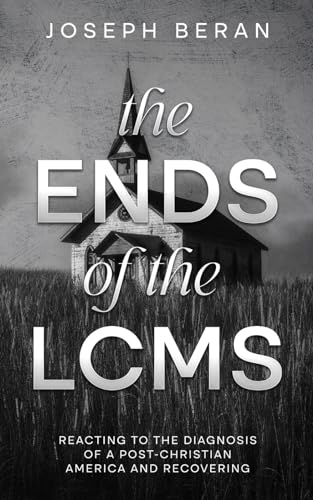
The Ends of the LCMS: Reacting to the Diagnosis of a Post-Christian America and Recovering
In a time of change and challenge, the Lutheran Church Missouri-Synod stands at a crossroads. As Christianity in America transforms, the LCMS is feeling many of the side effects.This book dives into the heart of the matter, examining the statistical trends of the LCMS and their impact on the church's many facets, including the reasons why it may seem like the LCMS is coming to an end. While the road may appear uncertain, there is a glimmer of hope. Discover how a renewed focus on our shared purpose as the body of Christ can guide us towards a harmonious and fulfilling future, where we find 'endless' possibilities as we redefine our 'ends' – both our goals and our unity.Explore the changing landscape of the LCMS and find inspiration in the endless possibilities that lie ahead, being reminded that, although things may seem dire, the kingdom of God endures forever.
141 pages, Paperback
Published November 10, 2023
Ratings & Reviews
Friends & Following
Create a free account to discover what your friends think of this book!
Community Reviews
Displaying 1 - 12 of 12 reviews

March 20, 2024
I wholeheartedly agree with the diagnosis, as presented in this book. I agree that social media makes us worse people, that correction is best presented in relationship, and that we should think locally.
I also appreciated the kind tone of this book. It was trying to start a dialogue, and was raising questions and trying to offer some solutions, not just pointing fingers or publicly complaining about an issue that the author feels passionately about.
However, I mostly disagree with the prescriptions offered in this book, and I think they are actually the type of thing that people have been trying for a while. We can try the things in this book, but they won't work in all contexts (which, yes, is actually somewhat the author's point). We can teach and try to engage people all we want, but we can't actually make people believe wholeheartedly and commit to their faith and local church. If parents aren't reinforcing Christ at home, then all our efforts in the church, as pastor or people, will still be unlikely to retain youth. Parents need to be committed if we are going to expect any commitment from their children.
I don't think this book explores all the possibilities when it comes to the pastor shortage. I think it's silly that we have so many of our ordained serving in administrative positions at Synod, CPH, CUS, etc. If those positions actually required an ordained man, then those should be the jobs for when pastors retire from the parish. We have a lot of ordained men serving in positions that could be served by theologically educated lay people. Ordained men under 55 should strive to stay in the parish as pastors. And other countries need missionaries, yes, but maybe our pastors shouldn't be recruited in such large numbers to International Mission, if the US is actually the 3rd largest mission field in the world. Clearly they are needed here. Neither of these things were even mentioned in the book. Plus, we have large churches that have 3 or 4 ordained pastors. Youth don't need an ordained man to serve them specifically, so we could spread out some of our ordained clergy by using the raise up from within model for specific youth ministry, if that's even an appropriate thing to do anymore. Youth should be encouraged to join with the adults in their Bible study and volunteer service, especially if having relationships across the generations helps with youth retention.
Also, if a man feels called into the Office of the Holy Ministry, why is it unreasonable to ask him to overcome the "bottlenecks" as listed in this book? Maybe SMP needs more scholarships, but pastors in the LCMS are expected to be able to take any Call throughout the Synod. So moving across the country shouldn't ever be considered a barrier. I know this world is expensive. But my family has moved around the US to accept a Call 3 times. It can be done. Christ and His Church take care of pastors and their families.
No one "owns" any part of ministry, and serving in the church doesn't have to be teaching oriented. We don't want people serving because they get an ego stroke from it, which makes them feel important. Yes, we want people to be committed and involved in the work of the church, but that should not be framed in language of ownership. It is Christ's Church and His ministry.
Also, Bible study is part of Word and Sacrament, and so are shut-in visits (since the pastor is bringing Jesus through Word and usually Communion to a person who is incapable of coming to Divine Service). We should not be passing those roles off to others. Those parts are the pastor's responsibility. And if we think that that type of service is the only type that fulfills ministry, then we are returning to a Medieval view of vocation, which Luther very strongly spoke against. The Christian garbage collector does as much of a good work for the sake of the community as does the one who preaches and teaches God's Word. Let's not lose our robust teaching on vocation.
This book also needed a proofreader. There were lots of times where there was an extra word or a word missing in various sentences.
I also appreciated the kind tone of this book. It was trying to start a dialogue, and was raising questions and trying to offer some solutions, not just pointing fingers or publicly complaining about an issue that the author feels passionately about.
However, I mostly disagree with the prescriptions offered in this book, and I think they are actually the type of thing that people have been trying for a while. We can try the things in this book, but they won't work in all contexts (which, yes, is actually somewhat the author's point). We can teach and try to engage people all we want, but we can't actually make people believe wholeheartedly and commit to their faith and local church. If parents aren't reinforcing Christ at home, then all our efforts in the church, as pastor or people, will still be unlikely to retain youth. Parents need to be committed if we are going to expect any commitment from their children.
I don't think this book explores all the possibilities when it comes to the pastor shortage. I think it's silly that we have so many of our ordained serving in administrative positions at Synod, CPH, CUS, etc. If those positions actually required an ordained man, then those should be the jobs for when pastors retire from the parish. We have a lot of ordained men serving in positions that could be served by theologically educated lay people. Ordained men under 55 should strive to stay in the parish as pastors. And other countries need missionaries, yes, but maybe our pastors shouldn't be recruited in such large numbers to International Mission, if the US is actually the 3rd largest mission field in the world. Clearly they are needed here. Neither of these things were even mentioned in the book. Plus, we have large churches that have 3 or 4 ordained pastors. Youth don't need an ordained man to serve them specifically, so we could spread out some of our ordained clergy by using the raise up from within model for specific youth ministry, if that's even an appropriate thing to do anymore. Youth should be encouraged to join with the adults in their Bible study and volunteer service, especially if having relationships across the generations helps with youth retention.
Also, if a man feels called into the Office of the Holy Ministry, why is it unreasonable to ask him to overcome the "bottlenecks" as listed in this book? Maybe SMP needs more scholarships, but pastors in the LCMS are expected to be able to take any Call throughout the Synod. So moving across the country shouldn't ever be considered a barrier. I know this world is expensive. But my family has moved around the US to accept a Call 3 times. It can be done. Christ and His Church take care of pastors and their families.
No one "owns" any part of ministry, and serving in the church doesn't have to be teaching oriented. We don't want people serving because they get an ego stroke from it, which makes them feel important. Yes, we want people to be committed and involved in the work of the church, but that should not be framed in language of ownership. It is Christ's Church and His ministry.
Also, Bible study is part of Word and Sacrament, and so are shut-in visits (since the pastor is bringing Jesus through Word and usually Communion to a person who is incapable of coming to Divine Service). We should not be passing those roles off to others. Those parts are the pastor's responsibility. And if we think that that type of service is the only type that fulfills ministry, then we are returning to a Medieval view of vocation, which Luther very strongly spoke against. The Christian garbage collector does as much of a good work for the sake of the community as does the one who preaches and teaches God's Word. Let's not lose our robust teaching on vocation.
This book also needed a proofreader. There were lots of times where there was an extra word or a word missing in various sentences.

November 8, 2025
Like most self-published books, this book is in dire need of a good copy editor and a more robust peer review regarding its argumentation.
The premise of this book is based on solid data derived from Lyman Stone’s demographic work done for the LCMS and general observations regarding demographic and cultural shifts. However, despite highlighting problems, this book also mischaracterizes the core issue. It includes poorly conducted surveys, such as those from the Barna Organization, which fail to adequately control for variables and lump a diverse range of Lutherans into a single, homogeneous group. The focus on the number of called positions—such as Pastors, DCEs, and Deaconesses—and concerns over the current structure of Concordia University and Seminary, which limits the number of qualified candidates, are also discussed. I am not a shill for the Concordia University and Seminary systems—rather, I am opposed to how the Synod manages these institutions and find most of the decisions within the University System baffling. Despite these reservations, the Concordia System provides doctrinal guardrails to fill these roles within the synod. I believe that the ongoing arguments and retrospectives on the Seminex situation speak for themselves and do not need to be rehashed here.
What is more troubling is the ignorance of data. This book is at best a thinly veiled attempt to shift the LCMS away from its sacramental and confessional identity toward a missional framework that seeks to eliminate vestments, liturgy, and water down Doctrine to make it “more palatable” to modern culture. Such arguments misrepresent the facts and, at best, demonstrate ignorance of survey data showing explosive growth in confessional churches, while “missional” churches are hemorrhaging attendance. Once doctrinal distinctiveness are no longer primary, attendance decisions inherently become focused on who has the better singers, smoke machines, and makes the observer feel good rather than the substance of what is being taught.
The premise of this book is based on solid data derived from Lyman Stone’s demographic work done for the LCMS and general observations regarding demographic and cultural shifts. However, despite highlighting problems, this book also mischaracterizes the core issue. It includes poorly conducted surveys, such as those from the Barna Organization, which fail to adequately control for variables and lump a diverse range of Lutherans into a single, homogeneous group. The focus on the number of called positions—such as Pastors, DCEs, and Deaconesses—and concerns over the current structure of Concordia University and Seminary, which limits the number of qualified candidates, are also discussed. I am not a shill for the Concordia University and Seminary systems—rather, I am opposed to how the Synod manages these institutions and find most of the decisions within the University System baffling. Despite these reservations, the Concordia System provides doctrinal guardrails to fill these roles within the synod. I believe that the ongoing arguments and retrospectives on the Seminex situation speak for themselves and do not need to be rehashed here.
What is more troubling is the ignorance of data. This book is at best a thinly veiled attempt to shift the LCMS away from its sacramental and confessional identity toward a missional framework that seeks to eliminate vestments, liturgy, and water down Doctrine to make it “more palatable” to modern culture. Such arguments misrepresent the facts and, at best, demonstrate ignorance of survey data showing explosive growth in confessional churches, while “missional” churches are hemorrhaging attendance. Once doctrinal distinctiveness are no longer primary, attendance decisions inherently become focused on who has the better singers, smoke machines, and makes the observer feel good rather than the substance of what is being taught.

February 23, 2025
A Bra e Voice within LCMS Questioning a Status Quo agenda
This is a brief overview of the declining membership and involvement of the LCMS; and it is one the challenges the status quo / "no change" approach to solving the issue; and it offers a few modest approaches [for discussion]. As one who spent 58 years of my life within the LCMS, including 30 years as a LCMS pastor, (before joining a NALC congregation these past two years), I found the to be a sane appraisal of the situation that offered reasonable suggestions for discussion -- A study of this book would be helpful not only within LCMS congregations, circuits, and districts, but also for other mainline Christian denominations (especially other Lutheran denominations.
It will be interesting to see how this book is received and discussed within the LCMS.
This is a brief overview of the declining membership and involvement of the LCMS; and it is one the challenges the status quo / "no change" approach to solving the issue; and it offers a few modest approaches [for discussion]. As one who spent 58 years of my life within the LCMS, including 30 years as a LCMS pastor, (before joining a NALC congregation these past two years), I found the to be a sane appraisal of the situation that offered reasonable suggestions for discussion -- A study of this book would be helpful not only within LCMS congregations, circuits, and districts, but also for other mainline Christian denominations (especially other Lutheran denominations.
It will be interesting to see how this book is received and discussed within the LCMS.
November 12, 2023
I've received an advance copy of the book, and Joe does a great job presenting the challenges that face the Christian church in the United States, and specifically the Lutheran Church Missouri Synod (LCMS). He notes that there are many congregations in history which simply are no more ... even though the Church of God marches on. He presents the stark reality facing the LCMS, which it seems some do not want to face, and lays out actions that should be considered going forward if the LCMS is to continue to be influential in the overall Kingdom of God. Great job, Joe!
November 11, 2023
Enjoyable and easy read that offers insight and discussion topics about the future of the Lutheran Church Missouri Synod. Although the focus is on this denomination, the topics apply to modern Christianity in the United States as a whole, presenting multiple facets of what the modern church is struggling with and possible options to discuss for future involvement in proclaiming the Gospel of Jesus Christ to local people God has placed right in front of us.
Read
November 11, 2023Written in a conversational, informal style, The Ends of the LCMS tackles some tough issues facing the church with a love and a passion for the Gospel that shines through on each page. The sections on pastoral formation, church planting, and social media are both challenging and thought-provoking. And the “What can I do?” section rings ring with a “We can because He can and will” assurance that is uplifting, almost a call to action.
April 21, 2024
Excellent!
Wow. I read this in a few hours; I simply couldn't put it down. I am a layperson who, after some 4 years away from regular church attendance, am trying to strengthen my own faith life as well as my children's. This book spoke deeply to me, and as a 40 year old woman with young children, I can absolutely attest that the issues raised by Pastor Beran are exactly those that are begging to be addressed. I recommend this to all LCMS pastors, church leaders, and laity.
Wow. I read this in a few hours; I simply couldn't put it down. I am a layperson who, after some 4 years away from regular church attendance, am trying to strengthen my own faith life as well as my children's. This book spoke deeply to me, and as a 40 year old woman with young children, I can absolutely attest that the issues raised by Pastor Beran are exactly those that are begging to be addressed. I recommend this to all LCMS pastors, church leaders, and laity.
November 22, 2023
Excellent read
Excellent book with evidence-based solutions and questions about issues facing the church. He draws from principles of leadership and education and integrates these into a focused discussion. Great read.
Excellent book with evidence-based solutions and questions about issues facing the church. He draws from principles of leadership and education and integrates these into a focused discussion. Great read.
November 29, 2023
Perspective of caring
The book presents interesting, relevant facts and alternatives as it looks at the ends (goals) for LCMS congregations and how they may be achieved. It is not doomsday.
A quick read which brings more light than heat!
The book presents interesting, relevant facts and alternatives as it looks at the ends (goals) for LCMS congregations and how they may be achieved. It is not doomsday.
A quick read which brings more light than heat!

November 5, 2025
Such a clear easy to read helpful book!
Joe does a masterful job at diagnosing where our nation and Synod is currently at. The questions that come from this book should have every Lutheran leader willing to do whatever it takes to reach the lost.
Joe does a masterful job at diagnosing where our nation and Synod is currently at. The questions that come from this book should have every Lutheran leader willing to do whatever it takes to reach the lost.
March 13, 2024
Fantastic and though provoking book on the path forward for the Church (not just the LCMS church) in America.
January 23, 2025
Great book. While I did not agree with every solution, it is a needed book for our day and age.
Displaying 1 - 12 of 12 reviews